Applications to Bitcoin
Yunlei Zhao
School of Computer Science, Fudan University, Shanghai, China [email protected]
Abstract. Aggregate signature (AS) allows non-interactively condens-ing multiple individual signatures into a compact one. Besides the faster verification, it is useful to reduce storage and bandwidth, and is espe-cially attractive for blockchain and cryptocurrency. In this work, we first demonstrate the subtlety of achieving AS from general groups, by a con-crete attack that actually works against the natural implementations of AS based on almost all the variants of DSA and Schnorr’s. Then, we show that aggregate signature can be derived from theΓ-signature scheme proposed by Yao, et al. To the best of our knowledge, this is the first aggregate signature scheme from general elliptic curves without bilinear maps (in particular, the secp256k1 curve used by Bitcoin). The security of aggregateΓ-signature is proved based on a new assumption proposed and justified in this work, referred to as non-malleable discrete-logarithm (NMDL), which might be of independent interest and could find more cryptographic applications in the future. When applying the resultant aggregateΓ-signature to Bitcoin, the storage volume of signa-tures reduces about 49.8%, and the signature verification time can even reduce about 72%. Finally, we specify in detail the application of the pro-posed AS scheme to Bitcoin, with the goal of maximizing performance and compatibility. We adopt a Merkle-Patricia tree based implementa-tion, and the resulting system is also more friendly to segregated witness and provides better protection against transaction malleability attacks.
1
Introduction
Bitcoin [50], with the introduction of the blockchain technology, was originally proposed by Nakamoto Satoshi in 2008. The key characteristics of blockchain consist in decentralization, openness, unforgeability, and anonymity. After about ten years of rapid development, blockchain has been more and more popular, and more applications are advocated into finance, healthcare, storage, education industries, etc. Nevertheless, there are still quite a lot of deficiencies to overcome. Taking Bitcoin as an example, below we review some deficiencies or bottlenecks it faces now.
longer confirmation latency, relatively higher transaction fees, and easier target of spam attacks [52].1
As the crucial elements of a global consensus system, kept in check by the ability for every participant to validate all updates to the ledger, the size of signatures and the computational cost for verifying them are the primary limiting factors for its scalability [47]. Bitcoin uses the EC-DSA signature scheme [37] over the secp256k1 curve [22]. According to Bitcoin Stack Exchange, in a standard “pay to public key hash” (P2PKH) transaction or a “pay to script hash” (P2SH) transaction, the signatures occupy about 40% of transcript size.2 In addition,
an EC-DSA signature involves non-linear combination of ephemeral secret-key and static secret-key, which is the source for relative inefficiency and for the cumbersome in extensions to multi-signatures [8, 47], scriptless scripts [66], etc. As a consequence, recently there is also renewed interests in deploying Schnorr’s signature with Bitcoin in the future.
Aggregate signature (AS) [17] can essentially mitigate the above deficien-cies or bottlenecks faced by Bitcoin (and actually almost all blockchain-based systems). An AS scheme is a digital signature scheme with the following ad-ditional property: multiple individual signatures {σ1,· · ·, σn}, where σi is a
signature on message mi under public-key pki, 1 ≤ i ≤ n and n ≥ 2, can
be non-interactively collected and condensed into a compact aggregate signa-ture σ. Here, in general, for any i, j such that 1 ≤ i 6= j ≤ n, it is assumed that (pki, mi)6= (pkj, mj). There is a corresponding aggregate verification
pro-cess that takes input {(pk1, m1),· · · ,(pkn, mn), σ}, and accepts if and only if
all the individual signatures are valid. Aggregate signature is useful to reduce bandwidth and storage volume, and is especially attractive for blockchain where communication and storage are more expensive than computation.
The differences between aggregate signature and multi-signature should be noted. With a multi-signature scheme [35, 51, 39, 48, 13, 40, 8, 57, 4, 42, 47, 34, 16], multiple signers sign the same message, and more importantly they need inter-active cooperation. Practical multi-signature schemes were built from general groups on which the discrete logarithm problem is hard [8, 47], in the plain public-key model where no trusted setup or proof-of-possession of secret key is needed. However, the known efficient aggregate signature schemes in the plain public-key model were all built from gap groups with bilinear maps [17, 7]. Ag-gregate signatures can also be built assuming: signer cooperation and interac-tion [41, 40], or trusted setup [48], or proof-of-possession of secret key [57], or synchronous communications [34]. But these assumptions are, in general, less realistic for decentralized blockchain systems like the Bitcoin.
1 As for spam attacks, if we can put more transactions into a block, the spammer has
to send more transactions with more transaction fee to congest the network, which increases the attack cost.
2
1.1 Contributions
In this work, we investigate the applicability of theΓ-signature scheme proposed by Yao and Zhao [69]. Akin to Schnorr’s, Γ-signature is generated with linear combination of ephemeral secret-key and static secret-key, and enjoys almost all the advantages of Schnorr’s signature. Besides, Γ-signature has advantageous features in online/offline performance, stronger provable security, and deploy-ment flexibility with interactive protocols like IKE. In this work, we identify one more key advantage ofΓ-signature in signature aggregation, which is particularly crucial for applications to blockchain and cryptocurrency.
We first demonstrate the subtlety of achieving aggregate signatures from general elliptic curves (EC). This is illustrated with a concrete attack against a natural implementation of aggregating Schnorr’s signatures. The attack is a type ofephemeral rogue-key attack, and actually works against the natural im-plementations of AS from almost all the variants of DSA and Schnorr’s. It serves as a good warm-up for achieving aggregate signature from general EC groups without bilinear maps.
Then, we show that aggregate signature can be derived from theΓ-signature scheme. To the best of our knowledge, this is the first aggregate signature scheme from general groups without bilinear maps in the plain public-key model. The security of aggregate Γ-signature is proved based on a new assumption pro-posed and justified in this work, referred to as non-malleable discrete-logarithm (NMDL), which might be of independent interest and could find more cryp-tographic applications in the future. We provide the implementation of ag-gregate Γ-signature, with source code (anonymously) available from https: //github.com/AggregateGammaSignature/source. When applying the resul-tant aggregateΓ-signature to Bitcoin, the storage volume of signatures reduces about 49.8%, and the signature verification time can even reduce about 72%.
Finally, we specify in detail the implementation of aggregateΓ-signature for Bitcoin. The goal is to maximize performance and compatibility with the existing Bitcoin system. Towards this goal, we adopt a Merkle-Patricia tree (MPT) aided implementation of our aggregate signature scheme. The implementation only brings minimal modifications, which are, in turn, more friendly to segregated witness (SegWit), and provide better protection against transaction malleability attacks [19].
2
Preliminaries
x1, x2,· · · and random coins (i.e., random bits) ρ. Let y ← A(x1, x2,· · · ;ρ)
denote the experiment of pickingρat random and lettingybeA(x1, x2,· · · ;ρ).
By Pr[E :R1;· · ·;Rn] we denote the probability of event E, after theordered
execution of random processes R1,· · ·, Rn. A function ε(l) is negligible if for
every c >0 there exists anlc such that ε(l)< l1c for alll > lc. Let P P T stand
for probabilistic polynomial-time.
A digital signature scheme consists of three algorithmsKeyGen, Sign and V erif y, where the key generation algorithmKeyGentakes a security parameter l as input and randomly outputs a key pair (sk, pk). The signature algorithm Signtakessk, mas input and outputs a signatureσ. The signature verification algorithmV erif ytakespk, m, σas input and outputsACCEP T orREJ ECT. Usually, the algorithmsKeyGenandSignare probabilistic, while the algorithm V erif y is deterministic. The completeness of a signature scheme requires that V erif y(pk, m, Sign(sk, m)) =ACCEP T always holds for anym ∈ {0,1}∗, as long as (sk, pk) is a valid key pair generated by runningKeyGen.
2.1 Elliptic Curve for Bitcoin
We consider signature implementations over elliptic curve groups. LetE(F) be the underlying elliptic curve group defined over finite fieldF, and the pointP generates a cyclic group of prime orderqon which the discrete logarithm problem is assumed to be hard, where|q|=lis the security parameter. The order ofE(F) is tq, wheret is called the cofactor that is usually a small constant. Denote by
∞the identity element inE(F).
Bitcoin uses the secp256k1 curve [22]:y2=x3+ 7 defined overF
p for prime
numberp= 2256−232−29−28−27−26−24−1. For the secp256k1 curve, both pandqhave the same length of 256 bits, i.e.,l= logq= 256, and the cofactor t = 1. For a point on the secp256k1 curve, it can be represented with 257 bits as (x, b), wherex∈Zp is itsx-coordinate andb∈ {0,1}indicates the sign of its y-coordinate. Thanks to the fact thatp= 2256−232−29−28−27−26−24−1 = 7 mod 8, recoveringy from (x, b) is very efficient for the secp256k1 curve [33, 43]. We remark that compact representation of public key has already been being employed in the Bitcoin system.
2.2 Schnorr Signature
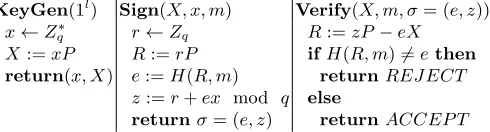
The Schnorr signature scheme is proposed in [60], and is proven secure in the random oracle model based on the discrete logarithm assumption [54]. At a high level, Schnorr’s signature is an instantiation of the Fiat-Shamir transformation [27] being applied to Σ-protocols (i.e., three-round public-coin honest-verifier zero-knowledge protocols) in the random oracle model. LetH :{0,1}∗→Z
q be
KeyGen(1l) Sign(X, x, m) Verify(X, m, σ= (e, z)) x←Zq∗ r←Zq R:=zP−eX
X:=xP R:=rP ifH(R, m)6=ethen return(x, X) e:=H(R, m) returnREJ ECT
z:=r+ex mod q else
returnσ= (e, z) returnACCEP T
Table 1.Schnorr’s signature
2.3 Γ-Signature
Under the motivation for achieving signature schemes of better online/offline performance, flexible and easy deployments (particularly with interactive proto-cols like IKE), and stronger security, Yao and Zhao introduced a new paradigm in [69]. Specifically, they proposed a special case ofΣ-protocol, which is referred to asΓ-protocol, and a transformation calledΓ-transformation that transforms anyΓ-protocol into a signature scheme in the random oracle model. The resul-tant signature is named Γ-signature. Below, we briefly review the Γ-signature scheme based on discrete logarithm problem (DLP), and its security result. The reader is referred to [69] for more details.
LetHd, He : {0,1}∗ → Zq∗ be two cryptographic hash functions, and m ∈
{0,1}∗be the message to be signed, the DLP-basedΓ-signature scheme is briefly reviewed in Table 2 (page 9). Here, for presentation simplicity, checkingz6= 0 in signature generation, and checkingd, z∈Zq∗andA6=∞in signature verification,
are not explicitly specified. In the actual implementation, it is also suggested in [69] that d = Hd(A) is replaced with d = xA modq, where xA is the x
-coordinate ofA. To ease signature verification, we can replacedin σwithd−1.
In this case, d−1 is not needed to computed in signature verification, and the
signature is rejected ifHd(A)d−16=∞.
Security of Γ-Signature.Strong existential unforgeability under concur-rent interactive attacks for a signature scheme Q = (KeyGen, Sign, V erif y), where a signature can be divided into two parts (d, z), is defined using the fol-lowing game between a challenger and a forger adversary F.
– Setup. On the security parameterl, the challenger runs (P K, SK)←KeyGen(1l).
The public-keyP Kis given to adversaryF(while the secret-keySKis kept private).
– SupposeFmakes at mostqssignature queries. Each signature query consists
of the following steps: (1)Fsends “Initialize” to the signer. Thei-th initial-ization query is denoted asIi, 1 ≤i ≤qs. (2) Upon the i-th initialization
query, the signer responds back di. (3) F adaptively chooses the message mi to be signed, and sends mi to the signer. (4) The signer sends backzi,
where (di, zi) is the signature on messagemi.F is allowed to adaptively and
concurrently interact with the signer in arbitrary interleaved order. As a special case,F can first makeqsinitialization queries, and get all the values
– Output. Finally,F outputs a pair ofmand (d, z), and wins the game if (1) V erif y(P K, m, d, z) = 1 and (2) (m, d, z)6∈ {(m1, d1, z1),· · · ,(mqs, dqs, zqs)}.
We define AdvSigsuf-cia
Q,F (1l) to be the probability that F wins in the above game, taken over the coin tosses of KeyGen, F, and the signer (and the ran-dom choice of the ranran-dom oracle). We say the signature scheme Q is strongly existential unforgeable, if AdvSigsuf-cia
Q,F (·) is a negligible function for every PPT forgerF.
It is proved in [69] that the above Γ-signature scheme is strongly existen-tial unforgeable under the DLP assumption, assuming Hd is a random oracle
while He is target one-way as defined in [69]. Roughly speaking,He is target
one-way w.r.t. an e-condition Re, if for any PPT algorithm A = (A1, A2) it
holds that Advtow He,A(1
l) = Pr[R
e(d, e = He(m), d0, e0 = He(m0)) = 0 : d ← Zq∗; (m, s)←A1(He, d);d0 ←Zq∗;m0 =A2(He, d, m, d0, s)] is negligible, where s
is some state information passed fromA1toA2. Here, thee-condition is defined
as Re(d, e, d0, e0) = 0 iff d−1e = d0−1e0modq. Introducing target one-wayness
in [69] is to mitigate the dependency of provable security on random oracles. Specifically, for the two hash functions Hd and He used for Γ-signature, only Hd is assumed to be a random oracle. Detailed discussions on target one-way
hash, including clarifications on the relations among target one-wayness, colli-sion resistance and preimage resistance, are presented in [69], which show target one-wayness is a natural and realistic property for cryptographic hash functions. In particular, target one-wayness is implied by random oracle [69].
3
Aggregate Signature and Motivation
An aggregate signature (AS) scheme is a tuple (KeyGen, Sign, V erif y, Agg, AggV erif y), where the last three are deterministic, while the first three algorithms constitute a standard signature scheme. Given multiple individual signatures {σ1,· · ·, σn}, where σi is a signature on message mi under
public-key pki, 1 ≤i ≤nand n≥2, the aggregation algorithm Agg condenses them
into a compact aggregate signaturesig. Here, in general, for any i, j such that 1 ≤ i 6= j ≤ n, it is assumed that (pki, mi) 6= (pkj, mj); but it might be
the case that pki = pkj or mi =mj. The completeness of an AS scheme says
thatAggV erif y({(pk1, m1),· · ·,(pkn, mn)}, sig) returns “ACCEPT”, whenever V erif y(pki, mi, σi) outputs “ACCEPT” for anyi, 1≤i≤n. Roughly speaking,
the security of an AS scheme says that it is infeasible for any PPT adversaryA
to produce a valid forged aggregate signature involving an honest signer, even when it can play the role of all the other signers (in particular choosing their public keys), and can mount a chosen-message attack on the target honest signer. Definition 1 (security of aggregate signature).
Let(pk, sk)←KeyGen(1l)be the public and secret key pair of the target
hon-est signer. The advantage of the attacker Aagainst the AS scheme is defined as AdvAAS(1l) =P r[AggV erif y({(pk
n is polynomial inl andpk∈ {pk1,· · · , pkn}. The probability is taken over the
random coins used byKeyGen andAin the following experiment: (pk, sk)←KeyGen(1l); (pk
1, ..., pkn, m1, ..., mn, sig)← ASign(sk,)(1l, pk).
To make the security definition meaningful, we only consider adversaries that are legitimate in the sense that, supposingpk=pki for somei,1≤i≤n, must
never have queried mi to its signing oracle. Then, an AS scheme is said to be
secure if for any PPT adversary A its advantage AdvASA (1l) is negligible in l.
Note that A can choose pk1, ..., pkn as it wishes, in particular as a function of
the target public keypk. There is also no requirement that the adversary “knows” the secret key corresponding to a public key it produces.
Practical aggregate signature schemes were proposed [17, 7] in the plain public-key model. They are derived based on the BLS short signature [18] in groups with bilinear maps. There have been some discussions on deploying the pairing-based AS schemes [17, 7] in the Bitcoin system [46], which are briefly summarized below.
– System complexity.Deploying pairing-based aggregate signature schemes re-quires the replacement of not only the EC-DSA algorithm but also the un-derlying elliptic curve. It makes a deployment in practice (such as Bitcoin) much more invasive than simply shifting algorithms.
– Bilinear group vs. general group. Intractability problems in groups with bi-linear maps are weaker than the discrete logarithm problem in general EC groups.
– Verification speed.As an individual signature scheme, the verification of the pairing-based BLS signature is significantly slower than that of EC-DSA. Note that the miners still need to verify the correctness of individual BLS signatures before aggregating them into a block. Some survey indicates that on a concrete hardware it can verify 70,000 secp256k1 signatures per second, while it could only verify about 8,000 BLS signatures per second [46]. It is thus highly desirable to develop aggregate signatures, with the following features simultaneously:
– It can be built from general elliptic curves (without bilinear maps), in the plain public-key model with fully asynchronous communications.
– The underlying signature scheme has provable security, and moreover, is more efficient and flexible than EC-DSA.
4
Subtlety and Warm-UP for Achieving Aggregate
Signatures from General Elliptic Curves
scriptless scripts (specifically, privacy-preserving smart contracts). However, we show the subtlety of aggregating Schnorr’s signatures. This is demonstrated by a concrete fatal attack, which actually works against the natural implementations of aggregate signature based upon almost all the variants of DSA and Schnorr’s. We first present the aggregate signature based on Schnorr’s scheme. Suppose there are nsigners, n≥2, and each has the public and secret key pair (Xi, xi)
whereXi=xiPandxi←Zq∗, 1≤i≤n. Denote byσi= (ei, zi) the signature by
userion messagemi∈ {0,1}∗. After receiving{(X1, m1, σ1),· · ·,(Xn, mn, σn)},
the miner first verifies the correctness of each individual signature (Xi, mi, σi),
during which it getsRi=ziP−eiXi. If all the individual signatures are correct,
the miner finally outputs ˆR = {R1,· · ·, Rn} and z = P n
i=1zi as the
resul-tant aggregate signature. On input (X1,· · · , Xn, m1,· · ·, mn,R, zˆ ),AggV erif y
works as follows: computesei =H(Xi, Ri, mi), and accepts ifzP =P n i=1Ri+
Pn
i=1eiXi.
The above aggregate signature scheme looks fine. But a deep speculation divulges the following subtle yet fatal attack. Without loss of generality, suppose the index of the attacker is 1, who possesses the public and secret key pair (X1, x1) and acts as follows.
– For any j, 2≤j ≤n, the attacker selects mj and arbitraryRj (from the
underlying EC group) on behalf ofXj, and computesej =H(Xj, Rj, mj).
Note that the attacker does not necessarily know the discrete logarithm of eitherXj orRj for 2≤j≤n.
– The attacker chooses its own message m1, sets the ephemeral rogue-key R1 = (−Pnj=2Rj −Pnj=2ejXj), and computes e1 = H(X1, R1, m1) and z=e1x1.
– Finally, it outputs (R1,· · ·, Rn, z) as the forged aggregate signature.
Note that zP = e1x1P =e1X1 =e1X1+R1+ (P n
j=2Ri+P n
j=2eiXi) =
Pn
i=1Ri+P n
i=1eiXi. Thus, the forged aggregate signature is valid, the attacker
can sign arbitrary messages on behalf of the victim users (X2,· · · , Xn). There
is no doubt that such an attack is really fatal, particularly for a cryptocurrency system like Bitcoin. To stop such an attack, one approach is to require proof of possession of the discrete logarithms for all the Rj’s, 1 ≤j ≤n [57]. But this
voids the advantage of signature aggregation.
We suggest that the above ephemeral rogue-key attack might implicitly ac-count for the reason why no previous AS scheme was built from general elliptic curve groups, though we are unaware of any explicit presentation of such an attack to the best of our knowledge. Nevertheless, it indeed serves as a good il-lustration of the subtlety of, as well as warm-up for, achieving AS from general groups without bilinear maps.
5
Aggregate
Γ
-Signature
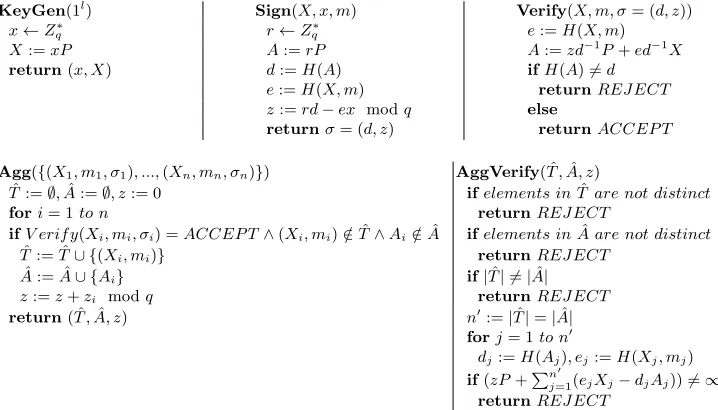
Section 2.3. For presentation simplicity, we use a single cryptographic hash func-tion H : {0,1}∗ → Z∗
q, and the checking of d, z ∈ Zq∗, mi 6= λand A 6= ∞ is
omitted in the specification of verification algorithms, where λ represents the empty string. The completeness property can checked directly.
KeyGen(1l) Sign(X, x, m) Verify(X, m, σ= (d, z))
x←Zq∗ r←Zq∗ e:=H(X, m)
X:=xP A:=rP A:=zd−1P+ed−1X
return(x, X) d:=H(A) ifH(A)6=d
e:=H(X, m) returnREJ ECT
z:=rd−ex modq else
returnσ= (d, z) returnACCEP T
Agg({(X1, m1, σ1), ...,(Xn, mn, σn)}) AggVerify( ˆT ,A, zˆ )
ˆ
T :=∅,Aˆ:=∅, z:= 0 ifelements inT are not distinctˆ
fori= 1to n returnREJ ECT
ifV erif y(Xi, mi, σi) =ACCEP T∧(Xi, mi)∈/Tˆ∧Ai∈/Aˆ ifelements inA are not distinctˆ
ˆ
T:= ˆT∪ {(Xi, mi)} returnREJ ECT
ˆ
A:= ˆA∪ {Ai} if|Tˆ| 6=|Aˆ|
z:=z+zi modq returnREJ ECT
return( ˆT ,A, zˆ ) n0:=|Tˆ|=|Aˆ|
forj= 1to n0
dj:=H(Aj), ej:=H(Xj, mj)
if(zP+Pn0
j=1(ejXj−djAj))6=∞
returnREJ ECT returnACCEP T
Table 2.AggregateΓ-signature
Given a list of individual signatures{(X1, m1, σ1= (d1, z1)),· · ·,(Xn, mn, σn =
(dn, zn))}, where n ≥ 2, the aggregation algorithm discards (Xi, mi, σi) if the
signature verification fails, or any one of (Xi, mi) orAi is repeated. The latter
checking is for provable security, as we shall see. But it still might be the case that, for somei6=j,Xi=Xj ormi =mj (this case occurs with Bitcoin P2SH
multi-signature transactions). We assume that the elements in ˆT and those in ˆ
A output by Agg are sorted to ease verification of aggregate signature. More details about the implementations are discussed in the next subsection. Observe that ˆT and ˆAare output and treatedseparately, andAggV erif ieractually does not care about the correspondence between the elements in ˆA and those in ˆT. This flexibility allows for implementations more friendly to SegWit and to being resistant to transaction malleability attacks, as we shall discuss in Section 6.
The total size of the aggregate signature ( ˆA, z) hasn0(l+ 1) +l bits, where eachAi is represented with logp+ 1 =l+ 1 bits. In comparison, the total size of n0 individual signatures has 2n0lbits. For Bitcoin,l= 256, andn0 is about 4000 on average. Thus, with aggregateΓ-signature, the storage volume of signatures reduces about 49.8%.
We use the simultaneous point multiplication techniques [33, 30, 26] in com-puting zP +Pn0
j=1ejXj−
Pn0
j=1djAj. Specifically, we divide the 2n
multiplications intod(2n0+ 1)/8egroups, and then apply the simultaneous mul-tiplication technique to each group of at most 8 point mulmul-tiplications. Denote byA(resp.,D) the timing cost for performing modular EC addition (resp., dou-bling), where 1D amounts to about 0.7A (with some optimization techniques, addition can be as efficient as doubling, i.e., 1Acan amount to 1D). The cost for performing 8 point multiplicationsseparately is about 8lD+ 4lA. In comparison, for performing 8 point multiplicationsimultaneously, the cost is aboutl(D+A) plus at most 256A(for preparing a table of size at most 28 = 256). This way,
the timing cost for verifying signatures can reduce about 72%.
5.1 NMDL Assumption, and Justification
Motivated for breaking some impossibility barriers of black-box cryptography and for achieving cryptographic schemes of conceptually simple structure and analysis, the research community has been paying more attention to achiev-ing cryptographic schemes based on non-black-box assumptions or primitives in recent years [5, 20, 21, 29, 24, 15]. As a popular non-black-box assumption, the knowledge-of-exponent assumption (KEA) and its variants have been shown to be successful and powerful (see, e.g., [23, 32, 9, 10, 55, 38, 25, 56, 1, 49, 20, 21, 31, 28, 29, 67, 24, 15, 68, 70, 58, 59]). In particular, a type of KEA assumption on pairing groups is used in Zcash [58, 59].
Yao and Zhao introduced and justified a variant of the KEA assumption, re-ferred to asjoint KEA (JKEA) assumption [68]. LetH1,· · ·, Hκ:{0,1}∗→Zq
be cryptographic hash functions that are modelled as random oracles (RO). Roughly speaking, the JKEA assumption says that, givenX =xP forx←Zq,
the ability of an efficient algorithmAto output{(Y1, m1),· · · ,(Yκ, mκ), Z}such
that Z= (Pκ
i=1eiYi)x, whereYi∈E(F) andmi ∈ {0,1}∗ and ei =Hi(Yi, mi)
for 1 ≤ i ≤ κ, implies knowing (y1,· · · , yκ) simultaneously, where yi is the
discrete logarithm of Yi. Here, “knowing” implies that (y1,· · · , yκ) can be
ef-ficiently extracted by an extractor algorithm E from the input and the ran-dom tape of A. The JKEA assumption is justified in [68] by the fact that, assumingHi’s are random oracles, no efficient algorithm can make the values in
{e1Y1,· · · , eκYκ}correlated. That is, no matter how the PPT algorithmAdoes,
the values{H1(Y1, m1)y1,· · · , Hκ(Yκ, mκ)yκ}are computationally independent
as defined in [68].
The JKEA assumption implies the following weaker assumption, referred to as explicit knowledge-of-exponent assumption (EKEA). Specifically, the ability of outputting{(Y1, m1),· · · ,(Yκ, mκ), z}, satisfyingz∈Zq andzP =P
κ i=1eiYi,
implies knowing (y1,· · · , yκ) simultaneously. That is, (y1,· · ·, yκ) can be
effi-ciently extracted. Unlike the JKEA assumption where the algorithm A only outputs CDH(X,Pκ
i=1eiYi), hereA explicitly outputs the discrete logarithm z = log(Pκ
i=1eiYi). Clearly, the EKEA assumption is implied by, and weaker
Definition 2 (non-malleable discrete logarithm (NMDL) assumption). Let G = (E(Fp), P, q) define a cyclic group over E(Fp) generated by P of
order q, where p and q are prime numbers, and l = dlogqe be the security pa-rameter. Let H1,· · ·, Hκ :{0,1}∗→Zq∗ be cryptographic hash functions, which
may not be distinct. On input (G, X)where X =xP forx←Zq∗, a PPT
algo-rithm A (called an NMDL-solver) succeeds in solving the NMDL problem, if it could output{(b1, Y1, m1)· · ·,(bκ, Yκ, mκ), z}, satisfying:
– z∈Zq, and for anyi,1≤i≤κ,Yi∈G,mi∈ {0,1}∗ that can be the empty
string, andbi∈ {0,1}.
– For any1≤i6=j ≤κ, it holds that(Yi, mi)6= (Yj, mj). But it might be the
case thatYi=Yj ormi =mj.
– X∈ {Y1,· · ·, Yκ}, andzP =P κ i=1(−1)
bie
iYi whereei =Hi(Yi, mi).
Then, the NMDL assumption says that, for any PPT algorithmA, the prob-ability that it succeeds in solving the NMDL problem is negligible inl. The prob-ability is taken over the random coins used to generate(G, x), the random coins used byA (and the choices of the random functions H1,· · · , Hκ in the random
oracle model).
It is easy to see that the NMDL assumption is implied by the standard discrete logarithm assumption and the EKEA assumption. Note also that the NMDL assumption is itself black-box in nature. Below, we further justify this assumption by proving that it holds in the generic group and random oracle model [12, 14, 61, 63], whereH1,· · ·, Hκare assumed to be random oracles (RO)
[11]. We suggest the NMDL assumption should be of independent interest, and could find more cryptographic applications in the future.
Briefly speaking, an algorithm is generic if it does not use the encoding of the group elements. It can only use group elements for group operations and relation verifications. There are many groups for which the fastest DL solver algorithms are generic. For example, general elliptic curves; general hyper-elliptic curves of genus 2; and subgroups of prime order q in Zp∗ when (p−1)/q is so large that sieving methods are inefficient [62]. For presentation simplicity, in the following analysis we use Maurer’s generic group model [44] that is actually equivalent to Shoup’s model [65, 36].
Theorem 1. For an NMDL-solver algorithm that runs τ generic steps and makes % RO-queries, its success probability is upper bounded by τq2+%−12 in the generic group and random oracle model.
(RO)H:{0,1}∗→Z∗
q. Here, for presentation simplicity, we use a single random
oracleHto represent{H1,· · · , Hκ}.
For thei-th GG-oracle access corresponding to a group operation, 1≤i≤τ, the value computed by the GG-oracleOcan be viewed as a linear polynomial of the formFi(x) =aix+bi modq, whereai, bi∈Zq are determined by previous
GG-oracle accesses. The valueFiis not returned toAdirectly, but is stored into
a position in the internal listLwhere the position index for storingFiis indicated
by A. A is always given the ability of verifying equality relation, by which A
queriesOwith (i, j) and gets result whetherL[i] =L[j] or not. For thek-th RO query, 1≤k≤%, the algorithm A queries the random oracleH with (tk, mk),
where mk ∈ {0,1}∗ and 1 ≤ tk ≤ τ represents the index of the component Ftk(x)P that is actually unknown to A in the generic group model. Upon the k-th RO-query (tk, mk), the random oracle H works as follows: (1) if L(tk) is
undefined, it returns⊥indicating invalid RO-query;3 (2) ifH(t
k, mk) has been
defined, it returns what already defined; (3) otherwise, it defines and returns a value taken uniformly at random from Zq∗ as H(tk, mk). Finally, A outputs
{(b1, i1, mi1),· · ·,(bκ, iκ, miκ), z}, and succeeds on the following conditions:
– z∈Zq, bα ∈ {0,1} andmα∈ {0,1}∗ where 1≤α≤κ, and 1≤iβ ≤τ for
1≤β≤κ. Here,iβ is the index ofFiβ(x)P.
– For any 1≤α6=β≤κ, it holds that (iα, mα)6= (iβ, mβ).
– 2 ∈ {i1,· · ·, iκ} where the index 2 represents the input X = xP to the
NMDL-solverAin the generic group model, andz=Pκ
α=1(−1) bαe
iαFiα(x)
modqwhere eiα=H(iα, miα)∈Z
∗
q.
As discussed in [44], in this generic group model we only need to consider non-adaptive adversaries, and there are only three approaches forAto succeed in the generic group model.
– Simply guessingx, which succeeds with probability q−11.
– Another approach is to cause two differentFi andFj to collide, 1≤i, j≤τ,
in the sense thataix+bi=ajx+bjwhere (ai, bi)6= (aj, bj). In other words,
(ai−aj)x+ (bi−bj) = 0. By Schwartz-Shoup lemma [64, 65, 45, 44], this
event can occur with probability at mostC2 τq−11.
– The third approach forAto succeed is to output{(ˆb1,ˆi1,mˆˆi1),· · ·,(ˆbγ,ˆiγ,mˆˆiγ),zˆ}
such that ˆz=Pγ
α=1(−1) ˆ bαe
ˆiαFˆiα(x) modq, whereγ >1 andeˆiα =H(ˆiα,mˆˆiα)∈ Zq∗. The observation here is that, for any tuple{(ˆb1,ˆi1,mˆˆi1),· · · ,(ˆbγ,ˆiγ,mˆˆiγ),zˆ},
the probability that ˆz=Pγ
α=1(−1) ˆ bαe
ˆiαFˆiα(x) modqis at most 1
q−1 in the
random oracle model. Then, by the birthday paradigm, the probability that
A succeeds with this approach is at most q%−21, where % is the number of queries made byAto the random oracleH.
Note that q−11+C2 τ
1 q−1 +
%2 q−1 <
τ2+%2
q−1 .
3
5.2 Security Analysis
Theorem 2. The aggregate Γ-signature scheme presented in Table 2 is secure under the NMDL assumption.
Proof. According to the security definition of aggregate signature presented in Section 3, supposing there exists a PPT forger A who breaks the security of the aggregate Γ-signature with non-negligible probability, we present another PPT algorithm B who can solve the NMDL problem also with non-negligible probability. Denote by (X =xP, x) the public and secret key pair of the target honest user, wherex←Zq∗. The algorithmBtakes (G, X) as input (whereGis the underlying cyclic group defined in the elliptic curve), runsAas a subroutine, and works as follows.
B controls and programs the random oracle H. WheneverA asks the tar-get user to sign a message m, B answers the signing query by running the Γ-signature simulator as described in [69]. As analyzed in [69], the simula-tion is statistically indistinguishable from what A gets in reality. Finally, sup-pose that A outputs a valid aggregate Γ-signature denoted ( ˆT ,A, zˆ ), where
ˆ
T = {(X1, m1),· · · ,(Xn0, mn0)}, ˆA = {A1,· · · , An0}. Assume that there are n00 distinct elements ¯X = {Xi1,· · ·, Xin00} in ˆX = {X1,· · ·, Xn0}, where Xij
appears tj times in ˆX and P n00
j=1tj = n0. For each j, 1 ≤ j ≤ n00, denote by Ij ={j1,· · · , jtj} the set of indices that Xij appears in ˆX where 1 ≤jα ≤n0
for 1≤α≤tj; specifically,Xij =Xj1 =· · ·=Xjtj. Boutputs{T ,¯ A, z¯ }, which
are specified below:
– T¯ = {(b1, Xi1, m1),· · ·,(bn00, Xin00, mn00)}, where for each j, 1 ≤ j ≤ n00, bj=−1 andmj =mj1|| · · · ||mjkj.
– A¯={(b01, A1, λ)· · · ,(b0n0, An0, λ)}, where for eachi, 1≤i≤n0, b0i = 1, and λrepresents the empty string.
According to the security analysis of Γ-signature in [69], what seen by A
under the run of B is statistically indistinguishable from what seen in real-ity. Thus, with also non-negligible probability, A will output a valid aggre-gate Γ-signature ( ˆT ,A, zˆ ) under the simulation ofB. Consequently, B outputs ( ¯T ,A, z¯ ) with the same probability. DefineH0:G×({0,1}∗)β→Z
q as follows: H0(X, m1,· · ·, mβ) =H(X, m1) +· · ·+H(X, mβ) mod qfor anyβ, 1≤β ≤n0.
It is easy to see that, assumingH{0,1}∗→Z
q is a random oracle, so isH0.
Fi-nally, we show that the output{T ,¯ A, z¯ }byBis a correct solution to the NMDL problem, by the following observations:
– All the tuples in ¯TS ¯
A are distinct. This is from the facts that: (1) the tuples in ¯T are distinct andmj 6=λ, 1≤j≤n00; (2) the tuples in ¯Aare also
distinct with the same empty string as the third element in each tuple. – As we assume the aggregate signature ( ˆT ,A, zˆ ) output byAis valid, we have
thatX ∈X¯ ={Xi1,· · · , Xin00}, and zP = Pn0
i=1diAi−
Pn00
j=1e
0
6
Applications to Bitcoin
In this section, we describe a Merkle-Patricia tree (MPT) aided implementa-tion of our aggregate signature scheme, and specify its applicaimplementa-tions to Bitcoin. The goal is to maximize performance and compatibility with the existing Bitcoin system, with the least modifications that are inherent in deploying aggregate sig-natures. Our modifications involve: txid, unlocking script, locking script, Merkle tree, block construction, block mining and block verification. For presentation simplicity, we describe our implementation for a hard-fork of Bitcoin (though it can also be implemented with a soft-fork), in a self-contained manner for ease of reading.
6.1 Inheritances: Keys, Addresses and Network
Bitcoin uses a specific elliptic curve, as defined in a standard called secp256k1, es-tablished by NIST. Our aggregateΓ-signature scheme also works on the secp256k1 curve. As for new key pair generation, algorithmKeyGen(1l) is the same as in
the existing Bitcoin system.
As for Bitcoin addresses, we inherit the existing design in Bitcoin. Specifically, this is the process of generating address from public key through the use of one-way hash algorithms SHA256 and RIPEMD160,
A=RIPEMD160(SHA256(X)),
where X is the public key and A is the Bitcoin address. The above address is called P2PKH address. There is another type of address called P2SH address, which is generated by the following equation:
A=RIPEMD160(SHA256(script)).
We also use the Base58 [3] and Base58Check [6, 2] formats for unambiguously and compactly encoding Bitcoin data such as addresses, etc.
We adopt the existing Bitcoin network which is structured as a peer-to-peer (P2P) network on top of the internet. And the Bitcoin network refers to the col-lection of nodes running the Bitcoin protocol. When a peer receives data, it will broadcast the data to its neighbouring peers after some necessary verification. With the usage of P2P network, in a very short period of time, the data such as transactions and blocks can be efficiently spread all over the network.
6.2 Transactions
Transactions are the most important part of the Bitcoin system. Everything else in Bitcoin is designed to ensure that transactions can be created, propagated on P2P network, validated, and finally added to the global ledger of transactions (i.e., the blockchain).
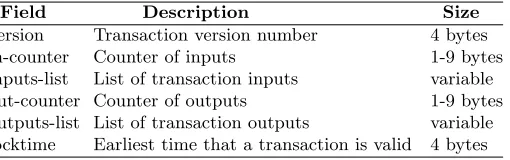
The Bitcoin transaction consists of fields such as version, in-counter, inputs list, out-counter, outputs list and locktime, which is shown in Table 3.
Field Description Size version Transaction version number 4 bytes in-counter Counter of inputs 1-9 bytes inputs-list List of transaction inputs variable out-counter Counter of outputs 1-9 bytes outputs-list List of transaction outputs variable locktime Earliest time that a transaction is valid 4 bytes
Table 3.Structure of Bitcoin transaction
– txid: a pointer to the transaction containing the unspent transaction output (UTXO).
– vout: the index number of the UTXO to be spent.
– unlocking script: a script that fulfills the conditions of the UTXO locking script.
– sequence: the block number where the UTXO is recorded in the blockchain.
In the Bitcoin system, txid is the double SHA256 hash of the transaction, including the witness (i.e., the associated signature). It is inherently impossible to retrieve the txid whenever aggregate signature is used, where multiple individual signatures are replaced with the aggregate signature in the block. So, for AS-based implementations, we modify the txid to be the double SHA256 hash of the transaction without witness. Note that tampering with the witness data is the source for launching transaction malleability attacks [19]. Removing it from the hash input in generating txid also removes the opportunity for transaction malleability attacks. This can also greatly improve the implementations for many other protocols, such as payment channels, chained transactions, and lightning networks.
Unlocking script of P2PKH is in the format of<sig><PubK>, where PubK is a public key and sig is a signature signed by the private key corresponding to PubK; The unlocking script of P2SH has a basic format of <sig I><sig J>, mainly for multi-signature. In our modifications, the sig is generated by the Sign(X, x, m) ofΓ-signature (wherem is part of a transaction defined by SIGHASH flag), which replaces the existing EC-DSA signature.
Within the outputs list field of transaction, it consists of (1) value which is an amount of Bitcoin; and (2)locking script which is a cryptographic puz-zle that determines the conditions required to spend the output. As for op-erations OP CHECKSIG and OP CHECKMULTISIG among locking script of P2PKH and P2SH, the EC-DSA verification procedure is replaced by running V erif y(X, m, σ= (d, z)) ofΓ-signature.
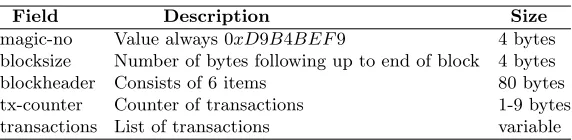
6.3 Block
Field Description Size magic-no Value always 0xD9B4BEF9 4 bytes blocksize Number of bytes following up to end of block 4 bytes blockheader Consists of 6 items 80 bytes tx-counter Counter of transactions 1-9 bytes transactions List of transactions variable
Table 4.Structure of Bitcoin block
Each block is identified by a hash which is generated by running the SHA256 cryptographic hash algorithm twice on the block header. The size of block header is 80-bytes, and its structure is shown in Table 5.
Field Description Size
version Block version number 4 bytes hashPrevBlock Hash of the previous block header 32 bytes hashMerkleRoot Hash of Merkle tree root in the block 32 bytes timestamp Current timestamp as seconds 4 bytes bits Current target in compact format 4 bytes
nonce 32-bit number 4 bytes
Table 5.Structure of Bitcoin blockheader
Every block in blockchain contains a summary of all the transactions using a Merkle tree. A Merkle tree, also known as a binary hash tree, is a data structure used for efficiently summarizing and verifying the integrity of large sets of data. In our modifications, we build Merkle tree with our modified txid which is the double SHA256 hash of the transaction without witness.
In the existing Bitcoin system, after validating transactions a miner will add them to the memory pool or transaction pool where transactions await until they can be included (mined) into a block. We adopt Merkle-Patricia tree (MPT) [53] to play the role of memory pool and to perform duplication check, as the elements in ˆT and ˆAin our aggregate Γ-signature are required to be distinct. MPT can provide a cryptographically authenticated data structure that can be used to store (key, value) pairs, and enjoys a faster speed both in element searching and in outputting ordered elements. The algorithmAggin our aggregateΓ-signature can be implemented with MPT as follows.
– Initialize two empty MPT instancesM P TAˆandM P TTˆ, whereM P TAˆ(resp., M P TTˆ ) is for the set of ˆA(resp., ˆT).
– Traverse the received transactions and do the following. For every transac-tion input, extract the public keyXi and the signatureσi = (di, zi) in the
SIGHASH flag; Then, calculateAi fromσi, and search inM P TA,M P TT to
check whether there already existsAior (Xi, mi); Finally, verify (Xi, mi, σi)
with ourV erif yalgorithm.
– If there already existsAior (Xi, mi), orV erif yalgorithm outputsREJ ECT,
drop the current transaction, and loop to the next transaction.
– InsertAiand (Xi, mi) toM P TAandM P TT respectively, and setz:=z+zi
modq.
– When all the transactions are traversed, output the ordered list ofAi’s as
ˆ
A, the ordered list of (Xi, mi) as ˆT, and a numberz∈Zq.
Now, we pay attention to P2SH unlocking script multi-signature, whereN public keys are recorded in the script and at leastM of them must provide sig-natures to unlock the funds. In order to aggregate the multi-signature, a Bitcoin node should extract each tuple (Xj, m, σj) from theM provided signatures on
the same messagem, and deals with it like a normal transaction input.
After collecting enough transactions, the miner constructs a candidate block, with the only witness of aggregate signature ( ˆA, z) being placed at the end of block as specified by segregated witness (SegWit).4This way, our result inherits
all the advantages of SegWitness, besides enjoying a more compact witness. When a miner finds a solution nonce (that is inserted into the block header) such that the block header hash is less than the target, the miner transmits the candidate block to all its peers immediately. By the consensus mechanism of Bitcoin, every node independently validates the new block before propagating it to its peers, which ensures that only valid blocks are propagated on the network. Instead of individually validating all the transactions within the block, with our modifications, each node only needs to simply verify one aggregate signature with algorithmAggV erif y( ˆT ,A, zˆ ), as follows.
– Note that both ˆT and ˆAare ordered. In order to ensure the elements within are distinct, just traverse the lists ˆT and ˆAto confirm that every two adjacent elements are different and are monotonically incremented.
– If the elements are not distinct in the above step, abort and outputREJ ECT. Otherwise, continue with the next procedure.
– Execute the aggregate signature validation, and output ACCEP T if the verification is successful. Otherwise, outputREJ ECT.
7
Conclusion and Future Work
In this work, we present the first aggregate signature (AS) scheme from general elliptic curve groups without bilinear maps. Compared to a list of individual signatures (on potentially pairwise distinct messages), the storage volume of sig-natures reduces about 49.8% and the signature verification time can even reduce 4 Segregated witness is an architectural change to Bitcoin, which aims to move the
about 72% with the proposed AS scheme. Its provable security is based on a new assumption, named non-malleable discrete logarithm (NMDL), which is proved in the generic group and random oracle model (and is also implied by the DL assumption and a weaker non-black-box assumption). We suggest the NMDL as-sumption should be of independent interest, and could find more cryptographic applications in the future. Finally, we specify in detail the application of the proposed AS scheme to Bitcoin, with the goal of maximizing performance and compatibility. Towards that, we adopt a Merkle-Patricia tree based implemen-tation of our AS scheme. Besides security inherited from Bitcoin, the AS-aided system is also more friendly to segregated witness, and provides better protection against transaction malleability attacks.
Though using both generic group model and random oracle model is not rare (particularly for arguing security of practical cryptographic schemes, e.g. [12, 14, 61, 63]), it is interesting to investigate whether practical AS schemes from general groups can be built with provable security only in the random oracle model. Note that our aggregate signature only about halves the bandwidth or storage volume of signatures. Studying the (im)possibility of constant-size AS from general groups is an important question for future research, on which we are inclined to a theoretical impossibility result (at least for the case of black-box security reduction).
Acknowledgement. We are grateful to Xing Chang, Leixiao Cheng, Boru Gong, Xingzhong Huang, Bao Li, Yuan Li, Wei Yu and Andrew C. Yao for many helpful discussions and assistance.
References
1. M. Abe and S. Fehr. Perfect NIZK with Adaptive Soundness. TCC2007: 118-136. 2. A. M. Antonopoulos. Mastering Bitcoin. Available at
https://github.com/bitcoinbook/bitcoinbook
3. A. M. Antonopoulos. Mastering Bitcoin. Section: Base58. Available at https://github.com/bitcoinbook/bitcoinbook
4. A. Bagherzandi, J.H. Cheon, and S. Jarecki. Multisignatures Secure Under the Dis-crete Logarithm Assumption and a Generalized Forking Lemma. ACM Conference on Computer and Communications Security2008: 449458.
5. B. Barak. How to Go Beyond the Black-Box Simulation Barrier. FOCS 2001: 106-115.
6. Base58Check Encoding. Available at https://en.bitcoin.it/wiki/Base58Check encoding 7. M. Bellare, C. Namprempre and G. Neven. Unrestricted Aggregate Signatures.
ICALP2007: 411-422.
8. M. Bellare and G. Neven. Multi-Signatures in the Plain Public-Key Model and a General Forking Lemma. ACM Conference on Computer and Communications Security2006: 390-399.
9. M. Bellare and A. Palacio. Towards Plaintext-Aware Public-Key Encryption with-out Random Oracles.ASIACRYPT 2004: 48-62.
11. M. Bellare and P. Rogaway. Random Oracles Are Practical: A Paradigm for De-signing Efficient Protocols. ACM CCS1993: 62-73.
12. Bethencourt, J., Sahai, A., Waters, B. Ciphertext-Policy Attribute-Based Encryp-tion. IEEE Symposium on Security and Privacy (S&P)2007, 321-334.
13. A. Boldyreva. Threshold Signatures, Multisignatures and Blind Signatures Based on the Gap-Diffie-Hellman-Group Signature Scheme. PKC 2003, LNCS 2567, Springer-Verlag.
14. A. Boldyreva, C. Gentry, A. O’Neill and D. H. Yum. Ordered Multisignatures and Identity-Based Sequential Aggregate Signatures, with Applications to Secure Routing. CCS2007: 276-285.
15. N. Bitansky, R. Canetti, A. Chiesa, and E. Tromer. From Extractable Collision Resistance to Succinct Non-Interactive Arguments of Knowledge, and Back Again. ITCS2012: 326-349.
16. D. Boneh, M. Drijvers, and G. Neven. Compact Multi-Signatures for Smaller Blockchains. ASIACRYPT2018.
17. D. Boneh, C. Gentry, B. Lynn and H. Shacham. Aggregate and Verifiably En-crypted Signatures from Bilinear Maps. EUROCRYPT2003: 416-432.
18. D. Boneh, B. Lynn and H. Shacham. Short Signatures from the Weil Pairing. ASIACRYPT2001: 514-532.
19. D. Bradbury. What the ‘Bitcoin Bug’ Means: A Guide to Transaction Malleability. Available at https://www.coindesk.com/ bitcoin-bug-guide-transaction-malleability/
20. R. Canetti and R. R. Dakdouk. Extractable Perfectly One-Way Functions.ICALP (2) 2008: 449-460.
21. R. Canetti and R. R. Dakdouk. Towards a Theory of Extractable Functions.TCC 2009: 595-613.
22. C. Research. SEC 2: Recommended Elliptic Curve Domain Parameters 2010. Avail-able at http://www.secg.org/sec2-v2.pdf
23. I. Damg˚ard. Towards Practical Public Key Systems Secure Against Chosen Ci-phertext Attacks. CRYPTO1991: 445-456.
24. I. Damg˚ard, S. Faust and C. Hazay. Secure Two-Party Computation with Low Communication. TCC2012: 54-74.
25. A. W. Dent. The Cramer-Shoup Encryption Scheme is Plaintext Aware in the Standard Model. EUROCRYPT2006: 289-307.
26. V. S. Dimitrov, G. A. Jullien, and W. C. Miller. Complexity and Fast Algorithms for Multiexponentiations. IEEE Trans. Computers(2) 2000: 141-147.
27. A. Fiat and A. Shamir. How to Prove Yourself: Practical Solutions to Identification and Signature Problems. CRYPTO1986: 186-194.
28. R. Gennaro, H. Krawczyk, and T. Rabin. Okamoto-Tanaka Revisited: Fully Au-thenticated Diffie-Hellman with Minimal Overhead. ACNS2010: 309-328.
29. S. Goldwasser, H. Lin, and A. Rubinstein. Delegation of Computation without Rejection Problem from Designated Verifier CS-Proofs. IACR Cryptology ePrint Archive2011: 456.
30. D. M. Gordon. A Survey of Fast Exponentiation Methods. J. Algorithms27(1) 1998: 129-146.
31. J. Groth. Short Pairing-Based Non-Interactive Zero-Knowledge Arguments. ASI-ACRYPT2010: 321-340.
32. S. Hada and T. Tanaka. On the Existence of 3-Round Zero-Knowledge Protocols. CRYPTO1998: 408-423.
34. S. Hohenberger, B. Waters. Synchronized Aggregate Signatures from the RSA Assumption. EUROCRYPT2018: 197-229.
35. K. Itakura and K. Nakamura. A Public-Key Cryptosystem Suitable for Digital Multisignatures. NEC Research&Development, 71:18, 1983.
36. T. Jager and J. Schwenk. On the Equivalence of Generic Group Models.ProvSec 2008: 200-209.
37. D. Johnson, A. Menezes and S. Vanstone. The Elliptic Curve Digital Signature Algorithm (EC-DSA). Int. J. Inf. Sec1(1) 2001: 36-63.
38. H. Krawczyk. HMQV: A High-Performance Secure Diffie-Hellman Protocol. CRYPTO2005: 546-566.
39. C.M. Li, T. Hwang, and N.Y. Lee. Threshold Multisignature Schemes where Sus-pected Forgery Implies Traceability of Adversarial Shareholders. EUROCRYPT 1994, LNCS 950, Springer-Verlag.
40. S. Lu, R. Ostrovsky, A. Sahai, H. Shacham, and B. Waters. Sequential Aggre-gate Signatures and Multisignatures without Random Oracles.EUROCRYPT2006, LNCS 4004, Springer-Verlag.
41. A. Lysyanskaya, S. Micali, L. Reyzin, and H. Shacham. Sequential Aggregate Sig-natures from Trapdoor Permutations. EUROCRYPT 2004, LNCS 3027, Springer-Verlag.
42. C. Ma, J. Weng, Y. Li and R. H. Deng. Efficient Discrete Logarithm Based Multi-Signature Scheme in the Plain Public Key Model. Codes Cryptography54(2) 2010: 121-133.
43. W. Mao. Modern Cryptography: Theory and Practice. CRC2004.
44. U. Maurer. Abstract Models of Computation in Cryptography.IMA Cryptography and Coding2005: 1-12.
45. U. Maurer and S. Wolf. Lower Bounds on Generic Algorithms in Groups. EURO-CRYPT1998: 72-84.
46. G. Maxwell. Signature Aggregation for Improved Scalablity. Available at https://bitcointalk.org/index.php?topic=1377298.0
47. G. Maxwell, A. Poelstra, Y. Seurin and P. Wuille. Simple Schnorr Multi-Signatures with Applications to Bitcoin. IACR Cryptology ePrint Archive2018: 68.
48. S. Micali, K. Ohta, and L. Reyzin. Accountable-Subgroup Multisignatures. ACM CCS2001, ACM Press.
49. T. Mie. Polylogarithmic Two-Round Argument Systems. J. Mathematical Cryp-tology2(4) 2008: 343-363.
50. S. Nakamoto. Bitcoin: A Peer-to-Peer Electronic Cash System. 2008 Available at http://bitcoin.org/bitcoin.pdf
51. K. Ohta and T. Okamoto. A Ddigital Multisignature Scheme Based on the Fiat-Shamir Scheme. ASIACRYPT1991, LNCS 739, Springer-Verlag.
52. L. Parker. Bitcoin ‘Spam Attack’ Stressed Network for at least 18 Months, Claims Software Developer. Available at https://bravenewcoin.com/news/bitcoin-spam-attack-stressed-network-for-at-least-18-months-claims-software-developer/ 53. Patricia Tree. Available at https://github.com/ethereum/wiki/wiki/Patricia-Tree 54. D. Pointcheval and J. Stern. Security Arguments for Digital Signatures and Blind
Signatures. Journal of Cryptology, 13(2) 2000: 36-396.
55. M. D. Raimondo and R. Gennaro. New Approaches for Deniable Authentication. ACM Conference on Computer and Communications Security2005: 112-121. 56. M. D. Raimondo, R. Gennaro, and H. Krawczyk. Deniable Authentication and
57. T. Ristenpart and S. Yilek. The Power of Proofs-of-Possession: Securing Multiparty Signatures against Rogue-Key Attacks. EUROCRYPT2007: 228-245.
58. E. B. Sasson, A. Chiesay, C. Garmanz, M. Greenz, I. Miersz, E. Tromerx and M. Virza. Zerocash: Decentralized Anonymous Payments from Bitcoin. IEEE Sympo-sium on Security and Privacy2014: 459-474.
59. E. B. Sasson, A. Chiesa, E. Tromer and M. Virz. Succinct Non-Interactive Zero Knowledge for a Von Neumann Architecture. USENIX Security2014: 781-796. 60. C. P. Schnorr. Efficient Identification and Signatures for Smart Cards. CRYPTO
1989: 239-252.
61. C. P. Schnorr. Security of Blind Discrete Log Signatures against Interactive At-tacks. ICICS2001: 1-12.
62. C. P. Schnorr. Small Generic Hardcore Subsets for the Discrete Logarithm. Infor-mation processing Letters79(2): 93-98, 2001.
63. C. P. Schnorr, M. Jakobsson. Security of Signed ElGamal Encryption. ASI-ACRYPT2000: 73-89.
64. J. T. Schwartz. Fast Probabilistic Algorithms for Verifications of Polynomial Iden-tities.Journal of the ACM, 27(3): 701-717, 1980.
65. V. Shoup. Lower Bounds for Discrete Logarithms and Related Problems. EURO-CRYPT1997: 256-266.
66. A. V. Wirdum. Scriptless Scripts: How Bitcoin Can Sup-port Smart Contracts Without Smart Contracts. Available at https://bitcoinmagazine.com/articles/scriptless-scripts-how-bitcoin-can-support-smart-contracts-without-smart-contracts/
67. A. C.-C. Yao and Y. Zhao. Deniable Internet Key Exchange.ACNS2010: 329-348. 68. A. C.-C. Yao and Y. Zhao. OAKE: A New Family of Implicitly Authenticated Diffie-Hellman Protocols. ACMCCS 2013: 1113-1128. Full version available at https://eprint.iacr.org/2011/035
69. A. C.-C. Yao and Y. Zhao. Online/Offline Signatures for Low-Power Devices.IEEE Trans Information Forensics and Security8(2) 2013: 283-294.
70. A. C.-C. Yao and Y. Zhao. Privacy-Preserving Authenticated Key-Exchange Over Internet. IEEE Trans Information Forensics and Security9(1) 2014: 125-140.
A
A Variant of Aggregate
Γ
-Signature
A variant of the aggregateΓ-signature scheme is described in Table 6.
KeyGen(1l) Sign(X, x, m) Verify(X, m, σ= (A, z)) x←Z∗
q r←Zq d:=H(A)
X:=xP A:=rP e:=H(X, m)
return(x, X) d:=H(A) if(zP+dA+eX)6=∞
e:=H(X, m) returnREJ ECT
z:=−(rd+ex) modq else
returnσ= (A, z) returnACCEP T
Agg({(X1, m1, σ1), ...,(Xn, mn, σn)}) AggVerify( ˆT ,A, zˆ )
ˆ
T :=∅,Aˆ:=∅, z:= 0 ifelements inT are not distinctˆ
fori= 1to n returnREJ ECT
ifV erif y(Xi, mi, σi) =ACCEP T∧(Xi, mi)∈/Tˆ∧Ai∈/Aˆ ifelements inA are not distinctˆ
ˆ
T:= ˆT∪ {(Xi, mi)} returnREJ ECT
ˆ
A:= ˆA∪ {Ai} if|Tˆ| 6=|Aˆ|
z:=z+zi modq returnREJ ECT
return( ˆT ,A, zˆ ) n0:=|Tˆ|=|Aˆ|
forj= 1to n0
dj:=H(Aj), ej:=H(Xj, mj)
if(zP+Pn0
j=1(djAj+ejXj))6=∞
returnREJ ECT returnACCEP T