LOAD FREQUENCY CONTROL OF FOUR AREA
POWER SYSTEM USING ARTIFICIAL INTELLIGENCE
1
Radharani Panigrahi ,
2Suchismita Swain
1,2
Asst professor, EEE, Kalam Institute of Technology (India
)
ABSTRACT
This paper presents the use of one of the methods of artificial intelligence to study the automatic generation control of interconnected power systems. In this paper, the AGC system investigated consists of four equal area reheat thermal systems. The load frequency is controlled by using Fuzzy Logic Controller (FLC). The design of FLC in MATLAB involves the allocation of areas inputs and outputs, mapping of rules between inputs and outputs and defuzzification of outputs into a real value. After comparing the dynamic responses with the one obtained from the conventional controller, Fuzzy logic controller is found to be a best controller than the conventional Integral controller.
Keywords
:
Area Control Error (ACE), Fuzzy logic Controller Interconnected Power System,
Frequency Control, Integral Controller, MATLAB / SIMULINK, Tie-line
I INTRODUCTION
Power systems are used to convert natural energy into electric power. They transport electricity to factories and
houses to satisfy all kinds of power needs. To optimize the performance of electrical equipment, it is important to
ensure the quality of the electric power. It is well known that three-phase alternating current (AC) is generally used
to transport the electricity. During the transportation, both the active power balance and the reactive power balance
must be maintained between generating and utilizing the AC power. Those two balances correspond to two
equilibrium points: frequency and voltage. When either of the two balances is broken and reset at a new level, the
equilibrium points will float. A good quality of the electric power system requires both the frequency and voltage to
remain at standard values during operation. For India, the standard values for the frequency and voltage are 50 Hertz
and 230 Volts respectively. However, the users of the electric power change the loads randomly and momentarily. It will be impossible to maintain the balances of both the active and reactive powers without control. As a result of the
imbalance, the frequency and voltage levels will be varying with the change of the loads. Thus a control system is
essential to cancel the effects of the random load changes and to keep the frequency and voltage at the standard
values.
Load Frequency Control (LFC) is a very important issue in power system operation and control for supplying
sufficient and reliable electric power with good quality. An interconnected power system can be considered as being
objectives of LFC is to maintain the system frequency at nominal value (50 Hz). In the steady state operation of
power system, the load demand is increased or decreased in the form of Kinetic Energy stored in generator prime
mover set, which results the variation of speed and frequency accordingly. Therefore, the control of load frequency
is essential to have safe operation of the power system (Kothari et al. 2003; Kundur, 1994; Wadhawa, 2007). Also
Load Frequency control is defined as, the regulation of power output of controllable generators within a prescribed
area in response to change in system frequency, tie-line loading, or a relation of these to each other, so as to
maintain the schedules system (Elgerd, 1971). Therefore, a control strategy is needed that not only maintains
constancy of frequency and desired tie-power flow but also achieves zero steady state error and inadvertent
interchange. Among the various types of load frequency controllers, the most widely employed is the conventional
proportional integral (PI) controller. The PI controller is very simple for implementation and gives better dynamic
response, but their performances deteriorate when the complexity in the system increases due to disturbances like
load variation boiler dynamics (Talaq et al. 1999; Arvindan et al. 2009). Therefore, there is need of a controller
which can overcome this problem.
In this work an attempt is made to compare the performance of the Fuzzy Logic Controller with conventional
Integral Controller. In this project four area interconnected thermal reheat system is used.
II MODELING INCLUDING GRC
In power systems having thermal plants, power generation can be changed only at a specified maximum rate. The
generation rate for reheat turbines is very low. If these constrains are not considered, the system is likely to chase
large momentary disturbances. This results in undue wear and tear of the controller. It is, therefore, extremely
important to understand the influence of Generation Rate Constraint (GRC) in the AGC problem. The GRCs result
in larger deviations in ACEs as the rate at which generation can change in the area is constrained by the limits
imposed. Therefore, the duration for which power needs to be imported increases considerably as compared to the
case where generation rate is not constrained.
III FUZZY LOGIC CONTROLLER
The increasing prominence of the computers has led to a new way of looking at the world. Artificial Neural
Networks and the Fuzzy logic (systems) that are considered as the so called soft computing methods are now a day’s
becoming predominant tools in the area of Artificial Intelligence linked application oriented methods
Fuzzy Systems or logic’s as introduced by Zadeh in 1965 has basically introduced to solve inexact and vague
concepts by relating those using multi-valued fuzziveness in a logical way. Earlier research in this field was based
on mathematical understanding of set theory and probability. Further as a part of developing it as mathematics the
applications of these theories were considered in different areas. The application of fuzzy systems were mainly in
the field of modal interface, speech recognition, functional reasoning hybrid application along with Neural nets,
3.1 Fuzzy Logic and Fuzzy Systems
Fuzzy set theory derives from the fact that almost all-natural classes and concepts are fuzzy rather than crisp in
nature. Fuzzy systems are model free systems in which all things are matters of degree. These systems use an
inferential approach oriented towards system analysis and decision support. Fuzziness describes event ambiguity. It
matters the degree, to which an event occurs, not whether it occurs or occurs in random to what degree it occurs is
fuzzy. Whether an ambiguous event occurs - as when we say, "there is 20 percent chance of light rain tomorrow" -
involves compound uncertainties, the possibility of fuzzy event emerges. Fuzzy systems store benefits of fuzzy
associates or common sense "rules". Fuzzy programming admits degrees. They systems "reason” with parallel
associate's interference. When asked a question or given an input, fuzzy systems fire each fuzzy rule in parallel, but
to a different degree, to infer a conclusion or output. Thus fuzzy systems reason with sets, “fuzzy" or multi valued
sets, instead of bivalent propositions. They estimate sampled functions from input to output. They may use linguistic
or numeric samples for example they may use HEAVY, LONGER or number (relative) for the degree of
fuzziveness. Fuzzy interpretations of data are a natural and intuitively plausible way to formulate and solve various
problems in pattern recognition.
Fuzzy logic is a thinking process or problem-solving logical system for formalization of approximate reasoning, and
in a wider sense, used anonymously with Fuzzy set theory. It is an extension of multi valued logic. Fuzzy logic
systems provide an excellent framework to more completely and effectively model uncertainty and imprecision in
human reasoning with the use of linguistic variables with membership functions. Fuzzification offers superior
expressive power, greater generality, and an improved capability to model complex problems at a low solution cost.
Unlike fuzziness the probability dissipates with increasing information.
3.2 Fuzzy Sets and Rules
In fuzzy set theory ' normal 'sets are called crisp sets, in order to distinguish them from fuzzy sets. Let C be a crisp
set defined on the universe U, then for any element of u of U, either u (C) or U (C) occurs. In fuzzy set theory this
property is generalized, therefore in a fuzzy set F, It is not necessary that either u ∈ F or u (F) exist. In the fuzzy sets
theory the generalization of the membership properties are as follows. For any crisp set C it is possible to define a
characteristic function μC: U [0,1] instead from the two-element set {0,1}. The set that is defined on the basis of
such an extended membership function is called as fuzzy set. Fuzzy rules are elementary or composed proposals.
They result from a conjunction between elementary fuzzy proposals. A fuzzy rule is composed of a premise and a
conclusion.
The classical structure of a rule is “If < premise> then <conclusion>”
When the premise is an elementary fuzzy proposal, the rule is described as follows. If <x is A> then < conclusion>.
The x is a variable; generally real, defined on a referential called the universe of discourse, given as a capital letter
here X. A is a linguistic term, taken in a set of terms noted as TX. Basic concept of fuzzy logic's is fuzzy " If then
IV FUZZY LOGIC CONTROLLER FOR LOAD FREQUENCY CONTROL OF THERMAL
REHEAT INTERCONNECTED SYSTEM
As we studied that Fuzzy logic is a thinking process or problem-solving control methodology incorporated in control
system engineering, to control systems when inputs are either imprecise or the mathematical models are not present
at all. Fuzzy logic can process a reasonable number of inputs but the system complexity increases with the increase
in the number of inputs and outputs, therefore distributed processors would probably be easier to implement.
Fuzzification is process of making a crisp quantity into the fuzzy (Ross, 1985). They carry considerable uncertainty.
If the form of uncertainty happens to arise because of imprecision, ambiguity, or vagueness, then the variable is
probably fuzzy and can be represented by a membership function.[5]
Defuzzification is the conversion of a fuzzy quantity to a crisp quantity, just as fuzzification is the conversion of a
precise quantity to a fuzzy quantity. The output of a fuzzy process can be the logical union of two or more fuzzy
membership functions defined on the universe of discourse of the output variables. There are many methods of
defuzzification, out of which smallest of maximum method is applied in making fuzzy inference system (Ross,
1985).[5]
4.1 SOM (Smallest of Maximum) Method
This is also called first (or last of maximum) and this method uses the overall output or union of all individual output
fuzzy sets Ck to determine the smallest value of the domain with maximum z membership degree in Ck (Ross,
1985). The equation for Z is as follows:
Z=infe∈z{e∈z µc, (z)=hgt(Ck)}……….………...……..(1)
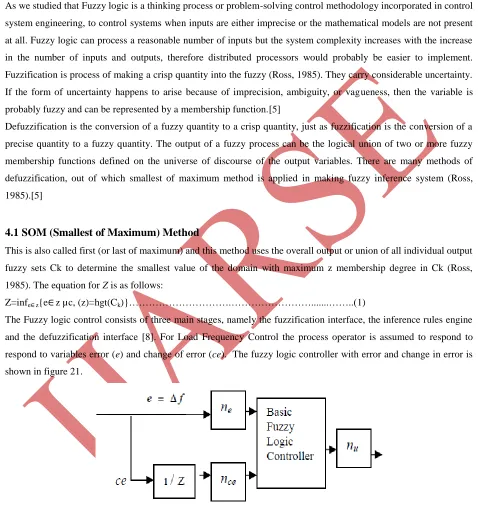
The Fuzzy logic control consists of three main stages, namely the fuzzification interface, the inference rules engine
and the defuzzification interface [8]. For Load Frequency Control the process operator is assumed to respond to
respond to variables error (e) and change of error (ce). The fuzzy logic controller with error and change in error is shown in figure 21.
Fig 2: Block diagram of 3 processes of a Fuzzy Logic controller
Fig 3: Simulink Representation of a fuzzy Logic Controller
Fig 4: Simulink Representation of a fuzzy Logic & I Controller
The variable error is equal to the real power system frequency deviation (ΔF). The frequency deviation Δ F is the difference between the nominal or scheduled power system frequency (FN) and the real power system frequency (F).
Taking the scaling gains into account, the global function of the FLC output signal can be written as.
ΔPC= F [nc e(k), nce ce(k)] ………...………..………..………..(2)
Where ne and nce are the error and the change of error scaling gains, respectively, and F is a fuzzy nonlinear
function. FLC is dependant to its inputs scaling gains . The block diagram of FLC is shown in Fig 5.3,. nuis output
control gain (Talaq et al. 1999) [6]. A label set corresponding to linguistic variables of the input control signals, e(k) and ce(k), with a sampling time of 0.01 sec is as follows:
For two area system A label set corresponding to linguistic variables of the input control signals, e(k) and ce(k), with a sampling time of 0.01 sec is as follows:
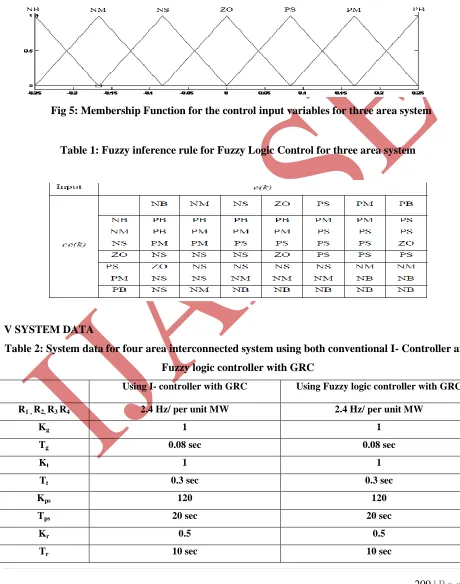
L(e, ce) = { NB, NM, NS, ZO, PS, PM, PB}, Where, NB = Negative Big,
NM = Negative Medium, PS = Positive Small,
NS = Negative Small, PM = Positive Medium,
Fuzzy logic controller has been used in three two area hydro-thermal interconnected areas with seven number of
triangular membership function (MFs) which provides better dynamic response with the range on input (error in
frequency deviation and change in frequency deviation) i.e universe of discourse is -0.25 to 0.25 and -0.01 to 0.01.
The numbers of rules are 49.
Fig 5: Membership Function for the control input variables for three area system
Table 1: Fuzzy inference rule for Fuzzy Logic Control for three area system
V SYSTEM DATA
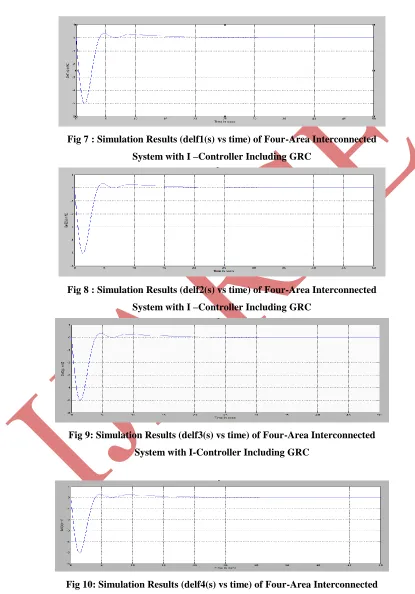
Table 2: System data for four area interconnected system using both conventional I- Controller and
Fuzzy logic controller with GRC
Using I- controller with GRC Using Fuzzy logic controller with GRC
R1 , R2, R3 R4 2.4 Hz/ per unit MW 2.4 Hz/ per unit MW
Kg 1 1
Tg 0.08 sec 0.08 sec
Kt 1 1
Tt 0.3 sec 0.3 sec
Kps 120 120
Tps 20 sec 20 sec
Kr 0.5 0.5
Ki 0.67 0.67
Ptie,max 200 MW 200 MW
H1 H2 H3 H4 5 sec 5 sec
Pr1 Pr2 Pr3 Pr4 2000MW 2000MW
D1 D2 D3 D4 8.33 * 10-3 p.u MW/Hz 8.33 * 10-3 p.u MW/Hz
aI a2 a3 a4 0.545(a=2*pi*T12=2*pi*T23=2*pi*T31=
0.545)
0.545(a=2*pi*T12=2*pi*T23=2*pi*T31=0
.545)
delPd1 delPd2
delPd3 delPd4
0.01 0.01
VI SIMULATION (USING I-CONTROLLER)
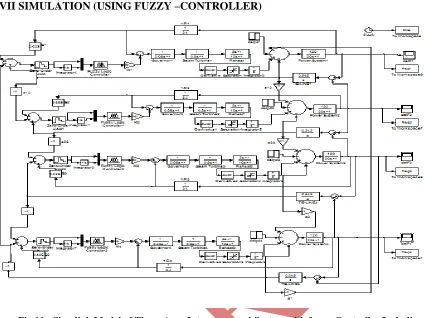
6.1 Simulation Results (Using I –Controller)
Fig 7 : Simulation Results (delf1(s) vs time) of Four-Area Interconnected
System with I –Controller Including GRC
Fig 8 : Simulation Results (delf2(s) vs time) of Four-Area Interconnected
System with I –Controller Including GRC
Fig 9: Simulation Results (delf3(s) vs time) of Four-Area Interconnected
System with I-Controller Including GRC
Fig 10: Simulation Results (delf4(s) vs time) of Four-Area Interconnected
VII SIMULATION (USING FUZZY –CONTROLLER)
Fig 11: Simulink Model of Three-Area Interconnected System with fuzzy-Controller Including GRC
7.1 Simulation Results (Using Fuzzy –Controller)
Fig 12: Simulation Results (delf1(s) vs time) of Four-Area Interconnected
System with Fuzzy -Controller
Fig 13: Simulation Results (delf2(s) vs time) of Four-Area Interconnected
Fig 14: Simulation Results (delf3(s) vs time) of Four-Area Interconnected
System with Fuzzy –Controller Including GRC
Fig 15: Simulation Results (delf4(s) vs time) of Four-Area Interconnected
System with Fuzzy –Controller Including GRC
The dynamic responses are found to be deteriorating. In the next part of the work, the conventional integral
controller is replaced by the fuzzy logic controller (FLC) and the dynamic responses are observed after simulation.
The FLC(Fuzzy Logic Controller) is designed with ACE and ∫ ACE as the inputs. It is observed from the responses
that with the FLC the oscillations in the positive side are totally eliminated in case of area control error and they are
almost eliminated in case of frequency. The settling time in all cases are also observed to be less than that used with
conventional I-controller with GRC. It is observed that the Fuzzy Logic Controller with GRC provides the
oscillations of smaller magnitude compared to the conventional ones. Hence Fuzzy Logic Controller is proved to be
effective in Automatic Generation Control of interconnected reheat thermal system.
VIII CONCLUSION
From the responses obtained, it is clear that use of Fuzzy Logic controller improves dynamic performance and
reduces the overshoots with respect to frequency deviation in each of the areas .Therefore, the intelligent control
approach using fuzzy logic concept is more accurate and faster. And also it gives better results even when GRC are
considered.
REFERENCES
[1] George-Gross, Lee J.W. 2001. Analysis of Load Frequency Control Performance Assessment Criteria, IEEE
transaction on Power System, Vol. 16, No. 16, pp. 520-525.
[2] Kothari D. P., Nagrath I.J., 2003. Modern Power System Analysis, Tata Mc Gro Hill, Third Edition
[4 Kundur P, 1994. Power System Stability and Control,Mc Graw hill New York
[5] Ross T.J. 1995. Fuzzy logic with engineering application. Mc Gro Hill, International Edition
[6] Talaq J., Fadel A.l., Basri, 1999. Adaptive Fuzzy gain scheduling for Load Frequency Control, IEEE Transaction
on Power System, Vol. 14. No.1, pp.145-150.
[7] Wadhawa C.L., 2007. “Electric Power System” New Age International Pub. Edition.