Demystifying Incentives in the Consensus Computer
Loi Luu
School of Computing National University of Singapore
[email protected]
Jason Teutsch
School of Computing National University of Singapore
[email protected]
Raghav Kulkarni
Centre for Quantum Technologies National University of Singapore
[email protected]
Prateek Saxena
School of Computing National University of Singapore
[email protected]
ABSTRACT
Cryptocurrencies like Bitcoin and the more recent Ethereum system allow users to specify scripts in transactions and con-tracts to support applications beyond simple cash transac-tions. In this work, we analyze the extent to which these systems can enforce the correct semantics of scripts. We show that when a script execution requires nontrivial com-putation effort, practical attacks exist which either waste miners’ computational resources or lead miners to accept incorrect script results. These attacks drive miners to an ill-fated choice, which we call theverifier’s dilemma, whereby rational miners are well-incentivized to accept unvalidated blockchains. We call the framework of computation through a scriptable cryptocurrency a consensus computer and de-velop a model that captures incentives for verifying com-putation in it. We propose a resolution to the verifier’s dilemma which incentivizes correct execution of certain ap-plications, including outsourced computation, where scripts require minimal time to verify. Finally we discuss two dis-tinct, practical implementations of our consensus computer in real cryptocurrency networks like Ethereum.
Categories and Subject Descriptors
C.2.0 [Computer-Communication Networks]: General— Security and protection; K.4.4 [Computers And Society]: Electronic Commerce—Cybercash, digital cash
Keywords
Bitcoin; Ethereum; cryptocurrency; incentive compatibility; verifiable computation; consensus computer
1.
INTRODUCTION
Cryptocurrencies such as Bitcoin [1] are attracting mas-sive investments in computing power, and the power con-sumed has been growing exponentially in recent years [2].
Permission to make digital or hard copies of all or part of this work for personal or classroom use is granted without fee provided that copies are not made or distributed for profit or commercial advantage and that copies bear this notice and the full cita-tion on the first page. Copyrights for components of this work owned by others than ACM must be honored. Abstracting with credit is permitted. To copy otherwise, or re-publish, to post on servers or to redistribute to lists, requires prior specific permission and/or a fee. Request permissions from [email protected].
CCS’15,October 12–16, 2015, Denver, Colorado, USA. c
2015 ACM. ISBN 978-1-4503-3832-5/15/10 ...$15.00. DOI: http://dx.doi.org/10.1145/2810103.2813659.
Bitcoin can be viewed as a large network of miners compet-ing in a lottery that awards newly minted currency, called Bitcoins, in exchange for contributing computational resources to solutions of cryptographic puzzles, or blocks. Bitcoin miners collectively agree upon who receives the minted Bitcoins and whichtransactionsto accept. This pro-cess of consensus, or agreement by majority, permanently records decisions in a public ledger called the blockchain. More than 50 cryptocurrencies use similar blockchain proto-cols. While the core blockchain mechanism has been used for establishing a public ledger of who-pays-whom transactions, it has features that go beyond this function. Specifically, the blockchain supports a light-weight scripting language, de-signed primarily to allow conditional transactions which can be repurposed for other applications. Emerging cryptocur-rencies can now enable computation for applications such as financial back-offices, prediction markets, distributed com-putation (e.g.,, Gridcoin for BOINC [3]), and perhaps even a decentralized Linux OS [4].
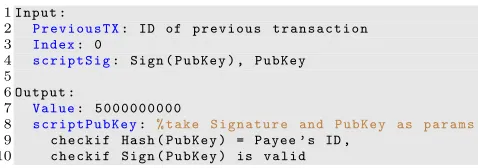
In Bitcoin, a transaction defines a particular activity in the network, e.g., sending Bitcoin between users. Trans-actions may include a script that specifies a validity con-dition. Figure 1 illustrates a basic transaction having a script check whether the payee in the transaction has the private key corresponding to the recipient’s Bitcoin wallet address. More interestingly, next-generation cryptocurren-cies such as Ethereum [5] introduce a Turing-complete script language which allows users to encode arbitrary computa-tion as scripts and support a variety decentralized applica-tions. The large number of miners on the cryptocurrency network, who both execute and verify computational tasks, reach agreement through an established consensus protocol. We therefore refer collectively to these miners as verifers, and the computation framework of scriptable cryptocurren-cies as a consensus computer. We wish to characterize the classes of computation that users can trust a cryptocurrency network to execute and verify correctly.
be extended to support high transaction rates [6,7]). Sec-ond, expressive transaction scripts in emerging cryptocur-rencies such as Ethereum can require significant compu-tational work to verify. These expressions create a new dilemma for miners — whether the miners should verify the validity of scripted transactions or accept them without verification. Miners are incentivized to verify all scripted transactions for the “common good” of the cryptocurrency so to speak. However, verifying scripts consumes compu-tation resources and therefore delays honest miners in the race to mine the next block. We argue that this dilemma leaves open the possibility of attacks which result in unver-ified transactions on the blockchain. This means that some computation tasks outsourced to cryptocurrency-based con-sensus computers may not execute correctly.
Our work makes three new contributions. First, we de-scribe the verifier’s dilemma in emerging cryptocurrencies which shows that honest miners have an ill-fated choice: whether to validate a block’s transactions or not. In either case, they are susceptible to a set of attacks from dishon-est miners. We show that malicious miners can attack their peers with zero financial risk via the scriptability feature of cryptocurrencies. Furthermore, our verifier’s dilemma im-plies that rational miners have incentive to skip the verifi-cation of expensive transactions to gain a competitive ad-vantage in the race for the next block. However, this results in an unvalidated blockchain containing unverified compu-tation results.
Second, we propose a security model to formalize the con-sensus computer. Our model allows us to study the incentive structure and attacks that affect the correctness of com-putations performed on a consensus computer. Verifiable computation methods on consensus computers differ from techniques that have been used on classical computers [8,9,
10, 11,12,13,14]. A consensus computer allows complete decentralization of verification — the puzzle giver need not trust any individual verifiers on the network or the prover who provides the solution. In our model, the network is as-sumed to implicitly agree on correct transactions if and only if the incentives donot advantage dishonest miners. Ver-ifiable computation techniques for classical setting have a different goal: that of producing an explicit cryptographic proof of the correctness of the computation. Often, such techniques require an involved key setup phase, and have impractical computational overheads for the prover.
Previous works implicitly assume that the Bitcoin con-sensus computer will always generate correct solutions,i.e., miners will verify and agree on correct transactions [15,16,
17, 18, 19, 20, 21]. Our present model provides a formal explanation as to why this assumption holds and suggests potential constraints of consensus computation in cryptocur-rencies with more expressive scripting languages. Specifi-cally, when the computational advantage of skipping verifi-cation is low, sayε, rational miners gain little by cheating thus behaving honestly to give correct solutions. We call a system restricted to such primitives anε-consensus com-puter and expect it to compute correctly.
We propose two mechanisms to realize an ε-consensus computer on Ethereum. Our first approach allows us to achieve correctness by splitting the computation into sev-eral smaller steps such that the consensus correctly verifies each step. This approach achieves exact correctness in re-sults but with higher computational burden to the network.
1I n p u t :
2 P r e v i o u s T X: ID of p r e v i o u s t r a n s a c t i o n
3 I n d e x: 0
4 s c r i p t S i g: S i g n ( P u b K e y ) , P u b K e y
5 6O u t p u t :
7 V a l u e: 5 0 0 0 0 0 0 0 0 0
8 s c r i p t P u b K e y: % t a k e S i g n a t u r e and P u b K e y as p a r a m s 9 c h e c k i f H a s h ( P u b K e y ) = Payee ’ s ID ,
10 c h e c k i f S i g n ( P u b K e y ) is v a l i d
Figure 1: Illustration of a simple transaction in Bitcoin. User’s address is computed by hashing their public key. scriptPubKeyis the script that defines how the payee claims the recieved Bitcoin.
Our second mechanism allows for approximate correctness. Specifically, we allow the approximation gap between sub-mitted and correct results to be tunable to a negligible quan-tity, at much lower computational cost. Whether one can design a distributed, cryptocurrency system which permits secure execution of a larger class of computations remains an interesting open problem, as is the problem of determin-ing the class of puzzles whose solutions admit light-weight verification.
Contributions.In summary, our work makes the follow-ing contributions:
• Verifier’s dilemma and attacks. We introduce a dilemma in which miners are vulnerable to attacks regardless of whether they verify a transaction or not. We further show that miners are incentivized to skip the verifica-tion and perform an attack to get more advantage in mining the next blocks.
• Security model for a Consensus computer. We for-malize the computation and verification by a consen-sus computer. We investigate the incentive structure, threat model and conditions under which a consensus computer can realize correct outsourced computation.
• Techniques to realize an ε-consensus computer. We propose techniques to realize ourε-consensus computer in real cryptocurrency networks like Ethereum. We illustrate the practical utility of our techniques with examples from outsourced computation.
2.
BACKGROUND: CRYPTOCURRENCIES
2.1
The consensus protocol
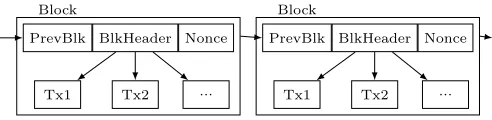
Most cryptocurrencies use a public peer-to-peer consen-sus protocol known as Nakamoto consensus, named after and introduced by the founder of Bitcoin [1], which does not require a central authority. At the heart of this protocol is a blockchain which acts as a public ledger and stores the complete transaction history of the network. The security of the blockchain is maintained by a cryptographic chain of puzzles (or blocks). Miners validate and approve transac-tions while generating, ormining, new blocks. Mining a new block rewards newly minted coins to one of the miners that demonstrates by consensus that it successfully solved a des-ignated cryptographic puzzle. Figure2concisely illustrates the structure of the blockchain data structure.
PrevBlk Block
BlkHeader Nonce
Tx1 Tx2 ...
PrevBlk Block
BlkHeader Nonce
Tx1 Tx2 ...
Figure 2: The Blockchain in popular cryptocurrencies like Bitcoin and Ethereum. Each block consists of several transactions (Txs).
the data in the blockchain must be consistent across miners, so that everyone knows who owns what. Thus the blockchain acts as a base to verify which transactions are valid.
2.2
Transactions & scriptability
A transaction in a cryptocurrency defines a particular ac-tivity in the network of that currency. For example, Fig-ure1is a basic transaction in Bitcoin which transfers Bit-coins from sender to receiver. ThescriptPubKeycomponent (Line 8) allows the sender to define the receiver’s address and on which condition he can spend the Bitcoins. The sender can dynamically program thescriptPubkeyto support var-ious use cases.
Transaction verification.In order to verify a transaction, one has to check whether the input provided inscriptSig
satisfies the logic encoded in thescritptPubkeyof the Priv-iousTX. For example, in Figure 1, miners will check if the receiver is the intended payee (on Line 9) and he indeed owns the payee’s address (on Line 10). The Bitcoin pro-tocol states that the verification of a transactionTXshould happen in two places, when:
• A new transaction is broadcast (step 1). When a user broadcastsTXto a miner, the miner verifies if the trans-action is correct according to the latest blockchain state. If so, he includes it in his block header to mine a new block and propagates the transaction to his neigh-bors.
• A new block is broadcast(step 2). WhenTXis included in a newly found block, before accepting the block ev-eryone will check the correctness of all transactions contained in the block.
2.3
Incentivizing correctness
While it is clear that Nakamoto consensus incentivizes a miner to mine new blocks with a reward of newly minted coins, the incentive for others to correctly verify the trans-actions is not generally understood. The folklore reasons for why miners verify transactions in the Bitcoin blockchain are:
• Verifying a transaction at both steps requires negligible additional work compared to mining a new block. For example, the Bitcoin transaction in Figure1has only 4 opcodes. Miners can do this extra check without expending any significant computational work. The cost of validation outweighs the miner’s risk of having their earned Bitcoins in new blocks be discarded, if the invalidity is detected in the future.
• When receiving a new block, miners can accept it with or without verifying the included transactions.
How-1c o d e :
2 if msg . d a t a s i z e = = 2 :
3 r e t u r n msg . d a t a [0] + msg . d a t a [1]
Figure 3: An Ethereum contract that returns sum of two numbers.
ever, mostminers want to maintain a cheap and cor-rect system (the “common good”), so that the Bitcoin blockchain remains healthy and Bitcoins act as a store-of-value. Thus miners check the validity of a block’s included transactions for free1.
In this work, we study the financial incentives of users more carefully to understand when these folklore assump-tions may fail and what happens when they do.
2.4
Ethereum—Turing-complete scripting
Ethereum is a next generation cryptocurrency which en-ables more applications beyond those supported by Bitcoin [5]. It provides a Turing-complete programming language in its design which equips users with a mechanism to express con-crete conditional semantics for transactions. Ethereum and Bitcoin share nearly identical incentive structures. The only conceptual difference is that Ethereum includes a small re-ward for late, valid “uncle block” [5]. However, as in Bit-coin, Ethereum miners maximize their rewards by racing to extend the longest valid block. Ethereum also introduces smart contracts which permit many potential applications to run on top of the blockchain.Smart contract. A smart contract is an entity on the Ethereum blockchain which can embed many contractual clauses and make it expensive for anyone to disoblige or deviate from the contract after agreement [22]. Each smart contract has its own address, balance, and storage space which is used to run a specified script. While Bitcoin only allows users to encode a stateless program, smart contracts support stateful programs. Users can trigger a contract by sending a transaction to its address. Once a smart contract transaction gets included in the blockchain, everyone in the network is expected to execute the contract script to verify its validity. Figure3is a simple contract which returns the sum of two numbers.
Gas system. It may be obvious to some readers that
having Turing-complete language in Ethereum script is a problem. More specifically, users can write a transaction or contract script with long verification time to perform Denial-of-Service (DoS) attack on the network. For example, one can write a simple transaction to make the network enter an infinite loop while verifying the transaction. To prevent such attacks, Ethereum introduces the concept ofgas [23]. The script is compiled into Ethereum opcodes while stored in the blockchain, and each opcode costs some predefined amount ofgas(a form of transaction fee) charged to trans-action sender. When a sender sends a transtrans-action to activate a contract, he has to specify the availablegasLimitthat he supports for the execution. The gas is paid to a miner who verifies and includes the transactions in his block. Intu-itively, the gas system seems to make it expensive for the attacker to perform DoS attack to the system. However, as
1Note that only the one who finds the block receives a
1i n i t :
2 # R e c o r d the i n i t i a t o r , r e w a r d and d a t a 3 c o n t r a c t . s t o r a g e [ 0 ] = msg . s e n d e r
4 c o n t r a c t . s t o r a g e [ 1 ] = 0
5 c o n t r a c t . s t o r a g e [ 2 ] = msg . v a l u e
6 # r e c o r d the s i z e n of the m a t r i c e s 7 c o n t r a c t . s t o r a g e [ 3 ] = msg . d a t a [0]
8 # r e c o r d the m a t r i c e s A and B 9 c o n t r a c t . s t o r a g e [4] = msg . d a t a [1]
10 c o n t r a c t . s t o r a g e [5] = msg . d a t a [2]
11 c o n t r a c t . s t o r a g e [6] = 1 # s t a t u s 12c o d e :
13 if c o n t r a c t . s t o r a g e [6] == 0:
14 r e t u r n (1)
15 # d a t a [ C ]: C is the r e s u l t m a t r i x 16 if msg . d a t a s i z e == 1:
17 C = msg . d a t a [0]
18 n = c o n t r a c t . s t o r a g e [3]
19 A = c o n t r a c t . s t o r a g e [4]
20 B = c o n t r a c t . s t o r a g e [5]
21 # c h e c k i n g the r e s u l t 22 for i in r a n g e( n ):
23 for j in r a n g e( n ):
24 c e l l = sum([ A [ i ][ k ] * B [ k ][ j ]
25 for k in r a n g e( n )])
26 if c e l l != C [ i ][ j ]:
27 r e t u r n (0)
28 # if e v e r y t h i n g is fine , s e n d the r e w a r d 29 s e n d (1000 , msg . sender , c o n t r a c t . s t o r a g e [ 2 ] )
30 c o n t r a c t . s t o r a g e [ 6 ] = 0 # u p d a t e s t a t u s 31 c o n t r a c t . s t o r a g e [ 7 ] = C # s t o r e r e s u l t 32 r e t u r n (2)
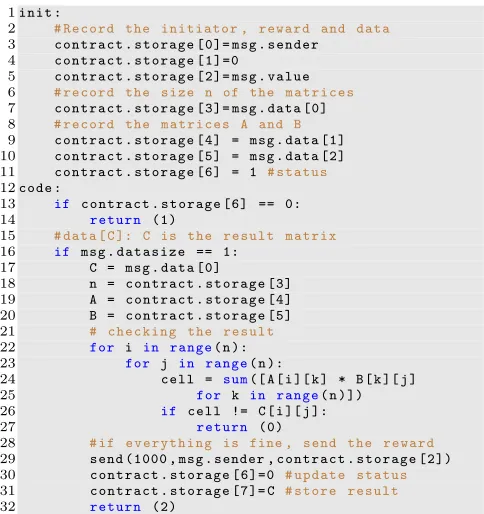
Figure 4: Code snippet of a contract which allows an user can outsource a matrix multiplication problem. The contract will verify the correctness of the result before sending out the reward.
we later show, this mechanism does not actually solve the DoS attack problem.
3.
THE VERIFIER’S DILEMMA
In Section 2.3, we discussed incentives for Bitcoin min-ers to verify transactions in a block. We show that these motivations fail when block verification requires significant computation effort. Various mechanisms can lead to longer verification times. Ethereum users can create transaction and contract scripts which place arbitrary computational demands on miners, and similarly Bitcoin miners face high computational demands when the number of transactions in a single block is large.
In this section we present a verifier’s dilemma in which the honest miners in the network decide whether to skip the verification of expensive transactions or to maintain the common good. To describe the verifier’s dilemma, we first introduce a motivating smart contract in Ethereum which we will use throughout the paper.
3.1
Example of outsourced computation
Figure4shows a code snippet of a contract in Ethereum which allows a problem giver (G) to ask anyone to compute A×BwhereA, Bare two matrices of sizen×n. In theinitphase,G first sends an transaction which specifiesn, A, B, and deposits the reward amount to the contract’s wallet ad-dress. All information is public including the reward amount since everything is stored on the blockchain. If a prover (P), i.e., a user is interested in solving the problem, wants to claim the solution to get the reward, he sends a transaction with the result matrixC to the verifier.
When other miners receive the transaction from the prover, they will verify ifC=A×Bby running thecodephase in the contract script. Gexpects that the Nakamoto consensus protocol used in Ethereum will ensure that the result is cor-rect due to the check on Lines 22–27, and only one prover will get paid due to the update of the contract’s status on Line 30. Note that for the purpose of demonstration, we use an example in which verifyingC requires to run the actual computation again. In practice, there are several problems that verifying whether a solution is correct is much easier than finding one, e.g., solving a SAT instance, finding a hash inversion, breaking cryptography key and so on. Thus,
Gcan create a contract to allow anyone to submit their so-lution and rely on the network to verify the correctness as in Figure4.
3.2
Attacks
When a transaction that asks miners to verify whether C =A×B appears in the network, miners have an option to either verify or not to verify. We show that the miners are susceptible to aresource exhaustion attackor aincorrect transaction attackdepending on their choice.
Attack 1 (Resource exhaustion attack by problem
givers). If miners honestly follow the protocol, they volun-tarily verify all transactions in a new block which is broad-cast to them (step 2 in Section 2.2). Thus, if an attacker broadcasts his expensive transactions to the network, other miners will have to spend a lot of power and time to verify all the transactions. To prevent such situations, Ethereum introduced a gassystem to charge the transaction initiator (sender) some amount of money for each operation he wants verified.
However, the gas system does not prevent the attacker from creating and including resource-intensive transactions in his newly minted block. This is because transaction fee (i.e., gas) is collected by the block founder only (in step 1, Section2.2). Thus, the attacker does not lose anything by adding his transactions to his own block. The other min-ers, on the other hand, have to spend asignificantamount of time verifying those transactions (in step 2, Section2.2) and get nothing in return. As a consequence, the attack not only exhausts other miners’ resource, but also gives the at-tacker some time ahead of other miners in the race for the next block. Note that the attacker has complete freedom to prepare the transactions, so the difficulty of verifying the transaction script is in his control. Since gas charged in each transaction is credited to his account in step 1, his attack works at a zero fee (no loss).
be delayed, while the attacker enjoys considerable advantage and has higher chance in finding the next valid blocks in the blockchain.
Remark 1. In Ethereum, the number of operations one in-cludes in a new block is bounded by oplimit, which can be varied by a certain rate after every block by miners [5]. However, we argue thatoplimit does not completely pre-vent the above attack since attackers can increaseoplimit
to a large enough value after some blocks to include his resource-intensive transactions. We explain this in the Ap-pendixA. Further, some may argue that attacker’s blocks are likely to become stale,i.e., other blocks get broadcast to the network faster, due to the long verification time. How-ever, in [24], Milleret al.find that there are (approx. 100) influential nodes in the Bitcoin network which are more effi-cient in broadcasting blocks. An attacker can broadcast his block to those influential nodes to reduce the chance that his blocks getting staledsignificantly.
Attack 2(Incorrect transaction attack by provers).
Due to Attack 1, rational miners have strong incentive to skip expensive transactions to compete for the race of the next block. The mechanism that drives the Bitcoin net-work (Section2.3) to achieve a consensus does not hold in Ethereum. This is because verifying a transaction now may take much more time and affect the miners’ mining speed. As a result, when the puzzle giverG asks for the product A×B, the malicious prover P can include a transaction which has a wrong solutionC. Since verifyingC =A×B requires long time, rational miners are well-incentivized to accept it as correct without running the verification check. Thus, the result of a contract/transaction, although is de-rived from the consensus of the network, is incorrect and unreliable. The problem giver G wastes his money for an incorrect answer. Unlike in Attack1,Gis a honest miner in this case. However his computational power is not enough to match the rational miners who are incentivized to skip the check.
It is clear that skipping verification is problematic. First,
Pcan include anything as the result of the contract execu-tion,e.g., sending others’ money deposited in the contract’s wallet to his wallet. Second, the health of the currency is affected since it is impossible to correctly verify who-owns-what. However, if the miners na¨ıvely verify all the transac-tions, they are vulnerable to Attack1.
3.2.1
Findings
Attack1and Attack2are not only specific to the running example, but are common challenges to any application that relies on a consensus protocol. From theverifier’s dilemma, we establish the following findings and implications.
Claim 1 (Resource exhaustion attack). In cryptocurren-cies that allow miners to create expensive blocks, the honest miners are vulnerable to amplified resource exhaustion at-tacks. Malicious miners can perform the attack without fee and gain significant advantage in finding the next blocks.
The attack is applicable to most cryptocurrency once they become widely adopted, regardless of the applications run-ning on top of the cryptocurrency. One can imagine the same problem will ocur in Bitcoin if block sizes were to in-crease dramatically, say to 1 GB per block. An attacker has incentive to create such a huge block to waste other
miners’ resources so as to gain advantage in the race for the next block. Such attacks have been reported in Bitcoin recently [25,26]. It is shown in [26] that one can create a block-size transaction which requires miners to hash 19.1 GB of data and takes an average of CPU 3 minutes to verify. Bit-coin patched this vulnerability by allowing only pre-defined standard transactions, and thus limiting the potential ap-plications of Bitcoin. Ethereum, on the other hand, has no such restrictions and permits users to define arbitrarily contracts.
Claim 2 (Nakamoto consensus permits unverified blocks).
Assuming all miners are rational, Nakamoto consensus may elect blockchains with unverified transactions.
Rationale. Miners in Nakamoto consensus-based cryptocur-renices are vulnerable to a resource exhaustion attack (At-tack 1). The time and computational resource required to verify all transactions in a block expands significantly with number of transactions. By skiping verifications, a miner starts the race to find the next block earlier than honest min-ers. As a result, rational miners yield a longer blockchain by not verifying transactions in all blocks that they receive. By Nakamoto consensus, the longer chain will be considered the main chain2 and contain unverified transactions.
Incentive incompatibility in existing cryptocurren-cies. Since users can place arbitrary computation in a script, miners in Ethereum have high incentive to skip verifying a block. For example in Figure 4, one can set n arbitrar-ily large to create a contract that requires, say, 30% of the computational power used in mining a block to verify its execution. That demand slows down the mining process of miners and incentivizes rational miners to skip verification in order to maintain their search speed in finding new blocks. Even though the remaining honest miners still account for the majority of the computational power in the network, their effective power is reduced by 30%. Thus, with high probability the rational miners will find more blocks and get a longer blockchain by skipping the verification of these transactions.
As we mentioned earlier, Ethereum introduced constraints on the rate of gasLimitvariation. Unfortunately, however, we discuss in AppendixAwhy thegasLimitconstraints are not a fool-proof mitigation against our attacks.
In Bitcoin, although the amount of work required to verify all the transactions is smaller, miners have non-zero incen-tive to skip verification as well. Indeed, on July 4 2015, a se-rious incident on the Bitcoin network was reported, wherein large pools extended blocks containing invalid transactions [27]. These pools mined on blocks without first verifying the block’s transactions and caused a fork in the blockchain. As the verifier’s dilemma describes, rational miners lack im-mediate economic incentives to verify transactions in newly mined blocks. The computational effort exhausted in verify-ing transactions detracts from the race to mine subsequent blocks, and it is possible that these pools skipped verifica-tion in order to gain computaverifica-tional advantage in the mining race.
2In Bitcoin, the protocol picks the blockchain which has
4.
INCENTIVIZING CORRECTNESS
In this section, we study and address the design drawbacks of the consensus protocol to prevent the aforementioned At-tack 1and Attack 2. Our goal is to incentivize miners to verify all transactions in each new block broadcast to them. Miners who deviate from the protocol should gain negligi-ble advantage, and honest miners who verify all transactions should suffer negligible disadvantage from dishonest or ma-licious miners. Our consensus-based computation protocol below is not tied to any particular cryptocurrency, however we show how one might realize it in Ethereum in a way so as to achieve correct computations.4.1
Consensus-based computation model
We define the consensus computation model, which for-malizes the verification process of transactions/contracts in any consensus protocol, as follows.Definition 1. Aconsensus-based computation protocol em-ployed by aconsensus computerinvolves three parties.
• Problem giver (G): who needs a solution for his partic-ular problem and provides a functionf which verifies the correctness of a solution.
• Prover (P): who submits a solutions to claim the re-ward fromG.
• Verifiers (V): miners in the network execute f(s) to decide whether s is a correct solution. In additionV
always try to mine a new block, which requires Wblk work on average, in order to gain a reward.
In Bitcoin, the verification functionfis rather simple. For the transaction in Figure1, the problem that a sender (G) asks is to determine whether a receiver is the intended payee. The solutionsthat the receiver (P) needs to provide is his public key signed by his private key. The miners (V) will execute a functionf defined inscriptPubKeyto determine ifs is correct andPcan spend the received amount in that transaction. Miners all try to find new blocks to get reward as newly minted coins.
Let us denote byWf the amount of work required to ex-ecute a verification functionf. We define the advantage of rational miner as follows.
Definition 2. Theadvantage for a rational miner by skip-ping the verification of a transaction with verification func-tionf is:
Adv(f) =Wf−Wdf
whereWdf is the work required by deviating from the honest
protocol.
GenerallyWdf =O(1), which is the cost of picking a
ran-dom result in{0,1}or evenWdf = 0 if the miners just
an-swer a constant value. Based on Definition2, the advantage that a dishonest miner can get by skipping the verification process in one block is:
Adv(Blk) = N X
i+1
Adv(fi) = N X
i=1
Wfi−O(1)
whereN is the total number of transactions in a blockBlk, and fi is the verification function for thei-th transaction inBlk. Our threat model assumes anε-rational miner as defined in Definition3.
Definition 3. Anε-rational mineris one who honestly ver-ifies the transactions in a block iff
Adv(Blk)≤εWblk,
and deviates from it otherwise.
Aε-rational miner is incentivized to deviate from the hon-est protocol if the the work required to verify all transactions in a block is higher than a thresholdεWblk. Being dishonest helps him have a higher chance of finding the next blocks since others have to do a significant amount of work verify-ing transactions. On the other hand, if the work required is less, skipping the verification does not gain him much ad-vantage (e.g., lesser than other practical factors like network latency) to make his blockchain the longest one. Doing that may even risk his new block value if other miners detect that the previous block includes invalid transactions.
Incentivizing correct consensus computation. We
incentivize miners to correctly execute f by limiting the amount of work required to verify all transactions in a block. Our goal is to provide an upper bound in the advantage that miners get by deviating from the honest protocol. This means honest miners are also guaranteed not to run long and expensive scripts while verifying the transactions. More specifically, we propose a new model defined as follows.
Definition 4. An ε-consensus-based computationprotocol is a protocol in which the total amount of work that all verification functions require miners to do isat mostεWblk per block.
Aε-consensus computer is a consensus computer that fol-lows anε-consensus-based computation. From Definition3, our ε-consensus computer is incentive-compatible w.r.t. ε -rational. More specifically, it incentivizes miners to behave correctly,i.e., honestly verify all transactions in a block.
4.2
Building an
ε-consensus computer in
Ethereum
One can estimate the value ofεto be the largest amount of “common good” work that the majority of miners find acceptable. This value, however, depends on several fac-tors including the real net-worth of applications on the cur-rency, the network properties, the incentive mechanism in the cryptocurrency, and individual miner’s beliefs about the currency’s value. Estimatingεis a separate and interesting research problem. Our next goal is to design a cryptocur-rency network which supportsε-consensus computing for a specific pre-chosen valueε.
We next describe how to support ε-consensus computer based on Ethereum without requiring any major changes in its design. We further discuss which classes of computa-tions can be run correctly on the existing cryptocurrency. While in general it is non-trivial to estimate the compu-tation required by programs written in a Turing-complete language [28], the gas charged for a transaction is a reliable indicator of the amount of work required in that transac-tion script. To make our approach clearer, we define a gas functionG(x) as in Definition5.
Definition 5. Thegas functionG(x) determines the maxi-mumgasamount that a program can require to doxamount of work.
easy. Moreover,G(x) can be computed once and used for all transactions. It only requires to updateG(x) again if the gas value is changed, or more opcodes are enabled.
We need only introduce a critical constraint on the trans-action to make Ethereum anε-consensus computer. That is, miners should only accept to verify the transaction that has
gasLimitbounded byG(εWblk/N0), whereN0 is the
max-imum number of transactions can be included in a block. Generally N0 is fixed and represents the upper bound on
the computational capacity of the network in one block time. We formally state our solution in Lemma1.
Lemma 1(Achievingε-consensus computer in Ethereum).
Given a specificε value, one can construct an ε-consensus computer from Ethereum by limiting thegasLimit in every transaction by
G
εWblk
N0
.
Proof. Let us denoteWtxas:
Wtx=
εWblk
N0
.
Since the gasLimit is at most G(Wtx), Wtx is the upper bound on the amount of work required to verify a transac-tion. Thus, the work required in verifying all transactions in a block is no greater thanεWblk. By Definition3, this an incentive-compatible strategy forε-rational miners.
There are certainly classes of computations that require more thanWtx and evenεWblk work to execute. While one can code such scripts in Ethereum, these puzzles fall outside the class of computations that our ε-consensus computer model can guarantee to execute and verify correctly.
4.3
Supporting more applications on an
ε
-consensus computer
We discuss two techniques for supporting puzzles which require greater than Wtx verification in Ethereum. One technique achieves correctness but sacrifices performance la-tency since it distributes the computation across multiple transactions and blocks that fit in the ε-consensus com-puter model. This technique effectively amortizes the veri-fication cost across multiple transactions and blocks in the blockchain. The second technique, on the other hand, sac-rifices only exactness and achieves probabilistic correctness.
4.3.1
Exact consensus computation
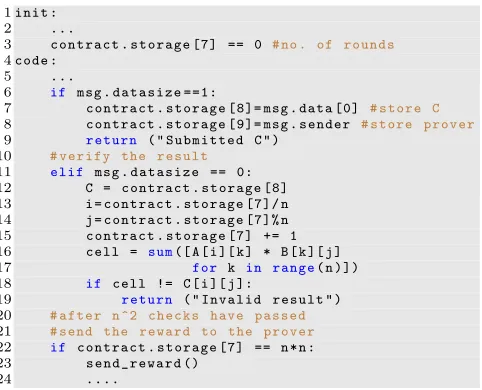
We introduce our first technique in the context of exact solutions. Here we simply split the execution of the script into smaller steps such that verifying each step requires at mostWtxwork. Once all the steps have been run and verified as separate scripts, the outcome is the same as the result one would obtain from correctly executing the original script. Although the total verification work that the ε-consensus computer has to do is the same regardless of whether we use a single or multiple scripts, splitting the task guarantees a correct outcome because theε-consensus computer correctly verifies smaller. We illustrate an alternative implementation for outsourcing matrix multiplication inn2 steps whereWtx is O(n) in Figure 5(instead of 1 transaction where Wtx is
O(n3) as in Figure4).
The execution of the contract in Figure5works as follows.
Pfirst submitsCto the contract as the solution forA×B.
1i n i t :
2 ...
3 c o n t r a c t . s t o r a g e [7] == 0 # no . of r o u n d s 4c o d e :
5 ...
6 if msg . d a t a s i z e = = 1 :
7 c o n t r a c t . s t o r a g e [ 8 ] = msg . d a t a [0] # s t o r e C 8 c o n t r a c t . s t o r a g e [ 9 ] = msg . s e n d e r # s t o r e p r o v e r 9 r e t u r n ( " S u b m i t t e d C " )
10 # v e r i f y the r e s u l t 11 e l i f msg . d a t a s i z e == 0:
12 C = c o n t r a c t . s t o r a g e [8]
13 i = c o n t r a c t . s t o r a g e [ 7 ] / n
14 j = c o n t r a c t . s t o r a g e [ 7 ] % n
15 c o n t r a c t . s t o r a g e [7] += 1
16 c e l l = sum([ A [ i ][ k ] * B [ k ][ j ]
17 for k in r a n g e( n )])
18 if c e l l != C [ i ][ j ]:
19 r e t u r n ( " I n v a l i d r e s u l t " )
20 # a f t e r n ^2 c h e c k s h a v e p a s s e d 21 # s e n d the r e w a r d to the p r o v e r 22 if c o n t r a c t . s t o r a g e [7] == n * n :
23 s e n d _ r e w a r d ()
24 . . . .
Figure 5: Matrix multiplication withO(n) work per transaction on a consensus computer.
The verification happens across the next n2 steps when P
sendsn2transactions to the contract. Each transaction
ver-ifies a particular and different elementCi,j of the submitted result. A counter stores the number of passed checks (Lines 13–15).
Advantage across multiple transactions. A careful
reader may be concerned that a rational miners might recog-nize the global connection between then2 transactions and skip verifying all of them to gain an advantage. However, the advantage from skipping the verification of transactions in the i-th block only helps the miners find the (i+ 1)-th block faster. In other words, one cannot “save” the “unspent” advantage in skipping the verification in one block and use that in the future since the competition for finding a new block “restarts” after every block. Essentially, we amortize the advantage of the computation across multiple transac-tions and blocks such that at any given block, the advantage of rational miners is bounded byεWblk. Thus our approach does not break the incentive compatibility of theε-consensus computer model.
Depending on the nature of the application, multiple steps can either happen in parallel or must be executed sequen-tially. For example in matrix multiplication, P can send simultaneouslyn2transactions. The reason is verifyingCi,j does not rely on the correctness ofCi,j−1, and the order of
verifying the two elements does not matter. On the other hand, if, say,Ci,j= 2·Ci,j−1, the prover would have to wait
until Ci,j−1 gets verified before sending the next
transac-tion which verifiesCi,j. In section6, we illustrate these two scenarios with case studies.
4.3.2
Approximate consensus computation
Our second approach avoids the latency of sequential com-putation processes by employing probabilistic, light-weight verification. This approach will guarantee the correctness of the solution to a certain (adjustable) extent while only having to check a small portion of the solution.
Definition 6. Let us denote a problem Z : {0,1}n →
{0,1}m
, an inputx ∈ {0,1}n
{0,1}m ofZ(x). We sayZis (δ, λ)-approximate verifiableif there exists a verification functionf such thatf acceptsy0 only ify0differs fromZ(x) in at mostδbits with probability greater thanλ.
Our task is to encodef to ensure that if a solution y0 is deemed correct only wheny0 does not differ much from the correct solution, i.e., different in at most δ bits. Further-more, in order to runf in aε-consensus computer model,f should not require more thanWtxwork to finish. The high level insight to encode such afis that by randomly sampling and checking an entry of the output, there is some proba-bility that we can detect if the output is incorrect at that sample. If we find an incorrect sample, we can conclude that the submitted solution is wrong and reject the solution. The more samples we take, the better the probability of catching an error. Otherwise, the solution is close to a correct one with an overwhelming probability greater thanλ.
In Definition6, we avoid defining too precisely the notion of “bits” and distance between two solutions since they vary slightly on specific encoding of the verification functionf. One can translate “bits” as the positions in an array, or the pairs of elements, where the solution differs. In either case, the fraction of errorsδwould change accordingly to the defi-nition of “bit.” For example, in the case of sorting, each “bit” would correspond to a pair (i, j) wherei < j and a bit in a solutiony0 differs from that inZ(x) ify0[i]> y0[j].
We borrow the above sampling idea from the property testing literature which shows that in many practical in-stances one can determine whether a large object has a de-sired property by inspecting a small number of samples [29,
30]. For instance, property testing is a technique which al-lows a verifier to sample the output to decide whether an array is sorted. Property testing differs from verifiable com-putation, however, in that verifiable computation deals with general computations whereas property testing can only con-sider decision problems. Decision problems are not inter-esting for consensus verifiability because without doing any work a proverPcan simultaneously post two solutions, “0” and “1,” and one of these is guaranteed to be correct. Such an answer shifts the entire burden of computation onto the verifier unless the prover also provides some certificate which helps the verifier to check his answer more quickly. To use property testing in verifiable computation, we need to check the two following properties:
• Property 1. The provided solution differs in at most δ-bits from a solution that satisfies the property of the computation with high probability.
• Property 2. The provided solution is computed from the given inputxwith high probability.
Note that given a particular number of samples, the correct-nesses that we can guarantee forProperty 1andProperty 2 are different. For example, in the case of sorting an-element array,nrandom samples may be sufficient to check whether the provided solution has the same elements as the given array with a 1−λ= 99% guarantee (Property 2). However, it may take more thann samples to fully check if the pro-vided solution is sorted (Property 1). Thus, to achieve the overall 99% guarantee of correctness for bothProperty 1and Property 2, the number of samples one must take is the max-imum of the numbers of samples to attain 99% guarantee of correctness for either of the checks.
5.
IMPLEMENTATION
In this section we discuss the challenges while encoding a verification function f in ourε-consensus computer model. We further discuss techniques to address those challenges.
5.1
Challenges in implementation
The presence of contract and Turing-complete language in Ethereum enables a verifiable computing environment in which users can ask anyone to solve their problem and get the results verified by the network. We have established how to encode those verification computationsfin Section4.2to work with ourε-consensus computer model. In fact,Pcan do the computation to arrive at the solution on his physical computer. Gencodes the verification function f such that it takes P’s solution and auxiliary data for the verification process. For example, if G asks Pto sort an array, G can encodef to askPto provide the sorted array (result) with the map between the result and the input. Our previous contract in Figure5is a concrete example where the matrix multiplication is outsourced to the network. We summarize the properties such a contract in ourε-consensus computer model can achieve.
1. Correctness. Greceives correct results.
2. No prior trust. No pre-established trust between P
andGis required.
3. No interaction. No interaction between P and G is required in order to verify the result.
4. Efficiency. GandPhave to do only a modest amount of work.
5. Fairness. Pis rewarded for a valid solution.
Properties 1–4 are immediate when we encode the verifica-tion funcverifica-tionfin ourε-consensus computer model. Specifi-cally,correctnessis guaranteed since miners are incentivized to verify all computation. PandGdo not need to trust or know each other, yet G cannot deviate after knowing the result. However, there are several challenges while imple-menting those verification function using smart contracts. In fact, simple smart contracts like the one in Figure5 can-not guaranteefairnessproperty due to one of the challenges that we describe below.
• Insecure relay attack. Once Pfinds a solutionC, he broadcasts a transaction havingCto his neighbors and to the whole network. However, since the solution is in the plaintext, a rational neighbor node may copy C, delay or even discard the prover’s transaction and forge a new transaction to claim the reward.
• How to randomly sample in Ethereum? In order
to verify computations via sampling, we need a mech-anism for generating random numbers. We want to make sure that the random generator is unbiased in seed selection, and that the seed is unpredictable. If it is biased or predictable, the correctness property may be violated sincePcan submit a solution which is cor-rect only in the “bits” that will be sampled. Ethereum does not natively support a random generator opera-tor. We discuss our solution in Section5.2.
Commitment: TXb
from: Prover to: contractCT
data:TXa’s ID
Solution: TXa
from: Prover to: contractCT
data: matrixC
Contract: CT
1. Accept commitment
2. Accept solutionC
3. VerifyC
4. Send reward commit
release
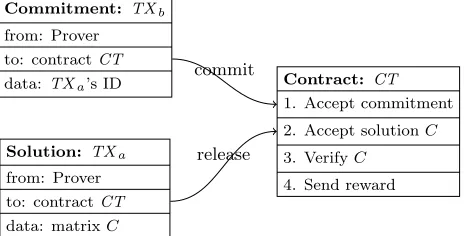
Figure 6: The commitment scheme used in our outsourced com-putation case studies.CTaccepts the commitment in transaction
TXbbefore recieving solution inTXa. That meansPshould see
TXbin the blockchain before he broadcastsTXatoCT.
is correct with his samples but the other miners see it incorrect since they have a different sets of sam-ples. Although M is honest, the other miners reject his block because with their sample setsM’s transac-tion including his solutransac-tion is invalid. It is unfair for M and problematic for the network as a whole since network consensus then becomes probabilistic.
One na¨ıve approach to defeat the insecure relay attack above is for the proverP to encrypt and sign his solution since a key management system already exists in Ethereum. Unfortunately this does not work since every miner needs to access P’s solution in order to verify the corresponding puzzle. In the next section, we devise a commitment scheme which helps us obtainfairnessand discuss how to implement all the necessary components in ourε-consensus computer protocol.
5.2
Construction
We now resolve the bullet points raised above in Sec-tion5.1.
Achieving fairness via a commitment scheme. A
commitment scheme provides two important features. First, it ensures that other users cannot see, thus stealP’s solution and claim the reward. Second,P once commits a solution cannot later alter it. This is to prevent some prover from submitting a fake answer to win the race with others (since only one prover is paid for correct solution), then spending more time computing the correct solution.
Our commitment scheme leverages the one-way hash func-tionSHA2, which is already used in current cryptocurrencies to compute proof-of-work and transaction ID’s. Specifically, we ask P to prepare a transaction TXa that he includes his solution, and a transactionTXbto commitTXato the contract. P first sends TXb, which includesTXa’s ID, to the contract to say that he has the solution and will send that in the next transactionTXa—commit phase. Once the contract acceptsP’s commitment, he sends TXa and pro-ceeds further as in without having the commitment—release phase. Our commitment scheme is shown in Figure6.
Since an ID is computed by crytographically hashing the transaction data, other miners by observing TXa’s ID in TXb are not able to constructTXato getC. Moreover,P cannot alterTXaby a different solution since doing that will raise a conflict between the committed ID and the new one. In addition, onceTXbgets accepted andPbroadcastsTXa,
the neighbors cannot claim the rewards with the solution observed inTXa. This is because the contract is waiting for transactionTXawhich has been committed before.
Random sampling in Ethereum. Recall that for
prob-abilistic verification, we need a psuedo random generator to randomly sample elements in a solution. Our key idea is to leverage some data in future blocks that miners do not know and cannot predict at the time of creating the trans-action/contract. For instance, the randomness source can be the hash of the next block. Given a pseudo-random vari-able R as the next block hash, one can generate n other pseudo-random numbers simply by taking a hash as:
SHA256(R||i)
in which 1≤i≤n, and||is a concatenation operator. Since the information of a block is public and consistent in the network, all miners when run the above pseudo-random generator will get the same set of samples, thus achieving consistency. Further, the information of block is unknown before it is mined by miners, coupling with the random-ness ofSHA256function makes our pseudo-random generator fair.
6.
CASE STUDIES
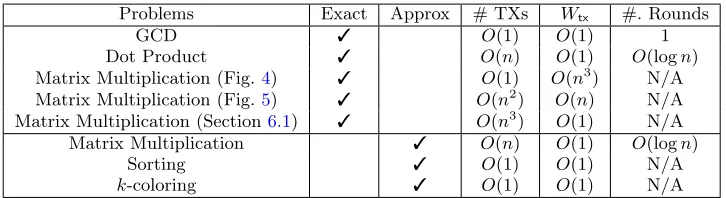
In this section, we exhibit several problems that can be solved by using our ε-consensus computer model. We are interested in the problems that require high computational resource to verify if are encoded na¨ıvely without using our techniques discussed in Section 4.2. The purpose of those examples is to illustrate the practicality of our techniques, and also describe how to encodeffor variousδ-approximate verifable problems. Our examples consists of several prob-lems in diverse domains such as Graph Theory, Linear Al-gebra, Number Theory and simple operations like matrix multiplication and sorting. In several of these cases we are able to easily verify whether a solution is correct. However, for several interesting problems verifying the correctness of a solution appears to be elusive. We try to circumvent this dif-ficulty by taking a recourse in an approximate verifiability. We illustrate how one can encode the verification function f to employ the light-weight verification and approximately verify the correctness of several problems. For the conve-nience of readers, we list our case studies in Table 1. In this section, we consider the basic operations as basic arith-metic operations,e.g., addition, multiplication and compar-ison over 32-bit integers, unless otherwise stated.
6.1
Exact computations
We show several applications that we can encode f to guarantee the correctness of a solution in an ε-consensus computer model. We also discuss the potential high latency due to the need of distributing the computation to multiple transactions.
6.1.1
GCD of Large Numbers
Problems Exact Approx # TXs Wtx #.Rounds
GCD 3 O(1) O(1) 1
Dot Product 3 O(n) O(1) O(logn)
Matrix Multiplication (Fig.4) 3 O(1) O(n3) N/A
Matrix Multiplication (Fig.5) 3 O(n2) O(n) N/A Matrix Multiplication (Section6.1) 3 O(n3) O(1) N/A Matrix Multiplication 3 O(n) O(1) O(logn)
Sorting 3 O(1) O(1) N/A
k-coloring 3 O(1) O(1) N/A
Table 1: Case studies for outsourced computation in ourε-consensus computer model. Wtxrepresents the amount of work required in each transaction.#. Roundsis the number of rounds required to have a solution verified if the transactions have to send in order (N/A means there is no such order).
with no additional latency. Specifically, the algorithm is as below.
1. Gposts two integersmandn.
2. Pposts five integersa,b,x,y, andz.
3. Vchecks that:
(a) ax=m,bx=n,
(b) |y|< b,|z|< a, and
(c) ay+bz= 1,
(d) If all of these checks succeed, thenV acceptsP’s solution. OtherwiseVrejectsP’s solution.
We claim that if both checks above succeed, then gcd(m, n) =x. If (a) is satisfied, then clearlyxdividesm and y di-vides n. To see that x is the smallest such number, we appeal to B´ezout’s Identity which tells us thata andbare relatively prime iff there existyandzsatisfying (b) and (c). If some integer greater thanxdivided bothmandn, then by uniqueness of factorization,xwould also divide that in-teger, forcing aand bto have a nontrivial common factor. Our verification uses 10 arithmetic operations over inputs of size log(n).
6.1.2
Dot product
We compute the exact dot product of two vectors
(a1, . . . , an)·(b1, . . . , bn) =a1b1+· · ·+anbn
by way of a sequence of transactions on the consensus com-puter. The puzzle giverG need not perform a single basic operation, while the miners perform no more than 3 basic operations per transaction. Each transaction will permit us to reduce the number of additions in the running sum by one. The puzzle giverGwill postdn/2etransactions to the first block,dn/4etransactions to the second block,dn/8eto the third, and so on for a total of at mostntransactions. For simplicity of presentation, we will assume thatGknows the quantityn, however this assumption is not necessary. One could modify the protocol below so that we iterate over all indicesifor whichaiandbiare both defined (with possibly one extra pairan+1=bn+1= 0 added in casenis odd), and
similarly for the partial sums in the subsequent stages.
1. For eachi≤ dn/2e,Gcreates a puzzle transactionT1,i requesting the suma2ib2i+a2i+1b2i+1.
2. For eachi,Pposts a numbers1,iequal to the requested sum, in some permanent, public place.
3. For each i, V accepts P’s solution iff s1,i =a2ib2i+
a2i+1b2i+1.
Subsequent stagesk, fork= 1 up to the leastk such that 2k≥nproceed similarly in a recursive way:
1. For each i≤ dddn/2e/2e. . . /2e (k 2’s in this expres-sion), G creates a puzzle transaction Tk,i requesting the sumsk−1,2i+sk−1,2i+1.
2. For eachi,Pposts a numbersk,iequal to the requested sum, in some permanent, public place.
3. VacceptsP’s solution iff∀i sk,i=sk−1,2i+sk−1,2i+1.
By induction onk, if for eachiP’s solution is correct, then P
isk,iis equal to the desired dot product. In the final stage, we obtain a single value which equals the dot product, and so our multi-stage protocol succeeds. It is easy to verify that the work required in each transaction isO(1)3.
6.2
Verification with random sampling
As discussed earlier, some applications have solutions which are not easy or cheap to be verified. We show how to encode the verification function f for such applications to achieve probabilistic correctness with much smaller latency.
6.2.1
Approximate Sorting
We apply the direct sampling method so that with high probability the consensus will accept a correct solution but reject a solution with many errors. Let A denote the in-put array of |A| =n elements. Let B denote the claimed output array ofnelements andf denote a permutation on {1, . . . , n}, representing theclaimedsorting order.
Definition 7 (δ-approximate sorting). For δ ≥ 0, we say that an array B (together with a permutation f) is a δ -approximate solution to sorting arrayAif:
• at most δ fraction of elements of B are incorrectly mapped byf, i.e.,A[i]6=B[f(i)], and
• at mostδn2pairs ofB are out of order.
We fix a δ > 0 and let k denote the number of sample used by our protocol. The work required in the protocol
3
below will be directly proportional tok. The protocol be-low guarantees that if the output is correctly sorted then it is accepted with high probability and if the output is not δ-approximately sorted then it is rejected with high proba-bility. Thus we get the guarantee that if an output is ac-cepted then it must be δ-approximately sorted with high confidence. The confidence can be made arbitrarily close to 1 at the cost of increasing the sample size.
1. Gposts an arrayAofnelements.
2. Pposts an arrayBofnelements andf, a permutation on{1, . . . , n}.
3. Vchooseskrandom indicesp1, . . . , pk≤ |A|andk ran-dom pairs of indices (q1, r1), . . . ,(qk, rk) and checks:
(a) if: for alli≤k,A[pi] =B[f(pi)], and (b) if: for alli≤k, ifqi≤rithenB[qi]≤B[ri]. (c) If both the checks (a) and (b) succeed then V
acceptsP’s solution. OtherwiseVrejects.
The verification requires k equality checks and k sorting comparisons.
Soundness of the protocol: Let us first assume thatP’s solu-tion (B, f) is a correct solution to sortingA, i.e.,B has no errors in the bijectionfand no pairs are out of order. In this case, check (a) and (b) will not fail as there are no errors. Thus the protocol will accept every correct solution.
Proof of approximate correctness: On the other hand if the arrayB differs fromA in more thanδ|A|places, then with probability at leastδ,Vwill detect this error in (a). Simi-larly, if at leastδ|A|2
pairs of elements inBare out of order, then with probability at leastδ, the verifier V will detect this error in (b). The probability that (a) is satisfied for alliis less than (1−δ)k, and similarly the probability that (b) is satisfied for alliis less than (1−δ)k. Thus the proba-bility that both of the checks succeed is at most the product (1−δ)2k. The verifierVfails to detect an error only when both checks (a) and (b) succeed. If we chooseklarge enough such that (1−δ)2k< λthen we the protocol will reject any solution that is notδ-approximately sorted with probability greater than 1−λ.
6.2.2
Approximate Matrix Multiplication
We want to guarantee that if our verification functionf accepts C then at least 1−δ fraction of the entries of C match with A×B with high probability. The idea is to randomly pick a small number of entries ofCand verify that they are computed correctly. For this check one may use the protocol for the Dot Product described in Section6.1.2. By a calculation similar to the one for Approximate Sorting in Section 6.2.1, logλ/log(1−δ) samples suffice to ensure (δ, λ)-approximate verifiability.
6.2.3
Approximate 2-Coloring
A 2-coloring of a graph is an assignment of one of two specified colors to each of its nodes. An edge is colored prop-erly if the two endpoints of the edge are assigned different colors. Recall that a graph is 2-colorable, orbipartiteif there a 2-coloring of its nodes such that every edge is properly col-ored. A 2-coloring isδ-approximate if at mostδ fraction of the edges arenotcolored properly.
Using the sampling method, we design a protocol for the following decision problem: does a given graph A have a
δ-approximate 2-coloring? Our protocol is inspired by the property testing algorithm for 2-coloring and its correctness relies on Szemeredi’s Regularity Lemma [31,32].
1. Gposts a graphA. 2. Pposts either posts:
(a) “yes” and a 2-coloring ofA, or (b) “no” and an array of
k(δ) = 34 ln
4(1/δ) ln ln(1/δ)
δ nodes fromA.
3. Vchecks:
(a) IfPanswered “yes,” thenVchoosesk(δ)-random nodesv1, . . . , vk(δ) fromA.
i. VacceptsP’s solution if the subgraph induced onv1, . . . , vk(δ) is 2-colorable, and
ii. Vrejects otherwise. (b) If Panswered “no,” then
i. VacceptsP’s solution if
A. P’s solution is an odd cycle, and
B. all the edges of the odd cycle are present inA.
ii. Vrejects if either of the above conditions fails.
Soundness of the protocol: With probability greater than 1/2, a graph isnotδ-approximate 2-colorable if and only if a ran-dom subset ofk(δ) nodes contains an odd cycle [33]. Thus if the graph is not δ-approximate 2-colorable then we will detect this with probability at least 1−λby repeating the above protocoldlog2(1/λ)etimes. On the other hand, if the
graph is 2-colorable then no subset ofk(δ) nodes will contain an odd cycle. Hence our protocol will correctly accept the solution. Thus our protocol computes correctly with high probability both when the answer is “yes” or “no.”
Complexity of verification: Note that if the graph is not δ -approximate 2-colorable then indeed we have a constant size witness for this. Hence the “no” answer from the prover has a light-weight verification. It remains to show that the “yes” answer from the prover also has an easy verification. This can be achieved by a sampling method similar to the one used for sorting. If more thanδfraction of the edges are not properly colored byP’s 2-coloring, then we will catch a vio-lated edge with high probability usings=k(δ)· dlog2(1/λ)e
samples.
In the “yes” instance,Vdoessbasic operations to choose the random nodes and s2 comparisons to check that the subgraph inherits a 2-coloring. In the “no” instance,sbasic operations are used to check whetherPgave an odd cycle, andsbasic operations to check it’s presence inAfor a total of 2sbasic operations.
Finally, we remark without proof that our protocol can in fact be modified to verify approximatec-coloring as well for any constantcusing [33]; see also [32].
7.
RELATED WORK
Consensus protocol. Since the Nakamoto consensus
consensus algorithm used in the network as the verifier’s dilemmaarises in any cryptocurrency that has high block’s verification cost.
Incentive compatibility in cryptocurrency.Apart from
verifying blocks and transactions, mining new blocks is one major activity in cryptocurrencies. Block mining requires a huge computational resource, thus miners often join hands to mine together in apool. Several previous works also study the incentive compatibility of Bitcoin mining [38,39,40,41]. For example, in [38,40], the authors prove that pooled min-ing protocol is not incentive compatible by showmin-ing that miners and pools are susceptible to a block withholding at-tack. Our work also studies the incentive compatibility in cryptocurrency, but via the lens of the verification activity. We show that in a network which allows Turing complete scripts, miners are vulnerable to a new class of attacks.
Security analysis of Bitcoin protocol. A recent paper
by Garyet al.models and analyses security of the Bitcoin protocol [42]. Garyet al.prove that Bitcoin can achieve all ideal properties,e.g., common prefix, chain quality, only if f is negligible, where f is the number of proof-of-work so-lutions that miners can generate while a block is broadcast. We find that our finding follows closely to their result. In fact, the parameterf in [42] typically depends on the pa-rameterεin our paper. The present work showed that when εis sufficiently large, the verifier’s dilemma exists. Our so-lution is to keepε small, which is equivalent to keepingf close to 0.
Verifiable computation. Our proposed outsourced
com-putation scheme on anε-consensus computer is the first sys-tem to achieve all the ideal properties mentioned in Sec-tion5. A popular line of work uses classical computers for verification that involves prior trust establishment to guar-antee thatGdoes not deviate after knowing the solution [8,
9,10,11,12,13,14]. A key difference is in the assumptions and goals. Our goal is not to produce explicit proofs of cor-rectness, rather to enable an incentive structure where cheat-ing provides no intrinsic advantage over followcheat-ing the proto-col honest. Secondly, our techniques are specific to certain algorithms, whereas verifiable computation enables proving correctness of arbitrary circuits. Moreover, verifiable com-putation can be and have been applied in our setting, since recent schemes have constant verification effort [43]. How-ever, such schemes impose impractically high overheads on provers and require expensive inial key setup between all miners in the protocol.
Since the rise of Bitcoin, a new line of work on repurposing the blockchain for other applications has been initiated [19,
21,16,20]. For example, in [19,21], Kumaresanet al. stud-ied how to run several applications, including verifiable com-putation, on Bitcoin. Their technique is fairly complicated and relies on the assumption that all the computations done by consensus protocol will be correct. As we have shown, with expressive scripting languages (c.f. Ethereum), one can achieve what these previous works have done in Bitcoin with a single concise smart contract. However, as we pointed out in this paper, miners have incentive to deviate from the honest protocol in a new Turing-complete cryptocurrency. Thus, techniques used in [20, 21] may not guarantee the correctness of the computation on someε-consensus com-puter having small ε. Furthermore, our technique differs from theirs by leveraging a new cryptocurrency design and
adapting property testing techniques within the verifiable computation domain.
8.
CONCLUSION
In this paper, we introduce a verifier’s dilemma demon-strating that honest miners are vulnerable to attacks in cryp-tocurrencies where verifying transactions per block requires significant computational resources. We formalize the se-curity sese-curity model to study the incentive structure and attacks which affect the correctness of computations per-formed on a consensus computer. Finally, we discuss how to implement our ε-consensus computer in Ethereum with various trade-offs in latency and accuracy. We consider it an interesting open problem to determine whether one can incentivize robust computations to execute correctly on a consensus computer by modifying its underlying consensus mechanism.
9.
ACKNOWLEDGMENT
We thank Frank Stephan, Shruti Tople, Pratik Soni, Ratul Saha, Virgil Griffith and Vitalik Buterin for useful discus-sions and feedback on the early version of the paper. This work is supported by the Ministry of Education, Singapore under under Grant No. R-252-000-560-112. All opinions ex-pressed in this work are solely those of the authors.
10.
REFERENCES
[1] Satoshi Nakamoto. Bitcoin: A peer-to-peer electronic cash system.bitcoin.org, 2009.
[2] Karl J. O’Dwyer and David Malone. Bitcoin mining and its energy footprint. InIrish Signals Systems Conference 2014 and 2014 China-Ireland International Conference on Information and Communications Technologies (ISSC 2014/CIICT 2014). 25th IET, pages 280–285, June 2014.
[3] Rob Halford. Gridcoin: Crypto-currency using berkeley open infrastructure network computing grid as a proof of work.http://www.gridcoin.us/images/ gridcoin-white-paper.pdf, May 2014.
[4] Use case for factom: The world’s first blockchain operating system (bos).http://kencode.de/
projects/ePlug/Factom-Linux-Whitepaper.pdf, Feb 2015.
[5] Ethereum Foundation. Ethereum’s white paper. https:
//github.com/ethereum/wiki/wiki/White-Paper, 2014.
[6] blockchain.info. Bitcoin average number of
transactions per block.https://blockchain.info/ charts/n-transactions-per-block.
[7] Gavin Andresen. Why increasing the max block size is urgent.http://gavinandresen.ninja/
why-increasing-the-max-block-size-is-urgent, May 2015.
[8] Justin Thaler. Time-optimal interactive proofs for circuit evaluation. InAdvances in Cryptology -CRYPTO 2013 - 33rd Annual Cryptology Conference, Santa Barbara, CA, USA, August 18-22, 2013. Proceedings, Part II, pages 71–89, 2013.
interactive proofs. InProceedings of the 3rd Innovations in Theoretical Computer Science Conference, ITCS ’12, pages 90–112, 2012.
[10] Srinath T. V. Setty, Richard McPherson, Andrew J. Blumberg, and Michael Walfish. Making argument systems for outsourced computation practical (sometimes). In19th Annual Network and Distributed System Security Symposium, NDSS, pages 253–268, 2012.
[11] Eli Ben-Sasson, Alessandro Chiesa, Daniel Genkin, Eran Tromer, and Madars Virza. Snarks for c: Verifying program executions succinctly and in zero knowledge. Cryptology ePrint Archive, Report 2013/507, 2013.http://eprint.iacr.org/. [12] Benjamin Braun, Ariel J. Feldman, Zuocheng Ren,
Srinath Setty, Andrew J. Blumberg, and Michael Walfish. Verifying computations with state. In Proceedings of the Twenty-Fourth ACM Symposium on Operating Systems Principles, SOSP ’13, pages 341–357, 2013.
[13] Srinath Setty, Victor Vu, Nikhil Panpalia, Benjamin Braun, Andrew J. Blumberg, and Michael Walfish. Taking proof-based verified computation a few steps closer to practicality. InProceedings of the 21st USENIX Conference on Security Symposium, Security’12, 2012.
[14] Bryan Parno, Jon Howell, Craig Gentry, and Mariana Raykova. Pinocchio: Nearly practical verifiable computation. InProceedings of the 2013 IEEE Symposium on Security and Privacy, SP ’13, pages 238–252, 2013.
[15] Joseph Bonneau, Andrew Miller, Jeremy Clark, Arvind Naryanan, Joshua A. Kroll, and Edward W. Felten. SoK: Research Perspectives and Challenges for Bitcoin and Cryptocurrencies. InIEEE Security and Privacy 2015, May 2015.
[16] A Miller, A Juels, E Shi, B Parno, and J Katz. Permacoin: Repurposing bitcoin work for long-term data preservation.IEEE Security and Privacy, 2014. [17] Ian Miers, Christina Garman, Matthew Green, and
Aviel D Rubin. Zerocoin: Anonymous Distributed E-Cash from Bitcoin.IEEE Symposium on Security and Privacy, 2013.
[18] Eli Ben Sasson, Alessandro Chiesa, Christina Garman, Matthew Green, Ian Miers, Eran Tromer, and Madars Virza. Zerocash: Decentralized anonymous payments from bitcoin. InProceedings of the 2014 IEEE Symposium on Security and Privacy, SP ’14, 2014. [19] Ranjit Kumaresan and Iddo Bentov. How to use
bitcoin to incentivize correct computations. In Proceedings of the 2014 ACM SIGSAC Conference on Computer and Communications Security, 2014, pages 30–41, 2014.
[20] Marcin Andrychowicz, Stefan Dziembowski, Daniel Malinowski, and Lukasz Mazurek. Secure multiparty computations on bitcoin. InProceedings of the 2014 IEEE Symposium on Security and Privacy, SP ’14, pages 443–458. IEEE Computer Society, 2014. [21] Iddo Bentov and Ranjit Kumaresan. How to use
bitcoin to design fair protocols. InAdvances in Cryptology - CRYPTO 2014 - 34th Annual Cryptology
Conference, Santa Barbara, CA, USA, August 17-21, 2014, Proceedings, Part II, pages 421–439, 2014. [22] Nick Szabo. The idea of smart contracts.http:
//szabo.best.vwh.net/smart_contracts_idea.html, 1997.
[23] Gavin Wood. Ethereum: A secure decentralised generalised transaction ledger.
http://gavwood.com/paper.pdf, 2014.
[24] Andrew Miller, James Litton, Andrew Pachulski, Neil Spring Neal Gupta, Dave Levin, and Bobby Bhattacharjee. Discovering Bitcoin’s public topology and influential nodes.http:
//cs.umd.edu/projects/coinscope/coinscope.pdf, May 2015.
[25] US-CERT/NIST. Resource exhaustion attack in bitcoin.https://web.nvd.nist.gov/view/vuln/ detail?vulnId=CVE-2013-2292, 2013.
[26] Sergio Demian Lerner. New bitcoin vulnerability: A transaction that takes at least 3 minutes to be verified by a peer.https://bitcointalk.org/?topic=140078, 2013.
[27] Some miners generating invalid blocks.https: //bitcoin.org/en/alert/2015-07-04-spv-mining, July 2015.
[28] Byron Cook, Andreas Podelski, and Andrey
Rybalchenko. Proving program termination.Commun. ACM, 54(5):88–98, May 2011.
[29] Dana Ron. Property testing (a tutorial).http: //www.eng.tau.ac.il/~danar/Public-pdf/tut.pdf, 2000.
[30] Oded Goldreich. Combinatorial property testing (a survey).Electronic Colloquium on Computational Complexity (ECCC), 4(56), 1997.
[31] Endre Szemer´edi. Regular partitions of graphs. In Probl`emes combinatoires et th´eorie des graphes (Colloq. Internat. CNRS, Univ. Orsay, Orsay, 1976), volume 260 ofColloq. Internat. CNRS, pages 399–401. 1978.
[32] Noga Alon and Asaf Shapira. Every monotone graph property is testable.SIAM Journal on Computing, 38(2):505–522, 2008.
[33] Noga Alon and Michael Krivelevich. Testing k-colorability.SIAM Journal on Discrete Mathematics, 15(2):211–227, 2002.
[34] Miguel Castro and Barbara Liskov. Practical byzantine fault tolerance. InProceedings of the Third Symposium on Operating Systems Design and Implementation, OSDI ’99, pages 173–186, 1999. [35] David Mazieres. The stellar consensus protocol: A
federated model for internet-level consensus. https://www.stellar.org/papers/
stellar-consensus-protocol.pdf, April 2015. [36] Kwon Jae. Tendermint: Consensus without mining.
http://jaekwon.com/2014/05/11/tendermint/, May 2014.
[37] King Sunny and Nadal Scott. Ppcoin: Peer-to-peer crypto-currency with proof-of-stake.http:
//peercoin.net/assets/paper/peercoin-paper.pdf, August 2012.