
Tweak-Length Extension
for Tweakable Blockciphers
⋆Kazuhiko Minematsu1and Tetsu Iwata2
1
NEC Corporation, Japan,[email protected]
2
Nagoya University, Japan,[email protected]
Abstract. Tweakable blockcipher (TBC) is an extension of standard blockcipher introduced by Liskov, Rivest and Wagner in 2002. TBC is a versatile building block for efficient symmetric-key cryptographic func-tions, such as authenticated encryption.
In this paper we study the problem of extending tweak of a given TBC of fixed-length tweak, which is a variant of popular problem of convert-ing a blockcipher into a TBC, i.e., blockcipher mode of operation. The problem is particularly important for known dedicated TBCs since they have relatively short tweak. We propose a simple and efficient solution, called XTX, for this problem. XTX converts a TBC of fixed-length tweak into another TBC of arbitrarily long tweak, by extending the scheme of Liskov, Rivest and Wagner that converts a blockcipher into a TBC. Given a TBC ofn-bit block andm-bit tweak, XTX provides (n+m)/2-bit se-curity while conventional methods providen/2 orm/2-bit security. We also show that XTX is even useful when combined with some blockcipher modes for building TBC having security beyond the birthday bound.
Keywords: Tweakable blockcipher, Tweak extension, Mode of opera-tion, LRW
1
Introduction
Tweakable blockcipher. Tweakable blockcipher (TBC) is an extension of standard blockcipher introduced by Liskov, Rivest and Wagner in 2002 [17]. An encryption of TBC takes a parameter called tweak, in addition to key and plaintext. Tweak is public and can be arbitrarily chosen. Due to its versatility, TBC is getting more and more popularity. Known constructions of TBCs are generally classified into two categories: dedicated design and blockcipher mode of operation, i.e. using a blockcipher as a black box.
For the first category, Hasty pudding cipher [30] and Mercy [10] are examples of early designs. More recently Skein hash function uses a dedicated TBC called Threefish [2]. Jean, Nikoli´c and Peyrin [13] developed several dedicated TBCs as components of their proposals to CAESAR [1], a competition of authenticated encryption (AE).
⋆
For the second category, Liskov et al. [17] provided two blockcipher modes to build TBC, and their second mode is known as LRW3. Rogaway [28] re-fined LRW and proposed XE and XEX modes, and Minematsu [22] proposed a generalization of LRW and XEX. These schemes have provable security up to so-called “birthday bound”, i.e. they can be broken if adversary performs around 2n/2queries, wherenis the block length of TBC. The first scheme to break this barrier was shown by Minematsu [23], though it was limited to short tweak and rekeyed for every tweak. Landecker, Shrimpton and Terashima [16] showed that a chain of two LRWs has security beyond the birthday bound, which is the first scheme with this property which does not use rekeying. Lampe and Seurin [15] extended the work of [16] for longer chains. Tweakable variants of Even-Mansour cipher [11] are studied by Cogliati, Lampe and Seurin [8] and Mennink [21]. A concrete example is seen in a CAESAR proposal, called Minalpher [29].
Tweak extension. In this paper, we study tweak extension of a given TBC. More formally, letEe be a TBC ofn-bit block andm-bit tweak, and we want to arbitrarily extendm-bit tweak ofEekeepingn-bit block. Heremis considered to be fixed. At first sight the problem looks trivial since most of previous studies in the second category already cover the case of arbitrarily long tweak when combined with a universal hash (UH) function of variable-length input, and a TBC with any fixed tweak is also a blockcipher. Coron et al. (Theorem 6, [9]) pointed out another simple solution by applying a UH function H to tweak and then use the hash value H(T) as the tweak of Ee. However, the problem is security. For TBCEeofn-bit block andm-bit tweak, applying LRW or XEX to (fixed-tweak)Ee the security is up toO(2n/2) queries. Coron et al.’s solution is also secure up toO(2m/2) queries. We would get a better security bound by using the chained LRW [16, 15], but it would significantly increase the computation cost fromEe.
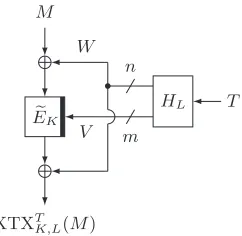
In this paper we provide an alternative solution, called XTX, which can be explained as an intuitive yet non-trivial combination of LRW and Coron et al.’s method mentioned above, applicable to any black-box TBC. Specifically, XTX converts a TBC Ee of n-bit block and m-bit tweak into another TBC of n-bit block andt-bit tweak for anyt > m, usingH which is a (variant of) UH function oft-bit input and (n+m)-bit output. See Fig. 1 for XTX. We proved the security bound ofq2ϵ whereϵdenotes the bias of UH function. This implies security up to O(2(n+m)/2) queries if ϵ is ideally small. As well as LRW, XTX needs one calls ofEe andH, hence the computation cost is only slightly increased, andH
is called only once for multiple encryptions sharing the same tweak, by caching the output ofH.
We observe that tweak length of existing dedicated TBCs are relatively short, at least not much longer than the block length. For instance, KIASU-BC [13] has 128-bit block and 64-bit tweak, and Threefish has 256 or 512 or 1024-bit block
3
with 128-bit tweak for all block sizes. One apparent reason for having fixed, short tweak is that it is enough for their primary applications, however, if tweak can be effectively extended it would expand their application areas. For another reason, we think the complexity of security analysis for dedicated TBC is expected to be dependent on the size of tweak space, since we have to make sure that for each tweak the instance should behave as an independently-keyed blockcipher. The TWEAKEY framework of Jean, et al. [13] provided a systematic way to build TBCs by incorporating tweak in the key schedule, and it shows that building efficient TBCs from scratch is far from trivial, in particular when we want to have long tweaks. Our XTX can efficiently extend tweak of dedicated TBCs with reasonably small security degradation in terms of the maximum number of allowable queries. In addition, XTX is even useful when applied to some modes of operations when the baseline TBC from a (non-tweakable) blockcipher has beyond-birthday-bound security. We summarize these results in Section 4.
Applications of tweak extension. We remark that a TBC with long tweak is useful. In general, a tweak of a TBC can be used to contain various additional information associated with plaintext block, hence it would be desirable to make tweak substantially longer than the block length (say 128 bits). For concrete examples, a large-block TBC of Shrimpton and Terashima [31] used a TBC with variable-length tweak, which was instantiated by a combination of techniques from [9, 16]. Hirose, Sasaki and Yasuda [12] presented an AE scheme using TBC with tweak something longer than the unit block.
2
Preliminaries
Notation. Let{0,1}∗be the set of all finite bit strings. For an integerℓ≥0, let {0,1}ℓbe the set of all bit strings of ℓbits. ForX ∈ {0,1}∗,|X|is its length in
bits, and forℓ≥1,|X|ℓ=⌈|X|/ℓ⌉is the length inℓ-bit blocks. Whenℓdenotes
the length of a binary string we also write ℓn to mean ⌈ℓ/n⌉. A sequence ofa
zeros is denoted by 0a. For set S ⊆ {0,1}n andx∈ {0,1}n, S ⊕xdenotes the
set {s⊕x: s ∈ S}. If random variable X is uniformly distributed over X we writeX ∈UX.
Cryptographic functions. For any keyed function we assume that its first argument denotes the key. For keyed functionF :K × X → Y, we writeFK(x)
to denote F(K, x) for the evaluation of inputx∈ X with keyK∈UK.
A blockcipher E : K × M → M is a keyed permutation over the message space M. We write encryption of M using K as C = EK(M) and its inverse
as M =E−K1(C). Similarly, a tweakable blockcipher (TBC) is a family of n-bit blockcipher indexed by tweak T ∈ T. It is written as Ee : K × T × M → M. If M={0,1}n andT ={0,1}t, we say Ee is an (n, t)-bit TBC. An encryption
of messageM with tweak T is written asEeT
then M = EeKT ,−1(C) holds for any (T, M). Let Perm(n) be the set of all n -bit permutations. For a finite set X, let PermX(n) be the set of all functions :X × {0,1}n → {0,1}n such that, for anyf ∈PermX(n) andx∈ X,f(x,∗) is a permutation. Ann-bit uniform random permutation (URP) is a keyed permuta-tion with uniform key distribupermuta-tion over Perm(n) (where a key directly represents a permutation). Note that implementation ofn-bit URP is impractical whennis a block size of conventional blockciphers (say, 64 or 128). We also define ann-bit tweakable URP (TURP) with tweak spaceT as a keyed tweakable permutation with uniform key distribution over PermT(n).
Let A be the adversary trying to distinguish two oracles, O1 and O2, by possibly adaptive queries (which we call chosen-plaintext attack, CPA for short). We denote the event that the final binary decision ofAafter querying oracleO is 1 byAO ⇒1. We write
AdvcpaO 1,O2(A)
def
= Pr[AO1⇒1]−Pr[AO2 ⇒1], (1)
where the probabilities are defined over the internal randomness ofOi andA. In
particular ifO1=EK andO2=GK′ for two keyed permutations,EK andGK′,
we assume A performs a chosen-ciphertext attack (CCA), i.e., has encryption and decryption queries and define
AdvccaE,G(A)def= Pr[A(EK,EK−1)⇒1]−Pr[A(GK′,GK−1′)⇒1], (2)
whereA(EK,EK−1)denotes thatAcan choose one ofEKorE−1
K for each query. In
the same manner we defineAdvcca e
EK,GeK′
(A) for two keyed tweakable permutations,
where tweaks in queries are arbitrarily chosen.
Forn-bit blockcipherEK and (n, t)-bit TBCEeK, we define SPRP (for strong
pseudorandom permutation) and TSPRP (for tweakable SPRP) advantages for Aas
AdvsprpE (A)def=AdvccaE,P(A), andAdv tsprp
e
E (A)
def
=AdvccaE,eeP(A), (3)
wherePisn-bit URP andePis (n, t)-bit TURP.
IfA is information-theoretic, it is only limited in the numbers and lengths of queries. IfA is computational, it also has a limitation on computation time in some fixed model, which is required to define computationally-secure ob-jects, e.g. pseudorandom function (PRF). In this paper most security proofs are information-theoretic, i.e. the target schemes are built upon URP or TURP. When their components are substituted with conventional blockcipher or TBC, a computational security bound is obtained using a standard technique [4].
2.1 Universal hash function and polynomial hash function
Definition 1. For functionH :K × X → Y being keyed by K∈UK, we say it isϵ-almost uniform (ϵ-AU) if
max
x̸=x′PrK[HK(x) =HK(x
′)]≤ϵ (4)
holds. Moreover if Y ={0,1}n for somen, we say it is ϵ-almost XOR uniform (ϵ-AXU) if
max
x̸=x′,∆∈{0,1}nPrK[HK(x)⊕HK(x
′) =∆]≤ϵ (5)
holds.
From the definition ifH isϵ-AXU then it is alsoϵ-AU.
Next we introduce polynomial hash function as a popular class of AU and AXU functions. LetPoly[a] :L × {0,1}∗→ {0,1}a for key spaceL= GF(2a) be the polynomial hash function defined over GF(2a). Formally, we have
Poly[a]L(X) =
∑
i=1,...,|X|a
L|X|a−i+1·X[i], (6)
where multiplications and additions are over GF(2a), and (X[1], . . . , X[|X|a])
denotes ana-bit partition of X ∈ {0,1}∗ with a mapping between{0,1}a and
GF(2a) and a padding for partial message. Here, padding must have the
prop-erty that the original message is uniquely recovered from the padded message. For example we can pad the non-empty sequence with v = 100. . .0 so that |X∥v|is a multiple ofa. Moreover, we writePoly[a, b] :L × {0,1}∗ → {0,1}a×
{0,1}b for L = GF(2a)×GF(2b) to denote the functionPoly[a, b]
(L1,L2)(X) = (Poly[a]L1(X),Poly[b]L2(X)), where L1 andL2 are independent. Further exten-sions, such asPoly[a, b, c], are similarly defined.
If we limit the input space of Poly to {0,1}ℓ for some predetermined ℓ, we
have the following.
Proposition 1. A polynomial hash function Poly[n] :L × {0,1}ℓ → {0,1}n is
ϵ-AXU with ϵ = ℓn/2n. Moreover, Poly[n1, n2, . . . , nc] : L × {0,1}ℓ → Y for
L = GF(2n1)× · · · ×GF(2nc) and Y ={0,1}n1 × · · · × {0,1}nc isϵ-AXU for
ϵ=∏i(ℓni/2
ni).
Polynomial hash function can work over inputs of different lengths if com-bined with appropriate encoding. However, for simplicity this paper mainly dis-cusses the case wherePolyhas a fixed input length, and in this respect we treat tweak length (in block or bit) appeared in the security bound as a constant, which is usually denoted byℓ. Recall that we useℓn to denote ⌈ℓ/n⌉.
3
Main construction
3.1 Previous schemes
Using blockcipher E : K × M → M with M ={0,1}n and a keyed function
H :L × T → M, LRW is described as
LRWTK,L(M) =HL(T)⊕EK(M⊕HL(T)), (7)
where T ∈ T is a tweak and K ∈U K and L ∈U L are independent keys. Let LRWP,L denote LRW using n-bit URP, P, as a blockcipher and H with
independent keyL∈UL. Its TSPRP-advantage is bounded as4
AdvtsprpLRW
P,L(A)≤ϵ·q
2, (8)
for any CCA-adversary A using q queries, if H is ϵ-AXU. Since ϵ≥1/2n this
implies provable security up to the birthday bound. The bound is tight in that there is an attack matching the bound. Rogaway’s XEX [28] and Minematsu’s scheme [22] reduce the two keys of LRW to one blockcipher key.
For tweak extension of given (n, m)-bit TBC,Ee, we have two previous solu-tions: the first one is to use LRW with blockcipher instantiated by Ee taking a fixed tweak. This has security bound of (8), hence n/2-bit security when H is (e.g.)Poly[n]. The second one, proposed by Coron et.al. [9] as mentioned earlier, is to useH :L × T → V and combineEe andH asC=EeV
K(M) forV =HL(T).
If H is ϵ-AU, this clearly has security bound of O(ϵq2) which implies m/2-bit security at best. Then, what will happen if we use both solutions all together? In the next section we show that in fact this combination gives a better result.
3.2 XTX
We describe our proposal. LetEe:K × V × M → Mbe a TBC of message space M = {0,1}n and tweak space V ={0,1}m. Let T be another (larger) tweak space. Let H : L × T → M × V be a function keyed by L ∈U L. We define XTX : (K × L)× T × M → Mbe a TBC of message spaceMand tweak space T and key space (K × L), usingEe andH, such that
XTXTK,L(M) =EeVK(M⊕W)⊕W, where (W, V) =HL(T). (9)
Fig. 1 shows the scheme. For security we need that H is a variant of ϵ-AXU function defined as follows.
Definition 2. Let H be a keyed function H :L × T → {0,1}n× {0,1}m. We sayH is (n, m, ϵ)-partial AXU ((n, m, ϵ)-pAXU) if it satisfies
max
x,x′∈T,x̸=x′ ∆∈{0,1}n
Pr
L[HL(x)⊕HL(x
′) = (∆,0m)]≤ϵ. (10)
Clearly anϵ-AXU function of (n+m)-bit output is also (n, m, ϵ)-pAXU. A change of a tweak in XTX affects to both block and tweak of inner TBC, whereas in LRW or XEX it affects only to input block, and in Coron et al.’s
4
W
V M
n
m
T EK
XTXT K,L(M)
HL
Fig. 1.XTX. A thick black line inEedenotes tweak input.
method it affects only to inner tweak. XTX’s structure is somewhat similar to a construction of (n, n)-bit TBC presented by Mennink [20], though [20] was based on ideal-cipher model, while XTX works on standard model and has no limitation on the outer tweak length. As well as LRW, XTX needs two keys. However it can be easily reduced to one by reserving one tweak bit for key generation. For instance, whenL ={0,1}n, we letL=Ee(0m)(0n) and use (n, m−1)-bit TBC
defined asEe(∗∥1)(∗).
3.3 Security
We prove the security of XTX when underlying TBC is perfect, i.e. a TURP.
Theorem 1. Let XTXeP,L beXTXusing(n, m)-bit tweakable URP,eP, and H : L × T → {0,1}n× {0,1}m for tweak space T with independent key L ∈U L. Then we have
AdvtsprpXTX
e
P,L(A)≤ϵ·q
2, (11)
for any CCA-adversaryA usingq queries ifH is(n, m, ϵ)-pAXU.
In particular, when T = {0,1}ℓ for some ℓ and H is Poly[n+m], we have
AdvtsprpXTX
e
P,L(A)≤ℓn+mq
2/2n+mfrom Theorem 1 and Proposition 1.
3.4 Proof of Theorem 1
Overview. Following the proof of LRW [22], our proof is based on the method developed by Maurer [18]5, though other methods such as game-playing proof [6]
5
or Coefficient-H technique [24] can be used as well. Basically, the proof is an extension of LRW proofs [17, 22], which shows that the advantage is bounded by the probability of “bad” event, defined as a non-trivial input collision in the underlying blockcipher of LRW. Intuitively, the security bound of XTX is obtained by extending this observation, and we can set “bad” event as non-trivial, simultaneous collisions of inputand tweak in the underlying TBC.
Proof. We start with basic explanations on Maurer’s method. They are mostly the same as those of [18], with minor notational changes. Consider the game that an adversary tries to distinguish two keyed functions, F and G, with queries. The game we consider is information-theoretic, that is, adversary has no com-putational limitation andF andGhave no computational assumption, say, they are URF or URP. There may be some conditions of valid adversaries, e.g. no repeating queries etc. Let αi denote an event defined at time i, i.e. when
ad-versary performs i-th query and receives a response from oracle. Letαi be the
negation of αi. We assume αi is monotone, i.e., αi never occurs if αi−1 oc-curs. For instance, αi is monotone if it indicates that allioutputs are distinct.
An infinite sequence of monotone events α = α0α1. . . is called a monotone event sequence (MES). Here, α0 denotes some tautological event. Note that
α∧β = (α0 ∧β0)(α1 ∧β1). . . is a MES if α = α0α1. . . and β = β0β1. . . are both MESs. Here we may abbreviate α∧β as αβ. For any sequence of random variables, X1, X2, . . ., let Xi denote (X1, . . . , Xi). We use dist(Xi) to
denote that X1, X2, . . . , Xi are distinct. We also write dist((X, Y)i) to denote
that (X1, Y1), . . . ,(Xi, Yi) are distinct. Let MESs α and β be defined for two
keyed functions, F : K × X → Y and G: K′× X → Y, respectively. For sim-plicity, we omit the description of keys in this explanation. Let Xi ∈ X and
Yi ∈ Y be the i-th input and output. LetPF be the probability space defined
by F. For example, PF
Yi|XiYi−1(y
i, xi) means Pr[Y
i =yi|Xi =xi, Yi−1 =yi−1]
where Yj = F(Xj) for j ≥ 1. If PYF
i|XiYi−1(y
i, xi) = PG
Yi|XiYi−1(y
i, xi) for all
possible (yi, xi), i.e. all assignments for which probabilities are defined, then we
writePF
Yi|XiYi−1 =P
G
Yi|XiYi−1. Inequalities such asP
F
Yi|XiYi−1 ≤P
G
Yi|XiYi−1 are
similarly defined. Using MESα=α0α1, . . . andβ =β0β1, . . . defined forF and
Gwe define the following notations, which will be used in our proof.
Definition 3. We write Fα≡Gβ if PYF
iαi|XiYi−1αi−1 =P
G
Yiβi|XiYi−1βi−1 holds for all i ≥ 1, which means PF
Yiαi|XiYi−1αi−1(y
i, xi) = PG
Yiβi|XiYi−1βi−1(y
i, xi)
holds for all possible (yi, xi)such that bothPF
αi−1|Xi−1Yi−1(y
i−1, xi−1)and
PG
βi−1|Xi−1Yi−1(y
i−1, xi−1)are positive.
Definition 4. We write F|α≡G|β ifPF
Yi|XiYi−1αi =P
G
Yi|XiYi−1βi holds for all
i≥1.
Definition 5. We define ν(F, αq)as the maximal probability ofαq for any
ad-versary usingqqueries toF, considered as valid in the definition of game, which we assume clear in the context.
Theorem 2. (Theorem 1 (i) of [18]) If Fα ≡Gβ or F|α≡G holds, we have AdvcpaF,G(A)≤ν(F, αq)for any adversary using qqueries.
We also use the following two lemmas of [18].
Lemma 1. (Lemma1 (iv) of [18]) Let MESsαandβ be defined for F andG. Moreover, let Xi and Yi denote the i-th input and output of F (or G),
respec-tively. Assume F|α≡G|β. IfPαF
i|XiYi−1αi−1 ≤P
G
βi|XiYi−1βi−1 fori≥1, which meansPF
αi|XiYi−1αi−1(x
i, yi−1)≤PG
βi|XiYi−1βi−1(x
i, yi−1)holds for all(xi, yi−1)
such thatPF
αi−1|Xi−1Yi−1(x
i−1, yi−1)andPG
βi−1|Xi−1Yi−1(x
i−1, yi−1)are positive.
Then there exists an MES γ defined forGsuch that Fα≡Gβγ.
Lemma 2. (Lemma6 (iii)of [18]) ν(F, αq∧βq)≤ν(F, αq) +ν(F, βq).
Analysis ofXTX. We abbreviate XTXeP,Lto XTX1. We define XTX2be TURP with tweak space T. What is needed is the indistinguishability of XTX1 and XTX2 for CCA adversary.
We write the adversary’s query asXi= (Xi, Ti, Bi)∈ {0,1}n× T × {0,1}.
Here Bi = 0 (Bi = 1) indicates thati-th query is an encryption (a decryption)
query. Let Yi ∈ {0,1}n be the corresponding response and we writeHL(Ti) =
(Wi, Vi) following (9). We also assume XTX2 has computation of HL(Ti) =
(Wi, Vi) as dummy, using independent and uniform sampling ofL. In XTX2,Wi
and Vi are not used in the computation of Yi. We write the set of scripts for
all i= 1, . . . , j-th queries as Zj = (X
1, . . . ,Xj, Y1, . . . , Yj). We may useMi to
denoteXiwhenBi= 0 orYi whenBi= 1, and useCito denoteYiwhenBi= 0
or Xi whenBi= 1. We say Zj is valid ifTi=Tj andMi̸=Mj (Ci̸=Cj) then
Ci ̸=Cj (Mi ̸=Mj) holds. We note that a transcript which is not valid is one
that cannot be obtained from a TBC.
We define Si = Mi⊕Wi and Ui = Ci⊕Wi for both XTX1 and XTX2.
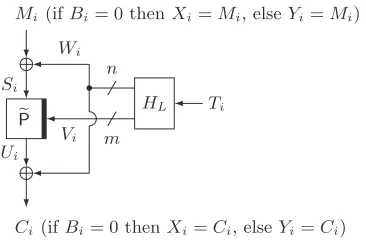
They correspond to the input and output ofPe in XTX1, and dummy variables in XTX2. MESs are defined as αq = dist((S, V)q) and βq = dist((U, V)q). We
observe that in XTX1, αq and βq are equivalent, however not equivalent in
XTX2. Let us define D(Vq)
def
= {1 ≤ i < q : Vi = Vq} and for n-bit variable
A ∈ {X, Y, W, S, U} define A[D(Vq)]
def
= {Ai : i ∈ D(Vq)}. Here A[D(Vq)]c =
{0,1}n\A[D(Vq)]. Fig. 2 shows XTX1 with the labels mentioned above.
We investigate the distributionPYG
q|Zq−1Xqαqβq for G∈ {XTX1,XTX2}. We
have
PYG
q|Zq−1Xqαqβq =
∑
L
PYG
q|Zq−1XqαqβqL·P
G
L|Zq−1Xqαqβq, (12)
Wi
Vi Si
Ui
P
Ti n
m HL
Mi(ifBi= 0 thenXi=Mi, elseYi=Mi)
Ci (ifBi= 0 thenXi=Ci, elseYi=Ci)
Fig. 2.XTX1 with labels used in the proof of Theorem 1.
L is uniform over all values consistent with the conditional clause (note thatL
defines Wq, Vq, Sq andUq−1, thusα
q andβq−1 are deterministic events given
L). Hence we have
PXTX1
L|Zq−1X
qαqβq =P
XTX2
L|Zq−1X
qαqβq. (13)
For PG
Yq|Zq−1XqαqβqL, if Bq = 0 and G = XTX1, Uq is uniform over U
def =
U[D(Vq)]c, thus Yq = Cq = Uq ⊕Wq is uniform overU ⊕Wq. If Bq = 0 and
G = XTX2 and there is no conditional clauseαqβq, Yq(= Cq) is uniform over
Cdef
=C[D(Tq)]c. HereUq is uniform over
{Ci⊕Wq :i∈D(Tq)}c={Ci⊕Wi:i∈D(Tq)}c={Ui:i∈D(Tq)}c. (14)
With conditionαqβq (here onlyβq is relevant sinceαq is deterministic given
L), Ui fori∈D(Vq) (butTi ̸=Tq) is further removed from possible values for
Uq, hence Uq is uniform over U = U[D(Vq)]c and Yq is uniform over U ⊕Wq.
ThereforeCq’s distributions are identical for both XTX1 and XTX2. The same
analysis holds for the caseBq = 1, and we have
PXTX1
Yq|Zq−1XqαqβqL=P
XTX2
Yq|Zq−1XqαqβqL. (15)
Thus Yq’s distributions are identical for both XTX1 and XTX2 if conditioned
byαqβq andL=l for anyl. Therefore from (13) and (15) we have
PXTX1
Yq|Zq−1Xqαqβq =P
XTX2
Yq|Zq−1Xqαqβq, that is, XTX1|αβ≡XTX2|αβ. (16)
Let us assumeBq= 0, and we focus on p(G) =PαGqβq|Zq−1Xqαq−1βq−1L. Note that the conditional clause uniquely determines whetherαq holds or not. If αq
does not hold,p(G) = 0 for bothG= XTX1or XTX2. Ifαq holds,p(XTX1) = 1 asβq ≡αq in XTX1, howeverp(XTX2)<1 sinceβq depends onUq which is not
determined by the conditional clause. This shows that
PXTX2
αqβq|Zq−1Xqαq−1βq−1L≤P XTX1
Moreover using similar argument as (12), we have
PXTX1
L|Zq−1Xqαq−1βq−1 =P XTX2
L|Zq−1Xqαq−1βq−1. (18) Thus, from (17) and (18), we have
PXTX2
αqβq|Zq−1Xqαq−1βq−1 ≤P XTX1
αqβq|Zq−1Xqαq−1βq−1. (19)
From (16) and (19) and Lemma 1, we observe that XTXαβγ1 ≡XTXαβ2 holds true for some MESγ. With this equivalence, Theorem 2 and Lemma 2, we have
AdvccaXTX1,XTX2(A)≤ν(XTX2, αq∧βq)≤ν(XTX2, αq) +ν(XTX2, βq) (20)
for any CCA adversaryAusingqqueries.
Let XTX2[pe] be XTX2 using a fixed tweakable permutation pe∈PermT(n). We observe that the last two terms of (20) are bounded as
ν(XTX2, αq)≤ max
e
p∈PermT(n)
ν(XTX2[pe], αq) (21)
ν(XTX2, βq)≤ max
e
p∈PermT(n)
ν(XTX2[pe], βq). (22)
Aspeis fixed, the adversary can evaluate it without oracle access, hence the right hand side terms of (21) are obtained by considering the maximum of possible and valid (Mq, Tq, Cq). For fixed (Mq, Tq, Cq), the probabilities ofα
q and βq
are determined byWq andVq. Thus, for any epwe have
ν(XTX2[pe], αq)
≤ max
(M q ,T q ,Cq) valid
Pr (W q ,V q) (Wi,Vi)=HL(Ti)
[∃i, j, s.t. (Wi⊕Wj =Mi⊕Mj)∧(Vi=Vj)]
≤
(
q
2
)
·ϵ, and (23)
ν(XTX2[pe], βq)
≤ max
(M q ,T q ,Cq) valid
Pr (W q ,V q) (Wi,Vi)=HL(Ti)
[∃i, j, s.t. (Wi⊕Wj =Ci⊕Cj)∧(Vi =Vj)]
≤
(
q
2
)
·ϵ, (24)
sinceH is (n, m, ϵ)-pAXU. From (20) and (23) and (24), we conclude the proof. ⊓ ⊔
Tightness of our bound. We note that the bound is tight in the sense that we have an attack with aboutq=O(2(n+m)/2) queries. The attack is simple, and let
M = 0n. The adversary makesqencryption queries (M, T
1), . . . ,(M, Tq), where
T1, . . . , Tqare distinct tweaks. With a high probability, we haveiandjsuch that
the adversary can make two more encryption queries (M′, Tj) and (M′, Tj) for
any M′ ̸= M, and see if the corresponding ciphertexts collide, in which case, with a high probability, the oracle is the tweakable blockcipher.
The attack works since in the ideal case, there exitiandjsuch thatCi=Cj
with a non-negligible probability, but we have the collision between ciphertexts of (M′, Ti) and (M′, Tj) with only a negligible probability.
4
Applications
Suppose we have an (n, m)-bit TBC Ee and want to extend tweak by applying XTX. We first remark ifEe is obtained by LRW this is almost pointless because
e
Eitself has only security up to the birthday bound. In this case a simple solution would be to extend the input domain of UH function used in LRW. However ifEe
is a dedicated TBC, or a mode of operation having security beyond the birthday bound, application of XTX toEe can have practical merits.
4.1 Dedicated TBC
Let us assumeEe is an (n, m)-bit dedicated TBC. As mentioned, using Ee with fixed tweak then applying LRW with some UH function only provides n/2-bit security, and Coron’s method only providesm/2-bit security, while XTX provides (n+m)/2-bit security. For example, KIASU-BC [13] is a (128,64)-bit TBC based on AES. By combining XTX usingH asPoly[192] orPoly[64,64,64] we obtain a TBC of longer tweak with 96-bit security with respect to the number of queries, while previous methods provide 64 or 32-bit security. Similarly, a (256,128)-bit TBC version of Threefish can be conveted into a TBC of longer tweak having 192-bit security, using XTX withH being Poly[384] orPoly[128,128,128].
We remark that the use of Poly[m, m, m] for m = n/3 instead of Poly[n+
m] can reduce the implementation size and gain efficiency. For example Aoki and Yasuda [3] proposed to use Poly[n/2, n/2] instead of Poly[n] used in GCM authenticated encryption. A drawback is that it will increase the advantage with respect to tweak length, from linear to cubic in our case (though we assumed it as a constant in Section 2.1). Therefore, the use of a polynomial hash function with a small field is not desirable if the impact of such increase is not negligible. In addition we have to be careful with the existence of weak keys in polynomial hash function pointed out by Procter and Cid [27].
4.2 Rekeying construction
Minematsu’s rekeying construction for TBC [23] is described as follows. Using a blockcipherE:K × M → MwithK=M={0,1}n, [23] builds a (n, m)-bit
TBC form < nsuch that
M
n
m
T HL EK
E 0n−m
XTXT
Min,L(M)
Fig. 3.XTX applied to Minematsu’s TBC.
The security bound of this construction is as follows. For anyAusingq queries with τ time, we have another adversaryB usingq queries with τ′ = τ+O(q)
time such thatAdvtsprpMin (A)≤(η+ 1)AdvsprpE (B) +2nη+12 , whereη = min{q,2
m}.
As analyzed by [23] this can provide a TBC with beyond-birthday security when
m < n/2. In particular [23] suggestedm=n/3 which provides security against 2n−m = 22n/3 queries. Despite the simple construction, one big shortcoming is its short tweak length, as mentioned by (e.g.) [20, 15, 16]. This is, however, recovered if (25) is combined with XTX. Let XTXMin,L be XTX with internal
TBC beingMinhavingn-bit block,m-bit tweak usingn-bit blockcipherE. Here we assume that tweak space of XTXMin,L is T = {0,1}ℓ, and underlying H :
L × T → {0,1}n+m is Poly[n+m]. Then for any adversary Ausing q queries
andτ time, from (25) and Proposition 1 and Theorem 1, we have
AdvtsprpXTX
Min,L(A)≤(η+ 1)Adv
sprp
E (B) +
η2 2n+1 +
ℓn+mq2
2n+m , (26)
for some adversaryBusingqqueries withτ+O(q) time, whereη = min{q,2m} as above. For choosing m, we can assume that AdvsprpE (B) is at least q/2n for
adversary B using q queries and τ time when q is about τ (since E has n -bit key and B can perform exhaustive key search, as observed by Bellare et al. [5]). Ignoring ℓn+m and substituting η with 2m in the bound, the first and
last terms are about q/2n−m and q2/2n+m. Then m = n/3 is a reasonable
choice which makes these terms (q/22n/3)i fori= 1 andi= 2. This shows that
we can extend tweak keeping the original security of rekeying construction. The resulting scheme is shown in Fig. 3, where a triangle in E denotes key input, andHL denotesPoly[n+m]. Still, we need rekeying for each tweak and this can
be another drawback for performance.
4.3 Chained LRW
independently-keyed chain of LRW, and is called6CLRW2. Assuming LRW shown as (7) using
H : L × T → M and E :K × M → M for M ={0,1}n and T ={0,1}ℓ as
underlying components, they proposed the construction described as
CLRW2TK
1,K2,L1,L2(M) = LRW
T
K2,L2(LRW
T
K1,L1(M)). (27)
The authors proved7 that its TSPRP-advantage is O(q3ϵ2) whenH is ϵ-AXU. More formally, TSPRP-advantage is at most 8q3ϵˆ2/(1−q3ˆϵ2) where ˆϵis defined as max{ϵ,1/(2n−2q)}. Thus, assuming ˆϵ=ϵand the denominator being larger
than 1/2, the bound is at most
16q3ϵ2. (28)
If H is Poly[n], we have ϵ=ℓn/2n, then the bound is 16q3ℓ2n/2
2n. In this case
CLRW2 needs 2ℓn GF(2n) multiplications for eachℓ-bit tweak.
A natural extension of CLRW2, i.e. a longer chain more than two, was proposed by Lampe and Seurin [15]. The construction for r chains is simply described as r-CLRWTK1,...,Kr,L1,...,Lr(M) in the same manner to (27), where
2-CLRW is equivalent to CLRW2. Ifrblockciphers are independent URPs, they proved thatr-CLRW for any evenrhas TSPRP-advantage of
crq
(r+2) 4 ϵ
r
4, wherecr= 4 √
2 √
r+ 2·2
r
4, (29)
when the underlyingH :L × T → Misϵ-AXU. IfT is{0,1}ℓandH isPoly[n], the bound is
crq
(r+2) 4 ℓ
r
4
n
2nr4
. (30)
Letr-CLRW(m) be ther-CLRW withn-bit blockcipherEK andm-bit tweak
(for some fixedm >0) processed by independently-keyedrinstances ofPoly[n]. We note thatr-CLRW(ℓ) needsrℓn multiplications over GF(2n).
r-CLRW combined with XTX. Letr >2 be an even integer. We apply XTX with H being Poly[n, n] using two keys in GF(2n) to r-CLRW(n), to build an (n, ℓ)-bit TBC. The resulting scheme usesr+ 2ℓn GF(2n) multiplications, hence
uses fewer multiplications thanr-CLRW(ℓ) ifℓn >1 andr≥4. See Fig. 4 for the
combined scheme. From Theorem 1, Proposition 1 and (30), TSPRP-advantage of the resulting scheme is
crq
(r+2) 4
2nr4 +ℓ
2
nq2
22n . (31)
6
The name CLRW2 means it is a chain of the second construction of [17], which we simply call LRW.
7
This provides the same level of security as (30), unless ℓn is huge.
In caser= 2 the above combination gives no efficiency improvement. Still, by combining CLRW2(m) for somem < n with XTX a slight improvement is possible. This is because CLRW2 needs twon-bit UH functions and the product of their biases is multiplied by q3, while the bias of (n+m)-bit UH function in XTX is multiplied by q2. For example, assuming n is divisible by 3, we set
m=n/3, and consider CLRW2(m) using twoPoly[n] (with padding of tweak), combined with XTX using Poly[n, m] to process ℓ-bit tweak. This requires ℓn
GF(2n) multiplications and 3ℓn GF(2m) multiplications. It is not
straightfor-ward to compare the complexity of one multiplication over GF(2n) and three multiplications over GF(2m), however, in most cases the latter is considered to be lighter than the former, though the gain will be depending on whether the underlying computing platform operates well overm-bit words. If this is the case our scheme will have a better complexity than the plain use of CLRW2.
As a more concrete example, let us consider CLRW2 using two instances of Poly[m, m, m] withm=n/3 (See the top of Fig. 5). Forℓ-bit tweak, this CLRW2 requires 2·3·3ℓn= 18ℓnmultiplications over GF(2m) and its TSPRP-advantage
is, based on (28), at most
16·q3
(
(3ℓn)3
(2n3)3
)2
=11664·q 3·ℓ6
n
22n . (32)
If we combine this instance of CLRW2(m) with XTX using Poly[m, m, m, m], then the advantage is at most
16·729q3 22n +q
2(3ℓn)4
(2n3)4
= 11664q 3
22n +
81ℓ4
nq2
243n
. (33)
See the bottom of Fig. 5 for the resulting scheme. As shown by (32) and (33), for a moderate tweak length both bounds indicate the security against about 22n/3 queries, while the combined scheme uses fewer GF(2m) multiplications, i.e. 6 + 4·3ℓn = 6 + 12ℓn. For comparison of these two bounds, Fig. 6 shows
the case ofn= 128 andℓn = 16. In Fig. 6 both bounds are close but CLRW2
combined with XTX is slightly better.
5
Conclusion
Poly[n, n]L
C M
EK1 HL1
EKr HLr
T
Fig. 4.r-CLRW with XTX, usingPoly[n, n] as outer universal hash function.
applied to some blockcipher modes for tweakable blockcipher which have beyond-birthday-bound security. A natural open problem here is to find tweak extension schemes that have better security bounds than that of XTX.
Acknowledgments. The authors would like to thank the anonymous reviewers for highly constructive and insightful comments. The work by Tetsu Iwata was supported in part by JSPS KAKENHI, Grant-in-Aid for Scientific Research (B), Grant Number 26280045.
References
1. : CAESAR: Competition for Authenticated Encryption: Security, Applicability, and Robustnesshttp://competitions.cr.yp.to/caesar.html/.
2. : Skein Hash Function. SHA-3 Submission (2008)http://www.skein-hash.info/. 3. Aoki, K., Yasuda, K.: The Security and Performance of ”GCM” when Short Mul-tiplications Are Used Instead. In Kutylowski, M., Yung, M., eds.: Information Security and Cryptology - 8th International Conference, Inscrypt 2012, Beijing, China, November 28-30, 2012, Revised Selected Papers. Volume 7763 of Lecture Notes in Computer Science., Springer (2012) 225–245
C M
EK1
T
EK2
Poly[m, m, m]L1
Poly[m, m, m]L2
m=n/3
n
m
C M
EK1
EK2
Poly[m, m, m]L1
Poly[m, m, m]L2
m=n/3
T
Poly[m, m, m, m]L n
Fig. 5. (Top) CLRW2 using Poly[m, m, m]. (Bottom) CLRW2 combined with XTX, where CLRW2 takesm-bit tweak usingPoly[m, m, m], and XTX usesPoly[m, m, m, m] as outer universal hash function.
5. Bellare, M., Krovetz, T., Rogaway, P.: Luby-rackoff backwards: Increasing security by making block ciphers non-invertible. In Nyberg, K., ed.: Advances in Cryptology - EUROCRYPT ’98, International Conference on the Theory and Application of Cryptographic Techniques, Espoo, Finland, May 31 - June 4, 1998, Proceeding. Volume 1403 of Lecture Notes in Computer Science., Springer (1998) 266–280 6. Bellare, M., Rogaway, P.: The Security of Triple Encryption and a Framework for
0.8
0.6
0.4
0.2
0
40 45 50 55 60 65 70 75 80 85
CLRW2
CLRW2 and XTX 1
ad
v
an
tage
log2q
Fig. 6.Security bounds for CLRW2 and CLRW2 combined with XTX, shown in (32) and (33). Here,n= 128 andℓn= 16.
7. Carter, L., Wegman, M.N.: Universal Classes of Hash Functions. J. Comput. Syst. Sci.18(2) (1979) 143–154
8. Cogliati, B., Lampe, R., Seurin, Y.: Tweaking Even-Mansour Ciphers. CRYPTO 2015, to appear. Full version in Cryptology ePrint Archive, Report 2015/539 (2015) http://eprint.iacr.org/.
9. Coron, J., Dodis, Y., Mandal, A., Seurin, Y.: A Domain Extender for the Ideal Cipher. In Micciancio, D., ed.: Theory of Cryptography, 7th Theory of Cryptogra-phy Conference, TCC 2010, Zurich, Switzerland, February 9-11, 2010. Proceedings. Volume 5978 of Lecture Notes in Computer Science., Springer (2010) 273–289 10. Crowley, P.: Mercy: A Fast Large Block Cipher for Disk Sector Encryption. In
Schneier, B., ed.: Fast Software Encryption, 7th International Workshop, FSE 2000, New York, NY, USA, April 10-12, 2000, Proceedings. Volume 1978 of Lecture Notes in Computer Science., Springer (2000) 49–63
11. Even, S., Mansour, Y.: A Construction of a Cipher from a Single Pseudorandom Permutation. J. Cryptology10(3) (1997) 151–162
12. Hirose, S., Sasaki, Y., Yasuda, K.: IV-FV Authenticated Encryption and Triplet-Robust Decryption. Early Symetric Crypto, ESC 2015 (2015)
13. Jean, J., Nikolic, I., Peyrin, T.: Tweaks and Keys for Block Ciphers: The TWEAKEY Framework. In Sarkar, P., Iwata, T., eds.: Advances in Cryptology -ASIACRYPT 2014 - 20th International Conference on the Theory and Application of Cryptology and Information Security, Kaoshiung, Taiwan, R.O.C., December 7-11, 2014, Proceedings, Part II. Volume 8874 of Lecture Notes in Computer Science., Springer (2014) 274–288
2012 - 18th International Conference on the Theory and Application of Cryptol-ogy and Information Security, Beijing, China, December 2-6, 2012. Proceedings. Volume 7658 of Lecture Notes in Computer Science., Springer (2012) 313–330 15. Lampe, R., Seurin, Y.: Tweakable Blockciphers with Asymptotically Optimal
Se-curity. In Moriai, S., ed.: Fast Software Encryption - 20th International Workshop, FSE 2013, Singapore, March 11-13, 2013. Revised Selected Papers. Volume 8424 of Lecture Notes in Computer Science., Springer (2013) 133–151
16. Landecker, W., Shrimpton, T., Terashima, R.S.: Tweakable Blockciphers with Be-yond Birthday-Bound Security. In Safavi-Naini, R., Canetti, R., eds.: Advances in Cryptology - CRYPTO 2012 - 32nd Annual Cryptology Conference, Santa Bar-bara, CA, USA, August 19-23, 2012. Proceedings. Volume 7417 of Lecture Notes in Computer Science., Springer (2012) 14–30
17. Liskov, M., Rivest, R.L., Wagner, D.: Tweakable Block Ciphers. In Yung, M., ed.: Advances in Cryptology - CRYPTO 2002, 22nd Annual International Cryptology Conference, Santa Barbara, California, USA, August 18-22, 2002, Proceedings. Volume 2442 of Lecture Notes in Computer Science., Springer (2002) 31–46 18. Maurer, U.M.: Indistinguishability of Random Systems. In Knudsen, L.R., ed.:
Advances in Cryptology - EUROCRYPT 2002, International Conference on the Theory and Applications of Cryptographic Techniques, Amsterdam, The Nether-lands, April 28 - May 2, 2002, Proceedings. Volume 2332 of Lecture Notes in Computer Science., Springer (2002) 110–132
19. Maurer, U.M., Pietrzak, K.: Composition of Random Systems: When Two Weak Make One Strong. In Naor, M., ed.: Theory of Cryptography, First Theory of Cryp-tography Conference, TCC 2004, Cambridge, MA, USA, February 19-21, 2004, Proceedings. Volume 2951 of Lecture Notes in Computer Science., Springer (2004) 410–427
20. Mennink, B.: Optimally secure tweakable blockciphers. In Leander, G., ed.: Fast Software Encryption - 22nd International Workshop, FSE 2015, Istanbul, Turkey, March 8-11, 2015, Revised Selected Papers. Volume 9054 of Lecture Notes in Com-puter Science., Springer (2015) 428–448
21. Mennink, B.: XPX: generalized tweakable even-mansour with improved security guarantees. IACR Cryptology ePrint Archive2015(2015) 476
22. Minematsu, K.: Improved Security Analysis of XEX and LRW Modes. In Biham, E., Youssef, A.M., eds.: Selected Areas in Cryptography, 13th International Work-shop, SAC 2006, Montreal, Canada, August 17-18, 2006 Revised Selected Papers. Volume 4356 of Lecture Notes in Computer Science., Springer (2006) 96–113 23. Minematsu, K.: Beyond-Birthday-Bound Security Based on Tweakable Block
Ci-pher. In Dunkelman, O., ed.: Fast Software Encryption, 16th International Work-shop, FSE 2009, Leuven, Belgium, February 22-25, 2009, Revised Selected Papers. Volume 5665 of Lecture Notes in Computer Science., Springer (2009) 308–326 24. Patarin, J.: The ”Coefficients H” Technique. In Avanzi, R.M., Keliher, L., Sica,
F., eds.: Selected Areas in Cryptography, 15th International Workshop, SAC 2008, Sackville, New Brunswick, Canada, August 14-15, Revised Selected Papers. Volume 5381 of Lecture Notes in Computer Science., Springer (2008) 328–345
25. Pietrzak, K.: Composition Does Not Imply Adaptive Security. In Shoup, V., ed.: Advances in Cryptology - CRYPTO 2005: 25th Annual International Cryptology Conference, Santa Barbara, California, USA, August 14-18, 2005, Proceedings. Volume 3621 of Lecture Notes in Computer Science., Springer (2005) 55–65 26. Procter, G.: A Note on the CLRW2 Tweakable Block Cipher Construction. IACR
27. Procter, G., Cid, C.: On Weak Keys and Forgery Attacks Against Polynomial-Based MAC Schemes. In Moriai, S., ed.: Fast Software Encryption - 20th Inter-national Workshop, FSE 2013, Singapore, March 11-13, 2013. Revised Selected Papers. Volume 8424 of Lecture Notes in Computer Science., Springer (2013) 287– 304
28. Rogaway, P.: Efficient instantiations of tweakable blockciphers and refinements to modes OCB and PMAC. In Lee, P.J., ed.: Advances in Cryptology - ASIACRYPT 2004, 10th International Conference on the Theory and Application of Cryptology and Information Security, Jeju Island, Korea, December 5-9, 2004, Proceedings. Volume 3329 of Lecture Notes in Computer Science., Springer (2004) 16–31 29. Sasaki, Y., Todo, Y., Aoki, K., Naito, Y., Sugawara, T., Murakami, Y., Matsui,
M., Hirose, S.: Minalpher. A submission to CAESAR competition.
30. Schroeppel, R.: Hasty Pudding Cipher. AES Submission (1998)http://www.cs. arizona.edu/rcs/hpc/.

![Fig. 4. r-CLRW with XTX, using Poly[n, n] as outer universal hash function.](https://thumb-us.123doks.com/thumbv2/123dok_us/7925958.1315978/16.595.228.387.114.334/fig-clrw-xtx-using-poly-outer-universal-function.webp)
![Fig. 5. (Top) CLRW2 using Poly[m, m, m]. (Bottom) CLRW2 combined with XTX,where CLRW2 takes m-bit tweak using Poly[m, m, m], and XTX uses Poly[m, m, m, m]as outer universal hash function.](https://thumb-us.123doks.com/thumbv2/123dok_us/7925958.1315978/17.595.184.434.109.472/combined-clrw-takes-tweak-using-poly-universal-function.webp)

