© 2015, IJCSMC All Rights Reserved 135 Available Online atwww.ijcsmc.com
International Journal of Computer Science and Mobile Computing
A Monthly Journal of Computer Science and Information Technology
ISSN 2320–088X
IJCSMC, Vol. 4, Issue. 5, May 2015, pg.135 – 147
RESEARCH ARTICLE
An Efficient Approach Generating Optimized Clusters
for Theoretic Clustering Using Data Mining
ANKITA G. JOSHI
1, PROF. R. R. SHELKE
21Department of Comp.Sci & Engg, HVPM’s COET Amravati University, Maharashtra, India
2Department of Comp.Sci & Engg, HVPM’s COET Amravati University, Maharashtra, India
Abstract— The aim of the data mining process is to extract information from a large data set and transform it into an understandable structure for further use. Data mining is the process of finding anomalies, patterns and correlations within large data sets to predict outcomes. Using a broad range of techniques, you can use this information to increase revenues, cut costs, improve customer relationships, and reduce risks and more. Clustering is a main task of exploratory data analysis and data mining applications. Theoretic Clustering is the task of grouping a set of objects in such a way that objects in the same group (called a cluster) are more similar (in some sense or another) to each other than to those in other groups (clusters). Centralizing the whole data at one source is not possible and it is impractical. Thus, there is great demand for distributed data clustering algorithms. Distributed clustering is to explore the hidden structure of the data collected/stored in geographically distributed nodes. Information theoretic measures take the whole distribution of cluster data into account for optimized clustering results. For this, we incorporate an information theoretic measure into the cost function of the distributed clustering. The proposed Diffused Kernel DMMI algorithm with association rule mining can achieve optimized cluster results on textual and numeric data in less time.
Keywords— ―Data mining‖, ―Theoretic clustering‖, ―clustering‖, ―Mutual information‖, ―Diffusion‖
I. INTRODUCTION
© 2015, IJCSMC All Rights Reserved 136
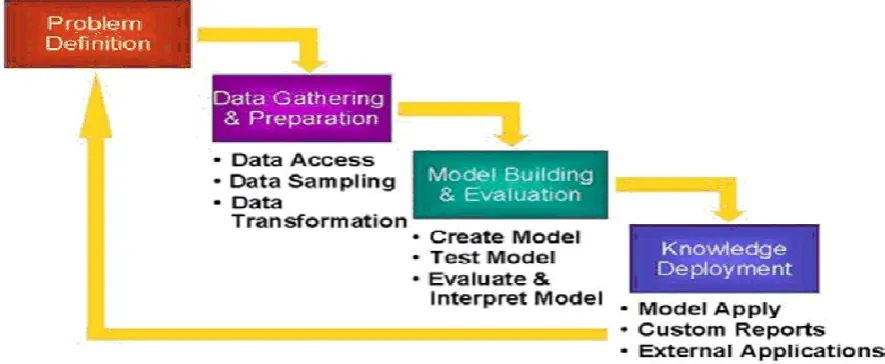
relationships. The unifying goal of the KDD process is to extract knowledge from data in the context of large databases. This valuable information can help the decision maker to make accurate future decisions. KDD applications deliver measurable benefits, including reduced cost of doing business, enhanced profitability, and improved quality of service. While data mining and knowledge discovery in databases (or KDD) are frequently treated as synonyms, data mining is actually part of the knowledge discovery process. In principle, data mining is not specific to one type of media or data. Data mining should be applicable to any kind of information repository [2]. Even after presenting knowledge to the user, new data can be added to the data set or mining can be further refined or a different data mining method can be chosen to get more accurate results. Thus, KDD is completely an iterative process. The actual data mining task is the automatic or semi-automatic analysis of large quantities of data to extract previously unknown interesting patterns such as groups of data records (cluster analysis), unusual records (anomaly detection) and dependencies (association rule mining). The related terms data dredging, data fishing, and data snooping refer to the use of data mining methods to sample parts of a larger population data set that are (or may be) too small for reliable statistical inferences to be made about the validity of any patterns discovered [3]. Figure 1 show the data mining process for any data input to get valid and meaningful output. Data mining involves six common classes of tasks:
Anomaly detection (Outlier/change/deviation detection) – The identification of unusual data records, that might be
interesting or data errors that require further investigation.
Association rule learning (Dependency modeling) – Searches for relationships between variables. For example a
supermarket might gather data on customer purchasing habits. Using association rule learning, the supermarket can
determine which products are frequently bought together and use this information for marketing purposes. This is
sometimes referred to as market basket analysis.
Clustering – is the task of discovering groups and structures in the data that are in some way or another "similar", without
using known structures in the data.
Classification – is the task of generalizing known structure to apply to new data. For example, an e-mail program might
attempt to classify an e-mail as "legitimate" or as "spam".
Regression – attempts to find a function which models the data with the least error.
© 2015, IJCSMC All Rights Reserved 137 Figure 1: Data Mining Process
Theoretic Clustering provides a common means of identifying structure in complex data, and there is renewed interest in clustering as a tool for the analysis of large data sets in many fields. Data clustering is to explore the hidden structure of data and group data items into a few clusters in an unsupervised way [4].
It is a division of data into groups of similar objects. Representing the data by fewer clusters necessarily loses certain fine details, but achieves simplification. It models data by its clusters. Data modeling puts clustering in a historical perspective rooted in mathematics, statistics, and numerical analysis. From a machine learning perspective clusters correspond to hidden patterns, the search for clusters is unsupervised learning, and the resulting system represents a data concept [5].
Similar to classification, theoretic clustering is the organization of data in classes. However, unlike classification, in clustering, class labels are unknown and it is up to the clustering algorithm to discover acceptable classes. Clustering is also called unsupervised classification, because the classification is not dictated by given class labels. There are many clustering approaches all based on the principle of maximizing the similarity between objects in a same class (intra-class similarity) and minimizing the similarity between objects of different classes (inter-class similarity).
Theoretic Clustering plays an important role in a broad range of applications, from information retrieval to CRM. Such applications usually deal with large datasets and many attributes. Exploration of such data is a subject of data mining. A "clustering" is essentially a set of such clusters, usually containing all objects in the data set. Additionally, it may specify the relationship of the clusters to each other, for example a hierarchy of clusters embedded in each other.
A good clustering method will produce high quality clusters with high intra-cluster similarity and low intercluster similarity. The quality of a result produced by clustering depends on both the similarity measure used by the method and its implementation [9]. The quality of a clusters produced by clustering method is also measured by its ability to discover some or all of the hidden patterns. Other requirements of clustering algorithms are scalability, ability to deal with insensitivity to the order of input records and with noisy data [10].
Severaldistributed data clustering techniques have been developed based on the K-means algorithm or the Gaussian mixture model. In these methods, data structures are captured by measures only based on the first and the second order statistics. When the structure of cluster data is complicated, these statistics are insufficient and may lead to unsatisfactory clustering results. To get good clustering performance, we use information theoretic measure and association rule mining. Clustering algorithms can be applied in many fields, for instance:
Marketing: finding groups of customers with similar behavior given a large database of customer data containing their properties and past buying records;
Biology: classification of plants and animals given their features;
Libraries: book ordering;
Insurance: identifying groups of motor insurance policy holders with a high average claim cost; identifying frauds;
City-planning: identifying groups of houses according to their house type, value and geographical location;
Earthquake studies: clustering observed earthquake epicenters to identify dangerous zones;
© 2015, IJCSMC All Rights Reserved 138
Requirements
The main requirements that a clustering algorithm should satisfy are:
scalability;
dealing with different types of attributes;
discovering clusters with arbitrary shape;
minimal requirements for domain knowledge to determine input parameters;
ability to deal with noise and outliers;
insensitivity to order of input records;
high dimensionality;
interpretability and usability;
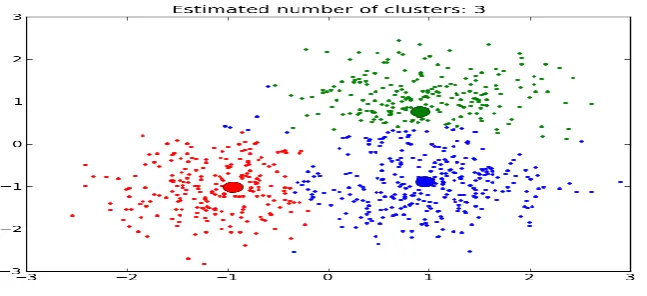
Figure 2: An example of theoretic cluster
Previous data clustering algorithms do not work well with complicated data structures of data. Most of the existing distributed data clustering algorithms are based on the K-means method or the Gaussian mixture model (GMM). In K-means based clustering algorithms, the cost functions usually measure the sum of distances (squared differences) between data items and estimated centroids of clusters. In GMM based clustering algorithms, the distribution of an individual cluster is assumed to be Gaussian, which is fully specified by its mean/centroid and variance. In these kinds of methods, data structures are captured by measures only based on the first and the second order statistics [12].
Centralizing the whole distributed data to one fusion node to perform centralized clustering may be impractical. Thus, there is a great demand for distributed data clustering algorithms in which the global clustering problem can be solved at each individual node based on local data and limited information exchanges among node [15].
We present distributed clustering algorithms based on an information theoretic measure. We incorporate the maximum mutual information (MMI) criterion into the cost function in distributed clustering, to present distributed MMI-based (DMMI) clustering algorithms.
In our method, each node solves a local clustering problem through cooperation with its single-hop neighboring nodes. Each node can utilize global information to help clustering its local data, at a low communication cost. Besides, in the cooperation, nodes do not transmit original data but merely exchange a few parameters of clusters. Hence, clustering task is performed under privacy preservation, which is important in some practical distributed applications [3], [4].
II. LITERATUREREVIEW
Nowadays we have many applications with massive amount of data which are caused limitation in data storage capacity and processing time. We can identify two main groups of techniques for huge data bases mining. One group refers to streaming data and applies mining techniques whereas second group attempts to solve this problem directly with efficient algorithms. Data considered as a stream of data which come in from one side and exit from another side so we aren’t able to visit data for second time just like river. This data stream’s main property arise some difficulties. Two main problems which are related to this property include:
1) One scan is possible for processing data.
© 2015, IJCSMC All Rights Reserved 139
Many researchers interest is to apply some techniques for increasing compactness of representation, fast and incremental processing of new data points, clear and fast identification of outliers. Primitive Clustering Methods and Data Clustering Methods are used in data stream clustering. Most data stream applications are high dimensions and new methods need to be developed. Concept drift is nature of data stream and should be managed by new methods. On the other hand data stream is similar to a river: data come in and come out. Evolving data, visiting data once and space limitations are major issues in data stream clustering.
The algorithm provides a framework for clustering different datasets by using different Bregman divergences (or equivalently, parametric models of different exponential distributions). For a given application (dataset), to obtain good clustering performance, it is expected to artificially choose a specific Bregman divergence (or equivalently, parametric model of a specific exponential distribution) which matches the generative model of current data. For a clustering result, large divergence means there are obvious differences or boundaries between data items belonging to different clusters. Hence, their goal is to maximize the divergence, by adjusting the assignment of cluster/class label on each data item. In this kind of method, calculating divergence relies on unknown conditional pdfs of cluster data, which need to be estimated during clustering. In order to make clustering adaptable to datasets of different data structures, the authors choose to directly estimate the conditional pdfs from labeled data in a nonparametric manner [6], [7], rather than to model them by predefined parametric models, e.g. exponential family distributions. Accordingly, the optimization of corresponding cost functions are directly related to the cluster label of each data item. Note that, when the algorithms are extended to the distributed clustering field, this characteristic would lead to request for transmission of original data (it may be not necessary under some kind of modification, however, we have not yet found an efficient modification scheme to avoid the transmission of data while maintaining good clustering performances).
K-Means based Clustering Algorithm
One of the most common iterative algorithms is the K-means algorithm [2], [10], [15] broadly used for its simplicity of implementation and convergence speed.
K-mean algorithm creates clusters by determining a central mean for each cluster.
Input: n objects (or points) and a number k
Algorithm
1. Randomly place K points into the space represented by the objects that are being clustered. These points represent initial group centroids.
2. Assign each object to the group that has the closest centroid.
3. When all objects have been assigned, recalculate the positions of the K centroids. 4. Repeat Steps 2 and 3 until the stopping criteria is met.
Gaussian Mixture Model based Algorithm
A Gaussian mixture model is a probabilistic model that assumes all the data points are generated from a mixture of a finite number of Gaussian distributions with unknown parameters. One can think of mixture models as generalizing k-means clustering to incorporate information about the variance structure of the data as well as the centers of the latent Gaussians. Gaussian is the probability given in a mixture of K Gaussians.
A Gaussian Mixture Model (GMM) is a parametric probability density function represented as a weighted sum of Gaussian component densities. GMMs are commonly used as a parametric model of the probability distribution of continuous measurements or features in a biometric system, such as vocal-tract related spectral features in a speaker recognition system. GMM parameters are estimated from training data using the iterative Expectation-Maximization (EM) algorithm.
GMMs are often used in biometric systems, most notably in speaker recognition systems, due to their capability of representing a large class of sample distributions. One of the powerful attributes of the GMM is its ability to form smooth approximations to arbitrarily shaped densities [14], [16].
Divergence and Maximum Mutual Information based Clustering
For the divergence-based clustering, there are roughly two types of algorithms, which are the parametric type and the nonparametric type, respectively. The Bregman soft clustering algorithm is a representative and typical sample for the former, In [7], the authors model the data source with a mixture of exponential family distributions (one component for one cluster), and pose the clustering problem as a parameter estimation problem for the mixture model. They find the correspondence between exponential families and regular Bregman divergences, and thereby bring up a Bregman divergence viewpoint for learning the maximum likelihood parameters of the mixture model [7].
© 2015, IJCSMC All Rights Reserved 140
a specific exponential distribution) which matches the generative model of current data. However, the prior knowledge for the generative models of real datasets can be lacking, which makes it hard to choose an appropriate parametric model.
As for mutual information, in the context of clustering, it can be used to measure the information shared by data items and cluster labels. In more detail, it measures the uncertainty about cluster labels reduced by knowing the data items, or the uncertainty about data items reduced by knowing the corresponding cluster labels. Large mutual information means that the structure information contained in data items is well preserved by the clustering result. Hence, MMI-based clustering algorithms seek the clustering result that maximizes the mutual information.
Kernel DMMI is appreciated for solving linearly non-separable problems. Real datasets are not always linearly separable; the linear DMMI algorithm may not work well when the boundaries between different clusters are complicated. Kernel DMMI give good clustering performance but fails to cluster data efficiently, which results in to its drawback [8].
III. ANALYSISOFPROBLEM
Centralizing the whole distributed data to one fusion node to perform centralized clustering may be impractical. Privacy preservation and communication resource saving (original data can be large) are usually important in real distributed applications. So, directly transmitting original data is not preferred. As real datasets are not always linearly separable, the linear DMMI algorithm presented may not work well, when the boundaries between different clusters are complicated. Testing on large datasets with hadoop not possible and Working on structural graph data not possible. Processing data regarding architectural aspects have received considerable attention, but most effort is concentrated on the mining and clustering aspects of the problem. Algorithms suffer from the ability to handle difficult clustering tasks without supervision. The algorithms required expert assistant in the form of the number of partitions expected or the expected density of clusters. Required to re-learn any recurrently occurring patterns, Compactness and separateness of data. Efficiency in terms of speed is a vital problem in data mining clustering. Some difficulties in realizing exact clusters of data in many applications are due to arbitrary shape causes. The most popular challenges in theoretic clustering is outliers detecting and High dimensionality is one of the major causes in data complexity. Data type treatment, Cluster validity, Space limitation, High dimensional data stream and uncertain data.
PROPOSEDMETHODOLOGY
Various datasets will be collected in the form of simple numeric data, text documents or mixture of both. The data must be loaded in the machine first to cluster. The Data mining technique named association rule mining will be combined with diffusion kernel DMMI technique, in order to improve the clustering output so that our proposed system generates optimized clusters for user.
We present distributed clustering algorithms based on an information theoretic measure [12]. We incorporate the maximum mutual information (MMI) criterion into the cost function in distributed clustering, to present distributed MMI-based (DMMI) clustering algorithms named as:
Proposed Algorithm for Theoretic Clustering
Input: - Data from database
Output: - List of similar & optimized clusters
Step 1: Enter number of clusters
Step 2: Specify the data (Specify data which user want to cluster)
Step 3: Perform Natural language processing
Step 4: Find similarity between data
a. Perform ranking (Support value is calculated) b. Find theoretic scores (for rules)
c. Perform theoretic clustering
Step 5: Group data with similar values of similarity together
© 2015, IJCSMC All Rights Reserved 141
Since real datasets are not always linearlyseparable, in order to handle linearly non-separable problems, the diffused kernel DMMI algorithm is proposed by using the modified kernel discriminative clustering function. The ranking model's purpose is to rank, i.e. produce a permutation of items in new, unseen lists in a way which is "similar" to rankings in the training data in some sense. Ranking is performed to find support value for given data. The process of using a model to make predictions about behavior that has yet to happen is called "scoring." The output of the model, the prediction, is called a score. Scores can take just about any form, from numbers to strings to entire data structures, but the most common scores are numbers (for example, the probability of responding to a particular promotional offer). The scoring mechanism is used to get the max distance, support and confidence values. Theoretic scores and ranks for given data are automatically calculated by the algorithm.
Support and confidence values are calculated on the basis od Euclidean distance formula as shown below:
d(p,q) = d(q,p) =
(q1 - p1)
2+ (q2 - p2)
2+…+(qn - pn)
2 =∑
Large amounts of data have been collected routinely in the course of day-to-day management in business. Such data is primarily used for accounting and for management of the customer’s database [16]. Typically, management data sets are very large and constantly growing and contain a large number of complex features. While these data sets reflect properties of the managed subjects and relations, and are thus potentially of some use to their owner, they often have relatively low information density. One requires robust, simple and computationally efficient tools to extract information from such data sets. The development and understanding of such tools is the core business of data mining. These tools are based on ideas from computer science, mathematics and statistics. Mining useful information and helpful knowledge from these large databases has thus evolved into an important research area [17].
Consider a shopping website with a large collection of items. Typical business decisions that the management of the shopping website has to make include what to put on sale, how to design coupons, etc. Analysis of past transaction data is a commonly used approach in order to improve the quality of such decisions.
IV. RESULT
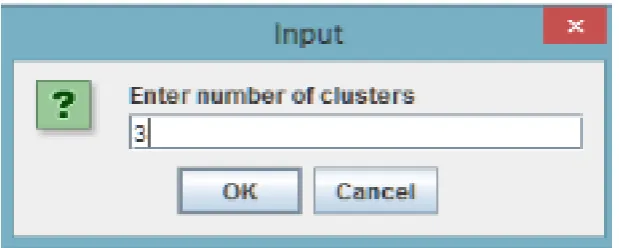
This result section presents the screenshots of the diffused kernel DMMI approach using association rules in order to demonstrate the complete process. The first screen after starting the system shown to the user is display below in the screenshots. It prompts the user to enter number of clusters which he wants for clustering the input data. This screenshot shows that user gives the number of clusters to the proposed system. The number of clusters means number of groups of similar data in which the inter–related information will be displayed regarding user requirement. Suppose for example user want 3 clusters for his given input data.
Figure 3: Window for user to enter number of clusters for given data
© 2015, IJCSMC All Rights Reserved 142
Figure 4: UCI Library (Collection of databases)
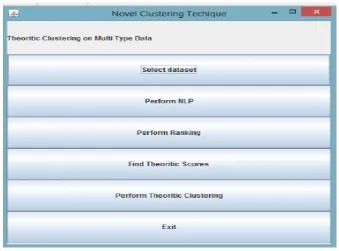
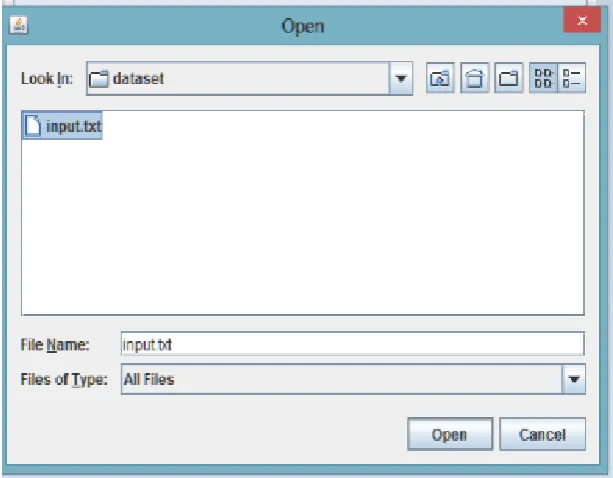
This screenshot allows user to select dataset for theoretic clustering. The datasets can be mixture of theory and numeric data. The desired dataset which user want to cluster must be loaded in the system first.
Figure 5: Dataset selection window
© 2015, IJCSMC All Rights Reserved 143
Figure 6: User selects input data to cluster
Figure 7: Time needed to perform NLP for user selected data
© 2015, IJCSMC All Rights Reserved 144
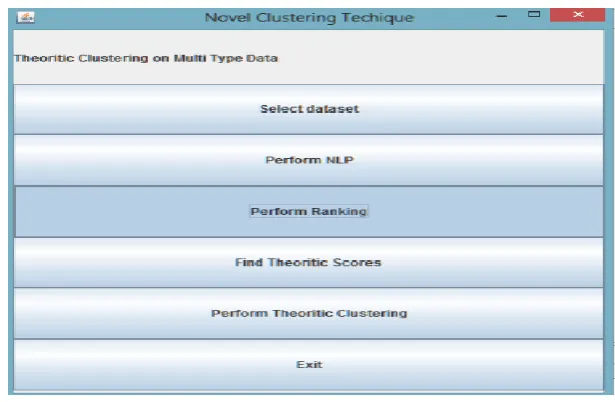
This screenshot shows that user want to perform ranking for specified file.
Figure 8: shows user want to perform ranking
Ranking method will give most similar & related data at the top for user convenience. This screenshot shows that user want to find theoretic scores for given data to get optimized result. Everything is internally automaticall and calculated for generating optimized clusters.
© 2015, IJCSMC All Rights Reserved 145
This screenshot shows that user finally performs theoretic clustering to get optimized clusters for his selected data efficiently.
Figure 10: User selected perform theoretic clustering
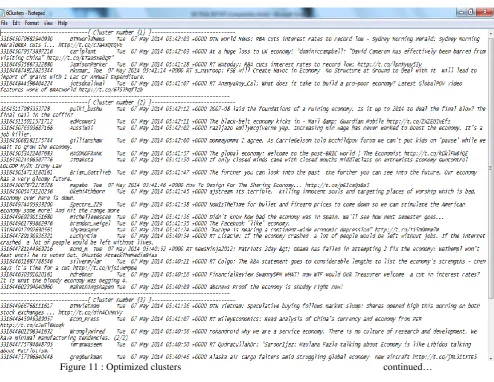
This screenshot shows that user gets optimized cluster for his given data, the data in respective clusters are inter-related to each other.
© 2015, IJCSMC All Rights Reserved 146
Figure 11: Optimized clusters
V.
CONCLUSION
The overall goal of the data mining process is to separate the information from a large data set and transform it into an understandable form for further use. Theoretic Clustering is an important task in data analysis and data mining applications. An optimal method for Document/ theoretic clustering has been proposed, which is both memory and time efficient, while maintaining good level of accuracy. Through this paper, we have compared theK-means-based and the GMM-based clustering algorithms with theMMI-based algorithms [9], and the MMI based algorithms can capture the data structures beyond the first and the second order statistics, thus leading to more satisfactory clustering results for datasets with complicated data structures. In order to handle linearly non-separable problems, we have proposed the diffused kernel DMMI algorithm by using the modified kernel discriminative clustering function with association rule mining. The diffused kernel DMMI generates optimized clusters for users in less time and shows excellent ability in exploring the overall data structure for the real atmosphere dataset, which indicates that the proposed information theoretic clustering algorithms are applicable in real distributed applications like environmental monitoring. The performances of the proposed algorithms are evaluated on textual and numeric datasets. To reflect the flexibility and applicability of the algorithms for practical cases, the proposed DMMI algorithm maintains good clustering performance in the cases of unbalanced data distribution over nodes. Proposed system can also remove empty clusters formed due to less matching between given datasets.
REFERENCES
1. U. Fayyad, G. Piatetsky-Shapiro, P. Smyth, and R. Uthurusamy, eds., “Advances in Knowledge Discovery and Data Mining”, in MIT Press, Menlo Park, CA, USA 1996.
© 2015, IJCSMC All Rights Reserved 147
3. S. Merugu and J. Ghosh, “A privacy-sensitive approach to distributed clustering,” Pattern Recognit. Lett. vol. 26, no. 4, pp. 399–410, 2005.
4. A. M. Elmisery and H. Fu, “Privacy preserving distributed learning clustering of healthcare data using cryptography protocols,” in Proc. IEEE 34th Ann. Computer. Software and Appl. Conf. Workshops, 2010, pp. 140–145.
5. E. Gokcay and J. C. Principe, “Information theoretic clustering,” IEEE Trans. Pattern Anal. Mach. Intell., vol. 24, no. 2, pp. 158–170, April 2002.
6. R. Jenssen, T. Eltoft, and J. C. Principe, “Information theoretic clustering: A unifying review of three recent algorithms,” in Proc. 6th
Nordic Signal Process. Symp. Espoo, Finland, 2004, pp. 292–295.
7. A. Banerjee, S. Merugu, I. S. Dhillon, and J. Ghosh, “Clustering with Bregman divergences,” J. Mach. Learn. Res., vol. 6, pp. 1705–1749, 2005.
8. P. A. Forero, A. Cano, and G. B. Giannakis, “Distributed clustering using wireless sensor networks,” IEEE J. Sel. Topics Signal Process. vol. 5, no. 4, pp. 707–724, Aug. 2011.
9. R. Xu and D. Wunsch-II, “Survey of clustering algorithms,” IEEE Trans. Neural Network, vol. 16, no. 3, pp. 645–678, May 2005.
10. A. K. Jain, M. N. Murty, and P. J. Flynn, “Data clustering: A review,” ACM Computer. Surveys, vol. 31, no. 3, pp. 265–323, 1999.
11. E. Gokcay and J. C. Principe, “Information theoretic clustering,” IEEE Trans. Pattern Anal. Mach. Intell., vol. 24, no. 2, pp. 158–170, April 2002.
12. J.Grabmeier and A. Rudolph, “Techniques of cluster algorithms in data mining,” Data Mining and Knowledge. Discovery, vol. 6, no. 4, pp. 303–360, 2002.
13. P. A. Forero, A. Cano, and G. B. Giannakis, “Distributed clustering using wireless sensor networks,” IEEE J. Sel. Topics Signal Process, vol. 5, no. 4, pp. 707–724, Aug. 2011.
14. M. Klusch, S. Lodi, and G. Moro, “Distributed clustering based on sampling local density estimates,” in Proc. Int. Joint Conf. Artificial. Intell. 2003, pp. 485–490.
15. C. Li, P. Shen, Y. Liu, and Z. Zhang, “Diffusion information theoretic learning for distributed estimation over network,” IEEE Trans. Signal Process, vol. 61, no. 16, pp. 4011–4024, Aug 15, 2013.
16. A. M. Elmisery and H. Fu, “Privacy preserving distributed learning clustering of healthcare data using cryptography protocols,” in Proc. IEEE 34th Ann. Computer Software and Appl. Conf. Workshops, 2010 pp. 140–145.