© 2015, IJCSMC All Rights Reserved
216
Available Online atwww.ijcsmc.com
International Journal of Computer Science and Mobile Computing
A Monthly Journal of Computer Science and Information Technology
ISSN 2320–088X
IJCSMC, Vol. 4, Issue. 4, April 2015, pg.216 – 220
SURVEY ARTICLE
Survey on Publish-Subscribe Based
Communication Middleware
Harish.K
1, S.Rajeswari
2¹
Student of M.Tech (Software Engineering),Department of Information Science, New Horizon College of Engineering, India²
Assistant Professor,Department of Information Science, New Horizon College of Engineering, India1 [email protected]; 2 [email protected]
Abstract— In the modern world there is demand in real time communication because in some situation any delay while communicating would leads to catastrophic results especially in defence operations and other military applications. Several middleware designs came to picture like client-server, message-passing, Publish-Subscribe architecture. Hence there is need to assess the communication needs in distributed systems. The Object Management Group’s Data Distribution Service (DDS) uses the specifications of Publish Subscribe model to standardise the data-centric publish-subscribe programming model. The paper concludes the DDS is best network communication solution.
Keywords— middleware, DDS, client-server, message-passing, publish-subscriber
I. INTRODUCTION
© 2015, IJCSMC All Rights Reserved
217
II. LITERATURE SURVEY
Generally there are three types of communication middleware namely Client-server, Message-Passing and Publisher-Subscriber [11]. Any new protocol will come under these three types as shown in figure 1.
Client-Server: As we know it includes client machine which request the data and server machine which responds to the request. This approach works fine for centralized processing systems such as transactions and databases. Here if multiple clients send the data then client-server architecture directs the information to server. Hence sometimes there will be an unknown delay in the system for servers to react and another issue is architecture has high rate of single point failure.
Message Passing: Supports direct peer-peer connection enabling efficient communication between the nodes. The major disadvantage is it does not support data-centric model.
Publish-Subscribe: It adds a particular model to the messaging where publisher “publishes” the data they produce and the subscriber “subscribes” the data which they need. The publisher-subscribe generally has both discovery and messaging
capability. In the next section we see the more details of the technologies which often based on publish-subscribe message exchange pattern.
© 2015, IJCSMC All Rights Reserved
218
III.PUBLISHER-SUBSCRIBER BASED TECHNOLOGIES
1. JMS
a. It is the acronym for Java Message Service.
b. It is message centric approach, the infrastructure really have no idea about the content. c. The JMS server must be determined and configured either with Queues or Topics. d. Does not support interoperability.
e. It supports only broker based architecture. f. Not suitable for real time applications.
2. AMQP
a. It is acronym for Advanced Message Queuing protocol.
b. It is message centric approach, the infrastructure really have no idea about the content. c. Unlike JMS it supports wire protocol.
d. Supports Interoperability.
e. It supports only broker based architecture. f. Not suitable for real time applications.
3. MQTT
a. It is an acronym for Message Queuing Telemetry Transport.
b. It is message centric approach, the infrastructure really have no idea about the content. c. It provides light weight device data collection.
d. It supports partial interoperability. e. It supports only broker based architecture. f. Not suitable for real time applications.
4. DDS
a. It is an acronym for Data Distribution Service.
b. It is Data centric approach, the infrastructure does aware of the contents and also maintains it. c. It supports multicast.
d. No need to specify end points.
e. Provides QOS policies such that ease tailoring of communication behaviour. f. No need to specify the end points.
g. Perfectly suites for real time applications.
IV.WHY DO WE NEED DDS?
As shown in the figure 1, JMS, AMQP, MQTT are the protocols which is used for communication between the nodes
or the applications but they are broker based (single queues or double queue) and also message-centric but DDS is based on data-centric and also provides decentralized broker less architectures ensures reliable, scalable, real-time and efficient communication between the publisher and subscriber.
The DDS is specifications that standardize the application program interface with Data-Centric publish-subscribe
© 2015, IJCSMC All Rights Reserved
219
without the knowledge of receiver location in the same way the receiver receives the data without knowledge of sender location.
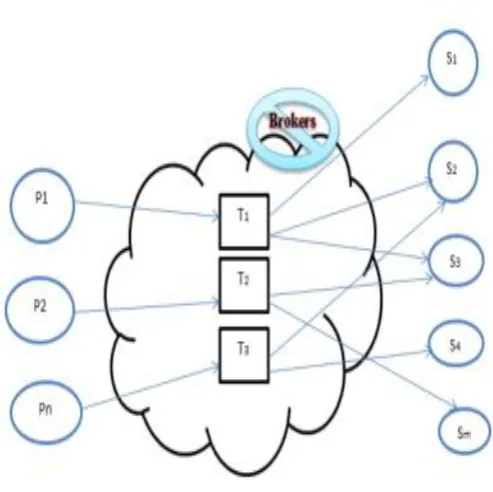
DDS completely based on Global Data Space (GDS) concept where publisher and subscriber would join and leave any
time as shown in figure 2, the publishers are represented as p1, p2,...pn and subscribers are s1,s2....sn. Topic(T1,T2,..Tn) is an entity is plays crucial role in logically connecting publisher and subscriber. There are no intermediate brokers available between publisher and subscribers which makes efficient for data sharing.
The single packet can be sent to multiple nodes supporting multicasting thus increasing the throughput of the network.
Figure 2.Global Data Space .
DDS supports direct peer-peer connection. The connections are established by the topic. When the node is known
where to send the data then the sending process would be highly effective.
The redundancy of publishers and Subscribers are generally built thus eliminating single point failure.
V. CONCLUSIONS
© 2015, IJCSMC All Rights Reserved
220
REFERENCES
[1] Patrik Huss, Niklas Wigertz, Jingcheng Zhang, Allan Huynh, Qinzhong Ye and Shaofang Gong Department of Science and Technology, Linköping University Norrköping, “Flexible Architecture for Internet of Things Utilizing an Local Manager”,2014.
[2] Bhagyashri Katole, Manikanta Sivapala, Suresh V C-DAC, Pune, India, “ Principle Elements and Framework of Internet of Things”.2013.
[3] Angelo Corsaro SELEX-SI – Roma Leonardo Querzoni, SirioScipioni, Sara Tucci- Piergiovanni, AntoninoVirgillitoUniversitá di Roma La Sapienza “Quality of Service in Publish/Subscribe Middleware,
2006
[4] Kamal Kumar Sharma , Ram Bahadur Patel , Harbhajan Singh India, “ A Reliable and Energy Efficient Transport Protocol for Wireless Sensor Networks”,2010.
[5] Ming Xiong, Jeff Parsons, James Edmondson, Hieu Nguyen, and Douglas C Schmidt, Vanderbilt University, Nashville TN, USA “Evaluating the Performance of Publish/Subscribe Platforms for Information Management in Distributed
Real-time and Embedded Systems.
[6] An Introduction to DDS and Data-Centric Communications Gerardo Pardo-Castellote Bert Farabaugh, 2006. [7] Real-Time Innovation, “High-Performance Distributed Control Applications over Standard IP Networks.
[8] R. Chand and P. Felber. Xnet: A reliable content-based publish/subscribe system. In 23rd International Symposium on Reliable Distributed Systems (SRDS 2004),pages 264–273, 2004.
[9] A. Cheung, H. Jacobsen, “Dynamic Load Balancing in Distributed Content-based Pub-lish/Subscribe,”ACM/IFIP/USENIX Middleware 2006, December, Melborne, Australia.
[10]Hapner, M., Burridge, R., Sharma, R., Fialli, J., and Stout, K. 2002. Java Message Service. Sun Microsystems Inc., Santa Clara, CA.
[11]Stan Schneider ,Bert Farabaugh,2006 Is DDS for you? A Whitepaper by Real-Time Innovations.
[12]Urs Hunkeler & Hong Linh Truong, Andy Stanford-Clark, MQTT-S – A Publish/Subscribe Protocol For Wireless Sensor Networks, Proc. Communication Systems Software and Middleware and Workshops, 2008. COMSWARE,2008.