algorithm Chaskey
?Chrysanthi Mavromati
1
Capgemini-Sogeti, R&D Lab, France
2
Universit´e de Versailles Saint-Quentin-en-Yvelines, Laboratoire PRISM, France
Abstract. Chaskey is a Message Authentication Code (MAC) for 32-bit microcontrollers proposed by Mouhaet. alat SAC 2014. Its underly-ing blockcipher uses an Even-Mansour construction with a permutation based on the ARX methodology. In this paper, we present key-recovery attacks against Chaskey in the single and multi-user setting. These at-tacks are based on recent work by Fouque, Joux and Mavromati pre-sented at Asiacrypt 2014 on Even-Mansour based constructions. We first show a simple attack on the classical single-user setting which confirms the security properties of Chaskey. Then, we describe an attack in the multi-user setting and we recover all keys of 243users by doing 243queries
per user. Finally, we show a variant of this attack where we are able to recover keys of two users in a smaller group of 232 users.
Keywords:Message Authentication Code, Collision-based cryptanalysis, ARX, Even-Mansour, Chaskey, Multi-user setting.
1
Introduction
A Message Authentication Code (MAC) algorithm is a basic component in many cryptographic systems and its goal is to provide integrity and data authentica-tion. For this, it takes as input a message M and a n-bit secret key K, and outputs a tag τ which is usually appended toM. In general, MAC algorithms are built from universal hash functions, hash functions or block ciphers. The first security property of a MAC is that it should be impossible to recover the key
K faster than 2n operations (key recovery attack). It should also be impossible for an attacker to forge a tag for any unseen message without knowing the key (MAC forgery). Here, the attacker selects a message and simply guesses the cor-rect MAC value without any knowledge of the key. The probability that the guess will be correct is 2−twheretis the size of the tagτ. However, such attacks can be avoided by making the tag sufficiently large. MACs based on universal hash functions compute the universal hash of the message to authenticate and then
?
encrypt this value. MAC algorithms based on block ciphers are usually given as a mode of operation for the block cipher. Typically, CBC-MAC is very similar to the CBC encryption mode of operation and is one of the most commonly used MACs.
The implementation of a MAC algorithm on a typical microcontroller is a challenging issue as many problems may appear. More precisely, the use of a MAC based on a hash function or a block cipher might have a negative impact on the speed of the microcontroller due to the computational cost of the operations required by the underlying functions.
Recently, at SAC 2014, a new MAC algorithm named Chaskey has been introduced by Mouha et al.[8]. It is a permutation-based MAC algorithm and its underlying permutation relies on the ARX design. The designers claim that Chaskey is a lightweight algorithm which overcomes the implementation issues of a MAC on a microcontroller. The construction of Chaskey is based on some simple variants of the CBC-MAC proposed by Black et al. [3]. As CBC-MAC is not secure when used with messages of variable length, these variants were designed to authenticate arbitrary length messages. Alternatively, Chaskey can also be seen as an iterated Even-Mansour construction where the same subkey is xored in the input and output of the last permutation round.
In Asiacrypt 2014, Fouqueet al.[6] presented new techniques to attack the Even-Mansour scheme in the multi-user setting. Based on this work, we present here some key-recovery attacks against the MAC algorithm Chaskey in the single and multi-user setting.
The paper is organized as follows: in Section 2 we recall the necessary back-ground, present the multi-user setting, the Even-Mansour scheme and the gen-eral principle of collision-based attacks using the distinguished points method, in Section 3 we present the main specifications of the Chaskey MAC algorithm and finally, in Section 4, we describe new attacks against Chaskey.
2
Preliminaries
2.1 The multi-user setting
The security of most schemes in cryptography is usually studied when we have a single recipient of encrypted data: the single-user model. However, this setting ignores an important dimension of the real world where there are many users, who are all using the same algorithms, but each one has its own key. In this setting, the attacker tries to recover all or fraction of keys more efficiently than the complexity of the attack in the single-user model times the number of users. This can be done by amortizing the cost of the attack among the users.
In [7], Menezes studies the security of MAC algorithms in the multi-user setting. He shows that the security degrades when we pass from one to many users. The scenario attack against MAC algorithms in the multi-user setting can be seen as follows. Let HK :{0,1}∗ → {0,1}t be a family of MACs where
has access to an oracle HK to generate a valid message-tag pair (m, τ) without knowing the keyK. In the multi-user setting, we suppose that we haveLusers with keys K(i)∈ {0,1}k where 0 ≤i≤(L−1). Then for an attacker who has access to oracles for HK(i), it should be difficult to produce a triplet (i, m, τ).
2.2 Collision-based attacks using the distinguished point technique against the Even-Mansour scheme
The distinguished point technique. The distinguished point technique allows to find collisions in a very efficient way. For this, we first have to define a function
f on a set S of size N and then define a distinguished subset S0 of S with
D distinguished points. The distinguished points should be easy to recognize and generate. For example, we can choose our distinguished points to ben-bits values withdzeros at the end. So, in a set of cardinalityN = 2nour distinguished subset contains D = 2n−d elements. Starting from a random pointx0 ∈ S we build chains by evaluating the function f:
xi+1=f(xi).
When a distinguished point is detected, i.e. x` ∈ S0, the construction of the chain stops. To be able to recover the chain we need to store the starting point
x0, the distinguished point x` and the length of the chain` which corresponds to the number of iterations of the functionf. Two chains that pass through the same point necessarily end at the same distinguished point. To detect a collision we use the inverse result: two chains that end at the same distinguished point necessarily merge at some point unless one chain is a subchain of the other. Once a collision in the distinguished points set is detected, the real collision can easily be recovered. We assume that we have two colliding chains of length ` and `0
and that `≥`0. Then, starting from the longer chain, we rebuild the chain by taking exactly`−`0 steps. From that point, it now suffices to build both chains in parallel until a collision is reached.
Collision-based attacks against Even-Mansour. The Even-Mansour scheme is a minimalistic very efficient design of a block cipher proposed at Asiacrypt 91 [5]. The main idea is the construction of a keyed permutation family ΠK1,K2 by a
public permutation πthat operates onn-bit values (N= 2n):
ΠK1,K2=π(m⊕K1)⊕K2,
where m is the plaintext andK1 andK2 are the two whitening keys. There is also a simpler version presented by Dunkelman et al. [4], the Single-key Even-Mansour, where K1 = K2. Even and Mansour showed that this simple block-cipher is secure up toO(2n/2) queries of the adversary to the keyed permutation
Π and to the public permutationπ. It has also been proved [4] that the Single-key Even-Mansour has the same security bound as the original version.
the Even-Mansour scheme in the multi-user setting. The main idea is to find a collision between two chains, one constructed from the public permutationπand one from the keyed permutationΠ. For this, as we cannot use permutations to detect collisions, we have to construct two functions F and f, one based onΠ
and one based onπ. In previous attacks on Even-Mansour [2, 4], these functions have been constructed by using the Davies-Meyer construction:F(m) =Π(m)⊕ Π(m⊕δ) and f(m) =π(m)⊕π(m⊕δ).However, these functions cannot be used with the distinguished point technique as chains built byF andf defined as previously can eventually cross but they cannot merge as they consist of evaluations of two different functions. As a consequence, they use a different definition of F andf to solve this problem:
F(m) =m⊕Π(m)⊕Π(m⊕δ) and f(m) =m⊕π(m)⊕π(m⊕δ).
For two messages mandm0 such asm0 =m⊕K1, they remark thatF(m0) =
f(m)⊕K1and so they get twoparallelchains,i.e.two chains that have a constant difference between them.
They also remark that, for two different users i and j, two chains con-structed by using FΠ(i) and FΠ(j), where FΠ(i)(m) =m⊕Π(i)(m)⊕Π(i)(m⊕δ) andFΠ(j)(m) =m⊕Π(j)(m)⊕Π(j)(m⊕δ), can also become parallel and their constant difference would be equal to the XOR of the users keys,i.e.K1(i)⊕K1(j). To attack Even-Mansour using the distinguished point technique in the multi-user setting, they build a set of chains for the public multi-user using the function f
and a small number of chains for every user by using the keyed permutationF. Whenever a collisionF(i)(x) =F(j)(y) for two pointsxandy, wherex=y⊕K1, is detected between two users Ui and Uj, it yields K
(i) 1 ⊕K
(j)
1 . From these collisions it is possible to construct a graph whose vertices are the users and the edges represent the xor of the first keys of the users with two colliding chains, i.e.K1(i)⊕K1(j). When enough edges are present a giant component appears in the graph. Then, it suffices to find a single collision F(i)(x) = f(y) between a user and the public user to reveal all keys of the users in the giant component.
One of the main ideas of their technique is to detect parallel chains by simply testing ifπ(y)⊕π(y⊕δ) =Π(x)⊕Π(x⊕δ) for two distinguished pointxandy
wherex=y⊕K1. This does not add any extra cost, as values ofπ(y)⊕π(y⊕δ) andΠ(x)⊕Π(x⊕δ) are needed to calculate the next element of the chain. Also, it does not require to go back and recompute the chains to detect the merging points.
3
The MAC algorithm Chaskey
decomposed in 4 words of 32-bits (instead of 64-bits in SipHash). Also, different rotation constants are used.
Chaskey takes as input a message M of arbitrary size and a 128-bit key
K. The message M is split into ` blocks m1, m2, . . . , m` of 128 bits each. If the last block is incomplete, a padding is applied. It outputs the t-bit tag τ
(where t≤n) that authenticates the messageM. The underlying function is a permutation constructed using the ARX design.
Two subkeysK1 andK2are generated fromKas follows:K1is equal to the result of the multiplication by 2 (binary notation) of K andK2 is equal to the multiplication by 2 of K1. In general, we define K1 =αK andK2 =α2K. To define multiplication inGF(2n), we need to specify the irreducible polynomial
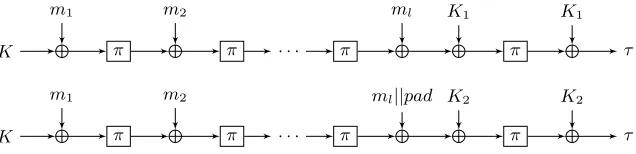
f(x) of degree n that defines the representation of the field. The designers of Chaskey choose their irreductible polynomial to bef(x) =x128+x7+x2+x+ 1. Chaskey operates in`+ 3 steps. On the first step, we xor the first blockm1 with the key K. On the next step, we process the previous result through the permutation π and we xor the output with the next block. This procedure is repeated `−1 times until all blocks are being processed. If the last block m`, which has been xored at the end of the`−1 step, is a complete block, then, on the`-th step, we simply xor the keyK1. If it is an incomplete block, it should be padded with 10n−|m`|−1 before being used. Then, on the `-th step, the keyK
2 will be used instead ofK1. Then, the state will pass through the permutationπ
and will be xored withK1ifm`is complete or withK2if incomplete. Finally, the
tleast significant bits are selected to be used as the tagτ. The whole procedure can be seen on Figure 1.
K m1
π m2
π . . . π
ml K1
π K1
τ
K m1
π m2
π . . . π
ml||pad K2
π K2
τ
Fig. 1.The Chaskey MAC algorithm. First line when|m`|=nand second line when
0≤ |m`| ≤nwherepad= 10n−|m`|−1.
There is also a variant of Chaskey, called Chaskey-B, where Chaskey can be seen as a MAC algorithm based on the Even-Mansour [5] block cipher. The authors define the block cipherEasEX||Y(m) =π(m⊕X)⊕Y and so it suffices to evaluate recursively the functionhi+1=EK||K(hi⊕mi) fori= 1, ..., l−1 and
h1 = 0n. If the last block is complete, we calculateh` =EK⊕K1||K1(h`⊕m`).
If not, we calculateh`=EK⊕K2||K2(h`⊕m`||10
n−|m`|−1). Finally, the tagτ is
at each iteration of the block cipher E. As a result, the key K intervenes only on the first block and the keys K1 orK2 on the last block:
τ=π(π(π(π(m1⊕K)⊕m2)⊕. . .)⊕ml⊕K1)⊕K1.
The permutationπ consists of 8 rounds of a function that follows the ARX design: addition modulo 232, bit rotations and XOR. For constructing this round function, the authors use the same structure as SipHash [1] but instead of 64-bit words they are using words of 32 bits and different rotation constants. They consider that 8 applications of the round function is secure but they suggest that the 16 rounds version (Chaskey-LTS: long term security) should also be implemented in case of security issues.
The authors prove that Chaskey is secure up toD= 2n/2 chosen plaintexts andT = 2n/Dqueries toπor π−1.
4
Collision-based attacks against Chaskey
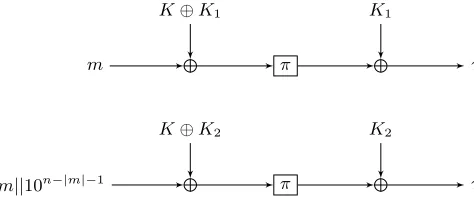
In this section, we show that the collision-based attack described in [6] can be applied on Chaskey. Furthermore, we show that variants of this attack can be applied in the case of Chaskey. All attacks can be performed when we use single-block messages. Chaskey then becomes an Even-Mansour cipher:
m
K⊕K1
π τ
K1
m||10n−|m|−1
K⊕K2
π τ
K2
Fig. 2.Single-block messages in Chaskey
The main idea of all attacks is to build chains by using a function based on Chaskey and then search for collisions between them. For this, a function that can be used to build chains should be defined. However, in the case of Chaskey, for every user we can build two different chains depending on the subkey that we are using.
To build the chains needed, we define the functions:
fs(M) =Ks⊕π(M⊕(Ks⊕K))
whereKis the users key,Kswiths∈ {1,2}represents the two subkeys generated as mentioned in section 3 andδis an arbitrary but fixed non zero constant.
In the multi-user setting we assume thatL different users are all using the Chaskey MAC algorithm based on the same public permutationπ. Each userUi, with 0≤i≤L, chooses its own keyK(i)at random and independently from all the other users and generatesKswiths∈ {1,2}. We define the functionsfs(M) andFfs(M) as above and we also define the functionFπ(M) for the public user
as follows:
Fπ(M) =M ⊕π(M)⊕π(M⊕δ).
We remark that for two plaintextsM andM0 whereM0 =M⊕Ks⊕K, we haveFfs(M⊕Ks⊕K) =Fπ(M)⊕(Ks⊕K). So, two chains based on functions
Ffs andFπ may become parallel.
4.1 Key-recovery attack in the single-user setting
In this section, we show that an attack with complexity 264 can be applied in the classical single-user scenario. This attack does not contradict the security bound showed in the original paper of Chaskey and has similar complexity with possible slide attacks based on [2]. However, with this attack we show a simple application on Chaskey of the parallel chains detection technique.
The attack is described below:
1. Create two chains constructed by using both:
Ff1(M) =f1(M)⊕f1(M⊕δ)⊕M and Ff2(M 0
) =f2(M0)⊕f2(M0⊕δ)⊕M0
untilf1(M)⊕f1(M⊕δ) andf2(M0)⊕f2(M0⊕δ) reach a distinguished point.
2. Store all endpoints of the constructed chains and search for collisions be-tween the two different types of chains, i.e. for two plaintexts M and M0
search for (Ff1(M))
a = (F f2(M
0
))b where a, b ≥1 is the number of itera-tions of the respective funcitera-tions. (For the rest of this paper, to facilitate the reading, the use ofa and b will be omitted from equations that represent collisions between chains.)
3. If a collision is found, recover the XOR of the two inputsM ⊕M0 which is expected to be equal to:
K1⊕K⊕K2⊕K= (α+α2)K
and thus recover the keyK.
Analysis of the attack. To find a collision between the two sets of endpoints, one constructed by using the functionFf1 and one constructed by usingFf2, we
4.2 Key-recovery attack in the multi-user setting
To apply the attack of Fouque et al.we use the iteration functionsfs, Ffs and
Fπ defined previously. The attack is described below:
1. In a set of L users, for every userUi where 0 ≤i ≤(L−1), build a con-stant number of chains, starting from an arbitrary plaintext, using the func-tionFfs. For every user, create some chains using the function Ff1(M) = f1(M)⊕f1(M ⊕δ)⊕M until f1(M)⊕f1(M ⊕δ) reaches a distinguished point and some chains using the functionFf2(M) =f2(M)⊕f2(M⊕δ)⊕M
untilf2(M)⊕f2(M⊕δ) reaches a distinguished poit.
2. Construct some chains for the unkeyed user starting from an arbitrary plain-text, by iterating the functionFπ.
3. Store the endpoints and search for collisions between the users. In the case of Chaskey, we can have three types of collisions between the keyed users:
– A collision between the two chainsFf1(M) andFf2(M 0
) of the same user
iand, in this case, we recoverK1(i)⊕K(i)⊕K(i) 2 ⊕K
(i). AsK(i) 1 =αK
(i)
andK2(i)=α2K(i), we have thatM ⊕M0 = (α+α2)K(i).
– A collision between two similar chains of two different users i and j:
Ff(i)
1 (M) =F
(j) f1 (M
0
) orFf(i)
2(M) =F
(j) f2 (M
0
). Then, we recover K1(i)⊕
K(i)⊕K(j)
1 ⊕K(j)= (1 +α)(K(i)⊕K(j)) orK (i)
2 ⊕K(i)⊕K (j)
2 ⊕K(j)= (1 +α2)(K(i)⊕K(j)).
– A collision between two different type of chains between two different users i and j (cross collision): Ff(i)
1 (M) = F
(j) f2 (M
0
). Then, we learn
K1(i)⊕K(i)⊕K2(j)⊕K(j)= (1 +α)K(i)⊕(1 +α2)K(j).
Also search for collisions between a chain of a keyed useriand the unkeyed user for whom we build chains by using the functionFπ. A collision of this type may occur by using bothFf1 or Ff2. From the first function, we learn K1(i)⊕K(i)and from the second function K(i)
2 ⊕K(i). As a consequence, in both cases, we are able to recoverK(i).
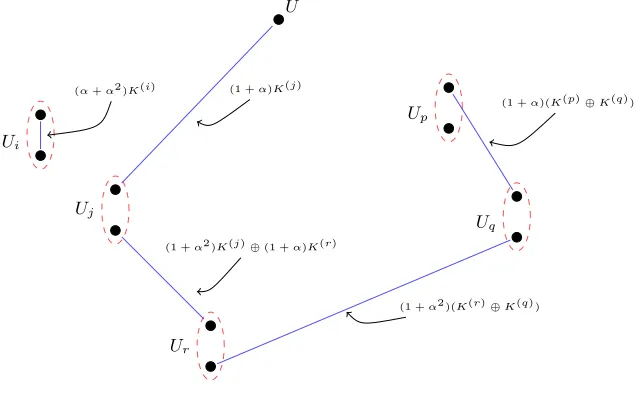
4. Build a graph where vertices represent the keyed and unkeyed users. More precisely, each user is represented by two vertices as for each user we use two different functions to build chains. Whenever a collision is obtained between two chains, add an edge between the corresponding vertices. This edge is labelled by the relation between the keys as explained in the previous step. An example of the graph can be seen in Figure 3.
Ui
Up
Uq
Ur
Uj
U
(α+α2 )K(i) (1 +α)K(j)
(1 +α2 )K(j)⊕(1 +α)K(r)
(1 +α2 )(K(r)⊕K(q) )
(1 +α)(K(p)⊕K(q) )
Fig. 3.Example of a giant component
Analysis of the attack. From [6] we know that in a group ofN1/3users we expect to recover almost all keys by doingc·N1/3 queries per user (where cis a small arbitrary constant) and N1/3 unkeyed queries. So, for Chaskey, we are able to recover almost all keys of a group of 243users by doing 243queries to the unkeyed user and 243 queries per user.
Improvement. We show here that in the case of Chaskey, the use of δ can be eliminated. This technique can be used when we search for a collision between two similar chains of two different users.
If we use a full-block message xand its corresponding ciphertexty we observe that:
αx⊕(1 +α)y=α(x0⊕(1 +α)K)⊕(1 +α)(y0⊕αK)
=αx0⊕
α(1 +α)K⊕(1 +α)y0⊕
α(1 +α)K
=αx0⊕(1 +α)y0
x
(1 +α)K
x0 π y0 y
αK
Fig. 4. The MAC algorithm Chaskey when single-block full messages are used (the subkeyK1=αKis used).
As previously, our goal is to define a function and build chains by using this function. Here, we define the functionFf1(x) as follows:
Ff1(x) =x⊕αx⊕(1 +α)f1(x) = (1 +α)(x⊕f1(x))
where f1(x) =K1⊕π(x⊕(K1⊕K)). We also assume that two plaintexts x1 andx2satisfyx1⊕x2= (1 +α)(K(i)⊕K(j)).
Thus, for two usersiandj for whom we detect a collision, we have that:
f1(i)(x1)⊕f1(j)(x2) =α(K(i)⊕K(j))
x1⊕x2⊕f (i)
1 (x1)⊕f (j)
1 (x2) =x1⊕x2⊕α(K(i)⊕K(j))
(x1⊕f (i)
1 (x1))⊕(x2⊕f (j)
1 (x2)) =K
(i)⊕K(j)
(1 +α)(x1⊕f (i)
1 (x1))⊕(1 +α)(x2⊕f (j)
1 (x2)) = (1 +α)(K
(i)⊕K(j))
Ff(i) 1 ⊕F
(j)
f1 = (1 +α)(K
(i)⊕K(j))
and so we observe that chains constructed byFf1 can become parallel and their
constant difference would be equal to (1 +α)(K(i)⊕K(j)).
A similar technique can be used when the last block is incomplete and so the keyK2 is used. Here, we observe that:
α2m⊕(1 +α2)τ=α2(m0⊕(1 +α2)K)⊕(1 +α2)(τ0⊕α2K)
=α2m0⊕
(((( ((
α2(1 +α2)K⊕(1 +α2)τ0⊕
(((( ((
α2(1 +α2)K
=α2m0⊕(1 +α2)τ0.
Thus, in this case, we define the functionFf2 as follows: Ff2(x) =x⊕α
2x⊕(1 +α2)f2(x) = (1 +α2)(x⊕f2(x))
where f2(x) =K2⊕π(x⊕(K2⊕K)). We also assume that two plaintexts x1 andx2satisfyx1⊕x2= (1 +α2)(K(i)⊕K(j)).
Equivalently, for two usersiandj, we observe that:
Ff(i) 2 ⊕F
(i)
f2 = (1 +α
So, chains constructed by Ff2 can also become parallel and their constant
dif-ference would be equal to (1 +α2)(K(i)⊕K(j)).
Thus, if we build our chains in the way presented here, we are able to have a small improvement and gain a factor of√2 on the calculation of our chains.
4.3 Variant of the previous attack with cross collisions
We show in this section that a variant of the previous attack is also possible. Indeed, we are able to apply a similar technique and we show that we can learn keys of two users when we detect one cross collision between them.
The attack works as follows:
1. For two usersUiandUjin a set ofLusers, build a constant number of chains, starting from an arbitrary plaintext, using the functionFfs, fors∈ {1,2}.
For each user, create some chains using the function Ff1(M) = f1(M)⊕ f1(M ⊕δ)⊕M and some chains using the function Ff2(M) = f2(M)⊕ f2(M⊕δ)⊕M. The construction of the chains stops whenf1(M)⊕f1(M⊕δ) andf2(M)⊕f2(M ⊕δ) reach a distinguished point.
2. For each chain, store the endpoints and search for a cross collision. A cross collision for usersUi and Uj and for two plaintexts M and M
0
is detected
whenFf(i)
1(M) =F
(j) f2 (M
0
). This indicates that the XOR of the two inputs
M⊕M0 is expected to be equal to:
K1(i)⊕K(i)⊕K2(j)⊕K(j)= (1 +α)K(i)⊕(1 +α2)K(j).
3. If a cross collision is detected, recover also the XOR of the corresponding outputs, which is equal to:
K1(i)⊕K2(j)=αK(i)⊕α2K(j).
4. Solve the system:
(1 +α)K(i)⊕(1 +α2)K(j)=∆1
αK(i)⊕α2K(j)=∆2
and thus recoverK(i) andK(j).
Analysis of the attack. This attack uses similar techniques to the attack described before. However, the innovation here consists of the fact that we are able to recover keys of two users, in a smaller group than before, by finding only a cross collision between them. More specifically, to find a cross collision between two users, it suffices to have a group of √4
N users and perform √4
5
Conclusion
In this paper, we presented key-recovery attacks against the MAC algorithm Chaskey. All attacks are using algorithmic ideas for collision based attacks of Fouque et al.presented in [6]. They all work when using single-block messages in the single or multi-user setting.
First, we show how to use these techniques to form an attack in the classical single-user setting. By applying this attack, we are able to recover the key of the user by doing 264 operations. However, this attack does not contradict the security claim of Chaskey. Next, we presented two attacks in the multi-user setting. The first one is able to recover almost all keys of a group of 243users by doing 243 queries per user. We also show that we can improve this attack and gain a factor of √2. Finally, the second attack in the multi-user setting, is able to recover the keys of 2 users in a smaller group of 232 by doing 232queries per user. We are able to achieve this new result by exploiting the use of two different keys for the last block of Chaskey.
References
1. Jean-Philippe Aumasson and Daniel J. Bernstein. Siphash: A fast short-input PRF. InProgress in Cryptology - INDOCRYPT 2012, 13th International Conference on Cryptology in India, Kolkata, India, December 9-12, 2012. Proceedings, pages 489– 508, 2012.
2. Alex Biryukov and David Wagner. Advanced slide attacks. InAdvances in Cryptol-ogy - EUROCRYPT 2000, International Conference on the Theory and Application of Cryptographic Techniques, Bruges, Belgium, May 14-18, 2000, Proceeding, pages 589–606, 2000.
3. John Black and Phillip Rogaway. CBC MACs for Arbitrary-Length Messages: The Three-Key Constructions. J. Cryptology, 18(2):111–131, 2005.
4. Orr Dunkelman, Nathan Keller, and Adi Shamir. Minimalism in cryptography: The even-mansour scheme revisited. In Advances in Cryptology - EUROCRYPT 2012 - 31st Annual International Conference on the Theory and Applications of Cryptographic Techniques, Cambridge, UK, April 15-19, 2012. Proceedings, pages 336–354, 2012.
5. Shimon Even and Yishay Mansour. A construction of a cipher from a single pseudo-random permutation. InAdvances in Cryptology - ASIACRYPT ’91, Fujiyoshida, Japan, November 11-14, 1991, Proceedings, pages 210–224, 1991.
6. Pierre-Alain Fouque, Antoine Joux, and Chrysanthi Mavromati. Multi-user Col-lisions: Applications to Discrete Logarithm, Even-Mansour and PRINCE. In Ad-vances in Cryptology - ASIACRYPT 2014 - 20th International Conference on the Theory and Application of Cryptology and Information Security, Kaoshiung, Tai-wan, R.O.C., December 7-11, 2014. Proceedings, Part I, pages 420–438, 2014. 7. Alfred Menezes. Another Look at Provable Security. In EUROCRYPT, volume
7237 ofLecture Notes in Computer Science, page 8. Springer, 2012.