Factors Facilitating L2 Acquisition in Learner-learner
Interaction in an English-medium University in Hong Kong
Ph.D. Thesis
Languages in Education
Institute of Education, University of London
By
I would like to take this opportunity to thank my university and the following people for their continuous and unconditional support for my study.
Firstly, I should thank Dr. Rob Batstone, my supervisor, for his meticulous supervision. He always helps me to organize my thoughts and glves me his insightful comments. Moreover, he shows perfect patience in reading my work.
Secondly, my debt is also owed to Dr. Guy Cook, Head of Languages in Education, for his comments on my thesis.
Thirdly, my thanks should be given to Professor David Nunan, Director of the English Centre, for supporting his staff to pursue their studies.
Fourthly, I am grateful to my colleagues at the English Centre, the University of Hong Kong, and my friends at the Institute of Education, university of London; particularly Ms Nim yin Chan, Mr. Max Hui-Bon-Hua, Dr. Agnes Lam, Ms Dora Pao and Mr. Fred Murphy. They gave me
full support when I was staying in London.
Fifthly, I would like to thank the University Staff Commi ttee for approving my vocational training leave and providing me with financial assistance.
The aim of the thesis is to study the ways in which factors regulating communicative tasks, particularly strategy use and planning time, could be beneficial to L2 acquisition. I hope that the study will have some contribution to make to the study of L2 acquisition and will throw further light on task-based learning and pedagogy, with particular reference to L2 learning at university level in Hong Kong.
Acknowledgements 1
Abstract ii
Table of contents 111
...
Chapter One
Abstract of Chapter One 1
Introduction 2
(1) Background information on Hong Kong and its 3 education system
(2) Role of English in trade and commerce 6 (3) Role of English in government documents 7
(4) Use of English in education 8
(5) From a 'second' language to a 'foreign' language: 9 A change of status
(6) Some observations on the teaching and learning of 10 English in Hong Kong L2 classrooms
6.1 Gaps between L2 learning in classrooms and 11 public examination requirements
6.2 Learning of English in classrooms 12 Interactions between teachers and learners
in schools
6.3 Language problems of L2 learners at 14 university : Oral interactions
6.4 Enhancing language use at university 17
Chapter Two
Abstract of Chapter Two
Introduction
Chapter Two (a)
(1) Acquisition of L2 in natural settings 1.1 Obtaining comprehensible input
1.2 Producing comprehensible output
20
21
22
23
(3) Means to facilitate better interaction and better
L2 output 36
3.1 strategy use
3.1.1
3.1.2
Functions of strategy in interaction Domains of strategy use
3.1.2.1
3.1.2.2
strategies as discourse process for negotiation strategies as cognitive process to avoid
communication breakdown 3.2 Communicative tasks
3.2.1
Chapter Two (b)
Factors facilitating 'pushed output' or 'stretching' in tasks
3.2.1.1 Task types 3.2.1.2 Time Pressure
36
37
40
41
43
47
49
52
55
(1) Limitations of communicative tasks for L2 57 acquisition
(2) strategy use in interaction for L2 acquisition 58 (3) Planning time in interaction for L2 acquisition 64
(4) Research questions 66
Chapter Three
Abstract of Chapter Three 68
Introduction 69
(1) Rationale of research design 69
1.1 Controlling factors 69
1.2 Controlling task types 69
1.3 Categories 69
(2) Method of study 70
(3)
2.3 Data collection techniques 73
2.4 Procedures 73
2.5 Conventions of transcription 76
2.6 Categories 77
Findings 81
3.1 Divergent task: Length of turns, variety 81 and complexity of syntax, variety of lexis
and discourse structure
3.1.1 Length of turns 82
3.1.2 Variety and complexity of syntax 82
3.1.3 Variety of lexis 89
3.1.4 Discourse structure 90
3.2 Convergent task: Length of turns, variety 95 and complexity of syntax, variety of lexis
and discourse structure 3.2.1 Length of turns
3.2.2 Variety and complexity of syntax 3.2.3 Variety of lexis
3.2.4 Discourse structure
3.3. strategies used in the discourse of learner-learner interaction
3.3.1 Paraphrase and example giving : for modification of the intended meaning
initiated by the speaker 3.3.1.1
3.3.1.2
3.3.1.3
Modification of the
intended meaning through paraphrasing one's
utterance (self-paraphrase)
Modification of the
intended meaning through paraphrasing the
interlocutor's utterance (other-paraphrase)
Modification of one's intended meaning through example giving
95
96
97
99
106
106
107
107
3.3.3
helping out : Modification of the intended meaning triggered by the interlocutor
Correction : Modification of the intended meaning and linguistic expression through sUbstitution of morphemes and key words
3.4 Planning time in interaction 3.4.1 Length of turns
3.4.2 strategies used in interaction 3.4.3 variety of syntax
3.4.4 Accuracy of L2 3.4.5 Variety of lexis 3.5 Interview results
3.5.1 Interviews - Part I 3.5.2 Interviews - Part II 3.5.3 Interviews - Part III 3.6 Retrospection
3.6.1 Summary of retrospections Chapter Four
Abstract of Chapter Four Introduction
(1) Relationship between communicative tasks and discourse structure
(2) Relationship between communicative tasks and strategy use for L2 acquisition
114
116 117 118 122 126 129 137 138 140 141 142 143
145 147 147
150
2.1 Causal relationship between communicative 150 tasks and strategy use
2.2 Assisting L2 acquisition in learner-learner 152 interaction through strategy use
2.2.1 Functions of clarification request and comprehension check
2.2.1.1 Triggering more L2 output
152
(3 )
(4)
2.2.2
2.2.3
2.2.4
Functions of helping out
Functions of paraphrasing one's idea or the interlocutor's idea, and
example giving
Functions of self correction and other correction
Planning time and second language acquisition 3.1 Effects of planning time
·
·
from thesubjects' responses
3.2 Effects of planning time
·
·
from quantitative and qualitiative data3.3 Effects of planning time on the use of a variety of syntax
3.4 Effects of planning time on the use of a variety of lexis
3.5 Effects of planning time on strategy use
Other factors influencing the use of L2 ln
.
communicative tasks158
159
163
165
165
167
167
168
169
171
4.1 Choice of topics 172
4.2 Limited linguistic ability and confidence 172 in manipulating L2
4.3 Task instructions 173
4.4 Role of individual learners' differences 174
4.5 Role of teachers 177
Chapter Five
Abstract of Chapter Five 181
Introduction 182
(1) Theoretical reflections 182
1.1 Implications of the study for task-based 182 learning theory
1.1.1 Interdependent relationship between 183 task types, planning time, strategy
(2)
(3)
(4)
learning
1.2 Implications of the study for L2 acquisition
1.2.1 Exploring L2 acquisition from a discourse approach
185
185
1.2.2 Exploring L2 acquisition from an 186 output perspective
1.2.3 Exploring the effects of planning 187 time on L2 syntactic development
Limitations of the study 2.1 Research design
2.2 Data collection techniques Practical reflections
3.1 Pedagogic implications for L2 learning at university in Hong Kong
3.1.1
3.1.2 3.1.3 3.1.4
3.1.5
Encouraging undergraduates to
produce more L2 output and stretch lexico-grammatical resoures
Using tasks in the classroom Manipulating planning time Encouraging strategy use in context
Requiring a re-interpretation of teachers' and learners' roles and a re-distribution of
responsibility between teachers and course-designers
Final comment
188 188 189 192 192 192 192 193 194 195 197
Bibliography 203
Appendices (1)
(2)
(3 ) (4)
Results of the interviews
Retrospections
Interview questions
convergent task - Rosy Fashion company
Divergent task - community Education commission
(6) More examples to illustrate the discourse structure of the convergent task
(7) Subjects' drafts
(8) Tables 1-3
(9) Communication strategies - convergent task (10) Communication strategies - divergent task (11) First discussion - convergent task
(12) Second discussion - divergent task
(13) Syntax - convergent task
(14) Syntax - divergent task
255
260
264
267
280
286
309
328
Abstract of Chapter One
Chapter one describes the environment of learning English as a foreign language (L2) in Hong Kong, and the communicative competence of Hong Kong L2 learners. The one-way teacher-student interaction in Hong Kong L2 classrooms and the examination-oriented teaching approach limit the opportunities for learners to produce clear, precise and accurate language output. In contrast, the oral papers of the two major public examinations require learners to interact in communicative tasks. University education, particularly in an English-medium university, requires students to carry out academic discussions in English in tutorials and English enhancement courses. The business and professional world also requires graduates not only to listen to instructions but also to express opinions and communicate with clients. In this light, it appears that there is a huge gap between most English teaching, learning, testing and the needs of the real world.
Chapter One Introduction
In this chapter, I will give some background
information on Hong Kong university students' (L21
learners) linguistic and communicative ability, and review
the prevalent teacher-dominant and product-oriented
teaching and learning approaches at school. Many Hong Kong
university students have learnt English (L2) for 13 years and a majority of them are from the so-called
English-medium schools. English is a compulsory subj ect in the
school curriculum in Hong Kong. Nonetheless, many Hong
Kong university students still lack confidence in using the
target language to express and argue. They may have
reached the advanced level of English prof iciency in some aspects, but they sti 11 experience diff icul ties in coping with the language demand of the university in other aspects
when they have to use English to discuss in the tutorial sessions of their disciplines, or in groups in English
enhancement classes.
The description forms the basis of the present study of an alternative means to promote language use in view of the dissatisfaction with the current teaching and learning
situations, among teachers (especially those teaching at
tertiary institutes) and in the professional world. This
dissatisfaction gives me a very strong incentive to explore the process-learning approach, which can provide chances for L2 learners to develop their language use and to boost
confidence in manipulating the target language through
interactions (in pairs, groups or with teachers) at
university. Engaging learners in tasks in which they can
acquire the target language from the process of
communication seems to be an alternative to the
product-oriented approach. Experience of such a method is
significant to university students who are expected by business community leaders to be able to exchange ideas
effectively face-to-face with customers or English-speaking
counterparts. However, the effects of this approach
require careful investigation. I hope this study of an
alternative means, that is process-learning, can throw
light on L2 acquisition and contribute to more effective language teaching at university level in Hong Kong.
The following sections give a glimpse of the Hong Kong
education system, the social environment outside the
classroom, the gaps between teaching and learning and some observations on the language problems of L2 learners who have entered the university.
(1) Background information on Hong Kong and its education system
Hong Kong is regarded as a meeting point between East
and West. It blends oriental and occidental customs and
social behaviour. Unlike Singapore, which has decided that
English should be the dominant language in communication in
addition to Mandarin and other languages used in the
community and households, the Hong Kong Chinese are
preserving their strong 'homogeneous ethnical and cultural
identity' (Miller 1990). About 98% of Hongkongers are
Chinese and the majority of Chinese in Hong Kong speak
, Cantonese', which is regarded as the ' vernacular' spoken language. Conversations in Chinese households and informal
chats in offices are in Cantonese. Cantonese is the
predominant language in the mass media in recent years and
is popularly spoken in the streets. The oral language is
one of a host of Chinese dialects. The written form for
work and study is modern standard Chinese.
In Hong Kong, children who have reached the age of six
will start receiving
followed by five years of matriculation level
SlX years of prlmary education,
of secondary education and two years
can receive three-year university or post-secondary
education in one of the seven tertiary institutes. The first nine years of education are free and compulsory.
There are two main types of school : Chinese-medium
(predominantly using Cantonese speaking) and
English-medium. The first type of school uses Chinese textbooks
for all subjects and Chinese is the medium of instruction.
The second type of school uses English textbooks, and
English is the medium of instruction except for two
subjects : Chinese and History of China. The second type of
school is most welcomed by parents because a good command of English guarantees brighter studying opportunities and careers. Students who have finished five years of secondary education have to sit for a public examination called the Hong Kong certif icate of Education Examination (hereafter
called HKCEE). Likewise, students who prepare for
university education need to sit for a joint university examination called the Hong Kong Advanced Level Examination
(hereafter called HKAL). Successful candidates can enter
one of the seven tertiary institutes including six
universities, and one institute of education for non-degree courses. The six universities are the University of Hong Kong, the Chinese University of Hong Kong, the University
of Science and Technology, the Hong Kong Polytechnic
University, the City University of Hong Kong and the Hong
Kong Baptist University. The University of Hong Kong
remains as the only English-medium university. English was once the dominant language in government documents and law; and the most popular medium of instruction in schools.
Nevertheless, with the approach of 1997, when Hong Kong
will be returned to China, Chinese has apparently been
recognised as an alternative official language, enjoying an
equal status with English. A government senior education
off icer for research has reminded people of the need of
both Chinese (he refers to Mandarin because Mandarin is the official language in Mainland China) and English in job markets and for survival, highlighting the need to make a
special effort to be proficient in both languages (Moy
English is used 1n Hong Kong for historical reasons.
.
Hong Kong has been a British colony since 1842 although it will revert to Chinese rule in July 1997. In the meantime, English 1S still.
enJoY1ng.
.
government and education,
a but
privileged the status
status 1n law,
.
of English and Cantonese after 1997 has not yet been explicitly spelt out.No one is certain about the language future. At the moment no decision has been made about replacing English as an off icial language in law, government and education. Although i t is agreed between China and the United Kingdom
in Article 9 in the Basic Law that the use of English is allowed 1n
.
addition to Chinese for the executive, legislature and jUdiciary 1n Hong Kong, which will be.
a special administrative region of China, the language issue is not dealt with and no final decisions have been made on the language future in the special administrative region. But one can argue that Hong Kong is still heading for a continued bilingual future because it acts as an intermediary between China and other countries in business and finance (Mao 1992, Miller 1990).English 1S one of the compulsory subjects in both primary and secondary schools. The rationale of learning English in schools in Hong Kong has been proposed explicitly and stipulated in the Syllabus for English (Form one to Form five) by the Curriculum Development Committee of Hong Kong (CDC)2. The principal aim of learning English is to develop the maximum degree of functional competence in the domains of use which are appropriate to Hong Kong's situation (Syllabus for English 1983:8). 'Functional competence' refers to 'the ability to carry out communication tasks successfully in English' and the domains of use specify the role of English in trade and commerce (workplace); in pleasure and entertainment; in
official documents and in the education system'. The focus of the curriculum has been shifted from grammar translation and aUdiolingual methods to more communicative language learning. Nevertheless, many classrooms are still dominated by traditional teaching methods, and learners lack sufficient opportunities to use English. As a result, school leavers find i t difficult to cope with the language demands of the professional and commercial world due to changes in the economic structure of Hong Kong.
(2) Role of English in trade and commerce
Tourists in Hong Kong come from different parts of the world. English is the main lingua franca for the tourist industry, at the airport, hotels and all holiday resorts. since Hong Kong is an international industrial and commercial business centre, it comes into contact with many countries
dealings
and with
English
arrangements for
most the
is the maln language
.
ln business.
of these countries.agreements and supply of
Contracts, technical services are all made ln English. Resul ts of numerous surveys on the use of English in the workplace have conf irmed the importance of English and the strong motivation to learn better English for a future career (Yau, Lee and Yau 1992). In the meantime, Hongkong' s economy is changing from being based on industries requiring mechanical manipulation of objects to being based on industries requiring constant expression of personal opinions and negotiation on alternatives. In view of the change from labour-intensive industry to service industry and new expectations from workers, the newly developed industries and expanding commercial centre require workers to be able to express opinions and negotiate with English-speaking counterparts, and not to be submissive. This requires richer language use and higher quality of L2 output so that messages can be effectively transmitted. It has been pointed out in the Education Commission Report
This 1S
·
speaking Asian countries such as Singapore.because Hong Kong workers use Cantonese for casual conversations among themselves,
business transactions only (both actual fact, English 1S
.
notand English in formal written and spoken). In used the whole time 1n business. Workers need to shift from English to Cantonese
.
.
or V1ce versa 1n the office. Therefore, developing communicative competence in English is not an easy task .
In V1ew of the continuing significance of English
.
1n·
commercial and industrial sectors, many local businessmen complain about the deteriorating standards of English of school leavers at all levels. In response to public complaints about the deteriorating standard of English in the territory, the Universities and Polytechnics Grant Committee (hereafter UPGC) , which is a government body to decide on funding for higher education inallocated funds to run English language
Hong Kong, has
·
programmes 1n tertiary institutions. The funds enable such institutions to provide more intensive English enhancement courses to tertiary students with a view to enhancing their communicative competence as far as possible.(3) Use of English in government documents
English has been the official language used 1n
.
.
circulars, recorded and written documents Slnce 1842. communication with senior staff requires a good command of spoken English. However, with the run-up to 1997 and the increasing number of popularly elected Legislative Councillors in the Legislative Council , Cantonese 1S regularly used in debates in the Council. Recently, more government documents have contained Chinese versions. In the court of law, Cantonese is also increasingly used by people who do not feel that they are able to speak English3 .
(4) Use of English in education
English was once the dominant medium of instruction in most secondary schools. with the introduction of the new
language policy in the mid 1980s, schools were encouraged to become Chinese-medium schools and were provided with additional funds and teachers to strengthen the teaching of English if they chose to use Cantonese as their medium of instruction. Some secondary schools have given up English as the medium of instruction, and English is spoken only in English lessons. Although some English-medium schools remain unchanged in their policy on the medium of instruction, teachers actually adopt a mixed-code approach in teaching English and other non-language sUbjects. Textbooks, written work and examinations are in English but teachers use Cantonese to explain the concepts and vocabulary. These confusing learning and teaching processes have prevailed in Hong Kong classrooms for many years. The same situation was described by Hinton (1976) who observed Hongkong secondary schools two decades ago.
are more optimistic about their competence English than their teachers.
.
ln the use of
(5) From a 'second' language to a 'foreign' language : A change of status
In Hong Kong, English used to be regarded as a 'second' language among local members of its social elites, and was commonly perceived as representing authority. However, both the education system and the professional sectors have recently become open to people from a much wider spectrum of socio-economic backgrounds. Although these two sectors lay stress on the importance of English, to most people of Hong Kong today, English is increasingly experienced on the personal level as a
(Miller 1990) . Everyday household
'foreign' language conversations and conversations in the streets are conducted in Cantonese, although some educated Hong Kong people enjoy including one or two English words in conversations, symbolising 'status' and 'prestige'. Cantonese is increasingly used in the courts of law by people who do not feel able to speak English. It is also regularly used ln the Legislative Council debates. Thus, English is not spoken in everyday contexts and there are few opportunities for learners to practise and use the language. Learners only know the target language through guided and structured discovery, mainly restricted to classroom contexts. Therefore, some educationists (Lord 1987) and an increasing number of English-speaking expatriates working in Hongkong have remarked that English in Hongkong as a whole is not a second language, but a foreign language. English in Hong Kong has become a foreign language and is learnt in a foreign language context in which almost all students come from monolingual cultural backgrounds and receive L2 input mainly from teachers only. The motivation to learn in a
(6) Some observations on the teaching and learning of English in Hong Kong L2 classrooms
Cries and complaints about the standard of English attract the attention of curriculum designers, researchers and teachers investigating the reasons for the deterioration of the language of school leavers. Such public complaints often result in attempts to analyze and reconsider the teaching and learning processes in schools in which students spend most of their language learning time. Since the 1980s, communicative language teaching has been advocated. Students are no longer taught to work on decontextualized sentence structures, but are required to demonstrate the ability to read, write, listen and speak in simulated real-life situations. This is supported by the design of examination papers which focus on the use of English for communication. For instance, the oral component of the HKCEE encourages learners to use the target language to interact with each other and to work on a given task. Similarly, an oral component was included in the university entrance examination syllabus in 1994;
learners are required to discuss a study-related or work-related situation in which there is a problem to be solved or a task to be addressed, and to use English for transactional purposes. The two oral components require learners to demonstrate a wide range of conversational skills, namely turn-taking, topic control, repairs, clarifying, questioning, expressing feelings and judgements. The foci are on both fluency and accuracy. The revision of the examination syllabus encourages learners to produce more accurate and appropriate L2 output. In the light of the demands of public examinations for learners' communicative competence, why are employers still not
with school leavers' and graduates' language satisfied
6.1 Gaps between L2 learning ~n
.
classrooms and publicexamination requirements
Owing to the stereotyped classroom discourse and a number of internal and external factors restricting the
learning of and exposure to English in the territory, it is unrealistic to expect Hong Kong learners of English to have ample opportunities to articulate thought, establish self image as English speakers, practise conversational skills, apply strategies for communication problems for group discussions.
the thrall of very little
since school teachers and students live under examinations, they can
time for discussion
arrange and afford work and language activities; for fear that these activities will take away too much class time and make their work more difficult. As
a result, one-way teacher-centred communication is prevalent.
6.2 Learning of English ~n
.
classrooms.
.
between teachers and learners in schools
Interactions
Sinclair and Brazil (1982), Wolfgang (1986) and Young (1992) have described the general and typical interaction pattern between teachers and students in most L1 and L2 classrooms across different cultures.
discourse,
Teachers navigate and def ine the and direct
acceptable
the classroom
responses. Teachers expect to take the initiative role while students do not expect to have to
.
.
glve any response 1n any situation. Teachers will use strategies such as description to explain the meaning of some abstract nouns but there is no need for students to use similar strategies to explain or paraphrase the message because it is the teachers' job.
their responses are minimal and
Even if students respond, short. They comply with whatever they are required or expected to do. Rarely 1S
.
there negotiation or navigation between both parties4The interaction pattern between language teachers and students in Hong Kong EFL classrooms in schools is similar to the researchers' descriptions. This limits the opportunities for learners to produce more language output and better language use. The interaction pattern has remained unchanged for decades, despi te advocacy of communicative language teaching in the territory since the 1980s. Many English teachers still stick to the direct grammar teaching approach in order to cover the prescribed syllabus and prepare learners for public examinations in secondary schools; this results in reliance on teacher talk. It 1S a common phenomenon that Hong Kong English
4 Allwright R.L. (1984) describes four modes of participation in
teachers do most of the talking, initiate very direct questions, seek response from individual students and evaluate their response, while students listen. In this climate, language teachers concentrate on instilling 'knowledge' (Bialystok and smith 1985) and the rules (Widdowson 1979) of the target language, and there are few opportunities for students to master the
(Bialystok and smith 1985) or 'procedures'
'control' aspect (Widdowson 1979) of the target language, or to practise the five aspects of management needed for language learning: turn management,
topic management, task management, tone management and code management (Allwright 1984). In short, Hong Kong EFL
learners are often encouraged to develop receptive skills and are deprived of the opportunity to produce the target language, to stretch their linguistic ability, to elaborate or modify their ideas in appropriate contexts, or to use strategies which help them produce more precise language. To put the description in another way, learners are encouraged5 to communicate with reduced goals6 and silence; they do not take much ini tiati ve in learning and do not have much confidence in using the target language to express ideas and feelings. In some cases, learners might retreat to their mother tongue for expreSSlon.
.
A very recent study on classroom discourse in eight Hong Kong English classes (Pennington 1995) has also confirmed that learners are inclined to use more Cantonese than English during their discussion at school. They use English only when they are prompted or asked to respond in English. Itis admitted that Cantonese is used for the purpose of negotiation of meaning while English is used for display
5
6
Teachers might not intend to encourage students to interact with reduced goals or silence. However, the teacher-centred approach and authority might not be conducive to the expression of ideas.
purposes including classroom rituals (1995:94). Pennington
(1995) suggests encouraging learners to practise strategies for interacting in the classroom, for instance, nominating
each other for responses, commenting on each other's
responses and asking for clarification from the teacher in English and each other, so that they will be more likely to
speak out. Too much teacher talk probably inhibits
language development, and learners may become proficient in some aspects (for instance receptive skills) but remain weak in other aspects (for instance productive skills). This situation has been widely condemned by the language
experts and educationists who have studied language
learning and the medium of instruction in Hong Kong (e.g. Hinton 1976, Tsui 1992).
6.3 Language problems of L2 learners at university: Oral interactions
After students have learnt English as a subject ln
.
school for 13 years (since beginning primary education), it is assumed by university teachers that many of them have reached an advanced level of proficiency in some aspects. However, when school leavers enter tertiary education, they
still lack confidence and experience difficulties in
expressing ideas in English in tutorials and group
discussions (Littlewood, Liu and Yu 1995). Some learners
who read their degrees at an English-medium university, for example, the University of Hong Kong, might experience more
difficulties than those studying at the other six
institutes. A recent large scale study (Littlewood, Liu
and Yu 1995) on learning experience and proficiency of
students entering tertiary education in Hong Kong shows that many university teachers are not satisfied with some
aspects of the language proficiency of learners. The
research language
students'
surveyed students'
proficiency (mainly language ability
and
.
lnas
teachers' perceptions of
the four skills), rated assessed by teachers and
students themselves, and interviewed teachers.
found that teachers consistently rated
It was
significantly lower than students rated themselves.
Concerning speaking skills, teachers valued spontaneous
speech in tutorials and discussions, while students valued
planned speech. Students thought that they could
communicate more successfully with planning than with no
planning. Teachers expected students to raise questions
and to produce impromptu speech in discussion. However,
students felt frustrated in expressing ideas and discussing
with teachers and peers in tutorials. They were not
inclined to adopt the communication strategies which they
would use when they used their mother tongue. Therefore, teachers perceived that students had difficulties in these
two aspects of oral interaction. According to the in-depth interviews with teachers, they attributed the cause to the
poor English language standard of some primary and
secondary school teachers, mixed code teaching,
insuff icient requirements and opportunities at uni versi ty for group work in English and even low expectations of
students' English proficiency from some university
teachers. with a view to encouraging learners to use
English in academic communication, some action learning
projects have been developed which explore strategies to enhance the use of English in group discussions at the tertiary institutes. The aim is to develop the proficiency
of these students by engaging them in interactions. It is
argued by many action learning project researchers that students rely on their mother tongue ln discussions in
English enhancement classes (e.g. Lee 1995) (For English
enhancement classes, see 6 . 4) . Whey they are asked to
comment on an issue or to express their opinions, they are
inclined to speak little; sometimes they may avoid getting
into the topic. They prefer to be listeners and observers,
and to converse in Cantonese in English enhancement classes
when the teacher is not around. It seems that L2 learners
do not have the tendency to grasp the opportunity to make
active use of the target language, even in English
enhancement classes. They begin to experience difficulties
to the time of writing, I know of very few solutions which have been suggested to overcome these difficulties.
Littlewood et al (1995) suggest some ways to improve the English learning situation at the tertiary institutes. One of these is to remind learners of the kinds of strategies needed for successful spoken communication, or to teach them if necessary.
'But research has shown that, when uSlng English, students tend not to adopt communication strategies which they would normally use when they use their mother tongue. . .. Is there then a case for reminding our students of the kinds of strategies (e.g. repair strategies, turn-taking, verbal/non-verbal feedback) needed for successful spoken communication? In some cases, there may even be a need for teaching specific language for doing these things. For example, some students may need to be taught the language of clarification and circumlocution in English.'
(Littlewood et al 1995:6)
A second way is to create a supportive classroom environment to enable learners to transfer linguistic knowledge to active language use. Students should be given time, patience, understanding and encouragement, practice opportuni ty and conf idence. To achieve this, structured group work and a low risk environment to encourage greater use are crucial.
'After 13 years of English learning and in some cases 7 years of English medium university, HK students have amassed a body of knowledge about the English language. Given time, patience, understanding and encouragement, they would be able to make active use of that knowledge for very successful academic communication. Two critical factors in this transition from knowledge to active use are practice opportunity and confidence. Carefully structured group work which requires the use of English in a low risk environment would boost students' confidence in the language.'
6.4 Enhancing language use at university
Given that many university teachers, the professional and the business world are not satisfied with the standard
of English of Hong Kong school leavers (sometimes even
university graduates) , the Hong Kong government is
investing millions of dollars in language, particularly at
the tertiary level, to enhance undergraduates' language
proficiency. The seven universities run enhancement
courses to improve their students' language prof iciency .
The Uni versi ty of Hong Kong (hereafter HKU) , which is an English-medium university, has
for all undergraduates since offered to the undergraduates
provided enhancement courses
1992. One of the courses at the Faculty of Social sciences is known as 'English for Academic Communication'.
The obj ecti ves of the course are to provide chances for students to learn how to write academically, to communicate
ideas and to learn independently. The course comprises two
written projects: the first one is about an area of their interest, and the second one is related to their discipline
of study. Students work in groups, discuss the topic, look
for relevant information from different sources and write
up the report. The course is project-directed. Teachers
are given teaching materials which familiarise students
with the different parts of a report and relevant language
input. There are tutorials and group discussions in the
classroom. The teaching schedule and materials may be
adjusted by the teacher to meet the needs of his or her
students. Nevertheless, students are so used to the
teacher-centred approach while at primary and secondary
schools that they need to take some time to get used to
expressing their ideas in front of the group and the
teacher, particularly ln English. As described previously,
they need to face a new learning approach and different
teachers' expectations of their language ability at the
university. Their unwillingness to speak in the tutorial
leads to unfavourable comments on their language ability.
incapable of learning 7 • It may be caused by individual
differences in personality or language ability, and the change of social context. The language demand in tutorials and group discussions at the university is different from the students' previous classroom experience at school. The gap between the previous classroom and current expectations of language and participation could be bridged by encouraging students to interact with one another in English in English enhancement classes. But there are a number of questions waiting to be solved.
•
•
•
•
How can teachers encourage learners to use English and take the initiative to talk ln
·
.
English enhancement classes, glven that many learners are used to teacher-centred and examination-oriented approaches?
How can a low risk environment be created ln
·
order to boost students' confidence in the language and produce more L2, as Littlewood et al suggested (1995)?What are the effects of engaglng learners
.
ln·
groups or pairs in language use?will learners enrich their current lexico-grammatical resources through interaction?
• What is the most conducive context for learners to enrich or improve their linguistic resources?
These questions motivated me to look at al ternati ve means to facilitate L2 acquisition for L2 learners at university level. The review of relevant literature concerning L2 acquisition forms the basis of the empirical research.
To conclude, Hong Kong L2 learners only have limited chances to use the target language under the dominance of
teacher talk at school. It is not possible to eradicate
the effects of teacher dominance in a fortnight at
university. One of the ways to overcome the dominance of
teacher talk and to enhance the low involvement of learners
might be to engage L2 learners to interact with one
another. In other words, it
context in which learners are their limited ability in order
is necessary to provide a pushed to use or stretch
to test L2 hypotheses in their learning process, and in which they feel comfortable
about using the language. If this is agreed, it is crucial
to understand how learners benefit from interacting with
one another in the classroom, particularly how this
approach facilitates better language use by Hong Kong L2 learners at university. All this gives me a very strong incentive to investigate the alternative means and its effects on acquisition, with a view to contributing to the teaching and learning of English at university level in Hong Kong, particularly to the English enhancement courses
Abstract of Chapter Two
Given the dissatisfaction with the ability of Hong Kong school leavers and university students to use English for work and study, their lack of confidence in using the language in spontaneous communication and the insufficient use of strategies to facilitate communication by undergraduates, there is a strong incentive for me to explore the ways to boost their confidence and assist them to acquire the target language.
There has been a growing interest in engaging L2 learners in tasks so that they could comprehend the target language and produce it in a meaningful way in second language acquisition. Therefore, in Chapter two, I start to examine the acquisition of L2 in process learning in contrast to product learning. Secondly, I investigate how strategy use, task types and time pressure can facilitate
Chapter Two
Introduction
The dominance of teacher talk 1n
.
Hong Kong L2 classrooms limits L2 learners' experience of using the target language. There are many chances to expose L2learners to a large amount of linguistic input, but there are limited chances to allow L2 learners to produce output at schools. L2 learners at university still lack confidence in using the language in spontaneous communication, and they rarely use strategies which they use in their mother tongue to facilitate L2 communication. As a result, university teachers and the professional world are not satisfied with graduates' English proficiency. Promoting output in process-oriented classrooms by engaging L2 learners in communicative tasks seems to be an alternative means to help them to acquire the target language. In interaction, L2 learners can use strategies to modify meaning linguistically in face of the interlocutor's linguistic demands for better and more precise expression; they can learn to manage communication breakdown in interaction and perhaps restructure the teacher-student relationship. In other words, the process-oriented learning approach or use of communicative tasksl is one of the means to provide a venue for learners to comprehend, manipulate, produce and interact in L2 (Nunan 1989) .
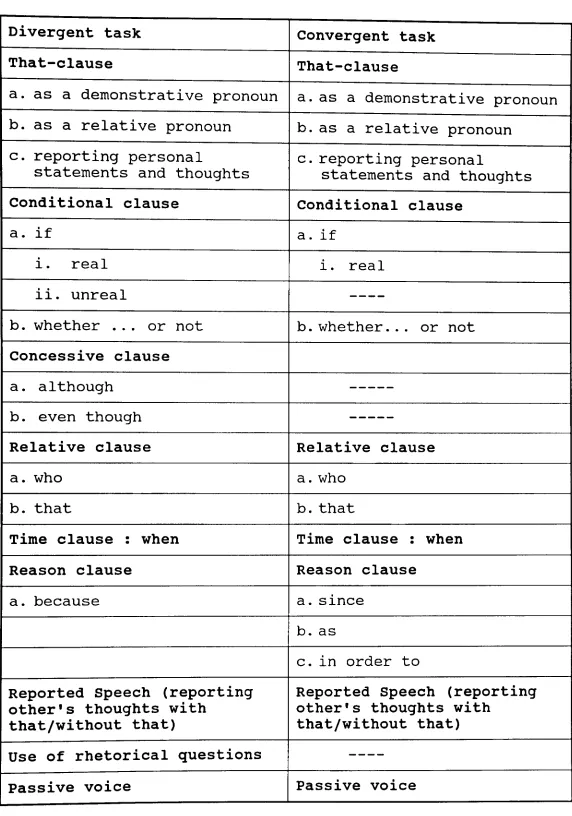
As some researchers have commented (e.g. Skehan 1996), meaning primacy or fluency in task-based learning, in which L2 acquisition is believed to be promoted in a more meaningful way through interaction in the use of different such discussion and debate,
.
achieved attask types as 1S
and complexity of L2
.
learner-the expense of accuracy 1n
learner interaction. Accuracy, complexity and fluency of L2 1n
.
learner-learner interaction 1n.
differentcommunicative tasks are indeed regulated by a number of factors. Task types, time pressure
three of these and their effects on
and strategy use L2 output quality
are are not adequately researched in the study of second language acquisition. However, it is agreed that Hong Kong L2
learners are not confident in communicating without planning, they are not inclined to use strategies in L2 communication, and researchers propose as reviewed in the
last chapter encouraging the active use of the language in a low risk environment. A study of the relationship between these three factors and acquisition is very relevant to Hong Kong context. The need for such a study has gained support from reviews of the literature and the Hong Kong L2 situations. Therefore, the questions of how the use of strategies and time pressure could be married in communicative tasks for richer and better L2 output quality, and could aid acquisition, are worth researching .
.
.
In Vlew of this, this chapter alms to set up background for the
relevant literature
empirical research on L2 acquisition
by
.
ln. .
revlewlngnatural
the the and classroom settings; and the factors of strategy use, time pressure and task types that regulate L2 output quality. Then, i t goes on to look at the way in which strategy use could marry with planning time in communicative tasks for more accurate, complex and fluent L2. The literature review forms the basis of the empirical research.
Chapter Two (a)
(1) Acquisition of L2 in natural settings
Generally speaking, two ways have been studied of how L2 can be acquired. The first way for L2 learners or non-native speakers2 to acquire L2 is to interact with native
speakers of the target language in natural settings with a view to obtaining comprehensible input and producing comprehensible output. The second way is to interact with L2 teachers or other L2 learners in classrooms. The following sub-section reviews the relevant literature on the first way so as to find out how comprehensible input can be best obtained and how comprehensible output can be best produced in interaction.
1.1 Obtaining comprehensible input
Krashen (1982:3) claims that obtaining input is necessary for second language acquisition. The input hypothesis, as suggested by Krashen, is the central part of his overall theory of second language acquisition. 'Input' seems to refer to the language which a child or a learner hears or learns through interaction with caretakers, teachers and native speakers of the language. Acquisition is glossed by him as 'a subconscious process
all important ways to the process children acquiring their first language.' (Krashen
identical in utilize ln
.
1982:1) In contrast, learning 'is a conscious process that results in 'knowing about' language'. The main difference between the two terms lies in the notion of 'consciousness'. Although the dividing line between the two terms seems to be clear, the distinction between ' conscious' and ' subconscious' is not as explicit as Krashen has defined. Children's acquisition of their first language seems to be not conscious to observers and analysts.
might be interpreted as ' conscious'
However, the process by children whenever the context requires them to make the effort; but their effort and concentration on the form of the language is relatively little. ' Acquisition' and 'learning3 " in my
view, also require children's or learners' effort and attention to the language, but to a different degree.
3
speakers of the target language and they do not have intuition of the rules and structures of the language.
'Input', in this thesis, mainly refers to the linguistic aspect, such as grammar and lexis.
There have been a number of theories and hypotheses which attempt to explain second language acquisition (hereafter L2 acquisition). The input hypothesis, which is a central part of an overall theory of second language acquisition, claims that humans acquire language in only one way by understanding messages, or by receiving 'comprehensible input' (Krashen 1982: 2) . It is argued by Krashen that humans acquire the rules of language in a predictable order and move from a current level, i, to the next stage, i + 1, by understanding input i + 1. The understanding and move from i to i+1 level is reached with the help of knowledge of the world, extra-linguistic information and previously acquired linguistic competence.
He illustrates the claim by referring to the contexts provided by caretakers and teachers. The two social agents provide different contexts, via 'here-and-now' context, visual aids and discussion of familiar topics. Therefore, what is essential for second language acquisition is
'input', and the input should be sufficient and understood by children or learners. If the input is 'sufficient' and 'understood' by children or learners, they will acquire the grammar of the target language. Instruction, in this
light, is redundant.
topics .... To be more precise, input is the essential environmental ingredient.'
(Krashen 1982:2)
Therefore, there is a
following from Krashen' s input hypothesis, widespread belief that input must be by learners and the more the input, the better comprehended
the second language is acquired. The notion of 'comprehensible input' is
quoted in Ellis 1985:157)
presented by Krashen (1981,
.
ln the form of the input hypothesis, arguing that for acquisition to take place, L2
learners need 'input' that might or might not be finely tuned. What is important for L2 learners is to understand the input, and 'understanding input' focuses on meaning and not language forms. Input that is 'comprehensible' refers to the input that is slightly ahead of learners' current second language ability, and which in turn benefits acquisition. In Krashen's term, it is 'i+1'.
Then, the next question lS,
.
how do children or learners acqulre.
the grammar of the target language? For learners of the target language, one of the ways for acquisition to take place lS.
to interact with native speakers of the target language. According to Richards, Platt and Weber (1985:188) , 'the intuition of a native speaker about the structure of his or her language is one basis for establishing or confirming the rules of the grammar'. Native speakers can provide comprehensible input when they interact with non-native speakers or L2 learners.other researchers, who also recognize the significance of comprehensible input (e.g. Long 1983c), explore the way in which comprehensible input is best obtained. From an interactive perspective, input can be obtained through negotiation. Negotiation, in second language research,
to resolve communication breakdowns and to work toward mutual comprehension'
(Pica et al 1989:65)
This process of obtaining input so as to aid acquisition is definitely different from
or iented approach adopted in L2 classrooms,
the
.
1n
product-which L2 learners are guided cautiously, by curriculum planners or practitioners, through learning activities and materials with a view to achieving the pre-determined learning outcomes. Long (1983c:212) mentions three methods in which input is made comprehensible. The first one is to use structures and lexis with which the interlocutor 1S
.
familiar; the second is to use a 'here and now' orientation in conversation, and linguistic and contextual information is used in caretaker speech; and the third is to modify the interactional structure of the conversation. It is believed that the second and the third methods are more likely to aid acquisition, because they can make unfamiliar input comprehensible and allow conversation to proceed. Native and non-native speakers' conversations in tasks provide baseline data for comparison with conversations between non-native and non-native speakers. Comprehensible input can be obtained through 'negotiation of meaning' and this can aid language acquisition. Negotiation of meaning takes place when native speakers make adjustments in their interaction with non-native speakers. It is glossed by Long and Porter (1985) as the collaborative work which speakers undertake to achieve mutual understanding using strategies of clarification request, comprehension and confirmation checks. Chaudron (1988:106) also glosses negotiation of meaning in a similar way, as reacting to the preceding discourse : clarifying, modifying, asking for clarification and so on.
Negotiation of meaning in communication 1S believed to
meaning, native speakers respond to feedback from native speakers by making interactional adjustments. the other hand, L2 learners can negotiate and also feedback on their use of the target language.
non-On
.
galn The interactional adjustments used by native speakers include the use of strategies that
reflect long term planning and some tactics that reflect spontaneity in order to make sure that the message is comprehensible. The interactional adjustments which affect how the topic is talked about have been identif ied (e. g. Long 1983a, 1983b). In the following diagram, Long
(1983c:214) accounts for the way in which conversations between native and non-native speakers4 lead to more comprehensible input and then L2 acquisition. This model is assumed to be applicable to all conversations between people at higher and lower levels of proficiency, such as caretakers and young children.
Diagram 1
Verbal
.
communl-cationinvolving two-way exchange of
information
opportunity for the less competent speaker to
1 - - - - ' provide feedback
on his or her lack of
comphrehension
1 - - - -....
Negotiated modification of the
conversation
Comprehen - ---+ Langl;laC}e
sible acqulsltion
input
of proficiency want to say by retreating to non-linguistic cues or by using short phrases to confirm the meaning. In such cases, the input is comprehensible to non-native speakers or to people at lower level of prof iciency; but the L2 input quality might not be rich. Negotiation of meaning can be achieved at the expense of accuracy and of extension of L2 learners' linguistic knowledge. It is also possible that negotiation of input might be comprehensible to the learner who seeks clarification, but not
.
.
comprehensible to the others if this 1S 1n a group
interaction. This comment has been made by Pica and Doughty (1985) when discussing the function
conversational adjustment in making input comprehensible a teacher-fronted activity.
'It must be emphasized, however, that the presence of any conversational adjustments in a teacher-fronted activity does not necessarily ensure that comprehension is enhanced for all classroom participants. It is possible that conversational adjustments serve to make input comprehensible only to individuals whose comprehension difficulty has triggered such modifications. For remaining students, the input may either be comprehensible in its pre-modified state or incomprehensible both before and after adjustments had been made. '
(Pica and Doughty 1985:246)
of
.
1nTherefore, the causal relationship between negotiation of meaning and comprehensible input that leads to L2 acquisition should be read cautiously. The model might be more comprehensive if negotiation of mean1ng
.
and comprehensible input could take into account the grammatical, syntactical and lexical use of L2.Although it is difficult to predict how input will facilitate better and richer L2 input, engaging L2 learners in communicative tasks in which there are more chances for negotiation of meaning and producing more fluent L2 appears
to be one of the means to facilitate L2 acquisition. Therefore, some researchers (e.g. Long 1981, 1983a, 1983b, Duff 1986, Porter 1986, Plough and Gass 1993, Pica et al 1987, 1989, 1991) have conducted a fair number of studies, reviewing the relationships among negotiation of meaning, input, contextual variables (e.g. task and interlocutor familiarity) and second language acquisition between native and non-native or non-native and non-native speakers in tasks.
1.2 Producing comprehensible output
Obtaining comprehensible input that is slightly ahead of one's second language ability (that is the i+1, in Krashen's term), or in the form of negotiation of meaning between native and non-native speakers, might be one of the plausibly suggested ways for L2 acquisition. Alternatively, there are claims in second language acquisition literature about the role of comprehensible output, which means
producing output that is understood by the interlocutor to supplement input (Swain 1985).
'Of the conclusions I will draw, one that I think is fundamental to our understanding of the role of input in second language acquisition is that although comprehensible input may be essential to the acquisition of a second language, it is not enough to ensure that the outcome will be nativelike performance. In fact, I will argue that while comprehensible input and the concomitant emphasis on interaction in which meaning is negotiated is essential, its impact on grammatical development has been overstated. The role of these interactional exchanges in second language acquisition may have as much to do with 'comprehensible output' as it has to do with comprehensible input.'
(Swain 1985:236)
Swain's claim (1982) is that comprehension of input is not sufficient for the acquisition of forms and structures.
.
message 1S understood, learners can pay their attention to
form. Comprehensible input is crucial because it allows
learners to focus on form after understanding the message.
What is missing in second language acquisition is the
consideration of the role of ' output' . She argues that
language output from learners assists second language
acquisition. It is through the process of manipulation of
L2 forms and structures that the second language is
enriched. Negotiation is only a trigger for acquisition;
when the meaning is clear, learners can pay attention to forms.
Learners can use their linguistic resources
meaningfully through output, especially speaking. Learners
need to test their input through output, and this is
necessary to benefit second language acquisition.
Therefore, L2 learners should be given opportunities to
produce comprehensible output. Learners can be pushed to
use alternative means to get across their message when they
receive some negative input. Negative input includes
clarification requests, explicit corrections and
confirmation checks, which are all indications that the
output is not well expressed. She further suggests
including the notion of being pushed toward the delivery of a message that is not conveyed precisely, coherently and
appropriated.
swain attributes three roles to output (ibid 248-9,
quoted in Ellis 1990:117):
'1. The need to produce output in the process of negotiating meaning that is precise, coherent and appropriate encourages the learner to develop the necessary grammatical resources.
2. Output provides the learner with the
opportunity to tryout hypotheses to see if they work.
3. Production, as opposed to comprehension, may help to force the learner to move from semantic
to syntactic processing. It is possible to
analysis of the input it contains. Production is the trigger that forces learners to pay attention to the means of expression.'
L2 output is the product of interaction. L2 output,
in Swain's definition, seems to focus on syntactical
processing, which can include a variety of
sentence structures that learners are familiar or not very
familiar with but are willing to try in negotiations. In
Swain's term, the use of a variety of structures is caused
by a pushing effect ln
.
interaction and is glossed as aneffort made by the learner to produce coherent and
appropriate expression and to ensure that the output is
comprehensible to or is understood by the interlocutor.
This form of output is described as 'pushed output',
represented in the form of using alternative syntax and
lexis. Nonetheless, the focus of 'output' is primarily on
the syntactic category, and not so much on meaning and lexical use6.
Recently, some studies (e. g. Pica 1988, Pica et al 1989) have researched how the interaction between native and non-native speakers led to 'pushed output'. Pica (1988) studied comprehensible output and supported the claim that
'pushed output' made the language become more grammatical
and morphosyntactic but with no new L2 items. It was
concluded that negotiation offered the learners models of
what output was like, rather than opportunities for
producing output themselves. In another research (Pica et
al 1989) the role of output in the process of second
S I am aware that Swain's definition of 'output' refers to syntactical processing. It includes sentence structures that learners are familiar or unfamiliar with. In order words, the 'output' is manageable by learners.