Attribute-Based Versions
of Schnorr and ElGamal
Javier Herranz
Universitat Polit`ecnica de Catalunya, Dept. Matem`atica Aplicada IV c. Jordi Girona 1-3, 08034, Barcelona, Spain
Abstract. We design in this paper the first attribute-based cryptosystems that work in the classical Discrete Logarithm, pairing-free, setting. The attribute-based signature scheme can be seen as an extension of Schnorr signatures, with adaptive security relying on the Discrete Logarithm Assumption, in the random oracle model. The attribute-based encryption schemes can be seen as extensions of ElGamal cryptosystem, with adaptive security relying on the Decisional Diffie-Hellman Assumption, in the standard model.
The proposed schemes are secure only in a bounded model: the systems admitLsecret keys, at most, for a bound
L that must be fixed in the setup of the systems. The efficiency of the cryptosystems, later, depends on this bound L. Although this is an important drawback that can limit the applicability of the proposed schemes in some real-life applications, it turns out that the bounded security of our key-policy attribute-based encryption scheme (in particular, with L = 1) is enough to implement the generic transformation of Parno, Raykova and Vaikuntanathan at TCC’2012. As a direct result, we obtain a protocol for the verifiable delegation of computation of boolean functions, which does not employ pairings or lattices, and whose adaptive security relies on the Decisional Diffie-Hellman Assumption.
Keywords:attribute-based cryptography, Discrete Logarithm setting, verifiable computation.
1 Introduction
Functional cryptography is emerging in the last years as a very interesting and powerful paradigm: decryptions or signatures can be now computed by several users, as long as they have enough rights, instead of by a unique user in possession of a secret key, as it is the case in the classical setting of public key cryptography. This more general setting of functional encryption seems much more suitable for real-life applications involving large amounts of different kinds of data, users and operations, such as storage and computation in the Cloud, big data analysis, social networks, or the Internet of Things.
Attribute-based cryptography is perhaps the particular case of functional encryption which has found more applications and, thus, has received more attention from the cryptographic community. In a typical attribute-based cryptosystem, the secret operation (signing or decrypting) can be performed only by users who hold a subset of attributes that satisfy some policy. Attribute-based cryptosystems must satisfy a collusion-resistance property: if a set of users, each of them holding attributes that do not satisfy the given policy, collude and try to perform the secret operation, they must fail to do so, even if the union of all their attributes satisfy the policy. This is the usual setting in attribute-based signature schemes [26, 28, 15, 4, 22] and in ciphertext-policy attribute-based encryption [7, 24, 25]. For encryption, the dual version of key-policy attribute-based encryption has also been defined and widely studied [20, 29, 9]: here the users’ secret keys are related to policies, and ciphertexts are related to subsets of attributes; the ciphertext can be decrypted by a secret key only if the subset of attributes in the ciphertext is authorized for the policy in the secret key. Although the notion of ciphertext-policy may seem a bit more realistic, it turns out that key-policy attribute-based encryption has found some interesting applications, for instance in the area of verifiable delegation of computation [30].
could in principle be implemented with RSA, as well. However, it is still desirable to study if attribute-based cryptography can be based on other classical techniques and security assumptions, like those in the traditional (pairing-free) Discrete Logarithm setting. The interest is both theoretical, to understand if more complex tools like pairings or lattices are necessary for building some cryptographic functionalities, and practical, because cryptosystems in the traditional Discrete Logarithm setting can be implemented in elliptic curves where elements in a group may have a shorter representation, which may lead to clear efficiency gains. We note that there exist (at least) two recent examples where the same problem of building cryptographic protocols in the Discrete Logarithm pairing-free setting has been considered, in scenarios quite close to that of attribute-based cryptography. In [2], for the problem of anonymous credentials systems, which is very related to attribute-based signatures; and in [1], for the problem of inner-product encryption, which is another particular case of functional encryption.
1.1 Our Contributions
We propose in this work the first (to the best of our knowledge) attribute-based cryptosystems which use techniques and security assumptions of the pairing-free Discrete Logarithm setting. For attribute-based sig-natures, the new scheme is proved secure (private and unforgeable) in the random oracle model, under the only assumption that the Discrete Logarithm problem is hard to solve. For attribute-based encryption, we design both a ciphertext-policy scheme and a key-policy scheme. The security of both schemes is proved in the standard model, under the assumption that the Decisional Diffie-Hellman problem is hard. With these security properties in mind, and also due to the similarities in their designs, it is natural to consider the new schemes as the attribute-based versions of classical cryptosystems like Schnorr signatures [33] or ElGamal encryption [14].
A positive property of the schemes is that they achieve adaptive security, meaning that the schemes are secure even in front of adversaries that choose the challenge input (messages, policy and subset of attributes) in the challenge phase. This is in contrast to selective security, where the considered adversaries choose the challenge input in the setup phase of the systems. A negative property of the new schemes is the fact that they are bounded: a boundL on the maximum number of secret keys generated by the system must be chosen in the setup phase. Once the system has generated Lkeys, the setup phase must be run again, to generate new public parameters. Furthermore, the efficiency of the schemes (for instance the size of the public parameters, signatures and ciphertexts, and the computational cost of the protocols) depends on this boundL. This may be a serious limitation for possible uses of the schemes in some real-life applications, like social networks, with a huge expected number of users. Therefore, a direct implementation of the new schemes could make sense only in quite closed applications, for instance in small companies or institutions.
As we explain in the next Section 1.2, it seems hard to avoid this limitation when designing attribute-based cryptosystems in the pairing-free Discrete Logarithm setting. Interestingly, the bounded-security prop-erty may be enough in some applications of attribute-based cryptography. Indeed, a generic tranformation from a key-policy attribute-based encryption scheme to a protocol for the publicly verifiable delegation of computation is given in [30], where the security level required for the attribute-based primitive is one-key security. Actually, authors of [30] mention as an open problem the design of one-key secure attribute-based cryptosystems with more efficiency or simplicity than the existing ones (which achieve unbounded security). Our results can be seen as an answer to this problem, because we show that nor pairings or lattices are needed in order to get one-key security. Combining our key-policy attribute-based encryption scheme with the con-struction in [30], one immediately obtains a protocol for the publicly verifiable delegation of computation of boolean functions, which does not require pairings or lattices, and whose adaptive security is based on the Decisional Diffie-Hellman Assumption.
1.2 Why to Bound the Number of Users?
realistic and common in the attribute-based literature, since the possible attributes in real-life applications are usually known in advance, and not so many. However, imposing a bound on the number of users is a very strong limitation, which restricts the possible application of the proposed schemes to particular situations with few expected users, for instance providing attribute-based features to a small company or institution.
The question at this point is: can we avoid this drawback (bounding the number of users) in an attribute-based cryptosystem which does not use pairings, where the parameters are polynomial on the number of attributes, and where security relies only on the Discrete Logarithm family of assumptions (including the Discrete Logarithm and Computational / Decisional Diffie-Hellman ones)? We give now some informal ar-guments which seem to indicate that the answer to the previous question is ‘No’. This will not be a formal (impossibility) result at all. In particular, our arguments are based on the current state-of-the-art in the area of digital signatures. Therefore, giving a final and formal answer to the previous question remains as an interesting and challenging open problem.
First of all, let us stress that we want to keep the parameters of the scheme polynomial on the (fixed) number N of attributes of the systems. If this is not a requirement, then it is quite easy to design attribute-based cryptosystems with the desired properties: if ˜P denotes the global set of attributes, let us just generate one pair of ElGamal / Schnorr keys (ski,pki) for each subset Ai ⊂ P˜. The set of public keys will form the public parameters of the attribute-based system. When a user requests a secret key for a subset of attributes S ⊂P˜, he receives the secret keysski for all subsetsSi⊂S. Note that the size of both the public parameters and secret keys are exponential onN. Later, for instance in the case of encryption, to encrypt a message for a decryption policy, one takes all the minimally authorized subsets {B1, . . . , Bk} for that policy (a basis), and encrypts the plaintext for all the public keys associated to these sets (using multiple encryption techniques to re-use the randomness). If a user is authorized, some subset Si in his secret key will match some of the subsets Bj in the basis of the decryption policy, and so he could use the corresponding secret key ski to decrypt and obtain the plaintext. A similar solution for the case of (Schnorr) signatures is straightforward. It is easy to prove the selective security of the resulting cryptosystems.
Taking apart these solutions with exponential dependence on the number of attributes, the best we can do is to include, in the public parameters, some elements for each of the attributes in ˜P ={at1, . . . ,atN}. Since we want to work in the (pairing-free) Discrete Logarithm scenario, where we have a public group G = hgi
with prime orderq, we can assume that we have some elements from Gin the public parameters, whereas the
master secret key contains the discrete logarithms (element inZq) of those values. So let us assume that the public parameters contain {(gxi,1, . . . , gxi,k}
ati∈P˜, for some value k (polynomial in N), whereas the master secret key contains the corresponding discrete logarithms{(xi,1, . . . , xi,k}ati∈P˜. When a user requests a secret
key for a subset of attributes S⊂P˜, he should get some secret, sensitive, unforgeable information related to the values {(xi,1, . . . , xi,k}ati∈S. Typically, as it happens in the identity-based setting, the values contained in the secret key can be thought as digital signatures computed by the master entity on the corresponding attributes; in the attribute-based setting, moreover, all the “signatures” must be linked, in order to prevent collusion attacks. We can distinguish three possibilities depending on the type of elements included in the resulting secret key skS:
(i) skS contains only elements from G. In this case, even the verification of the validity ofskS must involve the use of pairings, to check that the elements in skS and some elements from the public parameters satisfy some Diffie-Hellman relation. The same will happen later, in the signature/verification or encryp-tion/decryption protocols. Actually, all the current pairing-based attribute-based cryptosystems belong to this category (i).
key skS, specific and different for each user, which furthermore must be added as an input of the hash evaluations, to preserve unforgeability of the secret keys. All in all, it seems impossible, for instance in the case of attribute-based signatures, that a user can later prove possession of some attributes without revealing some information on R or values hi. This means that the resulting attribute-based signatures would be linkable, and so, the privacy requirement for attribute-based signatures would not be achieved. Note that this strategy is essentially the one proposed in [2] for an anonymous credential system based on DDH: the credentials can be used at most once, because a second use of the same credentials would break anonymity. After the first use of the credentials, the user must go to the master entity to obtain new credentials.
Something similar happens in the case of encryption: if we do not want to rely on pairings, then it seems that the valuesRshould be taken into account by the sender of the message when encrypting the plaintext, in order to allow later decryption. But this means that the sender must know in advance the identities of the users that will decrypt, and that those values R should be included in the public parameters. Both things are unrealistic.
(iii) skS contains elements from Zq, and the verification of the validity of skS does not involve the evaluation of any hash function. Taking into account that secret keysskS must be unforgeable, it seems we are now in the same situation as if we would like to design a secure digital signature scheme based on the Discrete Logarithm Assumption which does not use hash functions or pairings. The best that can be done in this situation, according to the current state-of-the-art, is to bound in advance (before defining the public key) the total number of messages that could be signed; otherwise, if the number of signatures available to an adversary is unlimited, he can infer enough equations between the signatures and the (unknown) elements of the secret key so that he gets the whole secret key and breaks the security of the system. In the digital signature setting, bounding the number of signatures led to the concept ofk-times signature (with particular interest in the case k = 1) [32, 6, 27]. Translating this concept to our attribute-based setting, what we will get is a situation where the number of secret key queries is bounded. If we assume that the system can control that each user makes at most one secret key query, then what we get is a situation where the number of users participating in the system must be bounded in advance.
Summing up, our personal conclusion (after spending some time trying to design attribute-based cryp-tosystems in the pairing-free Discrete Logarithm setting) is a conjecture: in such a setting, and keeping all the parameters polynomial in N, the best one can do is to have systems where the number of users is bounded in advance. Once again, we encourage researchers to consider this problem and try to give a formal answer to the question discussed in this section.
1.3 Organization of the Paper
The rest of the paper is organized as follows. In Section 2 we describe the Discrete Logarithm setting, in particular the Discrete Logarithm and Decisional Diffie-Hellman Assumptions, and also we recall the definitions for zero-knowledge proofs of knowledge, which will be the main building block in the design of our attribute-based signature scheme.
ease the global reading of the paper. Section 7 is the analogue of Section 6, but now for a new key-policy attribute-based encryption scheme.
For simplicity we describe and analyze our new schemes in the case of threshold policies; in Section 8 we explain how the schemes can be adapted in order to admit more general policies. We also discuss some (in)efficiency aspects of our schemes in that section, and we observe that our key-policy attribute-based encryption scheme can be combined with the construction in [30] to get a protocol for the publicly verifiable delegation and computation of boolean functions.
2 Mathematical Framework and Building-Blocks
The typical Discrete Logarithm framework consists of a cyclic group G of prime order q. Examples of such
groups are subgroups of Zp, for some primep, when q|p−1, or groups of points in an elliptic curve. Given
a generator g of G, and another element y ∈ G, the discrete logarithm of y with respect to g is the integer
x∈Zq such thatgx=y.
We will assume the existence of some algorithm (q,G, g) ← DLog.Inst(1λ) which, on input a security
parameter λ, outputs a triple (q,G, g), where q is a prime with λbits, and G=hgi is a cyclic group.
Definition 1. (Discrete Logarithm problem.) An algorithm ADLog solves the Discrete Logarithm prob-lem in G if it receives as input (q,G, g)←DLog.Inst(1λ) and a randomly chosen y←R G, and outputs x∈Zq
such that gx =y.
The Discrete Logarithm Assumption states that the probability that any algorithm ADLog solves the Discrete Logarithm problem in polynomial time is negligible in λ, meaning that this probability decreases (as λincreases) faster than the inverse of any polynomial.
Definition 2. (Decisional Diffie-Hellman problem.) An algorithm ADDH solves the Decisional Diffie-Hellman (DDH, for short) problem in G if it receives as input (q,G, g) ← DLog.Inst(1λ) and a triple of
elements (gx, gy, gz)in G, wherea, b←R Zq are randomly chosen andzis either random or z=xymodq, and
is able to distinguish which is the case.
A bit more formally, the advantage of an algorithm ADDH in solving the DDH problem is defined by considering the following experiment, ExpddhADDH(λ), involving an adversary B.
ExpddhADDH(λ)
Choose b← {R 0,1} at random (q,G, g)←DLog.Inst(1λ)
Choose x, y←R Zq independently and at random If b= 0, compute T =gxy; ifb= 1, sampleT R
←Gindependently and at random
b0 ← ADDH(q,G, g, gx, gy, T)
Output 1 if b0 =b, and 0 otherwise.
The advantage ofADDH in solving the DDH problem is defined as
AdvddhADDH(λ) =
Pr[ExpddhADDH(λ) = 1]− 1 2
.
2.1 Zero-Knowledge Proofs of Knowledge
Let R be a relation, containing pairs (x, w), such that, given (x, w), the fact (x, w) ∈ R can be verified in polynomial time. We will call x the statement and w the witness. We define the language LR as the set of
statements x for which there exists a witnesswsuch that (x, w)∈ R.
A zero-knowledge proof of knowledge (ZKPK) for a relationRis a (possibly interactive) protocol between two parties, a prover P and a verifierV, with common inputx, where the prover convinces the verifier that he knows a witnesswfor which (x, w)∈ R, without revealing any additional information. Namely, the inputs for the prover are a statement x and a witness w such that (x, w)∈ R, whereas the input for the verifier is just x. At the end, the output for the verifier is 1 if it accepts the proof or 0 if it rejects it.
In this work we deal with a particular kind of ZKPK protocols, known as Sigma protocols, where the interaction consists of three steps. First of all, the prover computes and sends a commitment Cmt, then the verifier sends a challenge c, and finally the prover computes and sends an answer Ans. The final output of the verifier depends only on R, x,Cmt, c,Ans. The transcript of an execution of this protocol is denoted as (Cmt, c,Ans).
For simplicity, we recall the security requirements of a ZKPK protocol for this particular case of Sigma protocols. A ZKPK must satisfy the following three properties:
Completeness. Intuitively, this property ensures that, if the prover behaves honestly, then everything works fine and a valid proof is always accepted.
Definition 3. A ZKPK for a relation Ris complete if, for all (x, w)∈ R, then an execution of the protocol where the input of the prover is (x, w) is always accepted by the verifier.
Knowledge Soundness. Informally, this property guarantees that a (possibly malicious) prover who makes a proof be accepted as valid must actually know a witness. Let W(x) = {w | (x, w) ∈ R} denote the set of valid witnesses for element x.
Definition 4. A ZKPK for a relationRhas knowledge soundness if there exists a polynomial-time extractor
E such that, for any prover P˜ and any statementx, the probability that E, given access to transcripts of the protocol executed by P˜, outputs w such that w ∈W(x), is not significantly less than the probability that the executions run by P˜ are accepted as valid.
Zero-knowledge. This property ensures that a valid proof forxdoes not reveal any information, other than the fact that there exists a witnessw such that (x, w)∈ R. More formally,
Definition 5. A ZKPK for a relation R is zero-knowledge if, for any (possibly malicious) verifier V˜, there exists a polynomial-time simulator algorithm S such that for any x ∈ LR, S(R, x,V˜) generates a transcript
(Cmt, c,Ans) whose distribution is indistinguishable from the transcript of an execution of the protocol run by a honest prover, with input (x, w)∈ R, and verifier V˜.
This zero-knowledge property implies witness indistinguishability [16], which states that given a valid exe-cution of the protocol for statement x, it is computationally hard to distinguish which witness in W(x) was used by the prover.
of knowledge), with security in the random oracle model. This is exactly what we will do in our signature scheme: a particular attribute-based signature will be a signature of knowledge, applied to the corresponding message, for a specific language that we will describe later.
3 (Bounded) Attribute-Based Signatures: Protocols and Security
In this section we describe the protocols that form an attribute-based signature scheme, as well as the security properties that must be required to such a scheme. An attribute-based signature is linked to a determined
signing policy (P, Γ): a set P of attributes and a (monotone increasing) family Γ ⊂ 2P of subsets of P. A valid signature means that a signer possessing all the attributes of some of the subsets in Γ is the author of the signature. The monotonicity property ensures that S1 ⊂S2, S1 ∈Γ ⇒S2 ∈Γ. The most common and
simple example of such a monotone increasing family of subsets is the threshold case: in a (t, n)-threshold signing policy, the setP containsnattributes, andΓ ={S ⊂ P : |S| ≥t}. That is, by verifying a threshold attribute-based signature, the verifier is convinced that the author of the signature holds at least t of the attributes included in the set P.
3.1 Syntactic Definition
A bounded attribute-based signature scheme consists of four probabilistic polynomial-time algorithms:
– Setup(1λ). The setup algorithm takes as input a security parameterλand outputs some public parameters pms and a master secret key msk. The public parameters contain the possible universe of attributes
˜
P ={at1, . . . ,atN}and a bound L for the maximum number of users.
– KeyGen(S,msk,pms). The key generation algorithm takes as input the master secret key msk, the public parameterspms and then a set of attributesS ⊂P˜ satisfied by the user. The output is a secret key skS.
– Sign(m,P, Γ,skS,pms). The signing algorithm takes as input a messagem, a signing policy (P, Γ) where
P ⊂P˜ and Γ ⊂2P, a secret key skS and the public parameters pms, and outputs a signature σ.
– Verify(σ, m,P, Γ,pms). The verification algorithm takes as input the signature σ, the message m, the signing policy (P, Γ) and the public parameters pms, and outputs 1 (accept) or 0 (reject), depending on the validity of the signature.
Of course, the usual property of correctness must be required. Intuitively, a signature for a signing policy (P, Γ) that is computed by using skS such that S ∩ P ∈ Γ must be always accepted by the verification protocol.
3.2 Security Definitions
Privacy. Intuitively, privacy means that, given a valid signature, nobody (including the master entity and the stateless user who computed the signature) can obtain any information about the real author of the signature. In other words, given two subsets S0 and S1, with S0, S1 ⊂ P∗, and a valid signature σ ←
Sign(m,P, Γ,skSb,pms) for a signing policyΓ such thatS0, S1∈Γ, nobody can guess the bitbwith probability significantly bigger than 1/2. The privacy property is formally defined via the following experimentExpprivB (λ), involving an adversaryB.
Expprivb,B(λ)
Choose b← {R 0,1}at random (pms,msk)←Setup(1λ)
(m,P, Γ, S0,skS0, S1,skS1, st1)← B(pms,msk)
Verify that skSi is a valid secret key for Si, fori= 0,1 Verify that S0∩ P ∈Γ and S1∩ P ∈Γ
σ∗ ←Sign(m,P, Γ,skSb,pms) b0 ← B(σ∗,pms,msk, st1)
The advantage ofB in breaking the privacy property is defined as
AdvprivB (λ) =
Pr[ExpprivB (λ) = 1]−1
2
.
Definition 6. An attribute-based signature scheme is private if, for any adversaryBthat runs in polynomial time, the advantage AdvprivB (λ) is negligible in the security parameter λ.
Since the adversaryBcan obtain the master secret key (and so, secret keys for all identities of his choice), it is easy to see that the privacy property, as defined above, implies other properties like signer’s anonymity and non-linkability of different signatures.
Unforgeability. An attribute-based signature scheme must satisfy the property of existential unforgeability against chosen message and signing policy attacks. Such property is defined by the following experiment
ExpunfF (λ) involving an adversary F.
ExpunfF (λ)
(pms,msk)←Setup(1λ)
(σ∗, m∗,P∗, Γ∗)← FKeyGen(·,msk,pms),Sign(·,pms)(pms)
Output 1 if the three following statements are true: (i) Verify(σ∗, m∗,P∗, Γ∗,pms) returns 1;
(ii)F has not made any secret key queryS such thatS∩ P∗ ∈Γ∗;
(iii) the number of secret key queries is at mostL(the bound given in pms); (iv) (m∗,P∗, Γ∗, σ∗) is not the result of any signature query from F.
Otherwise, output 0
The advantage ofF in breaking the unforgeability of the scheme is defined asAdvunfF (λ) = Pr[ExpunfF (λ) = 1]. We stress that F is allowed to make up to L adaptive queries for secret keys of subsets S of his choice, and adaptive signing queries for tuples (m,P, Γ) of his choice, where Γ ⊂ 2P. The last kind of queries are answered by choosing a random subset S ⊂ P withS ∈Γ, and then by runningskS ←KeyGen(S,msk,pms) and σ ←Sign(m,P, Γ,skS,pms).
Definition 7. An attribute-based signature scheme is unforgeable if, for any adversary F that runs in poly-nomial time, the advantage AdvunfF (λ) is negligible in the security parameter λ.
The above definition of unforgeability guarantees collusion resistance: a group of colluding users that pull their secret keys together will not be able to sign messages for a signing policy that none of the attribute sets of these users satisfies. The definition is in the adaptive setting where the attacker chooses the target signing policy (P∗, Γ∗) after making some queries. This is in contrast to the weaker selective setting where the attacker must choose the target signing policy at the very beginning of the attack.
4 The New Attribute-Based Signature Scheme (for Threshold Signing Policies)
In this section, we describe our attribute-based signature scheme. For simplicity, we consider the case of threshold signing policies. Therefore, a pair (P, Γ) will be represented as (P, t), where 1≤t≤ |P|. Later, we will explain how the scheme can be modified to support other (more general) signing policies.
4.1 Description of the Scheme
chosen. The global set of attributes ˜P = {at1, . . . ,atN} is chosen. A bound L for the maximum number of users in the system is given. Finally, the value M =L+N is defined.
For all i ∈ {1, . . . , N} and all j ∈ {1, . . . , M}, choose xi,j ←R Z∗q independently and at random, and compute Yi,j =gxi,j. An additional elementh←R G is also randomly chosen.
The public parameters of the system are pms = (q,G, g, h, H,P˜, L, N,{Yi,j}1≤i≤N,1≤j≤M), whereas the master secret key is msk={xi,j}1≤i≤N,1≤j≤M.
KeyGen(S,msk,pms). The key generation algorithm takes as input a subset of attributes S ⊂ P˜, the master secret key msk and the public parameters pms.
The master entity chooses at random a vectora= (a1, . . . , aM) R
←(Zq)M and, for eachati ∈S, computes
the value si = M
P
j=1
ajxi,jmodq. If some of the elements si is equal to zero (which happens with negligible
probability), the master entity chooses a new vectora.
The global secret key isskS = (a,{si}ati∈S). In total, skS containsM+|S|elements from Zq.
The receiver of the secret key can validate its correctness by checking thatgsi = M
Q
j=1
Yaj
i,j, for all ati∈S.
Sign(m,P, t,skid,S,pms). The signing algorithm takes as input a message m, a set of attributes P ⊂ P˜, a threshold t, a secret key skS = (a,{si}ati∈S) and the public parameters pms. The algorithm selects a minimally authorized set S0, this is, a subset ofS∩ P of cardinality exactlyt. Without loss of generality and to simplify notation, let us assume P ={at1, . . . ,atn} andS0 ={at1, . . . ,att}. To generate the signature, the user runs the non-interactive zero-knowledge proof of knowledge protocol described in Section 4.2, withmas an additional input of the hash function (signature of knowledge), to compute
P K
a, S0,{si}ati∈S0
s.t. S0 ⊂ P ^ |S0|=t ^ ∀ati ∈S0: si6= 0 ∧ gsi = M
Y
j=1
Yaj i,j
(m)
The resulting signature (following the notation in Section 4.2) is
σ= f(x),{(Ai, ui,u˜i, zi,z˜i, ei,{wi,j}1≤j≤M)}1≤i≤n , {wj}1≤j≤M
.
Verify(σ, m,P, t,pms). The verification algorithm takes as input a message m, the signature σ onm, the threshold signing policy (P, t), withn=|P|, and the public parameters pms. It simply checks the validity of the proof of knowledge. That is:
1. Verify that the degree off(x) is at mostn−t.
2. For all ati ∈ P, compute ci = f(i) and the values Ti = A−i c·hei · M
Q
j=1
Ywj
i,j , Ri = A
−ci i ·hzi ·
M
Q
j=1
Ywi,j i,j ,
Ui=A−i ci ·gui ·hzi, ˜Ai=Aui˜i ·h−z˜i·g−ci. 3. Return 1 if f(0) = H
m,x,nAi,A˜i, Ti, Ri, Ui
o
ati∈P
, and return 0 otherwise. Here we are denoting
x= g, h,{Yi,j}1≤i≤n,1≤j≤M,P, t
.
Remark 1. If some vectora given to some user as part of his secret key was a linear combination of other vectors a(`) given to other users, then the security of the scheme could be compromised, since the system could not resist a collusion attack. The probability of such a linear dependence is negligible in the security parameterλ. However, in a real implementation of this scheme, it could be desirable to explicitly check that such dependence relations do not occur. This can be done by the master entity, for instance, by choosing the L vectorsa(1), . . . ,a(L), linearly independent in (Zq)M, during the Setupprotocol, and then assigning vector
4.2 The Proof of Knowledge
The language of the zero-knowledge proof of knowledge that is used in the proposed attribute-based signature scheme is related to the public informationx= g, h,{Yi,j}1≤i≤n,1≤j≤M,P, t
, where (P, t) is the signing pol-icy chosen by the signer. A witnesswfor the fact thatxbelongs to this language consists of a, S0,{si}ati∈S0
, where a = (a1, . . . , aM) ∈(Zq)M, S0 ⊂ P is a subset with |S0|= t attributes and, for all ati ∈S0, it holds
that si ∈ Zq − {0} and gsi = M
Q
j=1
Yi,jaj. Without loss of generality, let us assume P = {at1, . . . ,atn} and
S0 ={at1, . . . ,att}.
An interactive zero-knowledge Sigma protocol (three steps) where the prover proves the knowledge of a witness for such a statement can be constructed by combining existing and well-known techniques (see for instance [12, 13, 10]), as follows.
1. The prover generates the first message (commitment) of the Sigma protocol as follows:
• For j = 1, . . . , M and for i = 1, . . . , n, choose ri, κi, δj ←R Zq, and compute Ai = hri · M
Q
j=1
Yaj i,j and
Ti=hκi· M
Q
j=1
Yδj i,j.
• Fori=t+ 1, . . . , n, chooseci, ui,u˜i, zi,z˜i R
←Zq, and for eachi=t+ 1, . . . , nandj= 1, . . . , M, choose
wi,j ←R Zq. Compute the values Ui =A−ici·gui·hzi, ˜Ai =Aiu˜i·h−˜zi ·g−ci,Ri =A−i ci·hzi· M
Q
j=1
Yi,jwi,j.
• Fori= 1, . . . , t, chooseαi, βi,α˜i,β˜i R
←Zq, and for eachi= 1, . . . , tandj= 1, . . . , M, chooseδi,j R
←Zq.
Compute the values Ui =gαi·hβi, ˜Ai =Aiα˜i ·h−β˜i,Ri =hβi· M
Q
j=1
Yi,jδi,j.
The commitment sent by the prover is
Cmt=
n
Ai,A˜i, Ti, Ri, Ui
o
1≤i≤n
.
2. The verifier choosesc R
←Zq and sends the challengec back to the prover. 3. Finally, the prover performs the following computations:
• Find the (only) polynomial f(x) ∈ Zq[X] with degree at most n−t such that f(0) = cmodq and f(i) =cimodq for all i=t+ 1, . . . , n.
• For i = 1, . . . , t, compute ci = f(i) modq and then compute the values ui = αi +cisimodq, ˜ui = ˜
αi+cis−i 1modq,zi=βi+cirimodq and ˜zi = ˜βi+ciris−i 1modq.
• Fori= 1, . . . , t and for j= 1, . . . , M, compute wi,j =δi,j+ciajmodq.
• For alli= 1, . . . , n, compute the values ei =κi+crimodq. For allj= 1, . . . , M, compute the values wj =δj +cajmodq.
The final answer sent by the prover is
Ans= f(x),{(ui,u˜i, zi,z˜i, ei,{wi,j}1≤j≤M)}1≤i≤n , {wj}1≤j≤M
.
In order to validate the correctness of the proof, the verifier outputs 1 if and only if the degree off(x) is at mostn−t andf(0) =cand all the following equalities hold for all i= 1, . . . , n, whereci =f(i) modq:
(1) Ti =A−i c·hei· M
Q
j=1
Ywj i,j .
(2) Ri=A−i ci·hzi· M
Q
j=1
Ywi,j i,j .
The Non-Interactive Version. We can apply the Fiat-Shamir heuristics to this Sigma protocol, by re-placing the value c ←R Zq chosen by the verifier with the output of a hash function H :{0,1}∗ → Zq when computed by taking as inputs all the public values of the language and statement, x, and also the values in Cmt. If we include as an additional input a messagemto be signed, the resulting answerAnsis a signature of knowledge, onm, that proves that the author of the message knows a witness for the corresponding statement.
In this particular case, the signature onm would be
σ= f(x),{(Ai, ui,u˜i, zi,z˜i, ei,{wi,j}1≤j≤M)}1≤i≤n , {wj}1≤j≤M
.
To verify the validity of such a signature for a message m and threshold policy (P, t), one checks that the degree off(x) is at mostn−t, definesci =f(i) fori= 1, . . . , n, computes the valuesTi, Ri, Ui,A˜i by following equations (1), . . . ,(4) above, and finally checks if
f(0) =H
m,x,nAi,A˜i, Ti, Ri, Ui
o
1≤i≤n
.
4.3 Security of the Proof of Knowledge
We will prove that the proposed attribute-based signature scheme satisfies the properties of privacy and unforgeability, as defined in Section 3.2. Both proofs will rely on the properties of the specific proof of knowledge (in Section 4.2) which is used as a building block of the signature scheme. Therefore, we first prove that such proof of knowledge achieves the necessary security level.
Correctness of the zero-knowledge proof of knowledge is very easy to validate.
Regarding the zero-knowledge property, let us describe a suitable simulatorS which works for any state-ment x in the language, and for any (possibly dishonest) verifier ˜V. Recall that the goal of S is to produce a transcript (Cmt, c,Ans) whose distribution is indistinguishable from the transcript of an execution of the protocol run by a honest prover, with input (x, w)∈ R, and verifier ˜V. The simulatorSacts as follows:
1. Choose c←R
Zq with the same distribution as ˜V does.
2. Choose at random a polynomialf(x)∈Zq[X] with degree at mostn−tsuch that f(0) =cmodq. Define ci=f(i) modq for all i= 1, . . . , n.
3. For alli= 1, . . . , n, choose at randomAi,A˜i ←R Gand ui, zi,u˜i,z˜i, ei ←R Zq. For all j= 1, . . . , M, choose
at randomwj ←R Zq. Finally, for all i= 1, . . . , nand all j= 1, . . . , M, choose at randomwi,j ←R Zq.
4. For alli= 1, . . . , n, compute the valuesTi=A−i c·hei· M
Q
j=1
Ywj
i,j ,Ri=A−i ci·hzi· M
Q
j=1
Ywi,j
i,j ,Ui=Ai−ci·gui·hzi, ˜
Ai =Aui˜i ·h−z˜i·g−ci.
5. Define the commitment as Cmt= nAi,A˜i, Ti, Ri, Ui
o
1≤i≤n
, and the final answer as
Ans= f(x),{(ui,u˜i, zi,z˜i, ei,{wi,j}1≤j≤M)}1≤i≤n , {wj}1≤j≤M
. 6. Output the transcript (Cmt, c,Ans).
It is easy to see that the distribution of this transcript is exactly the same as the distribution of a transcript generated by a honest prover P who knows a witness for x, and ˜V.
Finally, let us show that the proposed zero-knowledge proof of knowledge achieves the knowledge soundness property, assuming the hardness of the Discrete Logarithm problem.
Theorem 1. Assuming the Discrete Logarithm problem is hard inG, then the zero-knowledge proof of
knowl-edge proposed in Section 4.2 achieves knowlknowl-edge soundness.
probability 2, the two answers from ˜P to these two challenges are successful. If this is the case, Eknows two accepted transcripts (Cmt, c,Ans) and (Cmt, c0,Ans0). Let us denote them as
Cmt=
n
Ai,A˜i, Ti, Ri, Ui
o
1≤i≤n
Ans= f(x),{(ui,u˜i, zi,z˜i, ei,{wi,j}1≤j≤M)}1≤i≤n , {wj}1≤j≤M
Ans0 = f0(x), u0i,u˜0i, zi0,z˜i0, ei0,{wi,j0 }1≤j≤M 1≤i≤n , {w0j}1≤j≤M
.
Since the two transcripts are valid, we have f(0) =c 6=c0 =f0(0). The two polynomials have degree at mostn−t, so we conclude that there must be at least tindicesisuch thatci =f(i)6=f0(i) =c0i (otherwise, the two polynomials would be equal in more than n−t points and would therefore be the same polynomial, which contradicts the factf(0)6=f0(0)). Without loss of generality, let us assume thatci 6=c0i fori= 1, . . . , t. The two answers satisfy equations (1), . . . ,(4) in Section 4.2. Dividing the two valid instances of equation
(1) for each index i = 1, . . . , n, we have that Aic−c0 = hei−e0i · M
Q
j=1
Ywj−w
0
j
i,j holds for all i = 1, . . . , n. Let us
denote ri = ei−e0i
c−c0 modq and aj = wj−w0j
c−c0 modq, for all j= 1, . . . , M, and thus we have
Ai=hri· M
Y
j=1
Yaj
i,j (Eq.1i)
Dividing the two valid instances of equation (2) for each index i = 1, . . . , t, we have that Aci−c
0
i
i =
hzi−zi0 · M
Q
j=1
Ywi,j−w
0
i,j
i,j holds for all i = 1, . . . , t. Denoting ˆri = zi−z0i
ci−c0i modq and ai,j =
wi,j−w0i,j
ci−c0i modq, for all j = 1, . . . , M we have
Ai =hrˆi· M
Y
j=1
Yai,j
i,j (Eq.2i)
Now looking at equalities (Eq.1i) and (Eq.2i), for each index i = 1, . . . , t, we have two representations of Ai with respect to the basis h, Yi,1, . . . , Yi,M. Using a well-known result [11], under the assumption that the Discrete Logarithm problem is hard in G, it turns out that the two representations must be the same.
Therefore, we have ˆri =ri for all i= 1, . . . , t, and we haveai,j =aj for all i= 1, . . . , t and all j= 1, . . . , M.
If we divide now the two valid instances of equation (3) for each indexi= 1, . . . , t, we have thatAci−c0i
i =
gui−u0i·hzi−zi0 holds for all i= 1, . . . , t. Denotingsi = ui−u
0
i
ci−c0i modq, we have
Ai=gsi·hrˆi (Eq.3i)
Combining equalities (Eq.2i) and (Eq.3i), and using the fact thatri = ˆri for each index i= 1, . . . , t and ai,j =aj for all i= 1, . . . , t and all j= 1, . . . , M, we conclude that
gsi = M
Y
j=1
Yaj i,j,
for all i= 1, . . . , t, as desired. Now we have to show that these valuessi are different from zero.
If we divide the two valid instances of equation (4) for each index i = 1, . . . , t, we have that gci−c0i = A˜ui−˜u0i ·hz˜
0
i−˜zi holds for all i = 1, . . . , t. Let us note that ˜u
i −u˜0i 6= 0 under the assumption that Discrete Logarithm problem is hard in G; otherwise, from the previous equality one gets the discrete logarithm ofh
with respect to the basis g. Denoting ˜si= u˜i
−u˜0i
ci−c0i modq and ˜ri=
˜
zi0−z˜i
ci−c0i modq, we have ˜si
6
= 0 modq and
g=As˜i i ·h
˜
Combining equalities (Eq.3i) and (Eq.4i), for each indexi= 1, . . . , t, we getg1−sis˜i =h˜ri+˜siri. Under the assumption that the Discrete Logarithm is hard in G, again, the only possibility is 1−sis˜i= 0 modq, which in particular means that ˜si =s−i 1modq and thus si 6= 0 modq, for each i= 1, . . . , t, as desired. ut
4.4 Privacy of the Signature Scheme
This property is achieved, in the random oracle model, because two valid signatures computed with two different secret keys for the same signing policy are actually two valid proofs of knowledge for the same statement, but computed with different witnesses. We have proved that the interactive proof of knowledge protocol underlying our attribute-based signature scheme achieves the zero-knowledge property in a perfect way. This implies [16] the perfect witness indistinguishability of that proof of knowledge. When the interactive protocol is turned into a signature scheme via the Fiat-Shamir heuristic, the witness indistinguishability property is preserved, in the random oracle model for the hash function H.
4.5 Unforgeability of the Signature Scheme
Theorem 2. Assuming that the Discrete Logarithm problem is hard in G, then the proposed attribute-based
signature scheme satisfies the unforgeability property. The proof is in the random oracle model for H.
Proof. We are going to prove that, if there exists some adversaryF which breaks the unforgeability property of the scheme with probability ε, then we can solve the Discrete Logarithm problem with probability ≈ ε2
q2
H , where qH is the number of queries that F makes to the random oracle.
Let (q,G, g, y) be the instance of the Discrete Logarithm problem that we want to solve. We start running
the experimentExpunfF (λ) with adversaryF, by choosing the public parameters of the scheme. To do so, we choose the global set of attributes ˜P ={at1, . . . ,atN}and the boundLfor the maximum number of users in the system (and so, for the number of extraction queries thatF can make). We define the valueM =L+N. We chooseτ ←R Z∗q and defineh=yτ.
To define the values {Yi,j}1≤i≤N,1≤j≤M, we choose N vectors θi = (θi,1, . . . , θi,M) R
← (Zq)M, for i = 1, . . . , N, randomly, in general position. With overwhelming probability, these N vectors will be linearly independent (we repeat the random choice if this is not the case). We choose N other vectors µi = (µi,1, . . . , µi,M)
R
← (Zq)M, for i = 1, . . . , N, also randomly. For each i = 1, . . . , N and each j = 1, . . . , M, we define Yi,j =gµi,j ·yθi,j.
The public parameters of the system that we give toFarepms= (q,G, g, h, H,P˜, L, N,{Yi,j}1≤i≤N,1≤j≤M), where the description of H is simply “random oracle”. Therefore, we maintain a table TABH where we in-troduce and store the input-ouput relations of this oracle. Each time F makes a hash query, we check if the input is already in TABH; if this is the case, we answer with the corresponding output; if the input is new, we choose an output randomly in Zq, we answer with this output, and we introduce a new entry in TABH,
with this new input-output relation.
During the experiment, F will make up to L extraction queries, to obtain secret keys for subsets S of his choice, where S ⊂P˜, and also will make signing queries for messages m and (threshold) signing policies (P, t). We have to give correct answers to all such queries. To answer the `-th extraction query, where ` ∈ {1, . . . , L}, corresponding to some subset of attributes S(`), we choose a(`) = (a(1`), . . . , a(M`)) ←R (Zq)M
at random such that a(`) ·θi = 0 modq, for all ati ∈ S(`), and such that a(`) is linearly independent with
a(1), . . . ,a(`−1). For each ati ∈S(`), we compute si= M
P
j=1
a(j`)µi,j. It is easy to check that the resulting secret
key skS(`) = (a(`),{si}ati∈S(`)) is valid.
Regarding the signing queries for m and (P, t), we can answer them by following essentially the same procedure as the simulatorS in the proof of the zero-knowledge property of the proposed proof of knowledge (in Section 4.3). The only difference is that, once the transcript (Cmt, c,Ans) has been generated, we have to add the relationH(m,x,Cmt) =cto the hash table TABH (only with negligible probability this input forH had been queried before, as a hash query, by F; we abort the experiment if this is the case). Here,xdenotes the statement of the language, which contains the public parameters and also the signing policy (P, t). The signature sent back to F isσ=Ans.
With non-negligible probability ε, this forger F outputs a valid and non-trivial signature (σ, m,P, t), where P ⊂P˜ contains nattributes, 1≤t≤nand
σ= f(x),{(Ai, ui,u˜i, zi,z˜i, ei,{wi,j}1≤j≤M)}1≤i≤n , {wj}1≤j≤M
satisfying in particular c = f(0) = H(query), where query =
m,x,nAi,A˜i, Ti, Ri, Ui
o
1≤i≤n
and the
values Ti, Ri, Ui,A˜i are computed with equations (1), . . . ,(4) in Section 4.2.
Now the idea is to use thereplay technique, also known asforking lemma[31]: the experimentExpunfF (λ) is run again, with the same adversaryF and using the same randomness and the same random oracle answers, until the query H(query) corresponding to the first forged signature is made. At this time, a different value c0 ←R Zq0, c0 6= c is chosen and returned as the answer to this hash query, and the experiment goes on.
With some (non-negligible) probability ≈ ε q2
H
, the forgerF will produce another valid and non-trivial forgery (σ0, m0,P0, t0), where
σ0 = f0(x), A0i, ui0,u˜0i, z0i,z˜0i, vi0, e0i,{w0i,j}1≤j≤M 1≤i≤n , {wj0}1≤j≤M
and c0 = f0(0) = H(query0), satisfying query0 =query. This means that P0 = P, t0 = t, m0 = m, A0i = Ai, ˜
A0i = ˜Ai, Ti0 = Ti, R0i = Ri and Ui0 = Ui. On the other hand, since f(0) = c 6= c0 = f0(0) and the two polynomials have degree at mostn−t, where n=|P|, there must be a subset I ⊂ P with|I| ≥t such that f(i) =ci 6=ci0 =f0(i), for allati ∈ I (otherwise, the two polynomials would be the same one).
From this point, the analysis is exactly the same as in the proof of Theorem 1. From the two forgeries we can extract a vector a= (a1, . . . , aM)∈(Zq)M and values {si}ati∈I, wheresi ∈Z
∗
q, such that
gsi = M
Y
j=1
Yi,jaj, ∀ati ∈ I. (Eq.6)
According to the relation between vector a and vectors {a(`)}1≤`≤L that we gave to F in the queried secret keys, we can distinguish two cases.
Case 1: a is linearly independent to {a(`)}1≤`≤L.
Let us take an attribute ati ∈ I. Note that the corresponding vector θi = (θi,1, . . . , θi,M) ∈ (Zq)M is perfectly hidden in the public values Yi,j = gµi,j ·yθi,j, for j = 1, . . . , M. The only information that the attacker F could have obtained fromθi is derived from the extraction queries. Assuming thatati ∈S(`) for all the extraction queries, whatF knows is thatθi·a(`) = 0, for all`= 1, . . . , L. But in this Case 1, we know that a is linearly independent to {a(`)}1≤`≤L. Let us denote this subspace of (Zq)M as G={a(`)}1≤`≤L
. We have dimG=Land dim(Ker{θi}) =M−1> L, and also we are assumingG⊂Ker{θi}. The probability (over the random choices we have taken during the reduction) that a∈ Ker{θi} once we know that a∈/ G is 1/q. This can be seen, for instance, by extending the basis{a(1), . . . ,a(L)} ofG to a basis ofKer{θ
i}) (by adding M−1−L vectors) and finally extending this basis to a basis of the whole space (Zq)M by adding a
Therefore, with overwhelming probability we have a ∈/ Ker{θi} in this case. From the equality (Eq.6) applied to this attribute ati, we infer gsi =gµi·a·yθi·a, with θ
i·a 6= 0 modq. Therefore, we conclude that x= si−µi·a
θi·a modq satisfiesg
x=y and thus we solve the given instance of the Discrete Logarithm problem.
Case 2: a is a linear combination of vectors in {a(`)}1≤`≤L. Let us writea= P
1≤`≤L
ψ`a(`) and let us take some`∗ ∈ {1, . . . , L}such thatψ`∗ 6= 0 modq. Going back to
the`∗-th extraction query, for a subset of attributes S(`∗), by definition of a successful forgery, we know that
the number of attributes inS(`∗)∩ P is less thant. Therefore, there exists at least an attributeati ∈ I −S(`
∗)
. Let us now define the subset of extraction queries J1 ={`∈ {1, . . . , L} s.t.ati ∈S(`)}, and its complement
J2 = {1, . . . , L} − J1. We know that `∗ ∈ J2 and that a(`)·θi = 0 modq, for all ` ∈ J1. Let us write and
denote
a=
X
`∈J1
ψ`a(`)
+
X
`∈J2
ψ`a(`)
=aJ1 +aJ2,
whereaJ1·θi= 0 modqand aJ2 =ψ`∗a (`∗)
+ P
`∈J2,`6=`∗
ψ`a(`). Nowa∈Ker{θi}if and only ifaJ2 ∈Ker{θi}.
Furthermore, since all the vectors a(`) are linearly independent, we know that aJ2 ∈/ G =
{a(`)}`∈J1
. Therefore, we are in the same situation as in Case 1, and we conclude that the probability thataJ2 ∈Ker{θi} is negligible inλ. We thus havea·θi6= 0 modq with overwhelming probability, and we can use the same last step as in Case 1 to find the solution of the given instance of the Discrete Logarithm problem. ut
4.6 A Variation with Better Efficiency
In the proposed scheme, we could use Vandermonde vectorsa= (1, a, a2, . . . , aM−1), for some valuea←R Z∗q, for the vectors that are included in the secret keys skS. The vectors will be linearly independent as long as all the values a←R Z∗q are different, which happens with overwhelming probability in the security parameter. With this modification, since now the value a is enough to represent the whole vector a, the size of each secret key becomes|skS|= 1 +|S|, which is the usual size in the attribute-based literature.
Furthermore, the efficiency of the signature / verification protocols (and the size of the signatures) can be improved in this case, because now the kind of statements in the zero-knowledge proof of knowledge protocol have the form gsi = Q
1≤j≤M
Yi,jaj−1 =gfi(a), where f
i(Z) =xi,1+xi,2Z+. . .+xi,MZM−1 is the degree M−1 polynomial defined by the master secret values associated to attribute ati. The linear dependence on M in the efficiency of our zero-knowledge proof of knowledge protocol can be reduced to √M or even log(M), by using the techniques in [21, 3] for the polynomial evaluation part of the resulting zero-knowledge proof of knowledge.
The unforgeability proof has to be slightly modified, and in particular a loss factor of N L1 appears in the reduction, since we have to guess, before preparing the public parameters, the indices `∗ and i that appear in Case 2 of the proof of Theorem 2.
5 (Bounded) Attribute-Based Encryption: Protocols and Security
Let us move to attribute-based encryption, in both its ciphertext-policy and key-policy flavours. Through the rest of the paper, we will use CP-ABE and KP-ABE as abbreviations of ciphertext-policy attribute-based encryption and key-policy attribute-based encryption.
5.1 CP-ABE: Syntactic Definition
– Setup(1λ). The setup algorithm takes as input a security parameterλand outputs some public parameters pms and a master secret key msk. The public parameters contain the possible universe of attributes
˜
P ={at1, . . . ,atn} and a boundL for the maximum number of users.
– KeyGen(S,msk,pms). The key generation algorithm takes as input the master secret key msk, the public parameterspmsand then a set of attributesS ⊂P˜ satisfied by the user. The output is a private keyskS.
– Encrypt(m,P, Γ,pms). The encryption algorithm takes as input a message m, a decryption policy (P, Γ) whereP ⊂P˜ and Γ ⊂2P, and the public parameterspms, and outputs a ciphertextC.
– Decryption(C,P, Γ,skS,pms). The decryption algorithm takes as input a ciphertextC, a decryption policy (P, Γ), a secret keyskS and the public parameters pms, and outputs a message ˜m.
The usual property of correctness requires that the decryption algorithm, when run on a ciphertext C honestly computed for plaintext m and policy (P, Γ), using secret key skS, must output m if and only if S∩ P ∈Γ.
5.2 CP-ABE: Security Definition
Intuitively, any polinomial-time adversary must have negligible success probability in distinguishing an en-cryption of m(0) from an encryption of m(1), for the same decryption policy (P, Γ), where the two different
plaintexts and the policy are chosen by the adversary. This must hold even if the adversary has adaptive access to an oracle that answers valid secret keys for sets of attributes of his choice, provided none of these subsets is authorized for (P, Γ). This property, usually denoted as IND-CPA, is formally defined via the following experimentExpind-cpaA
CP (λ),involving an adversaryACP.
Expind-cpaA
CP (λ)
Choose b← {R 0,1} at random (pms,msk)←Setup(1λ)
(m(0), m(1),P, Γ, st1)← AKeyGen(
·,msk,pms)
CP (pms)
C∗←Encrypt(m(b),P, Γ,pms) b0← AKeyGenCP (·,msk,pms)(C∗,pms, st1)
If some of the following statements is not true, output⊥:
(i) ACP has not made any secret key queryS such thatS∩ P ∈Γ;
(ii) the number of secret key queries is at most L(the bound given in pms); (iii) m(0) 6=m(1)
Otherwise, output 1 ifb0 =b, and 0 ifb0 6=b.
The advantage ofACP in breaking the bounded IND-CPA property of the CP-ABE scheme is defined as
Advind-cpaA CP (λ) =
Pr[Expind-cpaA
CP (λ) = 1]− 1 2
.
Definition 8. A ciphertext-policy attribute-based encryption scheme is indistinguishable under bounded ad-pative chosen-plaintext attacks (IND-CPA secure) if, for any adversary ACP that runs in polynomial time, the advantage Advind-cpaA
CP (λ) is negligible in the security parameter λ.
5.3 KP-ABE: Syntactic Definition
A bounded key-policy attribute-based encryption (KP-ABE) scheme, for monotone policies, consists of four probabilistic polynomial-time algorithms:
– Setup(1λ). The setup algorithm takes as input a security parameterλand outputs some public parameters pms and a master secret key msk. The public parameters contain the possible universe of attributes
˜
– KeyGen(P, Γ,msk,pms). The key generation algorithm takes as input the master secret keymsk, the public parameters pms, a set of attributesP ⊂P˜ and a monotone policy Γ ⊂2P. The output is a private key skP,Γ.
– Encrypt(m, S,pms). The encryption algorithm takes as input a messagem, a set of attributesS ⊂P˜ and the public parameterspms, and outputs a ciphertext C.
– Decryption(C, S,skP,Γ,pms). The decryption algorithm takes as input a ciphertext C, the associated set of attributesS, a secret key skP,Γ and the public parameters pms, and outputs a message ˜m.
The correctness property requires that the decryption algorithm, when run on a ciphertext C honestly computed for plaintextmand subset of attributesS ⊂P˜, using secret keyskP,Γ, must output mif and only ifS∩ P ∈Γ.
5.4 KP-ABE: Security Definition
Any polinomial-time adversary must have negligible success probability in distinguishing an encryption of m(0)from an encryption ofm(1), for the same set of attributesS ⊂P˜, wherem(0)6=m(1)andS are chosen by the adversary. This must hold even if the adversary has adaptive access to an oracle that answers valid secret keys for pairs (P, Γ) of his choice, provided S∩ P ∈/ Γ holds, for all such queries. This IND-CPA property for KP-ABE schemes is formally defined via the following experiment Expind-cpaA
KP (λ),involving an adversary
AKP.
Expind-cpaA
KP (λ)
Choose b← {R 0,1} at random (pms,msk)←Setup(1λ) (m(0), m(1), S, st1)← AKeyGen(
·,msk,pms)
KP (pms)
C∗←Encrypt(m(b), S,pms)
b0← AKeyGenKP (·,msk,pms)(C∗,pms, st1)
If some of the following statements is not true, output⊥:
(i) AKP has not made any secret key query (P, Γ) such thatS∩ P ∈Γ; (ii) the number of secret key queries is at most L(the bound given in pms); (iii) m(0) 6=m(1)
Otherwise, output 1 ifb0 =b, and 0 ifb0 6=b.
The advantage ofAKP in breaking the bounded IND-CPA property of the KP-ABE scheme is defined as
Advind-cpaA KP (λ) =
Pr[Expind-cpaA
KP (λ) = 1]− 1 2
.
Definition 9. A key-policy attribute-based encryption scheme is indistinguishable under bounded adpative chosen-plaintext attacks (IND-CPA secure) if, for any adversary AKP that runs in polynomial time, the advantage Advind-cpaA
KP (λ) is negligible in the security parameter λ.
6 The New CP-ABE Scheme (for Threshold Policies)
For simplicity, we consider the case of threshold decryption policies. Therefore, a pair (P, Γ) will be repre-sented as (P, t), where 1≤t≤ |P|. Later, we will explain how the scheme can be modified to support other (more general) policies.
For alli∈ {1, . . . , N} and all j ∈ {1, . . . , M}, choosexi,j ←R Z∗q independently and at random. Compute Yi,j =gxi,j.
The public parameters of the system are pms = (q,G, g,P˜, L, N, M,{Yi,j}1≤i≤N,1≤j≤M), whereas the master secret key is msk={xi,j}1≤i≤N,1≤j≤M.
KeyGen(S,msk,pms). The key generation algorithm takes as input a subset of attributes S ⊂ P˜, the master secret key msk and the public parameters pms.
The master entity chooses a vectora= (a1, . . . , aM) R
←(Zq)M, randomly, from the set of vectors satisfying
a·(xi,1, . . . , xi,M) = 1, for allati∈S.
The secret key, skS =a, containsM elements from Zq.
The correctness of the secret key can be verified by checking that M
Q
j=1
Yi,jaj =g holds, for allati∈S.
Encrypt(m,P, t,pms). The encryption algorithm takes as input a message m ∈ G, a set of attributes
P ⊂P˜, a thresholdtand the public parameters pms. Without loss of generality and to simplify notation, let us assume P ={at1, . . . ,atn}. The algorithm proceeds as follows.
1. Choose at random r←R Z∗q, and compute the value C0 =m·gr.
2. Forj = 1, . . . , M, use Shamir’s (t, n)-threshold secret sharing scheme to share 0 among the attributes in
P. That is, choose a random polynomialfj(x)∈Zq[X] with degreet−1 such thatfj(0) = 0. 3. For eachi= 1, . . . , nand each j= 1, . . . , M, compute the value Ci,j =Yi,jr ·gfj(i).
The final ciphertext, C = ( C0 , {Ci,j}1≤i≤n,1≤j≤M ), containsnM+ 1 elements from G.
Decrypt(C,P, t,skS,pms). The decryption algorithm takes as input a ciphertext C, a set of attributes
P ⊂P˜, a thresholdt, a secret keyskS =aand the public parameterspms. The algorithm selects a minimally authorized setS0, this is, a subset ofS∩ P of cardinality exactly t. Let{λSi0}ati∈S0 denote the corresponding
Lagrange interpolation coefficients, such that f(0) = P
ati∈S0
λSi0f(i), for all polynomial f(x) with degree at
mostt−1. In particular, note that for the constant polynomialf(x) = 1, we get 1 = P
ati∈S0
λSi0. The decryption
algorithm simply computes and outputs the value
C0 ·
Y
ati∈S0
M
Y
j=1
Caj i,j
−λS0 i
6.1 Remarks and Correctness
If some vector a given to some user as part of his secret key was a linear combination of other vectors a(`)
given to other users, then the security of the scheme could be compromised, since the system could not resist a coalition attack. The probability of such a linear dependence is negligible in the security parameter λ. However, in a real implementation of this scheme, it could be desirable to explicitly check that such dependence relations do not occur.
In order to (slightly) improve efficiency, we can partially apply the idea in Section 4.6: vectorsa can be defined asa= (a(1),a(2)), wherea(1) = (1, a, a2, . . . , aL−1)∈(Zq)Lfor some valuea∈Z∗q, anda(2) ∈(Zq)2N. The first part ensures linear independence, and the second part contains enough degrees of freedom so that
a satisfies the desired properties. In this way, sincea(1) can be represented by elementa, the length of skP,t becomes 1 + 2N, independent of the boundLon the number of users.
C0 ·
Y
ati∈S0
M
Y
j=1
Caj i,j
−λS0 i
=m·gr·
Y
ati∈S0
M
Y
j=1
Yaj i,j
r
·
M
Y
j=1
gaj·fj(i)
−λS0 i
=
m·gr·
Y
ati∈S0
(gr)−λS
0
i
·
M
Y
j=1
Y
ati∈S0 gλS
0
i fj(i)
−aj
=m·gr·g−r·
M
Y
j=1
gfj(0)
−aj =m·
M
Y
j=1
1−aj =m.
6.2 Security of the CP-ABE Scheme
Theorem 3. Assuming that the Decisional Diffie-Hellman problem is hard inG, then the proposed
ciphertext-policy attribute-based encryption scheme is IND-CPA secure.
Proof. LetACP be an adversary against the IND-CPA security of the ABE scheme. Without loss of generality, let us assume that:
1. P ={at1, . . . ,atn} andt∈ {1, . . . , n}in the challenge threshold policy (P, t).
2. ACP makes L secret key queries, for subsets of attributes S1, . . . , SL such that |S`∩ P| = t−1, for all queries,`= 1, . . . , L. LetskS` =a
(`) denote the obtained secret key, for`= 1, . . . , L.
For each attribute ati ∈ P, let us define Zi ={a(`) s.t.ati ∈S`} and zi =|Zi|. We have 0≤zi ≤L and
P
1≤i≤n
zi= (t−1)L.
Assuming the existence of a successful adversaryACP with non-negligible advantageAdvind-cpaA
CP (λ), let us construct an adversaryADDH against the DDH problem. Let (g, gx, gy, T) be the given instance of the DDH problem.ADDH generates public parameterspmsfor the CP-ABE scheme as follows.ADDH chooses the global set of attributes ˜P ={at1, . . . ,atN}and the boundLfor the maximum number of users in the system (and so, for the number of extraction queries thatAcan make). The valueM =L+ 2N is defined. To define the values
{Yi,j}1≤i≤N,1≤j≤M,ADDH chooses 2N vectorsµi= (µi,1, . . . , µi,M)←R (Zq)M,θi = (θi,1, . . . , θi,M)←R (Zq)M,
fori= 1, . . . , N, all of them independent and random.ADDH definesYi,j =gµi,j·(gy)θi,j, for eachi= 1, . . . , N and each j= 1, . . . , M.
The public parameters of the system thatADDHgives toACP arepms= (q,G, g,P˜, L, N, M,{Yi,j}1≤i≤N,1≤j≤M). During the experiment, ACP will make up to L extraction queries, to obtain secret keys for subsets S of his choice, where S ⊂ P˜. We have to give correct answers to all such queries. To answer the `-th extraction query, where ` ∈ {1, . . . , L}, corresponding to some subset of attributes S`, ADDH chooses
a(`) = (a(1`), . . . , a(M`)) ←R (Zq)M, randomly from the set of vectors that satisfy a(`) ·µi = 1 modq and
a(`)·θi= 0 modq, for allisuch thatati∈S`, and such thata(`)is linearly independent witha(1), . . . ,a(`−1). SinceN is an upper bound for the size ofS, and the vector space (Zq)M has dimension M =L+ 2N, it is
always possible to find such L linearly independent vectors, and the distribution of the secret keys obtained by ACP is the same (up to a negligible factor) as in a real execution of the ABE scheme.
At some point ACP outputs a challenge query for two messages m(0), m(1) ∈G with m(0) 6=m(1) and a threshold decryption policy (P, t), where P = {at1, . . . ,atn} for simplicity. ADDH chooses at random a bit b∈ {0,1} and computesC0 =m(b)·(gx). Implicitly, this defines r=x in the challenge ciphertext.
For eachj = 1, . . . , M,ADDH chooses independently and at random a polynomial fj(x) =fj(1)x+. . .+ fj(t−1)xt−1 with degreet−1 such thatfj(0) = 0.
For eachi= 1, . . . , nand each j= 1, . . . , M,ADDH computes the value
Ci,j = (gx)µi,j ·Tθi,j·gfj(i)
When ACP outputs a bit b0, the adversary ADDH acts as follows: if b0 =b, then ADDH concludes that T =gxy and outputs 0; otherwise, if b0 6=b, thenADDH concludes that T is random, and outputs 1.
On the one hand, if the given instance of the DDH problem satisfies T = gxy, then it is easy to check that C∗ is a valid ciphertext for messagem(b). In this case, the output bit b0 of ACP will satisfy b0 =b with probability 12 +Advind-cpaA
CP (λ).
On the other hand, let us discuss what happens when, in the instance of the DDH problem,T is random and independent ofx, y. The goal is to show that, in this case, the distribution of the the values thatACP sees during the attack is independent of the bitb, even if ACP has unlimited computational power (in particular, we assume that ACP can compute discrete logarithms, now). If we succeed in proving this, then the output bit b0 of ACP will satisfyb0 =b with probability 12 in this case.
Let us write T = gxy+e, wheree 6= 0 modq with overwhelming probability, in the considered case. The information available to ACP during the attack includes:
– the discrete logarithms of values Yi,j in pms, for i = 1, . . . , n, j = 1, . . . , M. This means values δi,j := µi,j+yθi,j, fori= 1, . . . , n,j= 1, . . . , M;
– the secret keysskS` =a
(`), satisfyinga(`)·µ
i = 1 anda(`)·θi = 0, for allati∈S(`);
– the discrete logarithms of the elements in the challenge ciphertextC∗. This meansα(b)+x, beingm(b)=
gα(b) forC0, and finally the discrete logarithmci,j of eachCi,j, which is
ci,j = x(µi,j+yθi,j) + eθi,j + t−1
X
k=1
fj(k)ik
Note thatci,j can be rewriten asxδi,j+eθi,j+ t−1
P
k=1
fj(k)ik.
Let us consider the following vectorX of independent and uniform random variables in Zq,
X = x , {fj(k)}1≤j≤M,1≤k≤t−1 , {θi,j}1≤i≤n,1≤j≤M , {µi,j}1≤i≤n,1≤j≤M
and a vector Y of variables reflecting A’s view (values ci,j, δi,j and the relations between vectors a(`) and vectors µi and θi, for all attributeati ∈S(`) and`= 1, . . . , L):
Y =
x+α(b),{ci,j}1≤i≤n,1≤j≤M,{δi,j}1≤i≤n,1≤j≤M,0, . . . ,0,1, . . . ,1
The two vectors of variables are related by an affine transformationY =A·X+b, whereb= α(b),0, . . . ,0
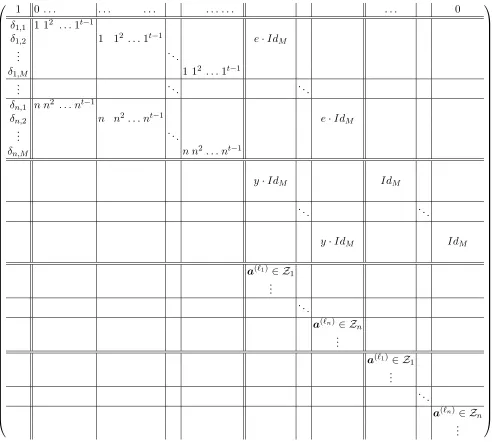
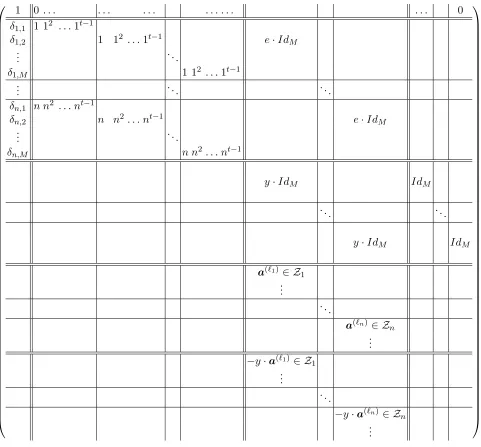
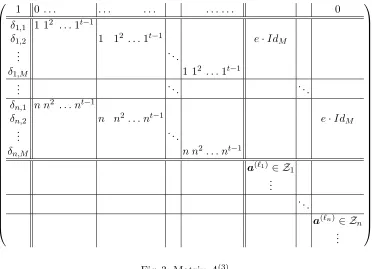
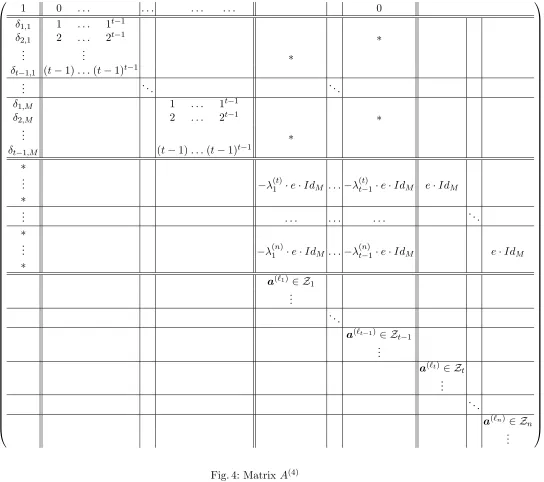
is the constant vector, and matrix Ahas 1 + 2nM+ 2L(t−1) rows and 1 + (t−1)(M+ 1) + 2nM columns. Since the variables inX are uniformly random and independent, if we are able to see that the first row of the matrix Ais linearly independent from the rest of rows, then we will conclude that the first random variable in Y, which corresponds to element C0 in the challenge ciphertext, is independent from the other values in A’s view. In such a case, we will conclude that the distribution of the ciphertext is independent of the bit b, as desired.
Lemma 1. The first row of matrixA is not contained in the vector space spanned by the rest of rows of A. Proof. To ease the global reading of the paper, in particular of this proof of Theorem 3, the proof of this
lemma is moved to Appendix A. ut
Final analysis. The probability that ADDH wins the DDH game is
Pr[ExpddhADDH(λ) = 1] = Pr[ADDH wins] =