Available Online atwww.ijcsmc.com
International Journal of Computer Science and Mobile Computing
A Monthly Journal of Computer Science and Information Technology
ISSN 2320–088X
IJCSMC, Vol. 4, Issue. 12, December 2015, pg.196 – 202
Security Improved Mobi-Sync Protocol for
Under Water Sensor Network
Anil C. B.
1, Dr. Sheena Mathew
21Research scholar, CUSAT, Cochin, India 2
Professor, CUSAT, Kerala, India
1 [email protected]; 2 [email protected]
Abstract— Time synchronization plays a critical role in distributed network systems. In this paper, we investigate the time synchronization problem in the context of underwater sensor networks (UWSNs). A synchronization algorithm for UWSNs must consider additional factors such as long propagation delays from the use of acoustic communication and sensor node mobility. These unique challenges make the accuracy of synchronization procedures for UWSNs even more. This paper modifies Mobi-Sync, a novel time synchronization scheme for mobile underwater sensor networks for developing secure time synchronization method. Mobi-Sync distinguishes itself from previous approaches for terrestrial WSN by considering spatial correlation among the mobility patterns of neighboring UWSNs nodes. Mobi-Sync outperforms existing schemes in both accuracy and energy efficiency, but mobi-Sync doesnt consider the security aspetcs.
Keywords— Underwater Sensor Networks, Time Synchronization, Security, Mobi-sync, WSN
I. INTRODUCTION
Time synchronization is an important concern that we need to consider especially for sensor networks. There are many time synchronization techniques that have been proposed for terrestrial WSN which provides high accuracy and high degree of precision. But the time synchronization techniques which are used in these terrestrial WSN cannot be directly applied to Underwater sensor networks (UWSN). This is because UWSN exhibit different features. These features include node mobility, long propagation delay, limited bandwidth, limited transmission rate, high bit error rate etc. In case of terrestrial WSN the propagation delay of sensor nodes are considered to be negligible. But in case of UWSN it suffers from the low propagation speed, of acoustic signals. UWSNs require long propagation delays due to the low transmission speed of sound in water. For mobile UWSNs, the delays in propagation between these sensor nodes are time-varying because of sensor node mobility. Wireless transmissions need to be energy efficient as it demands more power. All these reasons in UWSNs bring new challenges for time synchronization algorithms.
Networks are with many unattended sensor nodes. These sensor nodes are likely to undergo many critical security attacks. Therefore, time synchronization must prevent the modification attempts made by these attackers. Attackers are there especially in applications such as military surveillance and oceanographic data collection. These attackers manipulate time stamp information of the neighboring nodes and provide the nodes with incorrect information. So it is important to ensure the security of synchronization in UWSNs against these attacks.
There are many time synchronization algorithms that have been proposed in UWSNs. These algorithms include Mobi-Sync, DA-Sync, MU-Sync, D-Sync, TSHL, CLUSS etc. Each algorithm has their own strength and short comings. Such as TSHL is mainly used for static networks. Therefore it does not consider the mobility of the sensor nodes .But in case of MU-Sync it considers the node mobility, but it is not energy efficient. Whereas in Mobi-Sync, high energy efficient time synchronization algorithms has been designed for mobile UWSNs but Mobi-Sync is considered only for dense networks.
II. RELATED WORKS
Reference Broadcast Time synchronization (RBS) [1] is slightly different from traditional methods which synchronize the sender's with the receiver's clock. RBS allows nodes to synchronize their clocks. RBS allows the nodes receiving the synchronization packets to use the packet’s time of arrival as a reference point for clock synchronization. RBS removes most delay uncertainty involved in typical time synchronization protocols. For single-hop networks, the RBS algorithm is very simple. First, a transmitter broadcasts some number M as reference broadcasts. Each receiver that receives these broadcasts exchanges the time that each reference broadcast was received locally with its neighbors. Nodes then calculate phase shifts relative to each other as the average of the difference of the time stamps of the node’s local clocks for the M reference broadcasts.
Timing-sync Protocol for Sensor Networks (TPSN) [2] aims at providing network-wide time synchronization in a sensor network. TPSN works in two steps. In the first step, a hierarchical structure is established in the network and then a pair wise synchronization is performed along the edges of this structure to establish a global timescale throughout the network. Eventually all nodes in the network synchronize their clocks to a reference node. TPSN gives a 2 times better performance as compared to Reference Broadcast Synchronization (RBS).
Flooding Time Synchronization Protocol (FTSP)[3], uses low communication bandwidth and it is robust against node and link failures. The FTSP time-stamping protocol could be applied to existing multi-hop time synchronization protocols. It differs from previous time-stamping algorithms in that it utilizes a single broadcasted message to establish synchronization points between the sender and receivers of the message, while eliminating most sources of synchronization errors, except for the propagation time.
TSHL ie Time synchronization for high latency [4] is the first time synchronization technique introduced for high latency networks. In the first phase of TSHL, the nodes estimate clock skew. In the second phase inorder to determine the offset, they swap skew compensated synchronization messages within the network. After the completion of the 2 phases we get a model that maps the local, inaccurate clock to the reference timebase. In phase one, without receiving any knowledge about the propagation delay we are estimating the clock skew, which means the accuracy of the estimation is dependent on consistency, not the duration, of propagation delay. In this method we assume that the propagation is constant over the message exchange.
D-Sync [5] method is a powerful approach that incorporates physical layer information, namely an estimate of the Doppler shift. Large Doppler shift has been identified as a major challenge to underwater communication, and current systems implement sophisticated solutions to estimate and track such Doppler shift for each data exchange. Doppler shift contains highly useful information that can be leveraged to greatly improve time synchronization. Specially, it provides an indication of the relative motion between nodes. Therefore the protocol, called D-sync, strategically exploits this feature to address the timing uncertainty due to node mobility. As such, D-sync can handle substantial mobility, without making any assumptions about the underlying motion, and without extensive signaling.
MU-Sync [6] technique, which is a cluster-based synchronization algorithm for mobile underwater sensor networks. The MU SYNC mainly consists of 2 phases, namely, the skew and offset acquisition phase, and the synchronization phase. In the first phase, the clock skew and offset is estimated. Comparing MU-sync with other existing technologies, it performs the linear regression twice. The first regression enables the cluster head to gather the amount of propagation delay using message exchange technique from each reference packet (REF). After receiving the REF, it adjusts the REF beacons’ timings with their respective propagation delays. To estimate the skew and offset a second linear regression is applied to this new set of points. MU-Sync can be directly applied to mobile multi-hop UWSN.
WATERSync [7] method is a correlation-based time synchronization protocol specifically for shallow underwater sensor networks. WATERSync integrates the time synchronization procedure with the tree-like network routing topology in vertical direction (the surface station is the tree root), which consists of Gradual Depth Timing (GDT) phase and Level 1 (i.e., between the surface station and first depth nodes) Skew Compensation (LSC) phase. However, horizontal direction is neglected during the process of time synchronization, which results in high offset errors.
Mc-Sync [9] uses two mobile reference nodes for node mobility. MC-sync approach has two reference nodes along with time and will be located at opposite sides. Node N sends its synchronization information to both these reference nodes and due to the mobility of the node N, changes will occur in the sending position information. By using this information, the clock skew and offset have been calculated. The first requirement has been fulfilled designing equipment which consists of a two reference nodes, in which one node remains mobile and the other is a static reference node. The static reference node is connected to the mobile reference node through a light cable. After forming it we assume that the mobile reference node is in a still stage and the static reference node moves with the ocean current. The main factors affecting the movement of the static reference node is ocean current. Which in turn causes the light cable connecting the two reference nodes to move in a direction parallel to the direction of ocean current and the second requirement is fulfilled by considering the two reference nodes should be deployed at the opposite sides of the area. Reference nodes should move a little distance and should be in the still state to perform the time synchronization. Until all the nodes have been synchronized the reference nodes keep repeating this process. The MC-sync is not energy efficient when compared to mc-sync as it does not allow the reference nodes to broadcast the synchronization messages. Thus the packet number of Mc-Sync is smaller when compared to MU-Sync.
Fikret Sivrikaya. [10] proposed a survey paper which reviews the time synchronization problem and the need for synchronization in sensor networks. All network time synchronization methods rely on some sort of message exchange between nodes. Non determinism in the network dynamics such as propagation time or physical channel access time makes the synchronization task challenging in many systems. When a node in the network generates a timestamp to send to another node for synchronization, the packet carrying the timestamp will face a variable amount of delay until it reaches and is decoded at its intended receiver. This delay prevents the receiver from exactly comparing the local clocks of the two nodes and accurately synchronizing to the sender node. Basic source of errors in network time synchronization methods are the send time which is the time spent to construct a message at the sender. It includes the overhead of operating system (such as context switches), and the time to transfer the message to the network interface for transmission. Another source of error is Access Time ie each packet faces some delay at the MAC (Medium Access Control) layer before actual transmission. The sources of this delay depend on the MAC scheme used, but some typical reasons for delay are waiting for the channel to be idle or waiting for the TDMA slot for transmission. Then another source of error is the propagation time which is the time spent in propagation of the message between the network interfaces of the sender and the receiver.
Moreover, none of these protocols take security as one of their goals. Consequently, an adversary can easily attack any of these time synchronization protocols by capturing a fraction of the nodes and have them distribute faulty time synchronization messages. In effect, the nodes in the entire network will be out-of-sync with each other.
III. PROPOSED METHODOLOGY
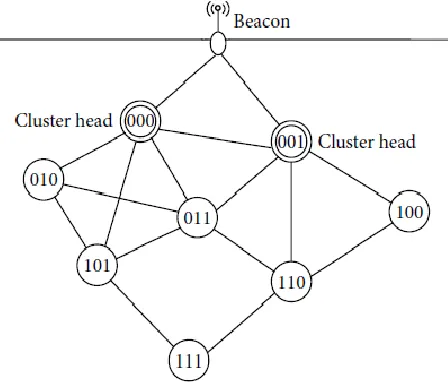
Here a Secure Synchronization protocol has been provided. In UWSN, the whole network is composed of three types of nodes: beacons, cluster heads, and ordinary nodes. Beacons have unlimited energy resources and perfect timing information. They can synchronize to UTC (Universal Time Coordinated) time constantly using GPS services without recalibrating their atomic clocks or performing any synchronization algorithms. In this regard, they provide the time reference for the sensors positioned underwater. Beacons communicate with cluster heads and each cluster has and only has one cluster head. The beacon is placed on the water surface and is equipped with GPS to obtain UTC time. Each sensor node is assigned a unique identifier (ID). The sensor nodes make autonomous decision about cluster formation without any centralized control.
The proposed system consists of the following procedure:
A. Topology creation
Initially all the 3 nodes required in the system have been deployed that is the ordinary nodes, super nodes and the surfacebuoys. As these nodes are considered to be in Underwater sensor network it has to be in motion. Therefore mobility is being provided for each of these nodes . In order for communication between these nodes create application agents and have been attached to the appropriate nodes.
B. Cluster Formation
During cluster formation each node belongs to one and only one cluster. Different clusters cannot share any common nodes. It is important for nodes to perform cluster consistency checking during the process of cluster formation. The ordinary nodes have been classified into different clusters. From each of the cluster a cluster head is being selected and that has been considered as the nearest super node for all the ordinary nodes in that cluster.
C. Cluster Head Selection
Each nodes in the cluster have been assigned an energy value. The node in each cluster with the highest energy has been chosen as the cluster head.
D. Authentication
After, all the nodes are assigned identities of either cluster heads or ordinary nodes ,an attacker may participate in the process of cluster formation using malicious nodes. These malicious nodes can launch different attacks in order to introduce cluster inconsistency. So in order to ensure that there are no malicious nodes all the nodes in the system are authenticated by the beacon by sending a hash value. If the node id and the hash values do not match it is considered as a malicious node. The malicious nodes are found and they are removed from the cluster.
E. Message Exchange
The message exchange happens initially between the cluster head of the 1st cluster and the beacon. The cluster head sends a request message to get synchronized. The beacons get the time information from the satellite. and send back a response to the cluster head with the time information.
F. Delay Calculation
As the nodes in the Underwater are considered to be in motion there are chances for delay during the propagation. The delay during propagation is being calculated and added along with the time information
G. Synchronization
The cluster head on obtaining the real information provides the synchronized time to the other ordinary nodes in the cluster and all the nodes in first cluster get synchronized. Then consider any another node named destination in any other cluster need to get synchronized. Then the ordinary nodes in the synchronized cluster find a path to the destination node and provide it with the time information.
IV. IMPLEMENTATION
The proposed method has been implemented using NS2.
The different nodes required for the system have been created. The node at the surface of the water is named as Beacon and a node representing the satellite has also been created. Mobility is provided for each of these nodes. An energy value is being provided to each of the nodes. The ordinary nodes have been grouped into different clusters. In each cluster the node with the highest energy value has been chosen as the cluster head. In order to ensure there are no malicious nodes authentication is being done and the malicious nodes are removed from the network.
V. RESULTS AND ANALYSIS
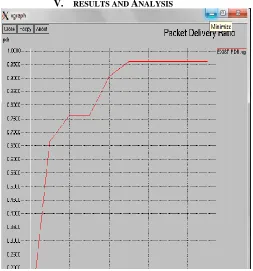
Figure 2.The Graph explains the ratio between the no of packets send and received during the network life.
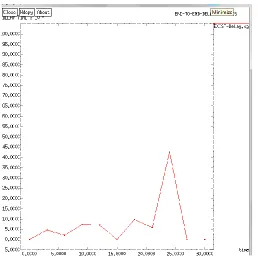
Figure 4. The graph plots the delay occurring during the packet delivery the difference in time received and the time sent.
V. CONCLUSION
Mobi-Sync, a time synchronization scheme for mobile UWSNs. Mobi-Sync is the first time synchronization algorithm to utilize the spatial correlation characteristics of underwater objects, improving the synchronization accuracy as well as the energy efficiency. In this paper we modified Mobi-Sync to get secure synchronization. Secure time synchronization is one of the key concerns for UWSNs. UWSNs are often deployed in an environment, with many unattended sensor nodes. These sensor nodes are likely to undergo many critical security attacks, such as replay attack, message manipulation attack, and delay attack. Therefore, time synchronization must prevent the modification attempts made by these attackers. So here we propose an authentication method that ensures the security of synchronization under harsh underwater environments against these attacks.
REFERENCES
[1] J. Elson, L. Girod, and D. Estrin, “Fine-grained network time synchronization using reference broadcasts,” in Proc. of the 5th Symposium on Operating Systems Design and Implementation, pp. 147–163, 2002.
[2] S. Ganeriwal, R. Kumar, and M. B. Srivastava, “Timing-sync protocol for sensor networks,” in Proc. of the 1st International Conference on Embedded Networked Sensor Systems (SenSys ’03), pp. 138–149,Nov. 2003
[3] M. Mar´oti, B. Kusy, G. Simon, and ´ A. L´edeczi, “The flooding time synchronization protocol,” in Proc. of the 2nd International Conference on Embedded Networked Sensor Systems (SenSys ’04), pp. 39–49,Nov. 2004.
[4] A. A. Syed and J. Heidemann, “Time synchronization for high latency acoustic networks,” in Proc. of the 25th IEEE International Conference on Computer Communications (INFOCOM ’06), pp. 1–6, Apr. 2006.
[5] F. Lu, D. Mirza, and C. Schurgers, “D-Sync: doppler-based time synchronization for mobile underwater sensor networks,” in Proc.s of the 5th ACM International Workshop on UnderWater Networks (WUWNet ’10), pp. 1–8, Oct. 2010.
[6] N. Chirdchoo, W.-S. Soh, and K. C. Chua, “MU-Sync: a time synchronization protocol for underwater mobile networks,” in Proc. of the 3rd ACM International Workshop on Underwater Networks (WUWNet ’08), pp. 35–42, Sept. 2008.
[7] F. Hu, S. Wilson, and Y. Xiao, “Correlation-based security in time synchronization of sensor networks,” in Proc. of the IEEE Wireless Communications and Networking Conference (WCNC ’08), pp. 2525–2530, Apr. 2008.
[8] X.Cao, F. Yang, X.Gan et al., “Joint estimation of clock skew and offset in pairwise broadcast synchronization mechanism,” IEEE Transactions on Communications, vol. 61, no. 6, pp. 2508–2521, 2013.
[10] Fikret Sivrikaya, Baulent Yener “Time Synchronization in Sensor Networks: A Survey”, Conference on Wireless, Mobile and Sensor Networks (CCWMSN07)2007.
[11] Jun Liu, Zhong Zhou, Zheng Peng, Jun-Hong Cui, Michael Zuba, “Mobi-Sync: Efficient Time Synchronization for Mobile Underwater Sensor Networks”, IEEE Trans on parallel and Distributed Systems, Vol. 24, No. 2, Feb 2013.