Available Online atwww.ijcsmc.com
International Journal of Computer Science and Mobile Computing
A Monthly Journal of Computer Science and Information Technology
ISSN 2320–088X
IJCSMC, Vol. 3, Issue. 6, June 2014, pg.168 – 175
RESEARCH ARTICLE
A Rule Based Clustering and Routing Approach
to Improve Clustered Network Communication
1
Shafali Vashist,
2Mr. Samit Yadav
1
M.Tech Scholar in CSE GITAM, Kablana, Haryana
[email protected]
2Guide, AP in GITAM, Kablana, Haryana
[email protected]
Abstract: Lots of challenges are associated with sensor network. Communication in sensor network is controlled using some routing protocol. To achieve the effective communication over the network, particular protocol selection is required. In this paper, the classification of sensor network is defined according to the applications and requirement. The paper has categorized all the available protocols in some related classes as well as the exploration to each protocol class is defined in this paper.
Keywords: Protocol Classification, Application Based, Location Oriented
I. INTRODUCTION
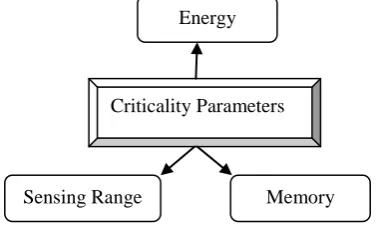
Sensor network is one of the most congested and critical communication network defined under lot of restrictions. These restrictions are defined in terms of energy specification and the memory limits. It means, each sensor node is a small sensing device having a limited memory, sensing range and the energy. The criticality parameters to a sensor network are shown in figure 1.
Figure 1: Sensor Node Criticality Parameters
The energy criticality is actually responsible for the network life time. A node having the effective energy is considered as the alive node. As the communication performed, each participating node lose some amount of energy. If the node energy set at 0, the node is considered as dead node. Another critical parameter considered here is sensing range. Each sensor node generally has a limited sensing range because of this, the light of site or the communication is restricted. Because of this, to perform long
Criticality Parameters Energy
distance communication, multi hop communication will be performed. Clustered network architecture also resolve the problem occur because of small sensing range. According to this architectural form, complete network is divided in smaller segments called clusters. Each cluster is controlled by a particular cluster head. As the communication performed, the cluster node performs communication with cluster head and cluster head perform communication with base station. Another criticality parameter in sensor network is memory constraint. Memory of each sensor network node is limited or some time the memory is absent. A node with memory and decision power constraint is called smart sensor node. But these kinds of sensor nodes are expensive and because of this used in few intelligent applications.
The main challenge in sensor network is to perform the power saving communication. To perform this communication, there are number of constraints and the limitations are defined in sensor network. These sensor networks are defined under different frequency bands to control the communication and to obtained the actual circuit design. The outcome of these communication networks depends on different factors such as the frequency range, kind of device, spectrum type etc.
Another improvement to the sensor network is in terms of intelligent sensing devices. These devices are called smart sensor devices. The network composed from these sensing devices is called smart dust network. In critical application areas such as medical network, these kind of communication architectures are been used.
II. EXISTING WORK
In this section, the work done by the earlier researchers in the area of Data classification is discussed and presented. In year 2000, a work on energy effective sensor network was defined by W. Heinzelman[6]. Author defined the clustering algorithm along with protocol specification. Author introduced the LEACH protocol. LEACH protocol includes the cluster formation based architecture so that the hierarchical communication will be carried on over the network. This proposed protocol divided the complete network in smaller segments called clusters and each cluster communication is control by the cluster head. The algorithmic approach is defined on the selection of this cluster head. This cluster head selection is performed under the energy and load based analysis. LEACH protocol is able to provide the effective communication in effective time frame. It also defined the communication under the assumptions and the constraints. The drawback of the protocol is the random selection of cluster head. It gives the equal probability of a node to set as cluster head. But this gives the unequal distribution of clusters over the network. There are the chances that a particular protocol is congested and some cluster is not having the enough nodes. It also gives the problem of orphan nodes i.e. the nodes that not covered by any cluster. Another drawback of this protocol is the election of cluster heads with each communicating round that gives the communication delay. Because of these reasons there was the requirement of certain improvement over the clustering architecture so that reliable and balanced communication will be performed over the network[1][2].
Different authors provided the improvement over the LEACH protocol and clustering architecture. One of these improvements includes the format energy LEACH and the multi hop LEACH. These improved protocols improve the process of cluster head selection. The cluster head is formed on each communication rounds based on the residual energy comparison on nodes. Another improvement to the protocol is done in terms of multi hop communication. It improves the network communication. Authors discussed the comparative analysis between the energy LEACH and multi-hop LEACH[5].
Some authors also provided the communication over the network under different routing protocols. A lot of work is done to identify the effective routes in network. Authors discussed different constraints while performing the route identification in sensor network. These parameters include the layered based communication, data centricity, path redundancy, location information analysis, QoS parameters evaluation etc. The type of network i.e. homogeneous or heterogeneous networks also affects the network architecture and the communication. The main objective behind the formation of this clustering architecture is to improve the network life time and to provide the energy effective communication. The work also controls the energy consumption and provides the dominated transmission and reception. The routing protocol designed here is energy effective as well as provide the network architecture so that the network life time is improved[7][8].
The energy criticality in case of LEACH protocol is discussed and resolved by many researchers under the energy restricted resources available in the sensor network. These sensor networks are defined under the energy source specification so that the effective design will be performed along with communication control. The author discussed the operative time span so that the restricted power supply over the network will be obtained. These protocols are dependent on the network layers. The communication in such network is based on the probabilistic estimation on the cluster head selection and to perform the communication based on network coordination. The network is defined with initial energy specification and to discuss the certainty in LEACH. Author discussed different aspects of these protocols so that the life time of the network will be improved. The communication is performed for N number of rounds and based on the energy effectiveness of network as well as the communication is measured. Simulated results shows the improvement to the network life upto 20% with the modification on the cluster head selection process[8][9].
improvements are defined in the form of cluster selection process. One of such improvement is presented in the form of N-LEACH protocol. This improvement protocol has restricted the number of clusters over the network so that the equalize distribution of network nodes will be obtained. The root node collects data from the base station and improves the network energy effectiveness and the life time. N-LEACH algorithm is discussed to provide the energy balanced communication. This communication protocol is also effective to provide the long distance communication [9].
Another improvement to LEACH protocol was presented by Khamayesh in year 2009. This improvement is presented in the form of a new protocol called V-LEACH protocol. This protocol reduces the energy consumption over the network and provides the effectiveness of clustering architecture. According to this new protocol, each cluster has two cluster heads called, Main Cluster head and Vice Cluster head. As the main cluster head dies, the vice-cluster head takes its position so that the process of cluster selection is reduced. Author defined this protocol to reduce the communication between the cluster head and the base station. The obtained results from the system shows that the defined protocol reduced the network communication and improved the network life. In VLEACH protocol, the number of messages generated by the cluster head is lesser than the traditional LEACH protocol [10].
Some author modification to the existing protocols is done by different authors. These protocols provided the energy adaptive communication in sensor network as well as provided a balanced communication over the network. The balanced network communication is controlled under the residual energy based communication so that the network communication and performance will be improved. The comparative analysis over the network is performed to provide the reliable communication[11][12].
III. RESEARCH METHODOLOGY
In this paper, an effective clustered approach is presented for clustered sensor network. The presented work has improved the existing clustered approach by defining a rule based specification for cluster head selection over the network. The presented approach is defined under the energy, distance, density and area limits parameters. The work as also defined the reserved area for the base station. The nodes defined in this reserve area can perform direct communication with base station without the involvement of cluster head. These nodes can use single hop or multi hop communication with base station. The sensing range based path will be constructed to the base station to perform effective communication. Once the reserve area and reserve nodes are specified, the next work is to divide the rest network in clusters. While generating the clusters over the network, a rule based scheme is adopted under the following constraints.
The cluster head will not be defined on boundary line area. The boundary line area is restricted to avoid the earlier failure for cluster head.
While performing the cluster head selection, the node strength analysis will be performed under the energy constraint. A high energy node can be considered as the cluster head. A threshold limit is defined to set the minimum energy requirement for cluster head specification.
While performing the cluster head selection, the connectivity analysis is defined. A node having the minimum number of sensor nodes in sensing limit, can be set as the cluster head.
The number of clusters over the network is also restricted.
Once the clusters are defined, the communication will be done under different aspects.
The nodes defined in base station reserve area can perform direct communication with base station. This communication can be single hop or multi-hop communication.
The nodes defined within a cluster can perform direct single hop communication with cluster head.
The cluster heads can perform multihop cluster based routing to communicate with base station.
The orphan node identification or analysis will be done over the network. As the orphan node will be identified, the nearest effective node will be identified. The orphan node will communicate with effective node and
then the communication will be performed via effective node to cluster head
IV. THE SIMULATION RESULT
Scenario
Parameter
Value
No of Nodes
100
Energy
1J
Transmission Energy
50nJ
Receiving Energy
50nJ
Forwarding Energy
50nJ
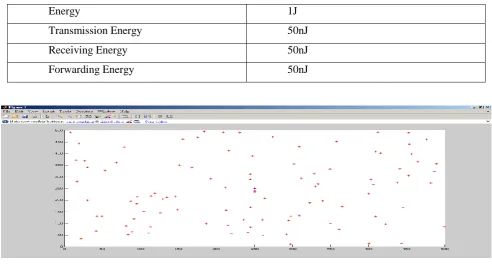
Figure 2: Design of network
Here figure is showing a network of 100 nodes in which red colored points are for the nodes and the blue colored point is for the base station.
Figure 3: Dead nodes (Existing )
Figure 4: Dead nodes (Proposed)
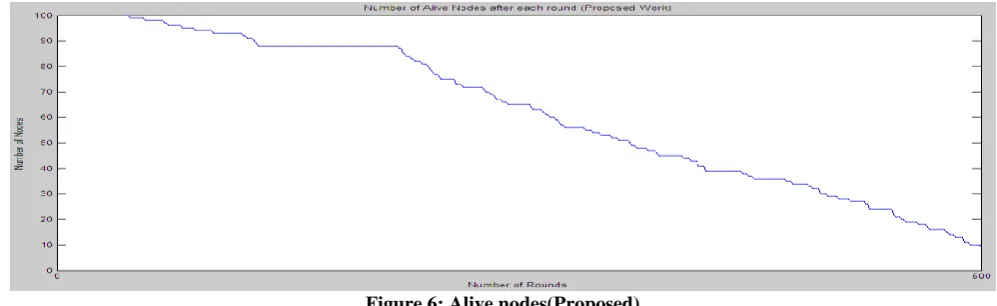
Here figure shows the proposed work that is being compared with existing work. By appling the method the energy consumption is reduced and the nodes become dead after 500 rounds.
Figure 5: Alive node (Existing)
Here figure shows the number of alive nodes in the existing work that are decreasing as the number of rounds are performed.
Figure 6: Alive nodes(Proposed)
Figure 7:Packets to base station(Existing)
Here figure is showing the number of packets that are transmitted to the base station in WSN in the existing work by performing the 1000 rounds.
Figure 8: Number of packet received by BS(Proposed)
Here figure shows number of packets received by base station in proposed work as compared to the existing work.
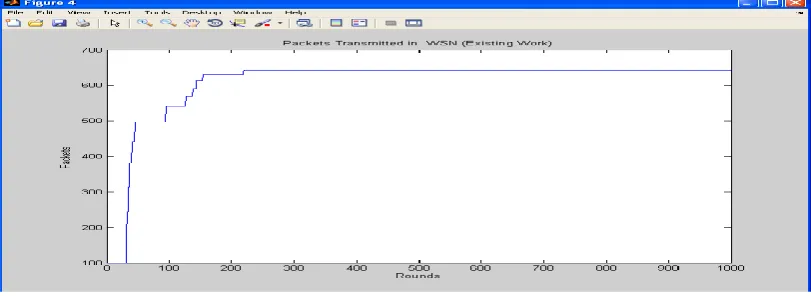
Figure 9: Packet transmitted in WSN(Existing)
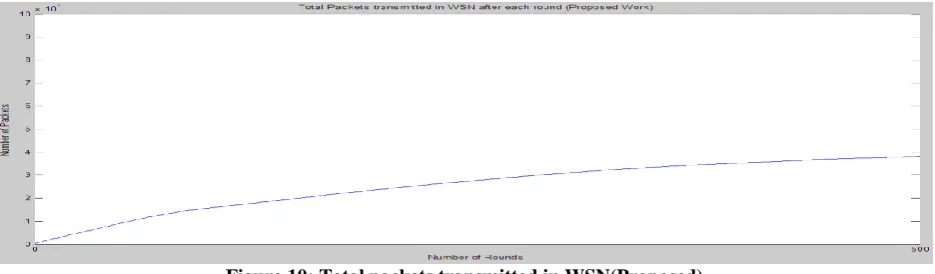
Figure 10: Total packets transmitted in WSN(Proposed)
Here figure shows the difference between the number of packets transmitted in existing work and after the proposed method.
CONCLUSION
In this paper, an effective rule based clustering architecture is defined. In this architecture, the complete network is splited in small area segments called clusters and each cluster is controlled by a cluster head. The work has defined the multi hop routing approach for cluster head communication and base station based communication. This paper made a load balancing in the overall network. It is also solving the problem of orphan node. Those nodes who are not the part of any cluster will be identified and communicated to the base station by multi hop communication. Here a comparison is also made between the existing and the proposed work to show the efficiency and reduced energy consumption of the later.
ACKNOWLEDGEMENT
Assistant Prof. Samit Yadav is the assistant professor in Department of Computer Science and Engineering at Ganga Institute of Technology and Management, Kablana, Haryana. I am specially grateful for his guidance and contributions by generously giving his time and carefully reviewing this manuscript.
REFERENCES
[1] Shio Kumar Singh, M P Singh, and D K Singh: Routing Protocols in Wireless Sensor Networks A Survey, International Journal of Computer Science & Engineering Survey (IJCSES) Vol.1, No.2, November 2010 [2] Ajay Jangra, priyanka, Swati, richa Wireless Sensor Network (WSN): Architectural Design issues and
Challenges, (IJCSE) International Journal on Computer Science and Engineering Vol. 02, No. 09, 2010, 3089-309.
[3] I.F. Akyildiz, W. Su*, Y. Sankarasubramaniam, E. Cayirci : Wireless sensor networks: a survey, Computer Networks 38 (2002) 393
[4] Joohwan Kim, Xiaojun Lin, Ness B. Shroff and Prasun Sinha “Minimizing Delay and Maximizing Lifetime for Wireless Sensor Networks With Any cast” IEEE/ACM Transactions On Networking, Vol. 18, No. 2, April 2010 page:515-527
[5] “Improvement on LEACH Protocol of Wireless Sensor Network”, M. Bani Yassein, A. Al-zou'bi, Y. Khamayseh, W. Mardini IEEE 2009.
[6 ] "Energy-Efficient Communication Protocol for Wireless Micro sensor Networks", W. Heinzelman , A.Chandrakasan and H. Balakrishnan , January 2000. IN 2000 IEEE. Published in the Proceedings of the Hawaii International Conference on System Sciences, January 4-7, 2000, Maui, Hawaii.
[7] “Improvement on LEACH Protocol of Wireless Sensor Network”, Fan Xiangning, Song Yulin IEEE 2007 International Conference on Sensor Technologies and Applications.
[8] “Routing Protocols in Wireless Sensor Networks”, Shio Kumar Singh1, M P Singh, and D K Singh ,A Survey, International Journal of Computer Science & Engineering Survey (IJCSES) Vol.1, No.2, November 2010.
IEEE Naveen Kumar, Mrs. Jasbir Kaur.
[10] “Research about Improvement of LEACH Protocol”, Zhao Yulan, Jiang Chunfeng IEEE 2010, 978-1-4244- 7618-3 /10/©2010 IEEE
[11] “MECN: Minimum Energy Mobile Wireless Networks”, V. Rodoplu and T. H. Meng, IEEE Journal Selected Areas in Communications, vol. 17, no. 8, Aug. 1999, pp. 133344.