Volume 3, No. 2, March-April 2012
International Journal of Advanced Research in Computer Science
REVIEW ARTICLE
Available Online at www.ijarcs.info
ISSN No. 0976-5697
Grooming a new Team with possible roles using the Scrum Practices
Syed Ibrahim K
Lecturer in Computer Science Jamoum University College Umm AL- Qura University Makkah, KSA.
Abstract: The Scrum, an agile development process allows quickly production of working piece of product by undergoing the development into small release cycles and in improvement ways. There is a growing demand to expose students to such practices. In the same time students also need to practice the possible roles that they will get when they join a real life project or an industry. Exercising the Scrum practices may help the students to learn and practice the possible roles to perform during a project. During a cycle of scrum called ‘sprint retrospective’, the team dedicated time to deliberately reflect how they are doing and to find ways to improve. The scrum team will be constantly looking for improving opportunities either for the product builds or the practices they chosen. In this paper, we discuss our experiences in practicing the Scrum practices in students’ development of final year projects. This may be very useful to the final year students and new recruitments whose are on job training.
Keywords: Scrum, training, roles, project team, Sprint
I. INTRODUCTION
In this business world everyday a new team is form. The team or an organizational success do not depends on individuals, but to the combine effort of the team. The accepted practices involved in Software Engineering are changing. The traditional software development practices will not always endow students with the understanding of the roles and responsibilities for their future workplace [1,2]. Many times the practices of doing the things are changing and looking for other better options. Proper utilization of the available knowledge and assigning proper responsibility are very important.
How do we get the best performance out of a team? How to learn and practice the possible varieties of roles in a real industry? What are various roles that one needs to learn before joining a project? These questions may be very interested to future employee, other name-the current students. Most of the recruiter also looks for the potential candidate who has some prior knowledge on roles and responsibilities. Such candidate will know their possible roles in a project. This will be a win-win situation for both the party, who is going to give training and also for those who are going to get job training.
Looking to the trends in changing industrial practices and switching of responsibilities we would suggest the students to familiarize with various roles and its supporting practices. The team must take on the responsibility for success and be motivated to succeed in their efforts. Scrum can be an alternative, more practical approach to train the software engineers to have varieties of roles during a lifecycle of a single project. Many of the projects are failing due to human factor, not by technical factors. Learning the possible roles to perform in an industry during university days will be great value to an individual while joining the industry. Such roles can be practice during final year project or while on job training period.
The rest of this paper is organized as follows: in Section 2, we briefly introduce the main practices of Scrum process. In Section 3, we further outline the background of our study and define aspects of the study. In Section 4, we evaluate the practices of Scrum practices with regards to the previously defined study aspects. We conclude this paper in Section 5 with a summary of the main observations.
II. THESCRUM
Scrum is one of most popular agile process used for software development [3,4]. It is a general-purpose project management framework that follows an empirical process. It does not specify software development activities in advance but focus on learning from past experience. Knowledge is used for guidance going forward. It focuses on maximizing business value, constant improvement and is a priority driven. This can be use for improving the current practice in a team also.
In Scrum, projects are developed via a series of iterations called sprints. Each sprint is typically 2-4 weeks long. A typical scrum team has five to nine people. The team does not include well-defined traditional software engineering roles such as programmer, designer, tester etc. In this practice, everyone in the team works together to complete the set of work that collectively committed to complete within a sprint. SCRUM has been successfully employed by hundreds of different companies in many different fields, with outstanding results.
A. broad roles in scrum:
a. Product Owner:
product into a production environment, understands business level risks as well as consequences of actions from a business perspective, develops and maintains the product backlog. Product backlog is prioritized list containing every desired feature to the product. Product backlog is own by the Product owner. In our study, product backlog is prepared by team, the students before the start of the project and verified from the project supervisor and also own by the team, unlike the normal scrum.
b. The Development Team:
The Development Team consists of professionals who do the work of delivering a potentially releasable Increment of “Done” product at the end of each Sprint. Only members of the Development Team create the Increment.
Development Teams are structured and empowered by the organization to organize and manage their own work. The resulting synergy optimizes the Development Team’s overall efficiency and effectiveness. Development Teams have the following characteristics:
a) They are self-organizing. No one (not even the Scrum Master) tells the Development Team how to turn Product Backlog into Increments of potentially releasable functionality;
b) Development Teams are cross-functional, with all of the skills as a team necessary to create a product Increment; c) Scrum recognizes no titles for Development Team
members other than Developer, regardless of the work being performed by the person; there are no exceptions to this rule;
d) Individual Development Team members may have specialized skills and areas of focus, but accountability belongs to the Development Team as a whole; and, e) Development Teams do not contain sub-teams dedicated
to particular domains like testing or business analysis.
c. Development Team Size:
Optimal Development Team size is small enough to remain nimble and large enough to complete significant work. Fewer than three Development Team members decreases interaction and results in smaller productivity gains. Smaller Development Teams may encounter skill constraints during the Sprint, causing the Development Team to be unable to deliver a potentially releasable Increment. Having more than nine members requires too much coordination. Large Development Teams generate too much complexity for an empirical process to manage. The Product Owner and Scrum Master roles are not included in this count unless they are also executing the work of the Sprint Backlog.
d. Scrum Master:
Scrum master owns the process, motivates and coaches the team. Scrum master ensures that the team does not go off target. The Scrum master is responsible for making sure the team is as productive as possible. The Scrum master does this by helping the team to use the Scrum process, by removing impediments to progress, by protecting the team from outside.
e. Scrum Master Service to the Product Owner:
The Scrum Master serves the Product Owner in several ways, including:
a) Finding techniques for effective Product Backlog management;
b) Clearly communicating vision, goals, and Product Backlog items to the Development Team;
c) Teaching the Development Team to create clear and concise Product Backlog items;
d) Understanding long-term product planning in an empirical environment;
e) Understanding and practicing agility; and, f) Facilitating Scrum events as requested or needed.
f. Scrum Master Service to the Development Team:
a) The Scrum Master serves the Development Team in several ways, including:
b) Coaching the Development Team in self-organization and cross-functionality;
c) Teaching and leading the Development Team to create high-value products;
d) Removing impediments to the Development Team’s progress;
e) Facilitating Scrum events as requested or needed; and, f) Coaching the Development Team in organizational
environments in which Scrum is not yet fully adopted and understood.
g. Scrum Master Service to the Organization:
The Scrum Master serves the organization in several ways, including:
a) Leading and coaching the organization in its Scrum adoption;
b) Planning Scrum implementations within the
organization;
c) Helping employees and stakeholders understand and enact Scrum and empirical product development;
d) Causing change that increases the productivity of the Scrum Team; and,
e) Working with other Scrum Masters to increase the effectiveness of the application of Scrum in the organization.
h. Scrum team member:
Plan tasks, manages their commitments and works as a team to achieve the vision set for them. Members are responsible for delivery of functionality.
B. Sprint Planning:
The following activities are undertaken in a sprint planning session
a. Sprint planning meeting time/date set by Scrum master b. Product backlog is presented, with any information
helpful to the team from the business by Product owner c. Select product backlog items for the sprint by the entire
team
d. Define the goal or vision for the sprint
f. Formal presentation to stakeholders by the Scrum master [5,6]
C. Daily Scrum:
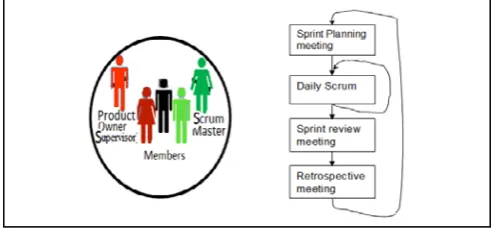
The Daily Scrum meeting is a 15-minute time-boxed event for the Development Team to synchronize activities and create a plan for the next 24 hours. This is done by inspecting the work since the last Daily Scrum and forecasting the work that could be done before the next one.
The Daily Scrum is held at the same time and place each day to reduce complexity. During the meeting, each Development Team member explains:
a. What has been accomplished since the last meeting? b. What will be done before the next meeting?
c. What obstacles are in the way?
The Development Team uses the Daily Scrum to assess progress toward the Sprint Goal and to assess how progress is trending toward completing the work in the Sprint Backlog. The Daily Scrum optimizes the probability that the Development Team will meet the Sprint Goal. The Development Team often meets immediately after the Daily Scrum to re-plan the rest of the Sprint’s work. Every day, the Development Team should be able to explain to the Product Owner and Scrum Master how it intends to work together as a self-organizing team to accomplish the goal and create the anticipated increment in the remainder of the Sprint.
Daily Scrums improve communications, eliminate other meetings, identify and remove impediments to development, highlight and promote quick decision-making, and improve the Development Team’s level of project knowledge. This is a key inspect and adapt meeting.
D. Sprint Session:
At the start of each sprint, a sprint planning meeting is held during which the product owner presents the top items on the product backlog to the team. Product owner, Scrum master and team members meet to prioritise the functional requirements and organise the work. The team identifies the set of functionality they can deliver, the choice is made by assessing business value of the functionality; this is the called
sprint backlog. That work is then moved from the product backlog to a sprint backlog which is the list of tasks needed to complete the product backlog items.
E. Sprint Review Meeting:
[image:3.612.330.577.59.173.2]After Sprint execution the team holds a review meeting in presence of the project supervisor. After the demonstration of the works, the supervisor takes its judgment to declare which items consider as done. The supervisor also recorded the sprint number, the leading member name for that, other members, their role types and their performances during that sprint. In such way the supervisor can provide feedback to the team [11]. The team identifies what they can learn from it. It is similar to iteration retrospective but includes a short presentation of the work done.
Figure 1. The Scrum team, Figure 2. The Scrum flow
F. Benefits of Scrum:
A transparent development process is achievable and the productivity increases. There is a continuous improvement. In no predictable software development learning and guiding in the team is possible with better team communication. During ‘sprint retrospective' the team dedicated time to deliberately reflect how they are doing and to find ways to improve.
III. TRAININGDESIGN
Scrum has been used to academic game development courses [7,8], other educations perspectives [9,10,12] and for large projects [5,6]. However we are interested to provide a chance to all team members of a project to explore all possible roles using the Scrum practices. Do to so we propose a framework for this study.
A. Aspects of the study:
We expect Scrum to have a positive impact on the following aspects. The project supervisor will record the student’s performance based on these points.
a. Teamwork: It is important in any software development. We believe that cause of the majority failures of the projects are human factor. Teamwork affects conflict management, communications, reliance, productivity etc.
b. Proper communication: Majority of the projects are executed by a team or group, not by a single person. Communication gap and misinterpretation is one root cause of team conflict. Each conflict will have an impact on any project.
c. Dynamic Roles: The entire scrum member will be given a chance to learn the possible roles in a project. The roles of the member will be interchange among the team. For example for the Sprint 1, the member X wrote a program and member Y did testing for the program of member X. In Sprint 2, the role will be swap between member X and member Y.
d. Empowerment: It may help the individuals to have more confident regarding their capabilities. Everyone's competence has impact on decisions which results in higher motivation and commitment during a project and move to next project.
compare with the time taken by other team member on the same or similar activity.
B. Structure of the Study:
In this section we propose a framework of our study. This covers the phases such as design, training, retrospective and its corresponding activities, deliverables or reports. The primary goal of the study is to let the candidate or the students experience and practices on possible roles they may get when they join a real project or an industry. We are in interest to adapt the scrum practices in such a situation. A proposed framework is given in table 1.
Table1. The study framework
Phase
Activity Deliverable or outputs
Design Team forming,
Planning, Prioritization
project design document, product backlog, possible
roles
Training Sprints Assigning roles, Execution of Sprint,
Swapping roles
recording time taken on each activity, performance recoding
Retrospective Post mortem of Performances,
Discussions
final product, grades of students, performance reports,
feedbacks, team performance report,
project progress reports
C. Design phase:
The goal of the design phase is to group the students into Scrum teams to draft a project design document. A team comprises of four to five candidates. Before the first meeting, the students’ backgrounds such as technical skills, requested roles etc are collected. These details are used to balance the teams [9]. In the first meetings, several iterations of brainstorm sessions are conducted to have a clear image on current project and it is followed by group discussions. All members together finalized the project design document. Thus the knowledge levels of every participant are easily identified. This helps to identify one or more possible roles for each participant.
Before entering the first Sprint, the teams create a Product Backlog based on the project design. In consultation with the Product Owner (the supervisor), the team members define and prioritize the necessary features.
D. Some changes to normal Scrum:
As our study goal is to complete the final year project and also to train all the scrum members on the possible roles, we propose to replace daily Scrum meetings with meeting at least twice a week. Normally the student get two lecture times for the project development during the semester. The maximum time for a final project is semester time.
We propose a student taking the role of the Scrum Master despite being part of the Scrum Team. The project supervisor acts as a Product Owner, with one exception regarding the creation of the Product Backlogs, however verify the items (similar to marking project plan). Such the project
requirements and the Product Backlog can only be planned by the Scrum Team member.
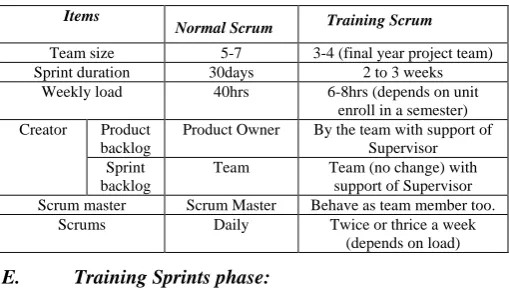
[image:4.612.323.578.176.320.2]In addition to the Scrum meetings, all Scrum Masters meet with the supervisor twice a week. The problems, conflict or technical issues are discussed. During the each meeting, the Scrum Masters reports the progress of the project and performance of the team members to Product Owner (project supervisor). Table 2 is showing the summary of the proposed changes.
Table 2. The changes to normal Scrum
Items
Normal Scrum Training Scrum
Team size 5-7 3-4 (final year project team)
Sprint duration 30days 2 to 3 weeks
Weekly load 40hrs 6-8hrs (depends on unit
enroll in a semester) Creator Product
backlog
Product Owner By the team with support of Supervisor Sprint
backlog
Team Team (no change) with
support of Supervisor
Scrum master Scrum Master Behave as team member too.
Scrums Daily Twice or thrice a week
(depends on load)
E. Training Sprints phase:
This is the main phase of our study. This includes the assigning of roles to team members, execution and swapping of the roles among the scrum team. The project supervisor will list down all the roles possible for the current project. While a member is acting for Scrum master for a sprint1, other member will observed how he assigned and coordinate with the product owner (supervisor). For next sprint 2, next member will act as Scrum master. So on the whole all the members will have a chance to act as a scrum master.
Next is the swapping of the project roles such are design, coding, testing. Such roles and responsibilities are also interchanged among the team. During the sprint review meeting the project supervisor takes its judgment to declare which items are considered as done. The supervisor recorded the sprint number, the leader name and other members, their role types and their performances. A marking scheme will be used by the supervisor providing feedback. The unsatisfactory situations will be recorded to discuss in retrospective phase and to provide a chance to rerun such sprints
F. Retrospective phase:
The Sprint Retrospective is possibly the most important to share lesson learning and looking for other improvement ways. This is accomplished in the retrospective by asking key questions about the practices that benefited the team or worked against it during the last Sprint and to identify new practices that should be started during the next Sprint. It is run by the Scrum Master and is time-boxed in real Scrum; we make some relaxation for our study. The amount of time spent in the meeting is determined by the team. The meeting is for the benefit of the team but anyone can attend. This is done by answering the following questions in the meeting.
The practices that worked well during the previous Sprint should be identified and continued in the coming Sprint and also share with other project team.
b. What didn’t work well last Sprint?
The team should identify practices that worked against the team during the last Sprint and looks for better alternatives.
c. What should we start doing?
The team identifies practices that should be following for the coming Sprint that will help them work better together.
The Scrum Master will record all the answers given for each question. These are done after a lot of debate and discussion that occurs during the Retrospective. Following the Retrospective, the Scrum Master will finalize the answers given during the meeting and shared within the team.
IV. EXPERIENCEREPORTS
The projects of some final year students are executed using this new changes scrum practices. The project supervisor records the performance of each team after a sprint in sprint review meeting. Some marks are allotted based on these performances. For some weak team members, suggestions are provided for improvement and also ask to rerun of some sprints till the performance comes out to satisfactory level. The marks are used for showing their performance measure. After getting satisfactory level on the project object and team performance, a final interview session will be conducted.
After the final presentation of all final year projects, interviews are taken for all the projects teams. Some team developed their projects using non scrum practices. Non scrum teams have restricted roles, where they have very less chances to explore other roles. When there was concern about the familiarity and confidence of acting into various roles, the team who chooses scrum has more confidence on all our study aspects stated above. We are in interest of running such final year projects adapting scrum practices continuously in future semesters. Once students are recruited, Interview and data collection will be doing from such. We are sure, there will be very positive feedback being the roles are practice before joining a real projects.
V. CONCLUSION
Scrum provides a structure and practices of roles, meeting, rule and deliverables to execute a project. Teams are responsible for creating and adapting their processes and practices within the framework. The roles will be changed for each of the sprint. In such way the whole team will be forced to practices all possible roles of a full lifecycle of a project under the supervision of their own team members and the project supervisor. A skilled scrum master can help the item and other weak member can share information among themselves. This could help to practice and bring a confident
in accepting any role of a project. The members are committed clear, short term goals, learn working in a team. They observe each other contribution and learn for effective communication skills. Productivity and Transparency goes hand-in-hand with eliminating unnecessary work, showing steps, inputs, and outputs of the development process.
During the Retrospective studies, analysis the team reflects on its own process. The supervisor observed the whole team on roles, progress and provide the feedback. Some weak members were asking to rerun of the sprints with alternate improvement ways. As this performance carries some marks, the team took it seriously. This helps them to bring the team to a full transparency in the project progress and roles. Our study aspects such as Teamwork, Proper communication, Dynamic roles, Empowerment and Productivity during a project are satisfied.
VI. ACKNOWLEDGMENT
First and foremost I offer my sincerest gratitude to my Dean, HOD, Dr Abdul Wahab, who has initiated me to write my article with his patience and knowledge whilst allowing me the room to work in my own way. Finally, I would like to thank everybody who was important to the successful realization of my article.
VII. REFERENCES
[1] C. Coupal and K. Boechler. Introducing Agile into a Software Development Capstone Project. In Proceedings Agile 2005 , Denver, Colorado, July 2005
[2] M. M. Muller and W. F. Tichy. Case study: Extreme
programming in a university environment, In Proceedings ICSE 2001, Canada, May 2001.
[3] A. Cockburn. Agile Software Development. Addison-
Wesley, 2001.
[4] R.C.Martin. Agile Software Development Principles,Pattern
and Practices. Prentice Hall,2002.
[5] Ken Schwaber and Mike Beedle, Agile Software
Development with SCRUM, Prentice Hall, 2001.
[6] Ken Schwaber, Agile Project Management with Scrum,
Microsoft Press, 2004.
[7] U. Wolz and S. M. Pulimood. An Integrated Approach to
Project Management through Classic CS III and Video Game Development. In Proc. of the SIGCSE '07, pp. 322-326. ACM Press, 2007.
[8] J. Schild, R. Walter and M. Masuch, ABC-Sprints: Adapting Scrum to Academic Game Development Courses". Foundations of Digital Games 2010, ACM, 2010.
[9] D. F Rico and H.H Sayani, Use of Agile Methods in Software Engineering Education. In Proc. AGILE Conference, pp. 174-179, 2009 Agile Conference, 2009.
[10] A. Gunasekaran, A. Agile manufacturing: a framework for
research and development, International Journal of Production Economics, pp.87-105, 1999.
[11] M. James, “Six Pages About Scrum,” CollabNet, 2010. [12] D. Sanders. Using Scrum to Manage Student Projects.