Volume 4, No. 4, March-April 2013
International Journal of Advanced Research in Computer Science
RESEARCH PAPER
Available Online at www.ijarcs.info
ISSN No. 0976-5697
Low Maintenance Wireless Network Architecture and Strategies For Mitigating
Challenges In Implementing Wireless Networks and Wireless Sensor Networks in
Dense Forests and Rural Areas
Samrat Pravin Patel*
B.E. in computer Engineering. (Database Developer, IT consultant) Thadomal Shahani College Of Engineering Mumbai,
Computer Society of India,Mumbai University [email protected]
Sumeet S. Deshmukh
Bachelor in Information Technology (Analyst/SAS programmer,DataBase Developer)
Karnataka State Open University, NIIT,Mumbai
Anil R. Rajbhar
Associate Scientist-Ph.d Research scholar (botany) St Xavier’s College Mumbai,Mumbai University
Abstract- An innovative ,cost effective and eco friendly approach for the implementation of wide area wireless network coverage for surveillance, remote wireless sensing , monitoring and other usage in dense forest and rural areas in developing countries like India and Africa .The paper gives an simplified layout for the network implementation for bridging the digital divide and the knowledge flow between the urban areas and the remote locations where telecom companies cannot reach easily or deploy network as it is a costly and difficult affair for implementation . The proposed paper shows a way to overcome challenges for implementation of the cellular and wireless network and making the technology accessible to the rural areas to enhance their growth and economic development.
Keywords: Wireless Networks , Passive Wireless Repeater , Wireless Sensor Networks, Cellular Networks , Bamboo , Cell Site , Wireless Tower , Solar Cell , Solar Panel, Solar Energy , Active Wireless Repeater, Cell Site, Tower
I. INTRODUCTION
In last decade we have seen a major growth in the Indian economy. India has emerged as a significant economic force in the world. The economic growth has fuelled the concurrent growth in the India’s Telecom sectors as well. India adds 6 Million Telephones a month and Wireless Technology has helped the telecom sector to grow in India by making the technology affordable to the masses. The boom in the Telecom sector has helped to make business more productive, propelling the Indian economy forward. However, the economic growth in India however is limited to urban areas only. Due to the low penetration of telecom and communications in the rural areas many remote rural regions and dense forests around the world, especially in developing regions in India, do not have good connectivity solutions which are economically viable. As a result, many of these regions remain disconnected from both the rest of the world and from progress in general. The use of wireless technology extends the scope for technological development and brings in a new hope to bridge in the gap of the digital divide and bring about a revolution by promoting information exchange amongst the masses and rural communities.[4][6][3]
Wireless communication technologies can be leveraged to develop the following in the rural areas: [4]
a. Education and training, b. Health Services,
c. Agriculture,
d. Rural BPOs (IT enabled services from rural India), e. IT enabled outsourcing of production work, f. Agro-industry.
g. Small Industry,
h. Commons: Community oriented efforts such as water-harvesting, local governance. The development of these areas will have direct impacts on the community as a whole
forest locations especially in developing countries such as India , Africa , Afghanistan . The coverage and scope of various wireless technologies currently which use radio communication are [1] [2] [3] [5]
Wireless Personal Area Network interconnect devices within a relatively small area Wireless Local Area Networks
A wireless local area network (WLAN) links two or more devices over a short distance using a wireless distribution method, usually providing a connection through an access point for Internet usage
Wireless Metropolitan Area Networks Wireless network that connects several wireless LANs. WiMAX is a type of Wireless MAN and is described by the IEEE 802.16 standard
Wireless Mesh Networks A wireless mesh network is a wireless network made up of radio nodes organized in a mesh topology. Each node forwards messages on behalf of the other nodes. Mesh networks can "self heal", automatically re-routing around a node that has lost power
Wireless Wide Area Networks wireless networks that typically cover large areas, such as between neighboring towns and cities, or city and suburb. These networks can be used to connect branch offices of business or as a public internet access system. The wireless connections between access points are usually point to point microwave link using parabolic dish antennas on the 2.4 GHz band, rather than omni directional antennas used with smaller networks. A typical system contains base station gateways, access points and wireless bridging relays or repeaters. When combined with renewable energy systems such as photovoltaic solar panels or wind systems they can be stand alone systems.[30]
Wireless Sensor Networks consists of geographically or spatially distributed autonomous sensor devices to monitor physical or environmental conditions, such as temperature , sound , pressure etc. and to cooperatively pass their data through the network to a main location or a base station. The more modern networks are bi-directional or full duplex, also enabling control of sensor activity. The development of wireless sensor networks was motivated by defense applications such as battlefield surveillance; today such networks are used in many industrial and consumer applications, such as industrial process monitoring and control, machine health monitoring, and so on.
Cellular Network a cellular network or mobile network e.g. GSM, CDMA is a radio network distributed over land areas called cells, each served by at least one fixed-location transceiver, known as a cell site or base station. In a cellular network, each cell characteristically uses a different set of radio frequencies from all their immediate neighboring cells to avoid any interference. When joined together these cells provide radio coverage over a wide geographic area. This enables a large number of portable mobile devices (e.g., mobile phones, pagers, etc.) to communicate with each other and with fixed devices and telephones anywhere in the network, via base stations, even if some of the mobile devices are moving through more than one cell during transmission.
Range of mobile phone cell site the range within which mobile devices (phone, PC , tablets etc) can
connect to it reliably which will depend on multiple factors such as[16][17] [18]
a. Height of antenna over surrounding terrain b. The frequency of signal in use
c. The transmitter's rated power
d. Uplink and downlink of the subscribers devices connected and the capacity of the trans receiver or the mast capacity. there is a finite number of calls or data traffic that a mast can handle at once. This limitation is another factor affecting the spacing of cell mast sites
e. The directional characteristics of the site antenna array
f. Reflection and absorption of radio energy by surrounding buildings or vegetation
g. local geographical or regulatory factors and weather conditions
Generally, in urban areas where there are enough cell sites to cover a wide area, the range of each one will be set to achieve the following based on the population density of that area i.e. numbers of cell sites and distance between the cell sites is directly proportional to population density with the most potential users.[18]
a. Ensure there is enough overlap for handover to/from other sites (moving the signal for a mobile device from one cell site to another, for those technologies that can handle it - e.g. making a GSM phone call while in a car or train).
b. Ensure that the overlap area is not too large, to minimize interference problems with other sites. c. Load balancing and reduced latency
As a rough guide, based on a tall mast and flat terrain, it is possible to get a range between 50 to 70 km (30–45 miles). When the terrain is hilly, the maximum range distance can vary from as little as 5 kilometers (3.1 mi) to 8 kilometers (5.0 mi) due to encroachment of intermediate objects into the wide center fresnel zone of the signal. Depending on terrain and other circumstances, a GSM Tower can replace between 2 and 50 miles (80 km) of cabling for fixed wireless networks.[4]
With more than 70% of India’s population living in rural areas with average earning less than Rs.5000/- per month, development of these areas poses a great challenge for the our nation that is fast becoming well known for its economic prowess in the world.[4]
The country varies diversely in topography. The northern part of the country is characterized by the presence of plains and flat land. The southern part of the country is characterized by the Deccan plateau that ranges in height between 300m and 600m above sea levels. The eastern part has flat land and hilly terrain while the West has desert and flat terrain. A high density of population of 253 to 525 persons per square kilometer can be found in the plain regions in India. In terms of geographical variation, the topography of the plains varies around 20-30 m in terrain with trees up to the height of 10-12 m.[4]
Current Overall Wireless Systems Networks Overview, Limitation and Challenges
case of a cellular network towers are about 40 m tall, and require considerable amounts of expensive steel for its construction. Infrastructure like roads and electricity has to be setup to support the equipment.
The second highest contributor to the cost is the powering of the infrastructure – Wireless Access-point Hardware, RF cables running to the top of the tower, the power amplifiers, RF filtering and the transceivers roughly account for more than 50% of the costs of the base tower. RF equipment is expensive affair to set up.
The maintenance of wireless repeaters or access points, cell site infrastructure requires local personnel who should be trained in wireless communications to deal with the problems that arise. Also for maintenance the exact location needs to be known. Also the weather conditions and geographic topography has to be taken into consideration before considering to develop a wireless network access point or a cell site.[4]
Too many mobile phone cellular repeaters within the crowded city can create health hazards due to increase in electromagnetic radiation due increase in power to improve the strength of the mobile signal in order to load balance the incoming mobile phone traffic which is dependant on the capacity of the repeater's hardware. One must note that with the increase in the gain the length of the pole on which the antenna is placed reduces and with the reduction in gain the length of the pole on which the antenna is placed increases vice versa.[18][19]
Due to lack of network coverage in the remote and dense forest regions, they can be subjected to crimes such as antisocial activities , economical hazards, illegal deforestation, wetland and water pollution , illegal encroachments and illegal killing of animals as there is no surveillance or monitoring possible for the changes in the forest ecosystem.
Proposed Strategies to Mitigate Challenges the mobile revolution of the last decade years has seen base stations sprouting in most towns but due to lack of infrastructure and various challenges involved telecom backbone that knits the country ends abruptly at the towns and larger villages. However there is a large scope for the telecom companies to grow their network and gain new prospective customers in the remote rural areas. Deployment of a base station or laying a link adds to the costs of the telecom companies. Cellular coverage can and will grow in rural areas, but this will depend on the rate at which infrastructure and operating costs reduce, and rural incomes increase. The proposed architecture is a means by which a telecom solution can become cost effective and affordable
Figure: 1
Figure 1. Shows a multipurpose solution which can be used within the dense forest or for providing the wireless or cellular connectivity to the remote rural areas with the help of a setup called as passive repeater antennas[28] thus bridging the digital divide between the urban sector and the rural areas and empower growth. The figure consists of a 40 meters or higher tower which is made of simple “Large Bamboo Sticks”[8][9][10][11][12][13][14]. They are all members of the true grass family Poaceae, subfamily Bambusoideae, tribe Bambuseae. The antenna on the Bamboo tower consist of Receiver and Transmitter. The antenna setup can be either active repeater (there is circuitry to boost the signal with additional addition of power to the signal) or passive repeater which takes in the signal through an antenna ( Yagi, Dish Antenna , Omni Directional etc.) directs it through a low loss coaxial cable and directs it to the other passive repeaters or access points located in the dense forest. In case of active repeater the antenna is powered using solar panels and battery storage [15][30]. This is a typical setup where the signal is then directed in the deep forest using a high gain directional antenna. The setup mentioned here can be utilized for eco monitoring and inter forest connectivity. The proposed setup deploys solar powered IP surveillance cameras , wireless sensor networks that can monitor forest fires , temperature , pressure weather etc. which is then passed to base station for further analysis and government usage[30][32]. Low power consumption portable wireless sensor networks which are miniature and which can run on a small cells and fit as an ideal solution for monitoring but there are still few limitations in security of these networks[31][32].
The setups proposed are subject to proper calculations based on the height of towers , fresnel zones , line of sight and free space signal loss, path loss in decibels as the use of active repeaters is restricted to a few or equivalent to null as the proposed model proposes a strategy for harsh weather and difficult topographic conditions.
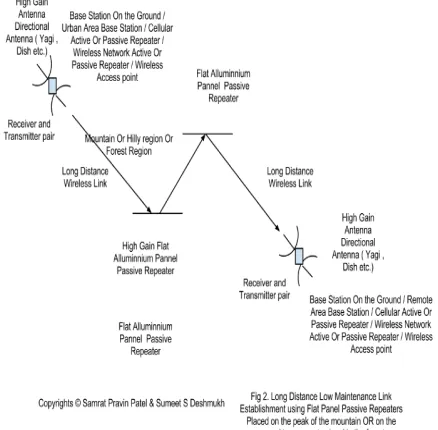
Figure: 3
Figure: 4
Figure 2. shows a setup where we are using high gain flat panel aluminum based passive repeaters to reflect the signals without addition of additional power through the dense forest or for propagating the signals over the mountain or hilly regions . This setup also used in various combinations with the setup mentioned in the Figure 1 and Figure 3 , Figure 4. The above two setups mentioned are strategies for curing the signal strength as signal degrades at distance beyond the fresnel zones and thus extending the signal to a greater extent to various remote locations.[20][21][22][23][24][25][26][27][28][29]
Advantages of the proposed models
a. reduced electromagnetic radiations within the environmental limits
b. Eco friendly usage of instruments (bamboo,solar etc)[30]
c. Low cost and less maintenance useful for physically challenging topographic landscape and remote locations
d. Used for curing effect of the weak signals
e. No additional power need in case of passive repeaters with no additional noise in the signal f. Self sustained solar powered eco friendly in case of
active repeaters[30]
g. Multipurpose applications for Cellular and 802.11 n/g Wireless Wide Area Networks
II. CONCLUSION
The development of the technology is limited to only the urban areas in developing countries like India and African countries due to factors such as infrastructure set up cost, maintenance, education & literacy level and economical growth of the remote rural areas. There is a need to monitor the dense forest ecology for studying its vivid ecosystem and for preventing illegal activities in forest like misuse, economical hazards, illegal encroachments and activities related to poaching which needs to be controlled to maintain healthy forest environment. There is a digital divide between the urban and the rural regions which needs to be bridged. Wireless technologies can bring a new hope for solving the communication problems among the remote rural regions and its people. Also it should be noted that with more and more cell sites coming up in various region due to increase in population density i.e. number of cellular sites is directly proportional to the population. Increase in the cell site adds to the electromagnetic radiation of the region which can pose health hazards for surrounding locality.
The proposed model is one of the ways by which the remote rural areas can have the connectivity in a cost effective way without any additional maintenance cost to extend the bandwidth to rural people in a eco friendly way to the people. Further studies need to be carried out on various type of antenna designs and application for extending the network without additional power and noise added to the existing signal and increasing its gain at the same time without decommissioning the cell sites in the urban areas with high population densities.
III. REFERENCES
[1]. http://en.wikipedia.org/wiki/Wireless_sensor_network
[2]. http://en.wikipedia.org/wiki/Wireless_network
[3]. http://static.usenix.org/events/nsdi08/tech/full_papers/su rana/surana_html/
[4]. Case Study: Connecting Rural India with Wireless Dr.
Ashok Jhunjhunwala,IIT Madras &
Anaka Aiyar, Rural Technology & Business Incubator Department of Electrical Engineering, IITM, Chennai 600 036, India
[5]. http://www.wirelessconnections.net/calcs/FresnelZone.a sp
[6]. A Low-Cost Efficient Wireless Architecture for Rural Network
Connectivity www.cs.nyu.edu/~lakshmi/wire.pdf
[7]. http://www.designmena.com/thoughts/bamboo-tower-designed-solve-chinas-housing
[8]. http://webecoist.momtastic.com/2011/06/20/building-with-bamboo-13-super-sustainable-structures/
[10]. http://tiffanytran.zxq.net/models.html
[11]. Materials for Architectural Design By Victoria Ballard
Bell, Patrick Rand ISBN-139781856694803 ,
Publication Year 2006
[12]. "Structural Analysis of Bamboo Trusses Structure in Greenhouse" 2011 2nd International Conference on Environmental Science and Technology IPCBEE vol.6 (2011) © (2011) IACSIT Press, Singapore By Putthadee Ubolsook, Sirichai Thepa
[13]. Case Study : Bamboo Structure focused on Simon
Velez’s project KyungJin-Hong
[14]. An environmental, economic and practical assessment of bamboo as a building material for supporting structures By P. van der Lugt,A.A.J.F. van den Dobbelsteen,J.J.A. Janssen
[15]. Reliance Solar Reference Projects : Telecom
Applications
http://www.relsolar.com/reference_projects.html
[16]. http://en.wikipedia.org/wiki/Cellular_repeater
[17]. http://en.wikipedia.org/wiki/Mobile_phone_signal
[18]. http://en.wikipedia.org/wiki/Cell_site
[19]. http://en.wikipedia.org/wiki/Mobile_phone_radiation_an d_health#Health_hazards_of_base_stations
[20]. http://en.wikipedia.org/wiki/Sector_antenna
[21]. Indoor Radio Planning: A Practical Guide for GSM, Dcs, Umts, Hspa and Lte (Hardcover) Author: Morten Tolstrup Publisher: John Wiley & Sons
[22]. Antenna Passive Repeaters For Indoor Recovery of Microwave Cellular Signals Hristo D. Hristov, Walter Grote and Rodolfo Feick, Universidad Téchnica
Federico Santa María, Valparaiso, Chile
http://www.microwavejournal.com/articles/6899- antenna-passive-repeaters-for-indoor-recovery-of-microwave-cellular-signals
[23]. Installation of an ATM Network
https://www.questnet.edu.au/questnet95/papers/atminst/a tminst.htm
[24]. Electronics World , May 1969
http://long- lines.net/places-routes/Thurmont_repeater/EW0569-fc.html
[25].
http://long-lines.net/places-routes/Thurmont_repeater/index.html
[26]. Reducing Phone Line Cost with Microwave Bypass (In this case, even using a Passive Repeater) http://www.dcbnet.com/notes/9703.html
[27]. http://en.wikipedia.org/wiki/Cellular_repeater
[28]. IEEE IRE International Convention Record "Passive repeater using double flat reflectors",Date of Conference: Mar 1957,Author(s): Yang, R.Andrew Corporation, Chicago, IL, USA
[29]. Wideband passive repeaters: Design and
measurements,Antennas and Propagation Society International Symposium, 2009. APSURSI '09. IEEE,Date of Conference: 1-5 June 2009,Author(s): Ali, A.
[30]. The design of a wireless solar-powered router for rural environments isolated from health facilities, Wireless Communications, IEEE, Date of Publication: June 2008, Author(s): Reigadas, F.J.S. Univ. Rey Juan Carlos, Madrid Fernandez, A.M. ; Garcia, P.O. ; Escola, F.R. ; Pascual,J.S.
[31]. Research Challenges for Wireless Sensor Networks John A. Stankovic Department of Computer Science University of Virginia