Name Data Networking for Interplanetary Internet:
An Architectural Perspective
Ritika Kumari1, R. L. Ujjwal2
USICT Guru Gobind Singh Indraprastha University1, USICT Guru Gobind Singh Indraprastha University2 Email: [email protected] 1, [email protected]2
Abstract—There are several challenges when communicating in space. We do not have fixed infrastructure and have long delays, the probability of high error, intermittent connectivity and disruption of the link. These challenges draw the attent ion for improving communication challenges in spaces technologies and networking architectures. The TCP/IP stack is not effective in handling challenging environments and has issues of compatibility with the present security protocols. An alternate solution is Delay Tolerant Networking Architectures. It specifies a bundle protocol. This protocol resides on the top of the transport layer. The Delay Tolerant Networking architecture provides information storage for a longer duration on transitional nodes. It is appropriate when encountering disrupted links, long links, and intermittent connectivity. NDN focuses on content instead of IP addresses making it a reliable and robust architecture for the future Internet. In NDN, there is no need for setting up and maintenance of steady paths between end nodes. It makes NDN suitable for network with intermittent connectivity and very large propagation delays. This paper discusses the perspective of integrating Delay Tolerant Networking with Name Data Networking.
Keywords—Name Data Networking, Interplanetary Internet, Delay Tolerant Networking.
1.INTRODUCTION
Interplanetary Internet defines the architecture & protocols that are important for permitting interoperation of the Internet systems on Earth/Spacecraft [6]. It involves communication between two entities when both of them are present in the space or when one entity is present on the ground and the other entity is there in space. With the ever-growing development in space invocations, empowering the acknowledgment of future space investigations missions, Interplanetary Networks are the next step ahead that will result in efficient and robust communication infrastructure. In such unfavorable and uncertain environment, our traditional protocols like TCP/IP do not perform as required. Therefore, there is a need to have a new architecture that can support interplanetary communication efficiently. There are several issues that come into the picture when we deal with Interplanetary Internet. We have extremely large and variable propagation delays in space. For maintaining a communications link between two spacecraft, we have two links-one forward physical and one or more multiple returns physical links. The challenge is that these links have asymmetrical capacities. It is impossible to establish and maintain a path, so there is a lack of fixed communication infrastructure. There is also a backward compatibility requirement because high investment is involved. There are other challenges like power, mass, size, and cost.
Name Data Networking is one among the projects funded by the U.S. National Science Foundation under its FIA [2]. The roots of name data networking are in content centric networks [12]. In NDN, data packets with content names are used. These names are unique allowing the network routers to monitor and keep track of packet states. Security in NDN is ensured as producer signs all the data packets and verification of the data packets is done by the consumers. Multi-path forwarding is also supported by the routers in
Name Data Network (NDN). The paper organization is as follows. Section II discusses the overview of name data networking, its classification, architecture, and working principle. A brief description of Interplanetary Networks and its architecture is given in section III. In section IV, we discuss how NDN is based on Interplanetary Networks/communication. Finally, conclusions are drawn.
2.NAME DATA NETWORKING
Fig. 1 – NDN Overview
A. NDN Classification
We have classified Name Data Networking features
as NDN applications, system services and system architecture [11].
● Applications: It deals with the real-life benefits of NDN
● System Services: Main Functions of NDN lies
here, i.e. mobility, privacy and trust, routing, store-and-forward, security, etc.
● System Architecture: Here lies the Component
organization as well as interaction mechanism between them
B. Architecture and Working Principles of NDN System
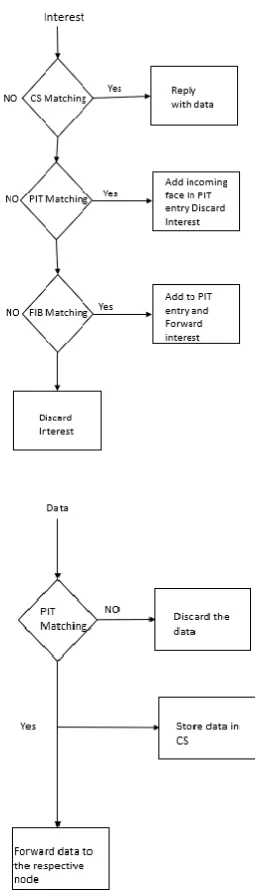
In Name Data Network (NDN), communication is started with the help of an I-pkt i.e. interest packet by the consumer [13]shown in Fig. 2(a). A Data Packet D-packet will be issued for the I-packet only when the I-packet shown in Fig. 2(b) [1].
reaches a node having the valid content. Content Names are embedded in both packets. D-pkt will travel back to the consumer by retracing the route of the interest packet. Each Router in NDN works by maintaining in 3 Data Structures [1].
● Content Store: A copy of D-pkt is kept by each router in the content store till the time they are replaced by some new data.
● Pending Interest Table (PIT): For every I-pkt,
there will be an entry in PIT. This entry will be stay as long as its corresponding D-pkt arrives or the entry’s lifetime expires, whatever happens earlier.
● Forwarding Information Base (FIB): Its job is to
maintain the next-hop(s) and related information for every destination name prefix which is reachable.
(a) I_pkt
Content Name Selector Nonce
Order,preference,publisher,filter,scope,…
(b) D_pkt
Content Name
Signature Signed info Data
Digest algorithm, witness,…
Fig. 2 - Packets in NDN Architecture
Fig. 3 – Flow diagram of packets in NDN PublisherID,key
ARCHITECTURE
A. Challenges
There are various challenges that we come across when dealing with the Interplanetary Networks. These are: extremely variable and large propagation delays; the presence of asymmetrical Up and Down link capacities; the potentially higher error; insufficient fixed communication infrastructure; power, mass and investment in hardware; requirement of backward compatibility. These issues undermine the efficiency and reliability of the communications process [3]. These challenges encourage further developments and enhancements of space communications technologies.
B. Interplanetary Networks Architecture
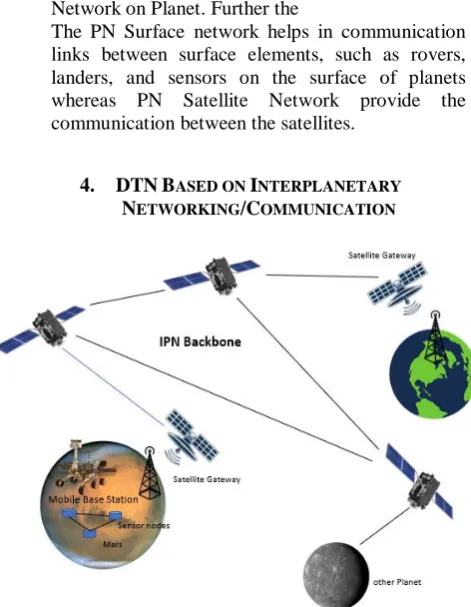
Interplanetary Networks mainly comprises of 3 networks:
● IPN Backbone Network: As there is a need for
huge capacity and always available link, IPN Backbone Network provides these services.
● IPN External Networks: This consists of nodes
having short and long-distance communication capabilities.
● PN Networks: It comprises of Satellite and surface
Network on Planet. Further the
The PN Surface network helps in communication links between surface elements, such as rovers, landers, and sensors on the surface of planets whereas PN Satellite Network provide the communication between the satellites.
4. DTN BASED ON INTERPLANETARY
NETWORKING/COMMUNICATION
Fig. 4 - Interplanetary Communication
Ongoing improvements in space interchanges have begun tending to current difficulties. Consultative Committee for
for space interchanges. CCSDS File Delivery Protocol (CFDP) is designed for reliable IPN file transfer.
A. PROTOCOL STACK
Both CCSDS protocol and the OSI Model Protocol Architecture are close to each other. But the protocols working in each layer of CCSDS are way more complex. They can support the unfavorable environment of space [6].
There are 8 layers working:
Fig. 5 - CCSDS Protocol Stack
1. Space Application Layer: End to End application services like transferring files, compression of data etc. are provided by the protocols in this layer.
2. Space file transfer layer: This layer provide support for two protocols: (1) FTP (File Transfer Protocol); (2) CCSDC File Delivery Protocol.
3. Space End to End Reliability Layer: Reliability from End to End is ensured by this layer.
4. Space End to End security Layer: In this layer, multiple levels of data protection is provided by IPSec and SCPS security protocol.
5. Space Networking Layer: This layer supports static as well as dynamic routing mechanisms.
7. Space Channel Coding Layer: Two important roles are: synchronization and channel coding over space.
8. Space Wireless Frequency and Modulation Layer: Frequencies and efficient types of modulations for creating
the channel connecting the two spacecraft are specified.
B. Brief of CFDP
CFDP is an approach for reliable transmission that can bear comparably variable and long round-trip latency [4]. There are two modes of CFDP operation. The modes are
unacknowledged and acknowledged mode.
In the latter, if the data is corrupted or lost then it will be retransmitted automatically.
C. ARCHITECTURE OF CFDP
Fig. 6 - Architectural elements in CFDP
Elements of CFDP Protocol
1. Protocol Entity: Core delivery procedures are
implanted by the protocol entity.
2. User: User must be present for the protocol to operate.
3. File Store: It is the storage service provided by the CFDP.
4. Communication System: It is also conveyed as a
Unit Data Transfer layer where all the entities have access.
5. Management Information Base (MIB): As the
data is static in nature usually, it can be stored in MIB as System Tables.
We have discussed the challenges that we face in space communications. The TCP/IP stack cannot handle this kind of challenging environments [6]. Delay Tolerant Networking architecture provides an alternative solution by specifying an overlay protocol known as Bundle protocol.
D. DTN Architecture and Bundle protocol
We have an overlay on top of transport layer or other layer protocols. The significance of overlays is that at each DTN hop, delays and disruptions can be tackled [5]. In DTN architecture, application data is stored on intermediate nodes before it is being forwarded to the next node on the path.
The Bundle Protocol is the most widely used DTN protocol. The elementary unit of data is” Bundle” in this protocol. Bundle consists of destination names, sender, data units and and other information that is necessary for an end to end communication [5]. Using convergence layer adapters (CLA), BP can be interfaced with different lower layer protocol networks. We can summarize DTN as:
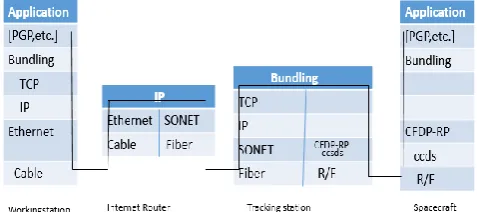
Fig. 7 – Bundling based Interplanetary Internet.
● DTN as an overlay
As explained earlier, we have an overlay on top of Transport layer or other lower layer protocols. The end to end path maybe disintegrated into multiple DTN hops [5] simply by installing a bundle protocol agent on the endpoints and nodes at the border of homogeneous segments.
Fig. 10 – DTN as an Overlay
● Information Storage at Intermediate Nodes
On the basis of information storage, we can say that there is stark difference between TCP/IP and DTN networks. In networks where we have better connectivity and minuscular delays, routers rely on short-term storage and information is persistently cached only at end nodes [15]. The information can be accessed directly from the source as the transmission is reliable.
Obviously, it isn’t the scenario with IPN. To deal with these challenges, information is stored for a longer duration at intermediate DTN.
Here, we see that without any modifications to the protocol, the development of supporting infrastructure will enable UDP/IP to work more like bundling [4] and will enable the deployment of DTN to be built on present capabilities. As IP protocol mediates with different link layer protocols i.e., we have a reliable system which uses TCP/IP tunnels and afterward, we built IP virtual interfaces to this RLT system, CFDP-RP and also to other systems. This provides end-to-end reliability to IP over heterogeneous links. Without performing protocol modifications, it becomes a challenge to have the Bundling capability within the Internet model. The strategy is as follows:
Fig. 8 – Integration of DTN and NDN Strategy
5. NDN BASED INTERPLANETARY
NETWORKING/COMMUNICATION
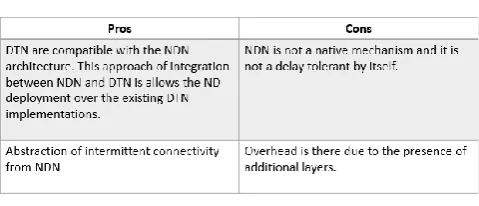
Name Data Networking was not developed for high-delay networks rather it was meant to be for low delay and highly connected networks environments. There is inefficiency in the case where we have intermittent connectivity. So, there is a need for some additional mechanisms. The challenge that we consider in this paper is to integrate NDN and DTN in order to provide support for delay intermittent connectivity. First, try to build delay/disruption tolerant functionality into NDN i.e., Data is lost when transferred back, as a result, the consumer has to send interest packet again, but is not efficient. Second, by integrating DTN, one can use the existing implementations rather than implementing delay/disruption-tolerant functionality from the scratch in NDN. It is like viewing DTN as an NDN underlay.
Fig. 9 – NDN-DTN Based Interplanetary Internet architecture.
The DTN architecture is suitable for 3 scenarios [5]:
● Geostationary Earth Orbit Satellites with fixed terminals
● Geostationary Earth Orbit with mobile terminals
● Lower Earth Orbit Satellites
Geostationary Earth Orbit Satellites with fixed terminals: With fixed terminals, end-to-end connectivity is mostly viable.
Geostationary Earth Orbit with mobile terminals: DTN can potentially increase resilience here.
Lower Earth Orbit Satellites: As no End to end connectivity is present here DTN can be of great utility here.
Fig. 10 – Approach Tradeoffs
6.CONCLUSION
REFERENCES
[1] Saxena, D., Raychoudhury, V., Suri, N., Becker, C. and
Cao, J., 2016. Named data networking: a
survey. Computer Science Review, 19, pp.15-55.
[2] Pan, J., Paul, S. and Jain, R., 2011. A survey of the
research on future internet architectures. IEEE
Communications Magazine, 49(7), pp.26-36.
[3] Wu, H., Li, Y. and Cao, B., 2015, November.
Interplanetary communication technologies,
architectures and applications. In 2015 IEEE/CIC International Conference on Communications in China (ICCC) (pp. 1-6). IEEE.
[4] Burleigh, S., Hooke, A., Torgerson, L., Fall, K., Cerf,
V., Durst, B., Scott, K. and Weiss, H., 2003. Delay-tolerant networking: an approach to interplanetary
internet. IEEE Communications Magazine, 41(6),
pp.128-136.
[5] Caini, C., Cruickshank, H., Farrell, S. and Marchese,
M., 2011. Delay-and disruption-tolerant networking (DTN): an alternative solution for future satellite
networking applications. Proceedings of the
IEEE, 99(11), pp.1980-1997.
[6] Rahman, K.S., Islam, M.M. and Kabir, M.H., 2014,
March. Interplanetary network: A brief introduction. In 16th Int'l Conf. Computer and Information Technology (pp. 261-266). IEEE.
[7] Ding, W., Yan, Z. and Deng, R.H., 2016. A survey on
future Internet security architectures. IEEE Access, 4, pp.4374-4393.
[8] Potdar, V., Sharif, A. and Chang, E., 2009. Wireless
multimedia sensor networks: a survey. In Proceedings of the international workshop on security in RFID and its industrial applications with IEEE 23rd international conference on advanced information networking and applications (AINA 2009) (pp. 636-641). IEEE Computer Society.
[9] Yi C, Afanasyev A, Moiseenko I, Wang L, Zhang B,
Zhang L. A case for stateful forwarding plane. Computer Communications. 2013 Apr 1;36(7):779-91.
[10]Baccelli E, Mehlis C, Hahm O, Schmidt TC, Wählisch
M. Information centric networking in the IoT: Experiments with NDN in the wild. InProceedings of the 1st ACM Conference on Information-Centric Networking 2014 Sep 24 (pp. 77-86). ACM.
[11]Burke J, Gasti P, Nathan N, Tsudik G. Securing
instrumented environments over content-centric
networking: the case of lighting control and NDN.
In2013 IEEE Conference on Computer
Communications Workshops (INFOCOM WKSHPS) 2013 Apr 14 (pp. 394-398). IEEE.
[12]Xylomenos G, Ververidis CN, Siris VA, Fotiou N,
Tsilopoulos C, Vasilakos X, Katsaros KV, Polyzos GC. A survey of information-centric networking research. IEEE Communications Surveys & Tutorials. 2014 May;16(2):1024-49.
[13]Perino D, Varvello M. A reality check for content
centric networking. InProceedings of the ACM
SIGCOMM workshop on Information-centric
networking 2011 Aug 19 (pp. 44-49). ACM.
[14]Yuan H, Song T, Crowley P. Scalable NDN forwarding:
Concepts, issues and principles. In2012 21st
International Conference on computer communications and networks (ICCCN) 2012 Jul 30 (pp. 1-9). IEEE.
[15]Balasubramanian A, Levine B, Venkataramani A. DTN