Coreference Resolution
Kristina Nilsson and Hans Hjelm
Swedish Graduate Schoool of Language Technology (GSLT) and Computational Linguistics, Department of Linguistics
Stockholm University, SE-106 91 Stockholm
{kristina.nilsson,hans.hjelm}@ling.su.se
Abstract
We investigate the effect of using word-space models as an approximation of the kind of lexico-semantic and common-sense knowledge needed for coreference resolution of definite descriptions, that is, definite NPs with a common noun as head, for Swedish news text. We contrast a sys-tem using semantic knowledge from the word-space models with a semantically ig-norant system and another system drawing its semantic information from a semantic dictionary called SynLex. We demonstrate an improvement in the results for two dif-ferent evaluation tasks for the system us-ing word space-derived semantic informa-tion over both other systems.
1 Introduction
Coreference resolution, that is, the identification of all expressions referring to the same entity within a discourse, is an important preprocessing step in many Natural Language Processing tasks, for example question answering, information ex-traction, automatic summarization, and machine translation (Mitkov, 2003). For example, extrin-sic evaluations of the effect of adding coreference resolution to systems for question answering show that adding referential relationships between noun phrases improves system performance as well as the quality of retrieved answers for passage re-trieval (Morton, 2005), and that the coverage of off-line answer extraction is improved (Hendrickx et al., 2008a).
The coreference resolution task, when applied to noun phrases, can be further divided into the fol-lowing sub-tasks where the classification is based on the type of referring expression:
a) pronoun resolution, e.g., the pronoun ’he’ can be used to refer to the NP
’presi-dent Kennedy’ with the Named Entity (NE) ’Kennedy’ as head,
b) identification of coreferent NEs, e.g., ’John F. Kennedy’, ’Kennedy’, ’President Kennedy’, and ’JFK’ might all refer to the same dis-course entity,
c) resolution of definite descriptions, that is, anaphoric definite NPs with a common noun as head, e.g., ’the president of the United States’ might refer to the same entity as ’the president’ or ’the commander-in-chief’ within a discourse.
This paper is concerned with the task ‘c’, the resolution of coreferent definite descriptions. This is a challenging problem in comparison to Named Entity coreference resolution (‘b’) and pronoun resolution (‘a’). For example, (Strube et al., 2002) report an f-score of 33.94% for definite descrip-tion resoludescrip-tion using a knowledge-poor, language-and domain-independent approach. The results for definite descriptions are markedly lower than the results for NEs and pronouns (with f-scores of 76.22% and 81.60% respectively) as well as the overall result for the system (an f-score of 67.89%).
Resolution of definite descriptions in turn in-cludes a number of sub-tasks of varying difficulty; we distinguish between these tasks:
1) resolution of identical head definite descrip-tions: cases where the anaphoric definite de-scription and the antecedent share the same head noun, as in the following example: ‘She has a revenue of three million a year [...]. Therevenueof Elly Lagerin’s store ...’1 About 50% of all anaphoric definite descrip-tions in our data share the same head noun as the antecedent, and thus can be resolved with various string and substring matching tech-niques combined with morphological analy-sis;
2) resolution of non-identical head definite descriptions: the remaining 50% of all anaphoric definite descriptions are cases where the anaphor has a different head noun than the antecedent. We distinguish between two types of cases based on whether the head of the antecedent NP is a NE or a common noun:
a) In cases where the antecedent is a NE of a certain type and the head noun of the anaphor is a common noun, as in the antecedent-anaphor pair ’<NE type=’PERSON’>Hans Stråberg</NE>’ - ‘the CEO of Elec-trolux’, an estimate of the semantic compatibility of the candidate an-tecedent and the anaphor might help resolution,
b) In cases where both the anaphor and the antecedent are definite descriptions but their head nouns are non-identical, res-olution might depend on information on lexical relations such as synonymy, hy-pernymy or hyponymy, or on additional information required for further reason-ing and/or keepreason-ing track of the current focus.
The main topic of this paper is resolution of non-identical head definite descriptions. We de-scribe an experiment on modeling lexical knowl-edge on domain-specific data using word-space models. This knowledge is used for deriving
1This example is an approximate translation from our
Swedish data.
features for coreference resolution of candidate antecedent-anaphor pairs. In order to evaluate these semantic features, they are added to a base-line feature set consisting of morphological, lex-ical, positional, and syntactic features. We also compare the effect of the word-space features to the effect of features based on a semantic dictio-nary, SynLex.
While coreference resolution is an important preprocessing task for many NLP tasks, the avail-ability of resources needed for the task varies de-pending on the language and the domain. For the sub-task of resolution of definite NPs with a com-mon noun as head, information on semantic relat-edness is essential. The word-space model meet these needs well: it can provide lexico-semantic similarity judgements in any language and do-main, as long as the appropriate text material is available. This is our main reason for choosing to work with word-space, or distributional, seman-tics in our experiments.
2 Related Work
Systems for coreference resolution (either for the coreference problem as a whole, or focusing on sub-tasks such as pronoun resolution, or process-ing of anaphoric definite NPs with common noun heads) commonly use resources such as the lex-ical database WordNet (Fellbaum, 1998) or its (smaller) European counterparts in EuroWordNet (Vossen, 1998) for adding information on seman-tic relatedness between NPs.
For example, WordNet was used to test the se-mantic compatibility of individual NP pairs by as-signing the first WordNet sense of the head noun as the semantic class of common noun NPs by (Soon et al., 2001), who found that both a better al-gorithm for assigning semantic classes and a more refined semantic class hierarchy were needed.
(Ng, 2007) shows that a system for English us-ing automatically induced semantic class knowl-edge performs better than a system using the WordNet first sense heuristic, while (Hendrickx et al., 2008b) reports that combining features based on automatically generated semantic clusters with features based on synonym and hypernym rela-tions in Dutch EuroWordNet, gives a small but sig-nificant improvement.
coverage of both vocabulary and relations, ambi-guity (there might be more than one sense to a concept, and synsets in WordNet are sorted by fre-quency), and semantically related words might be located far from each other in the WordNet struc-ture (see e.g., (Vieira and Poesio, 2000; Poesio et al., 1998)).
Furthermore, WordNet is a general ontology, while resolution might require domain-specific or context-dependent lexical information. Ef-forts towards automatically acquiring such infor-mation from corpora are described by e.g., (Poe-sio et al., 1998; Goecke et al., 2007). Again, as mentioned in Sect. 1, we choose to work with word-space semantics, precisely for its ability to provide language and domain-specific lexico-semantic knowledge to our system.
3 Semantic Features for Coreference Resolution
In this experiment, coreference is defined as a re-lation of identity of reference between two noun phrases. The resolution task is limited to classifi-cation of pairs of possibly anaphoric NPs and their candidate antecedents; the subsequent linking of classified pairs into coreference chains will not be discussed here as the aim of the paper is to discuss the influence of semantic features on the classifi-cation task.2
The task is further limited to resolution of non-identical head anaphora (listed as type ‘2’ in Sect. 1), i.e., cases where we cannot rely on string matching for resolving the anaphoric reference. We also divide the pair-wise classification into two sub-tasks, based on the respective NP types of the candidate antecedent and anaphor:
1. the candidate anaphor is a definite NP with a common noun head, and the candidate an-tecedent is a NE – listed as ‘2a’ in Sect. 1;
2. the candidate anaphor and the candidate an-tecedent are both definite NPs with non-identical common nouns as head – listed as ‘2b’ in Sect. 1.
3.1 Semantic relatedness as expressed in SynLex
SynLex3 is a free dictionary of general vocabu-lary Swedish synonyms consisting of 25.000 word
2Any influence on classification is likely to transfer to the
complete coreference chains.
3URL: http://lexikon.nada.kth.se/synlex.html
pairs (Kann and Rosell, 2006). Synlex was auto-matically constructed and later manually refined by volunteer users of an on-line dictionary. The users graded each candidate synonym pair accord-ing to their intuitive estimate as to how closely the candidate pair was related (semantically), and pairs with a user grade above a certain threshold were included in the dictionary. For each pair of words in SynLex, there is a score between 3.0 and 5.0 representing how the users graded the pair. Ac-cording to (Kann and Rosell, 2006), pairs with a score of 3.0 are synonymic to a lesser degree, whereas pairs with a score of 4.0 are very good synonyms. SynLex, unlike WordNet, does not dis-tinguish between different word senses.
We use SynLex for deriving two relational fea-tures, one binary feature indicating whether the base form of the head word of the candidate an-tecedent and the base form of the head word of the anaphor are a synonymy pair in SynLex, and one feature consisting of the SynLex score for that word pair (if there is one). For example, the word företag (‘business’) has three synonyms in Syn-Lex, with scores ranging from 3.2 to 4.0:
4.0 firma (‘firm’)
3.3 bolag (‘corporation’, ‘company’)
3.2 affärsverksamhet (‘business (activity)’)
and the 4.0 synonymfirma(‘firm’) is in turn listed with four synonyms:
4.4 rörelse (‘enterprise’)
4.0 företag (‘business’)
3.1 bolag (‘corporation’, ‘company’)
3.1 affärsverksamhet (‘business (activity)’)
Thus, the word pair företag and bolag would get a SynLex score of 3.3 in addition to a posi-tive binary feature, whereas the word pairföretag andrörelsewould get a SynLex score of 0.0 and a negative binary feature.
3.2 Semantic relatedness in word-space models
related vector-space model, the representational models in these theories are commonly referred to asword-spacemodels. Sahlgren (2006) argues that we can classify word-space models into two main groups: one which defines co-occurrence as two words occurring in the same document and one which defines it as two words occurring within a fixed-size sliding window. The first type is claimed to capturesyntagmaticrelations between words, the second type instead captures paradig-maticrelations. Sahlgren (2006) gives credence to these claims through a series of experiments, but also shows that there is quite a bit of overlap be-tween the two types. We investigate the effective-ness of these two types of models, separately as well as in conjunction, on the current task, using the standard cosine similarity measure.
Many researchers have experimented with applying singular value decomposition (SVD) (Golub and van Loan, 1996) to the matrices used by the word-space models to store the co-occurrence data. This process can be used for a dimensionality reduction for the similarity vec-tors. When the objects represented by the matrix are words and documents, this procedure is of-ten calledlatent semantic analysis (LSA) and it is described in (Deerwester et al., 1990) and given a psychological motivation in (Landauer and Du-mais, 1997). The advocates of LSA claim that it allows for capturing “latent” relations among words, that are not accessible through the raw co-occurrence data. In addition to the similarities cal-culated from the unprocessed matrices, we there-fore also examine the effects of using singular value decomposition on the two types of word-spaces described above (again using the cosine similarity measure).
3.2.1 Term selection techniques
Another closely related approach to capturing sim-ilarities between words are so-called term selec-tion or term weighting techniques. Just like the word-space models, their modeling capabilities are based on co-occurrence analysis. Where word-space models are based in geometry, term selec-tion techniques are based in statistics or infor-mation theory. We use the mutual information (MI) measure (also referred to in (Manning and Schütze, 1999) as expected mutual information) on the two types of co-occurrence mentioned pre-viously (within document or within a sliding win-dow) and compare the results on the current task.
3.2.2 Building the word-space models
The corpus used for training the word-space mod-els comes from the same newspaper and domain as the coreference annotated data (described in Sect. 4.1). It consists of about 1.5 million running words. When training the word-space model, we also include the coreference annotated data in the training data. However, this is not a case of “test-ing on the train“test-ing data”, since the annotations in the coreference data are not taken into consider-ation by the word-space model. The word-space model needs to see the words it is modeling as they occur in running text, and the more such ex-amples provided, the better the model will func-tion, typically. The coreference annotated data is just treated as another source for collecting co-occurrence data by the word-space model; the coreference data does not constitute a gold stan-dard for this part of our system.
3.2.3 Word-space features
We thus have three models of similarity: using sine or mutual information on vectors from the co-occurrence matrices (we merely apply a standard log-2 frequency damping) or using cosine on the dimensionality reduced vectors.
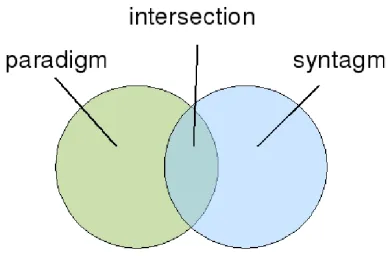
Table 1 gives an overview of all the word-space features, and the three models are repre-sented by the three rows in the table. Each of these three models has two variants: the context window-based (column ‘a’) and the document-based (column ‘b’). The score for the head words of each candidate anaphor-antecedent pair from each model is used as a feature, describing to what degree the two NPs are related within the respec-tive models. We also extract a binary feature for each model, which is positive only for the highest-ranking coreference candidate for each NP within a document (columns ‘c’ and ‘d’). Finally, we create sets consisting of the top 10 most similar coreference candidates for every definite descrip-tion and proper noun within a document. This is done for each model and similarity measure, with one set containing context window-based (column ‘e’) and one set containing document-based rela-tions (column ‘f’; see also Fig. 1). At least when using the cosine measure on the non-reduced vec-tors,4we are hoping that these sets will help us
dis-tinguish between words that are syntagmatically
4We do not rule out the same effect for the MI measure
Figure 1: Forming three sets of words: paradig-matically related (window-based co-occurrence), syntagmatically related (document-based co-occurrence) and the intersection of these.
and paradigmatically related. We create a binary feature for each of the three sets formed this way (column ‘g’ represents the intersection of the pre-vious two), hopefully indicating the type of rela-tion (or lack thereof) in which a particular pair of words stand.
4 Classification of Pairs of Definite Descriptions
4.1 Data
The annotation of the data used in these exper-iments was done by one of the authors, based on the BREDT annotation guidelines for referen-tial relations developed for Norwegian (Borthen, 2004) with minor modifications for the language (Swedish) and the domain (economic news text). The main goal of the annotation is to mark a se-lect set of anaphoric and cataphoric relations. The most frequent, and thus the most important one, is coreference, which is defined as a relation of iden-tity of reference. The annotated data we use here consists of 66 documents; there is a total of 6606 noun phrases of which 1887 (28%) are annotated as coreferent.
The preprocessing includes part-of-speech tag-ging and lemmatization with Granska (Carlberger and Kann, 1999), dependency parsing with Malt-Parser (Nivre et al., 2007), Named Entity tagging, and NP chunking. For NEs, basic semantic in-formation is added by extending each occurrence of the NE type ‘organization’ with the synset for företag, organisation(‘company’, ‘organization’), and the NE type ‘person’ with the synset for män-niska, person(‘human being’, ‘person’) from the
online version of the Swedish WordNet5 (Viberg et al., 2002).
Since we define coreference as a relation of identity of reference, each NP within a corefer-ence chain is coreferent with all other NPs within that chain. Thus, in order to construct pairs of anaphors and candidate antecedents, each NP is combined with all other NPs within the document. As stated in Sect. 3, we are concerned with two sub-tasks in these experiments; for the first task there are 269 positive instances, and for the second 328. The data is partitioned so that the instances used in the two experiments are disjoint.
4.2 Features
Our baseline feature set is comprised of language-and domain-independent features used in high-performing coreference resolution systems such as (Soon et al., 2001) and (Strube et al., 2002), some domain-dependent features handling e.g., quoted speech, and some features based on corpus studies on definite descriptions by e.g., (Fraurud, 1992) and (Vieira and Poesio, 2000) describing e.g., NP complexity. This feature set includes 90 features; 58 of these features describe each NP in a can-didate anaphor-antecedent pair (including gender, number and definiteness, as well as syntactic func-tion and approximafunc-tions to salience), and 32 fea-tures describe the candidate pair in terms of mor-phological similarity and syntactic parallelism, lo-cation (e.g., whether the two NPs are located within the same sentence, or in adjacent ones), and string similarity (e.g., complete and partial over-lap, and the Levenshtein distance). Classification with this feature set is used as a baseline.
In addition to this standard feature set, semantic information is added via two SynLex features (de-scribed in section 3.1), and 21 word-space features (described in section 3.2). We group the 21 word-space features into six different configurations as such (please also refer to Table 1):
• WS: includes all 21 word-space features (WS stands for word-space)
• WS cosine: all features in row 1 in Table 1
• WS MI: all features in row 2
• WS SVD: all features in row 3 (we use a standard dimensionality of 200 in our experi-ments)
5URL: http://www.lingfil.uu.se/ling/swn.html; We do not
window document window∗ document∗ paradigm∗ syntagm∗ intersection∗
cosine 1a 1b 1c 1d 1e 1f 1g
MI 2a 2b 2c 2d 2e 2f 2g
SVD 3a 3b 3c 3d 3e 3f 3g
Table 1: Features from word-space models. The *-character indicates that features in the marked column are binary. ‘MI’ stands for mutual information and ‘SVD’ for singular value decomposition.
• WS window: all features in columns a, c, and e–g; aims to capture paradigmatic relations (we use a standard window size of 3 words to each side of the focus word in our experi-ments)
• WS document: all features in columns b and d–g; aims to capture syntagmatic relations
4.3 Classification
For classification of pairs of definite descriptions, we use 5-fold cross validation with the memory-based learner TiMBL (Daelemans and van den Bosch, 2005). We use the IB1 (k-nn) algorithm with k=5, the distance metric MVDM/overlap, and gain ratio feature weighting, and feature sets adapted for each task.
The classification is evaluated on instance level using the following measures: precision, recall, andF-score. Precision is defined as the number of correct coreference relations given by TiMBL di-vided by the total number of coreference relations given by the system. Recall is the number of cor-rect coreference relations given by TiMBL divided by the total number of coreference relations in the data. F-score is the harmonic mean of precision and recall.
5 Results
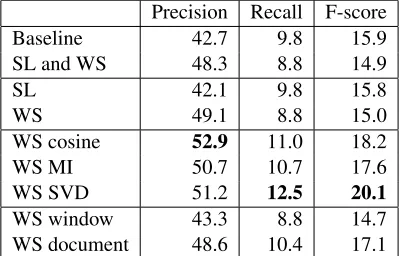
The results in Tables 2 and 3, below, show a pos-itive effect from the semantic features, though not in all configurations. The SynLex features do not provide any useful information to the system – their only effect is to lower the recall slightly. One might argue that the comparison between SynLex and our word-space models is unfair, as SynLex is a general resource whereas the word-space models are domain-specific. But this is in fact the point we wish to make: in order to handle coreference between noun phrases, we need domain-specific models of semantic relatedness. All but one con-figuration of word-space features produce higher precision than the baseline feature set, and the ma-jority also give a simultaneous increase in recall.
Precision Recall F-score
Baseline 28.3 22.1 24.8
SL and WS – – –
SL – – –
WS 30.7 18.6 23.1
WS cosine 27.7 19.0 22.5
WS MI 33.7 23.7 27.8
WS SVD 32.9 22.1 26.5
WS window 31.9 20.9 25.3
WS document 34.7 23.7 28.2
Table 2: Micro-averaged results: antecedent is an NE, anaphor is a common noun. SL stands for ’SynLex’. The feature sets are named and de-scribed in Sect. 4.2, above. SynLex does not con-tain names, therefore we cannot calculate results for settings involving this resource.
Precision Recall F-score
Baseline 42.7 9.8 15.9
SL and WS 48.3 8.8 14.9
SL 42.1 9.8 15.8
WS 49.1 8.8 15.0
WS cosine 52.9 11.0 18.2
WS MI 50.7 10.7 17.6
WS SVD 51.2 12.5 20.1
WS window 43.3 8.8 14.7
WS document 48.6 10.4 17.1
Table 3: Micro-averaged results, both antecedent and anaphor are common nouns.
More surprising was to see that the models with co-occurrence being defined on a document level give better results on both tasks than the ones where it is based on the sliding context windows. We expected the latter to capture paradigmatic re-lations better than the former, but other factors, perhaps related to data sparseness, seem to influ-ence the results contrary to our intuition. It can be argued, however, that the SVD can manage to cap-ture paradigmatic information even when consid-ering co-occurrence on a document level (features 3b and 3d – 3g in Table 1); that this in fact consti-tutes part of the “latency” in LSA. Further, in the task where the antecedent is an NE, it may well be that the relation between the two NPs is better thought of as syntagmatic than paradigmatic.
We also see that the ‘WS MI’ feature setting performs well on the task where the antecedent is an NE. It has been argued (Manning and Schütze, 1999) that the MI measure favors rare cases; some-thing which applies to the NEs, and therefore could explain why this feature setting does well on this task.
The subtask where both antecedent and anaphor are common nouns can conceptually be split fur-ther into two cases. First, we have cases that can be resolved using information on lexical re-lations between the head nouns of the anaphor and the candidate antecedent; relations such as (near) synonymy, as in ‘the business’ - ‘the company’, or hypernymy, as in ‘mediator’ - ‘the profession’. Second, we have cases that require additional in-formation for resolution, e.g., common-sense rea-soning or real-world knowledge as in ‘the period April-June’ - ‘the second quarter’, and/or keeping track of the current focus ‘two metal workers’ -‘the dismissed (employees)’. We expect the word-space approach to deal better with the former cases than the latter, but we cannot exclude that the lat-ter, too, will display some degree of similarity in a word-space model.
We performed an experiment where we used the word-space features exclusively (no baseline fea-tures were used) for classifying the instances. This results in rather low figures in terms of precision and recall, but the successful cases may still give us an idea of the type of information we can hope to extract. E.g., the word-space models correctly predicted a coreference relation between siffror andstatistik(‘numbers’ and ‘statistics’),anställda and personal (‘employees’ and ‘personel’), and
euroområdet and euroländerna (‘the Euro area’ and ‘the Euro countries’). These are all cases of near synonymy, and the results thus support our assumption that the word-space model will handle such cases better than cases where focus or rea-soning play a part in the resolution.
We have performed these experiments on Swedish news text, but we have reasons to be-lieve that the results are at least partly generaliz-able. First of all, the problem of having to resolve non-identical head definite descriptions exists and is relevant for other languages than Swedish, as we discussed in Sect. 1. Secondly, word-space mod-els can be constructed for any language and do-main where the tokenization of text into words is not a major issue. Finally, though they do not em-ploy word-space features directly, Hendrickx et al. (2008b) and Ng (2007) show, for Dutch and En-glish, that including semantics from statistically based corpus-methods has positive effects on the accuracy on their systems.
6 Conclusion
Coreference resolution of definite NPs is a com-plex problem, resulting in higher error rates compared to Named Entity coreference resolu-tion, or pronoun resolution. One reason for this is the problem of acquiring various types of domain-specific lexico-semantic and common-sense knowledge needed for resolution. We present encouraging results from a study on us-ing word-space similarity measures to approxi-mate this knowledge in a system for resolution of definite descriptions.
References
Kaja Borthen. 2004. Annotation scheme for BREDT. Version 1.0. Technical report, University of Bergen.
Johan Carlberger and Viggo Kann. 1999. Imple-menting an efficient part-of-speech tagger.Software Practice and Experience, 29:815–832.
Walter Daelemans and Antal van den Bosch. 2005.
Memory-Based Language Processing. Studies in Natural Language Processing. Cambridge Univer-sity Press.
Christiane D. Fellbaum, editor. 1998. WordNet: An Electronic Lexical Database. MIT Press.
Kari Fraurud. 1992.Processing Noun Phrases in Nat-ural Language Discourse. Ph.D. thesis, Stockholm University.
Daniela Goecke, Maik Stührenberg, and Tonio Wand-macher. 2007. Extraction and representation of semantic relations for resolving definite descrip-tions. InOTT’06. Ontologies in Text Technology: Approaches to Extract Semantic Knowledge from Structured Information. Publications of the Insti-tute of Cognitive Science (PICS) 1-2007, Osnabrück, Germany.
Gene H. Golub and Charles F. van Loan. 1996. Ma-trix Computations. Johns Hopkins University Press, Baltimore, MD, USA, 3 edition.
Gregory Grefenstette. 1994. Explorations in Auto-matic Thesaurus Discovery. Kluwer Academic Pub-lishers, Boston, MA, USA.
Iris Hendrickx, Gosse Bouma, Frederik Coppens, Wal-ter Daelemans, Veronique Hoste, Geert KloosWal-ter- Klooster-man, Anne-Marie Mineur, Joeri Van Der Vloet, and Jean-Luc Verschelde. 2008a. A coreference cor-pus and resolution system for Dutch. In Euro-pean Language Resources Association (ELRA), edi-tor,Proceedings of the Sixth International Language Resources and Evaluation (LREC’08), Marrakech, Morocco, May.
Iris Hendrickx, Véronique Hoste, and Walter Daele-mans. 2008b. Semantic and Syntactic Features for Dutch Anaphora Resolution. InProceedings of the 9th International Conference on Intelligent Text Processing and Computational Linguistics, CICLing 2008, Haifa, Israel, February 17-23, 2008, Lecture Notes in Computer Science. Springer.
Viggo Kann and Magnus Rosell. 2006. Free con-struction of a Swedish dictionary of synonyms. In S. Werner, editor,Proceedings of the 15th NODAL-IDA conference, Joensuu 2005, Ling@JoY : Univer-sity of Joensuu electronic publications in linguistics and language technology 1, Joensuu. SBN 952-458-771-8, ISSN 1796-1114.
Thomas Landauer and Susan Dumais. 1997. A Solu-tion to Plato’s Problem: The Latent Semantic Anal-ysis Theory of Acquisition, Induction, and Rep-resentation of Knowledge. Psychological Review, 104(2):211–240.
Christopher Manning and Hinrich Schütze. 1999.
Foundations of Statistical Natural Language Pro-cessing. The MIT Press, Cambridge, MA.
Ruslan Mitkov. 2003. Anaphora Resolution. In Rus-lan Mitkov, editor,The Oxford Handbook of Com-putational Linguistics, pages 266–283. Oxford Uni-versity Press.
Thomas Morton. 2005. Using Semantic Relations to Improve Information Retrieval. Ph.D. thesis, Uni-versity of Pennsylvania.
Vincent Ng. 2007. Semantic class induction and coref-erence resolution. InProceedings of the 45th An-nual Meeting of the Association of Computational Linguistics, pages 536–543, Prague, Czech Repub-lic, June. ACL.
Joakim Nivre, Johan Hall, Jens Nilsson, Atanas Chanev, Gül¸sen Eryiˇgit, Sandra Kübler, Svetoslav Marinov, and Erwin Marsi. 2007. Maltparser: A language-independent system for data-driven de-pendency parsing. Natural Language Engineering, 13(2):95–135.
Massimo Poesio, Sabine Schulte im Walde, and Chris Brew. 1998. Lexical Clustering and Definite De-scription Interpretation. InProceedings of the AAAI Spring Symposium on Learning for Discourse, Stan-ford, CA, March.
Magnus Sahlgren. 2006. The Word-Space Model: Using Distributional Analysis to Represent Syntag-matic and ParadigSyntag-matic Relations between Words in High-Dimensional Vector Spaces. Ph.D. thesis, Stockholm University, Stockholm, Sweden.
Hinrich Schütze. 1998. Automatic Word Sense Dis-crimination. Computational Linguistics, 24(1):97– 123.
Wee Meng Soon, Hwee Tou Ng, and Daniel Chung Yong Lim. 2001. A Machine Learning Ap-proach to Coreference Resolution of Noun Phrases.
Computational Linguistics, 27(4):521–544.
Michael Strube, Stefan Rapp, and Christoph Müller. 2002. The influence of minimum edit distance on reference resolution. In Proceedings of the Con-ference on Empirical Methods in Natural Language Processing (EMNLP), pages 312–319, Philadelphia, PA, USA, July. ACL.
Åke Viberg, Karin Lindmark, Ann Lindvall, and In-gmarie Mellenius. 2002. The Swedish WordNet Project. InProceedings of Euralex 2002, Copen-hagen University, pages 407–412.
Renata Vieira and Massimo Poesio. 2000. An empir-ically based system for processing definite descrip-tions.Computational Linguistics, 26(4):539–593.
Piek Vossen. 1998. Introduction to EuroWordNet.