Citations in the Digital Library of Classics: Extracting Canonical
References by Using Conditional Random Fields
Matteo Romanello, Federico Boschetti, Gregory Crane The Perseus Project
Medford, MA, USA
matteo.romanello, federico.boschetti, gregory.crane{@tufts.edu}
Abstract
Scholars of Classics cite ancient texts by using abridged citations called canonical references. In the scholarly digital library, canonical references create a complex tex-tile of links between ancient and modern sources reflecting the deep hypertextual nature of texts in this field. This paper aims to demonstrate the suitability of Con-ditional Random Fields (CRF) for extract-ing this particular kind of reference from unstructured texts in order to enhance the capabilities of navigating and aggregating scholarly electronic resources. In partic-ular, we developed a parser which recog-nizes word level n-grams of a text as be-ing canonical references by usbe-ing a CRF model trained with both positive and neg-ative examples.
1 Introduction
In the field of Classics, canonical references are the traditional way established by scholars to cite primary sources within secondary sources. By primary sources we mean essentially the ancient texts that are the specific research object of Philol-ogy, whereas by secondary sources we indicate all the modern publications containing scholarly in-terpretations about those ancient texts. This spe-cific characteristic strongly differentiates canoni-cal references from the typicanoni-cal references we usu-ally find within research papers.
Canonical references are used to shortly refer to the research object itself (in this case ancient texts) rather than to the existing literature about a cer-tain topic, as happens with references to other sec-ondary sources. Given this distinction, canonical references assume a role of primary importance as the main entry point to the information contained in scholarly digital libraries of Classics. To find a
parallel with other research fields, the role played by those references is somewhat analogous with that played by protein names in the medical liter-ature or by notations of chemical compounds in the field of Chemistry. As was recently shown by Doms and Schroeder (2005) protein names can be used to semantically index documents and thus to enhance the information retrieval from a digital li-brary of texts, provided that they are properly or-ganized by using an ontology or a controlled vo-cabulary. Moreover, by analyzing and indexing such references as if they were backlinks (Lester, 2007) from a secondary to a primary source, it is possible to provide quantitative data about the im-pact of an ancient author for research in a particu-lar disciplinary field, or in relation to a limited cor-pus of texts (e.g., the papers published by schol-arly journals in a given time interval).
In addition to serving as entry points to infor-mation, canonical references can also be thought of as a navigation apparatus that allows scholars to browse seamlessly through ancient texts and modern interpretations about them (Crane, 1987). For every scholar working on the ancient histo-riographer Herodotus, for instance, it would be extremely useful to be able to easily access all the secondary sources containing references to Herodotus’ works.
Therefore, the ability to automatically identify canonical references within unstructured texts is a first and necessary step to provide the users of dig-ital libraries of Classics with a more sophisticated way to access information and to navigate through the texts that are already available to scholars of other fields.
The volume of publicly available digitized books constituting what has been called the Mil-lion Book Library (Crane, 2006) has made it es-sential to develop automatic and scalable tools to automate the process of information extraction from electronic resources. Furthermore, the
lescence time for publications is far longer in Clas-sics than in other disciplines, meaning that typi-cally the value of a publication does not decrease drastically after a certain time. As a result, schol-ars in Classics may be the most potential benefi-ciaries of the recent mass digitization initiatives, since they have already started with many materi-als out of copyright.
In this paper we describe how Conditional Ran-dom Fields (Lafferty et al., 2001), the state of the art model in automatic classification, can be suit-ably applied to provide a scalable solution to this problem.
2 Related work
Canonical references to primary sources can be explored from at least three different angles: 1) identification and extraction; 2) hypertextual nav-igation; 3) semantics.
The identification and extraction of biblio-graphic references from what we called secondary sources (i.e. monographs, commentaries, journal papers, etc.) is a well explored task for which ef-fective tools already exist. Although the biggest efforts in this direction have been made in the scientific fields, those tools can also be suitably adapted to the field of Classics, since they are es-sentially based on machine learning techniques.
Several researchers recently focused on apply-ing computational lapply-inguistics methods to automat-ically extract information from both Classical texts and modern texts about them, in order to support the above described needs of scalability. Gerlach and Crane (2008), and Kolak and Schilit (2008) considered the identification of citations within primary sources by analyzing the syntactic and morphological features of texts, while (Smith and Crane, 2001) dealt with the disambiguation of ge-ographical names.
Looking at the problem of canonical references from the user point of view, a digital library of Classical texts such as the Perseus Digital Li-brary1. already offers to the reader the ability to navigate from secondary sources to the primary sources they refer to, a process called reference linking. The identification of references and the attribution of semantics to them, however, was done manually, and the navigation is limited to re-sources contained in the same text collection. An analogous reference linking system was proposed
1http://www.perseus.tufts.edu/hopper/
by Romanello (2008) as a value added service that could be provided to readers of electronic journals by leveraging semantic encoded canonical refer-ences.
(Smith, 2009) provided an essential contribu-tion to the research concerning the semantics of canonical references. The Canonical Text Services (CTS) protocol2was developed by Smith for
Har-vard’s Center for Hellenic Studies; it is based on URNs and is aimed at providing a machine action-able equivalent to printed canonical references. This protocol allows us to translate those refer-ences into machine actionable URNs that can then be resolved through resolution services against a distributed digital library of texts. The innovative aspect of the CTS protocol consists of a loose cou-pling system by which the linking between pri-mary and secondary sources can be realized. In-stead of hard linking a canonical reference to just one electronic edition of a primary source, by em-bedding the CTS URNs inside (X)HTML pages, it becomes possible to link it to an open ended num-ber of resources as shown by (Romanello, 2007).
3 Canonical Text References
Canonical references present unique characteris-tics when compared to bibliographic references to modern publications. First of all, they do not re-fer to physical facts of the rere-ferred work (such as publication date or page number), but refer rather to its logical and hierarchical structure. In addi-tion, canonical references often provide additional information needed by the reader to resolve the reference. For example “Archestr. fr. 30.1 Olson-Sens” means line 1 of fragment 30 of the comic poet Archestratus in the edition published by S. D. Olson and A. Sens in 1994.
The specification of the edition according to which a source is cited is an important piece of in-formation to be considered. Indeed, since the aim of Philology is to reconstruct for ancient works a text that is as close as possible to the original one (given that the original text may have been cor-rupted over centuries of manuscript tradition), ed-itors and scholars often disagree substantially as to what readings and conjectures have to be included in the established text.
Although some well established sets of abbre-viations exist, scholars’ practice of citing primary
2http://chs75.harvard.edu/projects/
sources may noticeably differ according to style preferences and the typographical needs of pub-lishers, journals or research groups. Aeschylus’ name might appear in the abridged forms “A., Aesch., Aeschyl.”, and similarly a collection of fragments like Jacoby’s Die Fragmente der Gri-eschischen Historiker may be abbreviated either as FrGrHist or FGrHist.
Moreover, some highly specialized branches of research exist within the field of Classics, such as those dedicated to Epic poetry or Tragedy, or even to a single author like Aeschylus or Homer. In those specialized branches a common tendency to use shorter references with a higher semantic den-sity for the most cited authors can be observed. For example, in publications containing thousands of references to Homer’sIliadandOdyssey, refer-ences to these texts are often expressed with Greek letters indicating the book number along with the verse number (e.g., “α1” stands for the first verse
of the first book of Homer’sOdyssey). Lowercase letters are used to refer to books of theOdyssey, whereas uppercase letters refer to the books of the
Iliad, according to a practice developed in the IV century B.C. by scholars of the library at Alexan-dria.
In the actual practice of scholarly writing, canonical references can appear with slightly dif-ferent figures according to the needs of narrative. Along with complete canonical references to a sin-gle text passage, expressed as either a sinsin-gle value or a range of values, other references can often be found that are missing one or more components that are normally present within canonical refer-ences, such as an indication of the author name, of the work title or of the editor name (e.g., “Hom. Od. 9.1, 9.2-3; Il 1.100”). This happens partic-ularly in subsequent references to passages of the same work.
Those differences that can be observed about the appearance of canonical references require us to apply different processing strategies to each case. We focus on the task of automatically iden-tifying complete references to primary sources. Once those references have been identified in the input document, we can find other anaphoric refer-ences by applying some scope-based parsing. In-deed, a canonical reference in the text constitutes thereference scopefor subsequent text passage in-dications referring to the same work.
4 Methodology
Provided that scholars may use canonical refer-ences with different abbreviation or citation styles, it is nevertheless possible to identify within canon-ical references common patterns in terms of token features.
CRF is used to classify a token depending on its features and is suitable to identify those feature patterns (Culotta et al., 2006). During the training phase, the CRF model learns what features make it more likely for a token to belong to a given cat-egory.
Our starting assumption is that it is possible to determine if a sequence of tokens constitute a canonical reference by evaluating (looking at) the features of its tokens. Each token of a sequence is assigned a category on the basis of a fixed num-ber of features. Those token categories are in turn used as features to classify the token sequence.
Starting from a dataset of canonical references and applying the above described criteria to assign features to the tokens, we obtain a training dataset where each canonical reference is reduced to a to-ken by removing whitespaces, and it is a assigned as many as features as the category assigned to its tokens.
Finally, in order to classify token sequences as “references” or “non-references” each canonical reference is assigned a convenient label. The ob-tained set of labelled references is used to train a CRF model to identify canonical references within unstructured texts.
4.1 Feature Extraction and Token Categorization
For feature extraction phase, it was important to identify both inclusive and exclusive token fea-tures. Indeed, to extract canonical references with a high level of precision, we need to identify not only the characteristic features of tokens occurring within actual references but also those characteris-tic features for tokens occurring in sequences that we want to be classified as non-references.
1. Punctuation: information about the punctu-ation concerning the presence of a final dot, hyphen, quotation marks and brackets (either single or paired), and marks used to divide and structure sequences (i.e. comma, colon and semicolon), which are particularly im-portant for sequences of text passages.
2. Orthographic Case: the orthographic case of a token is an essential piece of informa-tion to be tracked. Author names when ab-breviated still keep the initial as an upper-case letter, whereas collections of texts (such as collections of fragments) often present all uppercase or mixed case letters (e.g., “Tr-GrFr”,“CGF”, “FHG”, etc.).
3. Stopwords: given that the main language of the input document is passed as a parame-ter to the parser, we record in a separate fea-ture information regarding whether a token is a stopword in the input document language. This feature is particularly important in deter-mining more precisely the actual boundaries of a canonical reference within the text.
4. Greek Words: since we deal with Unicode UTF-8 text, we distinguish Greek letters and words. This allows us to identify more pre-cisely those references that contain Greek text such as the above mentioned Homeric references or references to the ancient lexica (e.g., Harpocr., Lex. s.v. Παναθήναια) since
they contain the lemma of the Greek word re-ferred to, usually preceded by the abbrevia-tion “s.v.” (i.e. sub voce).
5. Number: Roman and Arabic numerals com-bined in several figures are frequently used to indicate the scope of a reference. Arabic numerals that are used to represent modern dates, however, are distinguished by using a heuristic (for example, consider the prob-lem of a footnote mark which gets appended to a date). Nevertheless, sequences of both numbers and punctuation marks are assigned a specific value for this feature, since the scope of a reference is commonly expressed by dot and hyphen separated sequences such as “9.235-255”.
6. Dictionary matching: two features are as-signed if a token matches a dictionary entry.
Three different dictionaries are used to ver-ify if a token corresponds to a known canon-ical abbreviation (e.g. “Hom.” for Homer or “Od.” forOdyssey) or to another kind of ab-breviation, namely the abbreviations used by philologists to shortly refer to pages, lines, verses, etc. (“p”, “pp.”, “v.”, “vv.”, “cfr”, etc.) or to abbreviations used for modern journals. Abbreviations pertaining to the latter kind are likely to introduce some noise during the n-gram classification phase and thus are prop-erly distinguished through a specific feature. During preliminary analysis we particularly observed that journal abbreviations were of-ten confused with abbreviations for text col-lections since - as we noted above - they share the feature of having uppercase or mixed case letters.
7. Fragment indication: canonical references to fragments usually contain the indication “fr.” (and “frr.” for more than one). Therefore we expect tokens bearing this feature to occur almost exclusively within references to frag-mentary texts.
We extract from the training dataset those unique patterns of these 9 token features that are likely to be found within canonical references. In order to ensure both the scalability and the ex-tensibility of the suggested method to disciplinary fields other than Classics, we did not assign an identity feature to tokens or - in other words - the actual string content is not considered as a token feature. However, since this decision might de-crease the overall precision of the system, we in-troduced some features to record whether the to-ken string occurs in one or more controlled dictio-naries (e.g., list of widely adopted abbreviations).
An analogous consideration is valid also for the dependency of the system from a specific lan-guage. Even though the approach is substantially language independent, the performances of our system in terms of precision were improved by using language specific lists of stopwords in or-der to identify the actual boundaries of a canoni-cal reference within the text. Currently we support the most commonly used languages in the field of Classics (English, French, German, Italian, Span-ish).
that represent abbreviations of work titles. Since we are dealing with plain text input documents, however, and wish to keep the adopted approach as generalizable as possible, this feature has not been taken into account.
Token Features Cat.
F1 F2 F3 F4 F5 F6 F7 F8 F9
Od. ICP FDT NOD OTH OTH OTH CAB OTH OTH 1 c50
[image:5.595.73.166.255.299.2]9.216-535. OTH FDT DSN OTH OTH OTH OTH OTH OTH 2 c6
Table 1: Categorization of tokens of the reference “Od. 9.216-535” on the basis of their features.
Token Features Cat.
F1 F2
Od. 9.216-535 1 c50 2 c6 ref
Table 2: Categorization of the reference of Tab. 1 by using token categories as its features.
Feature Label
F1 Case
F2 Punctuation Mark
F3 Number
F4 Greek Sequence
F5 Stop Word
F6 Paired Brackets
F7 Contained in the 1st Dict.
F8 Contained in the 2nd Dict.
F9 Fragment Indication
Feature Value
CAB Canonical Abbreviation
DSN Dot Separated Number Plus Range
FDT Final Dot
ICP Initial Cap
NOD No Digit Sequence
OTH Other
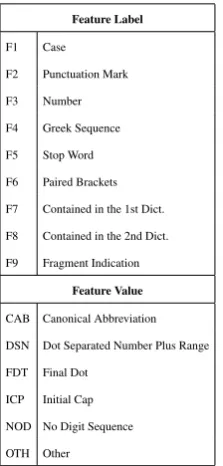
Table 3: List of abbreviations used in Tab. 1, 2.
4.2 Positive and Negative Training
Since the main goal of our parser is to identify canonical references by isolating them from the surrounding context, both positive and negative training examples are needed. Indeed, provided two token sequences where the first contains just a canonical reference (e.g., “Od. 9.216-535”) and the second additionally includes some tokens from the context phrase (e.g.,“Od. 9.216-535, cfr. p.
29.”), without a negative training phrase both to-ken sequences would have the same degree of sim-ilarity. When weighted by the CRF model the result would be that both sequences would share the same number of features with one of the refer-ences of the positive training. But since other se-quences presenting features from both the positive and negative training were included in the training, and since such sequences were labelled as “non-references”, the end result is that a token sequence with some tokens from a context phrase will be less similar to a pure canonical reference.
The first step of the training phase is the ex-traction of token features and the identification of unique patterns of token features. At this stage the processing units are the tokens of a reference. Given a dataset of canonical references, each ref-erence is firstly tokenized and each token is then assigned 9 labels containing the values for the above described features (see Section 4.1). Note that in Tab. 1, 2 the labels and values of features are indicated by the abbreviations given in Tab. 3.
The observed combinations of feature values are then deduplicated and rearranged into unique categories that are used to classify each token (see Tab 1). These categories correspond to the uniques combinations of features assigned to tokens of ref-erences in the training dataset. Each category is defined by a name such as “c6” or “c50”, where “c” simply stands for ‘category‘” and “6” or “50” are unique numeric identifiers. Besides, a numer-ical prefix corresponding to the position of the to-ken inside the canonical reference is then added to the category name to form the identifier. Indeed, the position of each token in the sequence is in itself meaningful information, provided that indi-cations of the reference scope (and other reference components as well) tend to occur at the end of the token sequence. What we obtain are category identifiers such as “1 c50” or “2 c6”.
The second step is building the training dataset. At this stage each canonical reference is reduced to a single token which is assigned the label “ref” (i.e. reference) and which has as distinctive fea-tures the category identifiers assigned to its tokens (see Tab 2).
[image:5.595.72.184.357.591.2]4.3 Sequence Classification Process
The system we propose to identify canonical ref-erences in unstructured texts is basically a binary classifier. Indeed, it classifies as “reference” or “non-reference” a sequence of word level n-grams depending on the features of its tokens. However, in the training dataset the positive examples are manually grouped by typology and different labels (such as “ref1”, “ref2” etc.) are assigned to canon-ical references pertaining to different types. This is done in order to avoid associating too many fea-tures to a single class and thus to maximize the difference in terms of features between sequence being references and non-references.
Since every token is assigned a certain number of features and finally a category, the likelihood for a token sequence to be a canonical reference can be determined on the basis of its similarity, in terms of token features, to the labelled references of a training set.
Once the input document is tokenized into sin-gle words, the n-grams are created by using a window of variable dimensions ranging from the minimum to the maximum length in terms of to-kens that was observed for all the references in the training dataset. For example, provided that the shortest canonical reference in the training dataset is 2 tokens long and the longest is 7 tokens long, for each token are created 6 word level n-grams.
For the sake of performance, however, the num-ber of n-grams to be created is determined for each token at parsing time. First of all a threshold value is passed to the parser as an option value. The threshold is compared to the weight value as-signed by the CRF model to the probability of a token to be classified with a label, in our case “ref” or “noref”. For each token, if the first n-gram is classified as not being a canonical refer-ence the processing shifts to the next token, since we observed that if the first n-gram is classified as a non-reference the following n-grams of increas-ing width never contain a reference. If the exam-ined n-gram is classified as reference, another of dimension n+1 is created: the parser passes on to process the next token only if the current n-gram is classified as a canonical reference with a like-lihood value greater that that of the previous n-gram.
5 Training and Evaluation Criteria
The system is based on both a positive and a neg-ative training.
The dataset for the positive training is built by labeling with the above explained criteria a start-ing set of approximatively 50 canonical references selected by an expert. The classifier trained with those positive examples is then applied to a ran-dom set of documents. Extracted candidate canon-ical references are scored by the CRF model by as-signing to each sequence of n-grams a value rep-resenting the probability for the sequence to be a canonical reference.
The first one hundred errors with the highest score, due to the sharing of several features with the actual canonical references, are marked as non-references and added to the set of sequences to use for the negative training. The negative training is needed in order to precisely segment a canonical reference and to correctly classify those sequences that are most likely to be con-fused with actual canonical references, such as se-quences only partially containing a canonical ref-erence or bibliographic refref-erences. In particular, bibliographic references are misleading sequences since they have several features in common with canonical references, such as capitalized titles and page numbers.
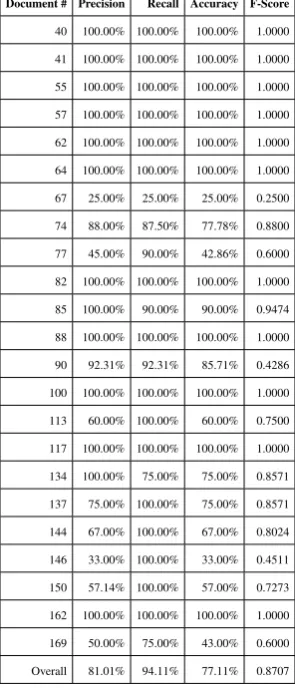
The overall performances of the system on a random sample of 24 pages can be summa-rized by: precision=81.01%, recall=94.11%, ac-curacy=77.11%, F-score=0.8707. Analytical data are provided in Tab. 4. Although the evaluation was performed on pages drawn from a publica-tion written in Italian, we expect to have analogous performances on texts written in each of the cur-rently supported languages (English, French, Ger-man, Italian, Spanish) for the reasons described in Section 4.1.
The results are encouraging, however, and some further improvements could concern the recovery of tokens wrongly included in or excluded from the sequence identified by the parser.
6 Conclusion and Future Work
Document # Precision Recall Accuracy F-Score
40 100.00% 100.00% 100.00% 1.0000
41 100.00% 100.00% 100.00% 1.0000
55 100.00% 100.00% 100.00% 1.0000
57 100.00% 100.00% 100.00% 1.0000
62 100.00% 100.00% 100.00% 1.0000
64 100.00% 100.00% 100.00% 1.0000
67 25.00% 25.00% 25.00% 0.2500
74 88.00% 87.50% 77.78% 0.8800
77 45.00% 90.00% 42.86% 0.6000
82 100.00% 100.00% 100.00% 1.0000
85 100.00% 90.00% 90.00% 0.9474
88 100.00% 100.00% 100.00% 1.0000
90 92.31% 92.31% 85.71% 0.4286
100 100.00% 100.00% 100.00% 1.0000
113 60.00% 100.00% 60.00% 0.7500
117 100.00% 100.00% 100.00% 1.0000
134 100.00% 75.00% 75.00% 0.8571
137 75.00% 100.00% 75.00% 0.8571
144 67.00% 100.00% 67.00% 0.8024
146 33.00% 100.00% 33.00% 0.4511
150 57.14% 100.00% 57.00% 0.7273
162 100.00% 100.00% 100.00% 1.0000
169 50.00% 75.00% 43.00% 0.6000
[image:7.595.72.220.69.414.2]Overall 81.01% 94.11% 77.11% 0.8707
Table 4: Performance evaluation of the system.
Once automatically identified, canonical refer-ences can have further semantic information added to them. By combining and then applying tech-niques of syntactic and semantic parsing to the identified references, it is possible to extract infor-mation such as the precise author name and work title, the text passage referred to, and the reference edition (either when implicitly assumed or explic-itly declared).
The first important outcome of our work is that such an automatic system allows us to elicit the hidden tangle of references which links together the primary and secondary sources of a digital li-brary. Another important outcome is that unstruc-tured texts could be analyzed on the basis of the canonical references they contain, for example by clustering techniques. Given a consistent corpus of texts it would be possible to cluster it on the basis of the distribution of canonical references within documents in order to obtain a first topic classification.
Among the benefits of the proposed approach there is the possibility of applying it to texts
per-taining to specific branches of Classics, like Pa-pyrology or Epigraphy. Indeed in those disci-plines papyri and epigraphs are also often cited by abridged references that are very similar in their structure and features to the canonical text ref-erences. In a similar way, a canonical reference parser can be trained on a particular citation style in order to tailor it to a consistent corpus of texts with consequent improvements on the overall per-formances.
Finally, since the task of automatic extraction of canonical references has never been explored before, we hope that in the future more resources will be available for this task (such as training datasets, golden standards, performance measure to be compared, etc.), analogous to those already existing for other more common tasks, like named entity recognition or the extraction and labeling of modern bibliographic references.
References
Gregory Crane. 1987. From the old to the new: in-tergrating hypertext into traditional scholarship. In Proceedings of the ACM conference on Hypertext, pages 51–55, Chapel Hill, North Carolina, United States. ACM.
Gregory Crane. 2006. What do you do with a million books. D-Lib Magazine, 12(3).
Aron Culotta, Andrew Mccallum, and Jonathan Betz. 2006. Integrating probabilistic extraction models and data mining to discover relations and patterns in text. InProceedings of the main conference on Hu-man Language Technology Conference of the North American Chapter of the Association of Computa-tional Linguistics, pages 296–303, Morristown, NJ, USA. Association for Computational Linguistics.
Andreas Doms and Michael Schroeder. 2005. GoP-ubMed: exploring PubMed with the gene ontology. Nucl. Acids Res., 33(suppl 2):783–786, July.
Andrea Ernst-Gerlach and Gregory Crane, 2008. Iden-tifying Quotations in Reference Works and Primary Materials, pages 78–87.
Okan Kolak and Bill N. Schilit. 2008. Generating links by mining quotations. InProceedings of the nine-teenth ACM conference on Hypertext and hyperme-dia, pages 117–126, Pittsburgh, PA, USA. ACM.
John Lafferty, Andrew Mccallum, and Fernando Pereira. 2001. Conditional random fields: Prob-abilistic models for segmenting and labeling se-quence data. In Proc. 18th International Conf. on Machine Learning, pages 289, 282. Morgan Kauf-mann, San Francisco, CA.
Frank Lester. 2007. Backlinks: Alternatives to the citation index for determining impact. Journal of Electronic Publishing, 10(2).
Andrew Kachites McCallum. 2002. MAL-LET: a machine learning for language toolkit. http://mallet.cs.umass.edu.
Matteo Romanello. 2007. A semantic linking sys-tem for canonical references to electronic corpora. Prague. to be next published in the proceedings of the ECAL 2007 Electronic Corpora of Ancient Lan-guages, held in Prague November 2007.
Matteo Romanello. 2008. A semantic linking framwork to provide critical valuadded services for e-journals on classics. In Susanna Mornati and Leslie Chan, editors,ELPUB2008. Open Scholarship: Au-thority, Community, and Sustainability in the Age of Web 2.0 - Proceedings of the 12th International Con-ference on Electronic Publishing held in Toronto, Canada 25-27 June 2008 / Edited by: Leslie Chan and Susanna Mornati.
David A. Smith and Gregory Crane. 2001. Disam-biguating geographic names in a historical digital li-brary. In ECDL ’01: Proceedings of the 5th Euro-pean Conference on Research and Advanced Tech-nology for Digital Libraries, pages 127–136, Lon-don, UK. Springer-Verlag.