Flexible Composition, Multiple Adjoining and Word Order Variation
Joan Chen-Main* and Aravind K. Joshi*
+*Institute for Research in Cognitive Science, and
+
Dept of Computer and Information Science
University of Pennsylvania
Philadelphia, PA 19104-6228
{chenmain,joshi}@seas.upenn.edu
Abstract
Tree-Local Multi-Component TAGs (called hereafter just MC-TAG for short) are known to be weakly equivalent to standard TAGs, however, they can de-scribe structures not derivable in the standard TAG. There are other variants of MC-TAG, such as MC-TAG with (a) flexible composition and (b) multiple ad-joining of modifier (non-predicative) auxiliary trees that are also weakly equivalent to TAGs, but can describe structures not derivable with MC-TAG. Our main goal in this paper is to deter-mine the word order patterns that can be generated in these MC-TAG variants while respecting semantic dependencies in the grammar and derivation. We use some word order phenomena such as scrambling and clitic climbing to illus-trate our approach. This is not a study of scrambling or clitic climbing per se. We do not claim that the patterns of depend-encies that are derivable are all equally acceptable. Other considerations such as processing will also come into play. However, patterns that are not derivable are predicted to be clearly unacceptable.
1
Introduction
This paper examines the different word orders that can be generated while maintaining the same word to word dependencies using several exten-sions of tree-local Multi-Component TAG (MC-TAG). We find that when the system is enriched to allow flexible composition, not all patterns can
be derived beyond two levels of embedding. Flexible composition is the mirror operation to adjoining; if tree α adjoins into tree β, the com-bination can be alternatively viewed as tree β “flexibly” composing with tree α (Joshi et al. 2003, Kallmeyer and Joshi 2003). By enriching MC-TAG with this perspective of adjoining, some derivational steps which appear to permit components from the same MC-set to combine into different trees can be recast as abiding by tree-locality. Tree-local MC-TAGs with flexible composition have been investigated from the point of view of understanding the range of structures they can generate. Some of the phe-nomena where flexible composition has been useful include scope ambiguity and available readings in nested quantifications (Joshi et al. 2003, Kallmeyer and Joshi 2003), complex noun phrases in pied-piping and stranding of wh-phrases (Kallmeyer and Scheffler 2004), and binding (Ryant and Scheffler 2006). The full range of flexibility that can be allowed without going outside the weak generative capacity of standard LTAG is not known yet. In this paper, the flexible composition we explore is limited to reverse adjoining at the root.
elemen-tary trees to be binary or we can allow some elementary trees to be non-binary. We find that binarizing the elementary trees results in addi-tional nodes (in comparison to its non-binarized counterpart), allowing additional patterns to be derived in MC-TAG with flexible composition.1
Most of this paper is devoted to illustrating our approach using scrambling in German. We assume a single set of linguistic dependencies, and we consider the possible word orders when the dependencies are respected throughout the derivation. Lastly, we take a preliminary look at clitic climbing under the same approach.
2
German Scrambling
In subordinate clauses in Standard German, the canonical order of verbs and their subject argu-ments is a nested dependency order. However, other orderings are also possible. For example, in the case of a clause-final cluster of three verbs, the canonical order is as given in (1), NP1NP2NP3V3V2V1, but all other permutations of
the NP arguments are also possible orderings.2
(1) NP1 NP2 NP3 V3 V2 V1
. . . Hans Peter Marie schwimmen lassen sah. . . . Hans Peter Marie swim make saw “ . . . Hans saw Peter make Marie swim.”
However, with an additional level of embed-ding, i.e. four NPs and four verbs, the situation is less clear both linguistically and formally. Some orderings, such as (2), are consistently taken to be (more) acceptable, while others, such as (3) are consistently dispreferred.
(2) NP4 NP1 NP2 NP3 V4 V3 V2 V1
(3) NP3 NP1 NP4 NP2 V4 V3 V2 V1
Interestingly, just as natural language appears not to permit all permutations of nouns at this deeper level of embedding, so too does tree-local MC-LTAG allow only certain permutations. (Becker
1Conversely, when binarization eliminates nodes, e.g. bi-narizing a grammar that allowed nodes with a single non-terminal daughter, binarization is expected to decrease the possible derivations.
2Some permutations sound better with full NPs instead of proper names. Examples can be found in (Rambow 1994). Our purpose here is just to illustrate possible patterns.
et al.,1991, Rambow 1994, Joshi et al., 2000). Here, we closely examine the situation involving three levels of embedding. Twenty four orderings result from permuting the four nouns while keeping the verb order fixed.3 Our focus is
on making the formal predictions of a system that allows flexible composition precise. The linguistic dependencies we assume here are (a) that between a verb and its NP argument and (b) that between a verb and its VP argument. The former is respected by the standard TAG approach to verbs and their arguments: the set anchored by Vi includes a substitution node for
NPi. The latter is respected both by having a
VPi+1 node in the set anchored by Vi as well as
requiring the VP argument of Vi to be Vi+1
throughout the derivation.4 For example, tree sets
for V1 and V3 can only combine with one another
if one of them has combined with V2 first. The
task at hand is to see which variants of MC-LTAG derive which permutations, setting the stage to compare whether the sequences that require more powerful extensions align with dispreferred sequences.
3
Tree-Local MC-TAG Extensions
We take tree-local MC-LTAG as our starting point: all components belonging to the same MC-set must combine into a single elementary tree. In the linguistic context, there is always a con-straint between the two components of an ele-mentary tree set of an MC-TAG. Usually, there is an implied “top” and “bottom” tree, and we require the foot node of the top tree to dominate (but not immediately) the root node of the bot-tom tree. Using Grammar 1 in Figure 1 as an ex-ample, this means that the Ni component must be above the Vi predicative component in the de-rived phrase structure. The constraint can also be a c-command relation. In any case, the constraint does not permit the immediate domination of the root node of the bottom tree by the foot node of the top tree. There would be no point of having a two component tree if this were to be the case.
An outcome of prohibiting immediate domina-tion between the two components is that each
3There are other patterns of scrambling, for example, N1 N2 N3 V1V3 V2, involving permutations of V’s. We do consider these here for now.
component must target two distinct nodes for the composition to be valid. If both components were to target the same node, the non-immediate domination constraint would violated. This kind of composition is ill-defined for MC-TAG.
3.1 Permitting Flexible-composition
We first investigate the effect of allowing flexi-ble composition, but only when adjoining would have taken place at a root. We do not consider reverse adjoining at internal nodes. Thus, if tree A flexibly composes into tree B, then it is the reverse of B adjoining into A’s root.
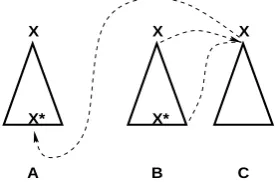
Under this extension, we also do not allow flexible-composition at a node that also serves as a target for adjoining. For example, this prohibits the derivational steps in Figure 1: A and B are auxiliary trees with the same root and foot node labels. B adjoins into the root of C, and C flexi-bly composes at its root with A. If we take the notion of flexible-composition as “reverse ad-joining” seriously, then allowing flexible-composition and adjoining at the same node would be multiple adjoining in disguise. In our example, the derivation shown is the same as adjoining both A and B into the root node of C. Some cases of flexible-composition and adjoin-ing at the same node will be permitted under the multiple adjoining extension described below.
A B C
X* X*
[image:3.595.78.216.465.556.2]X X X
Figure 1: Flexible composition and adjoining at the same node. This is prohibited in TAG exten-sions without multiple adjoining.
3.2 Permitting Multiple-adjoining
What we mean by multiple adjoining is the
Schabes and Shieber (1994) style multiple ad-joining extended to apply to MC-sets: more than one component tree may adjoin into a host node so long as at most one of those trees is a predica-tive tree.5 We follow Schabes and Shieber (1994)
5We treat the nouns as a type of modifier of the verb. I.e., we allow the following to adjoin into a single node: a)
in assuming that although either one of the mul-tiply-adjoined structures may be on top (i.e. one derivation tree may correspond to more than one phrase structure), the order of the elementary trees in the final derived tree is determined by the order of adjoining: if tree A adjoins into a node X before tree B adjoins into the same node X, then tree A will be below tree B in the derived tree. 6 Additionally, we require that trees that
target the same node belong to different MC-sets.
4
Non-binarized Phrase Structure
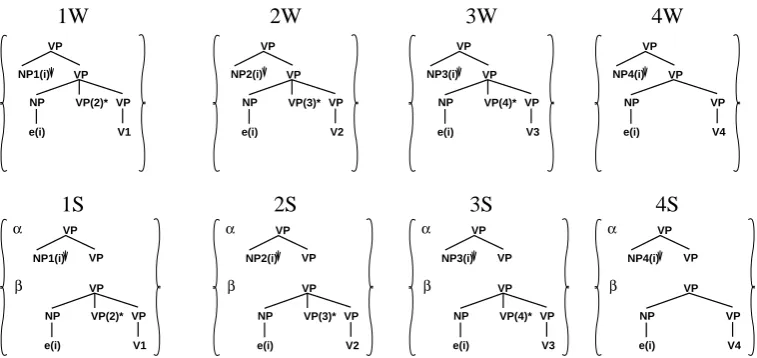
The grammar we first explore is shown in Figure 2. These tree sets are based on the tree-sets for a verb with two arguments given in Becker et al, (1991) which have been assumed for subsequent TAG approaches to German scrambling. A point of departure, however, is that these trees have more than one VP node. While we assume that the VP nodes belonging to the noun components do not carry the indexing information for the verb it is associated with, we do assume that both the root VP node and internal VP nodes, if any, of a predicative elementary tree carry the index-ing information associated with the verb. This means that there is an additional potential “host” node for adjoining, and hence, each scrambled sequence may have more than one structural de-scription. For example, consider the singleton sets in Grammar 1 for V1 and V2. The V1 tree
may adjoin into either the root node or the inter-nal VP node of the V2 tree and maintain semantic
coherence. In contrast, we also assume that the noun components in Grammar 1 do not have host nodes for predicates. This has the effect of ban-ning adjoiban-ning into the noun components in gen-eral: an NPi component cannot combine into an
NPj component without leaving the predicate Vi
tiple noun components, or b) any number of noun compo-nents and one verb component. Since we have a different notion of modifier and predicate, we diverge from Schabes and Shieber (1994) by assuming predicative trees appear below modifier trees.
6
NP1(i) VP
VP
NP VP(2)* VP
V1 e(i)
NP2(i) VP
VP
NP VP(3)* VP
V2 e(i)
NP3(i) VP
VP
NP VP(4)* VP
V3 e(i)
NP4(i) VP
VP
NP VP
V4 e(i)
1W 2W 3W 4W
α
β VP
NP3(i) VP
VP
NP VP(4)* VP
V3 e(i)
α
β VP
NP2(i) VP
VP
NP VP(3)* VP
V2 e(i)
α
β VP
NP1(i) VP
VP
NP VP(2)* VP
V1 e(i)
α
β VP
NP4(i) VP
VP
NP VP
V4 e(i)
[image:4.595.120.499.73.252.2]1S 2S 3S 4S
[image:4.595.142.474.297.455.2]Figure 2: Scrambling Grammar 1. Each verb anchors a singleton set and a set with a two components
Figure 3: Derivable sequences given Grammar 1. MC-TAG with flexible composition derives struc-tures for 15 permutations. Allowing multiple adjoining as well derives 22 permutations. The remain-ing 2 permutations require composition that is essentially ternary.
component without a host to combine into. Fig-ure 3 shows which sequences are derivable under which TAG extensions.7 Since we hold the
se-quence of verbs fixed, we use a number sese-quence to refer to the order of the NPs. E.g. We use 1234 as shorthand for NP1NP2NP3NP4V4V3V2V1.
Given Grammar 1, fourteen sequences are de-rivable with LTAG (i.e. using only the singleton sets in Grammar 1), and four additional se-quences are derivable with MC-LTAG. Since deriving one of the noun sequences in the case of three noun-verb pairs, 231, already requires MC-TAG, this is no surprise.
7
Note that not all of the subset relationships in Figure 3 and Figure 6 are obligatory. E.g. It is possible to allow multiple adjoining without allowing multi-component sets.
For this particular grammar, only one addi-tional sequence is derivable as the result of ex-tending MC-LTAG to include flexible composi-tion. Since each tree has at most three host VPs, there is no tree in Grammar 1 into which two MC-sets can combine. Since a tree from Gram-mar 1 only hosts at most one MC-set, many deri-vations involving flexible composition can be recast using classic adjoining. Additionally, be-cause the singleton sets’ trees include more than one host VP for a higher verb, more than one semantically coherent derivation are actually available for some sequences, even in LTAG.
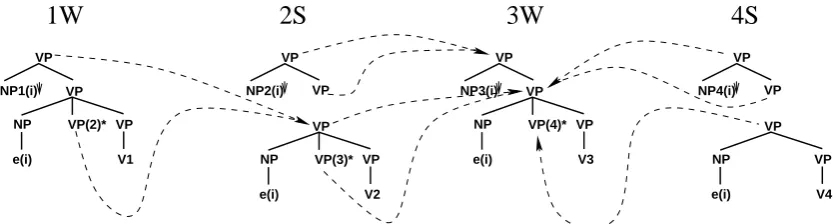
When the system allows multiple-adjoining, three more sequences become derivable. Con-sider the derivation for 2341 in Figure 4. Flexible composition allows the singleton set anchored by 2314
3412 3421 4231 MC-TAG LTAG
1234 2134 4123
1243 2143 4132
1324 4213
1423 3124 4312
1432 3214 4321
2431 2341 1342 + multiple
adjoining 2413
NP1(i) VP
VP
NP VP(2)* VP
V1 e(i)
VP
NP2(i) VP
VP
NP
e(i)
2S
3W
4S
NP3(i) VP
VP
NP VP(4)* VP
V3 e(i)
VP(3)* VP
V2
VP
NP4(i) VP
VP
NP VP
V4 e(i)
[image:5.595.78.498.75.187.2]1W
Figure 4: Derivation for 2341. Multiple-adjoining allows the upper components from 4S to target the internal VP node of 3W after 2S has already adjoined into the same node. Flexible composition al-lows the predicate component of 4S to combine into the foot node of 3W.
V3 to be the root-tree of the derivation (i.e. the
root in the derivation structure) even though it is an auxiliary tree. The MC-set anchored by V4
and that anchored by V2 both combine into V3.
One component from each set targets the internal VP node in V3’s tree.
Two sequences remain underivable: 3142 and 3241. We also explore what kind of modification is needed to derive these sequences. We find that a type of adjoining that appears effectively to be a ternary operation is capable of doing so, and we conjecture that deriving these sequences require some sort of ternary composition. We refer to this “ternary” operation as same-set mul-tiple adjoining: components belonging to the
same MC-set are permitted to adjoin into the same host node. The difference between ing a “whole tree” into a single node and adjoin-ing two components of the same set into a sadjoin-ingle node is that a non-predicative component from a different set is permitted to also adjoin into the same node. E.g. Given Grammar 1, an NP com-ponent associated with V2 can separate the top
and bottom components of the set anchored by V3 when all three components adjoin into the
same node. Note, however, that if we abide by the Schabes and Shieber (1994) convention that order of adjoining determines the order of the trees that adjoin into the same node, then the or-dering NP3NP2V3 requires that the predicate
component of the V3 set adjoin first, the NP2
component of the V2 set to adjoin next, and the
NP3 component of the V3 set to adjoin in last.
This application of same-set multiple adjoining needs access to three MC-sets: the host tree, the V3 set, and the V2 set.
Note that the need for same-set multiple ad-joining to derive structures for these sequences is
an observation about a formal system, not an ar-gument that this system is needed to adequately model natural language. It is not clear that these scrambling sequences are actually accepted by German speakers. Thus, unlike flexible compo-sition and the Schabes and Shieber (1994) style multiple adjoining, same-set multiple adjoining has not been linguistically motivated.
5
Binarized Phrase-structure
α
β NP1(i)
VP
VP
e(i)
NP VP
VP(2)*
V1 VP VP
α
β NP2(i)
VP
VP
e(i)
NP VP
VP(3)*
V2 VP VP
α
β NP3(i)
VP
VP
e(i)
NP VP
VP(4)*
V3 VP VP
α
β VP
NP4(i) VP
VP
NP VP
V4 e(i)
1S’ 2S’ 3S’ 4S’
NP1(i) VP
VP
e(i)
NP VP
VP(2)*
V1 VP
NP2(i) VP
VP
e(i)
NP VP
VP(3)*
V2 VP
NP3(i) VP
VP
e(i)
NP VP
VP(4)*
V3 VP
NP4(i) VP
VP
NP VP
V4 e(i)
[image:6.595.114.501.73.271.2]1W’ 2W’ 3W’ 4W’
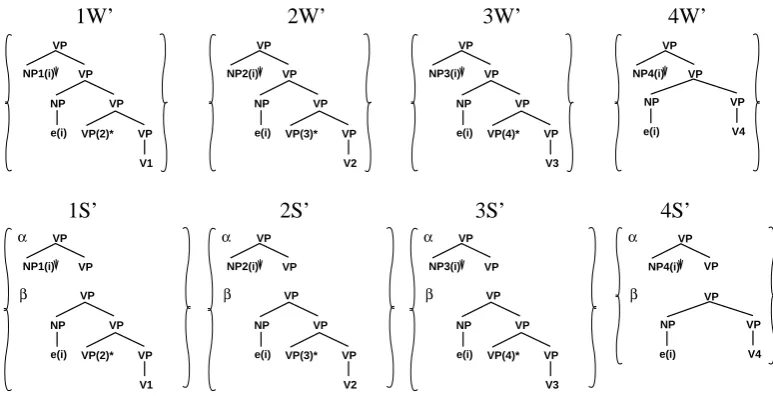
[image:6.595.108.503.314.488.2]Figure 5: Scrambling Grammar 2. The binarized counterpart to Grammar 1
Figure 6: Derivable sequences given Grammar 2. Sequences which required multiple adjoining under Grammar 1 can be derived with MC-TAG with flexible composition. The two sequences requiring ternary composition under Grammar 1 can be derived when multiple adjoining is permitted.
Figure 6 shows which sequences require which TAG extensions given Grammar 2. The same sequences are derivable with LTAG and MC-TAG. However, allowing flexible composi-tion now allows addicomposi-tional sequences to be de-rived. Because recasting ternary branching struc-ture as binary branching increases the nodes available to adjoin into, adjoining components into the same node is no longer needed in some cases. The three sequences that required multiple adjoining in Figure 3 now only require flexible composition. Similarly, the two sequences that required same-set multiple adjoining under Grammar 1 can now be derived with the Schabes and Shieber (1994) style multiple adjoining.
6
Clitic Climbing and MC-TAG
In Romance languages, pronominal clitics can optionally appear post-verbally, as in (4), or higher in the clause, preceding the tensed verb, as in (5).
(4) V0 V1 NP1 V2NP2
Quiere permitir-te ver-lo
wants to.permit-you to.see-it ‘S/he wants to permit you to see it.’
(5) NP1 NP2 V0 V1 V2
Te lo quiere permitir ver
2413
+ flexible composition
2431 2341 1342 2314
3412 3421 4231 MC-TAG LTAG
1234 2134 4123
1243 2143 4132
1324 4213
1423 3124 4312
1432 3214 4321
3142 3241 + multiple
NP IP
I VP
V VP
I te
(e) permitir I’
embedded verb highest (1st level)
2+ level embedded verb climbed clitic &
V VP*
VP
quiere
α
β I
VP I*
ver
lo me
I
V VP*
VP I*
dejar
α
β
[image:7.595.107.474.72.173.2]bridge verb
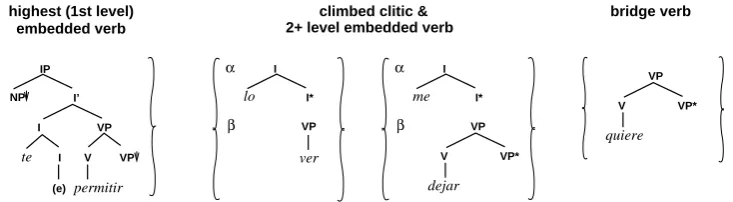
Figure 7: Grammar fragment for clitic climbing patterns. The highest embedded verb anchors a sin-gleton set in which the clitic is climbed. Deeper embedded verbs and their climbed clitics are mod-eled with an MC-set. Bridge verbs are modmod-eled with an auxiliary tree
As with scrambling, we approach (4) and (5) as different word orders, V0V1NP1V2NP2 and
NP1NP2V0V1V2, that correspond to the same
lin-guistic dependencies, (a) that between a verb and its clitic argument and (b) that between a verb and its VP argument. Given the grammar frag-ment in Figure 7, one can see how MC-TAG (without flexible composition or multiple-adjoining) allows the derivation of clitic climb-ing patterns shown here. Note that the tree for
quiere in Figure 7 can host additional verbs,
al-lowing clitic climbing across an unbounded number of triggering verbs.
These examples are taken from Bleam (2000), who argues that although sentences involving two climbed clitics and two verbs, such as (6), can be generated with a tree-local MC-TAG, the additional level of embedding in (5), requires the power of set-local MC-TAG.
(6) Te lo permito ver
you it I.permit to.see ‘I permit you to see it.’
Interestingly, while (5) and (6) show us that a cluster of two climbed clitics is permissible, our native speaker informants do not accept sentence (7) which involves three levels of embedding and includes a cluster of three climbed clitics, each of which is associated with a different verb. It is not clear whether the absence of clusters of three climbed clitics results from a restriction on clitic climbing per se or whether it is due to other re-strictions (e.g. on the clitic cluster template) (Bleam, p.c.) If, however, we assume that this unacceptability is strictly the result of the gram-mar rather than some other constraints on the output of the grammar, then the need for set-local MC-TAG dissolves.
(7) *Mari me te lo quiere permitir dejar ver.
Mari me you it wants to.permit to.let to.see ‘Mari wants you to permit me to see it.’
Further, given the MC-TAG discussed above, V0V1NP1V2NP2 and NP1NP2V0V1V2 are
deriv-able, but NP1NP2NP3V0V1V2V3 is not. Above,
we noted that assuming a grammar comprised of MC-sets of the type in Figure 7 predicts clitics can climb across an unbounded number of trigger verbs. However, this grammar cannot generate an unbounded number of climbed clitics. The tree for permitir does not have enough nodes to
host a third clitic-verb MC-set. Thus, the unac-ceptability of (7) is expected.8
7
Conclusion
This paper shows that even when we enrich tree-local MC-TAG by allowing flexible composi-tion, not all word order permutations are deriv-able. Our claim is not that all derivable patters are equally acceptable, but that we expect un-derivable patterns to be clearly unacceptable.
We note two main observations from our study of scrambling. First, even MC-LTAG with flexible composition cannot derive all twenty four permutations of the NPs at three levels of embedding. Specifically, the extensions required to derive more difficult cases involve allowing different degrees of multiple adjoining. The two most difficult cases require a type of composition that is otherwise unmotivated. This is a desirable outcome, as it makes MC-LTAG with flexible composition a candidate for aligning with the linguistic judgments for scrambling. Second, for
MC-LTAG with flexible composition, converting a grammar with non-binary branching elemen-tary trees to a grammar in which binary branch-ing is enforced allows additional scramblbranch-ing pat-terns to be derived. Enforcing binary branching requires fewer modifications to MC-LTAG to derive all twenty four permutations. The addi-tional derivations are possible because of the in-crease in the nodes available nodes to adjoin into. In fact, given enough nodes, the need for multi-ple-adjoining can be completely eliminated. In our case study, we consider the minimal addi-tional branching required to enforce binary branching. This sets a bound on the additional nodes that can be added. We conjecture that with an additional level of embedding (i.e. 5 NPs), binary branching will no longer provide enough nodes for generating all scrambling pat-terns using tree-local MC-TAG with flexible composition and multiple adjoining.
Our first observation from our preliminary look at clitic climbing is that the patterns at up to two levels of embedding diverge from the pat-terns at deeper levels of embedding. Tree-local MC-TAG is sufficient for accounting for the pat-terns up to two levels of embedding, and also makes at least some correct predictions regarding possible patterns at three levels of embedding. This is similar to the scrambling case in that a tree-local MC-TAG generates all patterns for two levels of embedding, but not for three. This is relevant to a study on recursion being carried out by Joshi (2008, in prep).
Acknowledgements
We thank the XTAG group, in particular Lucas Champollion, Tatjana Scheffler, and Joshua Tauberer, for helpful discussion and Tonia Bleam, Laia Mayol, and Irving Rodriguez-Gonzalez for Spanish data.
References
Becker, Tilman, Aravind K. Joshi and Owen Ram-bow. (1991). Long-distance scrambling and tree adjoining grammars. In: Fifth Conference of the European Chapter of the Association for Computa-tional Linguistics, Berlin, pp. 21-26.
Bleam, Tonia. (2000). Clitic climbing and the power of Tree Adjoining Grammar. In Anne Abeillé and Owen Rambow, eds., Tree Adjoining Grammars:
formalisms, linguistic analysis, and processing. CSLI Publications, Stanford, CA, pp. 193-220. Joshi, Aravind K.. (2008, in preparation) Does
recursion in language behave the same way as in formal systems? (preliminary version presented at Recursion in Human Language, University of Illinois, April, 2007).
Joshi, Aravind K., Tilman Becker and Owen Ram-bow. (2000). Complexity of scrambling: a new twist to the competence-performance distinction. In: Anne Abeillé and Owen Rambow (eds.). 2000. Tree Adjoining Grammars. Formalisms, Linguistic Analysis and Processing. CSLI Publications, Stan-ford, CA, pp. 167-181.
Joshi, Aravind K., Laura Kallmeyer and Maribel Ro-mero. (2003). Flexible composition in LTAG: quantifier scope and inverse linking. In H. Bunt and R. Muskens, eds., Computing Meaning 3. Kluwer, Dordrecht.
Kallmeyer, Laura. 2005. Tree-local multicomponent tree adjoining grammars with shared nodes. Com-putational Linguistics, 31(2):187–225.
Kallmeyer, Laura and Aravind K. Joshi. (2003). Fac-toring predicate argument and scope semantics: underspecified semantics with LTAG. Research on Languageand Computation, 1(1-2):3–58.
Kallmeyer, Laura and Tatjana Scheffler. (2004). LTAG Analysis for Pied-Piping and Stranding of wh-Phrases. Proceedings of the Seventh Interna-tional Workshop on Tree Adjoining Grammar and Related Formalisms (TAG+7) Vancouver, Canada, 32-39.
Kayne, Richard. (1994). The anti-symmetry of syntax. The MIT-Press, Cambridge, MA.
Rambow, Owen. (1994). Formal and Computational Aspects of Natural Language Syntax. PhD thesis, University of Pennsylvania.
Ryant, Neville and Tatjana Scheffler. 2006. Binding of anaphors in LTAG. Proceedings of the Eighth International Workshop on Tree Adjoining Gram-mar and Related Formalisms (TAG+8), Sydney, Australia, 65-72
Schabes, Yves and Stuart M. Shieber. An alternative conception of tree-adjoining derivation. Computa-tional Linguistics, 20(1):91-124, 1994
Stabler, Edward. 1997. Derivational Minimalism. In Retoré (ed.), Logical Aspects of Computational Linguistics. Springer. 68-95.
Steedman, Mark. 1996. Surface Structure and Inter-pretation. MIT Press, Cambridge, MA.