Introduction to the Shared Task
on Comparing Semantic
Representations
Johan Bos
University of Rome “La Sapienza” (Italy)
email:
[email protected]
Abstract
Seven groups participated in the STEP 2008 shared task on comparing semantic representations as output by practical wide-coverage NLP sys-tems. Each of this groups developed their own system for producing se-mantic representations for texts, each in their own sese-mantic formalism. Each group was requested to provide a short sample text, producing a shared task set of seven texts, allowing participants to challenge each other. Following this, each group was asked to provide the raw system output for all texts, which are made available onhttp://www.sigsem. org. Two groups were extremely inspired by the shared task and also provided gold-standard semantic representations for the seven texts, to-gether with evaluation measures. The STEP 2008 workshop itself will continue the discussion, focusing on the feasibility of a theory-neutral gold standard for deep semantic representations.
1
Introduction
Following advances made in computational syntax in the last years, we have recently witnessed progress in computational semantics too. Thanks to the availability of wide-coverage parsers, most of them implementing statistical approaches with models trained on the Penn Treebank, we now have at our disposal tools that are able to pro-duce formal, semantic representations on the basis of the output of the aforementioned parsers, achieving high coverage. Computational semantics isn’t anymore limited to tedious paper and pencil exercise, nor to implementations of tiny fragments of natural language, and has genuinely matured to a level useful for real applications.
As a direct consequence, the question as to how to measure the quality of semantic representations output by these systems pops up. This is an important issue for the sake of the field, but difficult to answer. On the one hand one might think that the quality of semantic representations, because they are more abstract than surface and syntactic representations, should be easy to evaluate. On the other hand, however, because there are several “competing” semantic formalisms, and the depth of analysis is arbitrary, it is hard to define a universal theory-neutral gold standard for semantic representations (see, e.g. Bos, 2008a).
Partly in response to this situation in the field, a “shared task” was organised as a special event on the STEP 2008 conference. The aim of this shared task was primarily tocomparesemantic representations for texts as output by state-of-the-art NLP sys-tems. This was seen as a first step for designing evaluation methodologies in computa-tional semantics, with a practical bottom-up strategy: rather than defining theoretical gold standard representations, we look what current systems can actually produce and start working from that.
2
Participants
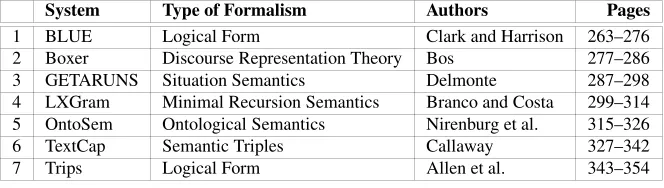
[image:2.595.132.464.574.668.2]In response to the call for participation seven groups were accepted to take part in the shared task. Table 1 gives an overview of the participants, the systems they have developed, and the semantic formalism they adopted. This volume contains full de-scriptions of these systems (please follow the page numbers in Table 1).
Table 1: Overview of shared task participants at STEP 2008
System Type of Formalism Authors Pages
1 BLUE Logical Form Clark and Harrison 263–276 2 Boxer Discourse Representation Theory Bos 277–286 3 GETARUNS Situation Semantics Delmonte 287–298 4 LXGram Minimal Recursion Semantics Branco and Costa 299–314 5 OntoSem Ontological Semantics Nirenburg et al. 315–326 6 TextCap Semantic Triples Callaway 327–342 7 Trips Logical Form Allen et al. 343–354
but also more interesting. After all, it is a reasonable assumption that semantic repre-sentations ought to be independent of the source language.
Also note that basically all participants adopt different semantic formalisms (Ta-ble 1), even though they all claim to do more or less the same thing: computing semantic representations for text. These differences in (formal) background make the shared task only more interesting.
3
The Shared Task Texts
All participants were asked to submit an authentic small text, not exceeding five sen-tences and 120 tokens. The pool of test data for the shared task is composed out of all the texts submitted by the seven participants. This procedure allowed the participants to “challenge” each other. Below are the original texts as submitted by the participants — the numbering follows the numbering of the participants in Table 1.
Text 1
An object is thrown with a horizontal speed of 20 m/s from a cliff that is 125 m high. The object falls for the height of the cliff. If air resistance is negligible, how long does it take the object to fall to the ground? What is the duration of the fall?
Text 2
Cervical cancer is caused by a virus. That has been known for some time and it has led to a vaccine that seems to prevent it. Researchers have been looking for other cancers that may be caused by viruses.
Text 3
John went into a restaurant. There was a table in the corner. The waiter took the order. The atmosphere was warm and friendly. He began to read his book.
Text 4
The first school for the training of leader dogs in the country is going to be created in Mortagua and will train 22 leader dogs per year. In Mortagua, Joao Pedro Fonseca and Marta Gomes coordinate the project that seven people develop in this school. They visited several similar places in Eng-land and in France, and two future trainers are already doing internship in one of the French Schools. The communitarian funding ensures the oper-ation of the school until 1999. We would like our school to work similarly to the French ones, which live from donations, from the merchandising and even from the raffles that children sell in school.
Text 5
from nitrocellulose chunks that were produced during World War II and were repackaged in 1987 in bags that were made in 1945. Initially it was suspected that this storage might have reduced the powder’s stability.
Text 6
Amid the tightly packed row houses of North Philadelphia, a pioneer-ing urban farm is providpioneer-ing fresh local food for a community that often lacks it, and making money in the process. Greensgrow, a one-acre plot of raised beds and greenhouses on the site of a former steel-galvanizing factory, is turning a profit by selling its own vegetables and herbs as well as a range of produce from local growers, and by running a nursery sell-ing plants and seedlsell-ings. The farm earned about $10,000 on revenue of $450,000 in 2007, and hopes to make a profit of 5 percent on $650,000 in revenue in this, its 10th year, so it can open another operation elsewhere in Philadelphia.
Text 7
Modern development of wind-energy technology and applications was well underway by the 1930s, when an estimated 600,000 windmills sup-plied rural areas with electricity and water-pumping services. Once broad-scale electricity distribution spread to farms and country towns, use of wind energy in the United States started to subside, but it picked up again after the U.S. oil shortage in the early 1970s. Over the past 30 years, re-search and development has fluctuated with federal government interest and tax incentives. In the mid-’80s, wind turbines had a typical maximum power rating of 150 kW. In 2006, commercial, utility-scale turbines are commonly rated at over 1 MW and are available in up to 4 MW capacity. The first text is taken from an AP Physics exam (the fourth sentence is a simplified reformulation of the third sentence) and constitutes a multi-sentence science question (Clark and Harrison, 2008). Text 2 is taken from theEconomist, with the third sen-tence slightly simplified (Bos, 2008b). Text 4 was taken from a Portuguese newspaper and translated into English (Branco and Costa, 2008). Text 6 is also a fragment of a newspaper article, namely theNew York Times(Callaway, 2008). Text 7 is an excerpt fromhttp://science.howstuffworks.com. The origin of Text 3 is unknown.
4
Preliminary Results
All groups produced semantic representations for the texts using their NLP systems. The results are, for obvious reasons of space, not all listed here, but available at the SIGSEM websitehttp://www.sigsem.org. The papers that follow the current arti-cle describe the individual results in detail. It should be noted that two groups created gold standard representations for all seven texts, and already performed a self evalua-tion (Nirenburg et al., 2008; Allen et al., 2008).
for deep semantic representations, and furthermore identify a set of problematic and relevant issues for semantic evaluation.
References
Allen, J. F., M. Swift, and W. de Beaumont (2008). Deep Semantic Analysis of Text. In J. Bos and R. Delmonte (Eds.),Semantics in Text Processing. STEP 2008 Con-ference Proceedings, Volume 1 ofResearch in Computational Semantics, pp. 343– 354. College Publications.
Bos, J. (2008a). Let’s not argue about semantics. InProceedings of the 6th Language Resources and Evaluation Conference (LREC 2008), Marrakech, Morocco. Bos, J. (2008b). Wide-Coverage Semantic Analysis with Boxer. In J. Bos and R.
Del-monte (Eds.),Semantics in Text Processing. STEP 2008 Conference Proceedings, Volume 1 ofResearch in Computational Semantics, pp. 277–286. College Publica-tions.
Branco, A. and F. Costa (2008). LXGram in the Shared Task “Comparing Semantic Representations” of STEP 2008. In J. Bos and R. Delmonte (Eds.),Semantics in Text Processing. STEP 2008 Conference Proceedings, Volume 1 ofResearch in Computational Semantics, pp. 299–314. College Publications.
Callaway, C. B. (2008). The TextCap Semantic Interpreter. In J. Bos and R. Del-monte (Eds.),Semantics in Text Processing. STEP 2008 Conference Proceedings, Volume 1 ofResearch in Computational Semantics, pp. 327–342. College Publica-tions.
Clark, P. and P. Harrison (2008). Boeing’s NLP System and the Challenges of Seman-tic Representation. In J. Bos and R. Delmonte (Eds.),Semantics in Text Processing. STEP 2008 Conference Proceedings, Volume 1 ofResearch in Computational Se-mantics, pp. 263–276. College Publications.
Delmonte, R. (2008). Semantic and Pragmatic Computing with GETARUNS. In J. Bos and R. Delmonte (Eds.),Semantics in Text Processing. STEP 2008 Confer-ence Proceedings, Volume 1 ofResearch in Computational Semantics, pp. 287– 298. College Publications.