Abstr
achie Divis and r proce overl soft h adjac behav Keyw The has l use comm subs servi divid radio mob the requ goin hand mana featu hand Soft syste regio from proc sprea curre frequ deter In m categ also befo chan of so
QUEUE
De JECRract: The most
eved by using t sion Multiple A receive their si edure, voice an lapping area (w handoff schem cent cells and d viors of handof
words: Balking,
I
rapid growth led to an inte of the sc munications cribers (MSs ices within a ded into mult o links to base
ile user move old base stat uired in the ne ng to enter. S doff. Handof
agement in ce
Mobility ure. Continuo doff (or hando handoff is em, wherein m on use multip m multiple bas
ess of chang ading code, or ent mobile u uently initiate rioration in qu mobile netwo
gories: (1) ha characterized re break” sy nnel is released
oft handoffs,
Interna
EING MO
Bhavtosh
epartment of M RC University,
Rajasthan
t important fea the procedure o Access (CDMA
ignals from mu nd signaling inf which is develop me for CDMA develop an anal ff calls have als
, MSC, Base sta
I. INTRO
in the deman ense research carce spectru
system. In s) are provid a geographica
iple adjacent e stations (BS es across a cel tion is releas ew base statio Such type of ff is an imp ellular radio sy
in cellular ne ous service over) procedu
an important mobile station
le radio chann se stations sim ging the cha r combination user while a ed either by cr uality of the s ork, Handoff ard handoff an d by “break stems. In cas d before assig both existing
Volu
ational Jou
Av
ODEL FO
WIRE
Awasthi Mathematics , Jaipur-30390 , Indiaature of the mo of handoff (or A) system. In CD
ultiple base sta formation must ped by the adjac cellular networ lytical model fo o considered an
ation, CDMA, O
ODUCTION
d for mobile c effort to achi um allocated
cellular ne ded with ca al area. The cells. MSs co Ss), one for ea
ll boundary[1] sed and an on in which m f phenomeno portant aspe ystem.
etwork is the can be achi ure from one t feature of c s (MSs) withi nels and rece multaneously. annel (time s n of them) ass a call is in
rossing a cell signal in the p is divided i nd (2) soft ha k before mak
se of hard ha gning new cha g and new ch
ume 9, No.
urnal of Ad
RESE
vailable On
OR SOFT
ELESS CE
05 obile network handover) from DMA system, ations simultanbe sent to mul cent cells) of ce rk is proposed or soft handoff nd different per
Overlap region,
communicatio ieve an efficie d for cellu etwork, mob alling and da
service area ommunicate v ach cell. When ], the channel
idle channel mobile user ju on is known ct of mobil
most importa ieved by usi
cell to anoth cellular CDM in a soft hando ive their sign . Handoff is t slot, frequenc
ociated with t progress. It boundary or present chann into two bro andoff. They a ke” and “ma
andoffs, curre annel but in ca hannels are us
1, January
dvanced Re
EARCH PA
nline at ww
HANDO
ELLULA
is mobility. G m one cell to a
mobile stations neously and all ltiple base stati ells, a handset c d and investigat
in CDMA syst rformance meas
, Soft handoff.
ons ent ular bile ata is via n a l in is ust as lity ant ing her. MA off als the cy, the is by nel. oad are ake ent ase sed du su an H ce du fr ce "m re in ha m di of ne th pr an co de sy te ha fo ha ba tra pr as K ha co m co th
y-February
esearch in C
APER
ww.ijarcs.in
OFF ANAL
AR NETW
JGood and contin another. Soft h s (MSs) within
l cells can also ions and the mo can connect to m ted. Here we i tem. In develo sures of the soft
uring the hand upport of a m nother base Handoff occurs
ell to another uring calls. Si equency, it is ell before lea make-before-b equires less ncreases capac
andoff to pr moving from o ivision multip f attention as etworks. Its m he capability
resented his o nd explained ommunication escription of ystem. Gilhou echniques for
andy phone s or a system fo andoff. Khan ack off techni
ansmission in rocess. Green ssign distinct n Kim and Sung andoff analy ommunication model for soft h
oncept of an o he handoff cal
y 2018
Computer
nfo
LYSIS IN
WORK
Been Departmen JECRC Univer Rajas nuous service handoff is verya soft handoff o share the sam obile station m multiple base st introduce the c oped soft hando t handoff mode
doff process [ mobile subscr
station is kn s when a call cell as the m ince all cells s possible to m aving the cur break" or " power, whi city. Cellular rovide seamle one cell to oth ple access (CD
a multiple ac main advantage of flexible overview on
different term n system a f code divisi usen et al.[3 r multiple ac system. Jabba or personal mo n et al.[5] dis iques for the n wide band nberg et al.[6 number of cod g [7] gave d ysis based o n system. The
handoff in CD overlapping re
ll attempt rate
Science
N CDMA
na Bundela
nt of Mathema rsity, Jaipur-3 sthan, India
in cellular mob important feat f region use mu me frequency. must combine th
tations. In this r concept of ove off model, the b l have develope
[13]. The proc riber from on nown as han has to be ha mobile user mo
in CDMA sy make the conn rrent cell. Th "soft" hando ich reduces
communicatio ess service f her cell in mob DMA) has rec ccess method es are higher r data transmis mobile comm m and future and also p ion multiple 3] discussed
ccess and de ari et. al.[4] p
obile commun scussed linea
uplink comm d CDMA fo 6] proposed a
de channels to ifferent analy on hard ha ey also develo DMA systems egion between e and the chan
BASED
atics 303905
bile network c ture of cellular ultiple radio cha During the ha he results. With research paper, erlap region be balking and ren ed.
cess of transfe ne base statio ndoff. Gene anded off from oves between ystem use the nection to the his is known
ff. Soft ha interference on system req for mobile u bile network. ceived a great d for future m radios capacity ssion. Lee [1 munication sy related to m provided ge access (CD on code div eveloped per proposed a sc nication using ar and expon mon channel p or Poisson a a scheme ho o each traffic ytical scheme andoff in m oped an analy
by introducin n adjacent cell
are derived. Applying these results to a non-prioritized CDMA system, the effects of soft handoff and the mean cell residual time are investigated. Lee et al.[8]-[9] analyzed performance of channel borrowing handoff scheme based on user mobility in CDMA cellular system and also studied the soft-handoff mechanism and compares its performance with the hard handoff. Performability of different models like CTMC, SRN and MRN have analyzed by Trivedi et al. [11]. They calculated different call blocking probability for wireless systems and wireless cellular systems. A new soft handoff scheme in case of CDMA cellular system
investigated by Xiaomin et al.[12]. They also estimated the
relative mobility of new handoff calls. The different aspect of a cellular geometry in code-division multiple-access (CDMA) systems with soft handoff have described by Xiaomin et al. [13]. They also described some important characteristics of the cellular configuration in soft handoff systems are used to propose a new design of efficient call admission control (CAC) in CDMA systems. Awasthi [14] developed directed retry scheme for cellular radio system having both type of traffic voice and data. He found that the directed retry scheme play an important role to reduce blocking probability of handoff voice calls. The efficient channel allocation and handoff strategies to guarantee continuous service with good Qos (Quality of service) to mobile multimedia users have studied by Nisha et al. [15]. Details on handoff protocols, handoff management issues and handoff decisions are also discussed. Kumar and Purohit [16] discussed the all handoff strategies where it shown that which handoff is required suitable parameters to minimize the handoff. Awasthi [17] analyzed the hand-off performance in personal communication system using splitted rating channel technique. It is observed that from the simulation results that the blocking probability of handoff calls can be reduced by using splitted rating channel and directed retry schemes. Elmadina et al. [18] gave an optimal algorithm for automatic controlling and adapting Global System for Mobile Communication (GSM) power system for handoff. They found that the use of this technique reduce the handoff blocking probability. Kesavan and Palani [19] presented a semi analytical model to study the performance degradation of soft and hard handoff schemes in a downlink CDMA system due to delay in the completion of handoff decisions. A comparison between different handover traffic channel assignment schemes discussed by Adewale et al. [20]. Gohil et al.[21] analyzed the performance of handoff algorithm that use a fixed value of RSS threshold of initiates the handoff process. The concept of overlap region between adjacent cells and develop an analytical model for hard handoff in CDMA system introduced by Awasthi [22]. He also discussed the balking and reneging behaviors of calls and found that the blocking probabilities are decreased as number of channels in a cell or service rate increases.
In this paper, we have developed the mathematical model for soft handoffs in CDMA system to analyze the problem of handoff in cellular radio system. In this model, the balking and reneging behaviors of queued handoff calls also taken into consideration. The system capacity is to be considered finite. We have developed different performance measures like blocking probability of new calls, call incompletion probability, blocking probability of handoff calls etc.
II. THE SOFT HANDOFF MODEL
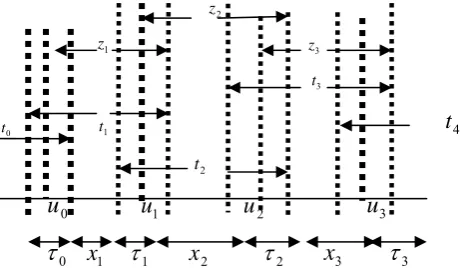
In soft handoff model, the following assumptions are used: The arrival of calls to/from a handset is according to Poisson process. The arrival rate of new calls is
n and the arrivalrate of handoff calls is
h. The mobile residence timez
iin a cell I have an exponential distribution with the density
function given by [8] zi
i
m z e
f ( ) (1)
The new call blocking probability is denoted by
p
n and the probability that a handoff call is blocked is denotedp
hThe network response time is represented byt
nrt and is exponentially distributed with mean
T . The balking behavior of calls is following exponential distribution with probability of balking
. The calls may renege according to exponential distribution with reneging parameter
. The call holding time tc is exponentially distributed with the mean
1 . The number of channels assigned to each cell to serve
the calls in a cell is denoted by C. Let
z
i be the residence time of the handset at cell.b
n Denotes new call blocking probability andp
fdenotes forced termination probability or the probability that a handoff call is blocked because no channel is available. The call in compilation probability is denoted byp
nc.
sh is the probability that a soft handoff call is blocked due to the network response time is too long.i
P
is the steady state probability that there is i customer in the system at any arbitrary point of time.2 z
z1 z3
t3
0
t t1
t
4t2
u
0u
1u
2u
3 [image:2.595.316.547.469.603.2]
0x
1
1x
2
2x
3
3the same distribution as
t
ii.e. it exponentially distributed with mean
1
1
1
1
u
=
2
(2)
For fixed period of time, the number of calls visited by a mobile user is independent of the handoff schemes and the moving rate of a mobile user in soft handoff is
.
1 1
1 (3)
Let
shbe the probability that a soft handoff call is blocked because the network response time is too long. In soft handoff scheme, probability of blocking a handoff call due to no radio channel is available is less than the blocking probability of new call. In soft handoff blocking probability of handoff calls due to no radio channel is available is less than new call blocking probability i.e. phpn .The probability that a handoff call is blocked because no radio channel is available or due to the network response time is too long is given by
sh
h
f p
p 11 1 (4)
The handoff calls arrival rate in a cell is given by
(5)
The call incompletion probability is derived as
1 (1 )(1 )
) 1 )( 1 ( 1 ) 1 (
h sh
h sh n
n nc
p p p
p p
(6)
III. MATHEMATICAL ANALYSIS
The soft handoff scheme for a cellular mobile system with finite buffering capacity using M/M/C/K finite capacity modelhas been developed. C channels are available in each cell of the cellular radio system for serving for handover and new calls. The occupancy time of a channel is exponentially distributed with rate
. The net traffic to the system is
n
h
. In each cell two types of calls are arriving:(1) new calls, and (2) handoff calls. The balking behaviors of calls are also considered. We assume that a handset can connect up to two radio links in a CDMA system.
The soft handoff scheme has been modeled according to Markov process with state T(n), where n
0 represents the number of busy channels in queueing system. Transition rate diagram of Markov Process has been given in figure 2. When the process is in state T(n) for 0
n
C, n channels are busy. The effective call traffic to a cell at the state T(n) is
n
h
and the process moves from states T(n) to T(n+1) with this rate. Since a busy channel is released with the rate(
w
) and the process moves from state T(n) to S(n-1) for 0
n
C with the rate n(
w
). When the process is in state T(C+j) where j
0, all the channels are busy and j handoff calls are looking for thesecond links. When a call arrives at state T(C+j), then call is dropped if it is a new call. On the other hand, if the call is a handoff call, then it is trying to connect to the second link before it leaves the overlay area during this a call may be walk from the system. Thus the process moves from state T(C+j) to state T(C+j+1) with rate
1
h for j
0. Since all channels are busy, the first completion among the C connected calls releases its channel with rate
. For those j handoff calls that look for the second links, before the second links are available, the calls may leave the system in three cases:(1) The handset leaves the overlapping area with rate
and is forced terminated. (2) The call is completed with rate
.(3) The call may be reneged with rate
.Thus the first such call leaves the system with the rate
) (
j and the process moves from the state T(C+j) to
state T(C+j+1) with rate
C(w) j( )
for j
0.Let
i be the steady state probability for T(i). Then
K i C j
C C
C i i
C K
j C
C i h C h n
i i h n
i
1 , !
1 0 , !
) (
0
1 0
(7)
Where
P
0can be obtained by using normalization condition K
i i
0 1
(8)
1
1 1
1 0
! !
1
C
i i i h n K
C i
C K
j C
C i h C h n
w i j
C
C
(9)
By using steady state probability given in (4), we calculate various blocking probabilities as
Blocking probability for new call is given by
K
C i
i n
p (10)
h n
n h nh nh nh
. . .
μ+w 2(μ+w) 3(μ+w) (C-1)(μ+w) C(μ+w)
h n
1h 1h 1h
... . . .
C( μ+w) C( μ+w) +(μ+
+ν) C( μ+w) + 2(μ+
+ ν) C( μ+w)+ (K-C)(μ+
+ ν)(Fig. 2: Transition rate diagram for M\M\C\K System)
0 1
C
C-1
C+1 K
2
1
1
]
1
[
)
1
(
h sh
n n h
p
p
Suppose that a handoff call
C
t arrives at time t when the cell is in state T(i) (i=C+j) and the call leaves the overlapping area at time t+ τ. Let
c be the remaining call holding time ofC
t at t i. e. the call will be completed at time t+
c. Consider c+j outstanding calls that arrive at the cell earlier thanC
t. Let among these C+j calls, the first call leaves the system (either completes, expires or leaves the cell) at time t+t
j.Then the density function for
t
j isj
t j w C j
j t C w j e
f ( )[ ( ) ()] [ ( )()]
(11)
If
t
j
, then at time t+t
j,C
t sees C handsets in conversations and j-1 handoff calls looking for the second links. Now consider the first call that leaves the system among these C+j-1 calls (excludingC
t). Let the call leaves the system at time t+t
j+t
j1.Assume Tj t0t1t2...tj
The probability that the
C
t is blocked is given by
) (C j S and T
P c
j r
=
0 0 0
1
0 0
0
...
j
j
c
c
t t
T
j c
j
k k
k t d d dt dt
f e e
=
1 1
j C
j (12)
The probability that no radio resource is available for a handoff call is
KC
j
j C c
j
h P T and SC j
p
0
/
=
C
K
j
j C j C
j
0 1
1
(13)
IV. DERIVATION FOR
sLet τi* be the period between the handset connects to the cell
and when the handset leaves the overlapping area. The probability that a soft handoff call is blocked because of too long network response time is given by
*
i nrt r
sh P t
0
*
*
*
i nrt
i nrt
T
t
i nrt t
T
e
e
dt
d
=
T
(14)V. FURTHER WORK
We can analyze using more than two base stations involved in soft hand to see the effect on performance of communication Network. Combination of other schemes like channel borrowing during handoff process can be analyzed for QoS parameters.
VI. DISCUSSIONS
We derived mathematical model to analyze the problem of handoffs in CDMA (Code Division Multiple Access) network. Balking and reneging behaviors of queued handoff calls are considered in this chapter and only voice traffic of new and handoff calls considered. Formulae for different type blocking probabilities have been developed and effect of Balking and reneging behaviors of calls on performance indices are summarized.
REFERENCES
[1] W. C. Y. Lee,” Mobile cellular telecommunication system,” New York: Mc Graw Hill, 1989.
[2] W. C. Y. Lee,” Overview of cellular CDMA,” IEEE Trans. Veh. Technol., Vol. 40, No. 2, pp. 291-302, 1989.
[3] K. S. Gilhousen, I. M. Jacobs, R. Padovni, A. J. Viterbi, L. A. Weaver, and wheatley, ”On the capacity of a cellular CDMA system,” IEEE Trans. Veh. Technol., Vol. 40, No. 2, pp. 303-312, 1991.
[4] B. Jabbari, G. Colombo, A. Nakajima, and J. Kulkarni,,”Network uses for wireless communications,” IEEE Commun., Mag., Jan. 1995.
[5] F. Khan, C. Roobol, and J. Larsson,”Performance of a common channel packet access in WCDMA,” IEEE Proc. Int. Symp. Pers.,” Indore Mobile Radio Commun. (PIMRC), Vol. 1, pp. 198-202, Sept. 1998.
[6] A. G. Grunberg,R. Srikant, and W. Whitt,” Resource sharing for book ahead and instantaneous request calls, IEEE / ACM Trans. Networking, vol. 7, pp. 10-22, 1999.
[7] D. K. Kim, and D. K. Sung, ”Characterization of soft handoff in CDMA systems,” IEEE Trans. Veh. Technol., Vol. 48, No. 4, pp. 1195-1202, 1999.
[8] D. J. Lee, and D. H. Cho,” Performance analysis of channel borrowing handoff scheme based on user mobility in CDMA cellular system,” IEEE, Trans Veh. Technol., Vol. 49, pp. 2276-2285, 2000.
[9] Y. B. Lin, and A. C. Pang,”Comparing soft and the hard handoffs, IEEE,” Trans. Veh. Technol., Vol. 49,no. 3, pp. 792-798, 2000.
[10] Y. B. Lin, ”Impact of PCS handoff response time,” IEEE Commun. Lett., Vol. 1, No. 6, pp.160-62, 1997.
[11] K. S. Trivedi, M. Xiaomin, and S. Dharmaraja ,”Performability modelling of wireless communication systems,” Int. J. Commun. Syst., Vol. 16, pp. 561–577, 2003.
[12] M. Xiaomin, Y. Liu, and K. S. Trivedi,” Design and Performance Analysis of a New Soft Handoff Scheme for CDMA Cellular Systems,” IEEE TRANSACTIONS ON VEHICULAR TECHNOLOGY, Vol. 55, no. 5, pp. 1603-1612, 2006.
[14] B. Awasthi, ”Performance Evaluation of Cellular Radio System with Directed Retry,” IOSR Journal of Mathematics (IOSR-JM), Vol. 7, Issue 6, pp.33-39, 2013.
[15] Nisha, S. Kumar, and J. Bhatnagar, ”Handoff Strategies in Cellular System,” International Journal of New Trends in Electronics and Communication,,Vol.1, Issue. 2, pp. 22-28, 2013.
[16] A. Kumar, and H. Purohit, “A COMPARATIVE STUDY OF DIFFERENT TYPES OF HANDOFF STRATEGIES IN CELLULAR SYSTEMS,” International Journal of Advanced Research in Computer and Communication Engineering, Vol. 2, Issue 11,pp. 4278-4287, 2013.
[17] B. Awasthi,”Hand Off Problem Analysis In Personal Communication System Using Splitted-Rating Channel Technique,” International Journal of Scientific & Technology Research, Vol. 3, Issue 1, pp. 103-108, 2014.
[18] Elmadina N. N., Abdalrahman R., Abudia M. and Bihary N.,”Optimal Performance of Algorithm Handoff in Wireless Mobile Networks,” International Journal of
Computer Science and Telecommunications, Vol. 6, Issue 5, pp. 14-18, 2015.
[19] Kesavan G. and Palani S.,”Performance Analysis of Channel-barrowing Hand-off Scheme in CDMA Cellular Systems,” Research Journal of Applied Sciences, Engineering and Technology Vol. 9, no. 6, pp. 466-470, 2015.
[20] A. A. Adewale, S. N. John, R. Emmanuel, and E. R. Adagunodo, ” Performance Comparison of Dynamic Guard Channel Assignment with Buffered Prioritized Scheme for Mobile WiMAX Network,” Vol. 1, June 29 - July 1, 2016, London, U.K.
[21] Z. M. Gohil, D. N. Khandhar, and K. M. Pattani, ”Implement & Analysis of RSS Threshold based Vertical handoff Decision Algorithm for LTE & WLAN,” Int. J. of Innovative Res. in Comp. and Commu. Engg., Vol. 5, Issue 1, pp. 311-317, 2017. [22] B. Awasthi, “ Handoff Analysis in CDMA Based