Challenges for extracting biomedical knowledge from full text
Tara McIntosh School of IT University of Sydney NSW 2006, Australia [email protected]
James R. Curran School of IT University of Sydney NSW 2006, Australia [email protected]
Abstract
At present, most biomedical Information Retrieval and Extraction tools process ab-stracts rather than full-text articles. The in-creasing availability of full text will allow more knowledge to be extracted with greater reliability. To investigate the challenges of full-text processing, we manually annotated a corpus of cited articles from a Molecular Interaction Map (Kohn, 1999).
Our analysis demonstrates the necessity of full-text processing; identifies the article sections where interactions are most com-monly stated; and quantifies both the amount of external knowledge required and the pro-portion of interactions requiring multiple or deeper inference steps. Further, it identi-fies a range ofNLPtools required, including: identifying synonyms, and resolving coref-erence and negated expressions. This is im-portant guidance for researchers engineering biomedical text processing systems.
1 Introduction
It is no longer feasible for biologists to keep abreast of the vast quantity of biomedical literature. Even keyword-based Information Retrieval (IR) over ab-stracts retrieves too many articles to be individually inspected. There is considerable interest inNLP sys-tems that overcome this information bottleneck.
Most bioNLP systems have been applied to ab-stracts only, due to their availability (Hirschman et al., 2002). Unfortunately, the information in ab-stracts is dense but limited. Full-text articles have the advantage of providing more information and
repeating facts in different contexts, increasing the likelihood of an imperfect system identifying them.
Full text contains explicit structure, e.g. sections and captions, which can be exploited to improve Information Extraction (IE) (Regev et al., 2002). Previous work has investigated the importance of extracting information from specific sections, e.g. Schuemie et al. (2004), but there has been little anal-ysis of when the entire document is needed for accu-rate knowledge extraction. For instance, extracting a fact from the Results may require a synonym to be resolved that is only mentioned in the Introduction. External domain knowledge may also be required.
We investigated these issues by manually anno-tating full-text passages that describe the functional relationships between bio-entities summarised in a
Molecular Interaction Map (MIM). Our corpus
tracks the process Kohn (1999) followed in sum-marising interactions for the mammalian cellMIM, by identifying information required to infer facts, which we calldependencies. We replicate the pro-cess of manual curation and demonstrate the neces-sity of full-text processing for fact extraction.
In the same annotation process we have identi-fiedNLP problems in these passages which must be solved to identify the facts correctly including: syn-onym and hypsyn-onym substitution, coreference reso-lution, negation handling, and the incorporation of knowledge from within the full text and the domain. This allows us to report on the relative importance of anaphora resolution and other tasks to the prob-lem of biomedical fact extraction.
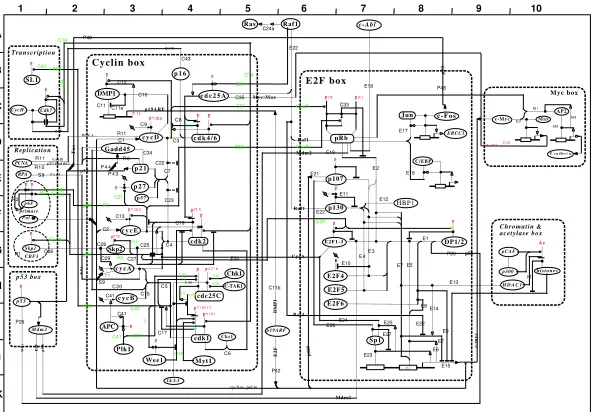
Figure 1: Map A of the Molecular Interaction Map compiled by Kohn (1999)
2 BiomedicalNLP
Full-text articles are becoming increasingly avail-able to NLP researchers, who have begun inves-tigating how specific sections and structures can be mined in various information extraction tasks. Regev et al. (2002) developed the first bioIR sys-tem specifically focusing on limited text sections. Their performance in the KDD Cup Challenge, pri-marily using Figure legends, showed the importance of considering document structure. Yu et al. (2002) showed that the Introduction defines the majority of synonyms, while Schuemie et al. (2004) and Shah et al. (2003) showed that the Results and Methods are the most and least informative, respectively. In con-trast, Sinclair and Webber (2004) found the Methods useful in assigning Gene Ontology codes to articles. These section specific results highlight the infor-mation loss resulting from restricting searches to in-dividual sections, as sections often provide unique information. Furthermore, facts appearing in dif-ferent contexts across various sections, will be lost. This redundancy has been used for passage valida-tion and ranking (Clarke et al., 2001).
There are limited training resources for biomedi-cal full-text systems. The majority of corpora con-sist of abstracts annotated for bio-entity recognition and Relationship Extraction, such as the GENIA (Kim et al., 2003) and the BioCreAtIvE corpora.
However, due to the lack of full-text corpora, many current systems only process abstracts (Ohta et al., 2006). Few biomedical corpora exist for other tasks, such as coreference resolution (Casta˜no et al., 2004; Vlachos et al., 2006), and these are very small. In this paper, we estimate the importance of these tasks in bioNLPsystems, which will help determine which tasks system developers should focus effort on first. Despite limited full-text training corpora, compe-titions such as the Genomics track of TREC, require systems to retrieve and rank passages from full text that are relevant to question style queries.
3 Molecular Interaction Maps
c-Myc and pRb enhance transcription from the E-cadherin promoter in an AP2-dependent manner in epithelial cells (mechanism unknown) (Batsche et al., 1998). Activation by pRb and c-Myc is not additive, suggesting that they act upon the same site, thereby perhaps blocking the binding of an unidentified inhibitor. No c-Myc recognition element is required for activation of the E-cadherin promoter by c-Myc. Max blocks transcriptional activation from the E-cadherin promoter by c-Myc, presumably because it blocks the binding between c-Myc and AP2.
Table 1:MIMannotation M4
1. M4 Subfact: Activation of E-cadherin by pRb and c-Myc is not additive, suggesting they act on the same site
a) However, the precise molecular mechanisms by whichRB,Myc, and AP-2 cooperate to effect transcriptional activation of E-cadherin requires further study. . . . the positive effects ofRBandc-Mycwere not additive. (Discussion)
Synonym: pRb equivalent to RB– undefined Synonym: c-Myc equivalent to Myc
b) The c-myc proto-oncogene, which encodes two amino-terminally distinct Myc proteins, acts as a transcription factor. (Intro)
Table 2: Example instances depending on synonym facts
In creating our corpus we have attempted to re-verse engineerand document theMIMcreation pro-cess for many of the interactions in Kohn (1999). We exhaustively traced and documented the process of identifying passages from the cited full-text articles that substantiate the MIM interactions. This allows us to identify and quantify the amount of informa-tion that is unavailable when systems are restricted to abstracts.
4 Corpus Creation
The first stage of corpus creation involved obtaining the full text of the articles cited in theMIM descrip-tions. There are 262 articles cited in Kohn (1999), and we have manually extracted the text from 218 of them; we have abstracts for the other 44 which have not been included in the analysis presented here.
Currently, the annotated part of the corpus con-sists of passages from 101 full-text articles, support-ing 95 of the 203 MIM descriptions. A
biomedi-cal expert exhaustively identified these passages by manually reading each article several times. 30% of these articles support multipleMIMdescriptions and
so passages from these articles may appear multiple times. We restricted the corpus to the cited articles only. This allows us to quantify the need for external resources, e.g. synonym lists and ontologies. The corpus collection involved the following:
1. Each sentence in aMIM description is a called amain fact.
2. For each main fact we annotated every passage
(instance) that the fact can be derived from. These include direct statements of the fact and passages the fact can be implied from.
3. Main facts are often complex sentences, com-bining numerous facts from the article. Pas-sages from which part of a fact can be de-rived are also annotated as instances. Asubfact
is then created to represent these partial facts. This may be repeated for subfacts.
4. Many instances cannot be directly linked to their corresponding fact, as theydependon ad-ditional passages within the full text or exter-nal domain knowledge. New facts are formed to represent the dependency information – syn-onymandextrafacts. Instances of these are an-notated, and a link is added between the origi-nal and dependency facts.
5. Each instance is annotated with its location within the article. Linguistic phenomena, in-cluding anaphora, cataphora, and negated ex-pressions which must be resolved to derive the fact are identified.
Tables 1 and 2 show an example of this pro-cess. One of the main facts of interaction M4 (Ta-ble 1) isActivation by pRb and c-Myc is not additive . . . blocking the binding of an unidentified inhibitor.
2. E13 Main Fact: HDAC1 binds to the pocket proteins pRb, p107 and p130 and in turn is recruited to E2F complexes on promoters
a) The experiments described above indicate that p107 and p130 can interact with HDAC1. We thus reasoned that they could repress E2F activity by recruitinghistone deacetylaseactivity to E2F containing promoters. (Results)
Extra:HDAC1 is a histone deacetylase
b) We have previously shown that Rb, the founding member of the pocket proteins family, represses E2F1 activity by recruiting the histone deacetylase HDAC1. (Abstract)
Table 3: Example instances depending on extra facts
3. N4 Main fact: RPA2 binds XPA via the C-terminal region of RPA2
Mutant RPA that lacked the p34 C terminus failed to interact with XPA, whereas RPA containing the p70 mutant (Delta RS) interacted with XPA (Fig. 2). (Results)
4. C9 Subfact: Cyclin D1 degraded rapidly by phosphorylation at threonine-286
Although “free” or CDK4-bound cyclin D1 molecules are intrinsically unstable (t1/2<30 min), a cyclin D1 mutant (T286A) containing an alanine for threonine-286 substitution fails to undergo efficient polyubiquitination in an in vitro system or in vivo, and it is markedly stabilized (t1/2 approximately 3.5 hr) when inducibly expressed in either quiescent or proliferating mouse fibroblasts. (Abstract)
Table 4: Example instances with negated expressions
5 Dependencies
In our corpus, an instance of a fact may depend on additional facts (dependencies) to allow the fact to be derived from the original instance. Dependencies may occur elsewhere in the document or may not be mentioned at all. We consider two types of depen-dencies: synonym facts and extra facts.
5.1 Synonym Facts
The frequent use of synonyms, abbreviations and acronyms in biomedical text is a common source of ambiguity that is often hard to resolve (Sehgal et al., 2004). Furthermore, synonym lists are dif-ficult to maintain in rapidly moving fields like bi-ology (Lussier et al., 2006). There has been recent interest in developing systems to identify and extract these (Ao and Takagi, 2005; Okazaki and Anani-adou, 2006).
In our corpus we group all of these synonyms, ab-breviations, acronyms and other orthographic varia-tions assynonym facts. For example, the synonyms (1)E2F4, (2)E2F-4and (3)E2F1-4in our cor-pus refer to the same entityE2F4, however term (3) also includes the entitiesE2F1,E2F2andE2F3.
In Table 2, an instance supporting subfact 1. is shown in 1.a). The bio-entitypRbmentioned in the subfact does not appear in this instance. Thus 1.a) depends on knowing that pRb is equivalent toRB, and so we form a new synonym fact. This synonym
is undefined in the article and cannot be assumed as
RBis also a homograph for the gene ruby (rb), ru-bidium (Rb) and Robertsonian (Rb) translocations.
Instance 1 also depends on a second synonym –
c-Myc and Myc are used interchangeably, where the protein Myc is referred to by its gene name,
c-Myc. Metonymy is common in biology, and an instance supporting this synonym fact was found in the article, 1.b).
5.2 Extra Facts
Extra facts include all assertions (excluding syn-onym definitions) which are necessary to make a valid inference from an instance to a fact or subfact. These extra facts must be found within the same ar-ticle. Many extra facts are descriptions or classes of bio-entities and hyponym relationships. Accord-ing to N´edellec et al. (2006), a clearer distinc-tion between entities and their classes/descripdistinc-tions is needed in bioNLPcorpora.
Example 2 in Table 3 is an instance which de-pends on an extra fact, 2.b), to derive the main fact. The class of proteins histone deacetylase
in sentence 2 must be linked to the specific pro-teinHDAC1in sentence 1, since the sortal anaphor
theyin sentence 2 refers to the antecedentsp107
andp130, and does not includeHDAC1. This extra fact is identified in the appositionthe histone
5. C11b Subfact:p19ARF induces cell cycle arrest in a p53-dependent manner
INK4a/ARF is perhaps the second most commonly disrupted locus in cancer cells. It encodestwo distinct tumor suppressor proteins: p16INK4a, which inhibits the phosphorylation of the retinoblastoma protein by cyclin D-dependent kinases, andp19ARF, which stabilizes and activates p53 to promote either cell cycle arrest or apoptosis. (Intro)
6. C36 Main fact:Cdc25C is phosphorylated by Cyclin B-cdk1
In this work, we examine the effect of phosphorylation on the human cdc25-C protein (Sadhu et al.,1990). We show that this protein isphosphorylatedduring mitosis in human cells and thatthisrequires active cdc2-cyclin B. (Intro)
Table 5: Example instances with cataphora and event anaphora
6 Negated Expressions
To quantify the importance of lexical and logical negations we have annotated each instance involv-ing one or more negated expressions that must be resolved to derive the fact. In biomedical literature, negated expressions are commonly used to describe an abnormal condition, such as a mutation, and its resulting abnormal outcome, such as cancer, from which the normal condition and outcome can be in-ferred. This typically requires two or more negated expressions to be processed simultaneously.
Table 4 shows examples of instances with negated expressions. In the subject NP of instance 3, the lex-ical negative form of RPA (Mutant RPA) is fol-lowed directly by a logical negative detailing the function it failed to perform. These two negative ex-pressions support the positive in the main fact. This implicit reporting of results expressed in terms of negative experimental outcomes is very common in molecular biology and genetics.
Example 4 requires external domain knowl-edge. Firstly, the amino acid alanine cannot be phosphorylated like threonine. Secondly,
polyubiquitination triggers a signal for a
protein (cyclin D1) to be degraded. Therefore from this negated pair the positive fact from interac-tion C9 can be inferred.
The context surrounding potential negative ex-pressions must be analysed to determine if it is in-deed a negative. For example, not all mutations re-sult in negative outcomes – the mutation ofp70in instance 3 did not have a negative outcome.
7 Coreference Expressions
In biomedical literature, coreference expressions are used to make abbreviated or indirect references to bio-entities or events, and to provide additional in-formation, such as more detailed descriptions.
To quantify the importance of coreference expres-sions, instances in our corpus are annotated with pronominal, sortal and event anaphoric, and cat-aphoric expressions, including those extending be-yond one sentence. Instances 4–6 in Tables 4– 5, each contain annotated pronominal or sortal anaphoric expressions. Instance 5 also involves a cataphoric expression, where suppressor
proteinsrefers top16INK4aandp19ARF
Event anaphora refer to processes and are quite common in biomedical text. We have annotated these separately to pronominal and sortal anaphora. Our event anaphora annotations are different to Humphreys et al. (1997). They associate sequential events, while we only refer to the same event.
An example is shown in instance 6 (Table 5) where the additional sortal anaphor complicates re-solving the event anaphor. The third this refers to the phosphorylation event,phosphorylated, and not the proteincdc25-Clike the secondthis.
8 Locating Facts
The key facts and results are generally repeated and reworded in various contexts within an article. This redundancy can be used in two ways to improve sys-tem precision and recall. Firstly, the redundancy in-creases the chance of an imperfect system identify-ing at least one instance. Secondly, the redundancy can be used for fact validation. By annotating every instance that supports a fact we are able to measure the degree of factual redundancy in full-text articles. We have also annotated each instance with its lo-cation within the article: which section (or structure such as a title, heading or caption) it was contained within and the number of the paragraph. Using this data, we can evaluate the informativeness of each section and structure for identifying interactions.
addi-Location Main Fact Subfact Synonym Extra Title 3.3 ( 0.2) 1.9 ( 0.7) 0.0 ( 0.0) 0.8 ( 0.8) Abstract 19.1 (10.1) 9.3 ( 5.1) 36.2 (21.7) 25.8 (14.8) Introduction 11.3 ( 5.2) 8.3 ( 3.4) 30.4 (17.4) 17.2 ( 7.8) Results 31.0 (13.8) 37.6 (16.1) 20.3 (15.9) 32.0 (12.5) Discussion 21.8 ( 7.3) 19.5 ( 6.6) 2.9 ( 1.4) 9.4 ( 3.1) Figure Heading 5.0 ( 0.6) 10.7 ( 3.8) 1.4 ( 1.4) 2.3 ( 0.0) Figure Legend 3.1 ( 1.3) 4.8 ( 2.0) 0.0 ( 0.0) 7.0 ( 4.7) Table Data 0.0 ( 0.0) 0.2 ( 0.0) 0.0 ( 0.0) 0.0 ( 0.0) Methods 0.2 ( 0.0) 0.1 ( 0.1) 0.0 ( 0.0) 4.7 ( 0.8) Conclusion 0.6 ( 0.4) 0.1 ( 0.0) 0.0 ( 0.0) 0.0 ( 0.0) Footnotes 0.0 ( 0.0) 0.0 ( 0.0) 5.8 ( 2.9) 0.0 ( 0.0) Headings 4.8 ( 0.6) 7.5 ( 2.7) 2.9 ( 1.4) 0.8 ( 0.8) Full-text 100.0 (39.4) 100.0 (40.6) 100.0 (62.3) 100.0 (45.3)
Table 6: Instances found excluding (including) all dependencies
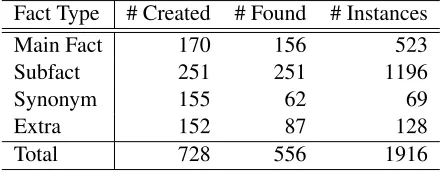
Fact Type # Created # Found # Instances
Main Fact 170 156 523
Subfact 251 251 1196
Synonym 155 62 69
Extra 152 87 128
Total 728 556 1916
Table 7: Distribution of fact types in corpus
tional knowledge outside of the current section to support a particular fact. This demonstrates how im-portant full-text processing is.
9 Corpus Analysis
Having described the corpus annotation we can now investigate various statistical properties of the data. Table 7 shows the distribution of the various anno-tated fact types within the corpus. There are a to-tal of 728 different facts identified, with 556 (76%) found within the documents. We have annotated 1916 individual passages as instances, totally 2429 sentences. There were 14 main facts that we found no instances or subfact instances for.
The most redundancy occurs in main facts and subfacts, with on average 3.35 and 4.76 instances each respectively, whilst synonym facts have almost no redundancy. Also, a large proportion of synonym and extra facts, 60% and 43% respectively, do not appear anywhere in the articles (Table 7).
This high level of redundancy in facts demon-strates the significant advantages of processing full text. However, the proportion of missing synonym
Instances Synonym Extra Main Fact 46.8 (10.9) 26.2 (18.9) Subfact 36.9 ( 8.2) 26.7 (15.4) Synonym 8.7 ( 2.9) 7.2 ( 4.3) Extra 25.0 ( 0.0) 13.3 (10.9)
Table 8: Instances with (all found) dependencies
and extra facts shows the importance of external re-sources, such as synonym lists, and tools for recog-nising orthographic variants.
9.1 Locating Facts
Table 6 shows the percentage of instances identified in particular locations within the articles. The best sections for finding instances of facts and subfacts were the Results and Discussion sections, whereas synonym and extra facts were best found in the Ab-stract, Introduction and Results. The later sections of each article rarely contributed any instances. In-terestingly, we did not find the Figure headings or legends to be that informative for main facts. Figure headings are restricted in length and thus are rarely able to express main facts as well as subfacts.
The proportion of main facts and subfact in-stances found in the abstract is quite small, further demonstrating the value of full-text processing.
Depth Fact Subfact Synonym Extra
0 35.2 45.1 87.0 64.8
1 53.9 44.2 13.0 26.6
2 9.6 9.5 0.0 7.0
3 1.3 0.9 0.0 1.6
4 0.0 0.3 0.0 0.0
Table 9: Maximum depth of instance dependencies
Breadth Fact Subfact Synonym Extra
0 35.2 45.1 87.0 64.8
1 36.5 35.5 7.2 29.7
2 22.6 15.7 5.8 4.7
3 4.6 2.9 0.0 0.8
4 0.8 0.6 0.0 0.0
5 0.2 0.2 0.0 0.0
Table 10: Breadth of instance dependencies
total, the number of instances drops to 39.4% and 40.6%, for main facts and subfacts, respectively. This again demonstrates the need for full-text pro-cessing, including the dependencies between facts found in different sections of the article.
9.2 Dependencies
Our corpus represents each of the facts and subfacts as a dependency graph of instances, each which in turn may require support from other facts, including synonym and extra facts.
Table 8 shows the percentage of instances which depend on synonym and extra facts in our corpus. 46.8% of main fact instances depend on at least one synonym fact, but only 10.9% of main fact instances which depend on at least one synonym were com-pletely resolved (i.e. all of the synonyms were found as well). Interestingly, synonym and extra facts of-ten required other synonym and extra facts.
Our corpus contains more synonym than extra fact dependencies, however more extra facts were de-fined in the articles. The large proportion of main facts and subfacts depending on synonyms and extra facts demonstrates the importance of automatically extracting this information from full text.
Since the inference from an instance to a fact may depend on other facts, long chains of dependencies may occur, all of which would need to be resolved before a main fact could be derived from the text.
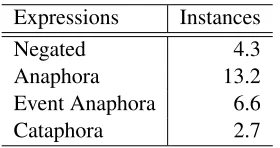
Expressions Instances
Negated 4.3
Anaphora 13.2
Event Anaphora 6.6
Cataphora 2.7
Table 11: Distribution of annotated expressions
Table 9 shows the distribution of maximum chain depth in our dependency graphs. The maximum depth is predominately less than 3. Table 10 shows the distribution of the breadth of dependency graphs. Again, most instances are supported by fewer than 3 dependency chains. Most instances depend on some other information, but luckily, a large proportion of those only require information from a small number of other facts. However, given that these facts could occur anywhere within the full text, extracting them is still a very challenging task.
9.3 Negated & Coreference Expressions
Table 11 shows the percentage of instances anno-tated with negated, anaphoric and cataphoric ex-pressions in our corpus. We have separated event anaphora from pronominal and sortal anaphora. There are fewer cataphoric and negated expressions than anaphoric expressions. Therefore, we would expect the greatest improvement when systems in-corporate anaphora resolution components, and lit-tle improvement from cataphoric and negated ex-pression analysis. However, negated expressions provide valuable information regarding experimen-tal conditions and outcomes, and thus may be ap-propriate for specific extraction tasks.
10 Conclusion
This paper describes a corpus documenting the man-ual identification of facts from full-text articles by biomedical researchers. The corpus consists of arti-cles cited in a Molecular Interaction Map developed by Kohn (1999). Each fact can be derived from one or more passages from the citations. Each of these
com-plex and as future work we will increase the relia-bility of our corpus by including the annotations of other domain experts using our guidelines, and use this resource for tool development. The guidelines and corpus will be made publicly available.
Our corpus analysis demonstrates that full-text analysis is crucial for exploiting biomedical litera-ture. Less than 20% of fact instances we identified were contained in the abstract. Analysing sections in isolation reduced the number of supported facts by 60%. We also showed that many instances were dependent on a significant amount of other informa-tion, both within and outside the article. Finally, we showed the potential impact of variousNLP compo-nents such as anaphora resolution systems.
This work provides important empirical guidance for developers of biomedical text mining systems.
Acknowledgements
This work was supported by the CSIRO ICT Cen-tre and ARC Discovery grants DP0453131 and DP0665973.
References
Hiroko Ao and Toshihisa Takagi. 2005. ALICE: An algorithm to extract abbreviations from Medline.Journal of the Amer-ican Medical Informatics Association, 12(5):576–586. J. Casta˜no, J. Zhang, and J. Pustejovsky. 2004. Anaphora
reso-lution in biomedical literature. InInternational Symposium on Reference Resolution in NLP, Alicante, Spain.
Charles L. A. Clarke, Gordon V. Cormack, and Thomas R. Ly-nam. 2001. Exploiting redundancy in question answering. InProc. of the 24th Annual International ACM SIGIR Con-ference on Research and Development in Information Re-trieval, pages 358–365, New Orleans, LA.
Lynette Hirschman, Jong C. Park, Junichi Tsujii, Limsoon Wong, and Cathy Wu. 2002. Accomplishments and chal-lenges in literature data mining for biology. Bioinformatics Review, (12):1553–1561.
Kevin Humphreys, Robert Gaizauskas, and Saliha Azzam. 1997. Event coreference for information extraction. InProc. of the ACL/EACL Workshop on Operational Factors in Prac-tical, Robust Anaphora Resolution for Unrestricted Texts, Madrid, Spain.
Jin-Dong Kim, Tomoko Ohta, Yuka Teteisi, and Jun’ichi Tsujii. 2003. GENIA corpus - a semantically annotated corpus for bio-textmining.Bioinformatics, 19(1):i180–i182.
Kurt W. Kohn. 1999. Molecular interaction map of the mam-malian cell cycle and DNA repair systems. Molecular Biol-ogy of the Cell, 10:2703–2734.
Yves Lussier, Tara Borlawsky, Daniel Rappaport, Yang Liu, and Carol Friedman. 2006. PHENOGO: Assigning phenotypic context to gene ontology annotations with natural language processing. InProc. of the Pacific Symposium on Biocom-puting, volume 11, pages 64–75, Maui, HI.
Clair N´edellec, Philippe Bessi`eres, Robert Bossy, Alain Kptou-janksy, and Alain-Pierre Manine. 2006. Annotation guide-lines for machine learning-based named entity recognition in microbiology. InProc. of the ACL Workshop on Data and Text for Mining Integrative Biology, pages 40–54, Berlin. Tomoko Ohta, Yusuke Miyao, Takashi Ninomiya,
Yoshi-masa Tsuruoka, Akane Yakushiji, Katsuya Masuda, Jumpei Takeuchi, Kazuhiro Yoshida, Tadayoshi Hara, Jin-Dong Kim, Yuka Tateisi, and Jun’ichi Tsujii. 2006. An intelli-gent search engine and GUI-based efficient Medline search tool based on deep syntactic parsing. InProc. of the COL-ING/ACL Interactive Presentation Sessions, pages 17–20, Sydney, Australia.
Naoaki Okazaki and Sophia Ananiadou. 2006. A term recog-nition approach to acronym recogrecog-nition. InProc. the 21st International Conference on Computational Linguistics and the 44th Annual Meeting of the ACL, pages 643–650, Syd-ney, Australia.
Yizhar Regev, Michal Finkelstein-Langau, Ronen Feldman, Mayo Gorodetsky, Xin Zheng, Samuel Levy, Rosane Char-lab, Charles Lawrence, Ross A. Lippert, Qing Zhang, and Hagit Shatkay. 2002. Rule-based extraction of experimen-tal evidence in the biomedical domain - the KDD Cup 2002 (Task 1).ACM SIGKKD Explorations, 4(2):90–92. M.J. Schuemie, M. Weeber, B.J.A. Schijvenaars, E.M. van
Mul-ligen, C.C. van der Eijk, R.Jelier, B.Mons, and J.A Kors. 2004. Distribution of information in biomedical abstracts and full-text publications. Bioinformatics, 20(16):2597– 2604.
Aditya K. Sehgal, Padmini Srinivasan, and Olivier Bodenreider. 2004. Gene terms and english words: An ambiguous mix. In
Proc. of the ACM SIGIR Workshop on Search and Discovery for Bioinformatics, Sheffield, UK.
Parantu K. Shah, Carolina Perez-Iratxeta, Peer Bork, and Miguel A. Andrade. 2003. Information extraction from full text scientific articles: where are the keywords? BMC Bioin-formatics, 4(20).
Gail Sinclair and Bonnie Webber. 2004. Classification from full text: A comparison of canonical sections of scientific papers. InProc. of the International Joint Workshop on Nat-ural Language Processing in Biomedicine and its Applica-tions, pages 66–69, Geneva, Switzerland.
Andreas Vlachos, Caroline Gasperin, Ian Lewin, and Ted Briscoe. 2006. Bootstrapping the recognition and anaphoric linking of named entities in drosophila articles. InProc. of the Pacific Symposium on Biocomputing, volume 11, pages 100–111, Maui, HI.