Advances in Medical Education and Practice
Dove
press
R E v i E w
open access to scientific and medical research
Open Access Full Text Article
interface between problem-based learning
and a learner-centered paradigm
Reza Karimi
Pacific University School of Pharmacy, Hillsboro, OR, USA
Correspondence: Reza Karimi Academic Affairs and Assessment, Pacific University School of Pharmacy, 222 SE 8th Avenue, HPC-Ste 451, Hillsboro, OR 97123, USA Tel +1 503 352 7276 Fax +1 503 352 7270 Email [email protected]
Background: Problem-based learning (PBL) has made a major shift in support of student learning for many medical school curricula around the world. Since curricular development of PBL in the early 1970s and its growth in the 1980s and 1990s, there have been growing numbers of publications providing positive and negative data in regard to the curricular effectiveness of PBL. The purpose of this study was to explore supportive data for the four core objectives of PBL and to identify an interface between the objectives of PBL and a learner-centered paradigm.
Methods: The four core PBL objectives, ie, structuring of knowledge and clinical context, clini-cal reasoning, self-directed learning, and intrinsic motivation, were used to search MEDLINE, the Education Resources Information Center, the Educator’s Reference Complete, and PsycINFO from January 1969 to January 2011. The literature search was facilitated and narrowed if the published study included the following terms: “problem-based learning”, “medical education”, “traditional curriculum”, and one of the above four PBL objectives.
Results: Through a comprehensive search analysis, one can find supportive data for the effec-tiveness of a PBL curriculum in achieving the four core objectives of PBL. A further analysis of these four objectives suggests that there is an interface between PBL objectives and criteria from a learner-centered paradigm. In addition, this review indicates that promotion of teamwork among students is another interface that exists between PBL and a learner-centered paradigm.
Conclusion: The desire of medical schools to enhance student learning and a need to provide an environment where students construct knowledge rather than receive knowledge have encouraged many medical schools to move into a learner-centered paradigm. Implementation of a PBL curriculum can be used as a prevailing starting point to develop not only a learner-centered paradigm, but also to facilitate a smooth curricular transition from a teacher-learner-centered paradigm to a learner-centered paradigm.
Keywords: problem-based learning, teamwork, learner-centered paradigm
Introduction
Problem-based learning (PBL) was created and initially implemented at McMaster University in Hamilton, ON, Canada, in 1969. The stakeholders at McMaster University were eager to introduce a new learning tool to reduce the faculty’s role as a primary information giver and to replace passive learning by students with an active learning process. At McMaster University, PBL was implemented into a medical curriculum in which small-group study of clinical problems with directed learning and self-assessment techniques were implemented.1 Soon after, PBL was positively received
by a few other medical schools, including the University of Limburg at Maastricht (The Netherlands), the University of Newcastle (Australia), and the University of New Mexico (US),1 and subsequently was implemented in a few medical schools
Advances in Medical Education and Practice downloaded from https://www.dovepress.com/ by 118.70.13.36 on 19-Aug-2020
For personal use only.
Number of times this article has been viewed
This article was published in the following Dove Press journal: Advances in Medical Education and Practice
Dovepress
Karimi
in the UK. In addition, PBL rapidly found its way into other disciplines, including education, law, business, and professional health sciences.1,2 In the years 1970–1990, over
60 medical schools adopted the PBL curriculum around the world.1 Today, the vast majority of medical schools in Canada
and approximately 80% of medical schools in the US have integrated PBL into their curricula. However, in half of the medical schools in the US, only a small portion (less than 10%) of their preclinical curriculum has been delivered in a PBL format.3
In the early 1970s, the stakeholders at McMaster University described PBL as a learning tool in which learners focused on a problem and used their previously gained knowledge in order to think rationally about solving the problem. In this manner, it was suggested that PBL would motivate students to participate in active intellectual processes at higher cognitive levels which ultimately would enhance student learning and knowledge retention.4 During
the implemented PBL, students were introduced to the learning strategies related to problem-solving, self-directed learning, and small-group tutorials, in which tutors played an important role in facilitating student group discussions.
Since 1970, PBL has been used in different formats to assist the curricula of different medical schools in enhancing student learning and clinical skills. The most frequently used PBL format is characterized as generating a series of carefully chosen problems to be presented to students in a small group setting. The problems are simulated with authentic patient cases in which patients complain about a disease or disorder with clinical signs and symptoms. The student group meets twice a week for 2 or 3 hours per each meeting. Between these meetings, group members are expected to spend significant time on self-directed learning to find relevant information for further group discussions. Usually, students are free to choose their own resources. In the meetings, the student group discusses and analyzes the main points of a problem and synthesizes possible explanations and working hypotheses for the problem. During each group discussion, the group is guided by a faculty member (a tutor) whose assignment is to stimulate group discussion and to evaluate and monitor group members’ contribution and progress in solving the problem. In addition, occasional lectures relevant to the problem may be given by the tutor. PBL problems are designed so that the student group is focused on simpler problems and progres-sively approaches more complex problems. For instance, the student group may work on insulin and its effect on carbo-hydrates and fatty acid metabolism before the group works on diabetic patient cases. This progressive sequence allows
students to acquire knowledge using simpler problems, and use their knowledge, with newly added information, to solve more complicated clinical problems effectively. In addition, it is important to provide training for student groups to col-laborate effectively with each other prior to receiving the problems and assignments.5,6
A learner-centered paradigm is a shift in higher education where lecture-based presentations and a passive transmis-sion of knowledge from faculty to students is no longer the core of curriculum and student learning.7 Rather, students
are actively involved in their learning and are motivated to explore information actively to synthesize and construct new knowledge. Many colleges and schools have attempted to depart from a teacher-centered environment and move toward a learner-centered environment.7,8 This paradigm
shift causes colleges and universities to ask how students are learning rather than how faculty are teaching. However, a paradigm shift does not occur overnight, and takes significant amounts of time and effort from administration, faculty, and students to facilitate the transition to a new environment. A systematic review of published studies was conducted in the present review to explore supportive data for the four core objectives of PBL. In addition, a further analysis of these published studies was carried out to indicate whether there was an interface between PBL objectives and a learner-centered paradigm.
Methods
The MEDLINE database was searched using different com-binations of keywords (see Table 1) from January 1969 to January 2011. Because the MEDLINE database provided only journals relevant to healthcare, it was important to include other educational journals. As a result, the following key words: “problem based learning”, “medical education”, “traditional curriculum”, and “self-directed learning” were used to search the Education Resources Information Center for 1969–2011 which produced three articles, the Educator’s Reference Complete for 1980–2011 which produced three articles, and PsycINFO for 1969–2011 which produced one article. Papers were included if they met the criteria of PBL being implemented in a medical school and provided comparative data between PBL and traditional curricula.
Results
Huba and Freed have elegantly outlined and compared the criteria for teacher-centered and learner-centered paradigms (Table 2).7 As Huba and Freed point out, student learning
is the ultimate goal that the educators should focus on
Advances in Medical Education and Practice downloaded from https://www.dovepress.com/ by 118.70.13.36 on 19-Aug-2020
Dovepress PBL and a learner-centered paradigm
and, as a result, they must shift from a traditional teaching model to a learner-centered model.7 In a learner-centered
environment, students are more active in a teamwork man-ner than a teacher-centered paradigm. Similarly, faculty are more engaged in accommodating and facilitating discussions among students, are encouraged to be innovative in teaching and assessment, integrate more disciplines into their teaching, and faculty and students assess student learning together.7
On the other hand, in a teacher-centered paradigm, the focus is on how well a faculty teaches. Questions such as how well organized and accurate the lectures are, how well the present-ers maintain student interest, and how well the material is presented, are the focus of teacher-centered instruction.
There are four major objectives of PBL that were well established by Barrows in 1986, which included structuring of knowledge and clinical context, clinical reasoning, self-directed learning skills, and intrinsic motivation.9 These
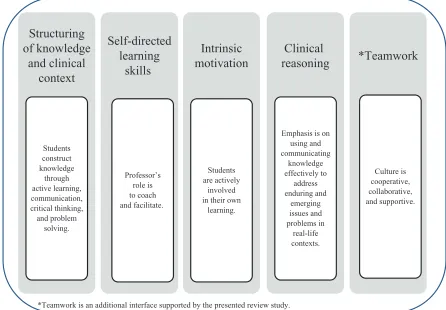
objectives were originally established to expose students to real-life problems so that students could learn the craft of examining a patient’s clinical problem, diagnosing it, and making an informed decision about appropriate action and treatment to remedy the problem. Figure 1 compares the PBL objectives of Barrows with a few criteria from the learner-centered model, and demonstrates an interface between all four objectives of PBL (gray box) and the listed learner-centered criteria (white box). In the following
sections, a series of interfaces between PBL objectives and learner-centered criteria are presented and discussed.
Structuring of knowledge
and clinical context
Student learning is based on structuring of knowledge rather than a passive memorization of facts. In order to structure knowledge, students analyze a problem, utilize their prior knowledge, and use and process new information to solve a problem or cope with an assignment. In a comparative study conducted by Van der Veken et al three different cur-ricula (conventional, integrated contextual, and PBL) were compared using Vermunt’s Inventory of Learning Styles to identify differences in student learning. In comparing PBL with the traditional curriculum, while students from the PBL curriculum gained fewer benefits from rote learning, rehearsing, and ability to express study content in a per-sonal manner, they gained higher benefits in knowledge and self-regulation of learning.10 In another study conducted by
Visschers-Pleijers et al in which 48 medical students par-ticipated in six focus group interviews, the authors assessed how the PBL curriculum assisted students in integrating and applying knowledge in their learning. Their assessment results indicated that the main learning effects for students were retention, understanding, integration, and application of knowledge.11 In addition, Kamin et al showed that a series
of cases, presented in a PBL curriculum, assisted students in structuring their knowledge, conceptualizing how to handle difficult situations, differentiating between abnormal and normal physical examination findings, and developing critical thinking skills.12 In a specific disease state, ie, hypertension,
Shin et al showed that the graduates of their medical school with a PBL curriculum were more up to date on knowledge of the management of hypertension than graduates of a tra-ditional curriculum.13 The ability to structure knowledge in
order to construct a correct answer is an important skill during clinical examinations in medical curricula. In a comparison study of PBL and traditional curricula, it has been suggested that PBL students perform better on clinical examinations than on basic science examinations.14
Table 1 MEDLINE was used to search different combinations of key words in order to find supportive and relevant data regarding
PBL curriculum in medical schools
*Keywords 1 1 and 2 1, 2, 6 1 and 3 1, 3, 6 1 and 4 1, 4, 6 1 and 5 1, 5, 6
Number of nonreview articles 2774 6 1 112 20 169 35 139 30
Number of review articles 238 0 0 5 3 20 10 8 2
Notes: *Keywords 1, problem-based learning and medical education; keywords 2, structuring of knowledge; keywords 3, clinical reasoning; keywords 4, self-directed learning; keywords 5, motivation; keywords 6, traditional curriculum.
Table 2 Comparison of criteria and activities implemented in a teacher-centered paradigm and a learner-centered paradigm7
Teacher-centered paradigm Learner-centered paradigm
Knowledge is transmitted from faculty to students in a passive traditional lecture-based format
Students construct knowledge through active learning, self-directed learning, critical thinking, and problem-solving skills
Emphasis is on how faculty teach Emphasis is on how students learn Faculty’s role is to be primary
information giver and primary evaluator
Faculty’s role is to coach and facilitate; faculty and students evaluate learning together Culture is competitive and
individualistic
Culture is cooperative, collaborative, and supportive
Huba ME and Freed J. Learner-centered assessment on college campuses: shifting the focus from teaching to learning, 1st ed, 2000, p5.
Reprinted by permission of Pearson Education, inc, Upper Saddle River, NJ.
Advances in Medical Education and Practice downloaded from https://www.dovepress.com/ by 118.70.13.36 on 19-Aug-2020
Dovepress
Karimi
The above studies match well with a learner-centered environment that encourages students to construct knowledge through active learning, communication, critical thinking, and problem solving.7 Structuring knowledge can assist
students in using their knowledge more effectively in order to solve ill-defined medical cases. For instance, it has been suggested that the reason some students do not remember facts and concepts of a discipline or do not know when to use their knowledge, compared with experts (faculty) who do remember their knowledge, is that faculty’s knowledge is well structured and organized in their memories.15 This indicates
assignments and problems that assist students in structuring their knowledge can promote the quality of student thinking and learning.
Clinical reasoning
Clinical reasoning skills are essential components of both didactic and experiential education at medical schools. They assist students in examining a patient’s history, performing a physical examination, and evaluating all relevant clini-cal and laboratory data in order to achieve an effective therapeutic outcome. In a meta-analysis study, the effect
of PBL during preclinical experience was assessed. The results indicated that the PBL experience was perceived very positively during the preclinical phase of student training and assisted students in building up their clinical competence during their first clerkship experiences.16 In a
similar study, in which a comparison was made between PBL and traditional curricula for clinical performance in a third-year medical clerkship, the results indicated that the preclinical PBL enhanced third-year students’ clinical performance.17 Characteristics and outcome data from PBL
and traditional curricula were compared by Distlehorst et al. In several of their clerkship performance assessments, PBL students performed significantly better than students from the traditional curriculum.18 In a series of studies conducted
by Barrows, it was indicated that PBL enhanced student clinical reasoning and problem solving skills.9,19 It has been
suggested that, in a PBL curriculum, the student’s approach to solving a clinical case is different compared with a tradi-tional curriculum. In a PBL curriculum, students not only study the clinical concepts of a case, but they also study the basic and social science concepts of the case in order to develop clinical reasoning skills.20
Structuring
of knowledge
and clinical
context
Students construct knowledge
through active learning, communication, critical thinking, and problem
solving.
Self-directed
learning
skills
Intrinsic
motivation
Students are actively
involved in their own
learning.
Clinical
reasoning
Emphasis is on using and communicating
knowledge effectively to
address enduring and
emerging issues and problems in
real-life contexts.
*Teamwork
Professor’s role is to coach and facilitate.
Culture is cooperative, collaborative, and supportive.
*Teamwork is an additional interface supported by the presented review study.
Figure 1 A parallel comparison between the objectives of problem-based learning9 (gray) and the criteria established in a learner-centered paradigm7 (white).
Advances in Medical Education and Practice downloaded from https://www.dovepress.com/ by 118.70.13.36 on 19-Aug-2020
Dovepress PBL and a learner-centered paradigm
In a learner-centered environment, students establish their reasoning strategies by communicating their knowl-edge to address emerging issues in real-life contexts.7
Quellmalz and Hoskyn have established many different reasoning strategies that can be applied in a learner-centered paradigm. A few of these reasoning strategies include comparing, error analysis, constructing support, analyz-ing perspectives, decision-makanalyz-ing, investigation, experi-mental inquiry, problem-solving, and invention.21 A closer
look at these reasoning strategies and the PBL curriculum indicates that the PBL curriculum accommodates many of these reasoning strategies during student group discussions to encourage students to use their clinical reasoning more effectively.9,17,19
Self-directed learning skills
Self-directed learning skills demonstrate that students are self-guided and know how to use their knowledge and resources to complete problems or assignments.8,22 Schmidt
et al have described the roles of PBL tutors as facilitators in student group discussions, who share their knowledge when the assigned problems turn out to be too complex or when there is a lack of essential knowledge for the group to progress effectively with their discussions.23 This is in
line with the role of faculty in a learner-centered paradigm, ie, “professor’s role is to coach and facilitate” rather than being the primary information giver.7 In another study,
Watmough et al conducted a study in which 45 physi-cians were interviewed to evaluate the impact of a PBL curriculum on their education and practice 6 years after their graduations. The study results indicated that the physicians felt they were clinically well prepared, with good clinical and communication skills, and had good self-directed learning and research skills. However, they felt their basic science knowledge level was weaker than traditional graduates.24 In a
comprehensive review study comparing PBL and traditional medical curricular conducted by Koh et al it was shown that self-directed learning skills from a PBL curriculum were rated by students as moderate.25 However, their systematic
review indicated that PBL had a positive effect on physi-cians’ performance and competence after graduation. In a similar review study, Rao and Rao showed that PBL is the most effective way to foster students to be independent thinkers and problem solvers by becoming self-directed learners to gather necessary information to resolve spe-cific clinical problems.26 Rahman et al conducted a 2-year
study to assess the knowledge and attitude of students before and after implementation of a PBL curriculum.
They demonstrated that the implementation of PBL sig-nificantly improved student skills in clinical knowledge, attitude, and practice. A majority of their students stated that PBL enhances self-directed learning.27 In another study
conducted from 1999 to 2002 in a medical school in India, the investigator indicated that the implementation of a PBL curriculum, alongside their traditional didactic curriculum, improved students’ motivation in self-directed learning and benefited student learning by relating a clinical condition to a basic science mechanism.28 In addition, in a review
con-ducted by Norman and Schmidt, it was suggested that PBL enhanced student self-directed learning and made students more enthusiastic learners.5
As a result of the role of the faculty as facilitator, rather than primary information giver, self-directed learning is strongly promoted in a learner-centered model. It has been suggested that when the faculty’s role is to guide and coach, they provide an environment for students to discuss, explore the available resources, and use their own knowledge to make an informed judgment.8,22,29
Intrinsic motivation
Behavioral psychologists have suggested that motivation plays an important role in student learning.30 As a result,
many medical schools are interested in implementing PBL because of its potential to enhance student motivation in learning. However, there is scarce research regarding the effect of PBL on intrinsic motivation. In a study by White, a PBL curriculum was compared with a traditional curriculum during the first and second academic years. The results indicated that the PBL curriculum had a positive impact on students, who found themselves motivated to learn, and were able to direct their motivation into effective transition from the classroom into their clerkship training. The authors con-cluded that self-regulated learning facilitated the transition from basic sciences to experiential experiences.31 Indeed,
Langelotz et al compared student motivation in learning from both traditional and PBL curricula during their fourth clinical semester, and found that the PBL in the surgical curriculum increased students motivation.32 Similarly, Chang et al found
that in a comparison between PBL and traditional curricula, students in a PBL curriculum cultivated their interest in anesthesia, increased their motivation to learn actively, and were more enthusiastic in anesthesia research.33 Barrows
and Tamblyn suggested that PBL increased student intrinsic motivation in learning, students were able to define their learning approach, and students decided what was important and relevant for their learning.34
Advances in Medical Education and Practice downloaded from https://www.dovepress.com/ by 118.70.13.36 on 19-Aug-2020
Dovepress
Karimi
In a learner-centered paradigm, students are actively involved in their own learning because they are motivated. In a study conducted by Cheang, a series of surveys was devel-oped to determine the effect of the learner-centered paradigm in enhancing students’ intrinsic motivation to complete a pharmacy course. The results of this study indicated that goal orientation, control of learning, and self-efficacy, which were a few domains of motivation, were significantly improved and assisted students in developing learning skills and self-awareness.35 Similarly, Spencer and Phipps, in their
learner-centered study of a drug literature evaluation course, suggested that students had more control of their learning environment and had multiple opportunities to demonstrate their learning.36
Teamwork
Teamwork is a trend that is clearly evident in the PBL cur-riculum in which student groups develop a common goal to complete a clinical case assignment. It has been suggested that a PBL curricular implementation can accommodate the needs for developing teamwork skills,37 and PBL medical
graduates, compared with traditional medical graduates, have learned better communication and teamwork skills.38
Because the success of each individual is tied to the suc-cess of the team, students are motivated to help each other, which in turn promotes cooperative learning.39 In addition,
students who work on teamwork assignments achieve a high understanding of complex and difficult problems that is often challenging to achieve individually.40 One apparent PBL
objective, although not listed in the four objectives of Barrow, is teamwork. Teamwork is also one of the learner-centered criteria (Table 2)7 which states that the culture of learning is
cooperative, collaborative, and supportive (Figure 1) or, in other words, the culture is noncompetitive. In both PBL and a learner-centered paradigm, team members feel their contribu-tions are appreciated and valued, that they make collective decisions, and focus on common goals. As Michaelsen and Sweet point out, teamwork provides an environment in which team members progress well, achieve a depth of understand-ing, identify their strengths and weaknesses, and the group develops into a self-managed learning team.40
Discussion
The fast-paced stream of medical information, a high expectation from the medical accreditation and national board examination agencies, an intensive trend of basic science learning followed by demanding clinical train-ing, and diverse student learning have encouraged many
faculty and stakeholders at medical schools to innovate new curricular designs to promote student learning. There are virtually three curricula that are implemented by most medi-cal schools in the US, ie, lecture-based, problem-based, and a combination of both. While the lecture-based curriculum is one of the most widely used instructional techniques, its effectiveness has been criticized and questioned for many years.41 On the other hand, PBL has been cited by mounting
literature as an effective curriculum that actively engages stu-dents in their learning.2,9,34 However, a few data have brought
into question the effectiveness of PBL in improving student overall learning and knowledge and the improvement of patient’s health, physicians’ knowledge and performance,42–44
or have suggested that a PBL curriculum does not teach prob-lem solving better than a traditional curriculum.45 Despite
the fact that the PBL curriculum has been endorsed by the Association of American Medical Colleges46 and the World
Federation of Medical Education,47 surprisingly, there are
few published data providing conclusive evidence that a PBL curriculum fosters more qualified physicians than any other curricula.
Despite a variation in the lengths of PBL curricula (at a course level versus at a program level) presenting a challenge in this study in terms of providing a pattern of consistent mea-sures of the effectiveness of PBL, one can create an interface between PBL and a learner-centered paradigm. During the last 40 years, PBL has represented a major shift in educational practice, particularly in medical schools, and is one of the most studied and researched curricula in higher education.34
On the other hand, since the mid 1980s, as a product of the Joint Task Force on Student Learning appointed by the American Association for Higher Education, the American College Personnel Association, and the National Association of Student Personnel Administrators, many universities and colleges have departed from a teacher-centered paradigm and moved toward a learner-centered paradigm.7,48
As suggested in the results section of this review, in a learner-centered paradigm, students construct knowledge through active learning, communication, critical thinking, and problem solving, which are also skills accommodated by a PBL curriculum. Structuring of knowledge and clinical context is a challenging task for medical students and often requires the faculty’s intervention to facilitate this skill. In a PBL curricular activity, collaborative learning is encouraged to conduct effective discussions, integrate new information, and apply prior knowledge which, in turn, provides an environment where students can construct knowledge.11
Advances in Medical Education and Practice downloaded from https://www.dovepress.com/ by 118.70.13.36 on 19-Aug-2020
Dovepress PBL and a learner-centered paradigm
Clinical reasoning plays an important role in developing qualified physicians because it reinforces a cognitive process by which a clinical case is reviewed, analyzed, and explored to diagnose or suggest a therapeutic solution to a disease.49
In other words, clinical reasoning skills develop when a student uses his/her knowledge effectively to review and address clinical issues in real-life contexts. Barrows, in his study, indicated that a PBL curriculum promotes clinical reasoning skills.9 In a teacher-centered paradigm, students
often face “black and white” assignments that are also called “well-defined”. A pattern of solving these problems does not prepare students for real-life problems that often are “gray” or “ill-defined”.7 On the other hand, in a
learner-centered environment, students are challenged to deal with “real-life” problems to promote their knowledge and skills in areas of inquiry, reasoning, and problem solving7 which
ultimately will assist them in developing their clinical reasoning skill. Promoting self-directed learning skills is a challenging process for faculty members and students. In a learner-centered paradigm, the role of the faculty is to coach and facilitate,7 which ultimately encourages students
to be self-guided and know how to use their knowledge and resources to complete a clinical case assignment.8,22 There is
increasing evidence that, in a PBL curriculum, compared with a traditional curriculum, students are more self-directed and enthusiastic learners, which ultimately promotes graduates to be life-long learners.9,50,51 In an interesting study, medical
students’ engagements in borrowing study material from libraries was compared between PBL students and traditional students. The results revealed that PBL students borrowed more material (67 books/student/year) than the traditional students (43 books/student/year). In addition, this difference was amplified during the clerkship, ie, 40 books/student/ year compared with 11 books/student/year.52 The latter
result indicated that students were enthusiastic learners, with a desire to explore and acquire more information in a self-directed manner.
Intrinsic motivation has been identified as one of the driving factors that ignites student’s interest in issues relevant to problems. When students are confronted with problems that they do not understand easily, they will actively seek information to solve the presented problems.53 In line with
the criterion for a learner-centered paradigm that states students are actively involved in their own learning, students must be motivated in order to be involved actively in their learning. Attending presentations and watching a series of faculty notes, the trends in a teacher-centered paradigm, do not support student learning.
This review suggests that there is an additional inter-face, ie, teamwork, which exists between PBL and learner-centered curricula. In teamwork, each team member brings a diverse set of knowledge, skills, experience, and expertise, not only to complement but also to support one another’s strengths.54 Collaborative learning is a trend that is evident
in a PBL curriculum in which students have a common goal to complete a clinical case assignment. The most recent Accreditation Council for Graduate Medical Education standards in 2011 emphasizes the role of teamwork in training medical residents. This standard states that “Residents must care for patients in an environment that maximizes effective communication. This must include the opportunity to work as a member of effective interprofessional teams that are appro-priate to the delivery of care in the specialty”.55 This statement
stresses the importance of teamwork in the graduate medical education, which is consistent with the teamwork that PBL and learner-centered curricula accommodate. The teamwork objective, although it is not listed in the four objectives of Barrow, corresponds to one of the learner-centered criteria (Table 2) that identifies the culture of learning as cooperative, collaborative, and supportive (Figure 1).
In addition to the interfaces between a PBL paradigm and a learner-centered paradigm identified above, Huba and Freed have developed eight hallmarks for a learner-centered paradigm.56 Many of these hallmarks are also supported by
the PBL curriculum, ie, learners are actively involved and receive feedback, apply knowledge to enduring and emerging issues and problems, and integrate discipline-based knowl-edge and general skills.
Finally, it is worth mentioning that tutors have a criti-cal role in the PBL process. A tutor’s way of coaching can change the interface between a PBL curriculum and a learner-centered paradigm. In order to maintain the interface between these two curricula, special attention needs to be paid to train tutors in a PBL process. For instance, when tutors are confronted with problems in group work, such as students who do not actively participate in group discussions or do not contribute to achieve the goals of the study, those tutors who implement solutions to problems or cases are character-ized as teachers in a teacher-centered paradigm rather than facilitators in a learner-centered paradigm.57
The information presented in this review shows that there is adequate support to create an interface between the objectives of PBL and a learner-centered paradigm. In addi-tion, the faculty’s role as a facilitator, involving students in evaluating student learning, and intertwining teaching and assessment, are other components of a learner-centered
Advances in Medical Education and Practice downloaded from https://www.dovepress.com/ by 118.70.13.36 on 19-Aug-2020
Dovepress
Karimi
paradigm that often are visible in a PBL curriculum. These parallel matches indicate that implementing a PBL curricu-lum can facilitate a smooth transition from a teacher-cen-tered paradigm to a learner-centeacher-cen-tered paradigm. The Flexner report of 1910 has influenced medical education in the US and Canada in a positive way.58 This report emphasized the
importance of applying alternative instructional methods that stressed active learning for medical students. Indeed, what Flexner was referring to was similar to what PBL and learner-centered curricula refer to regarding replacing student’s passive learning with an active learning process. However, it is important to stress that a theoretical well-matched alignment between a PBL objective and a learner-centered criterion does not justify an interface between a PBL curriculum and a learner-centered paradigm. In other words, there must be existing data to support a coherent curricular interface.
It is worth mentioning that this review has a number of limitations. Firstly, the Educator’s Reference Complete database did not provide data prior to January 1969 (data were only available for 1980 on wards). Secondly, whilst the literature search yielded compelling data that PBL sup-ports student learning, the impact of PBL on improving physician interaction and communication with patients and other healthcare providers has not been researched to any significant extent. Lastly, the inconsistency in the develop-ment and impledevelop-mentation of different PBL formats among medical schools made this review a challenging task to provide a pattern of consistent measures of the effective-ness of PBL.
Conclusion
Data published since 1969 in regards to PBL and tradi-tional curricula in medical schools have been explored and reviewed. A comparison between these two curricula suggests that there are similarities between PBL objectives and curricular benefits that a learner-centered paradigm provides. This paper is distinguished from other articles with regard to the effects of PBL curriculum in medical schools because it depicts a supportive interface between a few criteria from a learner-centered paradigm and the four major objectives of PBL. Because of this coherent interface, medical schools interested in departing from a teacher-centered environment and moving toward a learner-centered environment can implement a PBL cur-riculum to begin a smooth shift from their current teach-ing model.
Acknowledgment
The author would like to sincerely thank Cari Bauman, an Intern Pharmacist at Pacific University School of Pharmacy, for providing valuable comments on the manuscript.
Disclosure
The author reports no conflicts of interest in this work.
References
1. Neville A, Norman J, Geoff R. PBL in the undergraduate MD program at McMaster University: Three iterations in three decades. Acad Med. 2007;82:370–374.
2. Barrows HS. Problem-based learning in medicine and beyond: A brief overview. New Directions for Teaching and Learning. 1996;68:3–12. 3. Kinkade S. A snapshot of the status of problem-based learning in US
medical schools, 2003–04. Acad Med. 2005;80:300–301.
4. Neufeld VR, Barrows HS. The “McMaster Philosophy”: An approach to medical education. J Med Educ. 1974;49:1040–1050.
5. Norman GR, Schmidt HG. Effectiveness of problem-based learn-ing curricula: Theory, practice and paper darts. Med Educ. 2000;34: 721–728.
6. Schmidt HG, Loyens SM. Problem-based learning is compatible with human cognitive architecture: Commentary on Kirschner, Sweller, and Clark. Educ Psychol. 2006;42:91–97.
7. Huba ME, Freed JE. Learner-Centered Assessments on College
Campuses, Shifting the Focus From Teaching to Learning. Needham
Heights, MA: Allyn and Bacon; 2004.
8. Karimi R, Arendt CS, Cawley P, et al. Learning bridge: Curricular integration of didactic and experiential education. Am J Pharm Educ. 2010;74: Article 48.
9. Barrows HS. A taxonomy of problem-based learning methods. Med
Educ. 1986;20:481–486.
10. Van der Veken J, Valcke M, Muijtjens A, et al. The potential of the inventory of learning styles to study students’ learning patterns in three types of medical curricula. Med Teach. 2008;30:863–869.
11. Visschers-Pleijers AJ, Dolmans DH, de Grave WS, et al. Student perceptions about the characteristics of an effective discussion during the reporting phase in problem-based learning. Med Educ. 2006;40: 924–931.
12. Kamin C, Deterding R, Lowry M. Student’s perceptions of a virtual PBL experience. Acad Med. 2002;77:1161–1162.
13. Shin JH, Haynes RB, Johnston ME. Effect of problem-based, directed undergraduate education on life-long learning. CMAJ. 1993;148:969–976.
14. Thomas RE. Problem-based learning: Measurable outcomes. Med Educ. 1997;31:320–329.
15. Kurfiss JG. Critical thinking: Theory, research, practice, and possibilities. ASHE-ERIC higher education report No 2. 1988. Washington, DC: The George Washington University, Graduate School of Education and Human Development; 1988.
16. Heyman SN, Reches A, Safadi R, et al. Introduction of a brief problem-based-learning (PBL) experience in traditional medical faculty curriculum. Harefuah. 2007;146:435–438.
17. Richards BF, Ober KP, Cariaga-Lo L, et al. Ratings of students’ performances in a third-year internal medicine clerkship: A comparison between problem-based and lecture-based curricula. Acad Med. 1996;71:187–189.
18. Distlehorst LH, Dawson E, Robbs RS, et al. Problem-based learning outcomes: The glass half-full. Acad Med. 2005;80:294–299. 19. Barrows HS, Feltovich PJ. The clinical reasoning process. Med Educ.
1987;21:86–91.
Advances in Medical Education and Practice downloaded from https://www.dovepress.com/ by 118.70.13.36 on 19-Aug-2020
Advances in Medical Education and Practice
Publish your work in this journal
Submit your manuscript here: http://www.dovepress.com/advances-in-medical-education-and-practice-journal
Advances in Medical Education and Practice is an international, peer-reviewed, open access journal that aims to present and publish research on Medical Education covering medical, dental, nursing and allied healthcare professional education. The journal covers undergraduate education, postgraduate training and continuing medical education
including emerging trends and innovative models linking education, research, and healthcare services. The manuscript management system is completely online and includes a very quick and fair peer-review system. Visit http://www.dovepress.com/testimonials.php to read real quotes from published authors.
Dovepress
Dove
press
PBL and a learner-centered paradigm
20. Ives TJ, Deloatch KH, Ishaq KS. Integration of medicinal chemistry and pharmacotherapeutics courses: A case-based, learner-centered approach.
Am J Pharm Educ. 1998;62:406–411.
21. Quellmalz ES, Hoskyn J. Classroom assessment of reasoning strategies. In: Phye GD, editor. Handbook of Classroom Assessment. San Diego, CA: Academic Press; 1997.
22. Karimi R, Cawley P, Arendt CS. Learning bridge tool to improve student learning, preceptor training, and faculty teamwork. Am J Pharm Educ. 2011. 2001;75:Article 46.
23. Schmidt HG, De Grave WS, De Volder ML, et al. Explanatory models in the processing of science text: The role of prior knowledge activation through small-group discussion. J Educ Psychol. 1989;81:610–619. 24. Watmough SD, O’Sullivan H, Taylor D. Graduates from a reformed
undergraduate medical curriculum based on tomorrow’s doctors evalu-ate the effectiveness of their curriculum 6 years after graduation through interviews. BMC Med Educ. 2010;10:1–8.
25. Koh GC, Khoo HE, Wong ML, et al. The effects of problem-based learning during medical school on physician competency: A systematic review. CMAJ. 2008;178:34–41.
26. Rao KH, Rao RH. Perspectives in medical education. Implementing a more integrated, interactive and interesting curriculum to improve Japanese medical education. Keio J Med. 2007;56:75–84.
27. Rahman ME, Rahman S, Musa AK. Knowledge and attitude of clini-cal students on problem based learning. Mymensingh Med J. 2004;13: 125–129.
28. Ghosh S. Combination of didactic lectures and case-oriented problem-solving tutorials toward better learning: Perceptions of students from a conventional medical curriculum. Adv Physiol Educ. 2007;31: 193–197.
29. Cornesky R, Lazarus W. Continuous Quality Improvement in the
Classroom: A Collaborative Approach. Port Orange, FL: Cornesky
and Associates Inc; 1995.
30. Biehler RF, Snowman J. Psychology Applied to Teaching. 10th ed. Boston, MA: Houghton Mifflin Company; 2002.
31. White CB. Smoothing out transitions: How pedagogy influences medical students’ achievement of self-regulated learning goals. Adv Health Sci
Educ Theory Pract. 2007;12:279–297.
32. Langelotz C, Junghans T, Günther N, et al. Problem-based learning for surgery. Increased motivation with less teaching personnel? Chirurg. 2005;76:481–486.
33. Chang CH, Yang CY, See LC, et al. High satisfaction with problem-based learning for anesthesia. Chang Gung Med J. 2004;27:654–662. 34. Barrows HS, Tamblyn RM. Problem-based Learning: An Approach to
Medical Education. New York: Springer; 1980.
35. Cheang K. Effect of learner-centered teaching on motivation and learn-ing strategies in a third-year pharmacotherapy course. Am J Pharm
Educ. 2009;73:42.
36. Harpe S, Phipps LB. Evaluating student perceptions of a learner-centered drug literature evaluation course. Am J Pharm Educ. 2009; 72: Article 135.
37. Sellnow DD, Ahlfeldt SL. Fostering critical thinking and teamwork skills via a problem-based learning (PBL). Communication Teacher. 2005;19:33–38.
38. Prince KJ, van Eijs PW, Boshuizen HP, van der Vleuten CP, Scherpbier AJ. General competencies of problem-based learning (PBL) and non-PBL graduates. Med Educ. 2005;39:394–401.
39. Smith KA. Cooperative learning: Making “group work” work. In: Sutherland TE, Bonwell CC, editors. Using Active Learning in
College Classes: A Range of Options for Faculty. San Francisco,
CA: Jossey-Bass; 1996.
40. Michaelsen LK, Sweet M. Fundamental principles and practices of team-based learning. In: Michaelsen LK, Parmelee DX, McMahon KK, Levine RE, editors. Team-Based Learning for Health Professions
Education: A Guide to Using Small Groups for Improving Learning.
Sterling, VA: Stylus Publishing; 2008.
41. Guskin A. Learning more, spending less. About Campus. 1997;4–9. 42. Maudsley G. Do we all mean the same thing by “problem-based
learning”? A review of the concepts and a formulation of the ground rules. Acad Med. 1999;74:178–185.
43. Chang G, Cook D, Maguire T, et al. Problem-based learning: Its role in undergraduate surgical education. Can J Surg. 1995;38:13–21. 44. Smits P, Verbeek J, De Buisonje C. Problem based learning in
continu-ing medical education: A review of controlled evaluation studies. BMJ. 2002;324:153–156.
45. Berkson L. Problem-based learning: Have the expectations been met?
Acad Med. 1993;68:79–88.
46. Muller S. Physicians for the 21st century: Report of the project panel of the general professional education of the physician and college preparation for medicine. J Med Educ. 1984;59(11 Pt 2):1–208. 47. Walton HJ, Matthews MB. Essentials of problem based learning. Med
Educ. 1989;23:542–558.
48. Joint Task Force on Student Learning. Learning Principles and
Collaborative Action. Washington, DC: American Association for
Higher Education; 1998.
49. Norman G. Research in clinical reasoning: Past history and current trends. Med Educ. 2005;39:418–427.
50. Norman GR, Schmidt HG. The psychological basis of problem-based learning: A review of the evidence. Acad Med. 1992;67:557–565. 51. Saarinen-Rahiika H, Binkley JM. Problem-based learning in physical
therapy: A review of the literature and overview of the McMaster University experience. Phys Ther. 1998;78:195–207.
52. Blumberg P, Michael J. Development of self-directed learning behaviours. Teaching and Learning in Medicine. 1992;4:3–8. 53. Hunt J. Using intrinsic motivation to teach young children. In:
Personality Growth and Learning. London, UK: Longman; 1971. 54. Given B, Simmons S. The interdisciplinary health-care team: Fact or
fiction? Nurs Forum. 1977;16:165–185.
55. Accreditation Council for Graduate Medical Education, 2010. Avail-able at: https://www.aamc.org/download/181516/data/2010_acgme_ approved_standards.pdf. Accessed March 26, 2011.
56. Huba ME, Freed JE. Learner-Centered Assessments on College
Cam-puses, Shifting the Focus From Teaching to Learning. Needham Heights,
MA: Allyn and Bacon; 2004.
57. Dolmans DH, Wolfhagen IH, van der Vleuten CP, et al. Solving problems with group work in problem-based learning: Hold on to the philosophy. Med Educ. 2001;35:884–889.
58. Flexner A. Medical Education in the United States and Canada. Carnegie Foundation for Higher Education. 1910. Available at: http:// www.carnegiefoundation.org/sites/default/files/elibrary/Carnegie_ Flexner_Report.pdf. Accessed March 26, 2011.
Advances in Medical Education and Practice downloaded from https://www.dovepress.com/ by 118.70.13.36 on 19-Aug-2020