Scholarship@Western
Scholarship@Western
Electronic Thesis and Dissertation Repository
8-15-2017 12:00 AM
A Mixed Methods Exploration of Benefits for Youth Mentors in an
A Mixed Methods Exploration of Benefits for Youth Mentors in an
Indigenous High School Peer Mentoring Program
Indigenous High School Peer Mentoring Program
Melissa Coyne-Foresi
The University of Western Ontario Supervisor
Claire Crooks
The University of Western Ontario
Graduate Program in Education
A thesis submitted in partial fulfillment of the requirements for the degree in Master of Arts © Melissa Coyne-Foresi 2017
Follow this and additional works at: https://ir.lib.uwo.ca/etd Part of the Indigenous Education Commons
Recommended Citation Recommended Citation
Coyne-Foresi, Melissa, "A Mixed Methods Exploration of Benefits for Youth Mentors in an Indigenous High School Peer Mentoring Program" (2017). Electronic Thesis and Dissertation Repository. 4710.
https://ir.lib.uwo.ca/etd/4710
This Dissertation/Thesis is brought to you for free and open access by Scholarship@Western. It has been accepted for inclusion in Electronic Thesis and Dissertation Repository by an authorized administrator of
Abstract
This mixed methods case study investigated the benefits of serving as a youth mentor to younger
peers as part of the Fourth R: Uniting Our Nations Peer Mentoring Program. Data were collected
from 11 youth mentors via interviews and returned to them for interpretation and
meaning-making through a statement sorting activity as part of a larger concept mapping procedure. The
concept mapping was created through Concept Systems, and traditional thematic analysis of the
data were conducted with Dedoose. The concept mapping revealed three themes: 1) Cultural
Connections, 2) Benefits to Self, and 3) Relationships with Family and Friends. As part of the
thematic analysis, open-coding was used to analyze each transcript, from which four root codes
were derived: 1) Contributions, 2) Relationships, 3) Culture, and 4) Aspirations. The findings
indicated that mentors identified the program’s cultural relevancy, such as participation in
cultural practices, connecting with their Indigenous peers in a group setting, and exploring their
cultural identities, as the biggest benefit in their roles mentoring their younger peers. Other
benefits reported by mentors included perceived intrapersonal (i.e. perception,
self-confidence, relationship with self) and interpersonal (i.e. relationships with others, self-advocacy
skills) gains as a result of their participation in the program, as well as improved connection to
school. This study contributes to strengths-based research that supports Indigenous youth
development, cultural engagement and leadership potential.
Key words: Youth mentoring, Indigenous youth, cultural programming, youth engagement,
Table of Contents
Abstract ... i
Table of Contents ... ii
List of Figures and Tables... iv
List of Appendices ... v
Introduction ... 1
Historical Context of Colonization ... 2
Preserving Indigenous Culture ... 4
Engaging Indigenous youth through culturally relevant programming... 5
School-based Programming for Indigenous Youth ... 9
School-based Peer Mentor Programming ... 10
Benefits for youth mentors. ... 12
The Fourth R: Uniting Our Nations Programs ... 13
Fourth R: Uniting Our Nations peer mentoring program. ... 16
Research Questions ... 18
Method ... 19
Participants ... 20
Ethical considerations ... 20
Measures... 22
Demographic data ... 22
Interview ... 22
Procedure ... 24
Interviews ... 24
Sorting and rating activity ... 24
Data Analyses ... 25
Results ... 27
Concept Mapping ... 27
Multidimensional scaling: Data point map ... 27
Hierarchical cluster analysis: Cluster map ... 28
Importance ratings ... 31
Thematic Analysis ... 36
Contributions ... 40
Relationships ... 46
Culture ... 49
Aspirations ... 51
Previous mentoring experience ... 53
Thematic analysis summary ... 53
Discussion ... 54
Benefits of Complementary Methods ... 55
Parallels to Previous Research ... 57
Previous mentoring experience ... 60
Benefits to Youth Mentors through Meeting Program Goals ... 62
Leadership opportunities ... 62
Connection to culture... 62
Participation in education ... 63
Positive relationships ... 63
Consideration of Including Non-Indigenous Mentors ... 63
Limitations ... 65
Implications for Future Research and Programming ... 66
Conclusion ... 68
References ... 71
Appendix A: Western University Office of Research Ethics Approval Letter ... 81
Appendix B: Thames Valley District School Board Research and Assessment Approval ... 82
Appendix C: Western University Office of Research Ethics Amendment Approval Letter ... 83
Appendix D: Interview Guide ... 84
Appendix E: Peer Mentoring Draft Codebook (Version 4) ... 85
Appendix F: Codebook Audit Trail ... 88
List of Figures and Tables
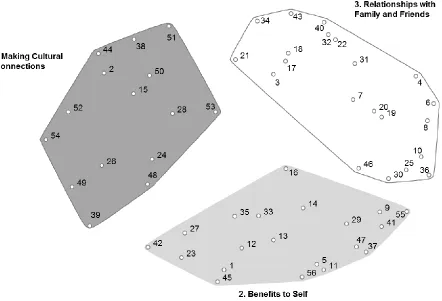
Figure 1: Concept Map………..………31
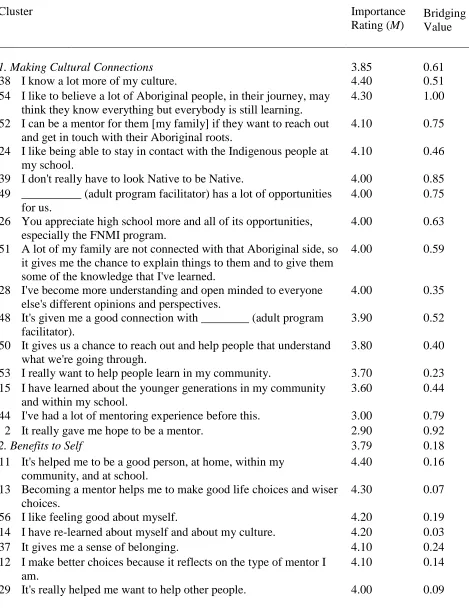
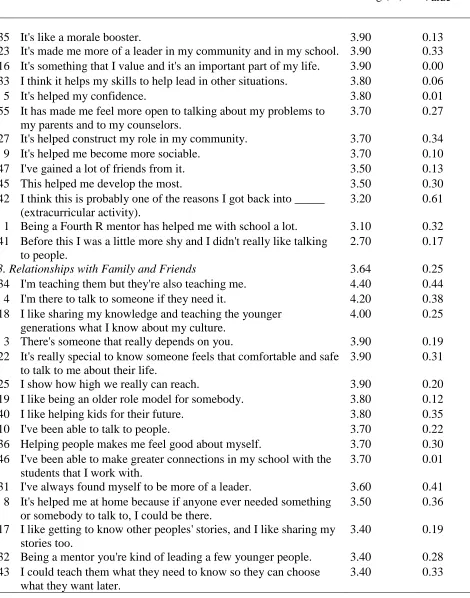
Table 1: Statements for Each Cluster, Importance Ratings, and Statement Bridging Indices... 34
List of Appendices
Appendix A: Western University Office of Research Ethics Approval Letter ... 81
Appendix B: Thames Valley District School Board Research and Assessment Approval ... 82
Appendix C: Western University Office of Research Ethics Amendment Approval Letter ... 83
Appendix D: Interview Guide ... 84
Appendix E: Peer Mentoring Draft Codebook (Version 4) ... 85
Appendix F: Codebook Audit Trail ... 88
A Mixed Methods Exploration of Benefits for Youth Mentors in an Indigenous High School Peer Mentoring Program
Introduction
People within community organizations and the education system are using
culturally-based programming to engage Indigenous youth in leadership roles and provide opportunities to
reconnect with their traditional cultural identities as well as promote general well being.
Indigenous peoples and their allies are preserving and promoting their cultures (Rose & Giles,
2007) with concern that, “If we become disconnected, we lose the ability to make meaning from
Indigenous stories” (Archibald, 2008, p. ix). Canadian schools are more frequently
demonstrating student inclusivity by providing platforms for cultural programming, such as
Indigenous study courses and language instruction. Further, some schools offer culturally
relevant programming, like Indigenous peer mentoring programs, as a means to engage students
in their schooling and encourage continued participation in formal education. Programs that
engage Indigenous youth within the school system encourage a connection to school while
providing opportunities to explore relationships with themselves, each other, community Elders,
and their traditional cultures. The purpose of this study was to investigate the benefits perceived
by youth who were mentors to younger peers in a structured Indigenous high school peer
mentoring program. In the introduction, I begin by providing a Canadian historical context that
provides insight into the inequities experienced by Indigenous peoples living in Canada. Further,
I provide a broad description of Indigenous worldviews that increasingly support the focus of
programming to re-engage Indigenous youth and connect them with their cultural traditions. The
Fourth R: Uniting Our Nations peer mentoring program is an example of a school-based and
Historical Context of Colonization
Assimilative colonization practices imposed by the Canadian government have displaced
not only Indigenous peoples in Canada, but also their cultural worldviews (Archibald, 2008;
Knudtson & Suzuki, 2006; Rose & Giles 2007; Zimmerman, Ramirez, Washienko, Walter, &
Dyer, 1998). The Canadian residential schooling system was part of a systemic plan
implemented by the federal government to displace and eliminate Indigenous cultures,
languages, attire, and spiritual beliefs (Blackstock, Clarke, Cullen, D’Hondt, & Formsma, 2004;
Gunn, Pomahac, Striker, & Tailfeathers, 2011; The Truth and Reconciliation Commission of
Canada (TRC), 2015). Many Indigenous families have experienced a disconnect from their
cultural traditions and identities stemming from the Canadian residential school legacy, where
children were not raised by their families, in their communities, and within their cultures (TRC,
2015). Intergenerational effects of family disruption continue to be evident (Bisanz, Cardinal, da
Costa, Gibson, Klinck, & Woodard, 2003; Klinck, Cardinal, Edwards, Gibson, Bisanz, & da
Costa, 2005; TRC, 2015) and are demonstrated by the disproportionate rates of poverty,
substance use, youth suicide, youth justice, child welfare, and violence experienced by
Indigenous families living in and off reserves (Blackstock et al., 2004; TRC, 2015).
The legacy of residential schooling has resulted in a mistrust of the education system in
Indigenous communities. Western-oriented educational practices, grown from policies that
regarded Indigenous peoples as racially and culturally inferior (Parent, 2011), are oppressive to
Indigenous identities (TRC, 2015). Oppressive educational practices continue to be evident in
current classroom structures, teaching styles, and assessment methods with little evidence of
Indigenous content or inclusion in curriculum and programming (Blackstock et al., 2004; Gunn
one of the contributors that can lead to feelings of inferiority in the classroom and result in
passive learning (Gunn et al., 2011). For example, experiences of racism at school are well
documented and contribute to these negative outcomes (Blackstock et al., 2004; Parent, 2011).
Further, these experiences contribute to low rates of academic success and graduation (Statistics
Canada, 2015; Stockdale, Parsons, & Beauchamp, 2013; TRC, 2015). Data from the 2011
Canadian National Household Survey reporting on secondary school graduation rates revealed
40% of First Nations students living on reserve graduated high school, compared to a 70%
graduation rate for First Nations students living off reserve, and rates of 80% for Métis students
and 90% for non-Indigenous students (Anderson & Richards, 2016). This outcome is just one of
many that reflects a history of systemic oppression imposed on Indigenous peoples living in
Canada that laid an uneven foundation for opportunity and advancement.
Through generations of inequality, Indigenous peoples have demonstrated resiliency in
the face of colonial oppression, multi-generational traumas, mass redistribution, and changes in
sociopolitical, cultural and physical environments (LaFramboise, Hoyt, Oliver, & Whitbeck,
2006). Resilience is a process resulting in a capacity to face challenges and become more capable
despite adverse experiences, ultimately contributing to growth in ability to withstand future
problems (LaFramboise et al., 2006). This resilience has been demonstrated through Indigenous
peoples, including residential school survivors, excelling to hold leadership roles in government,
law, education, the arts, and their communities (TRC, 2015). Further, resilience has been
demonstrated as Indigenous peoples fight to retain their cultural identities, including language,
arts, ceremonies and communities (TRC, 2015). Viewed through this strengths-based lens,
Preserving Indigenous Culture
Contrary to colonialism’s oppressive methods, the Indigenous worldviews supports the
concept of “power with,” rather than “power over,” with a “deep sense of reverence for
nature…and enormous responsibility for sustaining harmonious relations within the whole
natural world…” (Knudtson & Suzuki, 2006, p. 13).Within Indigenous worldviews, wisdom is
seen to develop over a lifetime and is traditionally conveyed through oral histories, stories,
dances and ceremonial activities, and passed through informal mentorship from Elders to
younger generations (Archibald, 2008; Blackstock et al., 2004; Parent, 2011). Archibald (2008)
said, “Only when our hearts, minds, bodies, and spirits work together do we truly have
Indigenous education” (p. 12).
Nearly 150 years after Canada founded itself a nation on the land of its Indigenous
peoples, it was in May 2016 that Canada officially adopted the United Nations Declaration on
the Rights of Indigenous Peoples. The Declaration describes the individual and collective rights
of Indigenous peoples around the world with emphasis on cooperative relationships with
Indigenous peoples (Government of Canada, 2016; United Nations, 2007). The Declaration
affirms that Indigenous peoples should have the freedoms of all human rights, including rights to
self-determination, and rights to a nationality and Indigenous nation or community without
forced assimilation or destruction of their culture (United Nations, 2007). Although the adoption
of the Declaration does not change the irreversible injustices that have been imposed on the
Indigenous peoples living in Canada, it does support conditions to further develop a mutually
respectful relationship based on principles of equality and partnership (Government of Canada,
Métis and Inuit peoples living in Canada as Aboriginal and towards the preferred term of
Indigenous, a preference also shared by other Indigenous peoples abroad (United Nations, n.d.).
Indigenous peoples living in Canada continue to demonstrate resiliency and strength in
remaining connected to their cultures (Archibald, 2008). Indigenous cultures share
commonalities based in principles of the interrelatedness between the intellectual, spiritual,
emotional and physical self, influenced by family, community, band, and nation (Archibald,
2008). Further, Indigenous peoples are concerned with promoting Indigenous ways for their
youth populations, especially for those who do not know or have lost their connections with
culture and community. Increasingly, the role of schools in providing these opportunities is being
explored. It is critical that the education system, as part of a larger structure that destroyed many
Indigenous cultures, responds accordingly and attempts to contribute and enhance the lives of
Indigenous students.
Engaging Indigenous youth through culturally relevant programming.
Spiritually-oriented and communal programs that integrate both Indigenous and Western knowledge while
emphasizing Indigenous values, languages and traditions are the premise of culturally relevant
programming (Canadian Council on Learning, 2009). Maintaining cultural relevance in
programming for youth encourages a sense of cultural awareness, identity, and continuity
(Canadian Council on Learning, 2009). In addition, cultural engagement, positive personal
identity, community connectedness, and positive peer and family relationships are identified as
key factors promoting resilience in Indigenous youth populations (Toombs, Kowatch &
Mushquash, 2016). There have not been many published evaluations of such efforts, although
Hackett and colleagues’ (2016) described the “Going Off, Growing Strong” program that
acknowledged the youth voice and desire to “go off” to explore the land, and gather food and
resources for the community. This culturally relevant program introduced Inuit youth with local
harvester-mentors to reconnect to their culture as a means of encouraging resilience in response
to a cluster of Inuit male youth suicides in Nunatsiavut, one of four self-governed Inuit regions in
Canada. The weekly program engaged youth in traditional Inuit activities, such as hunting,
gathering wood and plants, and participating in arts and crafts with program staff harvesters and
outreach workers. Two cohorts of male youth participated in the program from 2012 to 2015, of
which data were provided from the first cohort (n = 10). The program was evaluated through
both qualitative and quantitative data provided by youth, and community members and
researchers involved in the program. Youth reported improved confidence and improved skills in
learning traditional Inuit skills (Hackett et al., 2016). This study provides support in utilizing the
youth voice, in this example, their desire to “go off on the land,” as a springboard to Indigenous
youth engagement in learning traditional cultural practices.
Another community program cited in taking a proactive approach was Project Journey, a
program implemented by the Ontario Provincial Police to collaborate with Indigenous
communities that experienced a high number of youth suicides (Muise & Mackey, 2017). Project
Journey was based on similar strength-based programming in the United States, called Project
Venture, where adolescents were provided opportunities to engage in positive activities that
fostered leadership and personal growth within a cultural framework. The Ontario program
attempted to strengthen relationships among families, schools, communities, Elders, and police
through youth engagement in family activities, community services, arts and culture, and the
adolescents. This study noted success in engaging adolescents as leaders in their communities,
success in school buy-in and classroom accommodations to programming, as well as
community-level success observed in adolescent participation in a weekend retreat (Muise &
Mackey, 2017). This study demonstrates the receptiveness and engagement of both Indigenous
and non-Indigenous community members in addressing a community need. Further, this study
reveals the successes that can be achieved when these relationships are strengthened.
Further community programming that emphasized a connection to culture is Parent’s
(2011) article on community-based programming for Indigenous youth in Vancouver, British
Columbia, drawn from a study conducted with other researchers that investigated the role of
Indigenous knowledge, or holism, that supported youth. Holism is defined as the connection
among the person, community, environment, and spirit world. The four community organizations
of study featured a range of holistic programming, such as support services, spiritual guidance,
advocacy, sports and recreation, and arts and culture activities. Data were collected from an
Elder (n = 1) and eight youth participants through sharing circles and interviews. Findings
showed that when programs focused on the strengths of youth, program participation furthered
their physical, mental, emotional, and spiritual well-being and supported stronger connections to
family and community. The youth believed that the holistic programming received through
community organizations provided them with educational opportunities to live harmoniously
with others, their community, nature, and the spirit world; however, of formal education, youth
reported a negative school experience but held the belief that pursuing higher education would be
invaluable to their personal well-being and success. Holistic programs assisted youth in
understanding who they are, where they come from, and what their culture can teach them about
of belonging to their community and a space to receive guidance and mentorship to lead healthy
lives (Parent, 2011). This study supports identity development for youth involved in
programming that supports traditional teachings and cultural beliefs.
Mentoring programs provide adult guidance, support and companionship for children and
youth. Data investigating the impacts of community-based mentoring showed benefits for
Indigenous mentee participants. DeWit, Wells, Elton-Marshall and George’s (2017) investigation
compared Indigenous (n = 125) and non-Indigenous (n = 734) youth between 6 and 17 years old
participating as mentees to primarily non-Indigenous adult mentors within Canadian Big Brother
Big Sisters programming. The Big Brother Big Sisters mentoring programs utilize a
strengths-based approach in providing youth a one-to-one match with an adult role model within Canadian
urban centres. The study compared the mentoring experiences, mental health and behavioural
outcomes of mentoring program mentees reported through a Big Brothers Big Sisters national
survey, as well as parent reports on mental health outcomes. At 18-month follow up, Indigenous
mentees and their parents reported a reduction in parent-related emotional problems and social
anxiety not found among non-Indigenous mentees. Further, results supported that
culturally-matched mentors and mentees may prove even more effective. Indigenous mentees reported
higher levels of mentoring relationship quality, spent more time with their adult mentors on a
weekly basis, and participated in more mentoring activities than non-Indigenous mentees (DeWit
et al., 2017). This study provided evidence that, if interested and given the opportunity, many
Indigenous youth in a mentee-role reap the benefits that community mentoring programs seek to
provide.
Community-based programming for Indigenous youth can provide learning opportunities
venue to engage Indigenous youth through programming. Since education is compulsory for
children and youth living in Canada (Government of Ontario, 2006), the school is a convenient
place to engage students through programming addressed to meet an array of needs, including
intrapersonal and interpersonal development, as well as opportunities for cultural connection.
School-based Programming for Indigenous Youth
The school, as a place where students spend most of their waking hours, is an
environment that contributes to their guidance and influence. Indigenous youth can best identify
with the mainstream educational system when they see themselves represented as part of the
fabric of the school. Students who lack a sense of belongingness withdraw from the school
experience and do not feel accepted by classmates, nor believe that school is influential to their
future (Willms, 2003).
Considerable efforts are underway to support Indigenous engagement through education,
including Indigenous programming and more Indigenous school staff, to reverse the long history
of failures to Indigenous education that has left a gap in school achievement (Lewington, 2013).
The inclusion of Indigenous peoples in the planning of culturally relevant programming can
foster a sense of citizenship and contribution and benefit Indigenous youth in becoming more
connected to themselves, their communities and their cultures (Klinck et al., 2005; Rose & Giles,
2007). Indigenous youth programs must possess a cultural context, be evaluated by Indigenous
communities, and be approached through a strengths-based lens, rather than framed by individual
problems or deficits (Klinck et al., 2005; Parent, 2011; Snowshoe, Crooks, Tremblay, Craig, &
Hinson, 2015). Inclusive programming built on Indigenous cultures and values (Rose & Giles,
2007) may include a place for storytelling and stories in education and curricula (Archibald,
intergenerational relationships (Archibald, 2008) and focus on Indigenous languages, cultures
and history are more likely to retain Indigenous students in the school system (Gunn et al.,
2011). Crooks, Burleigh, Snowshoe, Lapp, Hughes, and Sisco (2015b) note that culturally
relevant programming can complement and enhance academic success, allowing students to
embrace their culture and be successful students. When a youth feels a sense of belongingness to
school they are more invested, see themselves as part of the school’s success, and value the
relationships and institutions where they experience these connections (Karcher, Holcomb, &
Zambrano, 2008).
When Indigenous youth are supported in finding a fluidity in moving between their
Indigenous and mainstream identities, they benefit from protective factors such as enhanced
adjustment, social competencies, personal mastery, and improved academics (LaFramboise et al.,
1993; LaFramboise et al., 2006). This skillset is known as bicultural competence (LaFramboise,
Coleman, & Gerton, 1993; Smith-Mohamed, 1998). Further, “… an emphasis on bicultural
competence suggests that it is through the strengthening of cultural identity in the school setting
that students experience enhanced identity and success overall” (Crooks et al., 2015b, p. 11).
This connectedness allows Indigenous peoples to reclaim and reaffirm their traditional ways of
knowing with emphasis on engagement in family, school and community (Crooks et al., 2010a).
School-based Peer Mentor Programming
Mentoring can promote connectedness by providing students with social bonding and
sense of belonging while developing stronger connectedness to self, others and society (Karcher,
2005). Research suggests that school-based mentoring enhances students’ connectedness to
school (Karcher, 2005; King, Vidourek, Davis, & McClellan, 2002; Portwood, Ayers, Kinnison,
community (Portwood et al., 2005). These connections can all serve as protective factors
(Battistich & Hom, 1997; Crooks, Chiodo, Thomas, & Hughes, 2010b; Karcher, 2009) offering
both social and academic benefits (Karcher, 2009; Portwood & Ayers, 2005). Peer mentoring
programs support youth development by providing participants with new experiences and
opportunities (DuBois, Portillo, Rhodes, Silverthorn, & Valentine, 2011; Rhodes & DuBois,
2008).
Although mentoring programs hold promise, not all programs are equally effective.
DuBois, Holloway, Valentine, and Cooper’s (2002) meta-analysis of the effects of 55 youth
mentoring programs found that participation alone yielded small benefits but program effects
were enhanced significantly when best practices were utilized and strong match relationships
were formed. Effective practices identified for youth mentoring programs are, (a) length of
involvement, (b) contact frequency, (c) mentor screening, (d) mentor training, (e) matching, (f)
structured activities, (g) mentoring relationship monitoring, (h) individual supervision, (i) mentor
support group, (j) ongoing mentor training, and (k) formal parent involvement (DuBois, et al.,
2002, p. 165). DuBois et al.’s (2011) second meta-analysis on effective youth mentoring
programs found a common pattern in benefits for mentees on outcome measures, such as
improved interpersonal and development processes, compared to declines among un-mentored
youth. Similar results in other peer mentoring research have shown that program participation
helped prevent the expected declines in connectedness that commonly occurs over a school year
(Karcher 2005, 2011). Meaningful relationships with mentors can foster interpersonal and
developmental processes that help mentees to avoid risks and reach their full potential (DuBois
contexts. Although most mentoring research has focused on benefits to mentees, there are also
benefits to mentors.
Benefits for youth mentors. Through modeling identity development (Karcher, 2008),
youth mentors may experience positive changes in how they see themselves and internalize their
social role (Rhodes, 2002). Riessman (1965) states, “While it may be uncertain that people
receiving help are always benefited, it seems more likely that the people giving help are profiting
from their role” (p. 27). Engagement with younger peers offers mentors the opportunity to
explore their leadership potential (Karcher, 2008; Walters, 2006). Utilizing a strengths-based
approach, mentors and mentees may become more aware of their talents and interests through
future-oriented activities that support their identity development (Karcher, 2008). This type of
exploration through activity and play provides opportunity for the group to appreciate the values
and uniqueness of others. Youth who fulfill a mentoring role to younger students report larger
gains in school-related connectedness and self-esteem compared to their peers, suggesting that
mentoring programs can promote positive development in both mentors and mentees (Karcher,
2009). Coyne-Foresi (2015) found that elementary youth mentors’ school connectedness scores
were significantly higher following participation in a peer mentoring program, compared to
declines reported on all subscales by a control group. This suggested program involvement may
have served as a protective factor and buffered against the normative decline in school
connectedness that is typically observed over the course of the school year (Coyne-Foresi, 2015).
Although some research has shown mentoring programs involving youth mentors to be
less effective in sustaining long-term effects of the program, as compared to adult mentors
(DuBois et al., 2011; Rhodes & DuBois, 2008), tapping into the leadership potential of youth
underestimated (Coyne-Foresi, 2015). These successes cannot always be captured by data
collection methods typically used in program investigations. In many ways, only the program
participants and facilitators can observe what the mentoring process can accomplish (Nakkula &
Harris, 2010). The continued exploration of the “messiness” of evaluating the real lived
experiences in programs is encouraged to move the field forward (Crooks, Exner-Cortens, Burm,
Lapointe, & Chiodo, 2017).
The following sections describe a culturally relevant school-based programming for
Indigenous youth of which, the peer mentoring program, specifically, is the focus of the current
study.
The Fourth R: Uniting Our Nations Programs
The Fourth R: Uniting Our Nations programs are a range of culturally-relevant,
strengths-based programs that were developed in partnership between the Fourth R and Thames Valley
District School Board (TVDSB). The TVDSB is home to 160 schools and 74, 000 students,
serving three counties and 7000 square kilometers surrounding London, Ontario (TVDSB, 2016).
Within its rural catchment, the TVDSB has tuition agreements with three First Nations
communities (Oneida Nation of the Thames, Chippewas of the Thames, Munsee-Delaware First
Nation) where youth attend school in their communities until grade six or eight, then are bussed
into London (TVDSB, 2014). Data from Statistics Canada (2013) National Household Survey
reports that London’s urban First Nations and Indigenous population is 2% of the municipal
population. In 2014 there were 1539 self-identified Indigenous students, with over three quarters
living in the city of London (TVDSB, 2014). Three secondary schools in London have
Indigenous student populations that account for 5 to 24% of the student body. These three
and Native Language and Studies courses1, of which are allocated and determined by TVDSB’s
review of Indigenous student enrollment numbers.
Indigenous youth in Ontario have the lowest rates of academic success and graduation
(Lewington, 2013; Stockdale et al., 2013) and these general patterns are evident in TVDSB. For
example, the TVDSB reports higher absenteeism among self-identified Indigenous students than
non-Indigenous students, with increasing absenteeism as students reach higher grades (TVDSB,
2014). Several recommendations made in 2012 by the TVDSB Indigenous Attendance Working
Group shifted focus from “student attendance” to “student engagement.” These
recommendations included exploring how education can support Indigenous student success,
work collaboratively with key stakeholders to develop a holistic Indigenous programming plan,
develop cultural competency of staff and students, and monitor and measure programming
outcomes (TVDSB, 2014). The Fourth R: Uniting Our Nations programming supports these
goals in its pursuit for Indigenous student engagement and empowerment.
The Fourth R: Uniting Our Nations program is a derivative of the Fourth R program
(Wolfe et al., 2009), a secondary school curriculum aimed to address three risk-behaviours in
adolescence: violence, substance abuse, and unsafe sex. The name Fourth R stems from the
phrase “reading, ‘riting, ‘rithmetic,” and places importance to the development of healthy
“relationships” (Crooks, Wolfe, Hughes, Jaffe, & Chiodo, 2008). The Fourth R utilizes role play
scenarios for realistic opportunities to practice skill development and challenge the societal
constructs of gender (Crooks et al., 2008), uses a prevention and harm-reduction approach to
1 As noted, Indigenous is the preferred term. First Nations and Native is used to as part of the job title and course,
substance use, and maximizes youth development of prosocial skills, including the use of
assertiveness (Wolfe, Crooks, Chiodo, Hughes, & Ellis, 2012).
The Fourth R program team began working with TVDSB and surrounding First Nations
community partners in 2006 to develop and evaluate culturally-relevant, relationship-focused,
school-based programming initiatives for Indigenous youth called The Fourth R: Uniting Our
Nations (Crooks et al, 2015b). The Fourth R: Uniting Our Nations program utilizes culturally
appropriate teaching strategies (e.g. sharing circles) and emphasizes the inclusion of community
members who share their teachings and experiences (Crooks, Burleigh, & Sisco, 2015a). Further,
the programs include locally relevant cultural teachings and traditions, and culturally appropriate
use of mentoring in encouraging youth identity and connectedness to culture (Crooks et al.,
2015a). The program initiatives include a peer mentoring program, of which is the focus of this
study. Other programming initiatives include a cultural leadership course (Crooks, Chiodo,
Thomas, Burns, & Camillo, 2010a), two credit courses (Aboriginal Perspectives Fourth R and
Aboriginal Peer Leadership), a small group program (Healthy Relationships Plus), a cultural
leadership camp, and an Indigenous Leadership Committee (Crooks et al., 2015b).
Crooks and colleagues (2015a) conducted qualitative case study with 12 adult
stakeholders’ (Elders, teachers, Indigenous counsellors, school board staff, and community
members) involved in Fourth R: Uniting Our Nations programming. Investigating the role of
culturally relevant programming on student intrapersonal and interpersonal development, their
analysis revealed two themes. The first theme identified the importance of identity and
belonging, displayed through knowing oneself, possessing confidence, a sense of belonging and
engagement, and leadership. The stakeholders reported their belief that the Indigenous
increased comfort and sense of belonging. Further, this increased belonging was believed to lend
to increased engagement beyond programming, and provided confidence for further success in
engagement in other school activities and developing youth roles as leaders. Further, the
stakeholders reported that Indigenous students could explore their identities and not need to
compromise their identities to learn. The second theme identified the role of programming in
building cultural connectedness as a way of enhancing the students’ sense of identity, and
provided the opportunity for students to perceive themselves as confident and successful leaders.
The adult stakeholders identified shame as a negative influence in lives of youth, and
acknowledged the possibility that youth do not identify shame as it may be an internalized
experience. Cultural connectedness plays a part in the program’s aims to combat shame
systemically shaped by colonialism and stresses the importance of identity and belonging as
sources of resiliency (Crooks et al., 2015a).
Similarly, the thematic outcomes found through student, educator and principal responses
in Crooks and colleagues’ (2015b) study of a variety of programming revealed participation
contributed to student success, improved confidence, leadership skills and a sense of belonging.
Participants believed the culturally relevant role models involved were instrumental to program
success (Crooks et al., 2015b).
Fourth R: Uniting Our Nations peer mentoring program. The Fourth R: Uniting Our
Nations peer mentoring program, as part of the larger Fourth R: Uniting Our Nations program,
runs in select TVDSB schools. The program matches students in grades 10 through 12, who
demonstrate a commitment to and have experienced success at school, with grade nine students
to assist in smoothing the transition to secondary school (Crooks et al., 2015b). The peer
mentorship among grade nine students and older student peers. The group meets weekly during
the lunch hour under the supervision of an Indigenous adult facilitator who engages the
participants in cultural activities. There is a workbook to support the mentoring work and it
includes some of the cultural teachings shared in the program. Mentors participate in a full-day
training in their roles and responsibilities and are supported by a mentor manual. A teacher from
the school assists with the coordination of the mentoring program and is available to support
students if required.
The goals of the peer mentoring program are to facilitate and foster healthy and positive
relationships with self and peers, including help-seeking and self-advocacy skills (Crooks et al.,
2017). Further, the program encourages student cultural identity and connectedness (Crooks et
al., 2015a) through exposure to culturally relevant activities and discussions. Additional goals, as
stated in the mentor manual (Lapp, Cywink, Crooks, Coyne-Foresi, Kirkham, & Hughes, 2016),
are to help younger mentees become involved and connected to their schools through positive
older peer leadership, and to provide youth mentors with volunteer experience while they
discover and develop their mentees’ interests at school and in the community. The peer
mentoring program fosters school engagement in hopes of further solidifying youth participation
in their education and pursuit of long-term educational goals.
Crooks and colleagues (2017) recently conducted a two-year longitudinal investigation of
the younger peer mentee (grades 7-9) participants (n = 28) in both the elementary and secondary
peer mentoring programs. The study revealed that mentees who had two years of mentoring
reported significantly better mental health and felt more connected to their cultural identity
compared to students who did not receive mentoring. Conversely, mentee participants who
cultural identity. Mentee interview data revealed perceived improvements in identified themes of
intrapersonal (i.e. cultural affirmation and improved self-confidence), interpersonal (i.e.
improved peer relationships and connection with the adult facilitator), cultural (i.e. meeting with
Indigenous peers and participation in cultural teachings) and healthy relationship development
(i.e. positive communication skills) (Crooks et al., 2017).
An earlier investigation of the peer mentoring program showed a high retention rate for
mentors and mentees, high satisfaction and enjoyment in the program, and revealed that the peer
mentoring program did engage students and enhance the school experience (Crooks et al.,
2010b). Students, educators and principals in Crooks et al.’s (2015b) study of the peer mentoring
program reported specific benefits related to developing healthy relationships skills and
communication styles, and increased comfort in school for student participants. The educators
and school principals identified the development of positive relationships as a stepping stone to
increase school involvement. Youth mentors reported they felt valued in their leadership roles
mentoring younger peers, and this contributed to a more positive self-concept and positively
influenced their behaviour (Crooks et al., 2015b). However, previous research with mentors did
not assess important protective factors (such as cultural connectedness and positive
self-perception) in a systematic way. Thus, the current study will more deeply explore the perceived
benefits of mentoring from the perspective of high school youth mentors.
Research Questions
Contributing to the strengths-based body of research investigating Indigenous youth
programming, this study asked: what are the perceived benefits of peer mentoring for youth
mentors? This study investigated the Fourth R: Uniting Our Nations peer mentoring program’s
identity for youth mentors. These elements are of particular focus in the Fourth R: Uniting Our
Nations curriculum created for student self-exploration, cultural reflection and personal goal
setting. It was hypothesized that through the experience of mentoring younger peers, mentor
participants would perceive an increase in intrapersonal (i.e. self-perception, self-confidence,
relationship with self) and interpersonal (i.e. relationships with others, self-advocacy skills)
development, as well as increased connectedness to school and culture. It was predicted that as a
result of participation, mentors will see themselves as role models to their younger mentees.
Method
This study utilized a mixed methods case study research design, incorporating both a
concept mapping procedure and thematic analysis. The Research Ethics Board at Western
University (Appendix A) approved all protocols, as did the Research and Assessment
Department with TVDSB (Appendix B). A TVDSB amendment request to the study’s consent
form was submitted and approved by Research Ethics Board at Western University (Appendix
C).
A mixed methods investigative approach is supported as an effective method addressing
the complexities of age, gender and culture that exist in community programming (Andrew &
Halcomb, 2006). A mixed methods design captures the complexities of real lived experience and
intersects the strengths of both the exploratory nature of qualitative investigation with
generalizable quantitative methods (Andrew & Halcomb, 2006). Concept mapping was utilized
as a mixed methods tool to highlight the student voice in determining the benefits found through
mentoring younger peers. Further, concept mapping’s quantitative analysis of qualitative data
aligned with Indigenous methods by putting the meaning-making of the collective focus question
methods findings were further explored through additional questions in the semi-structured
interviews (Appendix D), where students discussed the role of mentoring on different aspects of
their lives (e.g., family, school, community, culture, peers, self).
Participants
Twelve youth mentors consented to participate in the study of a possible 18 Fourth R:
Uniting Our Nations peer mentoring program participants. Eleven participants, four male and
seven female, were interviewed from two secondary schools, one rural (n = 6 students) and one
urban (n = 5 students), within TVDSB. The average age of the participants was 17.15 years (SD
= .69), with ages ranging from 16 to 18 years. All study participants served as mentors in the
Fourth R: Uniting Our Nations peer mentoring programs that commenced in the fall of 2016.
Nine mentors had previous experience as mentors in the Fourth R: Uniting Our Nations program;
this was the first experience as mentors for two of the participants. All students were Indigenous,
except for one. The decision was made to include this non-Indigenous participant because the
focus was on mentors in the program. Furthermore, cultural identity does not align perfectly with
ethnic identity; thus, a student who is not Indigenous may identify strongly with an Indigenous
community and teachings.
Ethical considerations. Research involving Indigenous populations has often been
conducted by non-Indigenous researchers producing results that have not been returned to
participants nor have benefitted them or their communities (Canadian Institutes for Health
Research, 2014; The First Nations Information Governance Centre, 2014). To protect the
interests and rights of Indigenous populations, a framework to guide the ethical principles has
been developed based on the core values of reciprocity and respect (Canadian Institutes for
Centre (2014) hold that Indigenous populations that participate in research must have
Ownership, Control, Access, and Possession of the information.
The concept mapping procedure of this study attempted to honour the Indigenous student
voice by retrieving the unique statements made by mentors in response to a question asking of
the general benefits of mentoring. The unique statements were kept as verbatim as possible and
returned to the mentors for this sorting and rating of importance. During the interview process,
the Indigenous youth mentors were encouraged to speak openly about their experiences
mentoring their younger peers. They were also provided with an opportunity to member check
their transcripts. Specific questions (Appendix D) prompted student reflection in numerous areas
of their lives (e.g., family, school, community, culture, peers, self). Further, when analyzing the
data, the codebook (Appendix E) used was originated from a codebook utilized in a similar
project (see Crooks et al., 2017) and revised to reflect the outcomes of this particular study and
the mentors’ responses. Through these steps outlined I endeavored to preserve the student voice
to achieve a collaborative research endeavor. The program evaluation put the research back into
the hands of the participants to truly capture the student voice.
I sought to acknowledge and respect the cultural protocols designated for working with
Indigenous populations. Provisions followed when conducting research with Indigenous
populations (see Canadian Institutes for Health Research, 2014) that were specific to this study
included the respect for community customs and codes of practice and mutual benefits in
research. When attending mentoring sessions at each secondary school where research was
conducted, I demonstrated respect for community customs and codes of practice by taking cues,
such as waiting to be introduced and participating in a smudge, from the Fourth R: Uniting Our
research with a commitment to offer mutual benefits in both providing me with research
experience and informing the Fourth R: Uniting Our Nations program’s design and delivery as
identified through voice of the mentor participants in the study.
Upon study completion, each mentor participant was provided a summary of the
collective findings (Appendix G) to honour their contribution and ownership of the information
they provided. The combination of quantitative and qualitative research methods used in
investigating the perceived benefits of mentoring younger peers can provide a platform to
highlight Indigenous ways of knowing in culturally relevant programming within the education
system. Data from this study were also included with the annual feedback report to the board,
which is an important venue for identifying benefits of programming and can influence future
funding decisions. That is, providing mentors with the opportunity to share the benefits they have
experienced with the board could directly influence the board’s decision to continue funding the
program.
Measures
Demographic data. The demographic data collected from the youth mentors included
school, age, and gender. I did not collect information on student Indigenous status.
Interview. Interview data informed two processes: concept mapping and thematic
analysis. The interview included nine questions (one concept mapping question, and eight
additional questions expanding on the participant experiences) (see Appendix D).
Concept mapping. The interviews utilized six-step concept mapping (preparing for
concept mapping, generating the ideas, structuring the statements, concept mapping analysis,
interpreting the maps, utilization) with use of multidimensional scaling and subsequent cluster
the many people and places in your life, as well as your own journey of personal growth, in what
ways has your role as a peer mentor benefitted your life?” were the basis of the concept mapping
procedure. My review of the 11 interviewee responses to the concept mapping questions
provided 56 unique statements. The statements were identified with supervisor collaboration. I
prepared packages for each interview participant that contained 56 strips of cardstock listing the
unique statements from the interview and a sheet of paper with all the statements to be rated.
Instructions for the activity accompanied the package contents and explained that mentor
participants were to first sort the 56 strips of cardstock in any way that made sense to them.
Further instructions detailed that participants were not to sort all the statements into one pile nor
put them in 56 different piles. Participants were provided coloured sticky notes and paper clips to
label and fasten the piles. The second task required participants to rate each statement on a
5-point Likert-type rating scale (1 = not important, 2 = somewhat important, 3 = moderately
important, 4 = very important, 5 = extremely important) in response to the focus question. When
complete, the unique statements sorted into labeled piles and rating scale sheets of paper were
returned to me in the envelopes labelled only with each participant’s identifier number, to
maintain confidentiality.
Thematic analysis. Additional interview questions followed an interview guide
(Appendix D) and asked the youth mentor participant of his/her experiences in the program, as
well as the program’s influence on the mentor’s life, schooling, culture, and self. Data from these
follow-up questions were analyzed to augment the concept mapping though thematic analysis.
Member checking was implemented where participants were provided a copy of the transcribed
Procedure
In April 2017, I attended a Fourth R: Uniting Our Nations peer mentoring program
session at each of the two schools. There, I explained the current study and research objectives
and procedures. Peer mentors who were interested in participating in the study received a letter
of information and consent form that required a parent or legal guardian’s signature (if the
student was under 18) or a consent form for them to sign (if they were 18 or older). I collected
the consent forms directly from participants who were 18 years old. I collected the additional
forms requiring parental consent from each school’s lead teacher, who was the school staff
member overseeing the Fourth R: Uniting Our Nations programs. On two occasions, I
telephoned parents of two willing participants under the age of 18 and obtained verbal consent
for their child to participate. I provided each schools’ lead teacher a schedule of available dates
and times for mentor interviews to be conducted.
Interviews. In early May 2017, I completed the mentor interviews during the school
lunch hour in a quiet space within each school site. Interviews averaged 8 minutes long, and
ranged from 3 minutes to 15 minutes in length. I conducted between one and six interviews per
day at lunchtime in an attempt to minimize disruption to the academic day. Following each
interview, each participant received a $10 gift certificate for their time. In all, 11 interviews were
conducted. Despite frequent contact with the lead teacher and four unsuccessful visits to the
school, the twelfth mentor could not be located at school and was not included in the study. The
adult facilitator reported that the twelfth mentor had poor attendance in the mentoring group.
Sorting and rating activity. In late May 2017, I coordinated and scheduled with each
school’s lead teacher dates to meet as many interview participants as possible for the sorting and
process. This step was essential so that students could provide their own interpretation and
meaning to the data. Nine youth mentors (n = 6 from rural secondary school and n = 3 from
urban school) participated in the initial the sorting and rating activities that were held at each
school. The participants worked independently with up to six people in a room at a time to
complete the sorting and rating tasks. The process took 45 minutes over the lunch hour to
complete at each school. One additional youth mentor from the urban school who was absent the
day her peers participated in the sorting and rating activity completed the tasks later that week
and took 20 minutes to complete the activities. In all, 10 youth mentors participated in the
concept mapping sorting and rating activity. As compensation for mentors’ time sorting the
statements, each student received a $20 gift certificate.
Data Analyses
The audio-recorded interviews were processed to text via Trint (2017), a cloud-based
transcription program, before employing the concept mapping analysis. Concept mapping
employs “…the open contribution of participant stakeholders’ ideas on a specific issue,
organizes the ideas, and portrays them in pictures or maps that are readily understood” (Kane &
Trochim, 2007, p. 2). Concept mapping is undertaken on the basis of one general question. The
question should be as broad as possible without leading participants in a particular direction
(Kane & Trochim, 2007). The concept mapping data analysis was conducted in response to the
focus question, “Thinking about the many people and places in your life, as well as your own
journey of personal growth, in what ways has your role as a peer mentor benefitted your life?”
Interview transcripts were entered in a Microsoft Excel (2016) program where each
unique statement was separated and arranged in its own cell. The unique statements were
verbatim statement, “So, I'm Métis, I'm like, I don't like look, I don't really have to look Native
to be Native, obvious,” was edited to reflect a more cohesive statement, “I don't really have to
look Native to be Native.” I endeavored to preserve the statements as close to their original states
as possible; however, some statements were minimally edited for clarity and conciseness (Kane
& Trochim, 2007).
Following the participant sorting and rating activity, the student structured and sorted
statements were entered and processed in Concept Systems Incorporated (2017) software, a
cloud-based tool for group concept mapping analysis. I used the software to conduct
multidimensional scaling and hierarchal cluster analysis. The multidimensional scaling data
point map placed the sorted statements along X-Y coordinates to demonstrate each statement’s
location and spatial relationship with the others. The hierarchal cluster analysis partitions the
statements on the map into clusters and reflects a conceptual grouping of the original statements.
Average importance ratings are calculated separately after the cluster solution has been chosen
(Kane & Trochim, 2007).
Beyond the concept mapping analysis, answers to additional questions were coded and
themed using Dedoose V7.6.6 (2017), a cloud-based program used for coding and analysis of
qualitative data. I used a revised provisional coding template (adapted from Crooks et al., 2017),
continually adding new codes or removing inapplicable codes. From the root codes utilized,
parent and child codes were developed to provide further specificity of data provided by student
mentors. This open-coding process is noted by coding themes as they emerge rather than
imposing preconceived categories (Patton, 2002). With the use of the refined codebook
(Appendix E), I reviewed and coded the 11 interview transcripts. A codebook audit trail
Memos of my thoughts, procedures and changes were documented through the coding process.
To ensure trustworthiness of the data, I established reliability in coding by recoding 35% (n = 4)
of all interviews with over 90% accuracy.
All data from the transcribed interviews provided by the youth mentor participants were
coded, but only data relevant to the research question, “What are the perceived benefits of peer
mentoring for youth mentors?” were analyzed. The four overarching themes identified were: (1)
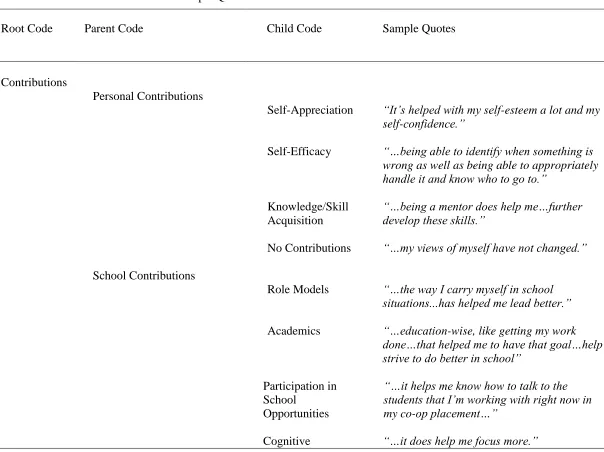
Contributions, (2) Relationships, (3) Culture, and (4) Aspirations. I compared and contrasted
themes by previous mentoring experience. A summary report of findings (Appendix G) was
provided to each student participant via each school’s lead teacher as well as a copy to the school
board.
Results
Concept Mapping
Multidimensional scaling: Data point map. The youth mentor participant statement
sorting and rating data were entered into the Concept Systems Incorporated (2017) program.
Data were sorted into a binary data matrix, where there were as many rows and columns as
statements (i.e., 56 statements in this case). Added together, the matrices created a group
proximity matrix that was used in multidimensional scaling displayed in a two-dimensional point
map, where each statement had a separate X-Y coordinate point on the map (Kane & Trochim,
2007). The point map (see Figure 1) shows each statement as a single point and provides a visual
representation of each statement’s spatial relationship relative to the others. Statements grouped
together by the participants more frequently appear closer together (Kane & Trochim, 2007). For
example, Statement 22, “It's really special to know someone feels that comfortable and safe to
people, and Statement 40, “I like helping kids for their future,” were plotted in close proximity to
each other and signify that they were frequently grouped together by participants in the sorting
activity. Statements grouped together less frequently by participants were located farther apart
(Kane & Trochim, 2007). For example, Statement 4, “I'm there to talk to someone if they need
it,” and Statement 39, “I don't really have to look Native to be Native,” were not sorted together
by participants and are plotted at opposite sides of the data map.
Nowicki and Brown (2015) explain that a stress value is produced to show how well the
data point map fits the group proximity matrix. The stress value ranges from 0 to 1, where 0
represents less stress and a better fit, and 1 represents a poor fit (Dare & Nowicki, 2015; Nowicki
& Brown, 2015). Stress values that range between 0.205 and 0.365 indicate an acceptable
goodness of fit (Kane & Trochim, 2007). Nowicki and Brown (2015) add, “Stress values of 0.39
and lower have less than 1% probability of reflecting a random configuration” (p.10). In this
study, the stress value was 0.3578, which falls in the acceptable range. Stress values tend to be
lower, reflecting a better statistical fit, when there are more statements and more participants
sorting (Kane & Trochim, 2007). In other words, the stress value speaks to the entire data point
map as it fits the group proximity matrix, different from the bridging values assigned to each
statement as explained below.
Hierarchical cluster analysis: Cluster map. To ensure the statements are clustered with
conceptually related statements, a hierarchal cluster analysis is conducted, described by Nowicki
and Brown (2015) as “…an iterative process which begins by putting each statement into its own
cluster and continues at each step to combine two clusters until all of the statements are put into
one cluster. The points on the map don’t change but the boundary line around the clusters differ
the maps and selected the best solution reflective of the focal question used in the concept
mapping process.
A bridging value is calculated for each statement and cluster and reflects how frequent a
statement was sorted with other statements in the vicinity on the map (Kane & Trochim, 2007).
Bridging indices range from 0 to 1, where values near 0 indicate that the statements were
frequently sorted in the same vicinity with a high degree of consistency, and values near 1 were
frequently not sorted in the same vicinity with a high degree of consistency (Dare & Nowicki,
2015; Nowicki & Brown, 2015). Statements with low bridging values (near 0) are considered
“anchor” statements as they represent statements more frequently sorted to a vicinity on a map
(Kane & Trochim, 2007). For example, Statement 16, “It's something that I value and it's an
important part of my life,” had a bridging value of 0.00 and acts as an anchor statement and is
interpreted to be the best indicator of content in that area of the map (Kane & Trochim, 2007).
Conversely, “bridging” statements have higher values (near 1) “bridge” or link two or more
distant areas on a map (Kane & Trochim, 2007). For example, Statement 54, “I like to believe a
lot of Aboriginal people, in their journey, may think they know everything but everybody is still
learning,” had a bridging value of 1.00, and was not rated consistently in the same vicinity by
participants; instead, this statement “bridges” different concepts in the map or may have been a
difficult statement to sort.
I, along with two other researchers, independently reviewed a range of models between
two and 10 clusters and came to the consensus that the three-cluster model was the best
conceptual fit to the data; further, the model’s acceptable bridging values indicate good statistical
between 0.18 to 0.61. Table 1 lists the statements grouped in each cluster and statement bridging
indices.
Cluster labelling. Cluster labels were determined through examination of three sources of
information: (a) contents of the clusters, (b) labels produced by the participants, and (c) the
researchers’ independent interpretations of the map (Kane & Trochim, 2007). The small sample
size produced a diverse array of participant-created labels for each concept. I sought to honour
the student voice and achieve a balance among the themes captured by the participants and the
statement contents within each cluster. The following key concepts were identified through the
three-cluster map to illustrate the ways youth mentors perceived their mentoring role to benefit
their life: (a) Making Cultural Connections (M bridging index = 0.61), (b) Benefits to Self (M
Figure 1. Concept map for the 3-cluster solution showing spatial relationship between 56 generated statements.
Note. Statements are labeled by number (see Table 1 for a list of the statements and their reference numbers). Distance between statements indicates degree of similarity; similar statements are closer together.
Importance ratings. As part of the concept mapping procedure, participants were asked
to rate each statement on a 5-point Likert type scale (1=low importance and 5=high importance)
reflective of each statement’s perceived importance as it related to the concept mapping focal
question, “Thinking about the many people and places in your life, as well as your own journey
of personal growth, in what ways has your role as a peer mentor benefitted your life?”A mean
importance rating was calculated for each statement, and cluster mean ratings were created by
averaging the statements contained in each cluster. Table 1 shows statement and identification
numbers sorted by averaged importance ratings, as well as the averaged cluster ratings with each
clusters and include Statement 38, “I know a lot more of my culture,” in the Making Aboriginal
Connections cluster, Statement 11, “It's helped me to be a good person, at home, within my
community, and at school,” in the Benefits to Self cluster, and Statement 34, “I'm teaching them
but they're also teaching me,” in the Relationships with Family and Friends cluster.
In the concept map, clusters are shaded dark to light per importance, where darker
shading denotes higher mean importance rating (see Figure 1). The light shaded cluster,
Relationships with Family and Friends, contains mean statement ratings from 3.60 to 3.69; the
medium shaded cluster, Benefits to Self, contain mean statement ratings from 3.70 to 3.79; the
darkest shaded cluster, Making Aboriginal Connections, contain mean statement ratings from
3.80 to 3.89. The importance ratings for clusters ranged between 3.65 and 3.84, indicating that
all clusters were believed to be important. Further, 19 of the 56 (33%) statements were rated as
highly important and given a rating of 4.00 or higher by participants. Importance ratings for
statements ranged from 2.70 to 4.40 (see Table 1). The findings are presented below and
arranged in order of importance, from highest to lowest average importance rating.
Cluster 1: Making cultural connections. Participants rated this cluster as most important
overall (M = 3.85, SD = 0.40), with statement ratings ranging from 2.90 to 4.40. Making Cultural
Connections contains the fewest number of statements of all the clusters at 15 statements, and
sorted with the least degree of consistency (M bridging index = 0.61).
Cluster 2: Benefits to self. This cluster contains 20 statements with ratings ranging from
2.70 to 4.40. Containing a high importance rating (M = 3.79, SD = 0.42), the youth mentor
participants sorted the statements in this cluster with the highest level of consistency in the map
Cluster 3: Relationships with family and friends. This cluster (M = 3.64, SD = 0.34)
contains 21 statements ranging in importance from 3.10 to 4.40. The participants sorted the
statements in this cluster with relatively high consistency (M bridging index = 0.25).
Cluster map summary. The three-cluster model demonstrates the best conceptual fit as
the individual clusters present as distinct from each other. The clusters Benefits to Self and
Relationships with Family and Friends are observed to be positioned closer to each other (see
Figure 1), with more distinct groupings of statements, meaning that statements were sorted more
frequently together with the same piles by participants. Conversely, the statements in the cluster
Making Cultural Connections was more sparsely positioned, however received the highest
importance ratings, with nine of 15 statements rated by participants as 4.00 or higher. The cluster
map reveals that participants sorted the statements within the Making Cultural Connections with
the least consistency (M bridging index = 0.61) but identified the statements within the cluster
most frequently with highest importance. Of all statement importance ratings, mentor
participants identified 33% (n = 19) of the 56 statements were averaged 4.00 or higher (see Table
Table 1. Statements for Each Cluster, Importance Ratings, and Statement Bridging Indices
Cluster Importance
Rating (M)
Bridging Value
1. Making Cultural Connections 3.85 0.61
38 I know a lot more of my culture. 4.40 0.51
54 I like to believe a lot of Aboriginal people, in their journey, may think they know everything but everybody is still learning.
4.30 1.00
52 I can be a mentor for them [my family] if they want to reach out and get in touch with their Aboriginal roots.
4.10 0.75
24 I like being able to stay in contact with the Indigenous people at my school.
4.10 0.46
39 I don't really have to look Native to be Native. 4.00 0.85
49 __________ (adult program facilitator) has a lot of opportunities for us.
4.00 0.75
26 You appreciate high school more and all of its opportunities, especially the FNMI program.
4.00 0.63
51 A lot of my family are not connected with that Aboriginal side, so it gives me the chance to explain things to them and to give them some of the knowledge that I've learned.
4.00 0.59
28 I've become more understanding and open minded to everyone else's different opinions and perspectives.
4.00 0.35
48 It's given me a good connection with ________ (adult program facilitator).
3.90 0.52
50 It gives us a chance to reach out and help people that understand what we're going through.
3.80 0.40
53 I really want to help people learn in my community. 3.70 0.23
15 I have learned about the younger generations in my community and within my school.
3.60 0.44
44 I've had a lot of mentoring experience before this. 3.00 0.79
2 It really gave me hope to be a mentor. 2.90 0.92
2. Benefits to Self 3.79 0.18
11 It's helped me to be a good person, at home, within my community, and at school.
4.40 0.16
13 Becoming a mentor helps me to make good life choices and wiser choices.
4.30 0.07
56 I like feeling good about myself. 4.20 0.19
14 I have re-learned about myself and about my culture. 4.20 0.03
37 It gives me a sense of belonging. 4.10 0.24
12 I make better choices because it reflects on the type of mentor I am.
4.10 0.14