© 2014, IJCSMC All Rights Reserved 11
Available Online atwww.ijcsmc.com
International Journal of Computer Science and Mobile Computing
A Monthly Journal of Computer Science and Information Technology
ISSN 2320–088X
IJCSMC, Vol. 3, Issue. 8, August 2014, pg.11 – 17
RESEARCH ARTICLE
Study and Comparison of Chain Based
Protocol to Enhance Energy Utilization in
Wireless Sensor Network
Sakshi Rana
1, Ankita Aggarwal
2Department of Electronics and Communication Engineering
Galaxy Global Educational Trust Group of Institutions, (Affiliated to Kurukshetra University),
Dinarpur, Ambala, India
1
[email protected]
Abstract— Wireless sensor network is an ad hoc network. Each sensor is defined with limited energy. Wireless sensor node deployed into the network to monitor the physical or environmental condition such as temperature, sound, vibration at different location. Each node collected the information than transmit to the base station. The data is transfer over the network each sensor consume some energy in receiving data, sending data. The lifetime of the network depend how much energy spent in each transmission. The protocol play important roll, which can minimize the delay while offering high energy efficiency and long span of network lifetime. One of such protocol is PEGASIS, it is based on the chain structure, every chain have only one cluster head, it is in charge with every note's receiving and sending messages who belong to this chain, the cluster head consumes large energy and the times of every round increasing. In PEGASIS, it take the advantage of sending data to it the closet neighbor, it save the battery for WSN and increase the lifetime of the network. The proposed work is about to select the next neighboring node reliably. For this it will combine few parameters such as Distance, Residual Energy and Response time. The proposed system will increase the overall communication and increase the network life.
Keywords— WSN, energy, node, LEACH, PEGASIS
I. INTRODUCTION
© 2014, IJCSMC All Rights Reserved 12
[3], [4]. Each node has transmit power control and an omni-directional antenna, and therefore can adjust the area of coverage with its wireless transmission. Typically, sensor nodes collect audio, seismic, and other types of data and collaborate to perform a high-level task in a sensor web. For example, a sensor network can be used for detecting the presence of potential threats in a military conflict. Most of battery energy is consumed by receiving and transmitting data. If all sensor nodes transmit data directly to the BS, the furthest node from BS will die early. On the other hand, among sensor nodes transmitting data through multiple hops, node closest to the BS tends to die early, leaving some network areas completely unmonitored and causing network partition. In order to maximize the lifetime of WSN, it is necessary for communication protocols to prolong sensor nodes’ lifetime by minimizing transmission energy consumption, sending data via paths that can avoid sensor nodes with low energy and minimizing the total transmission power.
II. ARCHITECTURE OF WIRELESS SENSOR NETWORK
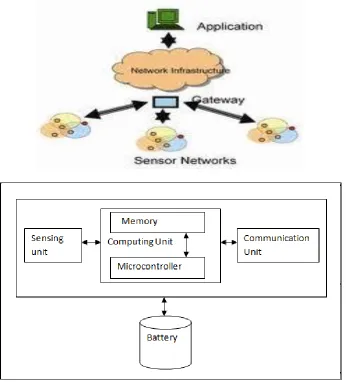
Figure.1 shows a typical schematic of a wireless sensor network (WSN). After the initial deployment (typically ad hoc), sensor nodes are responsible for self-organizing an appropriate network infrastructure, often with multi-hop connections between sensor nodes [5]. The onboard sensors then start collecting acoustic, seismic, infrared or magnetic information about the environment, using either continuous or event driven working modes. Location and positioning information can also be obtained through the global positioning system (GPS) or local positioning algorithms. This information can be gathered from across the network and appropriately processed to construct a global view of the monitoring phenomena or objects.
© 2014, IJCSMC All Rights Reserved 13
Mean while the sensor nodes have limited communication capacity and computing power. So how to optimize the communication path, improve the energy-efficiency as well as load balance and prolong the network lifetime has became an important issue of designing routing protocols for WSN. Hierarchical-based routing protocols [6] are widely used for their high energy-efficiency and good expandability. The basic idea of them is to select some nodes in charge of a certain region routing. These selected nodes have greater responsibility relative to other nodes which leads to the incompletely equal relationship between sensor nodes. LEACH (Low Energy Adaptive Clustering Hierarchy) [7], PEGASIS (Power-Efficient Gathering in Sensor Information System) [8] are the typical hierarchical-based routing protocols. As an enhancement algorithm of LEACH, PEGASIS is a classical chain-based routing protocol. It saves significant energy compared with the LEACH protocol by improving the cluster configuration and the delivery method of sensing data.
III. POWER CONSUMPTION MODEL FOR WSN
In order to understand the necessity of routing protocols and their benefits we briefly describe the power consumption model for WSN devices. The communications channel can be modeled by using the long distance path loss model [9] and ignoring more complex effects such as fading and multi-path. Thus, the power required by a node to transmit over a distance of d meters can be expressed as:
PT(d) = P0 × (d0 / d)α (1)
Where P0 represents the power of the signal received at distance d0 from the source and α is the path loss exponent which is dependent on the propagation environment and can take values between 2 and 5. Also, using the path loss model and the Friis model the power received at distance d from the node can be expressed as:
PR(d) = Ptx / (β × dα) (2)
where Ptx is the RF power delivered to the antenna of the transmitting node and β is parameter specific to the characteristics of the transmitting and receiving antennas. Therefore we can determine that the power required to make single hop transmission between two nodes is equal to PT + PR. The power required to make a multi hop transmission between n nodes is (n-1) × (PT + PR).
IV. THE DETAILS OF IMPROVED PEGASIS
PROTOCOL
It is possible that some nodes may have relatively distant neighbor nodes along the chain in PEGASIS. On one hand, nodes already on the chain cannot be revisited. On the other hand, when a node dies, the chain is reconstructed in the same manner (greedy algorithm) to bypass the dead node.
A Chain Construction Phase
The algorithm uses the following steps to form a chain:
a)Initialize the network parameters. Determine the number of nodes, initial energy, BS location information et al. Then chain construction starts.
b)BS broadcasts the whole network a hello message to obtain basic network information such as ID of nodes alive and
distance from each node to BS.
c)Set the node which is farthest from BS as end node, it joins the chain first and is labeled as node 1.
d)End node of the chain obtains the information of distance between itself and other nodes which have not joined the chain yet, finds the nearest node and sets it as node I waiting to join the chain, i represents the ith node joined.
© 2014, IJCSMC All Rights Reserved 14 Fig.1The chain formed in exiting PEGASIS Protocol
The figure 1 is showing the aggregative path identified by the PEGASIS protocol based on distance and energy comparison. The communication is performed between the sender node 1 and receiver node 100.
The identified path is
47 39 99 96 7 55 36 22 45 35 69 56 44 75 97 86 31 48 80 98 71 76 83 33 63 95 94 42 17 19 89 57 74 29 88 78 50 3 40 14 21 11 73 100 59 4 43 16 20 34 18 41 91 46 67 60 38 62 93 13 28 65 15 27 9 26 30 85 2 66 81 49 87 70 51 1 82 79 54 5 32 25 12 10 24 84 58 37 64 23 8 90 72 6 92 53 52 61 68 77
Here Node 47 is the initial node and node 77 is the terminal node. The total distance covered by the path is 6.1161e+006
The total Energy Consumed by the path is 502.8336
TABLE I. SYSTEM PARAMETERS VALUE
Parameter Value
Number of Nodes 100
Probability of .1
Selection
Energy 0.5
Transmission Energy 50*0.000000001
Receiving Energy 50*0.000000001
Forwarding Energy 10*0.000000001
© 2014, IJCSMC All Rights Reserved 15
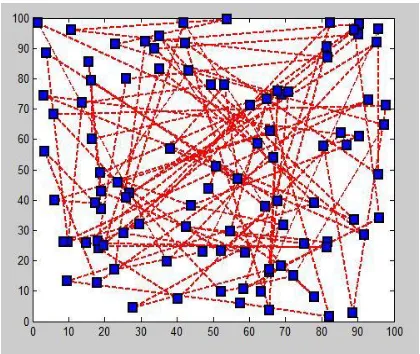
Fig.2 The chain formed in proposed PEGASIS protocol.
The fig.2 is showing the aggregative path identified by the PEGASIS protocol based on distance and energy comparison. The communication is performed between the sender node 1 and receiver node 100.
The identified path is
70 11 65 58 37 77 54 8 12 39 68 16 80 20 23 98 18 74 48 19 14 46 34 56 31 100 45 22 6 97 53 72 42 29 76 7 64 94 89 61 24 41 50 83 67 63 51 3 25 73 27 99 28 55 75 21 32 10 4 33 47 81 60 13 38 93 35 5 26 91 62 88 84 95 92 69 79 9 90 59 49 44 86 30 66 87 96 36 43 52 82 85 15 1 71 57 17 40 78 2
Here Node 70 is the initial node and node 2 is the terminal node. The total distance covered by the path is 8.1180e+006. The total Energy Cons umed by the path is 478.8014.
TABLE 2. SYSTEM PARAMETERS VALUE
Parameter Value
Number of Nodes 100
Probability of .1
Selection
Energy 0.5
Transmission Energy 50*0.000000001
Receiving Energy 50*0.000000001
Forwarding Energy 10*0.000000001
© 2014, IJCSMC All Rights Reserved 16
V. SIMULATION RESULTS AND EVALUATION
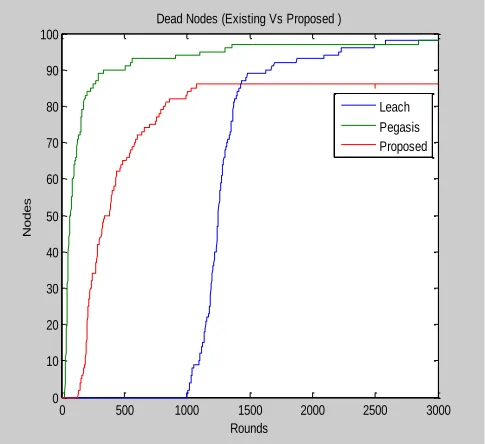
This paper uses Matlab as simulator to evaluate the performance of exiting PEGASIS protocol comparing with improved PEGASIS. The simulation focuses on number of sensor nodes alive and dead node, lifetime of network and energy efficiency which are important indicators to measure performance of different algorithms.
Fig. 3 Comparative Analysis (LEACH Vs Existing Vs. Proposed) Dead Nodes
Here in figure 3, the dead nodes are shown over the network As we can see there are about 98 nodes get dead after 3000 rounds in case of existing PEGASIS protocol and around 86 nodes dead after the Proposed Improved PEGASIS protocol. We can see the more number of nodes are dead after 3000 rounds in case of existing PEGASIS protocol.
Fig. 4 Comparative Analysis (LEACH Vs Existing Vs Proposed ) Alive Nodes
0 500 1000 1500 2000 2500 3000
0 10 20 30 40 50 60 70 80 90 100 Rounds N o d e s
Dead Nodes (Existing Vs Proposed )
Leach Pegasis Proposed
0 500 1000 1500 2000 2500 3000
0 10 20 30 40 50 60 70 80 90 100 Rounds N o d e s
Alive Nodes (Existing Vs. Proposed)
© 2014, IJCSMC All Rights Reserved 17
Here in figure. 4, the dead nodes are shown over the network as we can see there are about 2 nodes left alive after 3000 rounds in case of existing PEGASIS protocol and around 14 nodes left alive after the Proposed Improved PEGASIS protocol. We can see the more number of nodes are dead after 3000 rounds in case of existing PEGASIS protocol.
VI. CONCLUSION
In this paper, we describe PEGASIS, it is chain based protocol that is near optimal for a data-gathering problem in sensor networks. PEGASIS outperforms LEACH by eliminating the overhead of dynamic cluster formation, minimising the distance non leader-nodes must transmit, limiting the number of transmissions and receives among all nodes, and using only one transmission to the BS per round. The proposed system will improve the existing PEGASIS protocol. The proposed work is implemented on Wireless Sensor network to improve the network life in case of chain based protocol. The main problem with cluster network is to find the next neighbor for communication. Here the improvement is done for existing PEGASIS protocol. In this work we have include one parameter to select the next neighbor. The work is about to identify an energy efficient aggregative path to communicate over the network.
REFERENCES
[1] REN Feng-yuan, HUANG Hai-ning, and LIN Chuang, “Wireless Sensor Networks,” Journal of Software,
vol.14, pp.1282-1291,2003.
[2] CUI Li, JU Hai-ling, MIAO Yong et al, “Overview of Wireless Sensor Networks,” Journal of Computer Research and Development, vol.42, pp.163-174, 2005.
[3] K. Nakano and S. Olariu, “Energy-Efficient Initialization Protocols for Single-Hop Radio Networks with No
Collision Detection,” IEEE Trans.Parallel and Distributed Systems vol. 11, no. 8, Aug.2000.
[4] K. Nakano and S. Olariu, “Randomized Initialization Protocols for Ad Hoc Networks,” IEEE Trans. Parallel
and Distributed Systems, vol. 11, no.7, July 2000.
[5] Shio Kumar Singh, M P Singh, D K Singh, “ A Survey of Energy- Efficient Hierarchical Cluster-Based Routing in Wireless Sensor Networks”vol.2,pp.570-580,2010.
[6] TANG Yong, ZHOU Ming-tian, and ZHANG Xin, “Overview of Routing Protocols in Wireless Sensor
Networks, Journal of Software, vol.17, pp.410-421, March 2006.
[7] W. R. Heinzelman, A. Chandrakasan, and H. Balakrishnan, “Energy efficient communication protocol For wireless Microsensor networks,” In Proceedings of the Hawaii Conference on System Sciences, 2000, pp.3005-3014.
[8] S. Lindsey, and C. Raghavendra, “PEGASIS:Power- efficient gathering in sensor information systems,” IEEE
Aerospace Conference Proceedings,2002, pp.1125-1130.
[9] T. S. Rappaport, ―Wireless communications: Principles and Practice”, Prentice Hall, July 1996.
[10] Y. Chang Yu, “An Energy-Efficient Chain-Based Routing Protocol in Wireless Sensor Network” International