The Effectiveness of Hand Held Digital Microscope and Stereo
Microscope in Determining Sequence of Strokes of Green Pen Ink
and Blue Seal- A Comparative Study
Palak Aneja, Surbhi Mathur, M. S. Dahiya
Student, IFS, Gujarat Forensic Science University, Gandhinagar-382007, Gujarat; India; Email:
- Assistant Professor, Institute of Forensic Science, Gujarat Forensic Science University, Gandhinagar-382007, Gujarat; India; Email: [email protected]
-Director, Institute of Forensic Science, Gujarat Forensic Science University, Gandhinagar-382007, Gujarat; India;
ABSTRACT:
Background: Sequence of strokes is the study to determine the sequence in which writing strokes are made on the paper. Determining sequence of strokes is an important part of forensic document examination. The choice of method depends on the accessibility and availability of the means at that time.
Materials and Methods: In this paper, chronological sequence of intersecting pen strokes with seal ink has been determined using Stereo Microscope and hand held digital microscope. The exemplars were prepared at different time intervals. Intersections of blue seal impression with green colour ball point pen ink were studied. Strokes were examined under both the instruments and results were compared.
Results: Dragging of ink was not seen when seal was over signature whereas when signature was over seal dragging was seen in around 50 % of intersecting points. Continuity of pen was seen in
only 20% of intersecting points whereas continuity of seal was seen in 80% of intersecting points. Spreading of seal was seen in around 80% of intersecting points. Relative gloss of ball pen was seen in about 70% of intersecting points.
Conclusion: Due to the 3- dimensional view property of stereo microscope it was much more effective and results are more reliable. So therefore, it can be concluded that the stereo microscope is more effective in examination of sequence of intersecting lines than hand held digital microscope.
KEY WORDS: Seal impression, Pen inks,
Intersections, Digital Microscope, Stereo
Microscope, Green ink, Blue seal
Background
To determine the sequence of stroke is part of
types of ink used in different types of writing
instruments; due to which the determining the
sequence of stroke can be problematic. With the
advancement in technology many techniques have
been developed to determine the sequence of
strokes depending on the nature of writing
instrument, type of ink or type of material. The
need for the investigation of sequence of strokes of
writing emerges when it is said that part of written
material has been added after the signature was
done on the document or this examination can be
performed to learn which of the handwriting was
last written. The determination of sequence is very
important to verify the accountability of the
questioned document. By examining properties of
ink like absorption of ink onto the paper, color of
the ink, properties of ink like gloss and
luminescence can help in more easier and faster
detection of sequence of intersecting lines2,3,4. It is
possible to observe how the pen tip, besides
releasing the ink, deforms the paper. This is
because; the writing pressure leaves more or less
deep impressions, according to: Writing pressure
(amount of pressure exerted over the paper during
act of writing) ;Underlying material (sheet of
paper lying on metal surface or on paper block);
Writing material (fountain pen, pencil, gel pen,
ballpoint pen interact in different ways with
paper); Type of paper used (the production process
determines the size and the morphology of the
fiber’s layers in the paper) (Max Frei theory
revisitation: does really strokes depth changes
along time )Frei-Sulzer et al. (Based on
microscopic analysis) claimed that strokes are
time dependent, due to the (supposed by his
observations) 3-years paper elastic release time.
According to his theory it is possible to try to date
the handwritten document studying depth change
over time. Montani (2012), Examination of
Heterogeneous Crossing Sequences between
Toner and Rollerball Pen Strokes by Digital
Microscopy and 3-D Laser
Profilometery7.Giuseppe Schirripa Spagnolo
(2006). Potentiality of 3D laser profilometery to
determine the sequence of homogenous crossing
lines on questioned documents. In this paper the
potentiality of the 3D micro-topography to resolve
the writing order of signatures to detect the
tampering of manuscripts, to analyze pressure
variation, and to identify strokes in handwritten4.
Andre Braz (2014). A study to visualize and
examined sequence of strokes using Raman
spectroscopy by doing the analysis of inks.
Intersections are formed by the writing of ink; they
can also be formed by printed text, paper fold,
typewriting, indenture, and etc8.Ka Young Lee
(2014), Sequence discrimination of heterogeneous
crossing of seal impression and ink-printed text
using adhesive tapes, explained technique to
discriminate the sequence of stamped seal
impression and ink-printed text in a document to
detect falsely signed documents9.SC Leung
(1997), Systematic study of the lifting technique
for determining the writing sequence of
intersecting ball pen strokes using Kromekote
technique. A theory is proposed to explain the
lifting of ball pen ink and its application in the
metho10.
MATERIALS AND METHOD
Sample Size
Total of 120 intersections were prepared with Blue
seal ink and ball point green pen ink (writing
instrument) on A4 size white sheet.
Sample Preparation
In this the blue colour ink and round seal is used.
The content written on the seal- Institute of
Forensic Science, GFSU, Gandhinagar, with
University Logo in the center. The sequence of
preparing sample was either seal was placed first
or pen was written first. The samples were
prepared in a batch of 6 i.e. in the different time
interval ;In first batch of samples the seal was
immediately placed on the signature and vica
versa; In second batch of samples the seal was
placed on the signature after the time interval of
10 minutes and vica versa; In third batch of
samples the seal was placed on the signature after
the time interval of 2 hours and vica versa; In
fourth batch of samples the seal was placed on the
signature after the time interval of 3 days and vica
versa; The fifth batch of samples the seal was
placed on the signature after the time interval of
10 days and vica versa; The sixth batch of samples
the seal was placed on the signature after the time
interval of 1 month and vica versa.
Type of Paper
A4 size sheets were used of Xerox Company for
the purpose of sample preparation.
Writing Instrument
Ball pen of Flair brand was used.
The AM4113T Dino-Lite handheld digital
microscope is designed with a high quality 1.3
megapixel image sensor that lets you view and
capture objects with the greatest of details. It can
view objects at various magnifications depending
of distance with a max magnification of up to
220x13.
Stereo microscope uses light reflected from the
surface of an object rather than transmitted
through it. The instrument uses two separate
optical paths with two objectives and eyepieces to
provide slightly different viewing angles to the left
and right eyes. This arrangement produces a
three-dimensional visualization of the sample being
examined14.
RESULT AND DISCUSSION
When samples were observed, the following observations were made:
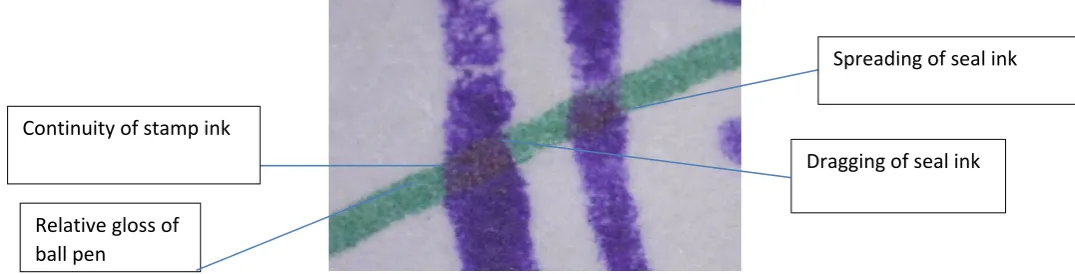
No Dragging of ink pigments were seen in samples when seal was over signature in both the instruments (as seen in fig. 1 and 3). When observed under Hand held digital microscope, samples in which signature was over seal, with no time interval i.e. immediate samples, with 10 minutes time interval and 2 hours interval out of all intersecting points approximately 60 % of them were showing dragging of seal ink pigments (as seen in fig. 3 and 4). In the samples of time
interval 3 days, 10 days and 1 month dragging of ink was not seen when signature was over seal. Whereas when same samples were observed in Stereo microscope for Dragging of ink, samples in which signature was over seal, with no time interval i.e. immediate samples, with 10 minutes time interval and 2 hours interval out of all intersecting points approximately 65 % of them were showing dragging of seal ink pigments, also it was seen in samples with time interval of 3days in approximately 50 % of intersecting points. And In the samples of time interval 10 days and 1 month dragging of ink was not seen when signature was over seal (as seen in fig. 1 and 2).
In both the instruments, When seal was over signature the Continuity of pen stroke was seen instead of seal ink i.e. where pen strokes were present there were no / or relatively very less interaction of seal ink with paper. This was seen in the samples of immediate and 10 minutes interval. In the time interval of 2 hours, 3 days and 10 days the continuity of pen stroke at some intersecting points and at some points the continuity of seal ink were seen. Last in the time interval of 1 month the continuity of only seal ink was seen. When signature was over seal only continuity of seal ink were seen in all the samples (as seen in fig. 1 to 4).
approximately 50% intersections (as seen in fig. 2 and 4).
When observed under Hand held digital microscope, Relative gloss of the ball point ink is seen in approximately 25% of intersecting points when seal was over signature, and when signature was over seal it was seen in approximately 65 % of intersecting points. Whereas when same samples were observed in Stereo microscope, Relative gloss of the ball point ink is seen in approximately 25% of intersecting points when seal was over signature, and when signature was over seal it was seen in approximately 69 % of intersecting point(as seen in figure 3 and 4)
CONCLUSION
Dragging of ink was not seen when seal was over
signature whereas when signature was over seal
dragging was seen in around 50 % of intersecting
point. Continuity of pen was seen in only 20% of
intersecting point whereas continuity of seal was
seen in 80% of intersecting point. Spreading of
seal was seen in around 80% of intersecting
points. Relative gloss of ball pen was seen in about
70% of intersecting point. Due to the 3-
dimensional view property of stereo microscope it
was much more effective and results are more
reliable. So therefore, it can be concluded that the
stereo microscope is more effective in examination
of sequence of intersecting lines than hand held
digital microscope.
References
[1] Osborn, A. (1910). Questioned documents.
Rochester, N.Y.: The Lawyers' co-operative
Publishing Co., pp.375-393.
[2] Ellen, D. (2006). Scientific examination of
documents. 2nd ed. Boca Raton, FL: Taylor &
Francis, pp.189-195.
[3] Kelly, J. and Lindblom, B.
(2006). Scientific examination of questioned
documents. 2nd ed. Boca Raton, FL: CRC/Taylor
& Francis, pp.327-329.
[4] Spagnolo, G. (2006). Potentiality of 3D
laser profilometry to determine the sequence of
homogenous crossing lines on questioned
documents. Forensic Science International,
164(2-3), pp.102-109.
[5] Ezcurra, M., Góngora, J., Maguregui, I.
and Alonso, R. (2010). Analytical methods for
dating modern writing instrument inks on
paper. Forensic Science International, 197(1-3),
pp.1-20.
[6] Vaid, B., Singh Ran, R., &Dhawan, C.
through reflection spectra. Problems of Forensic
Science, (LXXXVII,), pp.193-203.
[7] Montani, I., Mazzella, W., Guichard, M.
and Marquis, R. (2012). Examination of
Heterogeneous Crossing Sequences Between
Toner and Rollerball Pen Strokes by Digital
Microscopy and 3-D Laser Profilometry. Journal
of Forensic Sciences, 57(4), pp.997-1002.
[8] Ozbek, N., Braz, A., López-López, M. and
García-Ruiz, C. (2014). A study to visualize and
determine the sequencing of intersecting ink
lines. Forensic Science International, 234,
pp.39-44.
[9] Lee, K., Lee, J., Kong, S. and Kim, B.
(2014). Sequence discrimination of heterogeneous
crossing of seal impression and ink-printed text
using adhesive tapes. Forensic Science
International, 234, pp.120-125.
[10] Leung, S. and Leung, Y. (1997). A
systematic study of the lifting technique for
determining the writing sequence of intersecting
ball pen strokes. Science & Justice, 37(3),
pp.197-206.
[11] Google Books. (2017). Patent US6051629
- Ink composition. [online] Available at:
http://www.google.com/patents/US6051629
[Accessed 7 Apr. 2017].
[12] Technology, U. (2017). Document
Examination. [online]
Ultra-forensictechnology.com. Available at:
http://www.ultra-forensictechnology.com/document [Accessed 6
Apr. 2017].
[13] Digital image Retrived April 7, 2017, from http://www.dinolite.us/products/digital-microscopes/am4113t
[14] How Does a Stereo Microscope Work?
Retrieved April 7, 2017, from
http://www.microscope-detective.com/stereomicroscope.html#sthash.fSH
Fig 1 specimen of Stamp was over signature when observed under stereo microscope
Fig 2 specimen of signature was over stamp when observed under stereo microscope
Fig 3 specimen of Stamp was over signature when observed under hand held digital microscope
Fig 4 specimen of signature was over stamp when observed under hand held digital microscope Continuity of pen ink
Dragging of seal ink
Relative gloss of ball pen
Spreading of seal ink
Continuity of stamp ink
Continuity of stamp ink
Dragging of seal ink
Continuity of stamp ink Continuity of stamp ink
Light source Time gap Type of pen used
Stamp was over signature Signature was over seal
Visible Immediate Ball pen
Table-1 The Results Of Ball Pen Was Over Seal Impression And Vica-Versa When Observed Under Digital Microscope
No dragging of ink pigments were seen when seal was over signature whereas when signature was over seal out of all intersecting lines about 70% were
showing dragging of seal ink pigments.
When seal was placed over signature after the time interval of immediate the continuity of pen stroke at some intersecting points and at some points the
continuity of seal ink were seen whereas when signature was placed over seal after the time interval of 3days only continuity of seal ink were seen.
Spreading of seal ink was seen in both the groups i.e. when seal was over signature seal and vica-versa.
Relative gloss of the ball point ink was not seen when seal was over signature whereas when signature was over seal Relative gloss of the ball point ink
was seen
Characteristics /Sequence
Type of Pen Time Gap Dragging of ink pigment
Continuity of stroke Spreading of ink Relative gloss of the ballpoint ink
Seal was over signature
Ball pen Immediate Absent Continuity of pen strokes at
some points and Continuity of Seal ink at some points
Spreading of seal ink
Absent
Signature was over seal
Ball pen Immediate Present Continuity of Seal ink Spreading of seal
ink
Light source Time gap Type of pen used
Stamp was over signature Signature was over seal
Visible Immediate Ball pen
Table-2 The Results Of Ball Pen Was Over Seal Impression And Vica-Versa When Observed Under Stereo Microscope
No dragging of ink pigments were seen when seal was over signature whereas when signature was over seal out of all intersecting lines about 70% were showing dragging of seal ink pigments.
When seal was placed over signature after the time interval of immediate the continuity of pen stroke at some intersecting points and at some points the continuity of seal ink were seen whereas when signature was placed over seal after the time interval of 3days only continuity of seal ink were seen.
Spreading of seal ink was seen in both the groups i.e. when seal was over signature seal and vica-versa.
Relative gloss of the ball point ink was not seen when seal was over signature whereas when signature was over seal Relative gloss of the ball point ink was seen. Characteristics
/Sequence
Type of Pen Time Gap Dragging of ink pigment
Continuity of stroke Spreading of ink Relative gloss of the ballpoint ink
Seal was over signature
Ball pen Immediate Absent Continuity of pen strokes at some points and Continuity of Seal ink at some points
Spreading of seal ink
Absent
Signature was over seal
Ball pen Immediate Present Continuity of Seal ink Spreading of seal ink