H
n
-PERP: Hop by Hop - Power-Efficient Routing
Protocol over Underwater Wireless Sensor Networks
Tareq Krishan1,∗, Rami S. Alkhawaldeh1, Saed Khawaldeh2, Bilal Al-Ahmad1, Adnan Al Smadi3 1 Department of Computer Information Systems, The University of Jordan-Aqaba, 77110, Jordan;
{[email protected],[email protected],[email protected]}
2 Erasmus+ Joint Master Program in Medical Imaging and Applications; University of Burgundy (France),
University of Cassino (Italy) and University of Girona (Spain), Sensor Informatics and Medical Technology Group; Department of Electrical Engineering and Automation, Aalto University (Finland);
3 Department of Electronics Engineering, Yarmouk University, Irbid, Jordan;[email protected]
* Correspondence:[email protected]
Abstract: Underwater wireless sensor networks (UWSN) have recently been proposed as a way to monitor and explore the water depths’ environments. Efficiently delivering the data is still a challenging problem in these networks because of the weaknesses in the acoustic transmission. To tackle such a problem, we propose a novel algorithm provides controlling mechanisms for critical long-term data forwarding underwater sensor networks, called Hop by Hop Power-Efficient Routing Protocol (Hn-PERP). The proposed Hn-PERP is a centralized full-control model that enhances the network’s throughput and energy efficiency by a set of solutions depend on power monitoring in UWSN nodes. In particular, the model provides a guaranteed mechanism for scheduling and processing data transmission based on number of nodes, hops between the nodes, energy level and congestion within each node to minimize energy levels or power consumption by avoiding disconnected probability for any node, which in turn maximizing the network lifetime. Simulation results show that our proposed model is consistent with energy level and congestion, and is more accurate for enabling routing and data transmission. Therefore, the data packet delivery ratio and overall throughput also achieves robust scenarios of very sparse or/and weak networks, to keep on Performance stability in UWSN via adjusting hop-by-hop delay and energy consumption during packages delivery.
Keywords:Acoustic communication; Energy consumption; Smart routing protocols; UWSN MAC; Underwater Mobility.
1. Introduction
In recent decades, UWSNs have emerged as an infrastructure framework to explore environments at specific water depths such as gathering relevant data and monitoring of lakes, rivers, seas, and oceans [1]. UWSNs provide useful sensing capabilities that can be used for short and long-time minor. The wide sensing fields such as temperature, salinity, current movement, video, image, and chemical sensing lead to coherent understanding of underwater circumstances. Therefore, high density feature allows extensive discovering and exploration of wide underwater areas. The infrastructure of such networks consists of a large number of battery-powered vessels, sensors nodes and a variety of devices as shown in Figure1. Sensor nodes gather and monitor environmental variables (or data sample) such as water temperature, pressure, conductivity, turbidity, biological information, and pollutants by cooperative multi-hop acoustic communication and then deliver them to the surface nodes (or sinks) [2]. UWSNs offer the possibility of re-configure sensors remotely as logical manner and eliminate the need for physically accessing in underwater sites. When unexpected failure is occurred in any sensor in the network, rapid error detection and remote sensing are conducted as applicable features using UWSNS.
Figure 1.UWSN Infrastructure [3]
Although these networks have many characteristics as in terrestrial wireless sensor networks, such as numerous nodes and energy issues, they are distinguished from the terrestrial sensor technology in many aspects [4]. For Instance, regarding communication channels, the RF (Radio Frequency) signalling are not suitable, in underwater environments, due to the long time taken for propagation, large number of low frequencies, and absorption of such signals in water; hence, acoustic signals as a communication medium are exploited to be used in UWSNs [5]. UWSNs have, however, a broad range of possible applications [6] such as environmental research, assisted Geographical Information Systems (GISs) navigation, pollution monitoring, real-time control of autonomous underwater vehicles (AUV), and offshore exploration. To make these applications feasible, there is a need for statistical characterization of the acoustic channels [7]. In fact, the speed of acoustic signals is five orders of magnitude lesser than radio signals [8], which produces long propagation latency and end-to-end delay. Therefore, underwater sensor nodes are energy-constrained and their battery replacement is expensive due to the harsh underwater environment [9]. Moreover, the sensors energy level near to the surface is lower than the depth water. Transmission powers in UWSN exceed equivalent free space requirements by at least one order of magnitude. In deep waters, acoustic signals only propagate well at low-frequency signal carriers, which reduce signal bandwidth and transmission rates, thus extending communication time, and then reducing battery life [10]. These constraints motivate us to propose techniques to enhance network’s reliability and throughput in UWSNs, which serve as a challenge. The routing protocols of UWSNs must be calibrated to be more adaptive to the network environment due to achieve reliability by increasing throughput and minimizing delay. Many routing protocols have been proposed for UWSNs, each of these protocols have their own unique characteristics.
which one can obtain more adaptive routing with consideration energy level status in each sensor before transmission routing process.Hence, our contribution is to produce modelling parameters based on congestion and energy status. This model depends on full mobility, not on depths or division of layers, to provide high accuracy level in renewable paths. Since it takes optimal routing decision to support stability in the overall throughput synchronously with variations in residual energy within sensors.
The remainder of the paper is organized as follows: Section2 gives brief reviews of prior research related to present techniques to reduce bandwidth in UWSNs, Section 3 presents our proposed model including Hn-PERP routing protocol and scheduling algorithm, Section4explains the experimental parameters and settings as well as discusses the experimental results and evaluation. Finally, conclusions and future work are presented in Section5to summarise the results and take away messages.
2. Related Works
Many researchers have designed routing protocols based on dynamic topology, but still the research is needed for resolving many problems. Our study focuses on the issues of routing protocol operations regarding to the energy levels and congestions before making decision on routing process within each node.
Several research, however, have been emerged to solve UWSN issues [6]. These research still needs to investigate and analysis such issues and improve techniques for solving them due to underwater behaviour and Environmental conditions. In Random walk (RW) study [12], any mobile node can move in underwater environment from it’s current location to a new position in a mathematical approach. This movement depends on direction, speed and range factors without taking into consideration the number of nodes or the number of hops between sensors. Depth-based Protocol (DBR) [13] is proposed for the underwater wireless sensor network. In data forwarding mechanism perspective, each sensor node decides a decision on its own depth and the depth of the previous successive sender node, but DBR manages efficiently the resources regardless full dimensional location information of sensor node. The paper in [14] outlines a distributed algorithm to show the benefits of propagation-delays-based interference alignment (PD-IA) in a multi-hop UWSNs with the following consideration in protocol design (message format, control packet delay and overhead, recovery from a lost packet). A set of studies referred to another aspect regarding to the power efficiency within WSNs. A study in [15] showed that memory, power supply and processing capacity of sensor nodes are limited, making it difficult to replace and recharge batteries manually and the nodes’ energy can be exhausted easily. Many innovative energy harvesting methods, such as wireless energy harvesting [16] and wind energy harvesting [17], can promote the long lifetime of wireless sensor networks.
new reporting rate, at which each source is supposed to report data, on a reliability measurement, the received CN bits, and the previous reporting rate.
This centralized mechanism cannot be deployed on UWSNs. Congestion control notification messages sent through multiple hops might be lost due to the high link error probability of these networks. In addition to, as opposed to terrestrial sensor networks, the UWSNs have very large propagation delays. Therefore, the tardy response of Event-to-sink congestion control leads to a higher packet loss if there is congestion. For this reason, it is recommended that intermediate nodes rather than the sink participate to react to local congestion [21]. Temporary clustered based routing (TCBR) is table driven underwater routing protocol. TCBR is works on multi-hop and specially designed for equal energy consumption for entire network [22] with depending on two types of nodes (ordinary and courier). Communication range reached to 500 meters for better power usage. TCBR hello packet consists four fields (Node ID, Expiry time, Hope ID and MAX hop counts) and Data packet structured by five fields (Source Node ID, next node ID, Packet sequence number, Dest ID and Data field). The study in [22] also does not present directly the contribution through fields of packets in TCBR to make sure accurate routing depending on energy level for each node.
As discussed above there is no mechanism present adaptive dynamic addressing synchronously with the following consideration in each node, which are speed, the number of hops between sensors, the number of sensors, congestion in the nodes, depth for each sensor, noise level in the layer and energy level of each sensor. Therefore, our motivation is to build an adaptive approach to doing transmission depending on a renewable path between sensors, energy level for each one, and congestion status making sure forwarding data is performed in an accurate scheduling. These results keep on the stability of network via reducing delay and increasing throughput by adaptable UWSN scheduling.
3. Hn-PERP: Our Proposed Model
This sections discusses the proposed model as routing protocol and scheduling algorithms. In order to discuss the problem statement first section explains the problem formulation for routing packets in UWSNs.
3.1. Problem Formulation
The problem of transferring data packets under UWSNs is formulated as follows: Assume a set of sensors nodesN. A sensor nodeS(Sender) sends a packet along a path in the UWSN network to a receiver sensor nodeRat surface (or sink) in minimum energy and maximum network lifetime.
arg min Path(S,R)=S,n,n+1,···,R
R
∑
n=S,m=n+1E(n,m)∀m,n∈Path(S,R)
whereE(n,m)is the energy consumed when transfer the packet between the sensor nodenand sensor nodem. Hence we have to reduce the whole energy (summation of energies) between nodes in a path between the senderSand receiverR, which in turn maximizes the network lifetime. Hence, in this paper, we propose a protocol adopted from H2-DAB protocol to achieve reducing in energy when sending packets and long network lifetime.
3.2. Hn-PERP Routing Protocol
Hop to hop – Power-Efficient Routing Protocol (Hn-PERP) is a novel routing protocol that is presented in this study to achieve more adaptive scheduling based on neighbour count, time, congestion and residual energy as development on H2-DAB mechanism [11]. The proposed model has a set of advantages include:
Algorithm 1Hn-PERP Smart Algorithm N←Sensor Node
S←CSMA/CS sensing attribute Ri ←Su f f icient f or transmission
Re←Residual energy
Ph←Hello packet
Pd←Data packet
EnPerc←Energy percentage f or battery
Tf f n←Trade−o f f node(Selection)
FCwind ←Flag(Congestion status)
FEndown←Flag(Energy down)
f ←Flag
Sensor_Source←Sender Sensor_destination←Receiver
Endown Counter←#nodes that required charging
EnReq←Energy value f or sending localized packet
procedureHn-PERP
ifS∀N[Rj] and Re ≥0then
Sensor_sourceSENDPh
Sensor_destinationSENDACK Sensor_sourceReceiveACK fori=1 :N:Hn-PERPdo
SETFEndown=1∀N[EnPerc<70%]
SET ∑iN=1(FEndown=1):EndownCounter
RepInqNID∀Endown
if(FCwind=0)AND(EnPerc≥70%)then
if0<EnReq∀Pd≤0.3wattthen
SETTrade-off(EnPERC,CW I ND,Enrequired) =Yes
SETTf f n=OK
Sensor_SourceSENDPd
else
SETTf f n=No
else
SETTrade-off(EnPERC,CW I ND,Enrequired) =No
else
probability of delay and increasing throughput over UWSN synchronously with consideration of congestion and energy level.
• If the accuracy of the system is conducted, cost saving, increasing throughput and minimizing delay approaches will be a major finding that accurately achieved by Hn-PERP.
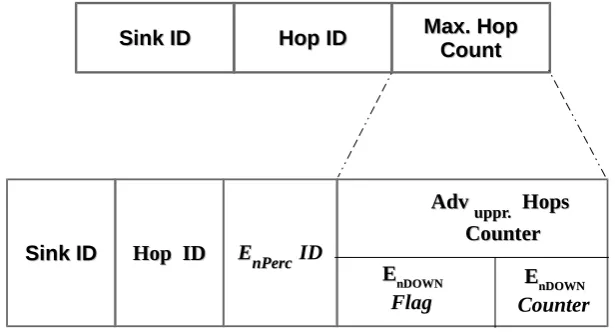
Several modifications on UWSN mathematical models with aspects to make delay and energy must consist with current hops number and congestion status to achieve reducing overall delay and enabling of increasing throughput with power consumption over UWSNs. Therefore, the first step is to achieve an adaptive addressing to the scheduling of paths process. Hence, hello and data packets that are provided in H2-DAB must be processed as shown in Figure2to be suitable for our future-oriented on introducing an adaptive methodology to the UWSNs.
Sink ID
Sink ID Hop IDHop ID Max. Hop Max. Hop Count Count
Figure 2.H2-DAB Hello Packet Frame.
Sink ID:is a unique ID used to initialise the sinks when they broadcast Hello packets during the first phase. This ID distinguishes the floating nodes when they receive Hello packets from different sinks. Hop ID:presents the IDs of the number of nodes between two nodes in the system. Left hop number has more priority as a primary route, while as compared to the right hop number that is used as a backup route.
Max. Hop Count:has an initialisation value of 10 at broadcasting Hello packet by sink. After receiving the packet, every node decrements the value by one til the tenth node is received to makes the value zero and then stops forwarding further to any other nodes. Our proposed protocol Hn-PERP contains new approach to the Hello Packet Frame via H2-DAB Frame as shown in Figure3.
EnPercID:New field in each sensor node that is used during sending a Hello Packet between nodes
Sink ID
Sink ID Hop IDHop ID Max. Hop Max. Hop Count Count
Sink ID
Sink ID Hop IDHop ID EEnPercnPercID
Adv
Adv uppr.uppr. Hops Hops Counter Counter
EEnDOWNnDOWN
Flag
EEnDOWNnDOWN
Counter
Figure 3.Proposed Hn-PERP Hello Packet.
and helps us to build scheduling depending on trade-off between nodes by determining residual energy in each node.
Advuppr.Hops Counter:If energy level is more than or equal to 70%, current node is being considered as a next hop.
EnDOWNFlag:it is 0 if energy level in the node >=70% else the flag is being 1.
Sender
Sender
Hop ID
Hop ID
Node ID
Node ID
Next
Next
Packet
Packet
Seq.
Seq.
Number
Number
Destination
Destination
ID
ID
Data
Data
Sender
Hop ID
Next Node
ID
Packet
Seq.
Number
Destination
ID
C
C
WINWINData
Data
E
E
n PERC n PERCDOWN
DOWN
Flag
Flag
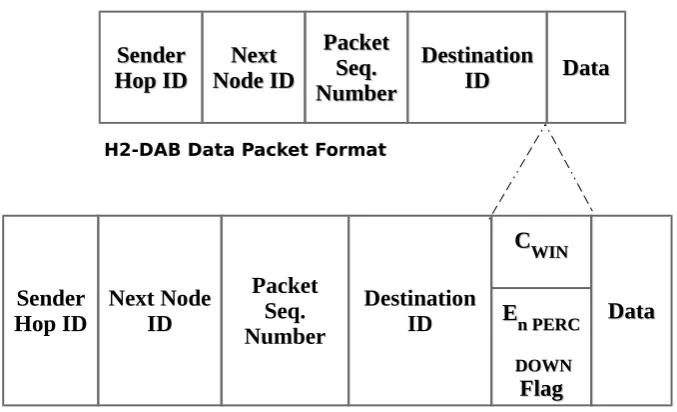
H2-DAB Data Packet FormatFigure 4.Proposed Hn-PERP Data Packet Frame.
Sender hop ID:the Hop ID of current node forwarding the Data Packet, if it’s an anchored node then it will use its static Hop ID ”100“.
Next Node ID:the unique ID of a node, eligible for next hop among the neighbors, usually a node from the upper layers.
Packet seq. number:a unique number assigned by the source node to the packets.
Destination ID:is a fix value ”0“, which is the destination ID of all the sinks on the surface, so packets can be delivered to any of the reachable sink.
Cwind:Congestion Status in Current node.
EnDOWNFlag:will be 0 if energy level in the node >=70% else the flag is 1.
3.3. Hn-PERP Scheduling Algorithm
The scheduling algorithm of Hn-PERP is described in Algorithm1and also in Table1provides a practical processing to the hop-by-hop trade-off for the nodes during data transmission between suggested sensor 1 and surface sink A over UWSNs. And how making decision depending on our selected parameters in this study to reaches the precision in routing path upon congestion and energy status.
Table 1.Hn-PERP Scheduling
Current node Hop Number Reached Node CW I ND EnPERC Enrequired Trade-off (EnPERC, CW I ND, Enrequired) Trade-off Node
Source
Node
1 1 6 1 77% 1.51 watt NO
-7 0 74% 0.25 watt Yes OK
2 0 84% 1.79 watt NO
-7 1 9 1 73% 1.47 watt NO
-13 0 68% 0.27 watt Yes Ok
13 1 3 0 59% 0.26 watt Yes OK
3 1 n · · · ·
1 n · · · ·
18 1 A - - - -
-3.4. Hn-PERP Evaluation
of the performance metrics are presented as follows:
Energy efficiency:is defined as the total amount of energy consumed over the total simulation time. These include all the energy spent in transmission, reception, idle and sleep state etc.
Throughput:is defined as the amount of data packets successfully transmitted from sender to receiver over the total simulation time (T). We compute throughput as number of bits (N) received successfully by all destinations. Mathematically, throughput can be defined as: N/T.
Delay: end-to-end delay can be defined as the average time taken by a data packet to arrive in the destination, which can be Mathematically defined as D=∑( arrival time – sending time ) /∑Number of connections.
Packet Delivery Ratio (PDR):is the ratio of number of delivered data packet to the destination. This illustrates the level of delivered data to the destination. PDR can be Mathematically defined as∑ Number of packet receive /∑Number of packet send.
Reliability: could be defined as guaranteed delivery of transmitted data in UWSNs to intended receiver (s), which also provides notifications to sender.
Hence, our selected metrics in the proposed study focus on the overall throughput in the suggested network and energy percentages within each node over UWSN.
4. Experimental Results
4.1. Experimental Parameters and Settings
Herein, we discuss the re-formalization of the packets’ headers that are presented in [11] and consider parameters to be included for building a new adaptive routing mechanism. Hence, in order to achieve that, we have a set of steps as follow:
System architecture:this step define the architecture that have to be used for building the proposed model which includes:
• Develop H2-DAB Frames to solve our issue and make routing process more adaptive with specific UWSN considerations such as neighbour hops, congestion, and residual energy. • Build a scheduling for routing paths to make sure that addressing processing supports increasing
throughput that is obtained by H2-DAB.
• Build a simulation to evaluate the proposed model.
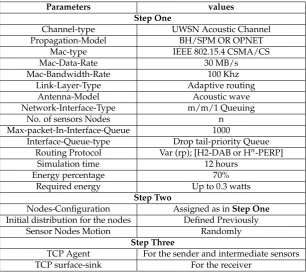
Pre-processing step:This represents the characteristics of our UWSN environment. The simulation setup includes the parameters and values that are selected depend on experimental tests. We randomly use varying numbers of nodes ranging from 5 to 50 in 3D region of size 1500m X 1500m. Sensor nodes have a transmission range of 200m, the data rate of 2 MB/sec, and use the CSMA MAC protocol. The size of the packet payload is 512 bits. The values of energy consumption are Enrequired, which are up to 0.3 watts for transmission and reception. This configuration is used throughout, which summarized in Table2:
Design:In this step, we present the design of Hn-PERP, A practical Adaptive routing Architecture schema for UWSN as shown in Figure6. Hn-PERP transparently addresses trade-off events in a smart sensing and routing while it allows flexible control sensors nodes.
4.2. Experimental Results and Evaluation
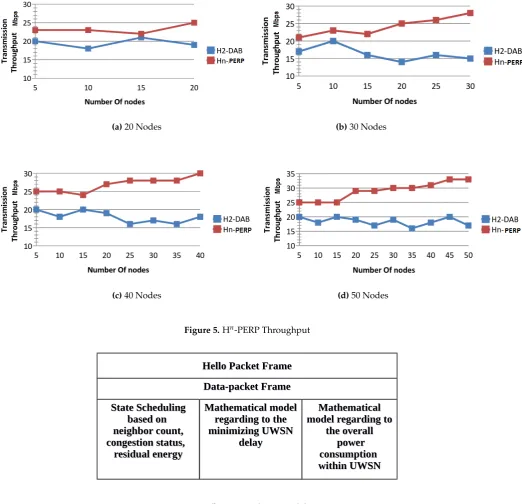
We evaluate the performance of Hn-PERP using the standard NS2 simulation. In our simulations, we considered 50 sensor nodes deployed within 1500m X 1500m X 1500m with a packet size of 512 bit and Max-packet-In-Interface-Queue up to 1000. Our performance metrics are throughput and number of nodes in the overall proposed network. To evaluate the efficiency of Hn-PERP protocol.
Table 2.Experimental parameters and values
Parameters values
Step One
Channel-type UWSN Acoustic Channel Propagation-Model BH/SPM OR OPNET
Mac-type IEEE 802.15.4 CSMA/CS
Mac-Data-Rate 30 MB/s
Mac-Bandwidth-Rate 100 Khz
Link-Layer-Type Adaptive routing
Antenna-Model Acoustic wave
Network-Interface-Type m/m/1 Queuing
No. of sensors Nodes n
Max-packet-In-Interface-Queue 1000
Interface-Queue-type Drop tail-priority Queue Routing Protocol Var (rp); [H2-DAB or Hn-PERP]
Simulation time 12 hours
Energy percentage 70%
Required energy Up to 0.3 watts Step Two
Nodes-Configuration Assigned as inStep One Initial distribution for the nodes Defined Previously
Sensor Nodes Motion Randomly
Step Three
TCP Agent For the sender and intermediate sensors TCP surface-sink For the receiver
makes our proposed routing algorithm more adaptive and precision in a different perceptions over UWSN depending on Hn-PERP mechanism. In more detail, the data transmission rate reaches to 33 Kbps with 50 nodes. Our focus here is to increase data bit rate level with a more precise energy level and congestion statues. Therefore, enabling the data transmission to be more stable with overall considerations as power consumption and congestion. On the other hand, H2-DAB present decrements in data ratio during increase with a number of nodes which ranges between 15–20 Kbps through 30 nodes.
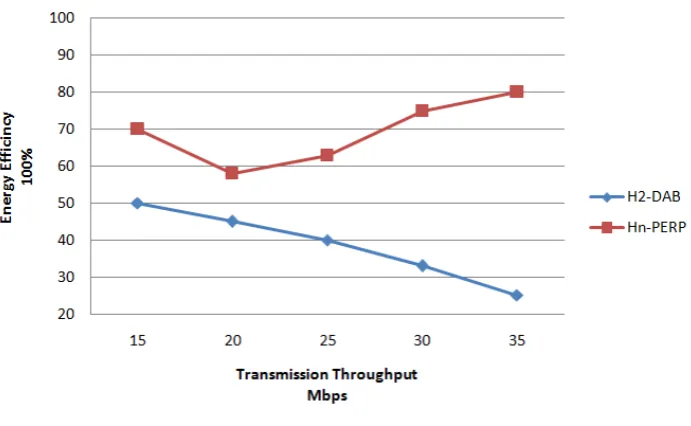
The energy efficiency regarding our proposed method is shown in Figure7.
As shown, the low level of energy efficiency in H2-DAB is synchronous with increasing productivity on the network occurred by increased probability of delay due to inefficient routing processes. This occurs due to the energy levels that are very low so increasing the opportunities of disconnect in data transmission between nodes. On the other hand, significant stability in the energy efficiency ofHn−PERPprotocol reflects to the minimum delay opportunities on the network due to our proposed routing mechanism based on multiple requirements within each node such as energy level. Thus, avoiding the contact with low energy nodes.
5. Conclusions and Future works
(a)20 Nodes (b)30 Nodes
(c)40 Nodes (d)50 Nodes
Figure 5.Hn-PERP Throughput
Hello Packet Frame Hello Packet Frame
Data-packet Frame Data-packet Frame
State Scheduling State Scheduling
based on based on neighbor count, neighbor count, congestion status, congestion status, residual energy residual energy
Mathematical model Mathematical model
regarding to the regarding to the minimizing UWSN minimizing UWSN
delay delay
Mathematical Mathematical model regarding to model regarding to
the overall the overall power power consumption consumption within UWSN within UWSN
Figure 6.Hn-PERP Architecture Schema.
over network as a promising network for the future. Our results showed the stability of the network performance in synchronising with the increase in the number of nodes and the variation difference in the levels of energy in the contract that did not affect the productivity of the network.
Figure 7.Hn-PERP Performance
Author Contributions:Krishan t., carried out the design and development of preprocessing steps, architecture schema, hello - Data packets and smart algorithm (sensing & routing). Alkhawaldeh R. supervised and provided advices for improving the quality of this research and gave specific processing approaches regarding to the simulation aspects and experimental results. Khawaldeh S. went through the related work and reviewed the most important research papers. Al-Ahmad, B. was responsible for Writing—Review & Editing. Al Smadi A, gives ideas regarding the design of the paper and structure of sections, graphs, and the algorithm (i,e. Supervision).
6. References
1. Ghoreyshi, S.M.; Shahrabi, A.; Boutaleb, T. A Novel Cooperative Opportunistic Routing Scheme for Underwater Sensor Networks. Sensors2016,16. doi:10.3390/s16030297.
2. Coutinho, R.W.; Boukerche, A.; Vieira, L.F.; Loureiro, A.A. A novel void node recovery paradigm for long-term underwater sensor networks. Ad Hoc Networks 2015, 34, 144–156. {ADVANCES} {IN} {UNDERWATER} {COMMUNICATIONS} {AND} {NETWORKS}, doi:https://doi.org/10.1016/j.adhoc.2015.01.012.
3. Heidemann, J.; Stojanovic, M.; Zorzi, M. Underwater sensor networks: applications, advances and challenges. Philosophical Transactions of the Royal Society of London A: Mathematical, Physical and Engineering Sciences 2011, 370, 158–175, [http://rsta.royalsocietypublishing.org/content/370/1958/158.full.pdf]. doi:10.1098/rsta.2011.0214.
4. Hong, L.; Hong, F.; Yang, B.; Guo, Z. ROSS: Receiver Oriented Sleep Scheduling for Underwater Sensor Networks. Proceedings of the Eighth ACM International Conference on Underwater Networks and Systems; ACM: New York, NY, USA, 2013; WUWNet ’13, pp. 4:1–4:8. doi:10.1145/2532378.2532396. 5. Wahid, A.; Kim, D. Analyzing Routing Protocols for Underwater Wireless Sensor Networks. IJCNIS2010,
2.
6. Ahmed, M.; Salleh, M.; Channa, M. Routing protocols based on node mobility for Underwater Wireless Sensor Network (UWSN): A survey. Journal of Network and Computer Applications2017,78, 242 – 252. doi:https://doi.org/10.1016/j.jnca.2016.10.022.
7. Xiang-ping, G.; yan, Y.; Rong-lin, H. Analyzing the Performance of Channel in Underwater Wireless Sensor Networks (UWSN). Procedia Engineering 2011, 15, 95 – 99. doi:http://dx.doi.org/10.1016/j.proeng.2011.08.020.
9. Wahid, A.; Lee, S.; Kim, D. A reliable and energy-efficient routing protocol for underwater wireless sensor networks. International Journal of Communication Systems2014,27, 2048–2062.
10. Uribe, C.; Grote, W. Radio Communication Model for Underwater WSN. Proceedings of the 3rd International Conference on New Technologies, Mobility and Security; IEEE Press: Piscataway, NJ, USA, 2009; NTMS’09, pp. 147–151.
11. Ayaz, M.; Abdullah, A. Hop-by-Hop Dynamic Addressing Based (H2-DAB) Routing Protocol for Underwater Wireless Sensor Networks. Proceedings of the 2009 International Conference on Information and Multimedia Technology; IEEE Computer Society: Washington, DC, USA, 2009; ICIMT ’09, pp. 436–441. doi:10.1109/ICIMT.2009.70.
12. Wang, P.; Akyildiz, I.F. Effects of Different Mobility Models on Traffic Patterns in Wireless Sensor Networks. 2010 IEEE Global Telecommunications Conference GLOBECOM 2010, 2010, pp. 1–5. doi:10.1109/GLOCOM.2010.5684190.
13. Yan, H.; Shi, Z.J.; Cui, J.H., DBR: Depth-Based Routing for Underwater Sensor Networks; Springer Berlin Heidelberg: Berlin, Heidelberg, 2008; pp. 72–86. doi:10.1007/978-3-540-79549-0_7.
14. Zeng, H.; Hou, Y.T.; Shi, Y.; Lou, W.; Kompella, S.; Midkiff, S.F. A Distributed Scheduling Algorithm for Underwater Acoustic Networks With Large Propagation Delays. IEEE Transactions on Communications 2017,65, 1131–1145. doi:10.1109/TCOMM.2017.2647940.
15. Wang, H.; Zhou, G. Power Allocation Based on Data Classification in Wireless Sensor Networks. Sensors 2017,17. doi:10.3390/s17051107.
16. Mekikis, P.V.; Lalos, A.S.; Antonopoulos, A.; Alonso, L.; Verikoukis, C. Wireless Energy Harvesting in Two-Way Network Coded Cooperative Communications: A Stochastic Approach for Large Scale Networks. IEEE Communications Letters2014,18, 1011–1014. doi:10.1109/LCOMM.2014.2320926.
17. Li, Z.; Zhou, G.; Zhu, Z.; Li, W. A Study on the Power Generation Capacity of Piezoelectric Energy Harvesters with Different Fixation Modes and Adjustment Methods. Energies 2016, 9. doi:10.3390/en9020098.
18. Kwon, J.K.; Seo, B.M.; Yun, K.; Cho, H.S. Time-Efficient High-Rate Data Flooding in One-Dimensional Acoustic Underwater Sensor Networks. Sensors2015,15, 27671–27691. doi:10.3390/s151127671.
19. Zenia, N.Z.; Aseeri, M.; Ahmed, M.R.; Chowdhury, Z.I.; Kaiser, M.S. Energy-efficiency and reliability in {MAC} and routing protocols for underwater wireless sensor network: A survey. Journal of Network and
Computer Applications2016,71, 72 – 85. doi:https://doi.org/10.1016/j.jnca.2016.06.005.
20. Akan, O.B.; Akyildiz, I.F. Event-to-sink reliable transport in wireless sensor networks. IEEE/ACM Transactions on Networking2005,13, 1003–1016. doi:10.1109/TNET.2005.857076.
21. Domingo, M.C. Marine communities based congestion control in underwater wireless sensor networks. Information Sciences2013,228, 203 – 221. doi:https://doi.org/10.1016/j.ins.2012.11.011.
![Figure 1. UWSN Infrastructure [3]](https://thumb-us.123doks.com/thumbv2/123dok_us/8014490.1332571/2.595.188.408.88.281/figure-uwsn-infrastructure.webp)