International Journal of Asian Social Science, 2014, 4(5): 676-689
† Corresponding author
ISSN(e): 2224-4441/ISSN(p): 2226-5139
© 2014 AESS Publications. All Rights Reserved. 676
THE DYNAMICS OF EXPORT AND IMPORT FUNCTIONS IN TURKEY:
COINTEGRATION AND MULTIVARIATE GRANGER CAUSATION ANALYSIS
Halil Altintaş
†Erciyes University, Faculty of Economics and Administrative Sciences, Department of Economics, Turkey
Oğuzhan Türker
Erciyes University, Faculty of Economics and Administrative Sciences, Department of Economics, Turkey
ABSTRACT
The study aims to analyze the determinants of foreign trade through the variables of national
income, foreign direct investment, real exchange rates, and export and import prices for the period
of 1987-2011. The export and import demand functions in Turkey are estimated using unit root test,
co-integration analysis, and Granger causality tests. There is one-way short term Granger causal
link from foreign income, real exchange rate and export price towards export in the export model.
This model is also characterized by the fact that foreign income, foreign direct investment, real
exchange rates and export price are the Granger causes of export in the long-run. In the import model, on the other hand, there is Granger causality link from Turkey’s real GDP, foreign direct investment, and real exchange rate towards import in the long-run. In addition, single way
causality links have been encountered from foreign direct investment, real exchange rate and
import price to import.
© 2014 AESS Publications. All Rights Reserved.
Keywords:
International trade, Export function, Import function, Granger analysis, Foreign direct investment, Causality test, Elasticity approach.JEL Codes:
F14, F41, F43.Contribution/ Originality
This study contributes in the existing literature that it considers the factors of the determinants export and import function collectively by using Johansen-Juselius Cointegration Tests and Multivariate Granger Causation Analysis.
International Journal of Asian Social Science
ISSN(e): 2224-4441/ISSN(p): 2226-5139
© 2014 AESS Publications. All Rights Reserved. 677
1. INTRODUCTION
From the 1950’s on, countries all over the World have been taking steps to improve multi-variate trade under the GATT, along with trying to make use of the contribution from regional integrations. As the foreign trade has improved in volume, the world economies have become more dependent to each other. The success of countries following theoretical literature and the strategy of export oriented industrialisation in practice have been influential in the proliferation of foreign trade. In theory, the view of Adam Smith and David Ricardo that countries have the best of foreign trade; the view of Nurkse that foreign trade has become “the engine of economic growth”, have directed countries towards foreign trade. In addition, most countries implemented foreign trade oriented industrialization along with rapid growth in practice thus getting them to pay more attention to foreign trade. Whereas in 1980’s, the obstacles facing foreign trade have been removed and commercial deregulation has been facilitated synchronically with globalisation.
Theoretically, the formation of foreign trade balance is analyzed through three approaches. These are elasticity approach, absorption approach and monetarist approach. Such economists as
Robinson (1947), Metzler (1948), Meade (1951), Alexander (1952; 1959), Polak (1957), Mundell (1968) have been the pioneers of these approaches.
This study aims to analyze the determinants of foreign trade in Turkey using the variables of national income, foreign direct investment, real exchange rates and export and import prices using the annual data covering the period of 1987-2011. The study has been limited being examined Turkish economy on the location-wise and analysing the period of 1987-2011 on the time-wise.
The outline of the paper is as follows. Section 2 describes the theoretically dynamics of export and import and related literature. Section 3 presents methodological considerations and the estimation results.
2. THE DYNAMICS OF EXPORT-IMPORT AND LITERATURE REVIEW
The formation of foreign trade balance is studied in three approaches in the literature. These are the elasticity approach, absorption approach and monetarist approach.
The concept of elasticity was developed by Robinson (1947) and Metzler (1948). According to this approach, the changes of exchange currency rate have an effect on trade balance of a country. While Marshall-Lerner condition is applied in elasticity approach, the loss of value in national money leads to an improvement in foreign trade balance. The Marshall-Lerner condition accounts for the fact that, under perfect elasticity of supply, the addition of domestic demand elasticity for import goods and foreign demand elasticity for export goods is equal to or higher than 1 as absolute value. If this condition is not met on the short term, a J-curve effect will appear.
© 2014 AESS Publications. All Rights Reserved. 678 The third approach in link to trade balance is the monetarist approach and basically founded by
Polak (1957) and Mundell (1968). According to this approach, the imbalance between money supply and demand spoils the trade balance. If the money supply is bigger than money demand, the trade balance will have deficit or surplus or vice versa.
The export and import functions of any given country are crucial for the identification of trade dynamics of this country. The variables forming the export function are mainly national income, foreign income, foreign direct investment, real exchange currency and export and import prices.
The relationship between foreign direct investment (FDI) and foreign trade has been developed through the theoretical approach devised by Heckscher, Ohlin, Samuelson and Mundell. This approach is based on the assumption that international goods trade could substitute for international production factors. According to Mundell, the international trade and mobility of productions factors are rather a substitute not a supplementary for countries with trade limitations. According to studies dealing with the connection between FDI and foreign trade, there is either a supplementary or substitutional relationship between these variables (Altıntaş, 2009). Whether FDI is a supplementary or substitute for trade depends on what objectives are aimed with FDI. If the FDI is vertical like how multi-national corporations spread their productions geographically, it will most probably encourage trade and be a supplementary to it. If FDI is horizontal like how international corporations get their goods produced at various locations, it will most likely be a substitute for trade (Delice and Birol, 2011).
The link between real exchange rate and foreign trade is generally explained in elasticity approach. According to this, when the exchange rate is high foreign trade balance improves, if low the foreign trade balance will be spoilt. Domestic income has a direct effect on import while foreign income has on export. When domestic income is high (low), import rates will increase posing a negative (positive) effect on foreign trade balance. When foreign income is high (low), import rates will increase bearing a positive (negative) effect on foreign trade balance. The increase (decrease) in export prices leads to an increase (decrease) in domestic goods prices from the foreigners’ point of view and has a negative (positive) effect on foreign trade balance dropping (escalating) export. The rising (lowering) of import prices refers to the fact that foreign goods are getting more expensive (cheaper) in domestic citizens’ point of view thus causing the import to decrease (increase) posing a positive (negative) effect on foreign trade balance.
© 2014 AESS Publications. All Rights Reserved. 679 concluded that any change in real exchange rates will not have a significant effect on foreign trade balance and that real exchange rate cannot be used to balance foreign trade effectively. Kharroubi (2011) directly tested the effects of real exchange rate on the foreign trade balance in 20 OECD countries for the sample period of 1985-2008. Analytical results indicate that the increase in the real exchange rate will deteriorate trade balance.
According to Helpman (1984) and Helpman and Krugman (1985), if the countries are different from each other in terms of factor endowment, the country which has a wealth of capital factor will export management, research and development services to the country with a wealth of workforce through FDI and import differentiated and homogenous goods from that country in exchange. In this case, FDI will be the supplementary of trade in the country with a wealth of workforce. According to some authors including Hortsmann and Markusen (1992), Markusen (1983) and
Brainard (1997), the choice between horizontal FDI and trade will be made through comparison between the benefit of proximity to the market with that of concentration. If the benefit of proximity is higher than that of concentration FDI will be preferred instead of trade. In this case, there will be a substitutive link between FDI and trade. Altıntaş (2009) analyzed the relationship between FDI and trade in Turkey for the years of 1996-2007 through VAR method and Granger causality analysis. According to the analysis, FDI increases import and export in Turkey and thus there is a supplementary link between FDI and foreign trade.
In addition to these studies, the studies of Lipsey and Weiss (1981), Blomstrom et al. (1988),
Sun (2001), Xuan and Xing (2008) can be regarded as examples of studies findings a supplementary link between FDI and foreign trade. Dritsaki et al. (2004) tested the effect of FDI on foreign trade in Greece for the period of 1960-2002 through co-integration and causality analyses. The analysis results suggest that there is a significant single way link from foreign direct investment to export in Greece. Pham and Tran. (2009) analyzed the causality link between FDI and export for 7 sectors in Vietnam for the period of 1995-2006 and identified a positive relationship between FDI inflow and export. Constant and Yaoxing (2010) tested the effects of FDI on export and economical growth in Ivory Coasts for the period of 1980-2007 by bounds test and Granger causality analysis. Analysis results suggest that there is a causality link from FDI towards export on the long-run.
3. ECONOMETRIC METHOD
3.1. Model and Data Set
This study aims to estimate the import and export function of Turkey on the base of Keynesian Elasticity and absorption methods. Following are the signs that
(TB
)
determiners of trade balanceand relevant variables could take in elasticity approach, known as Keynesian method, and absorption approach Weixian (1998):
)
*,
,
(
?
E
Y
Y
TB
TB
(1)Here Y and Y* respectively indicate domestic and foreign income and E shows real exchange
© 2014 AESS Publications. All Rights Reserved. 680 export income (X) and import (M) expense. If we explain this approach with the following model
(Buluswar et al., 1996; Weixian, 1998; Altıntaş and Çetin, 2009):
* * *
( , ,
)
( ,
, )
x x x m M M
TB
X
M
P Q P e Y
eP Q
e P Y
(2)Here e indicates exchange rate in terms of money,
Y
domestic income,Y
*
foreign income,x
P
y is for export price in domestic currency,Q
xexport quantity,P
M stands for export price inforeign currency and
Q
M shows export quantity. Devaluation of domestic currency is explainedwith the increase in
e
(nominal exchange rate). IfP
P
xshows domestic price andP
*
P
M*theforeign price level, the real exchange rate will be
E
eP
*
/
P
. According to this equation the determinants of foreign trade balance(TB
)
are domestic income(Y
)
and foreign income(Y
*)
.The higher
Y
is, the higher export rate and quantity will be thus deteriorating trade balance. Theincrease in foreign income
(Y
*)
will lead to an escalation in export quantity thus improvingTB
.Foreign direct investment flows (FDI) and export and import prices (respectively XPP and MPP) are added to the determinants of export and import on the basis of elasticity and absorption approaches and re-arranged to form the following export and import models for Turkey:
0 1
7
2 3 4t t t t t t
LXY
LG Y
LFDY
LRER
LXPP
(3)0 1 2 3 4
t t t t t t
LMY
LY
LFDY
LRER
LMPP
(4)
Here XY, MY and FDY indicate export, import and foreign direct investment to the country (in proportionate to GDP), G7Y indicate real income of G7 countries in terms of representing foreign income, RER real exchange rate and XPP and MPP export and import prices. The logarithms of all variables are taken in both models thus ensuring that export and import elasticity of independent variables are obtained.
In the export model expected signs of coefficient must be 1 > 0, 2 > 0, 3 < 0, 4 < 0. It is expressed in international trade theory that FDI will have an effect on transfer of technology, dissemination of knowledge, market structure and competition (Caves, 1974; 1996; Hymer, 1976).
© 2014 AESS Publications. All Rights Reserved. 681 In the import model, expected signs of coefficient must be
1
0
,
2
0
,
3
0
,4
0
. In both models
tindicates the error term.In the model XY, MY and FD, respectively export, import and direct investment values are multiplied with nominal exchange rate and the result is divided into Turkish GDP. Similarly, the G7 countries’ GDP values, in dollars, are divided into G7 country GDP deflators (2005=100) to obtain real GDP series (G7Y) of G7 countries. Turkey’s real GDP (Y) is obtained through the division of nominal GDP values to, GDP deflator (2005=100). Export and import price indexes (2005=100) are used to represent export and import unit prices. Then the logarithms are taken for all series and since the series are quarterly they are eliminated from seasonal effects through Tramo/Seats method. Following are the graphics about the variable series used in to model. All variables used in the model are obtained from International Financial Statistics. Eviews 7.1 econometrical package program is used in the estimation of models.
3.2. Unit Root Test
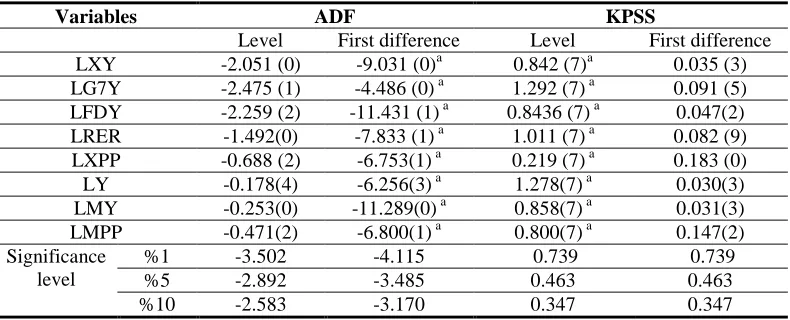
Among various testing strategies, The study used first tests for stationary of each variable by employing two traditional unit root test: ADF Dickey and Fuller (1981) and KPSS Kwiatkowski et al. (1992). Table 1 summarizes the results of the two unit root test, ADF and KPSS. The results of unit root test show that null of non-stationary cannot be rejected for any level of series. After their first differencing, all
the variables are integrated of one, i.e.
I(1).
Table-1. Results of Unit Root Tests
Variables ADF KPSS
Level First difference Level First difference LXY -2.051 (0) -9.031 (0)a 0.842 (7)a 0.035 (3) LG7Y -2.475 (1) -4.486 (0) a 1.292 (7) a 0.091 (5) LFDY -2.259 (2) -11.431 (1) a 0.8436 (7) a 0.047(2) LRER -1.492(0) -7.833 (1) a 1.011 (7) a 0.082 (9) LXPP -0.688 (2) -6.753(1) a 0.219 (7) a 0.183 (0)
LY -0.178(4) -6.256(3) a 1.278(7) a 0.030(3)
LMY -0.253(0) -11.289(0) a 0.858(7) a 0.031(3)
LMPP -0.471(2) -6.800(1) a 0.800(7) a 0.147(2)
Significance level
%1 -3.502 -4.115 0.739 0.739
%5 -2.892 -3.485 0.463 0.463
%10 -2.583 -3.170 0.347 0.347
Note: ADF unit root tests (except the KPSS) employed in our study have a null hypotheses that the series has a unit root tests against the alternative of the stationary. The null of KPSS, on the other hand, states that the variable is Stationary.
a indicates that unit root tests are rejected at 1% level, respectively.The values in brackets are lag lengths identified using
Akaike Information Criterion (AIC). The maximum lag length is 11.
3.3. Cointegration Analysis
© 2014 AESS Publications. All Rights Reserved. 682
Juselius, 1990). Any long-term cointegrating relationship found between the series will contribute an additional error –correction term to the ECM. The Johansen procedure is a vector autogressive (VAR) based test on restriction imposed by cointegration in the unrestricted VAR. The results of cointegration tests for export and import models is reported following tables.
Table-2. Results of Johansen-Juselius Cointegration Tests for Export Model
Eigenvalue
trace
maxHo H1
trace
Critical %5 valueHo H1
max
Critical % 5 value 0.357 r=0 r
1 79.384* 60.061 r=0 r=1 40.664* 30.439 0.222 r
1 r
2 38.720 40.174 r
1 r=2 23.190 24.159 0.084 r
2 r
3 15.529 24.275 r
2 r=3 8.166 17.797 0.076 r
3 r
4 7.363 12.320 r
3 r=4 7.354 11.224 0.0005 r
4 r
5 0.008 4.1299 r
4 r=5 0.008 4.129 Normalized cointegration equation:1.914 7 1.146 3.417 2.891
t t t t t
LXY LG Y LFDY LRER LXPP
t-ist: (5.360) (6.377) (-3.214) (-3.174)
Note: The critical values for trace and maximum likelihood tests (are taken from (Osterwald-Lenum, 1992). (*) indicates %5 level significance, r cointegration vector number.
These results suggest that there is a cointegration vector among five variables for the analysis period, in other words, there is a long-term link among export, foreign income, foreign direct investment inflow, real exchange rate and export price. In addition, long-term elasticity of export model are demonstrated in the normalized cointegration results in Table 2. In export model, all variables have expected signs along with statistical significance. The foreign income elasticity of export in the model is 1.91 and statistically significant at 1% level. These results suggest that a 1% increase in foreign income would account for a 1.9% increase in Turkish export. By the same token foreign direct investment inflow elasticity of export is 1.14 and it is statistically significant. 1% of increase in foreign direct investment inflow will result in a 1.14% increase in Turkish export. The real exchange rate and export price elasticities of export are respectively -3.41 ve -2.89’dur. This suggests that 1% increase in exchange rate and that of export price will bear respective decreases of 3.14 and 2.89 in the export.
Below are the results for import model obtained through Johansen-Juselius cointegration method.
Table-3. Import Model Johansen-Juselius Cointegration Test Results
Eigenvalue
trace
maxHo H1
trace%5 Critical
Value
Ho H1
max% 5 Critical
© 2014 AESS Publications. All Rights Reserved. 683 0.106 r
2 r
3 17.571 29.797 r
2 r=3 10.557 21.1310.062 r
3 r
4 7.014 15.494 r
3 r=4 6.024 14.264 0.010 r
4 r
5 0.990 3.841 r
4 r=5 0.990 3.841 Normalized cointegration equation:1.574 0.329 2.554 0.613
t t t t t
LMY LY LFDY LRER LMPP
t-ist (5.665) (4.547) -6.524) (-1.896)
Note: The critical values for trace and maximum likelihood tests (are taken from (Osterwald-Lenum, 1992). (*) indicates %5 level significance, r cointegration vector number.
The above Table rejects, as in the export model, the null hypothesis that there is no cointegration in 5% significance level in the import model thus indicating that there is a long-term link among import, domestic income, foreign direct investment inflow, real exchange rate and export price. The table also shows import model long-term elasticities in normalized cointegration results. In the model results, three variables have expected indicators except for real exchange rate and all variables are statistically significant. According to normalized cointegration equation a 1% increase in domestic real GDP and foreign direct investment inflow will bear an increase respectively of 1.57% and 0.29% in the import. The fact that real exchange rate coefficient is negative and significant indicates that import could decline even if national currency increases in value. The fact that import goods price elasticity regarding import is -0.61 suggests that a 1% increase in import goods prices will drop import by 0.61%.
The following results could be gathered when both models are evaluated together:
-The fact that import goods foreign income elasticity (1.91) is bigger than import goods domestic income elasticity (1.57) might lead us to think that the promotive effect that growth has on import is lower than the increasing effect foreign income has on goods demand in export. In addition, the fact that real domestic income elasticity (in absolute value) is bigger than 1 and that Turkish import includes mainly intermediate and investment goods shows that this eacalation in domestic income could increase the demand for these goods. Similarly, the flexibility of foreign
income coefficient for export goods suggests that export demand increase could be much higher for such goods because most of export goods are consumption goods.
-The foreign investment inflow elasticity of export is bigger than that of import (1.14>0.32) and elasticity is greater than 1. This shows that the increasing potential of foreign investment inflow to Turkey is bigger for export rather than import. For instance, as the rates of foreign direct
investment to manufacturing industry has recently risen in Turkey, the contribution of foreign corporations, giving service in these sectors, to export is continuously promoting. For example, 153 foreign capital companies are included in the ISO 500 list, issued by İstanbul Chamber of Industry (ISO) in 2009 and it is indicated that their shares are constantly rising. While the share of foreign capital companies included in the first 500 in ISO’s 2010 July Report was 29.1% in 1995, this figure has demonstrated a constant increase to become 37.5% in 2000, 47.4% in 2007 and 48.9% in 2009 (YASED, 2010).
© 2014 AESS Publications. All Rights Reserved. 684
higher than import expenses thus improving foreign trade balance, if export and import prices soar at the same level.
3.4. Causality Tests
Following the detection of the cointegrating relationship between real GDP and electricity consumption, an ECM was set up for investigating short and long-run causality.
The ECM used in this paper is specified as follows:
11 12 13 14 15 1
21 22 23 24 25 2
31 32 33 34 35 3
41 42 43 44 45 4
51 52 53 54 55 5
7 7
1
(1
)
(1
)
i i i i i t
t
i i i i i t
t
i i i i i
t
i i i i i t
t
i i i i i t
t LXY LXY LG Y p LG Y LF LFDY LRER
LRER i LXPP
LXPP
L
L
DYt
1 2 3 4 5 1 t t t t t tECT
(5)11 12 13 14 15 1
21 22 23 24 25 2
31 32 33 34 35 3
41 42 43 44 45 4
51 52 53 54 55 5
7
1
(1
)
(1
)
i i i i i t
t
i i i i i t
t
i i i i i t
t
i i i i i t
t
i i i i i t
t
b b b b b LMY LMY
b b b b b LY p
LG Y
b b b b b LFDY LY
b b b b b LRER
LRER i b b b b b LMPP
LMPP
L
L
1 2 3 4 5 1 t t t t t tECT
(6)In addition to the above defined variables (1-L) indicates difference processor and ECTt-1 shows lag error correction term obtained within long-term cointegration link and this term is added
to the model in case of a link among variables and indicates
1 t,
2t,
3 tve
4t error terms. In theerror correction model, the F-statistics of lagged explanatory variables indicates the significance of short-term causal effect while the t-statistics of lagged error correction term’s coefficients shows
the significance of long-term causal effect. For instance, while the significance of
ECT
t1coefficient in t-statistics model stands for long-term causality,
12i
0
i shows that the incomeof G7 countries are the Granger cause of export in the short-term.
The following Table 4 and Table 5 shows the short and long term Granger causality results in the models in which each variable, which were previously used respectively in export and import models under error correction model (ECM), is used as independent variable.
© 2014 AESS Publications. All Rights Reserved. 685 direct investments. The ECT coefficient is negative and significant in the export price model and this indicates the existence of a long term Granger causal link. In addition, there is a single way short-term Granger causality from real exchange rate to export price. The ECT coefficient is statistically significant in foreign income and real exchange rate models and this shows that there is no long-term Granger causal effect in these models.
Table-4. Granger Causality Test Results based on VECM Approach Dependent
Variable
Short-term Causal Effect
F-Statictics (p-value) Long-term Causal Effect t-st.(p-value) 1 t LXY
LG Y7 t1
LFDYt1
LRERt1
LXPPt1 ECTt1t
LXY
- 2.233**(0.050) 0.659 (0.419) 6.858*** (0.000) 17.967** (0.012) -0.228*** (0.004)
7
tLG Y
2.114 (0.127)- 1.202
(0.276) 1.881 (0.122) 12.535*** (0.000) 0.001 (0.859) t
LFDY
0.178 (0.674) 3.111** (0.050)- 0.234
(0.873) 0.064 (0.799) -0.473*** (0.000) t
LRER
1.067 (0.305) 2.108* (0.076) 5.042*** (0.000)- 2.056
(0.072) -0.077 (0.422) t
LXPP
2.757 (0.069) 1.230 (0.290) 3.447* (0.067) 2.602* (0.080) -0.301* (0.060)Note: The values in the Table indicate F-statistics values, the values in brackets show p-likelihood values and *, **, ***, respectively indicate 1%, 5% and 10% significance levels statistically.
The following are short and long term Granger causality results among the variables used in import model.
Table-5. Oriented Granger Causality Test Results based on VECM Approach Dependent
Variable
Short-term Causal Effect
F-Statistics (p-value) Long-term Causal Effect t-st.(p-value) 1 t LMY
LYt1
LFDY
t1
LRERt1
LMPPt1 ECTt1t
LMY
- 2.807(0.422) 5.922** (0.015) 21.033*** (0.000) 10.847* (0.093) -1.005*** (0.000) t
LY
0.002 (0.882)- 11.455*
(0.075) 9.648 (0.140) 1.514 (0.218) -0.003 (0.936) t
LFDY
0.375 (0.846) 0.898 (0.575)- 0.421
(0.516) 6.447** (0.039) -0.820*** (0.000) t
LRER
6.492 (0.261) 3.955 (0.266) 13.683*** (0.008)- 7.500
(0.277) -0.241* (0.069) t
LMPP
0.112 (0.736) 7.168** (0.027) 1.078 (0.299) 0.776 (0.378) -0.053 (0.151)© 2014 AESS Publications. All Rights Reserved. 686 According to the Table 5, the t-statistics of lagged ECT coefficient is negative and significant in import, foreign direct investment and real exchange rate. So, there is long-term Granger causal link in all these three approaches. There is long-term Granger causal link from Turkish GDP, foreign direct investment, real exchange rate and import price through import in the import model. This result, as in the export function, is in corroboration with the cointegration link obtained in VAR model for import. In addition, the F-statistics of the variables of foreign direct investment, real exchange rate and import price is significant in import model. This indicates that there is a single way short-term Granger causal link from foreign direct investments, real exchange rate and import prices through import. When it comes to foreign direct investment model, there is a long-term Granger causality link from the explanatory variables (import, Turkish real GDP, real exchange rate and import price) used in the model through foreign direct investment.
4. RESULTS AND CONCLUSION
Foreign trade balance had continuous deficits in Turkey between 1987 and 2011. In other words, import has always been higher than export. However, given the crisis conditions after the 90’s, the foreign trade deficit plummeted in 1994 and 2001. When it comes to the development of foreign direct investment, the FDI, which was 115 million $ in 1987, soared up to 14 billion $ in 2011. However, FDI faced a substantial decline in 2002 and 2009 within the period being examined. The reason for such declines was the liquidity crisis occurred in Turkey in 2001 and the global economical crisis that broke out in the USA in 2008.
A country’s export and import are influenced by a number of variables. Some of the major ones are studied in this work. The study deals with domestic income, foreign income, foreign direct investments to the country, real exchange rate and export and import prices as the determinants of export and import in Turkey.
The studies dealing with the determinants of export are based on Houthakker and Magee’s work, which uses traditional export demand model. The factors determining import in the import function are the GDP of that particular country and the ratio of import price index to whole sale price index. The factors determining export in the export function, on the other hand, GNP index of exporting countries, and the rate of export price index of that particular country to exporting countries’ export price indexes.
According to the studies dealing with the link between foreign direct investment (FDI) and foreign trade, there is either supplementary or subtitutory link between these variables. Whether FDI is a supplementary or a substitute for trade depends on why FDI is intended for. If FDI is vertical like how multi-national corporations disseminate their production stages geographically, it will most likely incite trade and become a complimentary of it. If FDI is horizontal like how multi-national corporations produce their final products at various locations, it will most probably be a substitute for trade.
The Turkish export and import demand functions is estimated for the period of 1987-2011 through unit root tests, cointegration analysis and Granger causality tests.
© 2014 AESS Publications. All Rights Reserved. 687 -The fact that import goods foreign income elasticity (1.91) is bigger than import goods
domestic income elasticity (1.57) might lead us to think that the promotive effect that growth has on import is lower than the increasing effect of foreign income has on goods demand in export. In addition, the fact that real domestic income elasticity (in absolute value) is bigger than 1 and that Turkish import includes mainly intermediate and investment goods shows that this escalation in domestic income could increase the demand for these goods.
-That the foreign investment inflow elasticity of export is bigger than the foreign investment inflow elasticity of import (1.14>0.32) and that its flexibility is more than 1, suggest that foreign investments to Turkey are potentially more likely to promote export as compared to import.
- The fact that the price elasticity of export goods in export are greater and more flexible than the price elasticity of import goods in import this might indicates that the prices of export goods are more sensitive than the prices of import goods in Turkey. This result shows that export income will be higher than import expenses thus improving foreign trade balance, if export and import prices soar at the same level.
The following findings are obtained as a result of Granger causality test:
- In export model, there is a one-way short-term Granger causality link from foreign income, real exchange rate and export price towards export. Also in this model, four independent variables (foreign income, foreign direct investment inflow, real exchange rate and export price) are the Granger causes of export in the long-term.
- In foreign direct investment model, export, foreign income, real exchange and export price are the Granger causes of foreign direct investment in the long-run. The same model has short-term causal effect from foreign income towards foreign direct investment.
- In export price model, there is one-way short term Granger causality from real exchange rate through export price.
- There is no long-term Granger causal effect on foreign income and real exchange rate models.
- There is long-term Granger causal link among import, foreign direct investment and real exchange rate models.
- In import model, there is long-term causality link from Turkish real GDP, foreign direct investment, real exchange rate and import price towards import. In addition, the import model seems to have a single way short term Granger causality link from foreign direct investment to import, from real exchange rate to import and import price to import.
- In foreign direct investment model there is a long-term Granger causality link from import, Turkish real GDP, real exchange rate and import price towards foreign direct investment.
REFERENCES
Aktaş, C., 2010. Türkiye’de Reel Döviz Kuru İle İhracat ve İthalat Arasındaki İlişkinin VAR Tekniğiyle
Analizi. Zonguldak Karaelmas Üniversitesi Sosyal Bilimler Dergisi, 6(11): 123-140.
Albuquerque, R., N. Loayza and L. Servén, 2005. World market integration through the lens of foreign direct
© 2014 AESS Publications. All Rights Reserved. 688 Alexander, S.S., 1952. Effects of a devaluation on a trade balance. International Monetary Fund Staff Papers,
2: 263-278.
Alexander, S.S., 1959. Effects of a devaluation: A simplified synthesis of elasticities and absorbtion
approaches. American Economic Review, 49(1): 22-42.
Altıntaş, H., 2009. Türkiye’de Doğrudan Yabancı Sermaye Girişi ve Dış Ticaret Arasındaki İlişkinin
Ekonometrik Analizi: 1996-2007. Ankara Üniversitesi Siyasal Bilgiler Fakültesi Dergisi, 64(2):
1-30.
Altıntaş, H. and R. Çetin, 2009. Türkiye’de Dış Ticaret Dengesi Belirleyicilerinin Sınır Testi Yaklaşımıyla
Öngörülmesi: 1989–2005. Ankara Üniversitesi Siyasal Bilgiler Fakültesi, 63(4): 29–64.
Blomstrom, M., R.E. Lipsey and K. Kulchycky, 1988. US and Swedish direct investment and exports. R. E.
Baldwin (Ed.). Trade policy issues and empirical analysis. Chicago: University of Chicago Pres. pp:
259-297.
Brainard, S.L., 1997. An empirical assesment of the proximity-concentration trade-off between multinational
sales and trade. American Economic Review, 87(4): 520-544.
Buluswar, M., H. Thompson and K.P. Upadhyaya, 1996. Devaluation and the trade balance in India:
Stationarity and cointegration. Applied Economics, 28(4): 429- 432.
Caves, R.E., 1974. Multinational firms, competition and productivity in host-country markets. Economica,
41(162): 176–193.
Caves, R.E., 1996. Multinational enterprise and economic analysis. 2nd Edn., Cambridge: Cambridge
University Press.
Constant, N.B.Z.S. and Y. Yaoxing, 2010. The relationship between foreign direct investment, trade openness
and growth in Cote D’ivoire. International Journal of Business and Management, 5(7): 99-107.
Delice, G. and Y.E. Birol, 2011. Dolaysız Yabancı Sermaye Yatırımları ve Dış Ticaret Bilançosu: Türkiye
Üzerine Bir Uygulama. Uludağ Üniversitesi İktisadi ve İdari Bilimler Fakültesi Dergisi, 30(2): 1-28.
Dickey, D. and A.W. Fuller, 1981. Likelihood ratio statistics for autoregressive time series with a unit root.
Econometrica, 49(4): 1057-1072.
Do, Q.T. and A.A. Levchenko, 2004. Trade and financial development. Paper Presented at LACEA 2004. San
José, Costa Rica.
Dritsaki, M., D. Chaido and A. Antonios, 2004. A causal relationship between trade, foreign direct investment
and economic growth for Greece. American Journal of Applied Sciences, 1(3): 230-235.
Helpman, E., 1984. A simple theory of international trade with multinational corporations. Journal of Political
Economy, 92(3): 451-471.
Helpman, E. and P.R. Krugman, 1985. Market structure and foreign trade. Cambridge: MIT Press.
Hortsmann, I. and J.R. Markusen, 1992. Endogenous market structure in international trade. Journal of
International Economics, 32(1-2): 109-129.
Houthakker, H.S. and S.P. Magee, 1969. Income and price elasticities in world trade. The Review of
Economics and Statistics, 51(2): 111-125.
Hymer, S.H., 1976. The international operations of national firms, a study of direct foreign investment.
Cambridge, MA: MIT Press.
Johansen, S. and K. Juselius, 1990. Maximum likelihood estimation and inference on cointegration- with
© 2014 AESS Publications. All Rights Reserved. 689 Kharroubi, E., 2011. The trade balance and the real exchange rate. BIS Quarterly Review: 33-42.
Kwiatkowski, D., P.C.B. Phillips, P. Schmidt and Y. Shin, 1992. Testing the null of stationarity against the
alternative of a unit root: How sure are we that economic time series have a unit root? Journal of
Econometrics, 54(1-3): 159–178.
Lane, P.R. and G.M. Milesi-Ferretti, 2004. International investment patterns. IMF Working Paper No.
WP/04/134.
Lane, P.R. and G.M. Milesi-Ferretti, 2005. A global perspective on external positions. IMF Working Paper
No. WP/05/16.
Lipsey, R.E. and M.Y. Weiss, 1981. Foreign production and exports in manufacturing industries. Review of
Economics and Statistics, 63(4): 488-494.
Markusen, J.R., 1983. Factor movements and commodity trade as complements. Journal of International
Economics, 14(3-4): 341-356.
Meade, J.E., 1951. The balance of payments. Oxford: Oxford University Press.
Metzler, L., 1948. A survey of contemporary economics. Richard D. Irwin: Homewood. IL.
Mundell, R.A., 1968. International economics. New York: Macmillan.
Osterwald-Lenum, M., 1992. A note with quantiles of the asymptotic distribution of the maximum likelihood
cointegration rank test statistics. Oxford Bulletin of Economics and Statistics, 54(3): 461-472.
Pham, T.H.H. and T.A.-D. Tran., 2009. Panel causal relationship between FDI and exports. Evidence from a
Sector Level Analysis of Vietnam. Available from
http://www.univ-rouen.fr/irshs/users/colloques/vietnam/docs/Tranad-and-Pham.pdf.
Polak, J.J., 1957. Monetary analysis on income formation and payments problems. International Monetary
Fund Staff Papers, 6(1): 1-50.
Riedel, J., 1984. Trade as the engine of growth in developing countries, revisited. The Economic Journal,
94(373): 56-73.
Robinson, J., 1947. Essays in the theory of employment. Oxford: Basil Blackwell.
Rose, A.K. and M.M. Spiegel, 2004. A gravity model of sovereign lending: Trade, default, and credit. IMF
Staff Papers, 51(Special Issue): 50-63.
Sun, H., 2001. Foreign direct investment and regional export performance in China. Journal of Regional
Science, 42(2): 317-336.
Swenson, D.L., 2004. Foreign investment and the mediation of trade flows. Review of International
Economics, 12(4): 609-629.
Weixian, W., 1998. An empirical study of the foreign trade balance in China. Applied Economics Letters,
6(8): 485–490.
Xuan, N.T. and Y. Xing, 2008. Foreign direct Economics of Transition, 16(2): 183–197.
YASED, 2010. Türkiye’de Sanayi Sektöründe Uluslararası Sermaye. Available from
http://www.yased.org.tr/webportal/Turkish/Yayinlar/Documents/ISO500Degerlendirmesi-Temmuz2010.pdf.