N-Best Hidden Markov Model Supertagging
to Improve Typing on an Ambiguous Keyboard
Saˇsa Hasan
∗and Karin Harbusch
Computer Science Department
University of Koblenz-Landau
{
hasan|harbusch
}
@informatik.uni-koblenz.de
Abstract
Ambiguous keyboards, i.e. several letters host on the same key (cf. telephone keyboard), pro-duce candidate lists with words that match the entered code. These lists have to be disam-biguated by the user for the intended word. Consequently, the primary goal is to order these candidates in a way that the most appropriate words are placed on top of the suggestion list for minimal selection costs or to postpone the attention to suggestions to a final editing step. This paper reports on promising results for this goal by inspecting the whole sentence on the basis of supertagging and lightweight depen-dency analysis.
1
Introduction
Watch-sized devices which lack space for a full keyboard, i.e. uniquely addressable keys, on the one hand, and on the other, Asian language typing or devices for speech-and motor-impaired people where not all letters can be addressed directly because so many buttons are not man-ageable in reasonable time make use of so-called
ambigu-ous or reduced or cluster keyboards (for one of the
ear-liest systems see (Witten, 1982)) — even only realized virtually on a screen (which does not make any differ-ence for the following considerations). Typing with am-biguous keyboards, i.e. keyboards where several letters, symbols or numbers, respectively, host on one and the same button (cf. telephone keyboards), basically can be performed in two different manners. Multi-tapping as ba-sic encoding method for short message sending (SMS) on cellular phones uniquely addresses a symbol by a pre-defined number of button hits in a row. Obviously, this method is cumbersome and time consuming.
∗The author is now affiliated with the Chair of Computer
Science VI, RWTH Aachen University, Germany.
As a consequence of an observation by (Witten, 1982), namely that in a dictionary with 24500 words only 8% are ambiguous if the respective button on a phone keyboard is pressed only once, predictive methods have emerged on the market. Predictive text entry devices (e.g., the prod-uct T9 by Tegic Communications for SMS typing (Kush-ler, 1998)) have been developed that reduce the number of keystrokes needed for entering a word by proposing possible candidates matching the current input. More-over, the possible candidates for completion all match the already entered prefix of the word. By selecting one of the available suggestions (irrespective whether assuming prediction or completion mode here), the number of key-presses decreases but the overall time to enter the word is not necessarily reduced due to the cognitive load that emerges while scanning the suggested candidate list (see, e.g., (Horstmann Koester and Levine, 1994)). Conse-quently, the primary goal is to order these candidates in a way that the most appropriate words are placed on top of the suggestion list for minimal selection costs or to postpone the attention to suggestion lists to a final edit-ing step. This paper reports on promisedit-ing results for this goal by inspecting the whole sentence on the basis of su-pertagging and lightweight dependency analysis (LDA).
The paper is organized as follows. Section 2 gives a short overview on related work in the area of predictive typing. Section 3 presents the sentence-wise approach based on supertagging and LDA. The experiments and results achieved with these methods are summarized in Section 4. Section 5, finally, summarizes our approach and the conclusions we reached.
2
State of the art in predictive typing
proceedings of the EACL-workshop on language model-ing for text entry methods (Harbusch et al., 2003) for an overview of recentn-gram systems). Tanaka et al. (2002) propose an adaptive language model utilizing prediction by partial match (PPM (Cleary and Witten, 1984), which actually originates from the information theory domain and deals with the problem of improving the compres-sion rates of arithmetic coding) that lowers the entropy of a language model by maintaining a list of already seen contexts and its corresponding successors. In (Matiasek et al., 2002), a system based on wordn-grams with addi-tional part-of-speech information is outlined. Fazly and Hirst (2003) also impose part-of-speech information on prediction. Surprisingly, additional part-of-speech infor-mation hardly improves the prediction lists. Thus, other information sources have to be investigated.
The only approach that goes beyond a word-wise step-by-step disambiguation we are aware of is reported in (Rau and Skiena, 1996). Instead of permanently chang-ing between two modes, i.e. a phase where a word is typed and a phase where it is disambiguated in a list of current suggestions, the user can solely concentrate on the process of text entry in a sentence-wise approach. Here, a telephone keypad that distributes the 26 letters and the blank character (word delimiter) on 9 keys serves as ambiguous keyboard (i.e. 3 letters are placed on one key at a time). The end of the sentence is marked un-ambiguously using the “#” key. Sentence disambigua-tion applies the Viterbi algorithm and involves word bi-gram probabilities and part-of-speech information ex-tracted from the Brown Corpus. The results obtained by simulating the typing of various text samples with this framework look promising. For various domains, the per-centage of correct words ranges from 92.86 to 97.67%. This is due to the relatively high number of keys and low number of ambiguous words, respectively.
A possible way of entering commonly used expres-sions such as “how are you” or “could you please open the door” fast is the use of sentence compansion (see e.g. in (Copestake, 1997; McCoy et al., 1998)). So, from the input “open door”, the system would generate “could you please open the door”. This cogeneration approach needs three knowledge sources, namely a grammar and a lexi-con, statistical information about collocations, i.e. syn-tagmatically related words, and a set of templates. A thinkable drawback for the user might be that the ex-panded sentences sound monotonous by and by. In con-trast, flexibility and individuality are valuable features of direct and unrestricted text entry systems. Thus, the mo-tivation of typing on a sentence level is reasonable. The idea is to make use of the syntactic relations that exist in the sentence the user wants to express and exploit them to present more accurate candidate lists that allow for faster selection by moving likely matches to the top.
a g j l m c f h k o s b d e i q r w z ¨a t u v x y ¨u ß n p ¨o -Button 1 Button 2 Button 3
Figure 1: The layout of the letter keys for German.
3
Sentence-wise predictive typing based on
Supertagging
In this paper, we report on results for a sentence-wise text entry system with a highly reduced ambiguous keyboard containing only three letter keys and one command key (the setting results from needs of our disabled test sub-jects). Nevertheless, the presented system called UKO-II (Harbusch and K¨uhn, 2003) is adaptive with respect to the number of keys, i.e. the system can be tailored to any number of keys where the symbol distribution is matter of definition.
The distribution of the letters on the keys that is used in this work is language-specific by applying a genetic algorithm which optimizes the candidate lists’ length and overall selection costs for a given lexicon. For German and English, the dictionaries are based on the CELEX lexical database (Baayen et al., 1995). The current key-board layout of the letter keys for the German language is depicted in Figure 1. In contrast to the approach in (Rau and Skiena, 1996), the word delimiter (space) is coded
unambiguously by entering the command mode.1 So for
example, in order to enter guten Morgen (“good
morn-ing”) the user types the code sequence 1 2 2 3 3 1 2 1 1 3 3 . For the first code, there exist 48 possible words (guten, außen, wohin, . . . ), for the second, there are 30 entries (wollen, morgen, Morgen, . . . ). This small example already allows for a total of 1440 sentence hypotheses.
3.1 N-best Supertagger
The entire technique that is chosen to achieve our goal is based on supertagging, a procedure that associates so-called supertags, i.e. elementary trees in the grammar formalism of Lexicalized Tree-Adjoining Grammar (see, e.g., (Joshi and Schabes, 1997)) that code local dependen-cies, with the corresponding words of the sentence (see, e.g., (Bangalore and Joshi, 1999)). The core of the pre-sented system is ann-best supertagger that is based on a second-order Hidden Markov Model (see (B¨acker and Harbusch, 2002)) and is able to find thenbest sentence hypotheses for a sequence of coded words.
LettN1 =t1t2· · ·tN be a sequence of supertags for a sentencewN1 = w1w2· · ·wN. We are interested in the
1
most probable tag sequencetˆN1 which is defined by
ˆ
tN
1 = argmaxtN
1 P(t
N
1|wN1 ). (1)
According to Bayes’ law and additional assumptions that the words are independent of each other, the probability of a supertag sequence given a sentence,P(tN1 |w1N), can be rewritten as
P(tN
1 |wN1)≈
N
i=1
P(ti|ti−2ti−1)P(wi|ti), (2)
where maximum likelihood estimation (MLE) is used for the probabilities by relative frequencies derived from an annotated training set of supertagged sentences. For un-known events, Good-Turing discounting in combination with Katz’s back-off is applied.
Usually, a dynamic programming technique (i.e. the Viterbi algorithm) finds the best supertag sequence of a sentence (cf. Equation 1) for a given HMM efficiently by storing the best local sequence probability and a back-pointer to the predecessor state for each word position in the sentence. In order to find the nbest paths through the HMM trellis, we have to allow the backpointer ta-ble to hold not only the best predecessor, but thenbest predecessor states sorted by the corresponding log prob-ability. Since we deal with trigrams in Equation 2, the states of the HMM have to be coded as supertag pairs, thus P(ti|ti−2ti−1) = P(ti−1, ti|ti−2, ti−1). This leads to the following recurrence formula for state prob-abilities at positionkin the sentencewN1,1≤k≤N:
δk(ti−1, ti) = max ti−2,ti−1
δk−1(ti−2, ti−1)·
P(ti−1, ti|ti−2, ti−1)·P(wk|ti−1, ti) (3)
The values in theδ-table are used to build an additional table which yields thenbest local hypothesis scores
φk(sj, si) =δk−1(si)P(sj|si)P(wk|sj) (4)
for states si = ti−2, ti−1 andsj = ti−1, ti. For each sj, the number of predecessorssi can be limited ton. The corresponding backpointers are stored in a ta-bleψk(sj, m) = si wherem = 1denotes the best and
m=nthenthpredecessing state.
Now, after this forward-trellis step, a backward-tree search is applied in order to find thenmost promising su-pertag sequences which are used to adjust the candidate lists and move likely matches to the top. The evaluation functionf(ti−1, ti)that associates the current path cost with a stateti−1, tican directly use the log probabilities from the forward-trellis step as a heuristich(ti−1, ti). This approach leads to greedy search. An important note is that the heuristic is optimal since it actually returns
the exact path costs to the goal. By also incorporating the backward partial path costsg(ti−1, ti)of the search
process, i.e.f = g +h, we arrive at A* search. The
resulting system is able to generate thenbest supertag hypotheses for a given sentence. For a more detailed pre-sentation of the system, see (Hasan, 2003).
3.2 Incorporating ambiguous codes
The starting point is an ambiguously coded word se-quence typed with a reduced keyboard as introduced in the beginning of this section. Every code generates a list of words and every word has several supertags associated with it. A supertagger is used to find the most likely su-pertag sequence for the sentence and on the basis of this information, the candidate list becomes reordered such that the most likely words (which are the lexical anchors of the supertags) appear at the top. Due to the ambiguous coding, the number of supertags for a code (which corre-sponds to the supertags of all word expansions of a code) is so large that the best supertag sequence is not sufficient to improve the results significantly. Therefore, we use the
n-best tree-trellis approach from Section 3.1 in order to produce more than one hypothesis. At this point, the code sequence of each sentence is associated with a list of the
nbest supertag sequences found by the supertagger. Every word usually has several supertags, since the lexical items of an LTAG are almost always associated with several elementary structures that encode the vari-ous local dependencies of each word. And since every code expands to several matching words, the result is a set of supertag sets that form a trellis (cf. detailed view in Figure 2). This trellis is the basis for the tree-trellis search that finds thenbest supertag hypotheses for a given sen-tence. Figure 2 also shows the different expansion steps for the sentence ich habe ein kleines Problem (“I have a
little problem”).
After typing the words of a sentence with the ambigu-ous keyboard, the code sequence is expanded and the can-didate list is obtained according to the CELEX lexicon. After that, the possible supertags are looked up in the trained language model, i.e. all supertags that occurred in the training corpus with its corresponding lexical anchor are primed for then-best tree-trellis search. The hypothe-ses that are returned by the search are then used to reorder the candidate lists. The effect is that likely words of the trained language model will move to the top of the match lists and improve the overall accuracy of the system.
3.3 Filtering ungrammatical hypotheses
detailed view
ich habe ein kleines Problem
kann:
habe:
die:
den:
bei:
ein:
bin:
kleines: Problem:
322 2133 333 2133332 3123131
candidate lists based on CELEX lexical database
trellis for finding the N best supertag hypotheses
supertag expansion based on trained language model
ist:
ich:
ist:
ich:
kann:
habe:
frame
disambiguation ambiguous keyboard
ich Not bot ißt Bus
habe Hand fand frei Sand
kleidet Kleides kreidet trippet triebet
näherer näherem emsiger proprer proprem den
bei ein
kann die
bin nie
ist kleines Problem
sentence
ambiguous codings
...
... ...
αV
αnx0Vnx1
αnx1VV
αV
αVnx0nx1
αNXPRON
βDnx
αNXPRON
βDnx
αP
αPXPnx
βPnxv
βPnxvx
βvPnx
αNXN
βDnx
βNn
αnx0Va
αV
βAn αNXN
αnx0Va
αnx0Vnx1
αV
αVnx0a
αVnx0nx1
αNXN
βS1nx0Vnx1
αnx0Va
αnx0Vnx1
αV
αVnx0a
αVnx0nx1
αNXN
βS1nx0Vnx1
αV
αnx0Vnx1
αnx1VV
αV
αVnx0nx1
t
... ... ... ... ...
...
...
... ...
[image:4.612.166.443.71.371.2]...
Figure 2: Coping with ambiguous words: disambiguation of coded words and the corresponding supertag expansion.
(supertags) can be used to actually derive a shallow parse of the sentence in linear time.2 We use a dependency
cov-erage criterion which determines how many dependency
slots of each supertag are filled to the left and right of its lexical anchor. The hypotheses that have a maximum number of covered elements are used to adjust the final candidate lists, i.e. the supertag hypotheses that span the largest portion of the sentence and seem most “consis-tent” are moved to the top. This method is applied in order to discard hypotheses that have syntactic inconsis-tencies.
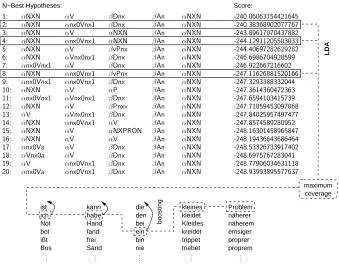
Figure 3 illustrates the rearrangements of the ambigu-ously typed sentence ich habe ein kleines Problem (“I
have a little problem”). The three marked hypotheses all
have a maximum coverage of 5, i.e. all supertags have their dependency slots filled, whereas the other hypothe-ses have coverages less than 5. One can see that lo-cal word probabilities would suggest ist kann die kleines
Problem (“is can the little problem”). The information
that is provided by the surviving hypotheses is used for additional final adjustments of the candidate lists to be presented to the user. We call this reordering process
2
We decided for LDA because it considers more syntactic knowledge than simple chunking techniques, while still being very efficient in comparison to full TAG parsing.
match list boosting, or shortly boosting (see Figure 3 for
an example).
4
Evaluation
For an evaluation of the techniques presented in the pre-vious section, the ambiguous typing of a sample text is simulated and processed with then-best supertagger. As performance criteria, the accuracy and the average rank of the correct word are compared to the values obtained from the baseline approach using the word frequencies from the CELEX lexical database (approx. 320 000 word
types). For this purpose, a lexicalized tree adjoining
grammar is needed because of the lightweight depen-dency analysis performed in the last step of then-best approach. The trigram HMM is directly trained on a cor-pus that is annotated with supertags.
N−Best Hypotheses: Score: maximum coverage LDA ich Not bot ißt Bus habe Hand fand frei Sand kleidet Kleides kreidet trippet triebet näherer näherem emsiger proprer proprem den bei ein kann die bin nie
ist kleines Problem
boosting 1: 2: 3: 4: 5: 6: 7: 8: 9: 10: 11: 12: 13: 14: 15: 16: 17: 18: 19: 20: αNXN αNXN αNXN αNXN αNXN αNXN αnx0Vnx1 αNXN αnx0Vnx1 αNXN αnx0Vnx1 αNXN αV αNXN αNXN αNXN αnx0Va αVnx0a αV αnx0Va αV αnx0Vnx1 αV αnx0Vnx1 αV αVnx0nx1 αV αnx0Vnx1 αnx0Vnx1 αV αVnx0nx1 αV αVnx0nx1 αnx0Vnx1 αV αV αV αV αnx0Vnx1 αnx0Vnx1 βDnx βDnx αNXN αNXN βvPnx βDnx βDnx βvPnx βDnx αP βDnx βPnxv βDnx αV αNXPRON αV βDnx βDnx βDnx βDnx αNXN αNXN αNXN αNXN αNXN αNXN αNXN αNXN αNXN αNXN αNXN αNXN αNXN αNXN αNXN αNXN αNXN αNXN αNXN αNXN -240.06063154421645 -240.38368902077767 -243.89617070437882 -244.12911205503033 -244.40697282629282 -246.6986704928599 -246.922667216602 -247.11626881520166 -247.3293388332044 -247.3614360472363 -247.6594103415739 -247.71859453097068 -247.84025957497477 -247.8574589280952 -248.16301458965847 -248.19436643686464 -248.53326733917402 -248.6975767283041 -248.77906034631118 -248.93993895577637 βAn βAn βAn βAn βAn βAn βAn βAn βAn βAn βAn βAn βAn βAn βAn βAn βAn βAn βAn βAn ... ... ... ... ...
Figure 3: Example for rearranging word hypotheses according to the results of supertagging and LDA.
amount of time. On a 1.4GHz AMD Athlon, the eval-uation of the reference test set needs approx. 10.58s for
n = 250, i.e. 423ms per sentence. The adjustments of
the match lists can therefore be performed in real-time for smaller values ofn.
Coping with unknown words in ambiguous typing is a more complicated problem. If the word is not in the dic-tionary, it has to be disambiguated letter by letter for all the keys of the code. Since the primary goal was not to simulate a specific keyboard but to evaluate whole sen-tences with then-best supertagging framework, the dic-tionary was patched by adding the unknown words with a zero-frequency and thus contained all words of the cor-pus.
4.1 Baseline
The baseline results are achieved with the simple uni-gram approach where the frequencies of the words that are stored in the lexicon order the candidate list in de-scending order, i.e. with highest frequency first. As eval-uation criteria, the accuracy of rank r and the average
match position is chosen. More formally, let
fr(w|c) =
1 ifw∈matches(c)∧rank(w) =r
0 else
(5) be a binary function that returns 1 if a disambiguated tar-get wordwcorrectly occurs on therthposition of the can-didate list of its codec, which is given bymatches(c).
Reference test set evaluation,r¯= 3.02
r= 1 r= 2 r= 3 r= 4 r= 5
acc(r)[%] 50.26 28.04 5.29 7.41 1.59
[image:5.612.137.476.70.337.2]cac(r)[%] 50.26 78.30 83.59 91.00 92.59
Table 1: The baseline results of ambiguously typing the test corpus.
For a test corpus containing a total ofN words, the
ac-curacy of rankr for the given corpus can be computed
as
acc(r) =
wfr(w|c)
N . (6)
For a cumulative accuracy, i.e. where the target words appear within the firstrranks of the candidate lists, the single accuracy values are summed:
cac(r) =
r
i=1
acc(i). (7)
The second evaluation measure is the average rank of words of the test corpus. It is simply computed by
¯
r=
wrank(w)
N . (8)
Reference test set evaluation (a) Average forn= 1, . . . ,1000,r¯= 2.18
r= 1 r= 2 r= 3 r= 4 r= 5
acc(r)[%] 61.84 23.01 1.84 8.38 0.55
cac(r)[%] 61.84 84.85 86.69 95.07 95.62
Single best results (b)
Overall best forn= 592,r¯= 2.11 (b.1)
acc(r)[%] 66.67 18.52 1.59 8.47 0.53
cac(r)[%] 66.67 85.19 86.78 95.25 95.78 Best accuracy/time trade-off forn= 250,¯r= 2.16 (b.2)
acc(r)[%] 61.90 22.75 2.12 8.47 0.53
cac(r)[%] 61.90 84.65 86.77 95.24 95.77
Trigram experiment (c)
Average forn= 1, . . . ,1000,r¯= 2.91
acc(r)[%] 60.01 19.64 4.09 6.59 2.26
cac(r)[%] 60.01 79.65 83.74 90.33 92.59
Upper bound experiment (d)
Average forn= 1, . . . ,1000,r¯= 2.11
acc(r)[%] 68.07 16.92 1.85 8.22 0.55
[image:6.612.73.298.70.281.2]cac(r)[%] 68.07 84.99 86.84 95.07 95.62
Table 2: The improved results using then-best supertag-ger/LDA system and additional experiments with tri-grams and an upper bound.
rank expectation for the reference test set is 3, i.e. the user has to scroll two times on average before selecting the desired word.
4.2 N-best system
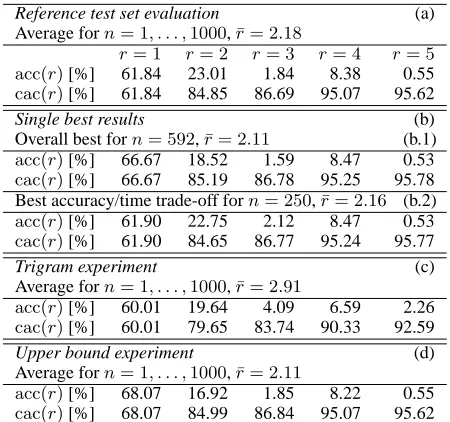
This section reports on the improvements obtained with the system using the n-best supertagger and additional LDA. The results show that the approach yields better rankings than the simple word-wise prediction method (baseline) and also outperforms a trigram language model. The overall results are shown in Table 2. The first part (a) shows the values computed for the reference test set, namely the average for the full evaluation runs with hypothesis sizes ranging from 1 to 1000. When compar-ing the values to those in Table 1, a significant improve-ment for the reference test set is visible. The cumulative accuracy of rank 1 raises by approx. 12%, i.e. 61.8% of the target words are now placed on top of the candidate lists. For the other ranks, the improvement is not as big as for rank 1, but there is still a significant increase. With then-best approach, 95.6% are placed within the top 5 ranks, whereas the average rank drops down to 2.18. The overall best run of this evaluation session is given in (b.1).
The maximum occurred for the hypothesis sizen= 592,
i.e. the 592 best supertag sequence hypotheses for the ambiguously coded sentences are used for adjusting the candidate lists. This result also shows that the biggest variation takes place for rank 1. The changes in cumu-lative accuracy for ranks≥ 2 are very small for larger
values of n. The graphs in Figure 4 give an overview
on the differences between then-best approach and the
baseline and also show the slightly better performance of A* search when compared to greedy search.
As can be seen in all graphs, enhancing the search from 1-best (Viterbi) ton-best has the largest effect for values ofn <250. After approx. 250 hypotheses, the results do not improve significantly, at least for higher cumulative ranks. In general, a hypothesis size ofn= 250(cf. Ta-ble 2 (b.2)) shows good results since the value forcac(5)
does not increase any more forn≥250and the
compu-tation time is quite fast.
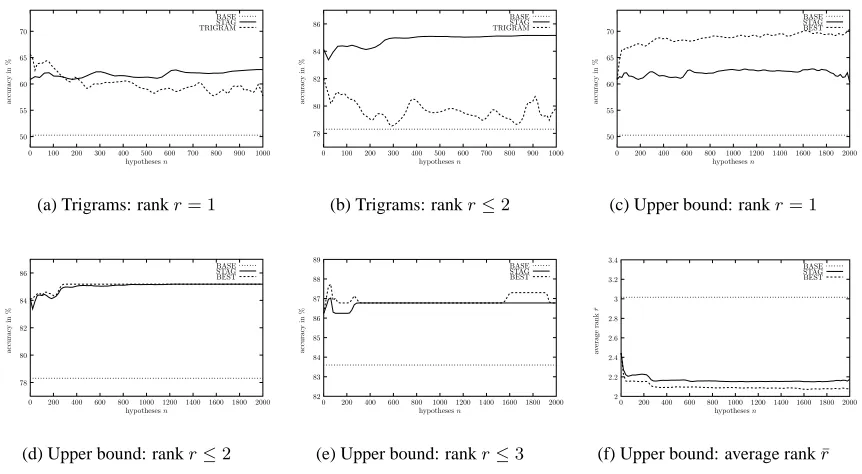
Another method of evaluating then-best supertagger is the possibility to look at the target words of the sentences that are typed ambiguously and use only the hypotheses that match closest for adjusting the candidate lists (cf. re-sults in Table 2 (d)). Clearly, this procedure is illegal for an objective evaluation since we are already looking at the desired result we want to achieve, but nevertheless it gives an upper bound of what accuracy then-best su-pertagger can theoretically reach by just picking the most promising hypotheses. The detailed evaluation graphs are given in Figure 5. As can be seen, the accuracy between the two approaches differs only for lower ranks (cf. (c)), while for higher ranks (cf. (d) and (e)), the graphs are nearly identical. This means that for the higher rank ac-curacy, then-best supertagger already performs in an op-timal way for the reference test set and it actually cannot get any better with this kind of training material. It is as-sumed that with a larger training corpus and thus better language model, the rankings can be further improved.
An interesting constellation is revealed in Figure 5 (a) where the trigram approach outperforms supertagging for lower hypothesis sizes considering rank 1, whereas the accuracy cannot compete for higher ranks (cf. (b)). This is possibly due to the sparseness of data, i.e. the few learned estimations lead to overproportionally many mis-classifications for a small hypothesis search space. This claim has to be verified on the basis of more data.
5
Conclusion
In this paper, we have presented a sentence-wise
predic-tive typing method based on ann-best Hidden Markov
50 55 60 65 70
0 200 400 600 800 1000 1200 1400
accuracy
in
%
hypothesesn
BASE STAG GREEDY
(a) rankr= 1
78 80 82 84 86
0 200 400 600 800 1000 1200 1400
accuracy
in
%
hypothesesn
BASE STAG GREEDY
(b) rankr≤2
82 83 84 85 86 87 88 89
0 200 400 600 800 1000 1200 1400
accuracy
in
%
hypothesesn
BASE STAG GREEDY
(c) rankr≤3
90 91 92 93 94 95 96 97
0 200 400 600 800 1000 1200 1400
accuracy
in
%
hypothesesn
BASE STAG GREEDY
(d) rankr≤4
90 91 92 93 94 95 96 97
0 200 400 600 800 1000 1200 1400
accuracy
in
%
hypothesesn
BASE STAG GREEDY
(e) rankr≤5
2 2.2 2.4 2.6 2.8 3 3.2 3.4
0 200 400 600 800 1000 1200 1400
av
erage
ran
k
¯
r
hypothesesn
BASE STAG GREEDY
[image:7.612.99.524.97.334.2](f) average rankr¯
Figure 4: Backward search: A* vs. Greedy, cumulative accuracy for ranksr= 1, . . . ,5and average match positionr¯. BASE refers to the unigram baseline, STAG/GREEDY is the supertagging+LDA approach with A* and Greedy search, respectively.
50 55 60 65 70
0 100 200 300 400 500 600 700 800 900 1000
accuracy
in
%
hypothesesn
BASE STAG TRIGRAM
(a) Trigrams: rankr= 1
78 80 82 84 86
0 100 200 300 400 500 600 700 800 900 1000
accuracy
in
%
hypothesesn
BASE STAG TRIGRAM
(b) Trigrams: rankr≤2
50 55 60 65 70
0 200 400 600 800 1000 1200 1400 1600 1800 2000
accuracy
in
%
hypothesesn
BASE STAG BEST
(c) Upper bound: rankr= 1
78 80 82 84 86
0 200 400 600 800 1000 1200 1400 1600 1800 2000
accuracy
in
%
hypothesesn
BASE STAG BEST
(d) Upper bound: rankr≤2
82 83 84 85 86 87 88 89
0 200 400 600 800 1000 1200 1400 1600 1800 2000
accu
racy
in
%
hypothesesn
BASE STAG BEST
(e) Upper bound: rankr≤3
2 2.2 2.4 2.6 2.8 3 3.2 3.4
0 200 400 600 800 1000 1200 1400 1600 1800 2000
av
erage
ran
k
¯r
hypothesesn
BASE STAG BEST
(f) Upper bound: average rankr¯
[image:7.612.96.527.430.667.2]to be carried out in the future to prove this claim. As for future work, experiments should be carried out with an enhanced training corpus. Furthermore, a com-parison has to be performed with the sentence-wise ap-proach in (Rau and Skiena, 1996). Both systems have to deploy a 9-button keyboard, the LTAG underpinning the supertagging approach and the same lexicon. Under the current circumstances, a direct comparison is not possi-ble.
As it is known (see, e.g., (Baayen, 1991)) that high frequency words often only differ in one letter, and thus, remain highly competitive in all syntactic approaches, we are going to add semantic features (taken from WordNet (Miller, 1995)) to the supertags. We expect that rear-rangements in the prediction list according to semantic clusters will considerably improve the accuracy of pre-dictions.
References
R. Harald Baayen, Richard Piepenbrock, and L´eon Gu-likers. 1995. The CELEX lexical database (release 2). CD-ROM, Linguistic Data Consortium, University of Pennsylvania, PA, USA.
R. Harald Baayen. 1991. A stochastic process for word frequency distributions. In Proceedings of the 29th
Meeting of the Association for Computational Linguis-tics, pages 271–278, Berkeley, CA, USA.
Jens B¨acker and Karin Harbusch. 2002. Hidden Markov model-based supertagging in a user initiative dialogue
system. In Proceedings of the Sixth International
Workshop on Tree Adjoining Grammar and Related Frameworks (TAG+6), pages 269–278, Venice, Italy.
Srinivas Bangalore and Aravind K. Joshi. 1999. Su-pertagging: An approach to almost parsing.
Compu-tational Linguistics, 25(2):237–265.
Srinivas Bangalore. 2000. A lightweight dependency an-alyzer for partial parsing. Computational Linguistics, 6(2):113–138.
John G. Cleary and Ian H. Witten. 1984. Data compres-sion using adaptive coding and partial string matching.
IEEE Transactions on Communications, 32(4):396–
402.
Ann Copestake. 1997. Augmented and alternative NLP techniques for Augmentative and Alternative Commu-nication. In Proceedings of the ACL workshop on
Nat-ural Language Processing for Communication Aids,
pages 37–42, Madrid, Spain. Association for Compu-tational Linguistics.
John J. Darragh and Ian H. Witten. 1992. The Reactive
Keyboard. Cambridge Series on Human-Computer
In-teraction. Cambridge University Press.
Afsaneh Fazly and Graeme Hirst. 2003. Testing the ef-ficacy of part-of-speech information in word comple-tion. In (Harbusch et al., 2003), pages 9–16.
Karin Harbusch and Michael K¨uhn. 2003. Towards an adaptive communication aid with text input from am-biguous keyboards. In Proceedings of the 10th
Con-ference of the European Chapter of the Association for Computational Linguistics (EACL03), Conference Companion, pages 207–210, Budapest, Hungary.
Karin Harbusch, Michael K¨uhn, and Harald Trost, edi-tors. 2003. Proceedings of the Workshop on Language
Modeling for Text Entry Methods, Budapest, Hungary.
Association for Computational Linguistics.
Saˇsa Hasan. 2003. N-Best Hidden Markov Model
Supertagging for Typing with Ambiguous Keyboards.
Diploma thesis, Computer Science Department, Uni-versity of Koblenz-Landau, Koblenz, Germany.
Heidi Horstmann Koester and Simon P. Levine. 1994. Modeling the speed of text entry with a word predic-tion interface. IEEE Transacpredic-tions on Rehabilitapredic-tion
Engineering, 2(3):177–187.
Aravind K. Joshi and Yves Schabes. 1997. Tree Adjoin-ing Grammars. In Grzegorz Rozenberg and Arto Sa-lomaa, editors, Handbook of Formal Languages, vol-ume 3, pages 69–214. Springer, Berlin, Germany.
Cliff Kushler. 1998. AAC using a reduced keyboard. In
Proceedings of the Technology and Persons with Dis-abilities Conference 1998. Online document available
at http://www.csun.edu/cod/conf/1998/
proceedings/csun98_140.htm.
I. Scott MacKenzie, Hedy Kober, Derek Smith, Terry Jones, and Eugene Skepner. 2001. LetterWise: Prefix-based disabiguation for mobile text input. In
Proceed-ings of the 14th Annual ACM Symposium on User In-terface Software and Technology (UIST 2001), pages
111–120, Orlando, FL, USA.
Johannes Matiasek, Marco Baroni, and Harald Trost. 2002. FASTY — A multilingual approach to text
pre-diction. In K. Miesenberger, J. Klaus, and W.
Za-gler, editors, Computers Helping People with Special
Needs — Proceedings of the 8th International Con-ference ICCHP 2002, Linz, Austria, volume 2398 of Lecture Notes in Computer Science, pages 243–250,
Berlin, Germany. Springer.
Kathleen F. McCoy, Christopher A. Pennington, and Ar-lene Luberoff Badman. 1998. Compansion: From re-search prototype to practical integration. Natural
Lan-guage Engineering, 4(1):73–95.
George A. Miller. 1995. WordNet: A lexical database for English. Communications of the ACM, 38(11):39–41.
Harald Rau and Steven S. Skiena. 1996. Dialing for doc-uments: An experiment in information theory. Journal
of Visual Languages and Computing, 7:79–95.
Kumiko Tanaka-Ishii, Yusuke Inutsuka, and Masato Takeichi. 2002. Entering text with a four-button de-vice. In Proceedings of the 19th International
Con-ference on Computational Linguistics (COLING ’02),
pages 988–994, Taipei, Taiwan.