A Dynamic Oracle for Arc-Eager Dependency Parsing
Yoav Gold ber g
1J oakim N ivre
1,2 (1) Google Inc.(2) Uppsala University
[email protected], [email protected]
A
BSTRACTThe standard training regime for transition-based dependency parsers makes use of an oracle, which predicts an optimal transition sequence for a sentence and its gold tree. We present an improved oracle for the arc-eager transition system, which provides a set of optimal transitions for every valid parser configuration, including configurations from which the gold tree is not reachable. In such cases, the oracle provides transitions that will lead to the best reachable tree from the given configuration. The oracle is efficient to implement and provably correct. We use the oracle to train a deterministic left-to-right dependency parser that is less sensitive to error propagation, using an online training procedure that also explores parser configurations resulting from non-optimal sequences of transitions. This new parser outperforms greedy parsers trained using conventional oracles on a range of data sets, with an average improvement of over 1.2 LAS points and up to almost 3 LAS points on some data sets.
1 Introduction
The basic idea in transition-based dependency parsing is to define a nondeterministic transition system for mapping sentences to dependency trees and to perform parsing as search for the optimal transition sequence for a given sentence (Nivre, 2008). A key component in training transition-based parsers is anoracle, which is used to derive optimal transition sequences from gold parse trees. These sequences can then be used as training data for a classifier that approximates the oracle at parsing time in deterministic classifier-based parsing (Yamada and Matsumoto, 2003; Nivre et al., 2004), or it can be used to determine when to perform updates in online training of a beam search parser (Zhang and Clark, 2008).
Currently, such oracles work by translating a given tree to a static sequence of parser transitions which, if run in sequence, will produce the gold tree. Most transition systems, including the arc-eager and arc-standard systems described in Nivre (2003, 2004), exhibitspurious ambiguity
and map several sequences to the same gold tree. In such cases, the oracles implicitly define a canonical derivation order. We call such oraclesstatic, because they produce a single static sequence of transitions that is supposed to be followed in its entirety. Static oracles are usually specified as rules over individual parser configurations – if the configuration has properties
Xand the gold tree isY, then the correct transition isZ – giving the impression that they define a function from configurations to transitions. However, these rules are only correct for configurations that are part of the canonical transition sequence defined by the oracle. Thus, static parsing oracles are only correct as functions from gold-trees to transition sequences, and not as functions from configurations to transitions.
There are at least two limitations to training parsers using static oracles. First, because of spurious ambiguity, it is not clear that the canonical transition sequence proposed by the oracle is indeed the easiest to learn. It could well be the case that a different sequence which also leads to a gold tree is preferable. Second, it happens often in greedy deterministic parsing that the parser deviates from the gold sequence, reaching configurations from which the correct tree is not derivable. The static oracle does not provide any means of dealing with such deviations. The parser’s classifier is then faced with configurations which were not observed in training, and this often leads to a sequence of errors. It would be preferable for the parser to explore non-gold configurations at training time, thus mitigating the effect of error-propagation. In this paper, we introduce the concept of adynamicparsing oracle. Rather than defining a single static canonical transition sequence for producing a given gold tree, the dynamic oracle answers queries of the form: Is transitionZvalid in configurationXfor producing the best possible treeY? A key difference compared to a static oracle is that the dynamic oracle no longer forces a unique transition sequence in situations where multiple sequences derive the gold tree. In this case, the dynamic oracle permits all valid transition sequences by answering “yes” on more than one transitionZin a given configuration.1The second crucial difference
to a static oracle is that the dynamic oracle defined in this work is well-defined and correct forallconfigurations, including configurations which are not a part of a gold derivation. For configurations which are not part of a gold derivation (and from which the gold tree is not reachable), the dynamic oracle permits all transitions that can lead to a tree with minimum loss compared to the gold tree. In this paper, we provide a provably correct dynamic oracle for the arc-eager transition system of Nivre (2003, 2008).
One important use for a dynamic oracle is in training a parser that (a) is not restricted to a
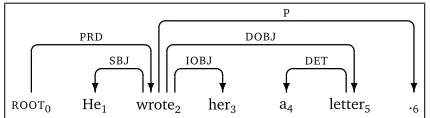
ROOT0 He1
✞ ☎
❄ SBJ
wrote2
✞ ☎
❄ PRD
her3
✞ ☎
❄ IOBJ
a4
✞ ☎
❄ DET
letter5
✞ ☎
❄ DOBJ
.6 ❄
[image:3.420.110.325.70.129.2]✞ P ☎
Figure 1: Projective dependency tree
particular canonical order of transitions and (b) can handle configurations that are not part of any gold sequence, thus mitigating the effect of error propagation. To this end, we provide an online training procedure based on the dynamic oracle that deals with spurious ambiguity by treating all sequences leading to a gold tree as correct, and with error-propagation by exploring transition sequences that are not optimal in the sense that they do not derive the gold tree, while training the parser to perform the optimal transitions on these non-optimal configurations. We show that both of these properties improve the accuracy of a deterministic left-to-right arc-eager parser by over 1.2 LAS points on average and up to almost 3 LAS points on some data sets, as compared to the conventional training procedure.
2 Background
2.1 Arc-Eager Transition-Based Dependency Parsing
Given a setLof dependency labels, we define adependency graphfor a sentencex=w1, . . . ,wn
as a labeled directed graphG= (Vx,A), consisting of a set of nodesVx={0, 1, . . . ,n}, where
each nodeicorresponds to the linear position of a wordwi in the sentence, plus an extra
artificial root node 0, and a set of labeled arcsA⊆Vx×L×Vx, where each arc(i,l,j)represents
a dependency with headwi, dependentwj, and labell. In order for a dependency graph to
be well-formed, we usually require it to be adependency tree, which is a directed spanning tree rooted at the node 0. In this paper, we further restrict our attention to dependency trees that areprojective, that is, where the presence of an arc(i,l,j)entails that there is directed path fromito every nodeksuch that min(i,j)<k<max(i,j). Figure 1 shows a projective dependency tree for a simple English sentence.
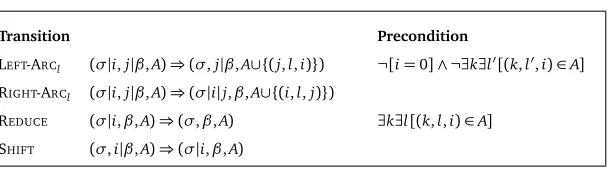
In the arc-eager transition system of Nivre (2003), aparser configurationis a triplec= (Σ,B,A) such thatΣ(referred to as thestack) andB(thebuffer) are disjoint sublists of the nodesVxof
some sentencex, andAis a set of dependency arcs overVx(and some label setL); we take
the initial configuration for a sentencex=w1, . . . ,wnto becs(x) = ([0],[1, . . . ,n],{ }); and we
take a terminal configuration to be any configuration of the formc= (Σ,[ ],A)(for any stackΣ and arc setA).2There are four types oftransitions, defined formally in Figure 2, for going from
one configuration to the next:
1. A LEFT-ARCltransition (for any dependency labell) adds the arc(b,l,s)toA, wheresis
the node on top of the stack andbis the first node in the buffer, and pops the stack. It has as a precondition that the tokensis not the artificial root node 0 and does not already have a head.
Transition Precondition
LEFT-ARCl (σ|i,j|β,A)⇒(σ,j|β,A∪{(j,l,i)}) ¬[i=0]∧ ¬∃k∃l′[(k,l′,i)∈A]
RIGHT-ARCl (σ|i,j|β,A)⇒(σ|i|j,β,A∪{(i,l,j)})
[image:4.420.58.363.66.151.2]REDUCE (σ|i,β,A)⇒(σ,β,A) ∃k∃l[(k,l,i)∈A] SHIFT (σ,i|β,A)⇒(σ|i,β,A)
Figure 2: Transitions for the arc-eager transition system
2. A RIGHT-ARCltransition (for any dependency labell) adds the arc(s,l,b)toA, wheresis
the node on top of the stack andbis the first node in the buffer, and pushes the nodeb
onto the stack.
3. The REDUCEtransition pops the stack and is subject to the preconditions that the top
token has a head.
4. The SHIFTtransition removes the first node in the buffer and pushes it onto the stack.
Atransition sequencefor a sentencex is a sequenceC0,m= (c0,c1, . . . ,cm)of configurations,
such thatc0is the initial configurationcs(x),cmis a terminal configuration, and there is a legal
transitiontsuch thatci=t(ci−1)for everyi, 1≤i≤m. The dependency graph derived byC0,m
isGcm= (Vx,Acm), whereAcmis the set of arcs incm. The arc-eager system is sound and complete
for the class of projective dependency forests, meaning that every legal transition sequence derives a projective dependency forest (soundness) and that every projective dependency forest is derived by at least one transition sequence (completeness) (Nivre, 2008). A projective dependency forest is a dependency graph where every connected component is a projective tree, with the special case of a projective dependency tree in case there is only one connected component. Hence, the arc-eager transition system is also complete (but not sound) for the class of projective dependency trees.
2.2 Static Oracles for Transition-Based Parsing
In the transition-based framework, parsing is implemented as search for an optimal transition sequence, that is, a transition sequence that derives the correct parse tree for a given sentence. The simplest version of this, and also the most efficient, is to train a classifier to predict the single best transition in each configuration and use a greedy deterministic procedure to derive a single dependency graph, which results in linear-time parsing provided that each transition can be predicted and executed in constant time (Nivre, 2003, 2008). The classifier is trained on a set of configuration-transition pairs, which can be derived from a dependency treebank by finding an optimal transition sequence for each sentencexwith gold treeGgold= (Vx,Agold).
Algorithm 1 defines the standard oracle function used to find the next transition tfor a configurationcand gold treeGgold= (Vx,Agold). This algorithm is provably correct in the sense
that, for every sentencexand projective dependency treeGgold= (Vx,Agold), if we initializec
tocs(x)and repeatedly execute the oracle transition, then we derive exactlyGgold= (Vx,Agold)
Algorithm 1Standard oracle for arc-eager dependency parsing
1: ifc= (σ|i,j|β,A)and(j,l,i)∈Agoldthen 2: t←LEFT-ARCl
3: else ifc= (σ|i,j|β,A)and(i,l,j)∈Agoldthen 4: t←RIGHT-ARCl
5: else ifc= (σ|i,j|β,A)and∃k[k<i∧ ∃l[(k,l,j)∈Agold∨(j,l,k)∈Agold]]then 6: t←REDUCE
7: else
8: t←SHIFT 9: returnt
The first is that it ignores spurious ambiguity in the transition system, that is, cases where a given dependency tree can be derived in more than one way. The dependency tree in Figure 1 is derived by two distinct transition sequences:3
(1) SH, LASBJ, RAPRD, RAIOBJ, SH, LADET, RE, RADOBJ, RE RAP
(2) SH, LASBJ, RAPRD, RAIOBJ, RE, SH, LADET, RADOBJ, RE RAP
Algorithm 1 will predict (1) but not (2). More generally, whenever there is a SH-RE ambiguity, which is the only ambiguity that exists in the arc-eager system, the oracle prediction will always be SH. In this way, the oracle implicitly defines a canonical transition sequence for every tree. The second limitation is that we have no guarantee for what happens if we apply the oracle to a configuration that does not belong to the canonical transition sequence. In fact, it is easy to show that the oracle prediction in such cases can be suboptimal. For example, suppose that we erroneously choose the SH transition instead of RAIOBJafter the first three transitions in
sequence (1). This results in the following parser configuration:
([0, 2, 3],[4, 5, 6],{(0,PRD, 2),(2,SBJ, 1)})
Starting from this configuration, the oracle defined by Algorithm 1 will predict SH, LADET,
SH, SH, which derives the dependency graph in the left-hand side of Figure 3. Using labeled attachment score to measure loss, this graph has a loss of 3 compared to the correct tree in Figure 1, since it fails to include the arcs(2,IOBJ, 3),(2,DOBJ, 5),(2,P, 6).4 However, if we
instead apply the transitions SH, LADET, LADET, RADOBJ, RE, RAP, we end up with the tree in the
right-hand side of Figure 3, which only has a loss of 1.
We say that Algorithm 1 defines astaticoracle, because it produces a single static sequence of transitions that is supposed to be followed in its entirety. The main contribution of this paper is the notion of adynamicoracle, which does not presuppose a single canonical transition sequence for each dependency tree and which can dynamically adapt to arbitrary configurations that arise during parsing and still make optimal predictions.
3To save space, we sometimes use the following abbreviations: LA
l=LEFT-ARCl, RAl=RIGHT-ARCl, RE=REDUCE, SH=SHIFT.
ROOT0 He1 ✞ ☎ ❄ SBJ wrote2 ✞ ☎ ❄ PRD
her3 a4
✞ ☎
❄ DET
letter5 .6 ROOT0 He1
✞ ☎ ❄ SBJ wrote2 ✞ ☎ ❄ PRD her3 ✞ ☎ ❄ DET a4 ✞ ☎ ❄ DET letter5 ✞ ☎ ❄ DOBJ .6 ❄
[image:6.420.51.356.69.121.2]✞ P ☎
Figure 3: Dependency graphs with loss 3 (left) and loss 1 (right)
3 Dynamic Parsing Oracles
We want to define an oracle that (a) allows more than one transition sequence for a given tree and (b) makes optimal predictions in all configurations (not only configurations that are part of a globally optimal transition sequence). It follows from the first requirement that the oracle should define arelationfrom configurations to transitions, rather than a function, and we will represent it as a boolean functiono(t;c,Ggold), which returnstruejust in casetis optimal inc
relative toGgold. But what does it mean for a transition to be optimal?
Intuitively, a transitiontis optimal if it does not commit us to a parsing error, which we take to mean that the best dependency tree reachable fromcis also reachable fromt(c). Consider the set of all dependency trees that are reachable fromc. From this set, we pick the set of trees that minimize some loss function relative toGgoldand say thattis optimal if and only if at least
one tree in this set is still reachable fromt(c). More precisely, we define thecostoftto be the difference in loss between the best tree reachable incand the best tree reachable int(c)and say thattis optimal if it has zero cost. In the special case where the gold treeGgoldis reachable
fromc, the set of trees that minimize the loss function is the singleton set containingGgold,
which entails thattis optimal if and only ifGgoldis still reachable fromt(c). Let us now try to make this precise.
3.1 Defining the Oracle
First, we define thelossL(G,Ggold)of a dependency graphG= (Vx,A)with respect to the gold
treeGgold= (Vx,Agold)to be the number of arcs that are inGgoldbut not inG:
L(G,Ggold) =|Agold\A|
We then say that a dependency graphG= (Vx,A)for a sentencexisreachablefrom a
non-terminal configurationcforx, writtenc Gif and only if there is a non-empty sequence of
transitionst1, . . . ,tmsuch that[tm◦ · · · ◦t1](c) = (Σ,[],A)andG= (Vx,A).
Next, we define thecostC(t;c,Ggold)of the transitiontin the configurationcrelative to the
gold treeGgoldas the loss difference between the minimum loss tree reachable before and after
the transition:
C(t;c,Ggold) =
min
G:t(c) GL(G,Ggold)
−min
G:c GL(
G,Ggold)
Note that, by definition, there must be at least one zero cost transition for every configurationc
and gold treeGgold. To see why, letGbe some dependency graph with minimum loss reachable
Finally, we define the oracleo(t;c,Ggold)to returntruejust in casethas zero cost relative toc
andGgold:
o(t;c,Ggold) =
¨
true ifC(t;c,Ggold) =0
false otherwise
3.2 A Dynamic Oracle for Arc-Eager Parsing
In order to implement the dynamic oracle in practice, we need an efficient method for com-puting the cost of each transition in a given configuration. A key property of the arc-eager system (stated here without proof) is that a dependency graphG= (Vx,A)is reachable from a
configurationcifGis a projective forest and if each individual arc inAis reachable inc. In the Arc-Eager system, an arc(i,l,j)is reachable inc= (Σ,B,A′)if either(i,l,j)is already inA′ (since arcs can never be removed) or if min(i,j)is inΣorB, max(i,j)is inB, and there is no arc inAthat already assigns a head toj(since it is always possible to reach a later configuration where min(i,j)is at the top of the stack and max(i,j)is at the head of the buffer, in which case the arc can be added in a LEFT-ARClor RIGHT-ARCltransition).
Given that our loss function (and hence our cost function) also decomposes into the loss of individual arcs, we can compute the cost of each transition by simply counting the gold arcs that are no longer reachable after that transition. We do this on a case by case basis. In all the cases, we assume a configurationcof the formc= (σ|s,b|β,A).5
• C(LEFT-ARCl;c,Ggold): Adding the arc(b,l,s)and poppingsfrom the stack means thats
will not be able to acquire any head or dependents inβ. The cost is therefore the number
of arcs inAgoldof the form(k,l′,s)or(s,l′,k)such thatk∈β. Note that the cost is 0 for
the trivial case where(b,l,s)∈Agold, but also for the case wherebis not the gold head of sbut the real head is not inβ(due to an erroneous previous transition) and there are no
gold dependents ofsinβ.6
• C(RIGHT-ARCl;c,Ggold): Adding the arc(s,l,b)and pushingbonto the stack means that
bwill not be able to acquire any head inσorβ, nor any dependents inσ. The cost is
therefore the number of arcs inAgoldof the form(k,l′,b), such thatk∈σork∈β, or of
the form(b,l′,k)such thatk∈σ. Note again that the cost is 0 for the trivial case where
(s,l,b)∈Agold, but also for the case wheresis not the gold head ofbbut the real head is
not inσorβ(due to an erroneous previous transition) and there are no gold dependents ofbinσ.
• C(REDUCE;c,Ggold): Poppingsfrom the stack means thatswill not be able to acquire any dependents inb|β. The cost is therefore the number of arcs inAgoldof the form
(s,l′,k)such thatk∈b|β. While it may seem that a gold arc of the form(k,l,s)should be
accounted for as well, note that a gold arc of that form, if it exists, is already accounted for by a previous (erroneous) RIGHT-ARCltransition whensacquired its head.
• C(SHIFT;c,Ggold): Pushingbonto the stack means thatbwill not be able to acquire any head or dependents ins|σ. The cost is therefore the number of arcs inAgoldof the form
(k,l′,b)or(b,l′,k)such thatk∈s|σ.
5This is a slight abuse of notation, since for the SHIFTtransitionsmay not exist, and for the REDUCEtransitionbmay not exist.
C(LAl;c= (σ|s,b|β,A),Gg) =
{(k,l′,s)∈A
g|k∈β} ∪ {(s,l′,k)∈Ag|k∈β}
C(RAl;c= (σ|s,b|β,A),Gg) =
{(k,l′,b)∈A
g|k∈σ∨k∈β} ∪ {(b,l′,k)∈Ag|k∈σ}
C(RE;c= (σ|s,β,A),Gg) =
{(s,l′,k)∈A g|k∈β}
C(SH;c= (σ,b|β,A),Gg) =
{(k,l′,b)∈A
g|k∈σ} ∪ {(b,l′,k)∈Ag|k∈σ}
Figure 4: Transition costs for the arc-eager transition system with gold treeGg= (Vx,Ag).
The computation of transition costs is summarized in Figure 4. We can now return to the example in Section 2.2 and analyze the behavior of the static oracle in the presence of erroneous transitions. In the example there, the last two SHIFTtransitions predicted by the static oracle
each has a cost of 1, because they each lose an arc going into the first word of the buffer. By contrast, the transition LEFT-ARCDETin place of the first SHIFThas a cost of 0, despite the fact
that the arc(5,DET, 3)is not in the gold tree, because it does not eliminate any gold arc that is
still reachable – the cost of the incorrect attachment is already accounted for in the cost of the erroneous SHIFTaction.
After defining the concept of adynamic oraclewhich is correct over the entire configuration space of a transition system and providing a concrete instantiation of it for the arc-eager transition system, we now go on to present one useful application of such an oracle.
4 Training Parsers with the Dynamic Oracle
Greedy transition-based parsers trained with static oracles are known to suffer from error propagation (McDonald and Nivre, 2007). We may hope to mitigate the error propagation problem by letting the parser explore larger portions of the configuration space during training and learn how to behave optimally also after committing previous errors. While this is not possible with the usual static oracles, the dynamic oracle defined above allows us to do just that, as it returns a set of optimal transitions for each possible configuration.
Algorithm 2 is a standard online training algorithm for transition-based dependency parsers using a static oracle. Given a training sentencexwith gold treeGgold, it starts in the initial
configurationcs(x)and repeatedly predicts a transitiontpgiven its current feature weightsw
and compares this to the transitiontopredicted by the static oracle. If the model prediction is
different from the oracle prediction, the feature weights are updated, but the new configuration is always derived using the oracle transition (line 10), which means that only configurations in the canonical oracle-induced transition sequence are explored.7
Algorithm 3 is a modification of the standard algorithm which makes use of the dynamic oracle to explore a larger part of the configuration space. The first difference is in line 7, where the new algorithm, instead of getting the single prediction of the static oracle, gets the set of
Algorithm 2Online training with a static oracle
1: w←0
2: forI=1→ITERATIONSdo
3: forsentencexwith gold treeGgoldin corpusdo 4: c←cs(x)
5: whilecis not terminaldo
6: tp←arg maxtw·φ(c,t) 7: to←o(c,Ggold) 8: iftp6=tothen
9: w←w+φ(c,to)−φ(c,tp) 10: c←to(c)
11: return w
transitions that have zero cost according to the dynamic oracle. The weight update is then performed only if the model prediction does not have zero cost (lines 9–10), which means that updates no longer need to reflect a single canonical transition sequence. Finally, the transition used to update the parser configuration is no longer the single transition predicted by the static oracle, but a transition that is chosen by the functionCHOOSE_NEXT, which may be a transition
that does not have zero-cost (lines 11-12). In our current implementation,CHOOSE_NEXTis
conditioned on the predicted transitiontp, the set of zero cost transitions, and the iteration
number. However, more elaborate conditioning schemes are also possible.
We propose two versions of theCHOOSE_NEXTfunction. In the first version,CHOOSE_NEXTAMB, the
training algorithm only follows optimal (zero cost) transitions but permits spurious ambiguity by following the model predictiontpif this has zero cost and a random zero cost transition
otherwise. In the second version,CHOOSE_NEXTEXP, the training algorithm also explores
non-optimal transitions. More precisely, after the firstktraining iterations, it follows the model predictiontpregardless of its cost in 100(1-p)% of the cases and falls back onCHOOSE_NEXTAMB
in the remaining cases. It is worth noting that Algorithm 3 subsumes Algorithm 2 as a special case if we defineZERO_COSTto contain only the predictiontoof the static oracle, and define CHOOSE_NEXTto always returnto.
The novel training algorithm presented here is based on perceptron learning.8 Since the
dynamic oracle provides a cost for every transition-configuration pair, it could be used also for cost-sensitive learning. Our preliminary attempts with cost-sensitive learning through the max-loss and prediction-based passive-aggressive algorithms of Crammer et al. (2006) show that the cost-sensitive variants of the algorithms indeed improve upon the non-cost-sensitive variants. However, the best passive-aggressive results were still significantly lower than those obtained using the averaged perceptron. We do not elaborate on cost-sensitive training in this work, and leave this direction for future investigation.
5 Experiments
We present experiments comparing greedy arc-eager transition-based parsers trained (a) using the static oracle (Algorithm 2), (b) using the dynamic oracle with spurious ambiguity (Al-gorithm 3 withCHOOSE_NEXTAMB), and (c) using the dynamic oracle with spurious ambiguity
Algorithm 3Online training with a dynamic oracle
1: w←0
2: forI=1→ITERATIONSdo
3: forsentencexwith gold treeGgoldin corpusdo 4: c←cs(x)
5: whilecis not terminaldo
6: tp←arg maxtw·φ(c,t)
7: ZERO_COST← {t|o(t;c,Ggold) =true} 8: to←arg maxt∈ZERO_COSTw·φ(c,t) 9: iftp6∈ZERO_COSTthen
10: w←w+φ(c,to)−φ(c,tp) 11: tn←CHOOSE_NEXT(I,tp,ZERO_COST) 12: c←tn(c)
13: return w
1: functionCHOOSE_NEXTAMB(I,t,ZERO_COST) 2: ift∈ZERO_COSTthen
3: returnt 4: else
5: returnRANDOM_ELEMENT(ZERO_COST)
1: functionCHOOSE_NEXTEXP(I,t,ZERO_COST) 2: ifI>kandRAND()>pthen 3: returnt
4: else
5: returnCHOOSE_NEXTAMB(I,t,ZERO_COST)
and non-optimal transitions (Algorithm 3 withCHOOSE_NEXTEXP). We evaluate the models on a
wide range of English data sets, as well as the data sets from the CoNLL 2007 shared task on multilingual dependency parsing (Nivre et al., 2007).
The parser is a greedy transition-based parser using the arc-eager transition system of Nivre (2003, 2008) with the feature representations defined by Zhang and Nivre (2011). As our primary goal is to compare the training methods, and not to achieve the highest possible score for each data set, we use the exact same feature representations and training parameters across all experiments. Specifically, we train an averaged perceptron model for 15 iterations. When usingCHOOSE_NEXTEXP, we setk=2 andp=0.1, meaning that the algorithm allows
non-optimal transitions in 90% of the cases, starting from the third training iteration. Note that many of these transitions will nevertheless be correct, as the first training iterations already put the model in a good region of the parameter space.
WSJ22 WSJ23 BNC BRN FTBL QTB ANS EML GRPS REVS BLGS Unlabeled Attachment Scores
Static 90.31 89.88 82.79 85.11 78.85 86.80 78.81 79.23 81.21 80.61 83.40 Dynamic-ambiguity 90.42 90.18 82.98 85.41 79.36 87.29 79.19 79.56 81.18 80.96 83.61 Dynamic-explore 91.24 90.96 84.17 86.22 80.04 87.50 80.21 80.04 82.08 81.81 84.72
Labeled Attachment Scores
Static 87.88 87.69 78.47 81.15 74.69 73.69 73.60 74.95 77.15 75.87 79.66 Dynamic-ambiguity 87.95 87.83 78.69 81.47 75.05 73.91 73.90 75.29 77.16 76.19 79.91 Dynamic-explore 88.76 88.72 79.75 82.30 75.82 74.36 74.95 75.85 78.11 77.06 81.09
Table 1: Results on the English data sets
structured-perceptron tagger, trained on the entire training set.
•WSJ22: Section 22 of the Penn-WSJ Treebank (development set). •WSJ23: Section 23 of the Penn-WSJ Treebank (test set).
•BNC: 1,000 manually annotated sentences from the British National Corpus (Foster and van Genabith, 2008).
•BRN: The entire Brown Corpus (Kucera and Francis, 1967). •FTBL: The entire Football Corpus (Foster et al., 2011). •QB: The entire QuestionBank (Judge et al., 2006).
•ANS, EML, GRPS, REVS, BLGS: the question-answers, emails, newsgroups, reviews and weblogs portions of the English Web Treebank (Bies et al., 2012; Petrov and McDonald, 2012).
The CoNLL models are trained on the dedicated training set for each of the ten languages and evaluated on the corresponding test set, with gold standard part-of-speech tags in both cases. Since the arc-eager parser can only handle projective dependency trees, all trees in the training set are projectivized before training, using the baseline pseudo-projective transformation in Nivre and Nilsson (2005). However, non-projective trees are kept intact in the test sets for evaluation. We include all ten languages from the CoNLL 2007 shared task:
•ARA: Arabic (Hajiˇc et al., 2004) •BAS: Basque (Aduriz et al., 2003) •CAT: Catalan (Martí et al., 2007) •CHI: Chinese (Chen et al., 2003)
•CZE: Czech (Hajiˇc et al., 2001; Böhmová et al., 2003) •ENG: English (Marcus et al., 1993)
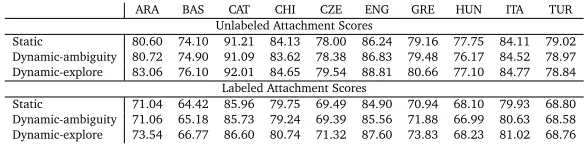
ARA BAS CAT CHI CZE ENG GRE HUN ITA TUR Unlabeled Attachment Scores
Static 80.60 74.10 91.21 84.13 78.00 86.24 79.16 77.75 84.11 79.02 Dynamic-ambiguity 80.72 74.90 91.09 83.62 78.38 86.83 79.48 76.17 84.52 78.97 Dynamic-explore 83.06 76.10 92.01 84.65 79.54 88.81 80.66 77.10 84.77 78.84
Labeled Attachment Scores
[image:12.420.55.349.70.143.2]Static 71.04 64.42 85.96 79.75 69.49 84.90 70.94 68.10 79.93 68.80 Dynamic-ambiguity 71.06 65.18 85.73 79.24 69.39 85.56 71.88 66.99 80.63 68.58 Dynamic-explore 73.54 66.77 86.60 80.74 71.32 87.60 73.83 68.23 81.02 68.76
Table 2: Results on the CoNLL 2007 data sets
• ITA: Italian (Montemagni et al., 2003)
• TUR: Turkish (Oflazer et al., 2003)
Table 1 gives the results for the English model, while Table 2 presents the multilingual evaluation. In both cases, we present unlabeled and labeled attachment scores excluding punctuation. For the English data sets, we see that adding spurious ambiguity (Dynamic-ambiguity) generally improves both labeled and unlabeled attachment scores by up to 0.5 percent absolute. The only exception is GRPS, where there is a small decrease in unlabeled attachment score. When the training procedure in addition explores non-optimal transitions (Dynamic-explore), the improvement is even greater, in some cases up to about 1.5 percentage points, which is quite substantial given that our baseline parser already performs at the state-of-the-art level for greedy deterministic transition-based parsers on English Stanford-dependencies.9
For the CoNLL data sets, results for the Dynamic-ambiguity condition are mixed causing a drop in accuracy for some data sets, but the Dynamic-explore condition makes up for it and brings substantial improvement in accuracy for all except two languages. We see very substantial improvements in both UAS and LAS for Arabic, Basque, Czech, English and Greek, as well as improvements for Catalan, Chinese and Italian. The average LAS improvement across all the CoNLL datasets is 1.5 LAS points. The only two exceptions are Hungarian and Turkish, where unlabeled attachment scores drop slightly as a result of not using the static oracle, and labeled attachment scores are practically unaffected. More analysis is needed to find out what is going on for these languages, but it is likely that results could be improved with language-specific tuning.10
Overall, the experimental results show a considerable improvement in the accuracy of determin-istic linear-time classifier-based dependency parsing through training procedures that explore a larger part of the search space than traditional methods based on static oracles.
9Note that the web data sets (ANS, EML, GRPS, REVS, BLGS) are annotated according to the Ontonotes corpus guidelines, which are somewhat different than the original Penn Treebank guidelines used in the training corpora. In particular, base-NPs in the web data sets are more nested. Our scores on these data sets are thus artificially lower than they could be. We could get better scores for these data sets for all training conditions by training on the Ontonotes corpora instead, but as our main concern is not in achieving the best scores, we opted for the simpler experimental setup.
6 Related Work
Deterministic classifier-based dependency parsing is an instance of independent sequential classification-based structured prediction. In sequential classification models, such as Maximum-Entropy Markov Models (McCallum et al., 2000), a structured output is produced by repeated application of a locally trained classifier, where each classification decision is conditioned on the structure created by previous decisions. Several methods have been developed to cope with error propagation in sequential classification, including stacked sequential learning (Cohen and Carvalho, 2005), LaSO (Daumé III and Marcu, 2005), Searn (Daumé III et al., 2009) and its followers SMILe (Ross and Bagnell, 2010) and DAgger (Ross et al., 2011).
While stacked learning is well suited for sequence prediction tasks such as tagging and chunking, it is not clear how to apply it to parsing.11Searn and the closely related DAgger algorithm are
more promising for dealing with the complexity of dependency parsing, but it appears that previous attempts to apply Searn-based learning to dependency parsing have been unsuccessful. A key component in the specification of a Searn learning algorithm is anoptimal policymapping states in the search space (such as parser configurations) to optimal outcomes (such as transi-tions). Attempts to approximate the optimal policy for parsing using static oracles are unlikely to work very well, since a static oracle is only correct for a small subset of the search space. The dynamic oracle introduced in this paper, which is correct for arbitrary parser configurations, can be used to define an optimal policy for Searn-based learning. Both Searn and DAgger require several complete training rounds over the entire data set and take a relatively long time to train. We instead use a simpler online algorithm which can be viewed as a stochastic approximation of the DAgger algorithm, which is itself heavily inspired by the Searn algorithm.
Recent work on beam search and structured prediction for transition-based dependency parsing has shown that parsing accuracy can be improved considerably if models are trained to perform beam search instead of greedy one-best search, and if training is done using a global structured learning objective instead of local learning of individual decisions (Zhang and Clark, 2008; Zhang and Nivre, 2011; Bohnet and Kuhn, 2012; Huang et al., 2012). Like our method, beam search with global structured learning mitigates the effects of error propagation by exploring non-canonical configurations at training time, but the use of a beam reduces parsing speed by a factor that is roughly proportional to the size of the beam, making parsing less efficient. Our method in contrast still trains classifiers to perform local decisions, and thus incurs no efficiency penalty at parsing time, but each local decision is trained to take into account the consequences of previous, possibly erroneous, decisions. Although we may not be able to reach the accuracy level of a beam-search parser, we show that a substantial improvement in accuracy is possible also for a purely deterministic classifier-based parser, making our method suitable for training accurate parsers in situations where maximum efficiency is needed, e.g., when there is a need to process very large corpora. Integrating our dynamic oracle in the training procedure for a transition-based parser with beam search is an interesting question for future work.
The work that probably comes closest to ours is Choi and Palmer (2011), who improve the accuracy of a greedy transition-based dependency parser through an iterative training procedure that they call bootstrapping. They start by training a classifier using a standard static oracle for a hybrid transition system combining elements of the arc-eager system and the algorithm of
Covington (2001). In a second step, they then use this classifier to parse the training corpus, creating one new training instance for every configuration visited during parsing, using an adapted version of the static oracle to predict the optimal transition for each configuration. They iterate this procedure as long as parsing accuracy improves on a held-out development set and report improvements in parsing accuracy of about 0.5 percent absolute for English and almost 2 percent absolute for Czech. The main difference compared to our approach, except for the fact that they use a different transition system, is that their method for finding the optimal transition after the first training round is heuristic and does not guarantee that the best parse is still reachable.
Finally, Cohen et al. (2012) tackle the problem of spurious ambiguity for static oracles by eliminating ambiguity from the underlying transition system instead of modifying the oracle. They show how this can be achieved for the arc-standard system of Nivre (2004) as well as the non-projective extension by Attardi (2006). It is still an open question whether their technique can also be applied to the arc-eager system targeted in this paper.
7 Conclusion
We have highlighted the shortcoming of traditional static oracles used to train transition-based dependency parsers, and instead proposed the notion of adynamic oracle, which allows more than one correct transition sequence in the case of spurious ambiguity, and which can predict an optimal transition also for non-optimal configurations. We have defined a concrete dynamic oracle for the arc-eager transition system and showed how it can be used in online training of greedy deterministic parsers.
Greedy deterministic transition-based dependency parsers are among the most efficient systems available for syntactic parsing of natural language. In terms of parsing accuracy, they perform near the state-of-the-art level for many languages but tend to suffer from prediction errors and subsequent error propagation. This problem can be mitigated by using our proposed training method. Experimental results for English show consistent improvements in parsing accuracy of up to almost 1.5 percent absolute on a wide range of data sets. Experimental results on the ten languages from the CoNLL 2007 shared task on dependency parsing show significant improvements of up to almost 3 LAS points for some languages, but there are also few cases where we see little or no improvement in parsing accuracy, a phenomenon that requires further investigation. Other topics for future research is the effective use of cost-sensitive learning instead of the perceptron loss used in this paper, the derivation of dynamic oracles for other transition systems, and utilizing the dynamic oracles in non-greedy settings, such as beam-search parsers.
References
Aduriz, I., Aranzabe, M. J., Arriola, J. M., Atutxa, A., Díaz de Ilarraza, A., Garmendia, A., and Oronoz, M. (2003). Construction of a Basque dependency treebank. InProceedings of the 2nd Workshop on Treebanks and Linguistic Theories (TLT), pages 201–204.
Attardi, G. (2006). Experiments with a multilanguage non-projective dependency parser. In
Proceedings of the 10th Conference on Computational Natural Language Learning (CoNLL), pages 166–170.
Böhmová, A., Hajiˇc, J., Hajiˇcová, E., and Hladká, B. (2003). The Prague Dependency Treebank: A three-level annotation scenario. In Abeillé, A., editor,Treebanks: Building and Using Parsed Corpora, pages 103–127. Kluwer.
Bohnet, B. and Kuhn, J. (2012). The best of bothworlds – a graph-based completion model for transition-based parsers. InProceedings of the 13th Conference of the European Chapter of the Association for Computational Linguistics, pages 77–87.
Chen, K., Luo, C., Chang, M., Chen, F., Chen, C., Huang, C., and Gao, Z. (2003). Sinica treebank: Design criteria, representational issues and implementation. In Abeillé, A., editor,
Treebanks, pages 231–248. Kluwer.
Choi, J. D. and Palmer, M. (2011). Getting the most out of transition-based dependency parsing. InProceedings of the 49th Annual Meeting of the Association for Computational Linguistics: Human Language Technologies, pages 687–692.
Cohen, S. B., Gómez-Rodríguez, C., and Satta, G. (2012). Elimination of spurious ambiguity in transition-based dependency parsing. Technical report.
Cohen, W. W. and Carvalho, V. R. (2005). Stacked sequential learning. InProceedings of the International Joint Conference on Artificial Intelligence, pages 671–676.
Covington, M. A. (2001). A fundamental algorithm for dependency parsing. InProceedings of the 39th Annual ACM Southeast Conference, pages 95–102.
Crammer, K., Dekel, O., Keshet, J., Shalev-Shwartz, S., and Singer, Y. (2006). Online passive-aggressive algorithms.Journal of Machine Learning Research, 7:551–585.
Czendes, D., Csirik, J., Guimóthy, and Kocsor, A. (2005).The Szeged Treebank. Springer. Daumé III, H., Langford, J., and Marcu, D. (2009). Search-based structured prediction.
Machine Learning, 75:297–325.
Daumé III, H. and Marcu, D. (2005). Learning as search optimization: Approximate large margin methods for structured prediction. InProceedings of the 22nd International Conference on Machine Learning, pages 169–176.
de Marneffe, M.-C., MacCartney, B., and Manning, C. D. (2006). Generating typed dependency parses from phrase structure parses. InProceedings of the 5th International Conference on Language Resources and Evaluation (LREC).
Foster, J., ÇetinoÄŸlu, O., Wagner, J., and van Genabith, J. (2011). Comparing the use of edited and unedited text in parser self-training. InProceedings of the 12th International Conference on Parsing Technologies, pages 215–219.
Foster, J. and van Genabith, J. (2008). Parser evaluation and the BNC: Evaluating 4 con-stituency parsers with 3 metrics. InProceedings of the 6th International Conference on Language Resources and Evaluation (LREC).
Hajiˇc, J., Smrž, O., Zemánek, P., Šnaidauf, J., and Beška, E. (2004). Prague Arabic Dependency Treebank: Development in data and tools. InProceedings of the NEMLAR International Conference on Arabic Language Resources and Tools.
Hajiˇc, J., Vidova Hladka, B., Panevová, J., Hajiˇcová, E., Sgall, P., and Pajas, P. (2001). Prague Dependency Treebank 1.0. LDC, 2001T10.
Hall, J., Nilsson, J., Nivre, J., Eryi˘git, G., Megyesi, B., Nilsson, M., and Saers, M. (2007). Single malt or blended? A study in multilingual parser optimization. InProceedings of the CoNLL Shared Task of EMNLP-CoNLL 2007, pages 933–939.
Huang, L., Fayong, S., and Guo, Y. (2012). Structured perceptron with inexact search. In
Proceedings of Human Language Technologies: The 2012 Annual Conference of the North American Chapter of the Association for Computational Linguistics (NAACL HLT).
Judge, J., Cahill, A., and van Genabith, J. (2006). Questionbank: Creating a corpus of parse-annotated questions. InProceedings of the 21st International Conference on Computational Linguistics and the 44th Annual Meeting of the Association for Computational Linguistics, pages 497–504. Association for Computational Linguistics.
Kucera, H. and Francis, W. N. (1967).Computational Analysis of Present-Day American English. Brown University Press.
Marcus, M. P., Santorini, B., and Marcinkiewicz, M. A. (1993). Building a large annotated corpus of English: The Penn Treebank.Computational Linguistics, 19:313–330.
Martí, M. A., Taule, M., Màrquez, L., and Bertran, M. (2007). CESS-ECE:
A multilingual and multilevel annotated corpus. Available for download from:
http://www.lsi.upc.edu/∼mbertran/cess-ece/.
Martins, A. F., Das, D., Smith, N. A., and Xing, E. P. (2008). Stacking dependency parsers. In
Proceedings of the Conference on Empirical Methods in Natural Language Processing (EMNLP), pages 157–166.
McCallum, A., Freitag, D., and Pereira, F. (2000). Maximum entropy markov models for information extraction and segmentation. InProceedings of the 17th International Conference on Machine Learning, pages 591–598.
McDonald, R. and Nivre, J. (2007). Characterizing the errors of data-driven dependency parsing models. InProceedings of the 2007 Joint Conference on Empirical Methods in Natural Language Processing and Computational Natural Language Learning (EMNLP-CoNLL), pages 122–131.
Montemagni, S., Barsotti, F., Battista, M., Calzolari, N., Corazzari, O., Lenci, A., Zampolli, A., Fanciulli, F., Massetani, M., Raffaelli, R., Basili, R., Pazienza, M. T., Saracino, D., Zanzotto, F., Nana, N., Pianesi, F., and Delmonte, R. (2003). Building the Italian Syntactic-Semantic Treebank. In Abeillé, A., editor,Treebanks: Building and Using Parsed Corpora, pages 189–210. Kluwer.
Nivre, J. (2004). Incrementality in deterministic dependency parsing. InProceedings of the Workshop on Incremental Parsing: Bringing Engineering and Cognition Together (ACL), pages 50–57.
Nivre, J. (2006).Inductive Dependency Parsing. Springer.
Nivre, J. (2008). Algorithms for deterministic incremental dependency parsing.Computational Linguistics, 34:513–553.
Nivre, J., Hall, J., Kübler, S., McDonald, R., Nilsson, J., Riedel, S., and Yuret, D. (2007). The CoNLL 2007 shared task on dependency parsing. InProceedings of the CoNLL Shared Task of EMNLP-CoNLL 2007, pages 915–932.
Nivre, J., Hall, J., and Nilsson, J. (2004). Memory-based dependency parsing. InProceedings of the 8th Conference on Computational Natural Language Learning (CoNLL), pages 49–56.
Nivre, J. and McDonald, R. (2008). Integrating graph-based and transition-based dependency parsers. InProceedings of the 46th Annual Meeting of the Association for Computational Linguistics (ACL), pages 950–958.
Nivre, J. and Nilsson, J. (2005). Pseudo-projective dependency parsing. InProceedings of the 43rd Annual Meeting of the Association for Computational Linguistics (ACL), pages 99–106.
Oflazer, K., Say, B., Hakkani-Tür, D. Z., and Tür, G. (2003). Building a Turkish treebank. In Abeillé, A., editor,Treebanks: Building and Using Parsed Corpora, pages 261–277. Kluwer.
Petrov, S. and McDonald, R. (2012). Overview of the 2012 shared task on parsing the web. In
Notes on the First Workshop on Syntatctic Analysis for Non-Canonical Language.
Prokopidis, P., Desypri, E., Koutsombogera, M., Papageorgiou, H., and Piperidis, S. (2005). Theoretical and practical issues in the construction of a Greek dependency treebank. In
Proceedings of the 3rd Workshop on Treebanks and Linguistic Theories (TLT), pages 149–160.
Ross, S. and Bagnell, J. A. (2010). Efficient reductions for imitation learning. InProceedings of the 13th International Conference on Artificial Intelligence and Statistics.
Ross, S., Gordon, G. J., and Bagnell, J. A. (2011). A reduction of imitation learning and structured prediction to no-regret online learning. InProceedings of the 14th International Conference on Artificial Intelligence and Statistics.
Yamada, H. and Matsumoto, Y. (2003). Statistical dependency analysis with support vector machines. InProceedings of the 8th International Workshop on Parsing Technologies (IWPT), pages 195–206.
Zhang, Y. and Clark, S. (2008). A tale of two parsers: Investigating and combining graph-based and transition-based dependency parsing. InProceedings of the Conference on Empirical Methods in Natural Language Processing (EMNLP), pages 562–571.