Quantum Double Models
Thesis by
Anna Kómár
In Partial Fulfillment of the Requirements for the
Degree of Doctor of Philosophy
CALIFORNIA INSTITUTE OF TECHNOLOGY
Pasadena, California
2018
© 2018
Anna Kómár
ORCID: 0000-0002-4701-4931
‘Would you tell me, please, which way I ought to go from here?’
‘That depends a good deal on where you want to get to,’ said the Cat.
‘I don’t much care where–’ said Alice.
‘Then it doesn’t matter which way you go,’ said the Cat.
‘–so long as I getsomewhere,’ Alice added as an explanation.
‘Oh, you’re sure to do that,’ said the Cat, ‘if only you walk long enough.’
ACKNOWLEDGEMENTS
I would like to thank John Preskill, for taking the risk of becoming my advisor, and for guiding my academic growth throughout the years. I could always count on his physical intuition and patience during our discussions. I thank Olivier Landon-Cardinal for being my mentor, for supporting me, both academically and personally, throughout the years; and for putting up with my trivial questions about physics. I thank my thesis committee: Xie Chen, Manuel Endres, Alexei Kitaev, and John Preskill for their valuable comments about the first version of this thesis, especially those regarding Chapter4.
I would like to thank my collaborators and colleagues: Kristan Temme, for helping me take my first steps as a researcher in the field; Elizabeth Crosson, for helping me appreciate Markov chains more; Sujeet Shukla, Burak Sahinoglu and Dave Aasen, for their time and patience while discussing quantum doubles and ribbon operators with me; Aleksander Kubica, for always being there when I needed advice. I thank Alexei Kitaev for his time he spent discussing quantum doubles with me; and David Poulin and Anirudh Krishna for making me feel welcome in Sherbrooke during my visit.
Spending five years at Caltech made me appreciate the importance of personal relationships. I would like to thank all my Caltech friends for being there during these five years, for throwing board game nights, coming to dinners, and playing Dungeons & Dragons together. You’re all awesome.
Special thanks is due to Ioana Craiciu, my mentee then friend, with whom I could discuss topics encompassing quantum physics, philosophy, travel, arts and crafts, and so much more. To my other best friend, Lena Murchikova: you’re the strongest person I know, and I feel honored to be your friend.
I wouldn’t be here without the two people who helped me start my career in science, my former advisors: Gergő Pokol and Tünde Fülöp. Thank you for helping me realize that doing research is fun, and for supporting me even after I left the field.
Last, but not least, I thank my family for their continuing support, in particular my parents, Antal and Erzsébet, for raising me to be a curious, skeptical, hard-working adult, for teaching me to never give up. I thank you both for encouraging and consoling me throughout all these years, and for accepting that I decided to move thousands of miles away from home. I thank my brother, Péter, for being a friend, a role model, someone who’s always there to help. Thank you for being a caring big brother.
ABSTRACT
The results of this thesis concern the real-world realization of quantum computers, specifically how to build their “hard drives” or quantum memories. These are many-body quantum systems, and their building blocks are qubits, the same way bits are the building blocks of classical computers.
Quantum memories need to be robust against thermal noise, noise that would other-wise destroy the encoded information, similar to how strong magnetic field corrupts data classically stored in magnetic many-body systems (e.g., in hard drives). In this work I focus on a subset of many-body models, called quantum doubles, which, in addition to storing the information, could be used to perform the steps of the quantum computation, i.e., work as a “quantum processor”.
In the first part of my thesis, I investigate how long a subset of quantum doubles (qudit surface codes) can retain the quantum information stored in them, referred to as their memory time. I prove an upper bound for this memory time, restricting the maximum possible performance of qudit surface codes.
Then, I analyze the structure of quantum doubles, and find two interesting properties. First, that the high-level description of doubles, utilizing only their quasi-particles to describe their states, disregards key components of their microscopic proper-ties. In short, quasi-particles (anyons) of quantum doubles are not in a one-to-one correspondence with the energy eigenstates of their Hamiltonian. Second, by in-vestigating phase transitions of a simple quantum double, D(S3), I map its phase
PUBLISHED CONTENT AND CONTRIBUTIONS
Anna Kómár, Olivier Landon-Cardinal, and Kristan Temme. Necessity of an energy
barrier for self-correction of Abelian quantum doubles. Physical Review A, 93 (5):052337, 2016. doi: 10.1103/PhysRevA.93.052337.
The project idea was conceived during discussions between AK, OLC and
KT, as a non-trivial extension of the pioneering work done by KT [3]. AK
derived the main result (upper bound on memory time), and proved that it is
a constant. The value of the prefactor of the bound was derived and proven
collaboratively by AK and OLC. The writing of the manuscript was led by AK,
and collaboratively done by all authors.
Anna Kómár, and Olivier Landon-Cardinal. Anyons are not energy eigenspaces of
quantum double Hamiltonians. Physical Review B, 96(19):195150, 2017. doi:
10.1103/PhysRevB.96.195150.
The project idea was conceived during discussions between AK and OLC. AK
derived the main results (construction of projectors, including their
commuta-tive and orthogonality properties). The proofs and interpretations of the results
were finalized during discussions between AK and OLC. The writing of the
manuscript was led by AK, and collaboratively done by the authors.
Anna Kómár, and Olivier Landon-Cardinal. Topological phase diagram ofD(S3)
induced by forbidding charges and fluxes. arXiv preprint: 1805.00032.
The project idea was conceived during discussions between AK and OLC. AK
derived the main results (what new phases emerge in each case of phase
transition), and categorized the intermediate processes during these phase
transitions. The writing of the manuscript was led by AK, and collaboratively
TABLE OF CONTENTS
Acknowledgements . . . iv
Abstract . . . v
Published Content and Contributions . . . vi
Table of Contents . . . vii
Nomenclature . . . x
Chapter I: Overview. . . 1
1.1 Topological Quantum Computation . . . 3
1.1.1 Topological order . . . 4
1.1.2 Anyons . . . 4
1.1.3 Error Correction . . . 6
1.1.4 Toric code . . . 8
1.2 Summary of results . . . 11
1.2.1 Memory time of Abelian quantum doubles . . . 12
1.2.2 Computation with non-Abelian quantum doubles . . . 13
Chapter II: Self correction requires an energy barrier for Abelian quantum doubles . . . 17
2.1 Introduction . . . 17
2.2 Framework . . . 20
2.2.1 Abelian quantum doubles . . . 20
2.2.2 Thermal noise model . . . 24
2.3 Generalized energy barrier . . . 26
2.3.1 Definition of the generalized energy barrier . . . 26
2.3.2 Arrhenius upper bound on the mixing time. . . 28
2.3.3 Generalized energy barrier is constant for Abelian doubles . 29 2.3.4 Length of the local errors path . . . 33
2.3.5 The effect of defect lines . . . 36
2.4 Discussion . . . 39
2.4.1 Possible improvements . . . 39
2.4.2 Implication for entropy protection . . . 39
2.5 Details of the derivation . . . 41
2.5.1 Diagonalizing the Hamiltonian, Jump operators . . . 42
2.5.2 Construction of the Dirichlet matrix and the variance matrix 45 2.5.3 Bounds on the gap (comparison theorem and canonical paths) 48 2.5.4 Evaluation of the bound and the generalized energy barrier . 50 2.6 Conclusions . . . 54
2.A Maximum cardinality and sum of multisets without a zero-sum subset 54 Chapter III: Anyons are not energy eigenspaces of quantum double Hamiltonians 58 3.1 Introduction . . . 58
3.2.1 Non-Abelian Aharonov-Bohm effect . . . 61
3.2.2 Kitaev’s quantum double on a lattice . . . 66
3.3 Refined quantum double Hamiltonian for arbitrary group . . . 71
3.3.1 Refined quantum double construction . . . 71
3.3.2 Example ofG =S3 . . . 77
3.4 Hilbert space splitting . . . 78
3.4.1 Two distinct yet consistent ways to split the Hilbert space . . 78
3.4.2 Dimension of the proper Hilbert space of a site . . . 80
3.4.3 Diagrammatic representation and energy sectors. . . 81
3.5 Local degrees of freedom . . . 85
3.5.1 Disagreement between anyons and energy sectors . . . 85
3.5.2 The role of finite lattice spacing . . . 86
3.5.3 Local vs. global degrees of freedom . . . 88
3.6 Discussion . . . 89
3.6.1 Consequences for quantum computation . . . 89
3.6.2 Consequences for quantum memories . . . 90
3.6.3 Holography between local, topological, and fusion degrees of freedom? . . . 90
3.A Mathematical proofs . . . 91
3.A.1 Proof of Lemma 3.11 . . . 91
3.A.2 Proof of Theorem 3.9 . . . 92
3.A.3 Proof of Lemma 3.12 . . . 92
3.B Induced representations of an arbitrary quantum doubleD(G) . . . . 94
Chapter IV: Topological phase diagram ofD(S3)induced by forbidding char-ges and fluxes . . . 97
4.1 Introduction . . . 97
4.2 Anyons in Drinfeld doubles . . . 99
4.2.1 Anyons and labeling . . . 99
4.2.2 Anyonic data . . . 101
4.2.3 Drinfeld doubles . . . 103
4.3 Phase transitions in Drinfeld doubles . . . 110
4.3.1 Mechanisms of phase transition . . . 110
4.3.2 Our protocol. . . 112
4.4 Phases of D(S3) . . . 113
4.4.1 Forbidding the conjugacy classCx leads toD(Z3) . . . 114
4.4.2 ForbiddingCxandΓ2jointly leads to the trivial theory . . . 118
4.4.3 ForbiddingCxandCyjointly leads to the trivial theory . . . 121
4.4.4 ForbiddingCx,Cy,Γ2jointly leads to the trivial theory . . . 121
4.5 Lattice realization . . . 121
4.5.1 Projecting out part of the Hilbert space. . . 122
4.5.2 Tuning a Hamiltonian . . . 124
4.6 Discussion . . . 128
4.6.1 Difference between Projection and Energy Suppression . . . 129
4.6.2 Expanding the phase diagram. . . 130
NOMENCLATURE
The purpose of this nomenclature is to provide an easily accessible reference to the reader of this thesis. The terms presented here will be explained in more detail in the main text, and don’t form an exhaustive list.
Abelian anyons. Anyonswhosebraiding statisticsis described by a phase, rather than a non-trivial operation (c.f. non-Abelian anyons).
Abelian group. A group whose elements all commute (c.f. non-Abelian group).
Abstract quantum double. A field theory that has the same excitations as alattice quantum double, but no underlying microscopic structure is assumed.
Anyon(s). Indistinguishable excitations of a two-dimensional field theory, exhibi-ting non-trivialbraiding statistics. Bosons and fermions are special (trivial) cases of anyons, with braiding statistics+1 and−1.
Braiding, Braiding statistics. Taking one particle around another; also equivalent to a double exchange of two particles. Braiding statistics of two particles refers to the outcome of braiding two particles with each other, e.g., fermionic braiding statistics yields a−1 phase.
Decoherence time. The characteristic time-scale of a system after which it deco-heres.
Decoherence. The process when a quantum state (e.g., a set ofqubits) loses cohe-rence, usually due to it coming into contact with its environment. As a result, entanglement and information is lost in the computation.
Flavors (of an anyon). The distinct inner states of anon-Abelian anyon. For exam-ple, different class representatives of a flux label are different flavors of an anyon with that flux.
Lattice quantum double. The lattice spin system introduced by Kitaev [4] that exhibits topological order, and has anyonicexcitations which can be utilized to apply computational gates.
Logical operator. Operator in a many-body system/codewhich acts non-trivially on the ground space/code space (e.g., by taking the encoded qubitfrom the “0” state to the “1” state).
Non-Abelian anyons. Anyonswhosebraiding statisticsis described by a non-trivial unitary operation (c.f. Abelian anyons).
Qubit. The unit of computation in a quantum computer, the counterpart of a clas-sical bit. Qubits can not only be in a state of “0” or “1”, but also in a state of superposition.
Qudit. A generalizedqubit, withdnumber of distinct orthogonal states. A qubit is a qudit withd =2.
C h a p t e r 1
OVERVIEW
The concept of quantum computers was first introduced by Richard Feynman [6], in the context of using a quantum system to simulate quantum phenomena. He believed that “there’s plenty of room at the bottom” [7], and he was right. Since then, the field of quantum computation underwent an enormous development: from when David Deutsch demonstrated the power of “parallel computing with qubits” [8], when Peter Shor constructed his factoring algorithm [9], to the first concept of quantum error-correcting codes (also pioneered by Shor [5,10,11]), all the way to today, when several research groups, both academic and commercial, already have or are on the brink of realizing working quantum computers [12,13].
What Deutsch and Shor utilized in their works is the power of entanglement, which can arise when a system is made of more than one elementary parts (qubits). Entanglement in many-body quantum systems wouldn’t be possible without a unique property of qubits: that they can be in a state ofsuperposition. While the blocks of classical computations,bits, are either in a state labeled as “0”, or in a state labeled “1”,qubitsin a quantum computation are in states of superposition:
a|0i+b|1i, (1.1)
where a and b are complex numbers, and normalization of the state dictates that |a|2+|b|2 =1.
Now, imagine having not one, but several, hundreds, or thousands of qubits, the joint state of which is then going to be a superposition of all possible states:
Õ
x∈{0,1}n
ax|x1,x2,x3, . . .xni. (1.2)
Herex =(x1,x2,x3, . . .xn)denotes a state of allnqubits, each xielement of which
could take the value of 0 or 1, independently of the rest.
product of the state of all the qubits:
Õ
x1=0,1
ax1|x1i !
⊗ Õ
x2=0,1
ax2|x2i !
⊗ Õ
x3=0,1
ax3|x3i !
⊗. . . Õ
xn=0,1
axn|xni
!
, (1.3)
and we call such statesproduct states. Any state ofnqubits that can’t be written as a product state is anentangled state, havingentanglementbetween its qubits. It is easy to see that the space that these states span is going to be exponentially larger than the space available for computation with classical bits only. The power of a quantum computer lies in the fact that the computations, when designed ap-propriately like Shor’s [9,14] or Grover’s algorithm [15,16], can take advantage of entanglement between qubits of the system.
However, what is an advantage of quantum states is also their greatest weakness, when considering performing computations on them: the nature of entanglement is delicate. When qubits come into contact with their environment, their states could lose entanglement anddecohere. Decoherence of quantum states, when it happens during a quantum computation scheme, will result in the loss of the quantum advantage (transforming the computation into a classical scheme), and needs to be avoided at all costs. This requires the isolation of the qubits from the environment, as well as efforts to reduce and correct the errors that are unavoidably introduced to the system while performing the quantum operations.
In order to build a working quantum computer, we need to address the following main aspects of a computational scheme:
1. preparation of states
2. reliable storage of information
3. implementation of the computational steps
4. readout of information
In Sec. 1.1 I will introduce the concept of topological quantum computation: in Sec. 1.1.1 I provide an overview of systems that exhibit topological order and non-Abelian anyons, braiding processes of which can realize a universal gate-set, followed by an overview of said anyons in Sec. 1.1.2. Sec. 1.1.3 is dedicated to the question of reliable information storage. In Sec. 1.1.4these concepts meet: I introduce the toric code, which both exhibits topological order, and serves as an error-correcting code.
Finally, in Sec. 1.2, building on the concepts introduced in Sec. 1.1, I give an overview of the main results of this thesis.
1.1 Topological Quantum Computation
One concept to store and manipulate quantum information is that of topological quantum computation, introduced by Kitaev [4]. In this scheme, the quantum information is encoded into topological degrees of freedom, in a way that performing local operations on the system will neither yield the encoded information, nor decohere it: the encoded information is topologically protected. As a result, the information can only be encoded and decoded by performing operations on a global scale (although it could be possible to realize this as a series of local operations).
This encoding can be done in various ways. One way to perform it is to encode into the degenerate vacuum space of a field theory. Then, one of the degenerate states would correspond to the state |0i, another to the state |1i. This type of encoding is typically done when the focus is on information storage: in the case of quantum memories. Another option would be to encode into the excitation spectrum of a theory. If the excitations (anyons) are non-Abelian, then the joint state of a pair of anyons can have multiple outcomes, and we can label these orthogonal outcomes to be the computational|0iand |1istates. This method is typically chosen for the purposes of performing topological quantum computation.
1.1.1 Topological order
Many examples of topologically ordered systems are now known in the literature. The most well-known ones are quantum Hall-states in two-dimensional electron gases in a high magnetic field [25]. Other proposals include Kitaev’s honeycomb model [26], whose Hilbert space can be mapped unto that of a system of Majorana fermions [27, 28], and its ground state is in the same universality class as that of a chiral p-wave superconductor [25]. Another example of systems with topological order and non-Abelian anyons are the Levin-Wen models [29], one example of which has a topological phase that exhibits Fibonacci anyons, supporting universal quantum computation. Yet different constructions are Kitaev’s quantum double models [4], which are based on spins placed on a lattice, each spin labeled by an element of a group G. The anyons quantum doubles exhibit are non-Abelian if the group G is non-Abelian, and the group can be chosen such that the resulting braiding statistics is universal for quantum computation [21, 22]. An interesting relation between these models and the more physical honeycomb model (whose interactions are two-body), is that in the right regime of parameters the honeycomb model reduces to the simplest quantum double: the toric code.
In my thesis, I focus on Kitaev’s quantum double models, exactly solvable models that are promising for quantum computation. In Ref. [4] Kitaev showed that we can realize a topological field theory by placing physical qubits (or qudits) on a lattice, and engineering interactions between those qubits. The resulting theory, a quantum double, will have all the properties of the field theory: its excitations, the topolo-gical protection, the possibility to realize quantum gates through braiding. Several useful properties of topological order and quantum doubles have since been proven, including their robustness against perturbations [30], and their properties in ther-mal environments [31, 32]. All this makes topological field theories and quantum doubles prime candidates for the real-world realization of quantum computers.
1.1.2 Anyons
Anyons are particles, or quasi-particles of two-dimensional field theories. While in three dimensions exchanging two particles twice can only yield one of two outcomes:
+1 (bosons), and−1 (fermions), a double exchange of particles (or quasi-particles)
aandbin two dimensions can yield an arbitrary phase:
R2
whereRabis the (counterclockwise) exchange operation of particlesaandb. When ϕa,b= 0 we have bosons, whenϕa,b = πwe have fermions, and for any other value
aandbare nontrivial Abelian anyons.
In contrast, non-Abelian anyons are particles or quasi-particles whose double ex-change is one step less trivial: it results in a nontrivial unitary operation,Ua,b, on their joint wave function:
R2
ab|a,bi=Ua,b|a,bi. (1.5)
For a convenient labeling of anyons, and a summary of their properties, [33] is an excellent reference. I will review their most important properties in the introductory sections of Chapters 3-4. Here, I will give an illustrative example of non-Abelian anyons: spin-1/2 particles.
Another defining property of non-Abelian anyons is that theirfusion, when we pull two particles together and consider their joint space as that of one particle. The fusion of non-Abelian anyons is non-deterministic. In the example of spin-1/2 particles, fusion is equivalent to combining the angular momentum of two particles, and it can result in multiple outcomes:
|ψ1/2i × |ψ1/2i=
| ↑↑i
| ↓↓i
(| ↑↓i+| ↓↑i)/ √
2 (| ↑↓i − | ↓↑i)/
√ 2
. (1.6)
The first three states are all symmetric, and we may consider them as being different internal states of a symmetric subspace, i.e., a symmetric anyon S (triplet state). The last, antisymmetric state can be regarded as another anyon, A(singlet state). Then, rewriting this fusion yields:
|ψ1/2i × |ψ1/2i= |Si ⊕ |Ai. (1.7)
non-Abelian anyons have quantum dimensions higher than 1.
1.1.3 Error Correction
During the process of quantum computation we have to protect the information from decoherence. The topological models detailed in Sec.1.1.1have an intrinsic topological protection, nevertheless, given a finite error rate and long enough time, independent local errors in the theory will eventually accumulate to form a global operation, and result in a logical error.
We can have additional protection of our information, if we manage to monitor the accumulation of errors, but without directly measuring the qubits (which would decohere them). This can be achieved by utilizing quantum error-correcting codes [5, 10, 11], generalizations of classical codes (henceforth referred to as codes). The underlying concept in both classical and quantum coding theory is to encode information with redundancy. The simplest example of an error-correcting code is the classical repetition code, wherein we encode the logical states ¯0 and ¯1 into several physical bits, e.g., three:
¯
0→ 000 (1.8)
¯
1→ 111. (1.9)
Then, if, e.g., the third physical bit flips, we find the states
¯
0→ 001 (1.10)
¯
1→ 110. (1.11)
Now, we might not know which bit(s) have flipped, but as long as the probability of a physical bit flip is small enough (p < 0.5 for this code), we can take a simple majority vote on the physical bits. This will give us the correct state of the logical bit.
We can utilize this idea of repetition code to construct a simple quantum error-correcting code: by using physical qubits instead of classical bits. However, deter-mining the place of a qubit-error is less straightforward: we can’t simply measure the states of the qubits, as that would decohere them! Instead, we should make parity-checkmeasurements, where we compare the states of pairs of qubits.
operators on each qubit individually (σz = Z):
Z1 or Z2 or Z3
while the parity-check measurements would be
Z1Z2 or Z2Z3 or Z1Z3.
Notice how the latter measurements don’t give us information about the specific states of the individual qubits, they don’t decohere them. Instead, they give a +1 or−1 result depending on whether the two qubits in question are in the same state or not. By applying all three parity-checks one after another we can deduce which qubit has flipped, and simply flip it back by applying anXioperation on it (Pauli-X on theith qubit).
The concept behind this repetition code would be sufficient to correct physical errors that manifest as a (qu)bit-flip like those above, but not those that arise as a phase error in our qubits (e.g., |0i + |1i → |0i − |1i). This is a fundamentally new problem, one that classical codes don’t but quantum codes would have to handle: the problem that quantum error-correcting codes will have to correct bothflipand phaseerrors. This is exactly what stabilizer codes do.
Stabilizer codes follow the construction of classical codes [5, 20]. We define a generator set, the set of Pauli operators (σx ≡ X, σz ≡ Z andσy ≡Y) acting onn qubits: Pn. For example, P1is
P1= {1,X,Y,Z}. (1.12)
Then, we choose the stabilizer operators (which generate the stabilizer groupS) to be a subset of the generator set, Pn. The code space, VS, is going to be the space invariant under the operations in the groupS:
VS =span{|vi | s|vi= |vi ∀s∈ S}. (1.13)
The power of stabilizer codes is that measuring elements of the stabilizer group won’t decohere the physical qubits. Such a measurement doesn’t give us the state of any individual qubit, rather it gives usrelativeinformation about the state of the qubits, when compared to each other.
Its stabilizer generators are the parity-checks: Z1Z2,Z2Z3,Z1Z3. The states|000i,
|111i are the code words that span the code space VS. Then, X3 would be a
detectable error (it is exactly the flip-error in Eqs. (1.10)-(1.11)), whileX1X2X3is a
logical error. Further, a single Z1is also a logical error, which shows that this code
can’t handle phase-errors.
Another well-known example of stabilizer codes is the toric code, which I will now describe in detail.
1.1.4 Toric code
The toric code [4] is a stabilizer code that exhibits topological order (thus it lies at the intersection of Secs.1.1.1and1.1.3), and is referred to as atopological code. It is a quantum double (the simplest, based on the groupZ2), and as such, it carries all
the useful properties of quantum doubles: it can be utilized for topological quantum computation. At the same time, it is a stabilizer code, and therefore it carries the beneficial properties of error-correcting codes: we may monitor the propagation of errors in this theory by performing stabilizer measurements (usually referred to as “syndrome measurements”).
The toric code is constructed fromn=2L2qubits, whereL is a scalable parameter. The fact that the toric code can be scaled up arbitrarily is an additional useful property of this code, as it increases its tolerance to errors.
The stabilizer group of the toric code is generated by two stabilizer operators: the
X-type (A(v)), and the Z-type (B(p)). Each of these act on 4 qubits of the code, and
all commute with each other:
[A(v),A(v0)] = 0 (1.14)
[B(p),B(p0)] = 0 (1.15)
[A(v),B(p)] = 0 (1.16)
even whenv, v0andp, p0, i.e., when they are distinct operators.
Figure 1.1: (a) A patch of the toric code on a square lattice. Vertices of the lattice are shown, qubits reside on edges between nearest-neighbor vertices. A(v)andB(p)are the vertex- and plaquette-operators, acting on four qubits each. (b) The toric code without its microscopic details shown. The two loops that wind around the torus are two of the four logical operators this theory has (twoX-type and twoZ-type logical operators).
We can assign a Hamiltonian to this many-body qubit system [4]:
H =−Õ
v
A(v) −Õ p
B(p), (1.17)
and the ground space of this Hamiltonian will coincide with the space stabilized by operators of the stabilizer group (the code space), i.e., it is left invariant by them.
Now, how to store information in this system? We can introduce a non-trivial topology, i.e., embed this system on the surface of a torus, hence the name “toric code”. Then, the ground space becomes 4-fold degenerate, allowing us to store 2 logical qubits in the ground space. In this new topology, we will have Pauli operators which leave the ground space invariant (they commute with the stabilizer group), but are not in the stabilizer group themselves: we call theselogical operators. Logical operators, in fact, transform one ground state of the degenerate ground space to another (orthogonal) state. For the toric code, these operators are loop-like X (and
Z) operators that wind around the torus (see Fig.1.1).
The toric code is a promising construction to serve as aquantum memory, a system to store quantum information in. The requirements for a D-dimensional quantum memory have been summarized in Ref. [35] as the “Caltech rules”:
1. (Finite spins) The model consists of finite-dimensional spins, embedded into RD, with a finite density.
2. (Bounded local interactions) Its Hamiltonian is composed of finite density interactions, with bounded strength and range.
3. (Nontrivial code space) Its code space is at least 2-fold degenerate, thus we can encode at least 1 qubit in it.
4. (Perturbative stability) The logical space corresponding to (at least one of the) qubits is stable under perturbations.
5. (Efficient decoding) There exists a polynomial-time decoding algorithm for the encoded qubit.
Forself-correctingquantum memories, the topic of Chapter 2of this thesis, there is one additional rule: that the lifetime of the encoded qubit scales (exponentially) with the number of spins (when the system is coupled to a thermal bath).
It is clear that the toric code satisfies the first, second and third rules, by construction. About its stability: its robustness against local errors was shown in Ref. [4], and its stability under perturbations was proven in Ref. [30]. The question of decoding was first explored in Ref. [36], where an error threshold was proven, below which increasing the size of the toric code improves its performance, proving the toric code is a goodactiveerror-correcting code.
Passiveerror correction would additionally require the property of self-correction, mentioned above as an additional “Caltech rule”. An intuitive argument for why the toric code doesn’t have such a long lifetime for its encoded qubits (memory timeof the code) can be constructed based on theenergy barrierof the code.
The toric code has a constant energy barrier [3,31]. The environment could simply create a pair of anyons (this requires constant energy only), move one of them around the torus (this doesn’t require additional energy), and then annihilate the anyon with its pair (this gives energy to the environment). This process applies a logical operator unto the encoded qubit, while only requiring a small (constant amount of) energy. In contrast, the four-dimensional toric code has an energy barrier that scales with the number of qubits, and is a self-correcting memory [32,36]. This intuitive concept of energy barrier will be formalized in Chapter2.
Surface codes
While the toric code has all the aforementioned useful properties, its toroidal geo-metry is experimentally unfeasible. However, we can use the intuition gained here, and instead build a surface code [36, 37]. Surface codes have the same microsco-pic details (identical stabilizer group, same lattice geometry) to those of the toric code, except for the fact that they are built on a trivial 2D sheet with two types of boundaries. These boundaries (smooth- and rough-edges) serve as sources and sinks of excitations in the model, e.g., an excitation created at one rough edge can be annihilated at any other rough edge. The logical operators in these models are
X- (Z-) type strings that start at a smooth (rough) edge and end at another smooth
(rough) edge.
It is also possible to cut out parts of the code and thus introduce holes: each new hole adds a new pair of logical operators: one of them winds around the hole, while the other extends from the perimeter of the hole to another edge (of the same type). The number of independent errors this code can tolerate (thecode distance) is half of the shortest distance between pairs of smooth (or rough) edges. (For the toric code there is only one such linear distance: L, and the code distance there is L/2.)
Surface codes are so promising for quantum computation that there has been ex-tensive research done on them in the last decade [38–41], and they are the focus of several research groups working on the experimental realizations of quantum computers [40,42].
1.2 Summary of results
In this thesis I focus on qudit surface codes (Abelian quantum doubles) and non-Abelian quantum doubles, to determine key properties of them related to quantum information.
quantum double ofZ2. The Abelian quantum doubles investigated in Chapter2are
based on cyclic groups,Zd. In Chapters3-4, the focus is on non-Abelian doubles, and their definitions and descriptions can be found in the introductory sections of those chapters.
The results of this thesis can be divided into two main parts: those concerning the thermal properties (memory time of information storage) of Abelian quantum doubles (Chapter2), and those that concern the structure of non-Abelian quantum doubles (and have consequences on quantum computation, see Chapters3-4).
1.2.1 Memory time of Abelian quantum doubles
In Chapter 2 I will present my result (an upper bound) on the memory time of Abelian quantum doubles, obtained in collaboration with IQIM postdocs Olivier Landon-Cardinal (moved to McGill U) and Kristan Temme (moved to IBM).
The first rigorous upper bound on the memory time of a stabilizer Hamiltonian was derived for the two-dimensional toric code model in Ref. [31]. Other no-go results for stabilizer quantum memories [43, 44] in lower dimensions rely on the absence of an energy barrier EB, c.f. [43, 45]. The argument proceeds to connect the energy barrier to the memory’s lifetime through the phenomenological Arrhenius lawtmem ∼ eβEB. It has been an open question, whether there is in fact a rigorous connection between the energy barrier EB and thermalization time of a quantum system. Recent results, c.f. Ref. [46], indicate that the Arrhenius law can only serve as an upper bound to the lifetime of the quantum memory.
has only been shown to exist in Haah’s 3D cubic code [46], which does have a logarithmically diverging energy barrier.
In Chapter2of this thesis, I will show the following. When considering quantum memories based on Abelian quantum doubles and subjecting these to the full Davies dynamics as noise model, we can conclude the following: the presence of an energy barrier for the logical operators is in fact, although not sufficient, a necessary condition for a thermally stable quantum memory. This result is a generalization of Ref. [3], where a similar bound was proven for quantum memories based on Pauli stabilizers.
That is, I prove an upper bound to the memory time that is of the form of the Arrhenius law. In particular I observe that the super-exponential scaling in tem-perature observed in Ref. [48] for a particular temtem-perature range is bounded by a linear scaling that holds for all temperatures, since the generalized energy barrier is independent of system size for these models.
This means that entropic protection is not possible for Abelian models, i.e., the scaling of the memory time can’t increase above this barrier. Nevertheless, a form of entropic enhancement is still possible: entropy can help prolong the memory time (e.g., by a constant factor), like in the construction of Ref. [48].
1.2.2 Computation with non-Abelian quantum doubles
As mentioned in Sec.1.1, systems exhibiting excitations with non-Abelian exchange statistics can be used to implement a universal gate-set for quantum computation. Therefore, it is worthwhile to investigate such models in detail, in order to find any properties that might improve or hinder their use for quantum computation.
In the second half of my thesis I consider the structural properties of non-Abelian quantum doubles, a work done in collaboration with Olivier Landon Cardinal, initiated at the end of OLC’s postdoc at Caltech and continued after he took his new postdoc position at McGill U. In Chapter3I investigate the microscopic details of quantum doubles, and find that their anyonic excitations are not in one-to-one correspondence with the energy eigenspaces of Kitaev’s original Hamiltonian. This could lead to the spontaneous decoherence of anyons during the computational process. In Chapter 4 I analyze phase transitions in the simplest non-Abelian quantum double,D(S3), and find processes that parallel those of the Landau-theory
Structural properties ofD(G)
In Chapter3of my thesis I investigate the structural properties of quantum doubles. Anyons of a quantum double can be grouped into charges, fluxes, anddyons. The way Kitaev’s construction is introduced is through a Hamiltonian that projects out the vacuum state of the model as the ground state. This results in an energy landscape where charges and fluxes have mass 1, while dyons have mass 2. My first goal was to make this energy landscape even richer, by introducing a Hamiltonian that assigns different mass to each different anyon, similar to the way masses of Abelian anyons were shown to be possible to tune [48,50].
As quantum doubles are candidates for topological quantum memories, a richer energy landscape could be the foundation of self-correction, as the system will react differently when put in contact with a thermal environment. This has been proposed in Ref. [48], and even though a substantial increase of memory time has been outruled in Ref. [50] for Abelian models (Chapter2of the current thesis), it is not clear whether a richer landscape can or cannot yield a self-correcting quantum memory for non-Abelian theories.
Introducing a tunable mass Hamiltonian is a nontrivial goal for non-Abelian quantum doubles, as Ref. [4] only defines the flux and vacuum projectors, and other works [51,52] only extend this mathematical description to charge projectors. Introducing projectors unto dyons of a non-Abelian theory is nontrivial1 since the fluxes and charges don’t immediately decouple in a non-Abelian model.
In Chapter3I introduce a tunable mass Hamiltonian for quantum doubles based on any finite groupG, by defining projectors unto all charge-type anyons. I prove that the charge projectors defined and the flux projectors (based on those of Ref. [4]) commute for all vertices and plaquettes. This, in the case of charge projectors, is a nontrivial consequence of the great orthogonality theorem in group theory. Furthermore, I argue that the combination of flux- and a charge projectors is sufficient to label dyons.
The Hamiltonian thus introduced is made of 4-body, commuting terms. Introducing this tunable Hamiltonian helped me realize the second (and main) result of this work: that eigenspaces of both this and the original Hamiltonian defined in Ref. [4] are not in one-to-one correspondence with anyons of the theory.
Non-Abelian anyons have a quantum dimension higher than 1, which we refer to as
1
having differentflavors. A main result of this chapter is that the 4-body Hamiltonian constructions widely used in the literature will distinguish between different flavors of the same anyon: they will assign a different energy to it based on its underlying charge flavor. Meanwhile, flavors of an anyon should be indistinguishable in a field theory!
I find that this disagreement is due to the underlying lattice structure of quantum doubles. Anyons live on a combination of a vertex and a plaquette of the lattice (a site), and a vertex and a plaquette have a finite separation from each other, due to the finite lattice spacing (even if they are on the same site). This separation makes it possible for an adversary (e.g., the environment) to braid an anyononly around the vertex, i.e., only with the charge of a dyon, thus making it possible to separate out charge flavors of the dyon. Such a process is not possible in a continuous field theory, as there is no lattice separation there.
Therefore, I conclude that the excitation spectrum of quantum doubles realized on a lattice don’t completely correspond to their ideal field-theory counterparts. (Even though the ground spaces are the same.) It is unclear whether this introduces a fundamental issue when one would try to utilize the excitations of quantum doubles for quantum computation. One problem could be if the decoherence of anyon flavors, induced by this property of the Hamiltonian, would lead to the loss of information encoded in the fusion channels. This question is explored more in the discussion section of Chapter3.
Emergent phases ofD(S3)
In Chapter 4 I will present an analysis of phase transitions in the simplest non-Abelian quantum double,D(S3). Phase transitions are well-described phenomena
for systems without topological order, and are described by Landau’s theory [49]. Understanding phase transitions in systems that exhibit topological order, however, is an active area of research. In this part of my thesis, I consider the quantum double D(S3), and describe its phase transitions into new theories, in a framework that is
parallel to the Landau theory.
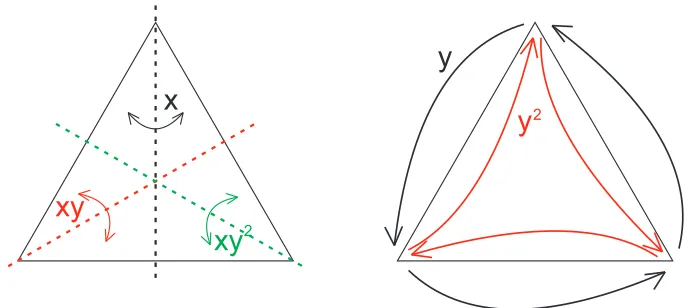
The double D(S3), is based on the group S3, isomorphic to the symmetry
trans-formations of an equilateral triangle. It is a non-Abelian group, a property that is inherited by the excitations of the quantum double. I chose this double as the focus of my analysis, as we may expect non-trivial phases emerging, as well as interesting processes being induced from non-Abelian doubles, and D(S3) is the simplest of
Focusing onD(S3) as a topological field theory, without considering microscopic
details, I provide a description of phase transitions in this model. The phase transitions are induced by forbidding certain anyon labels (chargeandfluxlabels) in the quantum double. Forbiddance in this context means anyons and anyon flavors related to the forbidden label won’t be created, neither through fusion of other anyons, nor from the vacuum through thermal processes.
I also provide proposals for realizing such phase transitions. Quantum doubles can be realized on a lattice, as per Kitaev’s construction [4]. To induce a phase transition in this construction, we will have to project out part of the Hilbert space, which can be done through a non-deterministic procedure (it involves measurements). However, this operation can be approximated by adding 4-local terms to the topological (6-local) Hamiltonian of the theory, strongly increasing their couplings to make the corresponding excitations have large energy. As a result, the creation of anyons related to the labels of the tuned terms will be thermally suppressed: it would require too much energy to create one of those anyons (Eanyon), and their creation
probability will be∝exp(−Eanyon/kBT)in a thermal environment with temperature T. Tuning these couplings to the extreme (Eanyon→ ∞) will realize the forbiddance
of that anyon as a limit of this operation.
Analyzing the phase transitions of D(S3) I summarize the processes a double
un-dergoes while transitioning into new theories: condensation and the split-up of higher-dimensional anyons. At the end of a series of these processes, a new topolo-gical theory emerges. I investigate the possible theories thatD(S3)could transition
into, and find that doubles of subgroups (D(Z3)) as well as their chargeon and
fluxon sectors (Z3andZ2) emerge. For the latter examples I conclude that they can’t
C h a p t e r 2
SELF CORRECTION REQUIRES AN ENERGY BARRIER FOR
ABELIAN QUANTUM DOUBLES
Anna Kómár, Olivier Landon-Cardinal, and Kristan Temme. Necessity of an energy barrier for self-correction of Abelian quantum doubles. Physical Review A, 93 (5):052337, 2016.
Abstract
We rigorously establish an Arrhenius law for the mixing time of quantum doubles based on any Abelian groupZd. We have made the concept of the energy barrier therein mathematically well-defined; it is related to the minimum energy cost the environment has to provide to the system in order to produce a generalized Pauli error, maximized for any generalized Pauli errors, not only logical operators. We evaluate this generalized energy barrier in Abelian quantum double models and find it to be a constant independent of system size. Thus, we rule out the possibility of entropic protection for this broad group of models.
2.1 Introduction
Whether it is possible to preserve arbitrary quantum information over a long period of time is a question of both fundamental and practical interest. Activequantum error correction provides a way to protect quantum information but requires keeping track of and correcting the errors over a short time scale. Alternatively, quantum self-correcting systems would passively preserve quantum information in the presence of a thermal environment without the need for external intervention on the system. The dynamics of these quantum “memories” would be such that the probability of an error occurring on the encoded information is exponentially suppressed with system size, resulting in an exponentially long memory time. Candidates for self-correction are typically systems governed by a local Hamiltonian whose degenerate ground space stores quantum information.
mimics the evolution of the system under thermalization and decoding. The intuition (and implicit conjecture) is that the system obeys the phenomenological Arrhenius law which relates the memory timetmem to the energy barrier∆E
∗
and the inverse temperatureβ ≡1/kBT
tmem ∝eβ∆E∗. (2.1)
The Arrhenius law is a useful guiding principle. For classical models, one can intuitively understand the exponentially long (classical) memory time of the ferro-magnetic 2D Ising model by realizing that its energy barrier is proportional to the linear system size. Indeed, to go from the all up state to the all down state, one needs to flip a macroscopic droplet of spins whose energy scale with its perimeter. For quantum models, the most widely known example of a self-correcting quan-tum memory is the 4D Kitaev’s toric code [4,32, 36] whose energy barrier is also proportional to the linear system size.
The scaling energy barrier of a quantum model is intimately related to the geome-trical support of operators mapping a ground state to a different orthogonal ground state, calledlogical operators. For the 4D toric code, logical operators are the tensor product of single qubit operators acting on a two-dimensional sheet-like subset of qubits, similar to the logical operator of the 2D Ising model which flips all spins.
While the 4D Kitaev’s toric code is self-correcting, it requires addressable long-range interactions if embedded in a lattice of lower dimensionality. Various attempts have been made to decrease the dimensionality of such a self-correcting code, while retaining a large energy barrier of the system [35, 53, 54]. A typical shortcoming of these codes includes sensitivity to perturbations [55], while genuine topological systems are known to be robust [30]. Finding a self-correcting system in three dimensions (or lower) is still an ongoing research direction.
to go through a scaling energy barrier. We could think of such a model as having an effective free energy barrier, i.e., there are free energy valleys in the landscape between the two ground states, and in order to get out of such a valley the system would have to overcome an effective barrier.
In 2014, Brown et al. proposed a local 2D Hamiltonian which seemed to realize entropy protection [48] since its memory time exhibits a super exponential scaling, albeit only in a limited range of temperature. This model consists of a toric code-like structure, where instead of qubitsd-level spins (qudits) are placed on the edges of a square lattice. This model also corresponds to the quantum double of Zd. Its elementary excitations are d different electric andd different magnetic anyons. Specifically, in Ref. [48] d = 5, and due to charge-flux duality, it is convenient to think only in terms of e.g., electric charges. Then there are 5 different charges, grouped as vacuum, light particle, heavy particle, heavy antiparticle, and light antiparticle. Particle-antiparticle pairs have the same mass, and furthermore the masses are set such that mheavy > 2mlight to ensure that thermal evolution of the
system favors the decay of a heavy particle into two light particles. The authors of Ref. [48] further introduce defect lines to the system by modifying local terms of the Hamiltonian. When a light particle crosses such a line, it becomes a heavy one and vice versa. This construction results in fractal-like splitting of typical anyon-paths, resembling the fractal geometrical support of logical operators in Haah’s cubic code [46, 56]. The authors of Ref. [48] numerically observed a memory time for this entropic code similar to the cubic code, that is, it grows super-exponentially with the inverse temperature (tmem ∝exp(cβ2)). A striking difference between the cubic
code and Brown’s entropic code is, however, that while the former has an energy barrier that grows logarithmically with system size, the energy barrier of the entropic code is a constant, independent of system size. Thus, Brown’s entropic code seems to have a better scaling of memory time than the one predicted by the Arrhenius law. However, it was also remarked that the super-exponential scaling did not remain valid at arbitrarily low temperature, i.e., in the limit of very large β. Thus, Brown’s entropic code argues for the possibility of entropy protection but failed to settle the question of whether entropy can protect quantum information and lead to a better scaling of than memory time than the one predicted by Arrhenius law.
upper bound for the mixing time of quantum doubles of Abelian groups. We prove that the mixing time – defined as the longest time an initial state takes to thermalize to the Gibbs state – and thus the memory time are upper bounded by poly(N)exp(2β), whereN is the size of the system and is thegeneralized energy barrier. We rigorously define by a natural quantity arising from our analysis which straightforwardly extends the intuitive notion of energy barrier. Finally, we evaluate the generalized energy barrier and show that it is independent of system size or temperature for two-dimensional Abelian quantum double models. As our bound holds for any temperature, this means that Abelian quantum doubles don’t allow for entropy protection, i.e., their memory time can at most scale exponentially with inverse temperature. Our results are based on the method presented in Ref. [3] and are a generalization of the results therein, where the author has derived a similar Arrhenius law bound and energy barrier for any commuting Pauli stabilizer codes in any dimensions.
The paper is organized as follows. In Sec.2.2.1and2.2.2we introduce the framework of our analysis: the construction of Abelian quantum doubles and the noise model used to simulate the thermal environment. In Sec.2.3we present our main result: the upper bound on the mixing time and the formula for the generalized energy barrier, followed by a discussion on the physical interpretation of this result in Sec.2.4. We present the details of the derivation of the bound in Sec.2.5. Finally, we conclude with possible future directions in Sec.2.6.
2.2 Framework
We now introduce the framework in which our result is valid. First, we introduce the systems of interests, i.e., the quantum double of Abelian groups. Second, we model the thermalization of such a system by the Davies map.
2.2.1 Abelian quantum doubles
Abelian quantum doubles are a special case of the quantum double construction introduced by Kitaev [4], where the quantum double is based on the cyclic group Zd. This was the model investigated in Ref. [48] withd = 5, and it is a generalized toric code construction (the toric code is the quantum double ofZ2) acting ond-level
spins orqudits.
Generalized Pauli operators
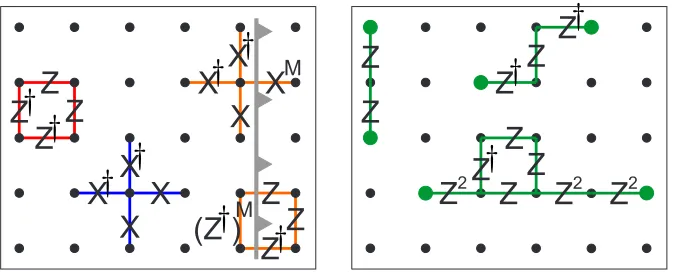
Figure 2.1: (a) Star operator A(v) in blue and plaquette operator B(p) in red. A defect line is shown as a thick gray line traversing the lattice, with the modified star and plaquette operators near such a line in orange. (b) Examples of anyon paths for an Abelian quantum double (d > 2).
operators, Xk andZk, k ∈Zd. They act on a qudit according to:
Xk|`i = |`⊕ ki, (2.2)
Zk|`i = ωk`|`i, (2.3)
where⊕is the addition modulodandω` =exp(i2π`/d),` ∈Zdare thedth roots of unity. The eigenvalues of theZgeneralized Pauli operator but also theXgeneralized Pauli operator are precisely the dth roots of unity. In our convention, the identity is a generalized Pauli operators with k = 0. One can straightforwardly derive the following useful identities:
X† = Xd−1 Z†= Zd−1 Zk0Xk = ωk k0XkZk0.
(2.4)
Hamiltonian
We now define the Hamiltonian of the quantum double of Zd on 2N d-level spins or qudits located on the edge of a two dimensional square lattice with N vertices. We define a (generalized) Pauli operator to be a 2N-tensor product of single-qudit (generalized) Pauli operatorXk orZk,k ∈Zd. For convenience, we will henceforth omit the (generalized) modifier. We notePM the set of Pauli operators acting non-trivially on at most M ≤ 2N qudits. The qudits on which a Pauli operator acts non-trivially are its (geometrical) support.
The local interactions of the Hamiltonian will be Pauli operators supported on four qudits neighboring either a vertexvof the lattice for star operatorsA(v)or a plaquette
of four edges or, equivalently, qudits located on those edges. It is convenient to label the qudits around a star + or plaquette using the cardinal points: East, South, West, and North. The star operator A(v)for vertexvis
A(vi)= XE ⊗ XS⊗ XW† ⊗ XN† (E,S,W,N)= +v (2.5)
and the plaquette operatorB(p)for plaquette pis
B(p)= ZE ⊗ ZS†⊗ ZW† ⊗ ZN (E,S,W,N)=p. (2.6)
The eigenvalues of star and plaquette operators are thedth roots of unity, inherited from the single-qudit Pauli operators. The projector unto the eigenvalue ωa of the star operator at vertexv is
Pva(v) =
1
d
d−1 Õ
k=0
(ωaA(v))k. (2.7)
Similarly, the projector unto the eigenvalueωaof the plaquette operator at plaquette
pis
Qb(p)p = 1
d
d−1 Õ
k=0
(ωbB(p))k. (2.8)
Note that those projectors commute since every star operator commute with every plaquette operator.
The Hamiltonian of theZdquantum double is [4,48]
H= Õ
v
d−1 Õ
a=0
Jva(v)P
a(v)
v +
Õ
p d−1 Õ
b=0
Jpb(p)Q b(p)
p , (2.9)
whereJva(v)andJ
b(p)
p are non-negative numbers. We set∀v,p Jv0= Jp0 =0 such that a ground state|Ωiis a common +1 eigenvector of allPv0andQ0p
∀v,p P0
v|Ωi=Q0p|Ωi= +|Ωi. (2.10)
The ground space is degenerate whenever this Hamiltonian is defined on a manifold with non-zero genus. For instance, on a square lattice with periodic boundary condition, i.e., a torus, the ground space isd2-degenerate and can be used to encode quantum information. The positive numbersJva(v)andJ
b(p)
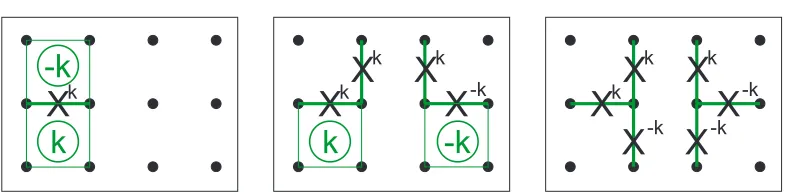
Figure 2.2: (a) Anyon pair created from vacuum, (b) one of the anyons moved and (c) the pair fused back to vacuum, all the while applying local operators.
we now discuss.
Excitations and syndromes
Every spectral projector Pva(v) and Q
b(p)
p are pairwise commuting. Moreover, they commute with the Hamiltonian. Thus, it is convenient to label an energy eigenvector |ψiusing the quantum numbersa= {av} andb= {bp} defined by
av = hψ|A(v)|ψi (2.11)
bp = hψ|B(p)|ψi. (2.12)
Using the terminology of quantum error correction, we define thesyndromeof |ψi by
e(|ψi)= (a,b) ∈ZNd+N. (2.13)
Therefore, the Hamiltonian can be diagonalized using the different syndrome values, i.e.,
H =Õ
(a,b)
(a,b)Π(a,b), (2.14)
where the explicit formula for the energies (a,b) and projectors Π(a,b) can be found in Sec.2.5.1. Let us try to draw a physical picture which will help intuition. The syndrome of an energy eigenvector is a bookkeeping of the different excitations at every vertex and plaquette. The +1 eigenvectors of Pva(v) for a(v) , 0 have a
point-like excitation located on the vertex v which we call an electric charge (or chargeon) of type a. Similarly, the +1 eigenvectors of Qb(p)p for b(p) , 0 have a point-like excitation located on the plaquette p which we call a magnetic flux (or fluxon) of typeb. The ground states of the Hamiltonian have syndrome(0,0).
back to the vacuum by applying a local operator. This can be understood at the level of the syndrome. Consider on a ground state and then apply a generalized Pauli operatorXkon a qudit located on a horizontal edge (see Fig.2.2). This will modify the eigenvalues of the plaquette operators North and South of that horizontal edge, denotedB(pN)andB(pS). Indeed, the resulting state will be a +1 eigenvector of the spectral projectorsQ−kpN andQ
k
pS. Physically, X
k
created a magnetic flux of type k (resp. −k) on the South (resp. North) plaquettes. In other words, Xk created a pair of conjugate magnetic fluxes out of the vacuum. Similarly, Zk would create a pair of conjugate electric charges out of the vacuum. We assign to any generalized Pauli operatorση the syndromee(η)of the stateση|Ωi
e(η)=e(ση|Ωi). (2.15)
In our examples,
e(Xk) = (a=0,b=[0, . . . ,0,k,−k,0, . . . ,0]) (2.16)
e(Zk) = (a=[0, . . . ,0,k,−k,0, . . . ,0],b=0). (2.17)
Given any energy eigenvector |ψi and any generalized Pauli operator η, the syn-drome of the stateση|ψiis obtained by
e(ση|ψi)= e(η) ⊕e(|ψi). (2.18)
This very simple addition rule stems for the Abelian structure of the groupZd and is related to the fusion rules of the excitations of this Abelian topological model.
Fluxons and chargeons turn out to be (Abelian) anyons, i.e., quasi-particles which are not bosonic nor fermionic. Yet their anyonic nature will not be essential in our work. However, we will from now on use the term anyon to designate a generic point-like excitation (either a fluxon or a chargeon). Moreover, chargeons and fluxons are related by an exact duality which maps the lattice to the dual lattice. Thus, it will often be convenient to focus on a single anyon type, e.g., chargeons in order to simplify our discussion and notations. Also, we would like to introduce a single index s which labels either the vertices or the plaquettes, i.e., s = v/p. Thus, any anyon (chargeon or fluxon) is located on a site (vertex or plaquette).
2.2.2 Thermal noise model
of many body systems [32,45,46,48]. The system is coupled to a bosonic bath and the Hamiltonian of {system+bath} reads
Hfull =Hsystem+ χÕ α
Sα ⊗Bα+Hbath, (2.19)
where Bα is the operator acting on the bath and Sα ≡ Sαj0 is an operator acting on
spin j of the system. We consider the weak coupling limit, with χ 1.
The density operator of the system, notedρ, evolves according to the master equation
dρ
dt = −i[Heff, ρ]+L(ρ), (2.20)
whereHeffis the (Lamb-shifted) system HamiltonianHeff = Hsystem+
Í
α,ωSα†(ω)Sα(ω)
and the Liouvillian is
L(ρ)=Õ
α,ω
γα(ω)
Sα(ω)ρSα†(ω) − 1
2
{Sα†(ω)Sα(ω), ρ}+
. (2.21)
The operators governing the evolution of the system in energy space are the spectral jump operators, Sα(ω). They take the system from energy eigenstate 0to another eigenstate with energy = 0+ω, and have the form
Sα(ω)= Õ
(a,b)−(a0,b0)=ω
Π(a,b)SαΠ(a0,b0). (2.22)
They are the Fourier transforms ofSα(t)(the time-dependent operator acting on the system due to its contact with the thermal bath):
Sα(t)= Õ (a,b),(a0,b0)
ei(a,b)tΠ(a,b)SαΠ(a0,b0)e−i(a0,b0)t. (2.23)
The rate with which a state of the system is taken to another stateω far in energy, by applying the jump operator Sα(ω)due to its coupling to the thermal bath is the transition rateγα(ω). These transition rates obey detailed balance
γα(ω)= eβωγα(−ω). (2.24)
This Liouvillian drives any state towards the Gibbs state
ρG ∝e−βHsystem,
which is its unique fixed point: L(ρG)=0.
Applying the Davies map to a Zd quantum double we need to choose an operator basis for the jump operatorsSα. Ford =2, a possible choice is the Pauli group, while ford > 2 it is the generalized Pauli group. We should be careful, since although the elements of the Pauli group are Hermitian, the elements of the generalized group are not: X†= Xd−1. We can circumvent this problem by either writing the interaction terms in the full Hamiltonian asσj,α0⊗Bα†+σ†
j,α0⊗Bαwithσj,α0=(l,m) = ZljXmj , and thusSj,α0 = Zl
jX m
j as in theZ2case, or by constructing Hermitian jump operators: Sj,α0 = 1/
√
2(σj,α0 +σ†
j,α0). Independent of which choice we make, our results in
the following sections are the same.
2.3 Generalized energy barrier
We establish a formerly ill-defined link between the energy barrier of a system and its mixing time for Abelian quantum doubles. We prove a rigorous Arrhenius law upper bound for the mixing time (Sec.2.3.2, details of the proof in section2.5), and give a proper definition for the energy barrier appearing in that bound (Sec.2.3.1). In section2.3.3we evaluate this energy barrier for Abelian quantum doubles in two dimensions and find it is a constant independent of system size or temperature.
2.3.1 Definition of the generalized energy barrier
Recall from the introduction that the energy barrier is intuitively related to the decomposition of operators acting non-trivially within the ground space (logical operators) into a sequence of local operators. Surprisingly, thegeneralizedenergy barrier arising from our analysis is related to the energy cost of building anarbitrary Pauli operator. This seems to go against intuition since an arbitrary Pauli operator ση ∈ P2N can create an extensive amount of energy. However, excitations which
appear in the final error configuration e(η) created by the Pauli operator will not contribute towards the generalized energy barrier: only intermediate excitations created in the sequential construction of this final error configuration do. Note that ifσηis a logical operator, the generalized energy barrier coincides with the intuitive energy barrier.
The idea is thus to consider sequences of Pauli operators n
σηt
o
Definition 2.1 (Local errors path). A local errors path {σηt}t≥
0 is a sequence of
Pauli operators such that
σηt=0 = I (2.26)
locality ∀t∃P∈ P1 σηt+1 = P·σηt (2.27)
convergence ∃ση,T t >T ⇒ σηt = ση. (2.28)
At any intermediate stept ≤T, the Pauli operatorσηt will create a syndromee(ηt)
corresponding to a pattern of anyons. At every site, only the energy of an anyon whose charge is different from the one in the syndromee(η)contribute towards the energy barrier. Formally, we define the additional energy of the error indexed byηt with respect to the error indexed byηas
Definition 2.2(Additional energy). Letηtandηbe indices of two Pauli operators. The additional energy of the errorσηt with respect to the reference operatorση is
(ηt|η)= Õ s
Jes(ηt)
s
1−δes(ηt),0 1−δes(ηt),es(η)
. (2.29)
Note that in Eq. (2.29), summands do not contribute if es(ηt) = 0, i.e., if the intermediate error does not create excitations on sitesbut also ifes(ηt)=es(η), i.e., if the intermediate error creates the same excitation on site sas the reference error ση.
We are now in position to define the generalized energy barrier of an error ση and then of the Hamiltonian.
Definition 2.3(Generalized energy barrier). Let{σηt}be an arbitrary local errors
path converging to the Pauli operatorση ∈ P2N. The generalized energy barrier of ση is
(η)= min
{σηt}→σηmaxt
(ηt|η). (2.30)
The generalized energy barrier of the Hamiltonian H is (H)=max
η (η). (2.31)
generalized energy barrier through a formula similar to the Arrhenius law given in Eq. (2.1).
2.3.2 Arrhenius upper bound on the mixing time
We define the mixing time as the time scale after which the evolution of any initial state of the system becomesε =e−1/2-indistinguishable from the Gibbs state defined by Eq. (2.25). Theε= e−1/2value is chosen so the relationship between the mixing time and the gap of the Liouvillian will have a convenient form, and the exact value won’t modify either the qualitative aspect of our calculations or the scaling of the bound obtained on the mixing time.
Definition 2.4 (Mixing time). The mixing time of a Liouvillian (whose fixed point is the Gibbs state ρG) is
tmix(ε)= min{t |t0> t ⇒ ||eLt
0
ρ0− ρG||1< ε∀ρ0}, (2.32)
withε =e−1/2,
where we used the trace norm,||A||1 =Tr
h√
A†A
i
, to measure the (in)distinguishability of two quantum states.
Loosely defining the quantum memory time as the maximal time after which one can recover information about the initial ground state, we immediately see it is upper bounded by the mixing time. Indeed, the Gibbs state treats all ground state on the same footing and thus information about the initial ground state has disappeared. We do not provide a formal definition of the quantum memory time in this work.
Our main result relates the generalized energy barrier to the mixing time through a relation similar to the Arrhenius law.
Theorem 2.5 (Arrhenius bound on mixing time). For any Abelian group Zd, for any inverse temperature β, the mixing time of the Davies map Liouvillian of the quantum double ofZd is upper bounded by
tmix ≤ O
βNµ(N)eβ(2 ¯+∆),
(2.33)
The derivation of this result can be found in section2.5. We will now show that for Abelian quantum double, ¯ is bounded by a constant independent of system size in Sec.2.3.3and thatµ(N)is bounded by 8N(d−1)in Sec.2.3.4. The right hand side of Eq. (2.33) has a dependence on a low power ofN, that does not qualitatively modify the scaling of the mixing time nor the behavior of the system when considered as a candidate for a quantum memory. The important physical quality of this bound is the Arrhenius law scaling. This scaling is not set by the gap of the system Hamiltonian but, more interestingly, by the generalized energy barrier, which we now evaluate.
2.3.3 Generalized energy barrier is constant for Abelian doubles
We will now evaluate the generalized energy barrier of any 2D quantum double of an Abelian group and show that it is a constant, independent of system size, more precisely 2Jmax. While this was known for the Z2case [3], we extend it to any Zd
quantum double. From now on, we consider aZdquantum double, with arbitraryd. Furthermore, we henceforth omit the ’generalized’ modifier in (generalized) energy barrier for simplicity.
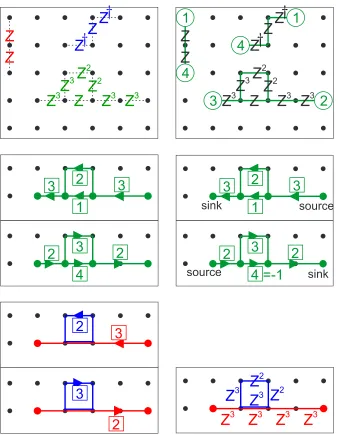
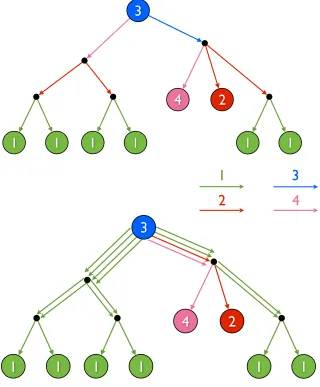
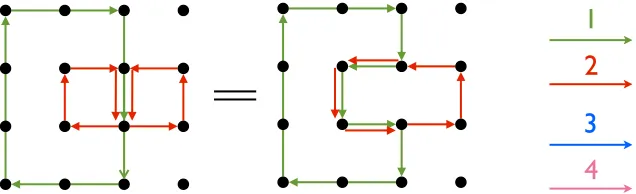
To evaluate the energy barrier of the Hamiltonian, given by Eq. (2.31), we want to bound the barrier of an arbitrary Pauli operator, given by Eq. (2.30). Thus, we aim to exhibit a local errors path where the additional energy of any intermediate error is a constant. To do so, we will use the following strategy. We will first turn the final error syndrome into a weighted directed graph intuitively corresponding to the worldlines of anyons. Then, we will decompose that graph into cycles and trees. Cycles correspond to pair of conjugate anyons appearing out of the vacuum, propagating and then fusing back to the vacuum. Trees represent propagation of anyons, whose position (resp. word lines) correspond to terminal vertex (resp. edges) of the tree. Finally, using different techniques for cycles and trees, we show how to build the error of each type by moving at most one anyon at a time in a way that the additional energy of any intermediate error involve at most two local terms of the Hamiltonian, resulting in an energy barrier of at most 2Jmax.
Graph corresponding to an error configuration
• Any error is the product of elementary errors whose supports are disjoint. The energy barrier of the error is the largest energy barrier of its elementary errors.

![Figure 2.6: Scaling of the logarithm of the quantum memory time tArrhenius behavior (pink dashed line) will transition to an Arrhenius behaviormem as a functionof the inverse temperature β.The quadratic scaling (tmem ∼ ecβ2) numericallyobserved in [48] (represented schematically by the green curve) cannot extend toarbitrary low temperature due to our upper bound (in blue).Thus, the super-(black dotted line) for sufficiently low temperature.](https://thumb-us.123doks.com/thumbv2/123dok_us/774632.1090328/52.612.146.462.70.242/behaviormem-temperature-numericallyobserved-represented-schematically-toarbitrary-suciently-temperature.webp)