A Semantic Feature for Relation Recognition Using A Web-based Corpus
Chen-Ming Hung Institute of Information Science Academia Sinica, Taipei, Taiwan
Abstract
Selecting appropriate features to represent an entity pair plays a key role in the task of relation recognition. However, existing syntactic features or lexical features cannot capture the interaction between two enti-ties because of the dearth of annotated rela-tional corpus specialized for relation recog-nition. In this paper, we propose a seman-tic feature, called thelatent topic f eature, which is topic-based and represents an en-tity pair at the semantic level instead of the word level. Moreover, to address the prob-lem of insufficiently annotated corpora, we propose an algorithm for compiling a train-ing corpus from the Web. Experiment results demonstrate thatlatent topic f eaturesare as effective as syntactic or lexical features. Moreover, the Web-based corpus can resolve the problems caused by insufficiently anno-tated relational corpora.
1 INTRODUCTION
Relation recognition is a challenging task because finding appropriate features to represent the rela-tionship between two entities is difficult and limited by the scarcity of annotated corpora. Prior works on relation recognition have focused on syntactic features, e.g., parsing trees (Culotta and Sorensen, 2004; Zelenko et al., 2003), and on lexical fea-tures, e.g., Part-Of-Speech (POS) features. These approaches show that syntactic features and lexical features outperform bag-of-words (BOW) on exist-ing annotated corpora such as the RDC corpus of the
ACE project. The superior performance achieved by syntactic and lexical features is due to their ability to capture the grammatical relations between two entities and the characteristics of the entities. For example, (Culotta and Sorensen, 2004) add hyper-nyms of entities to features derived from WordNet. However, neither syntactic nor lexical features can capture the interaction between two entities at the semantic level.
Another issue in the task of relation recognition is insufficiently annotated corpora. For example, given a pair{the U.N. body, Kosovo}, we can only find three sentences containing both entities in the RDC corpus, which is commonly used corpus in the relation recognition task. The problem of an in-sufficiently annotated corpus biases feature vectors and distorts the prediction of entity pairs. How-ever, (Huang et al., 2004; Hung and Chien, 2007) have shown that the Web can be used as an alterna-tive source of documents related to a given query. That is possibly because of the increasing size of the Web and the efficiency in commercial search en-gines, e.g., Google and Yahoo!.
the above{the U.N. body, Kosovo}example, it may be difficult to determine the relationship between U.N. bodyandKosovostraightforwardly. However, making the right guess about the relationship is eas-ier ifthe U.N. bodyis grouped witharmyand gov-ernment. Therefore, theright guessin this example ismanagement.
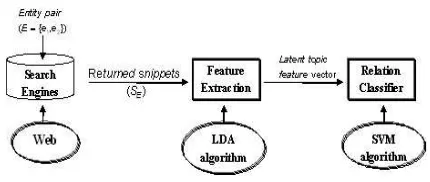
To overcome the problems caused by an insuffi-ciently annotated corpus, we exploit the Web as a source of training data for the relation recognition task. Given an entity pair, documents describing the entity pair are extracted from the Web via commer-cial search engines using both entities as the query. In other words, snippets returned from the Web are treated as documents related to the query. Our as-sumption, which has been proved in previously pub-lished works, is that returned snippets can capture the interaction between two entities. After thelatent topic featuresextracted from returned snippets using the Web as the corpus, an SVM classifier is trained as the relation recognition classifier for use in the later experiments.
The remainder of the paper is organized as fol-lows. in Section 2, we discuss works related to fea-ture selection in the relation recognition task as well as using the Web as a corpus. The concept of la-tent topic featuresis presented in Section 3. We also explain how we represent a document in the vector space of a latent topic feature. Section 4contains an evaluation of the latent topic feature. We then present our conclusions in Section 5.
2 RELATED WORK
In the field of information extraction (IE), the goal of relation recognition is to find the relationship between two entities. Without considering en-tity detection, relation recognition depends heav-ily on the representation of entity pairs. (Zelenko et al., 2003) showed how to extract relations by computing the kernel functions between the ker-nels of shallow parse trees. The kerker-nels are de-fined over a shallow parse representation of the text and used in conjunction with a Support Vector Ma-chine (SVM) learning algorithm to extract person-affiliation and organization-location relations. (Cu-lotta and Sorensen, 2004) extended this work to es-timate kernel functions between augmented
depen-dency trees, while (Kambhatla, 2004) combined lex-ical features, syntactic features, and semantic fea-tures in a maximum entropy model. However, the semantic features discussed in (Kambhatla, 2004) still focus on the word level instead of the concep-tual level.
LDA is an aspect model that represents docu-ments as a set oftopics instead of a bag-of-words. Latent semantic indexing (LSI) (Deerwester et al., 1990) and probabilistic latent semantic indexing (PLSI)(Hofmann, 1999) are also aspect models and have been widely used in the field of information retrieval. LSI simply assumes that each document is generated from single latent topic, while PLSI attempts to relax the assumption by using a mix-ture of latent topics for each document. However, PLSI is highly dependent on training documents; in other words, it cannot handle the probability of la-tent topics in a previously unseen document. In ad-dition, the number of parameters that must be esti-mated in PLSI grows linearly with the number of training documents. (Blei et al., 2003; Blei and Jordan, 2003) proposed LDA to resolve the above-mentioned limitations. It can easily generate an un-seen document under controllable parameters.
A number of works, e.g., (Huang et al., 2004), have investigated using the Web to acquire a train-ing corpus or acquire additional information not pro-vided by existing annotated corpora. (Huang et al., 2004) exploited the Web as a training corpus to train a classifier with user-defined categories. However, it is widely recognized that when using documents on the Web users must spend a great deal of time filtering out unrelated contents. (Hung and Chien, 2007) designed a bootstrapping method that adapts an existing corpus with an automatic verification al-gorithm in order to control the quality of returned snippets in each iteration. (Matsuo et al., 2006) used the Web to construct a social network system, called POLYPHONET, which visualizes the relationship between two personal names.
3 LATENT TOPIC FEATURE
f eaturesto represent entity pairs in the corpus for relation recognition.
Figure 1: The framework of the proposed approach.
3.1 Compiling a Web-based Relational Corpus For an entity pair, E = {e1, e2}, where e1 ande2
are named entities, it is difficult to find sufficient sentences to describe their relationship from exist-ing annotated corpora. In other words, given an en-tity pair without a relation label, users cannot rec-ognize the pair. Even with a widely used thesaurus, like WordNet, we can only obtain hypernyms or syn-onyms of given entities. It is not possible to obtain knowledge about the interaction between two enti-ties.
To capture the interaction between two entities, we send both entities, e1 AN D e2, to
commer-cial search engines and collect returned snippets as training documents for an entity pair, E. Snippets of returned search results are defined as the sur-rounding contexts of queries highlighted by com-mercial search engines. In other words, the full texts of search results are not considered in the collected corpus when filtering noisy information in full documents. Let R be the relation label of entity pairs {E1, . . . , EM}; then, the training
cor-pus forR is the collection of all returned snippets for {E1, . . . , EM}. Through effective commercial
search engines such as Google and Yahoo!, sen-tences describing the interaction between two enti-ties can easily be retrieved. Returning to the ex-ample {the U.N. body, Kosovo}, almost two mil-lion sentences with co-occurrences of the two en-tities are retrieved by Google. Another advantage of using the Web to retrieve relevant documents is the auto−correctionability of commercial search en-gines. The feature can correct a misspelled query or replace an uncommon word with a synonym or a common word which is correct, so that more related
information about entity pairs can be retrieved from the Web as returned snippets. For example, Google can automatically link the U.N. body to U nited N ations, which is used more frequently in search-ing. Clearly, the number of returned snippets must be considered. Actually, based on experiment re-sults in Section 4, we set the number as five, which achieves the best performance.
3.2 Modified LDA for the Relational Corpus LDA is an aspect model with three levels, namely, the corpus level, the document level, and the word level. Given a document, variables of the corpus it belongs to are sampled first, after which the variable of the document is sampled once. Finally, variables for words in the document are sampled.
For a document d in a corpus D, the modeling process is as follows:
1. Sampleθ∼Dir(θ|α).
2. For each wordwnind,n∈ {1, . . . , N}:
(a) samplezn∼M ult(θ),
(b) sample a wordwn ∼ p(wn|zn, β)from a
multivariate Gaussian distribution condi-tioned on the topiczn.
Note that α is a vector of corpus-level variables whose dimensionality is equal to the number of la-tent topics;θis a variable of the document and is as-sumed to follow Dirichlet distribution for the given corpus; andβ is a word-level variable. In addition, Z = {z1, z2, . . . , zN}are latent factors that gener-ate the document, andznis the latent topic thatwn
is generated from. Finally, N is the length of the documentd.
An entity pairEin the relational corpus is similar to a documentdin the text corpus. In other words, the corpusDRis comprised of returned snippets for
all entity pairsER with the same relation labelR.
Therefore, given the parametersαandβ, we obtain the distribution of entity pairEas follows:
p(E|α, β) =Z X
zn
p(θ, zn, SE|α, β)dθ,
where
p(θ, zn, SE|α, β) =p(θ|α) NE
Y
n=1
NE is the number of words in the returned snippets
for E; andwn is the nth word inSE, the returned
snippets ofE. Table 1 summarizes notations used in the paper.
Table 1: Notations used in this paper.
SYMBOL DESCRIPTION R relation label
DR corpus forR
ER
j jthentity pair in the relation labelR
SE returned snippets for an entity pairE
|ER| number of entity pairs in the relationR
NE number of words inSE
wn nthword inSE
zn latent topic thatwnis generated from
In Section 3.1, we discussed the advantages of us-ing the Web as a corpus to model entity pairs. In the modeling process, we estimate the probability of wnconditioned onzn,p(wn|zn, β), to maximize the
probability of the entire corpus ofR. The probabil-ity that we try to maximize is
p(DR|α, β) = |ER|
Y
j=1
p(EjR|α, β).
3.3 Latent Topic Feature
In different corpora, z obtains a different distribu-tion to maximize the likelihood of the given corpus. In this section, we describe how to exploitzas fea-tures to represent a snippet for an entity pairE, i.e., SE. In Section 3.2, we noted that the parameters to
be estimated in the aspect model are all probabilities of words in each latent topicz. Thus, we let the ex-pected number of words generated from latent topics be features of each entity pair. In other words, an en-tity pairE is represented as a feature vector whose length is equal to the number of latent topics and whoseithattribute is equal to
αi+
NE
X
n=1
|wn| ×p(wn|zn, β),
whereαiis theithprior Dirichlet parameter.
In addition, because there is no solution good enough to determine the dimensionality of the fea-ture vector or the number of latent topics, we set the
number of topics at thirty because it probably min-imize the computation cost without significantly af-fecting the performance.
4 EXPERIMENTS
In this section, we evaluate the performance of the latent topic f eature in representing entity pairs extracted from the Relation Detection and Charac-terization (RDC) corpus of the Automatic Content Extraction 2003 model (ACE 2003)1.
4.1 The RDC Corpus
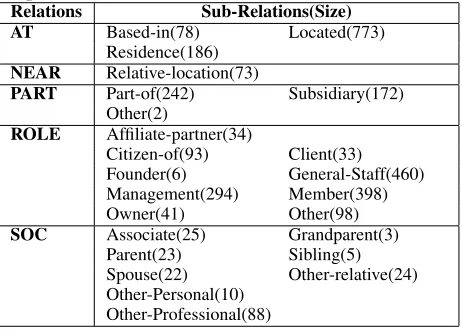
In the RDC corpus, five relation types,AT,N EAR, P ART, ROLE, andSOC, are defined; each rela-tion type has extended sub-relarela-tions. Table 2 sum-marizes the relations in the RDC corpus for ACE 2003. Based on Table 2, we find that the distribution of the number relations is very unbalanced, ranging from 2 to 773. In the following experiments, we only consider theRolerelation because it has the largest numbers of sub-relations and it is easier to verify the recognition results manually. Note that a rela-tion is dropped if it has less than ten sub-relarela-tions in order to avoid the bias of learned classifiers. There-fore, the sub-relation f ounder in Role is dropped in the following experiments because it occurs less than ten times. Other is also dropped because its definition is unclear.
Table 2: Distribution over relation types in the RDC corpus (ACE 2003).
Relations Sub-Relations(Size) AT Based-in(78) Located(773)
Residence(186)
NEAR Relative-location(73)
PART Part-of(242) Subsidiary(172) Other(2)
ROLE Affiliate-partner(34)
Citizen-of(93) Client(33) Founder(6) General-Staff(460) Management(294) Member(398) Owner(41) Other(98)
SOC Associate(25) Grandparent(3) Parent(23) Sibling(5) Spouse(22) Other-relative(24) Other-Personal(10)
Other-Professional(88)
4.2 Setting and Measurement
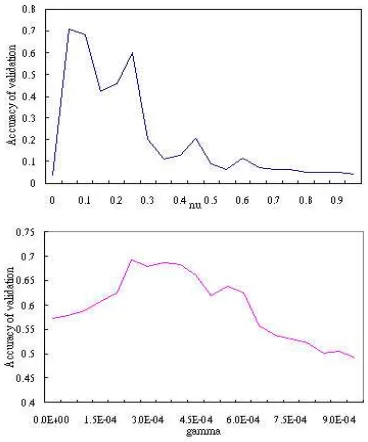
We used the package of (Chang and Lin, 2001) to design the following experiments. In addition, ν -SVM with a radial kernel function was used to learn the relation classifier. To determine the parameters in ν-SVM, i.e., γ and ν, we observed the perfor-mance of theν-SVM classifier by randomly select-ing80%of the sentences in the RDC corpus as train-ing data and the remaintrain-ing 20% as test data. In other words, we applied five-fold cross validation to build a temporary model for parameter estima-tion. Furthermore, it is well known that parame-ters in the SVM model must be optimized manually; therefore, we estimateνfirst and then estimateγ. γ is fixed while ν is being estimated and vice versa. After estimation, the best result is achieved at the point thatγis equal to2.5×10−4andν is equal to
0.05. We summarize the results in Figure 2. The top graph in Figure 2 is the accuracy curve, where fixed γ = 2.5×10⁻⁴and flexibleν; the bottom graph is
the accuracy curve with fixedν = 0.05and flexible γ.
Figure 2: Accuracy of five-fold cross validation us-ing bigram features. Top: ν withγ = 2.5×10⁻⁴.
Bottom:γwithν = 0.05.
For each sub-relation in Role, binary classifica-tion is used in the experiments and the F-measure of each sub-relation is used as the metric for assessing
the performance oflatent topic f eatures.
F−value = 2×P recision×Recall
P recision+Recall
Recall = ]of correct positive predictions
]of positive examples
P recision = ]of correct positive predictions
]of positive predictions
4.3 Web-based Corpus vs. Annotated Corpus
We now evaluate the performance of relational clas-sifier on a Web-based corpus and on an annotated corpus. To assess the performance of on the anno-tated corpus, sentences in the RDC corpus contain-ing a co-occurrence of both given entities were ex-tracted as training data to learn a benchmark relation classifier. On the other hand, the Web-based corpus is compiled from snippets retrieved by using both entities as a query. Thelatent topic f eatureis ap-plied on both the Web-based corpus and the RDC corpus using the procedure described in Section 4.2. In addition, to analyze the effect of the number of returned snippets, we increased the number of snip-pets from 3 to 45 in increments of three and then summarized the relationship between the number of returned snippets and the achieved accuracy curve shown in Figure 3. In the figure, the training data is comprised of snippets of information returned by querying80%of the entity pairs selected at random in the RDC corpus. The test data comprises snippets returned by querying the remaining 20% of entity pairs in the corpus.
Figure 3: Accuracy of five-fold cross validation us-ing the Web-based corpus and the annotated corpus.
4.4 Latent Topic Feature vs. Other Features
In this section, we compare the performance of latent topic f eatures with that of syntactic fea-tures and lexical feafea-tures, i.e., bag −of −words orparts−of −speech. Because of the superior performance achieved by using the Web-based cor-pus described in Section 4.3, we extracted features from the training corpus compiled from that corpus rather than the annotated corpus.
Based on the results reported in Section 4.3, five snippets were returned by the Web-based corpus for each entity pair. For each sub-relation, a one-class SVM was trained to perform binary classification.
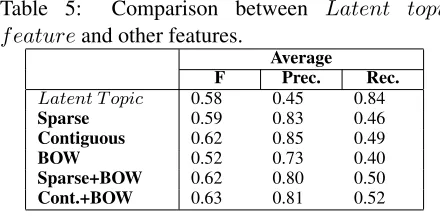
Each sub-relation of Role in Table 3 is applied with binary classification using a one-class SVM. Table 5 summarizes the results of a comparison be-tween the latent topic f eature and the features used by (Culotta and Sorensen, 2004). The lat-ter depends on dependency tree kernels, which rep-resent the grammatical dependencies in a sentence and are considered as syntactical features. In Table 5,BOW denotes bag-of-word,sparserepresents a sparse kernel, andcontiguousrepresents a contigu-ous kernel.
Surprisingly, for every sub sub-relation in Table 3, thelatent topic f eatureconsistently achieves a significantly higher average recall rate, but a lower average precision rate. This may be due to the latent topic f eature0sability to capture informa-tion at the semantic level precisely, but it cannot distinguish the information at the word level eas-ily. In other words, thelatent topic f eature can capture the common semantic information,
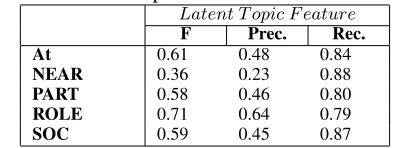
proba-bly theRole, of all sub-relations, but it cannot tell the difference betweencitizen−of andf ounder. Table 4 shows the results of applying binary classifi-cation to five relations in the RDC corpus. Although the precision rate for each relation is still low, the recall rate has been increased significantly. This de-mostrates the ability of thelatent topic f eatureto capture semantic information.
Table 3: Binary classification results for each sub-relation ofRole.
Latent T opic F eature F Prec. Rec. Aff.-Part. 0.30 0.18 1.00
Client 0.40 0.28 0.71
Citizen-Of 0.62 0.47 0.91
Gen.-Staff 0.78 0.64 0.99
Manage. 0.56 0.39 1.00
Member 0.62 0.46 0.93
Owner 0.45 0.29 0.98
Table 4: Binary classification results for each rela-tion in the RDC corpus.
Latent T opic F eature F Prec. Rec. At 0.61 0.48 0.84
NEAR 0.36 0.23 0.88
PART 0.58 0.46 0.80
ROLE 0.71 0.64 0.79
SOC 0.59 0.45 0.87
In Table 5, although the recall rate using the latent topic f eature is much higher than that achieved by the other features, unfortunately, the F −score of the latent topic f eaturecannot be redeemed because of the much lower precision rate. Moreover, thelatent topic f eatureis comparable to the sparse kernel method in a different way be-cause it has a low precision rate but a high recall rate. Finally, the latent topic f eatureachieves a higher average F-score than the bag-of-words fea-ture, which proves the assumption that the latent topic f eaturecan better capture the interaction be-tween two entities than features at the word level.
5 CONCLUSION
Table 5: Comparison between Latent topic f eatureand other features.
Average
F Prec. Rec. Latent T opic 0.58 0.45 0.84
Sparse 0.59 0.83 0.46
Contiguous 0.62 0.85 0.49
BOW 0.52 0.73 0.40
Sparse+BOW 0.62 0.80 0.50
Cont.+BOW 0.63 0.81 0.52
at the semantic level rather than at the word level. Therefore, combining the latent topic f eature with syntactic features and lexical features should achieve a better performance than using the features separately. In our future work, we will devise an ap-propriate way of combininglatent topic f eatures with syntactical and lexical features.
Because of the lack of a sufficiently annotated corpus for relation corpus for relation recognition, we have also proposed using a Web-based corpus to train classifiers for the purpose. Our experiment results demonstrates that Web documents can accu-rately capture information about the interaction be-tween two named entities in the absence of an an-notated corpus. By using a Web-based corpus, the time cost to manually annotating a corpus for rela-tion recognirela-tion is expected to be significantly re-duced if the quality of returned snippetscan be con-trolled.
References
David M. Blei and Michael I. Jordan. 2003. Model-ing annotated data. InProceedings of the 26th SIGIR, pages 127–134. ACM Press.
David M. Blei, Andrew Y. Ng, and Michael I. Jordan. 2003. Latent dirichlet allocation. J. Mach. Learn. Res., 3:993–1022.
Chih-Chung Chang and Chih-Jen Lin, 2001. LIBSVM: a library for support vector machines.
A. Culotta and J. Sorensen. 2004. Dependency tree ker-nels for relation extraction. Proceedings of the 42nd Annual Meeting of the Association for Computational Linguistics.
Scott C. Deerwester, Susan T. Dumais, Thomas K. Lan-dauer, George W. Furnas, and Richard A. Harshman. 1990. Indexing by latent semantic analysis.
Jour-nal of the American Society of Information Science,
41(6):391–407.
Thomas Hofmann. 1999. Probabilistic latent semantic analysis. InProc. of Uncertainty in Artificial Intelli-gence, UAI’99, Stockholm.
Chien-Chung Huang, Shui-Lung Chuang, and Lee-Feng Chien. 2004. Liveclassifier: creating hierarchical text classifiers through web corpora. In WWW ’04: Pro-ceedings of the 13th international conference on World
Wide Web, pages 184–192, New York, NY, USA.
Chen-Ming Hung and Leeq-Feng Chien. 2007. Web-based text classification in the absence of manually la-beled training documents. J. Am. Soc. Inf. Sci. Tech-nol., 58(1):88–96.
Nanda Kambhatla. 2004. Combining lexical, syntactic, and semantic features with maximum entropy models for information extraction. InThe Companion Volume to the Proceedings of 42st Annual Meeting of the Asso-ciation for Computational Linguistics, pages 178–181, Barcelona, Spain, July. Association for Computational Linguistics.
Yutaka Matsuo, Junichiro Mori, Masahiro Hamasaki, Keisuke Ishida, Takuichi Nishimura, Hideaki Takeda, Koiti Hasida, and Mitsuru Ishizuka. 2006. Poly-phonet: an advanced social network extraction system from the web. InWWW ’06: Proceedings of the 15th
international conference on World Wide Web, pages
397–406, New York, NY, USA.