Extracting Hierarchical Rules from a Weighted Alignment Matrix
Zhaopeng Tu, Yang Liu, Qun Liu and Shouxun Lin Key Lab. of Intelligent Info. Processing
Institute of Computing Technology Chinese Academy of Sciences P.O. Box 2704, Beijing 100190, China
{tuzhaopeng,yliu,liuqun,sxlin}@ict.ac.cn
Abstract
Word alignment is a fundamental step in machine translation. Current statistical machine translation systems suffer from a major drawback: they only extract rules from 1-best alignments, which adversely affects the rule sets quality due to align-ment mistakes. To alleviate this prob-lem, we extract hierarchical rules from
weighted alignment matrix (Liu et al., 2009). Since the sub-phrase pairs would change the inside and outside areas in the weighted alignment matrix of the hi-erarchical rules, we propose a new algo-rithm to calculate the relative frequencies and lexical weights of hierarchical rules. To achieve a balance between rule table size and performance, we construct a scor-ing measure that incorporates both fre-quency and lexical weight to select the best target phrase for each source phrase. Experiments show that our approach im-proves BLEU score by ranging from 1.4 to 1.9 points over baseline for hierarchi-cal phrase-based, and 1.4 to 1.5 points for tree-to-string model.
1 Introduction
Word alignment plays an important role in statis-tical machine translation (SMT). Most SMT sys-tems, not only phrase-based models (Och and Ney, 2004; Koehn et al., 2003; Xiong et al., 2006), but also syntax-based models (Chiang, 2005; Liu et al., 2006; Galley et al., 2006; Huang et al., 2006; Shen et al., 2008), usually extract rules from word aligned corpora. However, these systems suffer from a major drawback: they only extract rules from 1-best alignments, which adversely affects the rule sets quality due to alignment mistakes.
Typically, syntax-based models are more sensi-tive to word alignments because they care about
the development of China ’s economy
zh
o
n
g
g
u
o de
jin
g
ji
fa
zh
a
n
the development of China ’s economy
zh
o
n
g
g
u
o de
jin
g
ji
fa
zh
a
n
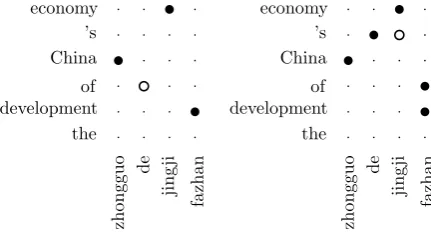
Figure 1: (a) One alignment of a sentence pair; (b) another alignment of the same sentence pair. Here coreless dots denote wrong links.
inside (i.e., subtracted phrases). Figure 1(a) shows an alignment of a sentence pair. Since there is a wrong link (de, of), we could not extract many useful hierarchical rules such as (zhongguo X1
jingji, China X1 economy).To alleviate this prob-lem, a natural solution is to extract rules fromn -best alignments (Venugopal et al., 2008).
However, usingn-best alignments still face two major challenges. First, n-best alignments have to be processed individually although they share many links, see (zhongguo, China) and (jingji,
economy) in Figure 1. Second, regardless of
prob-abilities of links in each alignment, numerous wrong rule would be extracted fromn-best align-ments. For example, a wrong rule (X1 de jingji,
of X1 ’s economy) would be extracted from the alignment in Figure 1(a).
Since Liu et al. (2009) show that weighted alignment matrix provides an elegant solution to these two drawbacks, we apply it to the hierarchi-cal phrase-based model (Chiang, 2005) and the tree-to-string model (Liu et al., 2006; Huang et al., 2006). While such an idea seems intuitive, it is non-trivial to extract hierarchical rules from weighted alignment matrices.
Our work faces two major challenges. The first is how to calculate the relative frequencies and
[image:1.595.308.524.205.321.2]the development of China ’s economy zh o n g g u
o de
jin g ji fa zh a n the development of China ’s economy zh o n g g u
o de
jin g ji fa zh a n the development of China ’s economy zh o n g g u
o de
jin g ji fa zh a n 1.0 0.6 0.4 0.4 1.0 1.0 0.4 0 0 0 0 0 0 0 0 0 0 0 0 0 0 0 0 0
(a) (b) (c)
Figure 2: (a) One alignment of a sentence pair; (b) another alignment of the same sentence pair; (c) the resulting weighted alignment matrix that samples the two alignments, of which the initial probabilities are 0.6 and 0.4 respectively.
ical weights of the rules with non-terminals (NTs). The sub-phrase pairs that are replaced with NTs in a rule, would change the inside and outside areas in the weighted alignment matrix of the rule. In addition, the sub-phrase pairs have their own prob-abilities and we should incorporate them to better estimate the probabilities of the hierarchical rules. Therefore, the calculations of relative frequencies and lexical weights for hierarchical rules are more complicated.
Another challenge is how to achieve a balance between performance and rule table size. Note that given a source phrase, there would be plenty of “potential” candidate target phrases in weighted matrices (Liu et al., 2009). If we retain all of them, these phrase pairs would produce even more hierarchical rules. For computational tractability, we need to design a measure to score the phrase pairs and wipe out the low-quality ones.
We propose a new algorithm to calculate the rel-ative frequencies of rules, and construct a mea-sure that incorporates both frequency and lexical weight to score target phrases. Experiments (Sec-tion 4) show that our approach improves BLEU score by ranging from 1.4 to 1.9 points over base-line for hierarchical phrase-based, and 1.4 to 1.8 points for tree-to-string model.
2 Weighted Alignment Matrix
A weighted alignment matrix (Liu et al., 2009)
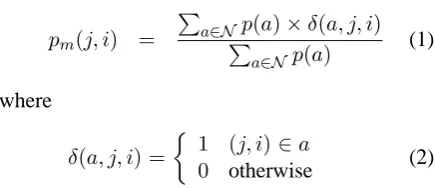
m is a J ×I matrix to encode the probabilities of n-best alignments of the same sentence pair. Each element in the matrix stores a link probabil-itypm(j, i), which is estimated from ann-best list
by calculating relative frequencies:
pm(j, i) =
P
a∈NPp(a)×δ(a, j, i) a∈Np(a)
(1)
where
δ(a, j, i) =
1 (j, i)∈a
0 otherwise (2)
HereN is ann-best list,p(a)is the probability of an alignment ain then-best list. The numbers in the cells in Figure 2(c) are the correspondingpm.
Sincepm(j, i) is the probability that fj and ei are aligned, the probability that the two words are not aligned is
¯
[image:2.595.119.480.63.205.2]pm(j, i) = 1.0−pm(j, i) (3) Figure 2 shows an example. The probability for the two words zhongguo and China being aligned is 1.0 and the probability that they are not aligned is 0.0. In another way, the two words are definitely aligned.
Given a phrase pair (fj2
j1,e
i2
i1), Liu et al. (2009)
calculate relative frequencies following Och and Ney (2004):
φ(˜e|f˜) = count(f
j2
j1, e
i2
i1)
P
ei′2
i′1
count(fj2
j1, e
i′
2
i′
1)
(4)
[image:2.595.308.526.292.386.2]the development of China ’s economy
zh
o
n
g
g
u
o de
jin
g
ji
fa
zh
a
n
1.0 0.6 0.4 0.4
1.0
1.0 0.4
0 0 0 0 0
0 0 0 0
0 0 0 0
[image:3.595.307.529.87.261.2]0 0 0 0
Figure 3: A weighted alignment matrix of a phrase pair. The light shading area is the outside area of phrase pair, and the area inside the pane with bold lines is the inside area.
one word in source phrase is aligned to a word in target phrase, and outside probability indicates the chance that no words in one phrase are aligned to a word outside the other phrase. The fractional count is calculated:
count(fj2
j1, e
i2
i1) =α(f
j2
j1, e
i2
i1)×β(f
j2
j1, e
i2
i1) (5)
whereα(·)andβ(·)denote the inside and outside probabilities respectively, which can be calculated as
α(·) = 1− Y
(j,i)∈in(·)
¯
pm(j, i) (6)
β(·) = Y
(j,i)∈out(·)
¯
pm(j, i) (7)
Here in(·) denotes the inside area, which in-cludes elements that fall inside the phrase pair, whileout(·)denotes the outside area including el-ements that fall outside the phrase pair while fall in the same row or the same column. Figure 3 shows an example. The light shading area is the outside area of phrase pair and the area inside the pane with bold lines is the inside area.
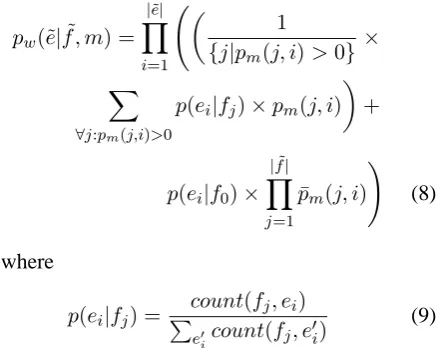
To calculate the lexical weights, Liu et al. (2009) adapt pm(j, i) as the fractional count
count(fj, ei). The fractional counts of NULL words can be calculated as:
count(fj, e0) = I
Y
i=1
¯ pm(j, i)
For example, in Figure 2,count(de,′s)is 0.4 and
count(de, N U LL)is 0.24.
Then the lexical weight can be calculated as:
pw(˜e|f , m˜ ) = |e˜|
Y
i=1
1
{j|pm(j, i)>0} ×
X
∀j:pm(j,i)>0
p(ei|fj)×pm(j, i)
+
p(ei|f0)× |f˜|
Y
j=1
¯ pm(j, i)
!
(8)
where
p(ei|fj) =
count(fj, ei)
P
e′
icount(fj, e
′ i)
(9)
We apply weighted alignment matrix to the hier-archical phrase-based model (Chiang, 2007) and the tree-to-string model (Liu et al., 2006; Huang et al., 2006).
3 Rule Extraction
In hierarchical rules, both source and target sides are strings with NTs. In tree-to-string rules, the source side is a tree with NTs, while the target side is a string with NTs. Since the tree structure of source side has no effect on the calculations of relative frequencies and lexical weights, we can represent both tree-to-string and hierarchical rules as below:
X→ hγ, α,∼i
where X is a nonterminal, γandαare source and target strings (consist of terminals and NTs), and ∼represents word alignments between NTs in γ
andα.
The bulk of syntax grammars consists of two parts: phrase pairs and variable rules. The differ-ence between them is containing NTs or not. Since we can calculate relative frequencies and lexical weights of phrase pairs as in Liu et al. (2009), we only focus on the calculation of variable rules. 3.1 Extraction Algorithm
Following Chiang (2007) and Liu et al. (2006), our extraction algorithm involves two steps. First, we extract phrase pairs from weighted alignment matrices. Then, we obtain variable rules by re-placing sub-phrase pairs with NTs.
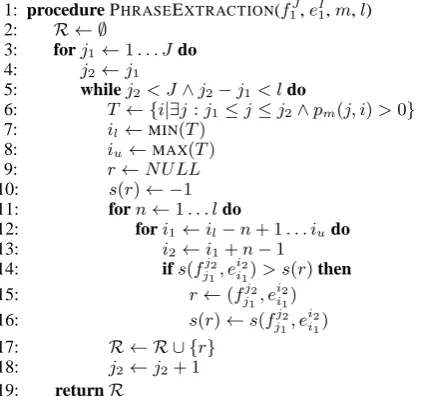
Figure 4 shows the algorithm of extracting phrase pairs from a weighted matrix for the hier-archical phrase-based model. The input of the al-gorithm is a sentence pair (fJ
1: procedure PHRASEEXTRACTION(fJ
1,eI1,m,l)
2: R ← ∅
3: forj1←1. . . Jdo
4: j2←j1
5: whilej2< J∧j2−j1< ldo
6: T← {i|∃j:j1≤j≤j2∧pm(j, i)>0} 7: il←MIN(T)
8: iu←MAX(T)
9: r←N U LL
10: s(r)← −1
11: forn←1. . . ldo
12: fori1←il−n+ 1. . . iudo
13: i2←i1+n−1
14: ifs(fj2
j1, e
i2
i1)> s(r)then
15: r←(fj2
j1, e
i2
i1)
16: s(r)←s(fj2
j1, e
i2
i1)
17: R ← R ∪ {r}
18: j2←j2+ 1
[image:4.595.74.285.63.263.2]19: returnR
Figure 4: Algorithm of extracting phrase pairs from a sentence pair hf1J, eI1i annotated with a weighted alignment matrix m. We just retain the best target phrase for each source phrase. Here
s(·)denotes the selection criteria in Section 3.2
target phrase α β count
China ’s economy 1.0 0.4 0.4
of China ’s economy 1.0 0.6 0.6
China ’s 1.0 0.0 0.0
of China ’s 1.0 0.0 0.0 Table 1: Some candidate target phrases of the source phrase zhongguo de jingji in Figure 3 (sup-pose the structure of zhongguo de jingji is a com-plete sub-tree). Here α is inside probability,β is outside probability, andcountis fractional count.
strings, a weighted alignment matrix m, and a phrase length limit l. Note that we just retain the target phrase of highest score for each source phrase (lines 13-16). We describe these in Sec-tion 3.2. After we extract phrase pairs, we can ob-tain variable rules by replacing sub-phrase pairs with NTs.
We can also extend this algorithm to tree-to-string model. The difference is that the source sentence should be a tree instead of a string and additional syntactic constraints operate.
3.2 Selection Criteria
(Liu et al., 2009) show that given a source phrase, there would be multiple “potential” candidate tar-get phrases in weighted matrices. Table 1 lists some candidate target phrases of the source phrase
zhongguo de jingji in Figure 3. If we retain all of
them, it will lead to an exponentially increasing rule table. To achieve balance between rule table size and performance, we just select the best can-didate target phrase.
An interesting finding is that a target phrase with the largest fractional count is not always the best one. For example in Table 1, the target phrase
of China ’s economy has a larger fractional count
than China ’s economy. However, we can see that (zhongguo de jingji, China ’s economy) is better.
To alleviate this problem, we incorporate lexi-cal weight to distinguish good target phrases from bad ones. While frequency indicates how of-ten the source phrase and target phrase occur to-gether, lexical weight models the correspondence between them. Therefore, we can construct a scor-ing measure that incorporates both frequency and lexical weight. The scoring equation below mod-els this effect:
s( ˜f ,e˜) =ω·count( ˜f ,e˜) + (1−ω)·pw(˜e|f , m˜ )(10)
where ω is the interpolation weight, count( ˜f ,e˜)
is calculated by Equation 5, and pw(˜e|f , m˜ ) by Equation 8. In practice, we setω= 0.5.1 Suppose
pw(China ’s economy|zhongguo de jingji) is 0.7 andpw(of China ’s economy|zhongguo de jingji) is 0.4, then we should choose the target phrase
China ’s economy although of China ’s economy
has a larger fractional count.
Note that we select the best target phrase for each source phrase for just one sentence. It means there could still be many target phrases for each source phrase during decoding.
[image:4.595.85.280.356.425.2]3.3 Calculating Relative Frequencies
Figure 5 shows an example of the matrix of a hier-archical rule, which is generated from the phrase pair in Figure 3. Due to the existence of sub-phrase pairs, the inside and outside areas changes (see the difference between Figure 3 and Figure 5). Therefore, we can not simply calculate the outside probability of the hierarchical rule using the prod-uct of outside probabilities of phrase pair and sub-phrase pairs.
We follow Liu et al. (2009) to calculate relative frequencies using the product of inside and outside probabilities. We now extend the definitions of in-side and outin-side probabilities to hierarchical rules that contain NTs.
1We tried a few other settings and found them to be less
rule α β count X1de jingji,X1’s economy 1.0 0.4 0.4
zhongguoX1, ChinaX1 1.0 0.4 0.4
zhongguo deX1, China ’sX1 1.0 0.24 0.24
[image:5.595.182.420.63.132.2]X1 deX2,X1’sX2 1.0 0.24 0.24
Table 2: Some hierarchical rules generated from the phrase pair (zhongguo de jingji, China’s economy) in Figure 3 (suppose the structure of zhongguo de jingji is a complete sub-tree). Hereαis inside probability,
βis outside probability, andcountis fractional count.
the development of China ’s economy
zh
o
n
g
g
u
o de
jin
g
ji
fa
zh
a
n
1.0 0.6 0.4 0.4
1.0
1.0 0.4
0 0 0 0 0
0 0 0 0
0 0 0 0
[image:5.595.308.528.600.716.2]0 0 0 0
Figure 5: A weighted alignment matrix of a vari-able rule, which is obtained by replacing
(zhong-guo,China) withXin (zhongguo de jingji,China ’s
economy). The diagonal area is the inside area of
the sub-phrase pair. The shading area is the out-side area of the variable rule, and heavy shading area is the duplicate outside area. The no shading area inside the pane with bold lines is the inside area.
Given a variable rule (f′,e′), which is generated from the phrase pair (fj2
j1, e
i2
i1) by replacing
sub-phrase pairs withX. We denoteRas the variable rule, P as the phrase pair (fj2
j1, e
i2
i1), and Xk as
the kth sub-phrase pair that is replaced with X. Therefore, the inside probability of a variable rule is calculated as:
α(R) = Y
k
α(Xk) (11)
We tried to follow the constraints of Chiang (2007): (1) unaligned words are not allowed at the edges of phrases; (2) a rule must have at least one pair of aligned words. This would take into ac-count the terminals in the variable rule, but make the calculation more complicated (especially con-straint (1)). However, it didn’t work well. Thefore, we only constraint that the rule should re-spect the word alignment, which means one ter-minal in a phrase could not align to another word outside the phrase (using outside probability).
Accordingly, the outside probability is calcu-lated as:
β(R) = Y
(j,i)∈out(R)
¯
pm(j, i) (12)
where
out(R) =out(P)[ [
k
out(Xk)
For example, the inside probability of (X1 de
jingji, X1 ’s economy) in Figure 5 is 1.0, and its outside probability is 0.4.
We also use Equation 5 to calculate the frac-tional counts of hierarchical rules. We follow Liu et al. (2009) to prune rule table using a thresh-old of frequency. Table 2 lists some hierarchical rules generated from the phrase pair (zhongguo de
jingji, China’s economy) in Figure 3. If the
thresh-old is 0.2, we retain all the rules in Table 2. 3.4 Calculating Lexical Weights
We denote SR as all words in source side of the inside area of variable ruleR, andTRas the words in target side. For the rule (X1 de jingji, X1 ’s
economy) in Figure 5,SRis{de, jingji}andTRis {’s, economy}. Then, we can calculate the lexical weight as:
pw(˜e|f , m˜ ) =
Y
i∈TR
1
|{j|pm(j, i) >0|}×
X
∀j:pm(j,i)>0
p(ei|fj)×pm(j, i)
+
p(ei|f0)×
Y
j∈SR ¯ pm(j, i)
!
(13)
Note that we only consider each word pair (fj,
economy) is
1
2× p(
′s|de)×0.4 +p(′s|jingji)×0.4+
p(′s|N U LL)×0.36×
p(economy|jingji)×1.0
Here the probability that economy translates a source NULL token is 0.0.
4 Experiments
4.1 Data Preparation
Our experiments are on Chinese-English transla-tion based on replicatransla-tions of hierarchical phrase-based system (Chiang, 2007) and tree-to-string system (Liu et al., 2006). We train a 4-gram language model on the Xinhua portion of GIGA-WORD corpus using the SRI Language Model-ing Toolkit (Stolcke, 2002) with modified Kneser-Ney smoothing (Kneser and Kneser-Ney, 1995). We opti-mize feature weights using the minimum error rate training algorithm (Och and Ney, 2002) on the NIST 2002 test set. We evaluate the translation quality using case-insensitive BLEU metric (Pa-pineni et al., 2002) on the NIST 2003/2004/2005 test sets.
To obtain weighted alignment matrices, we fol-low Venugopal et al. (2008) to produce n-best lists via GIZA++. We produce 20-best lists in two translation directions, then used “grow-diag-final-and” (Koehn et al., 2003) to all 20 × 20 bidi-rectional alignment pairs. We follow Liu et al. (2009) to useps2t×pt2sas the probabilities of an alignment pair. Analogously, we abandon dupli-cate alignments that are produced from different alignment pairs. After these steps, there are 110 candidate alignments on average for each sentence pair. We obtainedn-best lists by selecting the top
nalignments from 110-best lists. We re-estimated the probability of each alignment in then-best list using re-normalization (Venugopal et al., 2008). Finally, we construct weighted alignment matrices from thesen-best alignments.
We will first report results trained on a small-scaled corpus, and then scale to a larger one. When extracting tree-to-string rules, we limit the maximal height of rules to 3. We use the pruning threshold: t= 0.5.
4.2 Results on Small Data
To test the effect of our approach, we firstly car-ried out experiments on FBIS corpus, which con-tains 230K sentence pairs. Table 3 shows the rule table size and translation quality. Using n-best alignments slightly improved the BLEU score, but at the cost of much slower extraction, since each of top-nalignments has to be processed individu-ally although they share many align links. Matrix-based extraction, by contrast, is much faster due to packing and produces consistently better BLEU scores. The absolute improvements of ranging from +1.6 to +1.8 BLEU points and +1.4 to +1.8 BLEU points over 1-best alignments for hierarchi-cal phrase-based and tree-to-string models respec-tively, are statistically significant at p < 0.01 by using sign-test (Collins et al., 2005).
Basically, in the matrix case of the hierarchi-cal phrase-based model, we can use about twice as many rules as in the 1-best case, or 1.3 times of 10-best extraction. However, in tree-to-string sce-nario, matrix-based extraction produces less rules than k-best extraction. We contribute this to the extra complete sub-tree constraint.
4.3 Results on Large Data
We also conducted experiments on a larger train-ing data, which contains 1.5M sentence pairs com-ing from LDC dataset.2
The ruletable size and BLEU score are shown in Table 4. An interesting finding is that BLEU scores decline when using k-best extraction in some cases. We conjecture that some low-quality rules that harm the performance of decoder, are extracted fromk-best alignments. Using weighted matrices on larger corpus also achieved signifi-cant and consistent improvements over using 1-best and n-best lists. These results confirm that our approach is a promising direction for syntax-based machine translation.
4.4 Comparison of Parameter Estimation
In this section we investigated the question of how many rules are shared byn-best and matrix-based extractions on small data (FBIS corpus). Our mo-tivation is that weighted alignment matrices have been reported to be beneficial for better estimation of rule translation probabilities and lexical weights 2The corpus includes LDC2002E18, LDC2003E07,
Rules from. . . Extraction Total Rules NIST03 NIST04 NIST05
Rules BLEU Rules BLEU Rules BLEU
hierarchical phrase-based model
1-best 17 39.7M 2.5M 30.14 4.2M 33.82 3.0M 30.33
10-best 155 62.7M 4.2M 30.59 7.0M 34.30 5.0M 30.73
m(10) 89 86.7M 5.7M 31.81 9.5M 35.67 6.6M 31.94
tree-to-string model
1-best 21 9.3M 532K 27.39 762K 30.30 614K 27.06
10-best 231 19.6M 890K 27.57 1.13M 30.65 1.02M 27.07
[image:7.595.83.517.61.205.2]m(10) 44 9.2M 590K 28.92 836K 31.77 677K 28.87
Table 3: Results with different rule extraction methods on small data. Here 1-best, 10-best andm(10) denote 1-best alignments, 10-best lists and weighted matrices estimated from 10-best lists respectively. The rules are filtered on the corresponding test set. “Extraction” denotes extraction time in millsecs per sentence pair. We evaluate the translation quality using 4-grams case-insensitive BLEU metric.
Rules from. . . Total Rules NIST03 NIST04 NIST05
Rules BLEU Rules BLEU Rules BLEU
hierarchical phrase-based model
1-best 204M 10.3M 33.40 16.1M 34.65 11.7M 32.88
10-best 288M 16.5M 33.18 25.2M 34.75 18.6M 32.47
m(10) 524M 26.1M 35.10 40.7M 36.56 29.5M 34.31
tree-to-string model
1-best 30.7M 1.99M 30.76 2.68M 32.69 2.21M 30.36
10-best 71.4M 3.53M 31.54 4.63M 33.47 3.89M 31.09
m(10) 30.7M 2.24M 32.23 2.99M 34.24 2.48M 31.88
Table 4: Results with different rule extraction methods on large data. We usem(10) for the weighted matrices estimated from 10-best lists.
(Liu et al., 2009). The experiments are tested on NIST 2005 dataset.
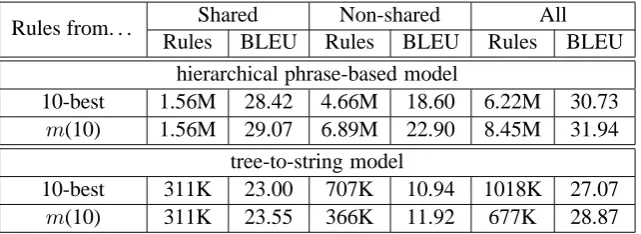
Table 5 gives some statistics. We use m(10) for the weighted matrices estimated from 10-best lists. “All” denotes the full rule table, “Shared” denotes the intersection of two tables, and “Non-shared” denotes the complement. There were
18.8%of rules learned from weighted matrices in-cluded by both tables in hierarchical phrase-based case, while36.5%for tree-to-string rules, indicat-ing that complete sub-tree constraint played an im-portant role in matrix-based tree-to-string rule ex-traction. Note that the probabilities of “Shared” rules are different for the two approaches. Liu et al. (2009) shows that using matrices outperformed using n-best lists even with the same rules. Our experiments confirmed these findings.
4.5 Best Rule or More Rules
Someone would argue that using more rules could improve the performance, especially for the
tree-to-string model. Therefore, we carried out exper-iments on small data for tree-to-string model to investigate which one is better. Note that even though we retain the best target side for each source side for each sentence, there could still be many target sides for each source side when de-coding.
Table 6 shows the results of different criteri-ons. The first column “Criteria” indicates how many target phrases are preserved: the best one or all phrases that reach pruning threshold. We can see that “More Rules” could not outperform “Best Rule” even using almost 2.5 times rules. One pos-sible reason is that it might introduce some low-quality target phrase such as of China ’s economy in Table 1, which will generate more substandard variable rules.
5 Related Works
[image:7.595.111.490.276.421.2]Rules from. . . Shared Non-shared All
Rules BLEU Rules BLEU Rules BLEU
hierarchical phrase-based model
10-best 1.56M 28.42 4.66M 18.60 6.22M 30.73
m(10) 1.56M 29.07 6.89M 22.90 8.45M 31.94
tree-to-string model
10-best 311K 23.00 707K 10.94 1018K 27.07
[image:8.595.140.461.62.179.2]m(10) 311K 23.55 366K 11.92 677K 28.87
Table 5: Comparison of rule tables learned fromn-best lists and weighted matrices. The rules are filtered on both development and test sets. “All” denotes the full rule table, “Shared” denotes the intersection of two tables, and “Non-shared” denotes the complement. Note that the probabilities of “Shared” rules are different for the two approaches.
Criteria Total Rules NIST03 NIST04 NIST05
Rules BLEU Rules BLEU Rules BLEU
Best Rule 9.2M 590K 28.92 836K 31.77 677K 28.87
More Rules 21.4M 1.54M 29.07 1.97M 31.66 1.72M 29.02
Table 6: Comparison of rule tables learned from weighted matrices using different criterions. “Best Rule” denotes the rule table using the criteria described in Section 3.2, “More Rules” denotes the rule table using the criteria that retains all candidate target phrases that reach pruning threshold.
and Huang (2008) and Tu et al. (2010) use forests instead of 1-best trees; Venugopal et al. (2003) and Deng et al. (2008) soft the alignment consis-tency constraint to extract more rules; Dyer et al. (2008) use word lattices instead of 1-best segmen-tations to generate more alignments for a sentence pair; Venugopal et al. (2008) use n-best align-ments directly for rule extraction.
To generate larger rule sets, de Gispert et al. (2010) extract hierarchical rules from alignment posterior probabilities. They concern how to ex-tract larger rule sets using simple yet powerful hi-erarchical grammar, while we focus on whether weighted alignment matrix could overcome the alignment errors for different translation models (e.g. phrase-based, hierarchical phrase-based and tree-based models). They use phrase posteriors as the fractional count, while we use the product of inside and outside probabilities. Besides, they filter rules after extracting all rules from corpus, while we prune rules when extracting.
6 Conclusion and Future Works
Liu et al. (2009) proposed a new structure named weighted alignment matrix that make a better use of noisy alignments. Since weighted matrices proves effective for phrase-based model, we ap-ply it to syntax-based models, which are more
sensitive to word alignments. Due to the differ-ence in structure between phrases and hierarchi-cal rule, we develop new algorithms to hierarchi-calculate relative frequencies and lexical weights of hierar-chical rules. To achieve a balance between rule table size and performance, we develop a scor-ing measure that incorporates both frequency and lexical weight to select the best target phrase for each source phrase. Our experiments show that our approach improves BLEU score significantly, with reasonable extraction speed, indicating that weighted alignment matrix also works for syntax-based models.
Besides the hierarchical phrase-based model and tree-to-string model, our method is also ap-plicable to other paradigms such as the tree models (Galley et al., 2006) and the string-to-dependency models (Shen et al., 2008). Another interesting direction is to use a simpler alignment model that can compute alignment point posteriors directly, such as word-based ITG model (Zhang and Gildea, 2005; Haghighi et al., 2009).
7 Acknowledgement
References
David Chiang. 2005. A hierarchical phrase-based
model for statistical machine translation. In
Pro-ceedings of the 43rd Annual Meeting on Association for Computational Linguistics, pages 263–270.
As-sociation for Computational Linguistics.
David Chiang. 2007. Hierarchical phrase-based trans-lation. computational linguistics, 33(2):201–228.
M. Collins, P. Koehn, and I. Kuˇcerov´a. 2005. Clause restructuring for statistical machine translation. In
Proceedings of the 43rd Annual Meeting on Associ-ation for ComputAssoci-ational Linguistics, page 540.
As-sociation for Computational Linguistics.
Adri`a de Gispert, Juan Pino, and William Byrne. 2010. Hierarchical phrase-based translation grammars ex-tracted from alignment posterior probabilities. In
Proceedings of the 2010 Conference on Empirical Methods in Natural Language Processing, pages
545–554, Cambridge, MA, October. Association for Computational Linguistics.
Yonggang Deng, Jia Xu, and Yuqing Gao. 2008.
Phrase table training for precision and recall: what
makes a good phrase and a good phrase pair? In
Proceedings of ACL-08: HLT, pages 81–88,
Colum-bus, Ohio, June. Association for Computational Lin-guistics.
Christopher Dyer, Smaranda Muresan, and Philip Resnik. 2008. Generalizing word lattice transla-tion. In Proceedings of ACL-08: HLT, pages 1012– 1020, Columbus, Ohio, June. Association for Com-putational Linguistics.
Michel Galley, Jonathan Graehl, Kevin Knight, Daniel Marcu, Steve DeNeefe, Wei Wang, and Ignacio Thayer. 2006. Scalable inference and training of context-rich syntactic translation models. In
Pro-ceedings of the 21st International Conference on Computational Linguistics and 44th Annual Meet-ing of the Association for Computational LMeet-inguis- Linguis-tics, pages 961–968, Sydney, Australia, July.
Asso-ciation for Computational Linguistics.
Aria Haghighi, John Blitzer, John DeNero, and Dan Klein. 2009. Better word alignments with super-vised itg models. In Proceedings of the Joint
Con-ference of the 47th Annual Meeting of the ACL and the 4th International Joint Conference on Natural Language Processing of the AFNLP, pages 923–
931, Suntec, Singapore, August. Association for Computational Linguistics.
Liang Huang, Kevin Knight, and Aravind Joshi. 2006. Statistical syntax-directed translation with extended domain of locality. In Proceedings of AMTA, pages 66–73. Citeseer.
Reinhard Kneser and Hermann Ney. 1995. Improved
backing-off for m-gram language modeling. In
ICASSP IEEE INT CONF ACOUST SPEECH SIG-NAL PROCESS PROC, volume 1, pages 181–184.
Philipp Koehn, Franz Joseph Och, and Daniel Marcu.
2003. Statistical phrase-based translation. In
Proceedings of the 2003 Conference of the North American Chapter of the Association for Computa-tional Linguistics on Human Language Technology-Volume 1, pages 48–54. Association for
Computa-tional Linguistics.
Yang Liu, Qun Liu, and Shouxun Lin. 2006. Tree-to-string alignment template for statistical machine
translation. In Proceedings of the 21st
Interna-tional Conference on ComputaInterna-tional Linguistics and 44th Annual Meeting of the Association for Compu-tational Linguistics, pages 609–616, Sydney,
Aus-tralia, July. Association for Computational Linguis-tics.
Yang Liu, Tian Xia, Xinyan Xiao, and Qun Liu. 2009. Weighted alignment matrices for statistical machine translation. In Proceedings of the 2009 Conference
on Empirical Methods in Natural Language Pro-cessing, pages 1017–1026, Singapore, August.
As-sociation for Computational Linguistics.
Haitao Mi and Liang Huang. 2008. Forest-based
translation rule extraction. In Proceedings of the
2008 Conference on Empirical Methods in Nat-ural Language Processing, pages 206–214,
Hon-olulu, Hawaii, October. Association for Computa-tional Linguistics.
Franz Josef Och and Hermann Ney. 2002. Discrim-inative training and maximum entropy models for statistical machine translation. In Proceedings of
40th Annual Meeting of the Association for Com-putational Linguistics, pages 295–302, Philadelphia,
Pennsylvania, USA, July. Association for Computa-tional Linguistics.
Franz J. Och and Hermann Ney. 2004. The alignment template approach to statistical machine translation.
Computational Linguistics, 30(4):417–449.
Kishore Papineni, Salim Roukos, Todd Ward, and
Wei-Jing Zhu. 2002. Bleu: a method for automatic
evaluation of machine translation. In Proceedings
of 40th Annual Meeting of the Association for Com-putational Linguistics, pages 311–318, Philadelphia,
Pennsylvania, USA, July. Association for Computa-tional Linguistics.
Libin Shen, Jinxi Xu, and Ralph Weischedel. 2008. A new string-to-dependency machine translation al-gorithm with a target dependency language model. In Proceedings of ACL-08: HLT, pages 577–585, Columbus, Ohio, June. Association for Computa-tional Linguistics.
Andreas Stolcke. 2002. Srilm - an extensible language modeling toolkit. In Proceedings of Seventh
Inter-national Conference on Spoken Language Process-ing, volume 3, pages 901–904. Citeseer.
Zhaopeng Tu, Yang Liu, Young-Sook Hwang, Qun
for-est for statistical machine translation. In
Proceed-ings of the 23rd International Conference on Com-putational Linguistics (Coling 2010), pages 1092–
1100, Beijing, China, August. Coling 2010 Organiz-ing Committee.
Ashish Venugopal, Stephan Vogel, and Alex Waibel. 2003. Effective phrase translation extraction from alignment models. In Proceedings of ACL.
Ashish Venugopal, Andreas Zollmann, Noah A. Smith, and Stephan Vogel. 2008. Wider pipelines: n-best alignments and parses in mt training. In
Proceed-ings of AMTA, Honolulu, Hawaii.
Deyi Xiong, Qun Liu, and Shouxun Lin. 2006. Max-imum entropy based phrase reordering model for
statistical machine translation. In Proceedings of
the 21st International Conference on Computational Linguistics and 44th Annual Meeting of the Associa-tion for ComputaAssocia-tional Linguistics, pages 521–528,
Sydney, Australia, July. Association for Computa-tional Linguistics.
Hao Zhang and Daniel Gildea. 2005. Stochastic lex-icalized inversion transduction grammar for
align-ment. In Proceedings of the 43rd Annual
Meet-ing on Association for Computational LMeet-inguistics,