An Example-based Decoder for Spoken Language Machine
Transla-tion
Zhou-Jun Li
Wen-Han Chao
Abstract
In this paper, we propose an example-based decoder for a statistical machine translation (SMT) system, which is used for spoken language machine translation. In this way, it will help to solve the re-ordering problem and other problems for spoken language MT, such as lots of omissions, idioms etc. Through experiments, we show that this approach obtains improvements over the baseline on a Chinese-English spoken lan-guage translation task.
1
Introduction
The state-of-the-art statistical machine translation (SMT) model is the log-linear model (Och and Ney, 2002), which provides a framework to incorporate any useful knowledge for machine translation, such as translation model, language model etc.
In a SMT system, one important problem is the re-ordering between words and phrases, especially when the source language and target language are very different in word order, such as Chinese and English.
For the spoken language translation, the re-ordering problem will be more crucial, since the spoken language is more flexible in word order. In addition, lots of omissions and idioms make the translation more difficult.
However, there exists some "useful" features, such as, most of the spoken text is shorter than the written text and there are some fixed translation
structures. For example, ( 你能…? / Would you please … ? ), (能…?/May I…?).
We can learn these fixed structures and take them as rules, Chiang (2005) presents a method to learn these rules, and uses them in the SMT. Gen-erally, the number of these rules will be very large. In this paper, we propose an example-based de-coder in a SMT model, which will use the transla-tion examples to keep the translatransla-tion structure, i.e. constraint the reordering, and make the omitted words having the chance to be translated.
The rest of this paper is organized as follows: Since our decoder is based on the inversion trans-duction grammars (ITG) (Wu, 1997), we introduce the ITG in Section 2 and describe the derived SMT model. In Section 3, we design the example-based decoder. In Section 4, we test our model and com-pare it with the baseline system. Then, we con-clude in Section 5 and Section 6.
2
The SMT model
ITG is a synchronous context-free grammar, which generates two output streams simultaneously. It consists of the following five types of rules:
j i
j i p
e
c
e
c
AA
AA
A
⎯
⎯→
[
]
|
<
>
|
/
|
/
ε
|
ε
/
(1)Where A is the non-terminal symbol, [] and <>
represent the two operations which generate out-puts in straight and inverted orientation respec-tively. and are terminal symbols, which rep-resent the words in both languages,
i
c ej
ε is the null
National Laboratory for
Parallel and Distributed
Processing, Changsha,
China
School of Computer
Sci-ence and Engineering,
Beihang University,
China
National Laboratory for
Parallel and Distributed
Processing, Changsha,
China
c
Yue-Xin Chen
National Laboratory for
Parallel and Distributed
Processing, Changsha,
words. The last three rules are called lexical rules. is the probability of the rule.
p
In this paper, we consider the phrase-based SMT, so the and represent phrases in both lan-guages, which are consecutive words. And a pair of and is called a phrase-pair, or a block.
i
c ej
i
c ej
During the process of decoding, each phrase in the source sentence is translated into a target phrase through lexical rules, and then rules [] or <> are used to merge two adjacent blocks into a larger block in straight or inverted orientation, until the whole source sentence is covered. In this way, we will obtain a binary branching tree, which is different from the traditional syntactical tree, since each constituent in the branching tree is not a syn-tactical constituent.
i c
j e
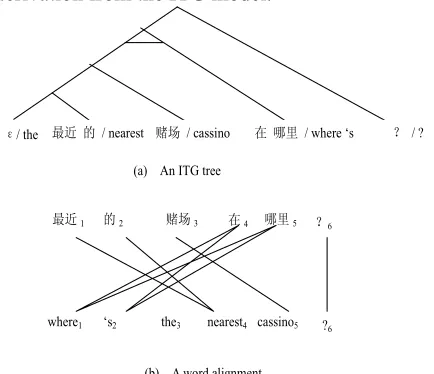
Thus, the model achieves a great flexibility to interpret almost arbitrary reordering during the de-coding, while keeping a weak but effective con-straint. Figure 1(a) gives an example to illustrate a derivation from the ITG model.
最近1 的2 赌场3 在4 哪里5 ?6
where1 ‘s2 the3 nearest4 cassino5 ?6
(b) A word alignment (a) An ITG tree
ε/ the 最近的 / nearest 赌场 / cassino 在 哪里 / where ‘s ? / ?
Figure 1. (a) An ITG tree derived from the ITG where the line between the branches means an in-verted orientation, otherwise a straight one, (b) A word alignment corresponds to the ITG tree in (a).
Since we regard the process of the decoding as a sequence of applications of rules in (1), i.e., the output sentence pair (C,E) will be a derivation D of
the ITG, where C represents the source sentence
and E is the target sentence.
Following Och and Ney (2002), we define the probability for each rule as:
∏
=
i
i rule i h
rule) ( )λ
Pr( (2)
Where the hi represents the feature and λi is the
corresponding weight of the feature.
We will consider mainly the following features for rules:
z Translation Models: , ,
and . The first two mod-els consider the probability of phrase transla-tion; and the latter two consider the lexical translation, i.e., the probability that the words in source (or target) phrase translate to the ones in the target (or source) phrase.
) | (e c
P P(c|e)
) | (e c
Plex Plex(c|e)
z Reordering model: , where o is
the output orientation and b
) , | (o b1 b2 P
1, b2 are the two
blocks in the rule.
z Language model:
Δ
Pr
lm(
e
)
, which considers the increment of the language model for each rule.And the probability for the derivation will be:
∏
=
∈D r
r
D
)
Pr(
)
Pr(
(3)So the decoder searches the best E* derived
from the best derivation D*, when given a source
sentence C.
) Pr( max arg *
) (
D D
C D c =
= (4)
2.1 Building the models
In our SMT model, we use the translation models and reordering model. They will be built from the training corpus, which is a word-aligned bilingual corpus satisfying the ITG constraint.
We define the word alignment A for the
sen-tence pair (C,E) in the following ways:
z A region (i..j,s..t): i.. represents a sequence j
of position index in sentence C, i.e. j
i
i, +1,..., and represents a sequence of
position index in sentence E, i.e.
t
s
..
t s
s, +1,..., .
We also call the i..j and s.. are regions in t
monolingual sentences. The region corre-sponds to a phrase pair, which we called as a block. The length of the block is
|)
1
|
|,
1
z A link : And each link represents the alignment between the consecutive words in both of the sentences, which position in-dexes are in and
link a null-align.
z A word alignment A: a set of links links are adjacent in both of the sentences, i.e.
is adjacent to where merging two adjacent links gradually, we call the region is independent, and the corresponding block is also independent.
1
In our system, the word alignment must satisfy the ITG constraint, i.e. the word alignment is able to form a binary branching tree. Figure 1(b) illus-trates a word alignment example; the number be-low the word is the position index. In the example, the region (1..3, 3..5) is independent, and the block
(最近 的 赌场,the nearest cassino) is also
inde-pendent.
In order to obtain the word alignment satisfying the ITG constraint, Wu(1997) propose a DP algo-rithm, and we (Chao and Li, 2007) have transferred the constraint to four simple position judgment procedures in an explicit way, so that we can in-corporate the ITG constraint as a feature into a log-linear word alignment model (Moore, 2005).
After obtaining the word-aligned corpus, in which each word alignment satisfy the ITG con-straint, we can extract the blocks in a straight-forward way. For the word alignment forms a hier-archical binary tree, we choose each constituent as a block. Each block is formed by combining one or more links, and must be independent. Considering the data sparseness, we limit the length of each block as N (here N=3~5).
We can also collect the reordering information between two blocks according to the orientation of the branches.
Thus, we will build the translation models
, , and , using
the frequencies of the blocks, and the re-ordering
model ,
following way:
)
Considering the data sparseness, we transfer the re-ordering model in the following way:
)
where * represents any block, repre-sents the probability when , i.e., when
occurs, the orientation it merges with any other block is o. So we can estimate the merging
orien-tation through the two blocks respectively. ,*)
2.2 A Baseline Decoder
In order to evaluate the example-based decoder, we develop a CKY style decoder as a baseline (Chao et al. 2007), which will generate a derivation from the ITG in a DP way. And it is similar with the topical phrase-based SMT system, while maintain-ing the ITG constraint.
3
The Example-based Decoder
The SMT obtains the translation models during training, and does not need the training corpus when decoding; while the example-based machine translation system (EBMT) using the similar ex-amples in the training corpus when decoding.
However, both of them use the same corpus; we can generate a hybrid MT, which is a SMT system while using an example-based decoder, to benefit from the advantages within the two systems.
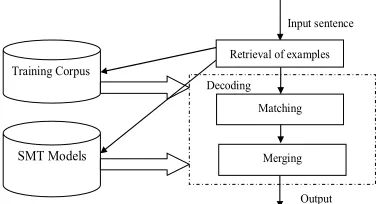
Our example-based decoder consists of two components: retrieval of examples and decoding. Figure 2 shows the structure of the decoder.
Training Corpus
SMT Models
Input sentence
Decoding
Merging Retrieval of examples
Matching
Output
3.1 Retrieval of Examples
Our training corpus is a sentence-aligned bilingual corpus. For each sentence pair (C,E), we obtained
the word alignment A, satisfying the ITG constaint
through the methods described in section 2. We call the triple (C,A,E) as an example.
So, the problem of retrieval of examples is: given the input source sentence C0 and the training
corpus, collecting a set of translation examples {( C1, A1, E1) , ( C2, TA2, E2),....} from the corpus,
where each translation example (Ci, Ai, Ei) is similar to the input sentence C0.
The quality of the retrieval of the similar exam-ples is very import to the hybrid MT. For the trans-lating may run in a large-scale corpus and in a real-time way, we divide the retrieval of similar exam-ples into two phases:
z Fast Retrieval Phase: retrieving the similar examples from the corpus quickly, and take them as candidates. The complexity should not be too high.
z Refining Phase: refining the candidates to find the most similar examples.
3.1.1 The Similarity Metric for Fast Retrieval
Given an input sentence and an ex-ample (C, A, E), we calculate the number of the
matched source words between the input sentence and the source sentence C in the example firstly.
n
Given an input sentence , we ob-tain the relative blocks in the translation model for
each word . We use to
represent the blocks, in which for each block , the source phrase c use the word as the first word, and the length of c is , i.e. the
. For each c, there may exists more than one blocks with c as the source phrase, so we
will sort them by the probability and keep the best N (here set N=5) blocks. Now we represent the input sentence as:
n the source phrase.
i
In the same way, we represent the example as:
where
A
*
represents the blocks which are links in the alignment or can be formed by merging ad-jacent links independently. In order to accelerate the retrieval of similar examples, we generate the block set for the example during the training proc-ess and store them in the corpus.A
Now, we can use the number of the matched blocks to measure the similarity of the input and the example:
Exam
Since each block is attached a probability, we can compute the similarity in the following way:
Exam
So the final similarity metric for fast retrieval of the candidates is:
p b w
fast I Exam Sim Sim Sim
Sim ( , )=α +β +γ (12)
where 10≤α,β,γ ≤1 α +β +γ = . Here we use mean values, i.e.
α
=
β
=
γ
=
1
/
3
. During the fast retrieval phase, we first filter out the examples us-ing the , then calculate the for each example left, and retrieve the best N examples.w
3.1.2 The Alignment Structure Metric
After retrieving the candidate similar examples, we refine the candidates using the word alignment structure with the example, to find the best M
simi-lar examples (here set M=10). The word alignment
in the example satisfies the ITG constraint, which provides a weak structure constraint.
Given the input sentence
I
and an example, we first search the matched blocks, at this moment the order of the source phrases in the blocks must correspond with the order of the words in the input.
) , , (C A E
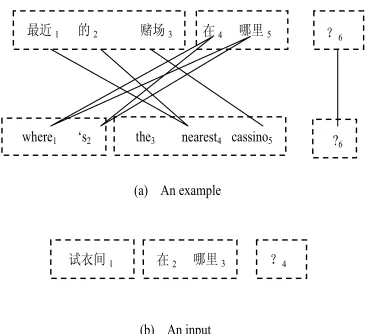
As Figure 3 shows, the matching divides the in-put and the example respectively into several re-gions, where some regions are matched and some un-matched. And we take each region as a whole and align them between the input and the example according to the order of the matched regions. For example, the region (1..3,3..5) in is un-matched, which aligns to the region (1..1) in
) , , (C A E
I
. In this way, we can use a similar edit distance method to measure the similarity. We count the number of the Deletion / Insertion / Substitution operations, which take the region as the object.最近1 的2 赌场3 在4 哪里5 ?6
where1 ‘s2 the3 nearest4 cassino5 ?6
(a) An example
试衣间1 在2 哪里3 ?4
(b) An input
Figure 3. An input and an example. After matching, there are three regions in both sides, which are in-cluded in the line box, where the region (4..5,1..2) in the example matches the region (2..3) in the in-put, so do (6..6,6..6) to (4..4). And the region (1..3,3..5) in the example should be substituted to (1..1) in the input.
We set the penalty for each deletion and inser-tion operainser-tion as 1, while considering the un-matched region in the example may be independ-ent or not, we set the penalty for substitution as 0.5
if the region is independent, otherwise as 1. E.g., the distance is 0.5 for substituting the region (1..3,3..5) to (1..1).
We get the metric for measuring the structure similarity of the
I
and (C,A,E):exmaple input
align
R R
S I D Exam
I Sim
+ + + −
=1 ) ,
( (13)
where D, I, S are the deletion, insertion and substi-tution distances, respectively. And the and
are the region numbers in the input and example.
input R
exmaple R
In the end, we obtain the similarity metric, which considers all of the above metrics:
align fast
final I Exam Sim Sim
Sim ( , )=α' +β' (14)
where
0
≤
α
,'
β
'
≤
1
α
'
+
β
'
=
1
. Here we also use mean valuesα
'
=
β
'
=
1
/
2
.After the two phrases, we obtain the most simi-lar examples with the input sentence.
3.2 Decoding
After retrieving the translation examples, our goal is to use these examples to constrain the order of the output words. During the decoding, we iterate the following two steps.
3.2.1 Matching
For each translation example (Ck, Ak, Ek) consists of the constituent structure tree, we can match the input sentence with the tree as in Section 3.1.2.
After matching, we obtain a translation of the input sentence, in which some input phrases are matched to blocks in the tree, i.e. they are trans-lated, and some phrases are un-translated. The or-der of the matched blocks must be the same as the input phrases. We call the translation as a transla-tion template for the input.
If we take each un-translated phrase as a null-aligned block, the translation template will be able to form a new constituent tree. And the matched blocks in the template will restrict the translation structure.
template can be derived from the ITG as follows (here we remove the un-matched phrase):
could
we will get more than one translation template for the input sentence. So we define the evaluation function f for each translation template as :
)
Where is the probability for the new ITG tree without the un-translated phrases, which is a derivation from the ITG, so we can calculate it using the SMT model in Section 2 ( formula 3).
) (Dtrans P
And the is the estimated score for the un-translated phrases. In order to ob-tain , we estimate the score for each un-translated phrase in the following way:
)
That is, using the best translation to estimate the translation score. Thus we can estimate the
as:
untrans
H
c
C
H
(
)
(
..)
(18)We call the un-translated phrases as child inputs, and try to translate them literately, i.e., decoding them using the examples. If there are no un-translated phrases in the input, the decoding is completed, and the decoder returns the translation template with the best score as the result.
3.2.2 Merging
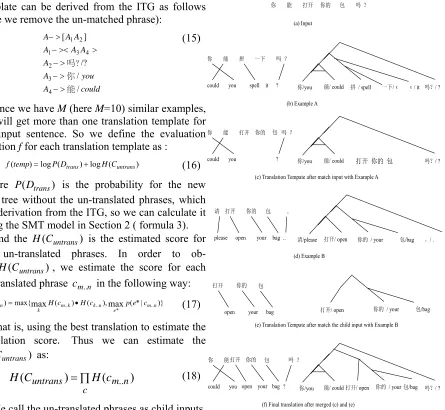
If one child input is translated completely, i.e. no phrase is un-translated. Then, it should be merged into the parent translation template to form a new template. When merging, we must satisfy the ITG constraint, so we use the rules [] and <> to merge the child input with the adjacent blocks. Figure 4(c-f) illustrates a merging process.
(b) Example A
你 能 拼 一下 吗?
could you spell it ? 你/you 能/ could 拼 / spell 一下/ε ε/ it 吗?/ ?
你 能 打开 你的 包 吗?
(a) Input
(c) Translation Tempate after match input with Example A
你 能 打开 你的 吗?
(e) Translation Tempate after match the child input with Example B
你的 / your
打开/ open 包/bag
打开 你的 包
open your bag
(f) Final translation after merged (c) and (e)
吗?
Figure 4. An example to illustrate the example-based decoding process, in which there are two translation examples.
When merging, it may modify some rules which are adjacent to the child inputs. For example, when merging Figure 4(c) and (e), we may add a new
Achild is the root non-terminal for the child input.
And we should modify the rule A−>[A1A2] as:
The merged template may vary due to the fol-lowing situations:
template and the preceding or posterior blocks may be straight or inverted.
zThe position to merge may vary. We may merge the new block with either the whole preceding or posterior blocks, or only the child blocks of them respectively, i.e. we may take the preceding or posterior blocks as the whole blocks or not.
Thus, we will obtain a collection of the merged translation templates, the decoder will evaluate them using the formualte (16). If all the templates have no un-translated phrases, return the template with the best score.
3.2.3 Decoding Algorithm
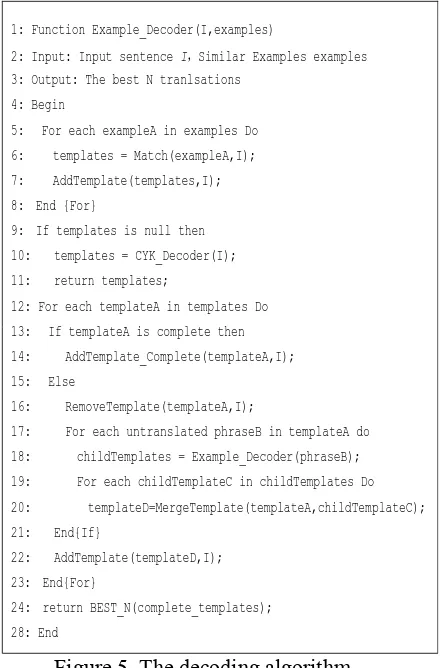
The decoding algorithm is showed in Figure 5. In line 5~8, we match the input sentence with each similar example, and generate a collection of translation templates, using the formular (16) to evaluate the templates.
In line 9~11, we verify whether the set of the templates for the input is null: If it is null, decoding the input using the normal CKY decoder, and return the translations.
In lin 12~23, we decode the un-matched phrase in each template, and merge it with the parent template, until all of the template are translated completely.
In line 24, we return the best N translations.
4
Experiments
We carried out experiments on an open Chinese-English translation task IWSLT2007, which con-sisting of sentence-aligned spoken language text for traveling. There are five development set, and we take the third development set, i.e. the
IWSLT07_devset3_*, to tune the feature weights.
Chinese English
stemmed Sentences 39,963
Words 351,060 377,890 Train.
cor-pus Vocabu-lary
11,302 7,610
Sentences 506 Dev.
Set Words 3,826
Sentences 489 Test
Set Words 3,189
Table 1. The statistics of the corpus
1: Function Example_Decoder(I,examples)
2: Input: Input sentence I,Similar Examples examples 3: Output: The best N tranlsations
4: Begin
5: For each exampleA in examples Do 6: templates = Match(exampleA,I); 7: AddTemplate(templates,I); 8: End {For}
9: If templates is null then 10: templates = CYK_Decoder(I); 11: return templates;
12: For each templateA in templates Do 13: If templateA is complete then 14: AddTemplate_Complete(templateA,I); 15: Else
16: RemoveTemplate(templateA,I);
17: For each untranslated phraseB in templateA do 18: childTemplates = Example_Decoder(phraseB); 19: For each childTemplateC in childTemplates Do 20: templateD=MergeTemplate(templateA,childTemplateC); 21: End{If}
22: AddTemplate(templateD,I); 23: End{For}
24: return BEST_N(complete_templates); 28: End
Figure 5. The decoding algorithm.
Considering the size of the training corpus is relatively small, and the words in Chinese have no morphological changes, we stemmed the words in the English sentences.
Table 1 shows the statistics for the training cor-pus, development set and test set.
In order to compare with the other SMT systems, we choose the Moses1, which is an extension to the
state-of-the-art SMT system Pharaoh (Koehn, 2004). We use the default tool in the Moses to train the model and tune the weights, in which the word alignment tool is Giza++ (Och and Ney 2003) and the language model tool is SRILM(Stolcke, 2002).
The test results are showed in Table2.
The first column lists the different MT systems, and the second column lists the Bleu scores (Pap-ineni et. al, 2002) for the four decoders.
The first system is the Moses, and the second is our SMT system described in section 2, which using a CKY-style decoder. We take them as base-line systems. The third is the hybrid system but
only using the fast retrieval module and the fourth is the hybrid system with refined retrieval module.
Considering the result from the Moses, we think that maybe the size of the training corpus is too small, so that the word alignment obtained by Giza++ is poor.
The results show that the example-based de-coder achieves an improvement over the baseline decoders.
Decoder Bleu Moses 22.61 SMT-CKY 28.33 Hybrid MT with fast retrieval 30.03
Hybrid MT with refined retrieval 33.05 Table 2. Test results for several systems.
5
Related works
There is some works about the hybrid machine translation. One way is to merge EBMT and SMT resources, such as Groves and Way (2005).
Another way is to implement an exmaple-based decoder, Watanabe and Sumita (2003) presents an example-based decoder, which using a information retrieval framework to retrieve the examples; and when decoding, which runs a hill-climbing algo-rithm to modify the translation example ( Ck, Ek,
Ak) to obtain an alignment ( C0, E'k, A'k).
6
Conclusions
In this paper, we proposed a SMT system with an example-based decoder for the spoken language machine translation. This approach will take ad-vantage of the constituent tree within the transla-tion examples to constrain the flexible word re-ordering in the spoken language, and it will also make the omitted words have the chance to be translated. Combining with the re-ordering model and the translation models in the SMT, the exam-ple-based decoder obtains an improvement over the baseline phrase-based SMT system.
In the future, we will test our method in the written text corpus. In addition, we will improve the methods to handle the morphological changes from the stemmed English words.
Acknowledgements
This work is supported by the National Science Foundation of China under Grants No. 60573057, 60473057 and 90604007.
References
Wen-Han Chao and Zhou-Jun Li.(2007). Incorporating Constituent Structure Constraint into Discriminative Word Alignment. MT Summit XI, Copenhagen, Denmark, September 10-14, 2007. pp.97-103.
Wen-Han Chao, Zhou-Jun Li, and Yue-Xin Chen.(2007) An Integrated Reordering Model for Statistical Ma-chine Translation. In proceedings of MICAI 2007, LNAI 4827, pp. 955–965, 2007.
David Chiang. (2005). A Hierarchical Phrase-Based Model for Statistical Machine Translation. In Proc. of ACL 2005, pages 263–270.
Declan Groves and Andy Way: Hybrid Example-Based SMT: the Best of Both Worlds? In Proceedings of the ACL Workshop on Building and Using Parallel Texts, pp. 183-190(2005)
P. Koehn.(2004) Pharaoh: a beam search decoder for phrase-based statistical machine translation models. In: Proceedings of the Sixth Conference of the Asso-ciation for Machine Translation in the Americas, pp. 115–124.
R. Moore. (2005). A discriminative framework for bilin-gual word alignment. In Proceedings of HLT-EMNLP, pages 81–88, Vancouver, Canada, October. Franz Joseph Och and Hermann Ney.(2002). Discrimi-native training and maximum entropy models for sta-tistical machine translation. In Proceedings of the 40th Annual Meeting of the ACL, pp. 295–302. Franz Joseph Och and Hermann Ney. (2003) A
System-atic Comparison of Various Statistical Alignment Models. Computational Linguistics 29(1), 19–52 Kishore Papineni, Salim Roukos, Todd Ward and
Wei-Jing Zhu. (2002). BLEU: a Method for Automatic Evaluation of Machine Translation. In Proceedings of the 40th Annual Meeting of the Association fo Computational Linguistics (ACL), Philadelphia, July 2002, pp. 311-318.
A. Stolcke. (2002). SRILM – An extensible language modeling toolkit.In Proceedings of the International Conference on Spoken Language Processing, Denver, Colorado, 2002, pp. 901–904.
Taro Watanabe and Eiichiro Sumita. (2003). Example-based Decoding for Statistical Machine Translation. In Machine Translation Summit IX pp. 410-417. Dekai Wu. (1997). Stochastic Inversion Transduction