Search Result Clustering Using Label Language Model
Yeha Lee Seung-Hoon Na Jong-Hyeok Lee Div. of Electrical and Computer Engineering
Pohang University of Science and Technology (POSTECH) Advanced Information Technology Research Center (AITrc) San 31, Hyoja-Dong, Pohang, Republic of Korea, 790-784
{sion,nsh1979,jhlee}@postech.ac.kr
Abstract
Search results clustering helps users to browse the search results and locate what they are looking for. In the search result clustering, the label selection which anno-tates a meaningful phrase for each cluster becomes the most fundamental issue. In this paper, we present a new method of using the language modeling approach over Dmoz for label selection, namely label language model. Experimental results show that our method is helpful to obtain meaningful clus-tering labels of search results.
1 Introduction
Most contemporary search engines generate a long flat list in response to a user query. This result can be ranked by using criteria such as PageRank (Brin and Page, 1998) or relevancy to the query. However, this long flat list is uncomfortable to users, since it forces users to examine each page one by one, and to spend significant time and effort for finding the really relevant information. Most users only look into top 10 web pages in the list (Kummamuru et al., 2004). Thus many other relevant information can be missed out as a result. Clustering method is pro-posed in order to remedy the problem. Instead of the flat list, it groups the search results to clusters, and annotates a label with a representative words or phrases to each cluster. Then, these labeled clusters of search results are presented to users. Users can benefit from labeled clusters because the size of in-formation presented is significantly reduced.
Search result clustering has several specific re-quirements that may not be required by other cluster algorithms. First, search result clustering should al-low fast clustering and fast generation of a label on the fly, since it is an online process. This require-ment can be met by adopting “snippets”1rather than entire documents of a search result set. Second, la-bels annotated for clusters should be meaningful to users because they are presented to users as a general view of results. For this reason, recent search result clustering researches focus on selecting meaningful labels. This differs from general clustering which focuses on the similarity of documents. In Zamir and Etzioni (Zamir and Etzioni, 1998), a few other key requirements of search result clustering are pre-sented.
In this paper, we present a language modeling approach with Dmoz for search result clustering. Dmoz2 is an Open Directory Project, and contains manually tagged categories for web-sites. Since these categories are built by human, they provide a good basis to build labels for clusters. We can view the problem of label selection for clusters as a prob-lem of label generation by Dmoz.
We define a language model for each Dmoz-category and select labels for clusters according to the probability that this language model would gen-erate candidate labels.
Thus, our method can select more meaningful la-bels for clusters because we use lala-bels generated by human-tagged categories of Dmoz. The selected
la-1
The term “snippet” is used here to denote fragment of a Web page returned by certain search engines
2
bels enable users to quickly identify the desired in-formation.
The paper is organized as follows. The next sec-tion introduces related works. In Secsec-tion 3, we for-mulate the problem and show the detail of our ap-proach. The experiment results and evaluations are presented in Section 4. Finally, we conclude the paper and discuss future works in Section 5.
2 RELATED WORKS
Many approaches have been suggested for organiz-ing search results to improve browsorganiz-ing effectiveness. Previous researches such as scatter/Gather (Hearst and Pedersen, 1996) and Leuski (Leuski and Allan, 2000), Leouski (Leouski and Croft, 1996), cluster documents using document-similarity, and generate representative terms or phrases as labels. However, these labels are often not meaningful, which compli-cates user relevance judgment. They are also slow in generating clusters and labels because they use entire document contents in the process. Thus it is difficult to apply these approaches to search engine applications.
Due to the problems mentioned above, research in search result clustering has focused on choosing meaningful labels which is not usually addressed in general document clustering. Zeng et al. pre-sented salient phrase ranking problem for label se-lection, which ranks labels scored by a combination of some properties of labels and documents (Zeng et al., 2004). Kummamuru regarded label se-lection as a problem making a taxonomy of the search result, and proposed a label selecting crite-rion based on taxonomy likelihood (Kummamuru et al., 2004). Zamir presented a Suffix Tree Cluster-ing (STC) which identifies sets of documents that share common phrases, and clusters according to these phrases (Zamir and Etzioni, 1998). Maarek et al. and Osinski presented a singular value de-composition of the term-document matrix for search result clustering (Maarek et al., 2000), (Osinski and Weiss, 2004). The problem of these methods is that SVD is extremely time-consuming when ap-plied to a large number of snippets. Ferragina pro-posed a method for generating hierarchical labels by which entire search results are hierarchically clus-tered (Ferragina and Gulli, 2005). This method
pro-duces a hierarchy of labeled clusters by constructing a sequence of labeled and weighted bipartite graphs representing the individual snippets on one side and a set of labeled clusters on the other side.
3 LABEL LANGUAGE MODEL
The main purpose of Label Language Model(LLM) is to generate meaningful labels on-the-fly from search results, specifically snippets, for web-users. The generated labels provide a view of the search re-sult to users, and allow the users to navigate through them for their search needs.
Our algorithm is composed of the four phases:
1. Search result fetching 2. Candidate Labels Generation 3. Label Score Calculation 4. Post-processing
Search result fetching. LLM operates as a
meta-search engine on top of established meta-search engines. Our engine first retrieves results from dedicated search engines in response to user queries. The search results are parsed through HTML parser, and snippets are obtained as a result. We assume that these snippets contain enough information to provide user-relevance judgment. Hence, we can generate meaningful labels using only those snippets rather than the entire document contents of the search result set.
Candidate Labels Generation. Candidate labels
are generated using the snippets obtained by search result fetching. Snippets are processed by Porter’s algorithm for stemming and stopword removing, then every n-grams becomes a candidate label. Each candidate label is tagged with a score calculated by the Label Language Model. Finally, top N
candidate labels with highest scores are displayed to users as labels for clusters of search result.
Google (Rerragina and Gulli, 2005).
Language model ranks documents according to the probability that the language model of each doc-ument would generate the user query.
Dmoz is a human-edited directory, which contains meaningful categories. We can use the probability that categories of Dmoz would generate candidate labels as criteria to rank labels.
In our approach, the user query and the document correspond to the candidate label and the Dmoz’s category, respectively. We can obtain the probability that LLM of each category would generate a label by language model. We assume that the probability of certain candidate label being generated can be esti-mated by the maximum value of the probability that LLM of each category would generate the candidate label.
Letlabeli beith label,wij bejthword oflabeli,
andCkbekthcategory of Dmoz, respectively. If we
assume that the labels are drawn independently from the distribution, then we can express the probability that Dmoz generates labels as follows:
p(labeli|Dmoz) = max
k p(labeli|Ck) (1)
p(labeli|Ck) =
∏
p(wij|Ck) (2)
We use two smoothing methods, Jelinek-Mercer smoothing and Dirichlet Priors smoothing (Zhai and Lafferty, 2001), in order to handle unseen words. The score oflabeliis calculated as follows:
Si = max k
∑
j
log (
1 + λp(wij|Ck) (1−λ)p(wij|Call)
) (3)
Si = max k
∑
j
log#(w
k
ij) +µp(wij|Call)
#(Ck) +µ
(4)
To solve the equation, p(wij|Ck) and p(wij|Call)
should be estimated. Let #(Ck) and #(Call)3 be
the number of words inkthcategory and the number of words in Dmoz. Further, let#(wkij)and#(wallij ) be the number of word,wij, inkthcategory and the
number of word,wij, in Dmoz. Thenp(wij|Ck)is
estimated as #(w
k ij)
#(Ck), andp(wij|Call)as
#(wall ij)
#(Call).
3
Calldenotes all categories of Dmoz
In Candidate Labels Generation phase, all can-didate labels are scored. After post-processing, candidate labels are shown in a descending order.
Post-processing. In post processing phase, labels
are refined through several rules. First, labels com-posed of only query words are removed because they do not provide better clues for users. Second, la-bels that are contained in another label are removed. Since every possible n gram is eligible for candidate labels, multiple labels that differ only at the either ends, i.e., one label contained in another, can be as-signed a high score. In such cases, longer labels are more specific and meaningful than shorter ones, therefore shorter ones are removed. Users can ben-efit from a more specific and meaningful label that clarifies what a cluster contains. Finally, TopN La-bels with highest scores produced by post processing are presented to users.
4 EXPERIMENTS
We conducted several experiments with varying smoothing parameter values,λ, µ. We investigated the influence of the smoothing parameter on the la-bel selection procedure.
4.1 Experiment Setup
Despite heavy researches on search result cluster-ing, a standard test-set or evaluation measurement does not exist. This paper adopts the methodology of (Zeng et al., 2004) in order to evaluate the ex-pressiveness of selected label and LLM
4.1.1 Test Data Set
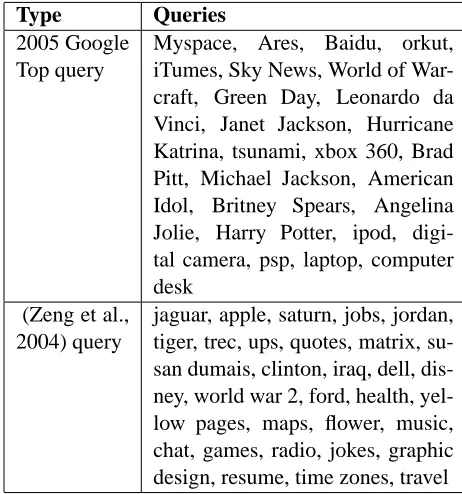
We obtained Google’s search results that corre-spond to fifty queries. The fifty queries are com-prised of top 25 queries to Google and 25 from (Zeng et al., 2004). For each query of the fifty, 200 snippets from Google are obtained. Table 1 summa-rizes the query used in our experiment.
Type Queries
2005 Google Top query
Myspace, Ares, Baidu, orkut, iTumes, Sky News, World of War-craft, Green Day, Leonardo da Vinci, Janet Jackson, Hurricane Katrina, tsunami, xbox 360, Brad Pitt, Michael Jackson, American Idol, Britney Spears, Angelina Jolie, Harry Potter, ipod, digi-tal camera, psp, laptop, computer desk
(Zeng et al., 2004) query
jaguar, apple, saturn, jobs, jordan, tiger, trec, ups, quotes, matrix, su-san dumais, clinton, iraq, dell, dis-ney, world war 2, ford, health, yel-low pages, maps, fyel-lower, music, chat, games, radio, jokes, graphic design, resume, time zones, travel
Table 1: Queries used in experiment
4.1.2 Answer Label Set for Evaluation
In order to evaluate LLM, we manually created labels for each query which are desired as outputs of our test, and we refer them as answer labels. There might be a case where an answer label and label se-lected by our model are semantically equivalent but lexically different; for example, car and automobile. To mitigate the problem, we used Wordnet to han-dle two different words with the same semantic. We explain the use of Wordnet further in section 4.1.3.
4.1.3 Evaluation Measure & Method
We used precision at topN labels to evaluate the model. Precision at top N is defined as P@N =
M@N
N , where isM@N is the number of relevant
la-bels among the topN generated labels to the answer set. As explained in section 4.1.2, the labels gen-erated by our model might not be equal to answer labels even when they have the same semantic mean-ing. It might be very time consuming for a human to manually compare the two label set where one set can vary due to the varying smoothing parameter if semantic meaning also has to be considered.
We used WordNet’s synonyms and hypernyms relationships in order to mitigate the problem ad-dressed above. We regard a test label to be equal to an answer label when WordNet’s synonyms or
hypernyms relationship allows them. Only the first listed sense in Wordnet is used to prevent over-generation.
We evaluated the overall effectiveness of LLM with P@N and the effect of smoothing parameter onP@N.
4.2 Experimental Result
We usedP@5,P@10andP@20to evaluate the ef-fectiveness of our model because most users disre-gard snippets beyond 20.
First, for each query, we obtained each label’s MAP4 for two smoothing methods. Figures 1 and 2 depicts MAP of Jelinke-Mercer smoothing and Dirichlet Priors smoothing.
0 0.2 0.4 0.6 0.8 1
0.4 0.45 0.5 0.55 0.6 0.65 0.7 0.75 0.8
Lambda
Precision
P@5 P@10 P@20
Figure 1: Jelinek-Mercer Smoothing
0 1000 2000 3000 4000 5000
0.2 0.3 0.4 0.5 0.6 0.7 0.8 0.9 1
Mu
Precision
P@5 P@10 P@20
Figure 2: Dirichlet priors Smoothing
In figures 1 and 2,X-axis denotes smoothing pa-rameter, andY-axis denotes MAP. The figures show that the smaller the value of the smoothing is , the
4
higher the precision is. This indicates that a better label is selected when the probability that a specific category would generate the label is high. In our test result, when using Dirichlet smoothing, the pre-cision of top5and10labels are82%and80%, thus users can benefit in browsing from our model using 5or10labels. However, the precision rapidly drops to60%atP@20. The low precision atP@20shows the vulnerability of our model, indicating that our model needs a refinement.
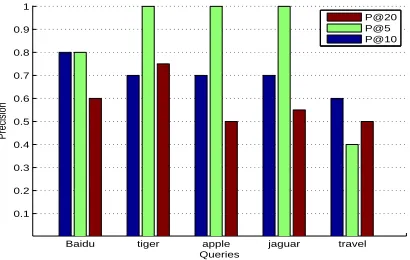
Figure 3 shows individual precisions of labels for randomly selected five queries. The labels were gen-erated by using Dirichlet priors smoothing.
Baidu tiger apple jaguar travel
0.1 0.2 0.3 0.4 0.5 0.6 0.7 0.8 0.9 1
Queries
Precision
P@20 P@5 P@10
Figure 3: Using Dirichlet priors Smoothing
As shown in figure 1 and 2, the general order of result precisions is as follows: P@20 ≤ P@10 ≤
P@5. However, figure 3 shows that the precision for query “travel” is the lowest at P@5. This re-sult indicates that words that appear many times in a specific category of Dmoz might have higher proba-bility regardless of snippet’s contents.
Average Baidu apple jaguar tiger travel 0
0.1 0.2 0.3 0.4 0.5 0.6 0.7 0.8 0.9 1
Queries
Coverage
Top 5 Top 10 Top 20
Figure 4: Coverage
Figure 4 shows the average coverage of labels generated by our model. The coverage of the labels is about0.32%,0.51%and0.66%at top5,10and20 labels respectively. This means that the labels allow browsing over only60%of the entire search results. The lack of coverage is another pitfall of our model, and further refining is needed.
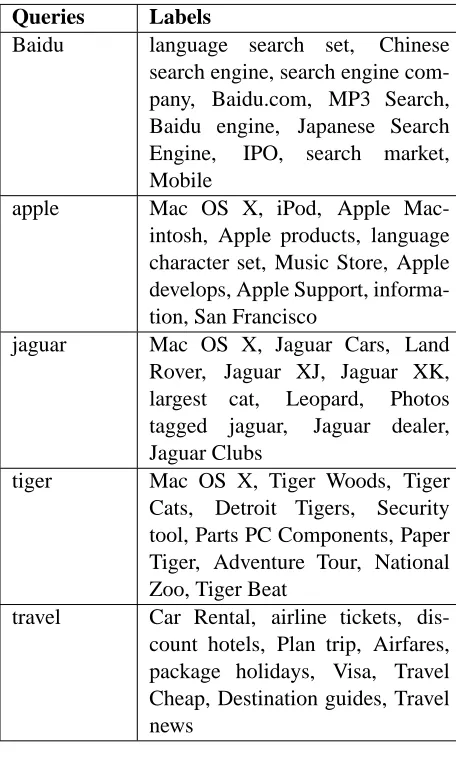
Finally, in Table 2, we list top10 labels for five queries.
5 CONCLUSION & FUTURE WORKS
We proposed a LLM for label selection of search re-sults, and analyzed the smoothing parameter’s effect on the label selection. Experimental results showed that LLM can pick up meaningful labels, and aid users in browsing web search results. Experimental results also validated our assumption that the high probability that Dmoz categories generate a label in-dicates meaningful labels. Further research direc-tions remain as future works.
Our model is sensitive to Dmoz because we use the language model based on Dmoz. Our model may result in poor performance for labels that are not rep-resented or over-reprep-resented in Dmoz. Therefore, it is meaningful to study how sensitive to Dmoz the performance of the LLM is, and how to mitigate sen-sitivity. We used Google’s search results as an input to our system. However, multiple engines offer a better coverage of the web because of the low over-lap of current search engines (Bharat and Broder, 1998). Further work can utilize multiple engines to generate input to our system. In our test, snippet’s title and content were assigned the same weight, and titles and descriptions of Dmoz’s category were also assigned the same weight. Future work might bene-fit from varying the weights to them. We did not uti-lize the information buried in the documents, such astf·idf, but used only knowledge provided by the external system, Dmoz. We believe that this also af-fected LLM’s poor performance on over-represented terms. Future work will benefit from incorporating the information derivable from the documents.
6 ACKNOWLEDGMENTS
Queries Labels
Baidu language search set, Chinese search engine, search engine com-pany, Baidu.com, MP3 Search, Baidu engine, Japanese Search Engine, IPO, search market, Mobile
apple Mac OS X, iPod, Apple Mac-intosh, Apple products, language character set, Music Store, Apple develops, Apple Support, informa-tion, San Francisco
jaguar Mac OS X, Jaguar Cars, Land Rover, Jaguar XJ, Jaguar XK, largest cat, Leopard, Photos tagged jaguar, Jaguar dealer, Jaguar Clubs
tiger Mac OS X, Tiger Woods, Tiger Cats, Detroit Tigers, Security tool, Parts PC Components, Paper Tiger, Adventure Tour, National Zoo, Tiger Beat
travel Car Rental, airline tickets, dis-count hotels, Plan trip, Airfares, package holidays, Visa, Travel Cheap, Destination guides, Travel news
Table 2: Queries used in experiment
(AITrc), also in part by the BK 21 Project and MIC & IITA through IT Leading R&D Support Project in 2007.
References
P. Rerragina and A. Gulli. 2005. A personalized search engine based on web-snippet hierarchical clustering. In Special Interest Tracks and Poster Proceedings
of WWW-05, International Conference on the World Wide Web, 801-810
H. Zeng, Q. He, Z. Chen, W. Ma and J. Ma 2004. Learn-ing to cluster web search results. In ProceedLearn-ings of the
27th ACM SIGIR Conference on Research and Devel-opment of Information Retrieval
M. A. Hearst and J. O. Pedersen. 1996. Reexamining the cluster hypothesis: Scatter/Gather on retrieval results. In Proceedings of 19th ACM SIGIR Conference on
Re-search and Development in Information Retrieval,
76-84
K. Kummamuru, R. Lotlikar, S. Roy, K. Signal and R. Krishnapuram 2004. A hierarchical monothetic docu-ment clustering algorithm for summarization browsing search results. In Proceedings of 13th International
Conference on World Wide Web, 658-665
A. Leuski and J. Allan. 2000. Improving Interactive Re-trieval by Combining Ranked List and Clustering. In
Proceedings of RIAOI, College de France, 665-681
A. V. Leouski and W. B. Croft. 1996. An Evaluation of Techniques for Clustering Search Results. In
Tech-nical Report IR-76, Department of Computer Science,
University of Massachusetts, Amherst
O. Zamir and O. Etzioni. 1998. Web Document Clus-tering: A Feasibility Demonstration. In Proceedings
of the 21th ACM SIGIR Conference on Research and Development of Information Retrieval, 46-54
Y. Maarek, R. Fagin, I. Ben-Shaul and D. Pelleg. 2000. Ephemeral document clustering for Web applications.
Technical Report RJ 10186, IBM, San Jose, US
S. Osinski and D. Weiss. 2004. Conceptual clustering using Lingo algorithm: Evaluation on Open Directory Project data In Proceedings of IIPWM-04, 5th
Confer-ence on Intelligent Information Processing and Web Mining, 369-377
P. Ferragina and A. Gulli. 2005. A personalized search engine based on Web-snippet hierarchical clustering. In Special Interest Tracks and Poster Proceedings of
WWW-05, International conference on the World Wide Web, 801-810
S. Brin and L. Page 1998. The anatomy of a large-scale hypertextual(Web) Search Engine. In Proceedings of
the 7th International Conference on World Wide Web,
107-117
C. Zhai and J. Lafferty 2001. A study of smoothing methods for language models applied to ad hoc infor-mation retrieval. In Proceedings of the 24th ACM
SI-GIR Conference on Research and Development of In-formation Retrieval, 334-342
K. Bharat and A. Broder. 1998. A technique for measur-ing the relative size and overlap of public web search engines. In Proceedings of the 7th International