Sentence Subjectivity Detection with Weakly-Supervised Learning
Chenghua Lin1,2, Yulan He2 and Richard Everson1
1Department of Computer Science, University of Exeter, Exeter, EX4 4QF, UK 2Knowledge Media Institute, The Open University, Milton Keynes, MK7 6AA, UK
{C.Lin,Y.He}@open.ac.uk, [email protected]
Abstract
This paper presents a hierarchical Bayesian model based on latent Dirichlet allocation (LDA), called subjLDA, for sentence-level subjectivity detection, which automatically identifies whether a given sentence expresses opinion or states facts. In contrast to most of the existing methods relying on either labelled corpora for classifier train-ing or ltrain-inguistic pattern extraction for subjectivity classification, we view the problem as weakly-supervised generative model learning, where the only input to the model is a small set of domain independent subjectivity lexical clues. A mechanism is introduced to incor-porate the prior information about the subjectivity lexical clues into model learning by modifying the Dirichlet priors of topic-word distributions. The subjLDA model has been evaluated on the Multi-Perspective Question Answering (MPQA) dataset and promising results have been observed in the preliminary experiments. We have also explored adding neutral words as prior information for model learning. It was found that while incorporating subjectivity clues bearing positive or negative polarity can achieve a significant performance gain, the prior lexical information from neutral words is less effective.
1 Introduction
Subjectivity detection seeks to identify whether the given text expresses opinions (subjective) or reports facts (objective). Such a task of distin-guishing subjective information from objective is useful for many natural language processing ap-plications. For instance, sentiment classification
often assumes that the input documents are opin-ionated, and ideally only contain subjective state-ments. Document summarization systems need to summarize different perspectives and opinions. For question answering systems, extracting and presenting information of the appropriate type, i.e., opinions or facts, is imperative according to the specific question being asked (Yu and Hatzi-vassiloglou, 2003; Wiebe and Riloff, 2005; Pang and Lee, 2008).
Work on sentence-level subjectivity detection is relatively sparse compared to document-level sentiment classification. Early work used a boot-strapping algorithm to learn subjective (Riloff and Wiebe, 2003) or both subjective and objec-tive (Wiebe and Riloff, 2005) expressions for sentence-level subjectivity detection. In contrast to bootstrapping, there has been some recent at-tempts exploring variousn-gram features and dif-ferent level of lexical instantiation for detecting subjective utterance from conversation data (Wil-son and Raaijmakers, 2008; Raaijmakers et al., 2008; Murray and Carenini, 2009).
However, the aforementioned line of work tack-led subjectivity detection either as supervised or semi-supervised learning, requiring labelled data and extensive knowledge which are expensive to acquire. On the other hand, both subjectivity and sentiment are context sensitive and in general quite domain dependent (Pang and Lee, 2008), so that classifiers trained on one domain often fail to produce satisfactory performance when shifted to new domains (Gamon et al., 2005; Blitzer et al., 2007). Moreover, user generated content from web are often massive and evolve rapidly over time, which imposes more challenges to the sub-jectivity detection task. These observations have thus motivated us to develop a subjectivity detec-tion algorithm that is relatively simple compared to existing methods (e.g., based on bootstrapping orn-gram features), and yet can easily be
ferred between domains through unsupervised or weakly-supervised learning without using any la-belled data.
In this paper, we focus on the problem of weakly-supervised sentence-level subjectivity de-tection. Instead of learning subjective extrac-tion patterns or exploring variousn-gram features, we view the problem as generative model learn-ing with the proposed subjectivity detection LDA (subjLDA) model. In this model, the generative process involves: (1) three subjectivity labels for sentences (i.e., sentence expresses subjective opin-ions as being positive/negative, or states facts as being objective); (2) a sentiment label for each word in the sentence (either positive, negative, or neutral), and (3) the words in the sentences.
We test the subjLDA model on the publicly available Multi-Perspective Question Answering (MPQA) dataset. Two lists of domain indepen-dent subjectivity lexicons, namely the subjClue and SentiWordNet lexicons (Esuli and Sebastiani, 2006), were incorporated as prior knowledge for subjLDA model learning. Preliminary results show that the weakly-supervised subjLDA model is able to significantly outperform baseline. Fur-thermore, it was found that while incorporating subjectivity clues bearing positive or negative po-larity can achieve a significant performance gain, the prior lexical information from neutral words is less effective for improving the classification ac-curacy.
The rest of the paper is organized as follows. Section 2 reviews the previous work on subjec-tivity classification. Section 3 presents the sub-jLDA model. Experimental setup and results on the MPQA dataset are discussed in Sections 4 and 5, respectively. Finally, Section 6 concludes the paper and outlines the future work.
2 Related Work
2.1 Subjectivity Detection
While sentiment classification and subjectivity de-tection are closely related to each other, it has been reported that separating subjective and objective instances from text is more difficult than sentiment classification, and the improvement of subjectivity detection can benefit the latter as well (Mihalcea et al., 2007).
Early work by Riloff and Wiebe (2003) fo-cused on a bootstrapping method for sentence-level subjectivity detection. They started with
high-precision subjectivity classifiers which auto-matically identified subjective and objective sen-tences in un-annotated texts. The subjective expression patterns were learned from syntactic structure output from the previously labelled high confidence texts. The learned patterns were used to automatically identify additional subjective stences, which enlarged the training set, and the en-tire process was then iterated. Wiebe and Riloff (2005) used very similar method for subjectivity detection as Riloff and Wiebe (2003). But they moved one step forward that they also learned ob-jective expressions apart from subob-jective expres-sons. As the subjective/objective expression pat-terns are based on syntactic structures, they are more flexible than single words orn-grams.
Wilson and Raaijmakers (2008) compared the performance of classifiers trained using word n -grams, charactern-grams, and phonemen-grams for recognizing subjective utterances in multiparty conversation. Raaijmakers et al. (2008) extended the work in (Wilson and Raaijmakers, 2008) by further analyzing the performance of detecting subjectivity in meeting speech by combining a va-riety of multimodal features including additional prosodic features. More recently, Murray and Carenini (2009) proposed to learn subjective ex-pression patterns from both labeled and unlabeled data using n-gram word sequences. Their ap-proach for learning subjective expression patterns is similar to (Raaijmakers et al., 2008) which re-lies onn-grams, but goes beyond fixed sequences of words by varying levels of lexical instantiation as in (Riloff and Wiebe, 2003).
2.2 Weakly-supervised Sentiment Classification
In this section, we first review some work in senti-ment analysis using generative models as it partly inspires our work of viewing subjectivity detec-tion as generative model learning. We then dis-cuss other weakly-supervised sentiment classifica-tion approaches which also use prior word knowl-edge.
mod-els with topic modmod-els for sentiment retrieval. Mei et al. (2007) proposed the topic-sentiment mixture (TSM) model for capturing mixture of topics and sentiment simultaneously on Weblogs. The multi-aspect sentiment (MAS) model by Titov and Mc-Donald (2008) focused on aggregating sentiment text for sentiment summary of rating aspects.
The more recently proposed joint sentiment-topic (JST) model (Lin and He, 2009; Lin et al., 2010) holds the closest paradigm to the proposed subjLDA model. They targeted document-level sentiment detection with weakly-supervised gen-erative model learning, where the only knowledge being incorporated was from generic sentiment lexicons. In the JST model, topics are assumed to be generated dependent on sentiment distribu-tions and then words are generated conditioned on sentiment-topic pairs. However, there are several intrinsic differences between JST and subjLDA: (1) JST mainly focused on document-level senti-ment classification, while, in contrast, subjLDA has a different scope of targeting sentence-level subjectivity detection; (2) in JST the prior knowl-edge was encoded during the Gibbs sampling by assigning a word with its prior sentiment label if that word appears in the sentiment lexicon. This essentially places hard sentiment label to words and can not resort the situation when words have ambiguous sentiment polarity. Our proposed ap-proach incorporates sentiment prior knowledge in a more principled way, in that we use sentiment lexicons to modify the topic-word Dirichlet priors and essentially create an informed prior distribu-tion for the sentiment labels.
Another common solution to
weakly-supervised sentiment classification is to make use of prior word polarity knowledge, where one uses a small number of seed words with known polarity to infer the polarity of a large set of unidentified terms. Turney and Littman (2002) classified the sentiment orientation of other terms in the corpus through mutual information, based on a small set of positive/negative paradigm words. Starting with a single seed word meaning “good” and a negation check, Zagibalov and Carroll (2008) derived a classifier through iteratively retraining, and treated sentiment and subjectivity as a continuum rather than distinct classes.
3 The SubjLDA Model
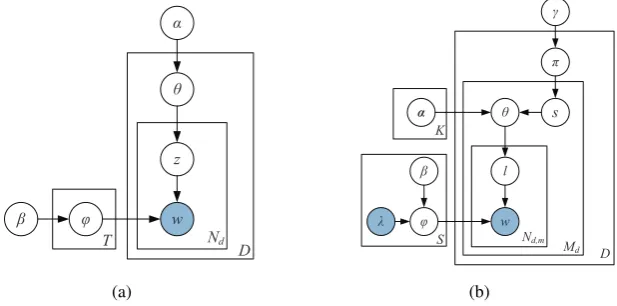
As shown in Figure 1(b), subjLDA is essentially a four-layer Bayesian model. In order to gener-ate a wordwd,m,t(i.e., thetth word token of sen-tencem within document d), one first chooses a subjectivity label1s
d,m ∈[1, K]for each sentence in document dfrom the per-document subjectiv-ity distributionπd. Following that, one chooses a sentiment labelld,m,t∈[1, S]for each word in the sentences from the per-sentence sentiment distri-butionθsd,m. Finally, one draws a word from the
per-corpus word distribution ϕld,m,t conditioned
on the corresponding sentiment label. The clas-sification of sentence subjectivity in subjLDA is determined directly from the sentence subjectivity labelsd,m. The formal definition of the subjLDA generative process is as follows:
• For each sentiment labell∈[1, S]
– Drawϕl∼Dir(λl×βTl).
• For each documentd ∈ [1, D], choose distributions
πd∼Dir(γ).
• For each sentencem∈[1, Md]in documentd,
– Sample a subjectivity labelsd,m∼Mult(πd),
– Choose a distributionθd,m∼Dir(αsd,m),
– For each of theNd,mword position,
∗ Choose a sentiment label
ld,m,t∼Mult(θsd,m),
∗ Choose a wordwd,m,t∼Mult(ϕld,m,t).
In practice, it is quite intuitive that one classi-fies a sentence as subjective if it contains one or more strongly subjective clues (Riloff and Wiebe, 2003). However, the criterion for classifying ob-jective sentences could be rather different, because a sentence is likely to be objective if there are no strongly subjective clues. In order to encode this knowledge into the subjLDA model learning, during the model initialization step, we initialized sentence subjectivity label s based on the afore-mentioned criterion with prior knowledge input from the sentiment lexicon. If a sentence does not match any sentiment words, its subjectivity label will be randomly sampled.
1We have conducted another set of experiments modelling
w
!
"
z
#
Nd
D T
(a)
w !
l "
Nd,m
Md
s #
K
$
D S
%
(b)
Figure 1: (a) LDA model; (b) subjLDA model.
3.1 Incorporating Model Prior
Compared to the LDA model, besides adding a sentence-level subjectivity label generation layer, we also add an additional dependency link of ϕ
on the matrixλof sizeS×V which we use to en-code word prior sentiment information. The ma-trixλcan be considered as a transformation
ma-trix which modifies the Dirichlet priors βso that
the word prior sentiment polarity can be captured. Intuitively, λ is firstly initialized as a matrix
with all the elements taking a value of 1. Given a sentiment lexicon, for each termw ∈ {1, ..., V} in the corpus vocabulary, ifwis found in the sen-timent lexicon, then for each l ∈ {1, ..., S}, the elementλlw is updated as follows
λlw =
0.9 ifS(w) =l
0.05 otherwise , (1)
where the function S(w) returns the prior
senti-ment label ofw in a sentiment lexicon, i.e., pos-itive, negative or neutral. For example, the word “excellent” with index wt has a positive senti-ment polarity. The corresponding row vectorλwt
is [0.05,0.9,0.05] with its elements representing
neutral, positive, and negative prior polarity. Mul-tiplying β with λ, we can enforce that the word
“excellent”has much higher probability of being drawn from the positive topic word distributions generated from a Dirichlet distribution with pa-rameterβlposwt.
The previously proposed DiscLDA (Lacoste-Julien et al., 2008) and Labeled LDA (Ramage et al., 2009) also utilize a transformation matrix to modify Dirichlet priors by assuming the availabil-ity of document class labels. In contrast, we use word prior sentiment as supervised information to modify the topic-word Dirichlet priors.
3.2 Model Inference
The total probability of the model is
P(w,l,s,θ,ϕ,π;α, β, γ) =QSj=1P(ϕj;λ×β)· QD
d=1P(πd;γ)QMm=1d P(sd,m|πd)P(θd,m;αsd,m)·
QNd,m
t=1 P(ld,m,t|θd,m)P(wd,m,t|ϕld,m,t), (2)
where the bold-font variables denote vectors. We use Gibbs sampling to estimate the posterior of subjLDA by sequentially sampling each vari-able of interest,ld,m,t andsd,mhere, from the dis-tribution over that variable given the current val-ues of all other variables and the data. Letting the index x = (d, m) and the subscript −x denote a quantity that excludes counts in sentence m of documentd, the conditional posterior forsxis
P(sx=k|s−x,l,w, α, β, γ)∝
(Nd,k+γk)−1
(Nd+PKk=1γk)−1 ·
QS j=1
QNd,m,j−1
b=0 (b+αsx,j)
QNd,m−1
b=0 (b+
P3
j=1αsx,j)
,
(3)
whereNd,kdenotes the frequency of sentences as-signed to subjectivity labelkin document d; Nd is the total number of sentences in document d; Nd,m,jis the total number of words in sentencem of document dassociated with sentiment labelj; Nd,m is the total number of words in sentencem of documentd.
conditional posterior forltis
P(ly =j|s,l−y,w, α, β, γ)∝ Nd,m,j+αsd,m,j−1
Nd,m+PSj=1αsd,m,j−1
· Yj,wt+λj,wtβj,wt−1
Yj+PVr=1λj,rβj,r−1 ,
(4)
whereYj,wt denotes the frequency of wordwt
as-sociated with sentiment label j in the document collection; Yj is the total number of words asso-ciated with sentiment labeljin the document col-lection.
Equations 3-4 are the conditional probabilities derived by marginalizing out the random variables π, θ, and ϕ. Samples obtained from the Markov chain are used to approximate the per-document subjectivity distribution
πd,k =
Nd,k+γk Nd+PKk=1γk
. (5)
The approximated per-sentence sentiment distri-bution is
θd,m,j =
Nd,m,j+αsd,m,j
Nd,m+PSj=1αsd,m,j
. (6)
Finally, the per-corpus sentiment-word distribu-tion is
ϕj,r =
Yj,r+λj,rβj,r Yj +PVr=1λj,rβj,r
. (7)
4 Experimental Setup
4.1 Dataset
We tested our model on the MPQA dataset2
ver-sion 1.2, which is derived from a variety of for-eign news documents. The whole corpus consists of 535 documents with a total number of 6,111 subjective and 5,001 objective sentences. We per-formed a two-stage preprocessing on the dataset by first removing stop words and non-word char-acters, followed by standard stemming for reduc-ing vocabulary size and minimizreduc-ing sparse data problems. After preprocessing, the MPQA dataset contains 131,220 words with 10,511 distinct terms (cf. the original dataset with 264,808 words and a vocabulary size of 31,201 without any preprocess-ing).
2http://www.cs.pitt.edu/mpqa/ databaserelease/
4.2 Lexical Prior Knowledge
We explored incorporating two subjectivity lexi-cons as prior knowledge for subjLDA model learn-ing, namely, the subjClue3 and SentiWordNet4
lexicons. We point out that the subjClue lexicon is not related to the MPQA dataset as it was col-lected from a number of sources, where some were culled from manually developed resources and others were identified automatically using both an-notated and unanan-notated data (Wiebe and Riloff, 2005). We only extract the lexical clues that are considered strongly subjective, with the weakly subjective clues being discarded. The rationale be-hind the filtering is that while a strongly subjective clue is seldom used without a subjective meaning, weakly subjective clues are ambiguous, often hav-ing both subjective and objective uses. After stem-ming, removing the duplicated lexical terms and retaining those that have appeared in the corpus, we finally obtained a lexicon subset of 477 posi-tive and 917 negaposi-tive words.
SentiWordNet provides a wide coverage of lex-ical terms by tagging all the synsets of WordNet with three sentiment labels, i.e., positive, negative and neutral. In our experiment, we only use the neutral words from SentiWordNet for investigat-ing how neutral words would affect the subjLDA model performance. After the same preprocess-ing as performed on the subjClue lexicon, a total of 193,871 neutral words were extracted. Further mapping the extracted neutral words with the cor-pus results in 6,457 neutral words.
5 Experimental Results
In this section, we first present the experimental results of sentence-level subjectivity classification on the MPQA dataset, and subsequently evaluate the impact on the classification performance by varying the proportion of prior information being incorporated. All the results reported here are av-eraged over 5 runs with 800 Gibbs sampling itera-tions.
5.1 Overall Results
The baseline is calculated by counting the over-lap of the prior lexicon with the dataset. We clas-sify a sentence as subjective if it contains one or more positive/negative sentiment words; if there is no matching, the sentence will be classified as
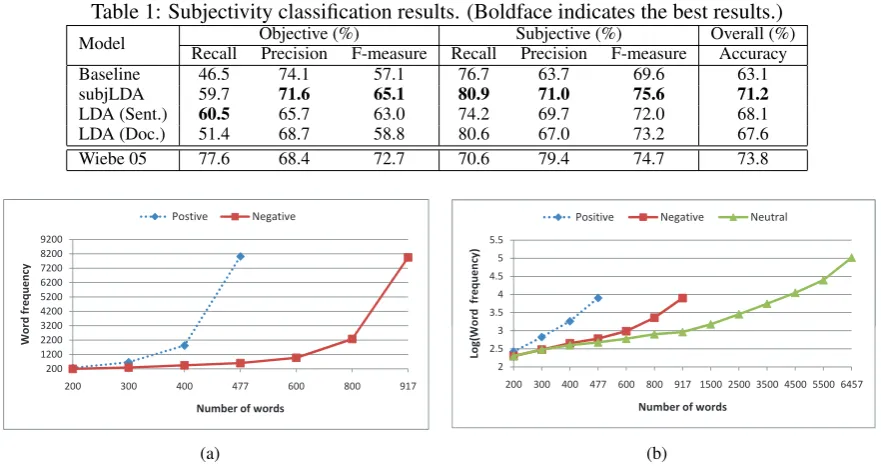
Table 1: Subjectivity classification results. (Boldface indicates the best results.) Model Recall Objective (%)Precision F-measure Recall Subjective (%)Precision F-measure Overall (%)Accuracy
Baseline 46.5 74.1 57.1 76.7 63.7 69.6 63.1
subjLDA 59.7 71.6 65.1 80.9 71.0 75.6 71.2
LDA (Sent.) 60.5 65.7 63.0 74.2 69.7 72.0 68.1
LDA (Doc.) 51.4 68.7 58.8 80.6 67.0 73.2 67.6
Wiebe 05 77.6 68.4 72.7 70.6 79.4 74.7 73.8
200
200 300 400 477 600 800 917
W
200 300 400 477 600 800 917 1500 2500 3500 4500 5500 6457
Lo
Figure 2: (a) Positive and negative lexicon statistics; (b) Positive, negative and neutral lexicon statistics.
objective. The improvement over this baseline will reflect how much subjLDA can learn from data. The LDA model (Blei et al., 2003), as shown in Figure 1(a), has been used as baseline in document-level sentiment classification in pre-vious research (Lin et al., 2010). Thus, we also evaluated LDA on the sentence-level subjectivity detection task by modelling a mixture of three sen-timent topics, i.e., positive, negative and neutral. For fair comparison, we encoded prior knowledge of sentiment lexicon into LDA as identical to sub-jLDA. Thus the LDA model here can be consid-ered as a weakly-supervised version. Moreover, we tested LDA under two different modes, i.e., modelling a normal document vs. treating each individual sentence as a separate document. The sentence sentiment is determined as follows.
(a) LDA in document mode: sentiment of sen-tencemin documentDis calculated using
P(l|m)∝P(m|l)P(l|d) = Y
wt∈m
P(wt|l)P(l|d).
(8)
We define that sentence mis classified as an ob-jective sentence if its probability of neutral label given sentence P(l = neu.|m), is greater than
both P(l = pos.|m) and P(l = neg.|m).
Oth-erwise, the sentence is classified as subjective.
(b) LDA in sentence mode: sentence subjec-tivity is directly determined based on the
per-sentence sentiment distribution θ, using identical classification metrics to the document mode.
As can be seen from Table 1, a significant per-formance gain was observed for both subjLDA and LDA over the baseline. Particularly, more than 8% gain was observed for subjLDA, giv-ing the best overall accuracy of 71.2% which is 3.1% and 3.6% higher than LDA(Sent.) and LDA(Doc.), respectively. In addition, except for objective recall, subjLDA outperforms LDA in both the sentence and document modes for all the other evaluation metrics, with more bal-anced objective and subjective F-measures be-ing attained compared to the other two models. On the other hand, it was observed that while LDA(Doc.) can achieve a comparable subjective F-measure to LDA(Sent.), its objective F-measure is nearly 5% lower, resulting in worse overall per-formance. This is probably due to the fact that by treating each individual sentence as a document, LDA(Sent.) can avoid inferencing global senti-ment topics and thus capture more accurate sen-timent information from local topics. We mea-sured the overall accuracy significance with paired t-Test (critical P=0.01). Results show that the improvements of subjLDA over both LDA(sent.) and LDA(doc.) are highly statistically significant. Thus, we conclude that subjLDA is superior than LDA in the subjectivity detection task.
boot-0.650
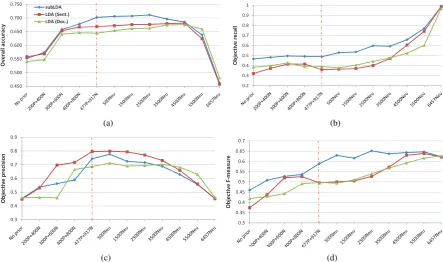
Figure 3: Subjectivity classification performance vs. different prior information by gradually adding the subjective and neutral words. The vertical dashed line denotes the point where all the positive and negative words have been incorporated into the model; 200P+400N denotes adding the least frequent 200 positive and 400 negative words; 500Neu denotes adding the least frequent 500 neutral words in addition to all the positive and negative words.
strapping approach (Wiebe and Riloff, 2005), sub-jLDA is about 2% lower in terms of overall ac-curacy. However, it should be noted that, their approach used a much larger training set for self-training which consists of more than 100,000 sen-tences. Moreover, apart from subjectivity clues, they also used additional features such as subjec-tive/obejctive pattern and POS for the Naive Bayes sentence classifier training. In contrast, the pro-posed subjLDA model is relatively simple with only a small set of subjectivity clues being incor-porated as prior knowledge.
5.2 Classification Results with Different Priors
While positive/negative sentiment lexicon is com-monly used in lexical approaches to sentiment classification, the impact of incorporating neutral words remains relatively unexplored. In this ex-periment, we investigated the impact on the model performance by incorporating additional knowl-edge from neutral words. We started by first con-sidering the positive and negative words only and gradually increased the number of words starting with the lowest frequency words. After all the
pos-itive and negative words have been incorporated, we then gradually added additional neutral words into the model also from the lowest frequency to the highest. Figure 2 shows the lexicon statistics of all the positive, negative and neutral words, where the value on the x-axis represents the number of words sorted by word frequency and the corre-sponding y-axis value indicates the total number of times those words appear in the corpus. For instance, the 400 least frequent positive words ap-pear a total of 1,826 times in the corpus as shown in Figure 2(a).
with more higher frequency subjective words be-ing incorporated, subjLDA shows stronger perfor-mance boosting over LDA and gives the best ac-curacy of 70.2% when all the subjective words were incorporated, being 3.4% and 5.8% better than LDA(Sent.) and LDA(Doc.), respectively, as indicated by the vertical dashed line in the figure.
On the other hand, adding neutral words is also beneficial, where performance gain was observed for all the 3 models in addition to the best re-sults using subjective words only (i.e., subjLDA by 1%, LDA(Sent.) by 1.6% and LDA(Doc.) by 2.9%). Analyzing the objective recall and preci-sion shown in Figure 3(b) and 3(c) reveals that, while incorporating the 4,500 least frequent neu-tral words considerably increases the objective re-call, the objective precision does not drop much which eventually leads to the overall improvement of all the three models.
However, compared to the subjective words, the classification improvements by incorporating ad-ditional neutral words are less significant. This is probably due to the fact that while the presence of positive/negative words conveys clear subjec-tive meanings, neutral words are relasubjec-tively vague which could bear objective or subjective sense un-der different contexts. Furthermore, all three mod-els experience a significant performance drop af-ter the point of (4500Neu). Examining Figure 2 reveals that, while the 4,500 least frequent neutral words appear 11,142 times in the corpus, the 1,957 most frequent words (i.e., from 4500 to 6457) ap-pear 93,036 times, nearly 10 times as much as the former. Thus, the high frequency neutral words become dominant in the model and result in se-vere classification bias towards the objective class. Therefore, appropriate filtering of neutral words is necessary in order to avoid introducing bias into model learning.
5.3 Sentiment Topics
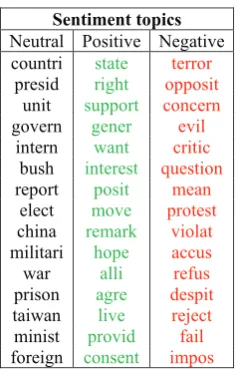
In subjLDA, we model three topics in the per-corpus word distribution, each of which corre-sponds to neutral, positive and negative sentiment. Figure 4 shows the top 15 topic words of the sen-timent topics extracted from the MPQA dataset by subjLDA. It can be easily observed that while the positive and negative sentiment topics consist of clear sentiment bearing words, the neutral topic contains mostly theme words with no sentiment, which illustrates the effectiveness of subjLDA in
Sentiment topics
Neutral Positive Negative
countri state terror
presid right opposit
unit support concern
govern gener evil
intern want critic
bush interest question
report posit mean
elect move protest
china remark violat
militari hope accus
war alli refus
prison agre despit
taiwan live reject
minist provid fail
foreign consent impos
Figure 4: Sentiment topics extracted by subjLDA.
extracting sentiment bearing topics from text.
6 Conclusions and Future Work
This paper presents the subjectivity detection LDA Model (subjLDA) for sentence-level subjectivity classification. In contrast to most of the exist-ing approaches requirexist-ing labelled corpora or lin-guistic pattern extraction, we view this problem as weakly-supervised generative model learning where the only input to the model is a small amount of domain independent subjective/neutral words. The subjLDA model has been evaluated on the MPQA dataset. Preliminary results show that except slightly lower in objective recall, sub-jLDA outperformed LDA over all other evaluation metrics, and is comparable to the previously pro-posed bootstrapping approach using a much larger training set. Moreover, it was found that while in-corporating more subjective words can generally yield better results, the performance gain by em-ploying extra neutral words is less significant.
Acknowledgements
This work was supported in part by the EC-FP7 projects ROBUST (grant number 257859) and VPH-Share (grant number 269978).
References
David M. Blei, Andrew Y. Ng, and Michael I. Jordan.
2003. Latent Dirichlet allocation. J. Mach. Learn.
Res., 3:993–1022.
John Blitzer, Mark Dredze, and Fernando Pereira. 2007. Biographies, bollywood, boom-boxes and blenders: Domain adaptation for sentiment classi-fication. InProceedings of the Association for
Com-putational Linguistics (ACL), pages 440–447.
Koji Eguchi and Victor Lavrenko. 2006. Sentiment
retrieval using generative models. In Proceedings
of the Conference on Empirical Methods in Natural
Language Processing (EMNLP), pages 345–354.
A. Esuli and F. Sebastiani. 2006. SentiWordNet: A publicly available lexical resource for opinion min-ing. InProceedings of LREC.
M. Gamon, A. Aue, S. Corston-Oliver, and E. Ringger. 2005. Pulse: Mining customer opinions from free text. Lecture Notes in Computer Science, 3646:121– 132.
S. Lacoste-Julien, F. Sha, and M.I. Jordan. 2008. Dis-cLDA: Discriminative learning for dimensionality reduction and classification. InNIPS.
Chenghua Lin and Yulan He. 2009. Joint
senti-ment/topic model for sentiment analysis. In
Pro-ceedings of the ACM conference on Information and
knowledge management (CIKM).
Chenghua Lin, Yulan He, and Richard Everson. 2010. A comparative study of Bayesian models
for unsupervised sentiment detection. In
Confer-ence on Computational Natural Language Learning
(CoNLL).
Qiaozhu Mei, Xu Ling, Matthew Wondra, Hang Su, and ChengXiang Zhai. 2007. Topic sentiment mix-ture: modeling facets and opinions in weblogs. In
Proceedings of the 16th international conference on
World Wide Web (WWW), pages 171–180.
R. Mihalcea, C. Banea, and J. Wiebe. 2007. Learning multilingual subjective language via cross-lingual projections. InIn Proceedings of the Association for
Computational Linguistics (ACL), page 976.
G. Murray and G. Carenini. 2009. Predicting
subjec-tivity in multimodal conversations. InProceedings
of the Conference on Empirical Methods in Natural
Language Processing (EMNLP), pages 1348–1357.
Bo Pang and Lillian Lee. 2008. Opinion mining and sentiment analysis. Found. Trends Inf. Retr., 2(1-2):1–135.
S. Raaijmakers, K. Truong, and T. Wilson. 2008. Mul-timodal subjectivity analysis of multiparty
conver-sation. In Proceedings of the Conference on
Em-pirical Methods in Natural Language Processing
(EMNLP), pages 466–474.
D. Ramage, D. Hall, R. Nallapati, and C.D. Manning. 2009. Labeled LDA: A supervised topic model for credit attribution in multi-labeled corpora. In Pro-ceedings of the Conference on Empirical Methods
in Natural Language Processing (EMNLP), pages
248–256.
E. Riloff and J. Wiebe. 2003. Learning extraction pat-terns for subjective expressions. InProceedings of the conference on Empirical methods in natural
lan-guage processing (EMNLP), pages 105–112.
Ivan Titov and Ryan McDonald. 2008. A joint model of text and aspect ratings for sentiment
summariza-tion. InProceedings of the Aunal Meeting on
Asso-ciation for Computational Linguistics and the
Hu-man Language Technology Conference (ACL-HLT),
pages 308–316.
Peter D. Turney and Michael L. Littman. 2002. Un-supervised learning of semantic orientation from a
hundred-billion-word corpus. ArXiv Computer
Sci-ence e-prints, cs.LG/0212012.
J. Wiebe and E. Riloff. 2005. Creating subjective and objective sentence classifiers from unannotated
texts. InProceedings of the Conference on
Compu-tational Linguistics and Intelligent Text Processing
(CICLing), volume 3406, pages 486–497. Springer.
T. Wilson and S. Raaijmakers. 2008. Comparing word, character, and phoneme n-grams for
subjec-tive utterance recognition. In Proceedings of
IN-TERSPEECH, pages 1614–1617.
Hong Yu and Vasileios Hatzivassiloglou. 2003. To-wards answering opinion questions: Separating facts from opinions and identifying the polarity of
opin-ion sentences. InProceedings of the Conference on
Empirical Methods in Natural Language Processing
(EMNLP), pages 129–136.
T. Zagibalov and J. Carroll. 2008. Automatic seed word selection for unsupervised sentiment classifi-cation of Chinese text. InProceedings of the Inter-national Conference on Computational Linguistics