Proceedings of the 3rd Workshop on Scalable Natural Language Understanding, pages 41–48,
Catching Metaphors
Matt Gedigian, John Bryant, Srini Narayanan, and Branimir Ciric International Computer Science Institute
1947 Center Street. Suite 600 Berkeley, CA 94704, USA
{gedigian, jbryant, snarayan}@icsi.berkeley.edu
Abstract
Metaphors are ubiquitous in language and developing methods to identify and deal with metaphors is an open problem in Natural Language Processing (NLP). In this paper we describe results from us-ing a maximum entropy (ME) classifier to identify metaphors. Using the Wall Street Journal (WSJ) corpus, we anno-tated all the verbal targets associated with a set of frames which includes frames of spatial motion, manipulation, and health. One surprising finding was that over90% of annotated targets from these frames are used metaphorically, underscoring the importance of processing figurative lan-guage. We then used this labeled data and each verbal target’s PropBank annotation to train a maximum entropy classifier to make this literal vs. metaphoric distinc-tion. Using the classifier, we reduce the final error in the test set by 5% over the verb-specific majority class baseline and 31% over the corpus-wide majority class baseline.
1 Introduction
To move beyond “factoid” style questions, question answering systems must rely on inferential mecha-nisms. To answer such commonplace questions as
Which train should I take to get to the airport? re-quires justifications, predictions and recommenda-tions that can only be produced through inference.
One such question answering system (Narayanan and Harabagiu, 2004) takes PropBank/FrameNet an-notations as input, uses the PropBank targets to in-dicate which actions are being described with which arguments and produces an answer using probabilis-tic models of actions as the tools of inference. Initi-ating these action models is calledsimulation.
Such action models provide deep inferential capa-bilities for embodied domains. They can also, when provided with appropriate metaphoric mappings, be extended to cover metaphoric language (Narayanan, 1997). Exploiting the inferential capabilities of such action models over the broadest domain requires a system to determine whether a verb is being used lit-erally or metaphorically. Such a system could then activate the necessary metaphoric mappings and ini-tiate the appropriate simulation.
2 Metaphor
Work in Cognitive Semantics (Lakoff and Johnson, 1980; Johnson, 1987; Langacker, 1987; Lakoff, 1994) suggests that the structure of abstract actions (such as states, causes, purposes, and means) are characterized cognitively in terms ofimage schemas
which are schematized recurring patterns from the embodied domains of force, motion, and space.
Consider our conceptualization of events as ex-emplified in the mapping called the Event Structure Metaphor.
• States are locations (bounded regions in space).
• Changes are movements (into or out of bounded regions).
• Causes are forces.
• Actions are self-propelled movements.
• Purposes are destinations.
• Difficulties are impediments to motion.
This mapping generalizes over an extremely wide range of expressions for one or more aspects of event structure. For example, take states and changes. We speak of being in or out of a state, of entering or
leavingit, ofgetting to a stateoremerging fromit. This is a rich and complex metaphor whose parts interact in complex ways. To get an idea of how it works, consider the submapping Difficulties are impediments to motion. In the metaphor, purpose-ful action is self-propelled motion toward a destina-tion. A difficulty is something that impedes such motion. Metaphorical difficulties of this sort come in five types: blockages; features of the terrain; bur-dens; counterforces; lack of an energy source. Here are examples of each: Blockages: He’s trying to get around the regulations. We’ve got him boxed into a corner. Features of the terrain:It’s been uphill all the way.We’ve been hacking our way through a jun-gle of regulations. Burdens: He’s carrying quite a load. Get off my back!Counterforces: Quit pushing me around. She’s leading him around by the nose. Lack of an energy source:I’m out of gas.We’re run-ning out of steam.
In summary, these metaphors are ontological mappings across conceptual domains, from the source domain of motion and forces to the target do-main of abstract actions. The mapping is conven-tional, that is, it is a fixed part of our conceptual sys-tem, one of our conventional ways of conceptualiz-ing actions. Conventional metaphors capture gener-alizations governing polysemy, over inference pat-terns, and governing novel metaphorical language (Lakoff and Turner, 1989).
2.1 Metaphors vs. Different Word Senses
Presumably, one could treat the metaphoric usage of
runas a different sense, much in the same way that
move forward on a business planis treated as a dif-ferent sense from literalmove forward. From a pars-ing/information extraction point of view, these two approaches are equivalent in terms of their represen-tational requirements.
The benefit of employing the metaphor-based ap-proach, as suggested in the introduction, comes
when performing inference. As shown by
(Narayanan, 1997), a metaphorical usage and a lit-eral usage share inferential structure. For example, the aspectual structure ofrun is the same in either domain whether it is literal or metaphorical usage. Further, this sharing of inferential structure between the source and target domains simplifies the repre-sentational mechanisms used for inference making it easier to build the world models necessary for knowledge-intensive tasks like question answering (Sinha and Narayanan, 2005).
3 Objective
While this work in Cognitive Semantics is sugges-tive, without a corpus-based analysis, it is hard to accurately estimate the importance of metaphoric in-formation for Natural Language Processing (NLP) tasks such as Question Answering or Information Distillation. Our work is a first step to remedy this situation. We start with our computational defini-tion of metaphor as a mapping from concrete to ab-stract domains. We then investigate the Wall Street Journal (WSJ) corpus, selecting a subset of its ver-bal targets and labeling them as either metaphoric or literal. While we had anticipated the pervasive-ness of metaphor, we could not anticipate just how pervasive with over 90% of the labeled data being metaphoric.
Provided with labeled training data, our task is to automatically classify the verbal targets of unseen utterances as either metaphoric or literal. Motivated by the intuition that the types of a target’s arguments are important for making this determination, we ex-tracted information about the arguments from the PropBank (Kingsbury et al., 2002) annotation for each sentence, using WordNet (Fellbaum, 1998) as the type hierarchy.
3.1 Using Verbal Arguments
A metaphor is a structured mapping between the roles of two frames that makes it possible to describe a (usually) more abstract concept in terms of a more concrete one (Lakoff and Johnson, 1980). The more abstract concept is referred to as thetarget domain while the more concrete concept is referred to as the
1. MET : Texas Air has{run}into difficulty...
2. LIT : “I was doing the laundry and nearly broke my neck{running}upstairs to see ...
Figure 1: Examples taken from the WSJ Corpus. MET indicates a metaphoric use of the target verb and LIT indicates a literal use.
sourcedomain. More precisely, the metaphor maps roles of the target frame onto the source frame.
Figure 1 shows some example sentences with a particular verbal targetrunin curly braces. Example 1 is a metaphoricusage (marked by MET) of run
where the destination role is filled by the state of
difficulty. Example 2 is aliteralusage (marked by LIT) ofrun.
The arguments of a verb are an important fac-tor for determining whether that verb is being used metaphorically. If they come from the source do-main frame, then the likelihood is high that the verb is being used literally. In the example literal sen-tence from Figure 1, the theme is a person, which is a physical object and thus part of the source domain. If, on the other hand, the arguments come from the target domain, then it is likely that the verb is being used metaphorically. Consider the metaphor-icalrunfrom Figure 1. In that case, both the theme and the goal of the action are from the target domain. Thus any approach that tries to classify sentences as literal or metaphoric must somehow incorporate in-formation about verbal arguments.
4 Data
Because no available corpus is labeled for the metaphoric/literal distinction, we labeled a subset of the WSJ corpus for our experiments. To focus the task, we concentrated on motion-related frames that act as the source domain for the Event Structure Metaphor and some additional non-motion based frames includingCureandPlacing. Figure 2 shows the selected frames along with example lexical units from each frame.
To identify relevant sentences we first obtained from FrameNet a list of lexical units that evoke the selected source frames. Since WSJ is labeled with PropBank word senses, we then had to deter-mine which PropBank senses correspond to these
Frame Example LUs
Motion float, glide, go, soar
Motion-directional drop, fall, plummet
Self-motion amble, crawl, hobble
Cause-motion catapult, haul, throw, yank
Cotheme accompany, escort, pursue
Placing cram, heap, pocket, tuck
Cure cure, ease, heal, treat
Figure 2: The frames selected for annotation and some of the lexical units that evoke them.
CureFrame LU PropBank Sense
alleviate alleviate.01
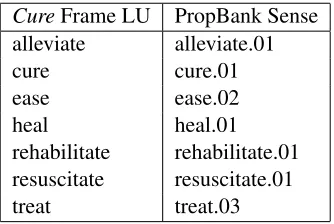
Figure 3: The lexical units that evoke theCureframe and each unit’s associated PropBank sense2.
FrameNet lexical items. The lexical items that evoke the Cure frame and the corresponding PropBank senses are shown in Figure 3.
As anyone who has inspected both PropBank and FrameNet can attest, these two important lexical resources have chosen different ways to describe verbal senses and thus in many cases, determining which PropBank sense corresponds to a particular FrameNet sense is not a straightforward process. Verbs likeslidehave a single PropBank sense used to describe both theslidinThe book slid off the ta-bleand theslidinI slid the book off the table. While FrameNet puts slide both in the Motion frame and in theCause-motionframe, PropBank uses the argu-ment labeling to distinguish these two senses.
Periodically, PropBank has two senses, one for the literal interpretation and one for the metaphoric interpretation, where FrameNet uses a single sense. Consider the wordhobbleand its two senses in Prop-Bank:
• hobble.01 ”walk as if feet tied together”
Frame #MET #LIT Total %MET
Cause-motion 461 44 505 91
Cotheme 926 8 934 99
Motion-directional 1087 21 1108 98
Placing 888 110 998 89
Self-motion 424 86 510 83
Cure 105 26 131 80
All Frames 3891 295 4186 93
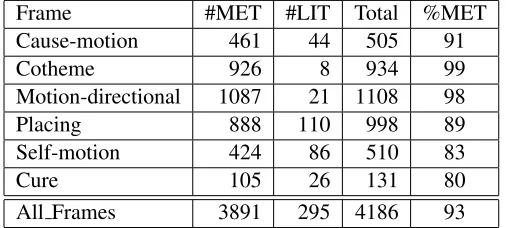
Figure 4: The number of targets annotated metaphoric or literal, broken down by frame.
Because we intended to classify both literal and metaphoric language, both PropBank senses of hob-blewere included. However most verbs do not have distinct literal and metaphoric senses in PropBank.
The final step in obtaining the relevant portion of the WSJ corpus is to use the lists of PropBank senses that corresponding to the FrameNet frames and ex-tract sentences with these targets. Because the Prop-Bank annotations label which PropProp-Bank sense is be-ing annotated, this process is straightforward.
Having obtained the WSJ sentences with items that evoke the selected source frames, we labeled the data using a three-way split:
• MET: indicating metaphoric use of the target
• LIT: indicating literal use of the target
• ? : indicating a target that the annotator was unsure of
For our experiments, we concentrated only on those cases where the label was MET or LIT and ignored the unclear cases.
As is shown in Figure 4, the WSJ data is heav-ily weighted towards metaphor over all the frames that we annotated. This tremendous bias towards metaphoric usage of motion/cause-motion lexical items shows just how prevalent the Event Structure Metaphor is, especially in the domain of economics where it is used to describe market fluctuations and policy decisions.
Figure 5 shows the breakdown for each lexical item in theCure frame. Note that most of the fre-quently occurring verbs are strongly biased towards either a literal or metaphoric usage. Ease, for ex-ample, in all 81 of its uses describes the easing of an
Lexical Unit #MET #LIT
alleviate 8 0
cure 7 3
ease 81 0
heal 3 0
rehabilitate 1 0
resuscitate 2 0
treat 3 23
Figure 5: The lexical units that evoke theCureframe and each unit’s counts for metaphoric (#MET) and literal (#LIT) usage.
economic condition and not the easing of pain.Treat
on the other hand, is overwhelmingly biased towards the treating of physical and psychological disorders and is only rarely used for an abstract disorder.
5 The Approach
As has been discussed in this paper, there are at least two factors that are useful in determining whether the verbal target of an utterance is being used metaphorically:
1. The bias of the verb
2. The arguments of the verbal target in that utter-ance
To determine whether the arguments suggest a metaphoric or a literal interpretation, the sys-tem needs access to information about which con-stituents of the utterance correspond to the argu-ments of the verbal target. The PropBank annota-tions fill this role in our system. For each utterance that is used for training or needs to be classified, the gold standard PropBank annotation is used to deter-mine the verbal target’s arguments.
For every verbal target in question, we used the following method to extract the types of its argu-ments:
1. Used PropBank to extract the target’s argu-ments.
2. For each argument, we extracted its head using rules closely based on (Collins, 1999).
Feature Schema Example Instantiation Comment
verb verb=treat The verbal target
ARG0 TYPE uninstantiated ARG0 (Doctor role) not present
ARG1 TYPE uninstantiated ARG1 (Patient role) not present
ARG2 TYPE ARG2 TYPE=anemia The WordNet type isanemia.
ARG3 TYPE ARG3 TYPE=drug The WordNet type isdrug.
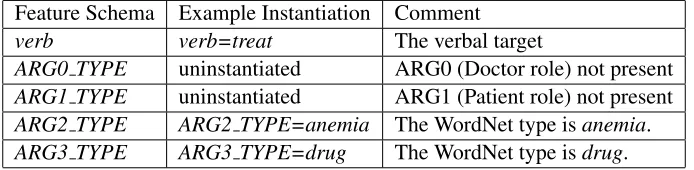
Figure 6: The feature schemas used for classification. The instantiated features are drawn from the sentence
The drug is being used primarily to{treat}anemias.
3. If the head is a pronoun, use the pronoun type (without coreference resolution) as the type of the argument.
4. If the head is a named entity, use the Identi-finder tag as the type of the argument (BBN Identifinder, 2004).
5. If neither, use the name of the head’s WordNet synset as the type of the argument.
Consider the sentenceThe drug is being used pri-marily to {treat} anemias. The PropBank annota-tion of this sentence marks the drug as ARG3 and
anemiasas ARG2. We turned this information into features for the classifier as shown in Figure 6.
The verb feature is intended to capture the bias of the verb. TheARGX TYPE feature captures the type of the arguments directly. To measure the trade-offs between various combinations of features, we randomly partitioned the data set into a training set (65% of the data), a validation set (15% of the data), and a test set (20% of the data).
6 Results
6.1 Classifier Choice
Because of its ease of use and Java compatibility, we used an updated version of the Stanford condi-tional log linear (aka maxent) classifier written by Dan Klein (Stanford Classifier, 2003). Maxent clas-sifiers are designed to maximize the conditional log likelihood of the training data where the conditional likelihood of a particular classcon training example
iis computed as:
1
Zexp(fi·ωc)
HereZ is a normalizing factor, fi is the vector of features associated with exampleiandωcis the vec-tor of weights associated with classc. Additionally, the Stanford classifier uses by default a Gaussian prior of 1 on the features, thus smoothing the fea-ture weights and helping prevent overfitting.
6.2 Baselines
We use two different baselines to assess perfor-mance. They correspond to selecting the ity class of the training set overall or the major-ity class of verb specifically. The strong bias to-ward metaphor is reflected in the overall baseline of 93.80% for the validation set. The verb baseline is higher, 95.50% for the validation set, due to the pres-ence of words such astreatwhich are predominantly literal.
6.3 Validation Set Results
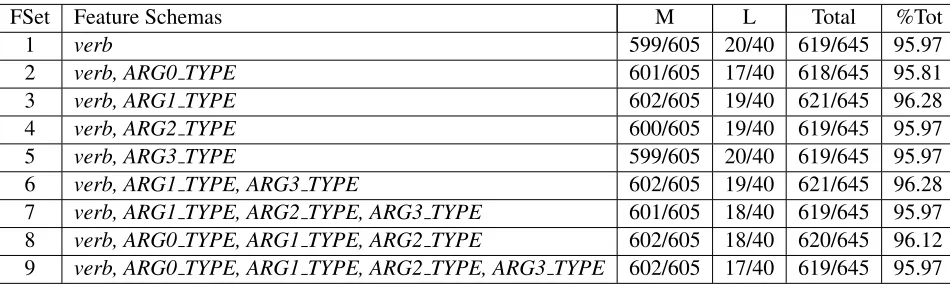
Figure 7 shows the performance of the classifier on the feature sets described in the previous section. The overall and verb baselines are 605 and 616 out of 645 total examples in the validation set.
The first feature set we experimented with was just the verb. We then added each argument in turn; trying ARG0 (Feature Set 2), ARG1 (Feature Set 3), ARG2 (Feature Set 4) and ARG3 (Feature Set 5). Adding ARG1 gave the best performance gain.
ARG1 corresponds to the semantic role ofmover
in most of PropBank annotations for motion-related verbs. For example, stocksis labeled as ARG1 in both Stocks fell 10 points and Stocks were being thrown out of windows3. Intuitively, the mover role is highly informative in determining whether a mo-tion verb is being used metaphorically, thus it makes sense that adding ARG1 added the single biggest
3
FSet Feature Schemas M L Total %Tot
1 verb 599/605 20/40 619/645 95.97
2 verb, ARG0 TYPE 601/605 17/40 618/645 95.81
3 verb, ARG1 TYPE 602/605 19/40 621/645 96.28
4 verb, ARG2 TYPE 600/605 19/40 619/645 95.97
5 verb, ARG3 TYPE 599/605 20/40 619/645 95.97
6 verb, ARG1 TYPE, ARG3 TYPE 602/605 19/40 621/645 96.28 7 verb, ARG1 TYPE, ARG2 TYPE, ARG3 TYPE 601/605 18/40 619/645 95.97 8 verb, ARG0 TYPE, ARG1 TYPE, ARG2 TYPE 602/605 18/40 620/645 96.12 9 verb, ARG0 TYPE, ARG1 TYPE, ARG2 TYPE, ARG3 TYPE 602/605 17/40 619/645 95.97
Figure 7: For each Feature Set, the feature schemas that define it, along with the ratio of correct to total examples on the validation set for metaphor (M), literal (L) and total (Total) is shown.
jump in performance compared to the other argu-ments.
Once we determined that ARG1 was the best ar-gument to add, we also experimented with combin-ing ARG1 with the other arguments. Validation re-sults are shown for these other feature combinations (Feature Sets 6,7, 8 and 9)
Using the best feature sets (Feature Sets 3,6), 621 targets are correctly labeled by the classifier. The accuracy is 96.98%, reducing error on the validation set by 40% and 17% over the baselines.
6.4 Test Set Results
We retrained the classifier using Feature Set 3 over the training and validation sets, then tested it on the test set. The overall and verb baselines are 800 and 817 out of 861 total examples, respectively. The classifier correctly labeled 819 targets in the test set. The results, broken down by frame, are shown in Figure 8. The final accuracy of 95.12%, represents a reduction of error by 31% and 5% over the base-lines.
6.5 Discussion
A comprehensive assessment of the classifier’s performance requires a measure of interannotator agreement. Interannotator agreement represents a ceiling on the performance that can be expected on the classification task. Due to the very high base-line, even rare disagreements by human annotators affects the interpretation of the classifier’s perfor-mance. Unfortunately, we did not have the resources available to redundantly annotate the corpus.
We examined the 42 remaining errors and catego-rized them into four types:
• 13 fixable errors
• 27 errors caused by verbal biases
• 2 errors caused by bias in the training set
The fixable errors are those that could be fixed given more experimentation with the feature sets and more data. Many of these errors are probably caused by the verbal bias, but a verbal bias that should not be insurmountable (for example, 2 or 3 metaphor to each 1 literal).
The 27 errors caused by verbal biases are ones where the verb is so strongly biased to a particu-lar metaphoric class that it is unsurprising that a test example of the opposite class was missed. Verbs liketreat(0 metaphoric to 20 literal) and lead(345 metaphoric to 0 literal) are in this category.
The two remaining errors are cases where the verb was not present in the training data.
7 Related Work
Previous work on automated metaphor detection includes Fass (1991), Martin (1990), and Mason (2004). Whereas our aim is to classify unseen sentences as literal or metaphorical, these projects address the related but distinct task of identifying metaphorical mappings. All three use the selectional preferences of verbs to identify metaphors. In lit-eral usage, the arguments that fill particular roles of a verb are frequently of a common type. For in-stance, in the MEDICAL domain, the object of the
Frame M L Total %Tot %OBL %VBL
Cause motion 78/78 1/10 79/88 89.77 88.64 88.64
Cotheme 179/179 0/2 179/181 98.90 98.90 98.90
Cure 26/30 3/3 29/33 87.88 90.91 90.91
Motion directional 242/242 0/2 242/244 99.18 99.18 99.18
Placing 176/181 13/25 189/206 91.75 87.86 91.26
Self motion 87/90 14/19 101/109 92.66 82.57 91.74
All Frames 788/800 31/61 819/861 95.12 92.92 94.89
Figure 8: The results of the classifier on the test set, using Feature Set 6. For each frame, the ratio of correct to total examples for metaphor (M), literal (L) and total (Total) is shown. The total percent correct for the frame (%Tot), the overall baseline percentage (%OBL), and the verb baseline percentage (%VBL) are also shown. The cumulative performance over all frames is located in the bottom row of the table.
verbtreatis usually a pathological state. In the FI-NANCE domain, the object of treat is usually an economic problem. This difference in selectional preference suggests metaphorical usage. Further-more, it suggests a metaphorical mapping between health problems and economic problems.
The systems described by Fass and Martin exhibit impressive reasoning capabilities such as identify-ing novel metaphors, distidentify-inguishidentify-ing metaphor from metonymy, and interpreting some metaphorical sen-tences. But they require hand-coded knowledge bases and thus have limited coverage and are dif-ficult to extend. More similar to our efforts, Ma-son’s CorMet uses a corpus-based approach. In CorMet, domains are characterized by certain key-words which are used to compile domain-specific corpora from the internet. Based on differences in selectional preferences between domains, CorMet seeks to identify metaphorical mappings between concepts in those domains.
One shortcoming of using syntactic arguments is reflected by CorMet’s mistaken identification of a mapping between institutions and liquids. This arises from sentences like The company dissolved
and The acid dissolved the compound. Such sen-tences suggest a mapping between the subjects in the target domain, institutions, and the subjects in source domain,liquids. Using semantic roles avoids this source of noise. This is not to suggest that the syntactic features are unimportant, indeed the selec-tional preferences determined by CorMet could be used to select which arguments to use for features in our classifier.
Our approach considers each sentence in isola-tion. However the distribution of metaphorical us-age is not uniform in the WSJ corpus (Martin, 1994),. It is therefore possible that the information about surrounding sentences would be useful in de-termining whether a usage is metaphorical. CorMet incorporates context in a limited way, computing a confidence rating, based in part upon whether a metaphoric mapping co-occurs with others in a sys-tematic way.
8 Conclusion
Metaphors are a ubiquitous phenomenon in lan-guage, and our corpus analysis clearly bears this out. It is somewhat gratifying that with a judicious com-bination of the available wide-coverage resources (WordNet, FrameNet, PropBank) we were able to build classifiers that could outperform the baseline even in the most skewed cases. Our results show the utility of our approach and more generally the matu-rity of the current NLP technology to make progress in attacking the challenging and important problem of interpreting figurative language.
Our classifier relies on PropBank senses, so we can use the high performance classifiers available for PropBank. The price is that we have to con-struct mappings from FrameNet frames to PropBank senses. However, this is a one-time effort pursued by many groups, so this should not present a prob-lem to extending our approach to cover all frames and metaphors. Additionally, we are in the process of linking the metaphor detector to a metaphor infer-ence system. We hope to have initial results to report on by conference time.
References
BBN Identifinder. 2004.
http://www.bbn.com/for government customers/ data indexing and mining/identifinder.html.
Michael Collins. 1999. Head-Driven Statistical Models
of Natural Language Parsing. Ph.D. thesis, University of Pennsylvania.
Dan Fass. 1991. Met*: a method for discriminating
metonymy and metaphor by computer. Comput.
Lin-guist., 17(1):49–90.
Christine Fellbaum, editor. 1998. WordNet: An
Elec-tronic Lexical Database. MIT Press.
Mark Johnson. 1987. The Body in the Mind: The Bodily
Basis of Meaning, Imagination and Reason. Univer-sity of Chicago Press.
Paul Kingsbury, Martha Palmer, and Mitchell Marcus. 2002. Adding semantic annotation to the penn
tree-bank. In Proceedings of the Human Language
Tech-nology Conference.
George Lakoff and Mark Johnson. 1980. Metaphors We
Live By. University of Chicago Press.
George Lakoff and Mark Turner. 1989. More Than Cool
Reason: A Field Guide to Poetic Metaphor. University of Chicago Press.
George Lakoff. 1994. The contemporary theory of
metaphor. In Andrew Ortony, editor, Metaphor and
Thought. Cambridge University Press.
Ronald Langacker. 1987. Foundations of Cognitive
Grammar I: Theoretical Prerequisites. Stanford Uni-versity Press.
James Martin. 1990. Computational Model of Metaphor
Interpretation. Academic Press.
J.H. Martin. 1994. A corpus-based analysis of context effects on metaphor comprehension. Technical report, Boulder: University of Colorado: Computer Science Department.
Zachary J. Mason. 2004. Cormet: a computational,
corpus-based conventional metaphor extraction sys-tem. Comput. Linguist., 30(1):23–44.
Srini Narayanan and Sanda Harabagiu. 2004. Question
answering based on semantic structures. In
Proceed-ings of the International Conference on Computational Linguistics.
Srini Narayanan. 1997. Knowledge-Based Action
Rep-resentations for Metaphor and Aspect. Ph.D. thesis, University of California at Berkeley.
Steve Sinha and Srini Narayanan. 2005. Model-based
answer selection. In Proceedings of the AAAI
Work-shop on Inference for Textual Question Answering.
Stanford Classifier. 2003.
http://nlp.stanford.edu/software/classifier.shtml.