Text Sentiment Analysis based on Fusion of Structural Information and
Serialization Information
Ling Gan and Houyu Gong
College of Computer Science and Tecnology Chongqing University of Posts and Telecommunications
Chongqing 400065, China
[email protected],gonghouyu [email protected]
Abstract
Tree-structured Long Short-Term Memo-ry (Tree-LSTM) has been proved to be an effective method in the sentiment analy-sis task. It extracts structural information on text, and uses Long Short-Term Memo-ry (LSTM) cell to prevent gradient vanish. However, though combining the LSTM cell, it is still a kind of model that extract-s the extract-structural information and almoextract-st not extracts serialization information. In this paper, we propose three new mod-els in order to combine those two kind-s of information: the kind-structural informa-tion generated by the Constituency Tree-LSTM and the serialization information generated by Long-Short Term Memory neural network. Our experiments show that combining those two kinds of infor-mation can give contributes to the perfor-mance of the sentiment analysis task com-pared with the single Constituency Tree-LSTM model and the Tree-LSTM model.
1 Introduction
Text sentiment analysis, namely Opinion mining, is an important research direction in the field of Natural Language Processing (NLP). It aims to ex-tract the author’s subjective information from text and provide useful values for us. In recent years, there were more and more researchers paying at-tention to the study of text sentiment analysis.
Up to date, a variety of methods have been de-veloped for improving the performance of sen-timent analysis models. The distributed repre-sentation for words has been proposed in 2003 (Bengio et al., 2003). This model trained by t-wo kinds of three-layer neural nett-works gener-ates vectors to represent words. Glove, which is
the improvement of the model mentioned above, has been proposed in 2014 (Pennington et al.,
2014). The improved representation of words gives contribution to the research of NLP tasks including sentiment analysis, and are used as the input of sentiment analysis models. There are several kinds of deep learning method-s to extract text featuremethod-s. Sequential modelmethod-s such as Recurrent Neural Network (Schmidhuber,
1990), Bidirectional Recurrent Neural Networks (Member et al., 1997), Long Short-Term Memo-ry (Hochreiter and Schmidhuber, 2012) and Gat-ed Recurrent Unit (Cho et al., 2014) mainly ex-tract serialization information of text. Multi-layer sequential models have also been proposed for sentiment analysis (Wang et al.,2016)(Tang et al.,
2015)(He et al., 2016)(Yang et al., 2016). Tree-structured models extract structural information. The first tree-structured model named Recur-sive Neural Network has been proposed in 2012 (Socher et al., 2012b), followed by more model-s model-such amodel-s Matrix-Vector Recurmodel-sive Neural Net-work (Socher et al.,2012a) and Recursive Neural Tensor Network (Socher et al., 2013). In 2015, Tree-structured Long Short-Term Memory Neural Network (Tree-LSTM), which combines the LST-M cell and tree-structured models, has been pro-posed and it outperforms the traditional LSTM and tree-structured neural networks (Le and Zuidema,
2015)(Tai et al., 2015)(Zhu et al., 2015). Differ-ent from the traditional tree-structured model, Tree-LSTM uses the LSTM cell to control the in-formation from bottom to top so that it can effec-tively prevent the vanishing gradient problem.
As mentioned above, though combining the L-STM cell, Tree-LL-STM does not really combine the structural information and serialization infor-mation. In this paper, we introduce three models: Tree-Composition LSTM (TC-LSTM), Leaf-Tree LSTM (LT-LSTM) and Leaf-Composition-Tree
STM (LCT-LSTM). Those models combine those two kinds of information and experiments show that they perform better than the traditional LSTM and the Constituency Tree-LSTM model.
The remainder of this paper is organized as fol-lows: Section 2 introduces the LSTM and Tree-LSTM model which are related to our work. Sec-tion 3 introduces the models proposed in this pa-per. Experimental results are shown in Section 4 and in Section 5 we give the conclusions and fu-ture work.
2 Background
2.1 Long Short-Term Memory
Recurrent Neural Network (RNN) (Schmidhuber,
1990) encodes text information according to time. Giving a sentence, its words are encoded by the model in chronological order. For example, xt
represents the vector of input word at time stept, the hidden unit of time steptcan be calculated as follows:
ht=tanh(W xt+Uht−1+b). (1)
ht represents the hidden layer at time step t,
ht−1represents the hidden state at time stept−1,
W is the weight matrix of the input layer,Uis the weight matrix betweenht−1 andht, brepresents
the bias andtanhis the activation function which can normalize output information:
tanh(x) = sinh(x)
cosh(x) =
ex−e−x
ex+e−x. (2)
At each time step, the hidden layer produces an output layer:
ot=softmax(V ht+b). (3)
Usually, the output of the final time step can be used to represent the feature of a sentence. Then, after forward propagation, the weights of model are trained by the backward propagation. Traditional RNN model has the problem of gra-dient vanish. Long Short-Term Memory (LSTM) (Hochreiter and Schmidhuber, 2012) Neural Net-work has effectively solved the problem. The model has four gates which help to selectively for-get or remember information. A memory cell has also been added to memory information transmit-ted over time steps. The information calculatransmit-ted by an LSTM unit can be shown as follows (Tai et al.,
2015):
it=σ(W(i)xt+Uiht−1+bi), (4)
ft=σ(W(f)xt+Ufht−1+bf), (5)
ot=σ(W(o)xt+Uoht−1+bo), (6)
ut=tanh(W(u)xt+Uuht−1+bu), (7)
ct=it∗ut+ft∗ct−1, (8)
ht=ot∗tanh(ct). (9)
Here, it, ft, ut, ot denote the four gates,ct is
the memory cell, ∗represents element-wise mul-tiplication. Intuitively, input gate (it) and update
gate (ut) denote how much the memory cell
up-date information, forget gate (ft) determines how
much the memory cell forget history information and output gate (ot) controls how much the hidden
unit get information from the cell.σrepresents the sigmoid function. The weights of different layers are different but they are shared at each time step in the same layer.
2.2 Tree-LSTM
Dependency LSTM and Constituency Tree-LSTM are two types of Tree-Tree-LSTM structures. We discuss the latter because it achieves a better per-formance in the sentiment analysis task (Tai et al.,
2015). Constituency Tree-LSTM includes three types of layers. Input layer includes the leaf nodes, it consists of the words in the sentence, each word is represented by a vector. Composition layer acts as the hidden layer which composes the informa-tion flowing from the leaf nodes to the root node. Each composition unit can be seen as the structural feature of its leaf nodes. The final composition n-ode (root nn-ode) represents the structural feature of the whole sentence, it is the input of output lay-er. LSTM cell is used to control the information flowed bottom-up. Different from the cell in se-quential models, the hidden information of a com-position node comes from their two child nodes:
ij =σ(W(i)xj + N
∑
l=1
Ul(i)hjl+b(i)), (10)
fjk =σ(W(f)xj + N
∑
l=1
Ukl(f)hjl+b(f)), (11)
oj =σ(W(o)xj+ N
∑
l=1
uj =tanh(W(u)xj+ N
∑
l=1
Ul(u)hjl+b(u)), (13)
cj =ij∗uj + N
∑
l=1
fjl∗cjl, (14)
hj =oj∗tanh(cj). (15)
It is worth noting that, in the input layer, the formation composing the gates only include the in-put words (xj) but do not have hidden information
(hjl). In the composition layer and output layer,
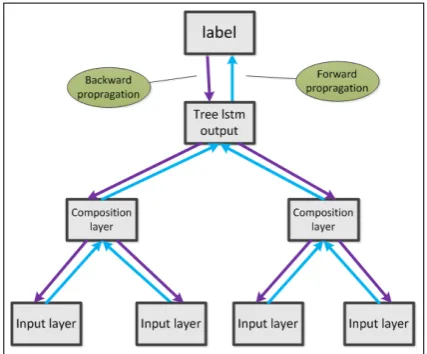
only hidden information from two sub nodes par-ticipates in the construction of gates. The struc-ture of Constituency Tree-LSTM model is shown in Figure 1.
Figure 1: Constituency Tree-LSTM model. The upward arrows represent the direction of forward propagation, the downward arrows represent the direction of the backward propagation.
3 Our model
In this section, we discuss three new models which combine the structural information generated by tree-structured model (Constituency Tree-LSTM) and serialization information generated by sequen-tial model (LSTM).
3.1 TC-LSTM
Constituency Tree-LSTM uses composition node at the root of the tree to represent the feature of sentence. We propose a new model named Tree-Composition LSTM (TC-LSTM) which generates a new feature taking all the leaf nodes, compo-sition nodes and their sequential information in-to account. Firstly, we use posin-torder traversal in-to get all the nodes in the tree, and those nodes are
treated as a sequence. The sequence contains not only the words in the sentence, but also the struc-tural information in their parent composition n-odes. Then we put the sequence into LSTM model for training, thus obtaining the serialization infor-mation of those hidden nodes with structural in-formation. It is worth noting that, though sharing the same hidden nodes, in our first proposed mod-el, the weights of the original Tree-LSTM module and the new added LSTM module are trained in-dependently. The input word vectors firstly per-form forward propagation on the Tree-LSTM, and then, the sequence mentioned above is obtained. Then the forward propagation of the sequence is performed on the LSTM model. The output er-ror and gradient of the two modules are obtained through the training label separately. Finally, the backward propagation performs independently of each other. The gradients of back propagation up-dating the word vectors of input layer only flows from Tree-LSTM module.
TC-LSTM model is shown in Figure 2. After training, we only use the output of LSTM mod-ule to test on test data in order to verify the per-formance of sequential information extracted from tree-structured model.
Figure 2: TC-LSTM model. New LSTM module is added to the original Tree-LSTM model. They shared the same hidden nodes but trained separate-ly. Only the output of LSTM module is used to do the prediction.
3.2 LT-LSTM
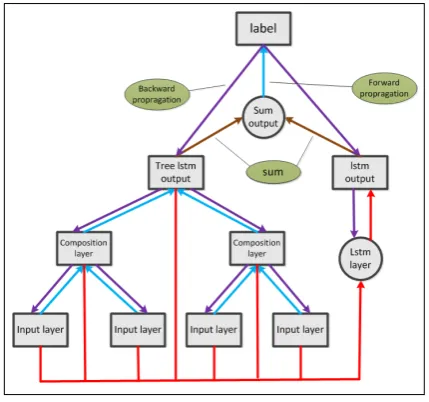
t-wo modules but it only has one output. The first module is the same to Tree-LSTM, and the sec-ond module is the LSTM module which takes the leaf nodes of the tree, namely only the words of a sentence as input. During the forward propaga-tion, we add the output of two modules and take the result as the output of the whole model. Gradi-ent of the whole model is generated by the output, and then, assigned to the output of two modules for their backward propagation. Figure 3 shows the structure of the LT-LSTM model.
The output represents the combination of those two kinds of information: structural information and serialization information. Correspondingly, The gradient of the output layer contains the er-ror information of the Tree-LSTM module and L-STM module. Letting the gradient propagate top-down through those two modules can make them learn from each other, thus having the chance to make the comprehensive performance of the w-hole model better.
Figure 3: LT-LSTM model. The new added LST-M model only takes the leaf nodes as input. The output represent the fusion of two kinds of infor-mation, and its gradient trains the whole model.
3.3 LCT-LSTM
The third model proposed by us is Leaf-Composition-Tree LSTM (LCT-LSTM).Different from the LT-LSTM and TC-LSTM, this model not only takes the composition nodes into consid-eration when building the LSTM layer, but also makes sum of the outputs of two modules men-tioned above. That is, LCT-LSTM can be seen as the composition of TC-LSTM and LT-LSTM for
the reason of not only building the sequential fea-ture for the composition nodes which contain the structural information, but also combining the se-quential feature and the structural feature of the input sentence. The structure of LCT-LSTM is shown in Figure 4.
Figure 4: LCT-LSTM model.
4 Experiment
4.1 Dataset
We evaluate our proposed models on the Stanford Sentiment Tree Bank (SST) dataset, which con-tains sentences collected from movie reviews. The sentences in the dataset are split into three parts: 8544 for training, 1101 for development and 2210 for test. SST dataset has two classification tasks, one for fine-grained classification (five categories: very negative, negative, neutral, positive, and very positive) and the other for binary classification (t-wo categories: negative and positive). The fine-grained subtask is evaluated on 8544/1101/2210 splits, and the binary classification is evaluated on 6920/872/1821 splits (there are fewer sentences because the neutral examples are excluded). Ev-ery sentence in the dataset is processed into tree structure, and every phrase (corresponding to the nodes in the tree) in the sentence is also labeled.
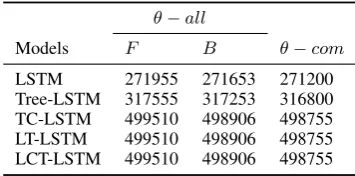
θ−all
Models F B θ−com
LSTM 271955 271653 271200 Tree-LSTM 317555 317253 316800 TC-LSTM 499510 498906 498755 LT-LSTM 499510 498906 498755 LCT-LSTM 499510 498906 498755
Table 1: Parameters of models.θ−allrepresents the number of all the parameters in a model forF
(fine-grained) tasks andB(binary tasks). θ−com
represents parameters of composition layer. TC-LSTM, LT-LSTM and LCT-LSTM have the same number of parameters but they are trained in dif-ferent ways.
algorithm is used for training, the minibatch size set by us is 25, L2-regularization is used for each batch using the value of 1e-4, and the dropout for the output layer is 0.5.
The dimension of the input layer is the same as the word vector, and the hidden layer consisted of tree nodes has the dimension of 150. For the se-quential module, both of the inputs and the hidden layer have the dimension of 150, the vectors of leaf nodes are projected into the 150 dimension when put into the sequential part. The numbers of pa-rameters for all the models are shown in Table 1.
Every model is trained on the training set for 20 epochs, and tested on the development set for validation after finishing every epoch. We choose the parameters performing best among them to do the evaluation on the test set. For every model, we repeat experiments for 8 times and take the aver-age of their results as the final performance of the model.
4.3 Baseline
The models proposed by us fuse the structural information and serialization information, so we compare those models with other models which do not combine those two kinds of information. We choose the Constituency Tree-LSTM, LSTM and BiLSTM mentioned in 2015 (Tai et al.,2015) as the baseline models, other tree-structure models such as RNN, MV-RNN and RNTN are also used for comparison.
4.4 Result
The results of experiment are shown in Table 2. We use accuracy to measure the performance of models.
Models Fine-grained Binary
LSTM (Tai et al.,2015) 46.4 84.9 Bi-LSTM (Tai et al.,2015) 49.1 87.5 RNN (Socher et al.,2013) 43.2 82.4 MV-RNN (Socher et al.,2013) 44.4 82.9 RNTN (Socher et al.,2013) 45.7 85.4 Constituency Tree-LSTM 50.7 88.0
TC-LSTM 49.6 88.2
LT-LSTM 51.0 88.5
LCT-LSTM 50.9 88.7
Table 2: The result of accuracy on the test set. Fine-grained represents the five-category classification and the Binary represents the posi-tive/negative classification.
From Table 2, we can see that on the whole, the models fusing structural and serialization informa-tion outperform other models which do not com-bine those two kinds of information. LT-LSTM achieves the best performance among our com-pared models in the fine-grained subtask and LCT-LSTM has the best performance in the binary sub-task. TC-LSTM performs slightly better than Con-stituency Tree-LSTM in the binary subtask but worse than fine-grained subtask, but it still per-forms better than other single sequential models and tree-structured models.
We find that building the serialization feature for the nodes in tree-structure (TC-LSTM) does not really help the tree-structural models, but fus-ing the structural information and serialization in-formation gives help to it. While fusing, adding the hidden nodes containing the structural infor-mation to the sequential model (LCT-LSTM) per-forms better in the binary subtask, but slightly worse in the fine-grained subtask compared to the model does not do so (LT-LSTM).
5 Conclusion
be used in place of the tree-structured model and the sequential model used in our models. Atten-tion mechanism (Luong et al., 2015) can also be used to do some improvement.
References
Yoshua Bengio, Rjean Ducharme, Pascal Vincent, Christian Jauvin, K Jaz, Thomas Hofmann, Toma-so Poggio, and John Shawe-Taylor. 2003. Journal of machine learning research 3 (2003) 1137–1155 submitted 4/02; published 2/03 a neural probabilis-tic language model .
Kyunghyun Cho, Bart Van Merrienboer, Caglar Gul-cehre, Dzmitry Bahdanau, Fethi Bougares, Holger Schwenk, and Yoshua Bengio. 2014. Learning phrase representations using rnn encoder-decoder for statistical machine translation. Computer Sci-ence.
Yunchao He, Liang Chih Yu, Chin Sheng Yang, K. Robert Lai, and Weiyi Liu. 2016. Yzu-nlp team at semeval-2016 task 4: Ordinal sentiment clas-sification using a recurrent convolutional network. InInternational Workshop on Semantic Evaluation. pages 251–255.
Sepp Hochreiter and Schmidhuber. 2012. Long short-term memory. Neural Computation 9(8):1735– 1780.
Filippos Kokkinos and Alexandros Potamianos. 2017. Structural attention neural networks for improved sentiment analysis .
Phong Le and Willem Zuidema. 2015. Compositional distributional semantics with long short term mem-ory.Computer Science.
Minh Thang Luong, Hieu Pham, and Christopher D. Manning. 2015. Effective approaches to attention-based neural machine translation. Computer Sci-ence.
Member, IEEE, Mike Schuster, and Kuldip K. Pali-wal. 1997. Bidirectional recurrent neural net-works. IEEE Transactions on Signal Processing 45(11):2673–2681.
Jeffrey Pennington, Richard Socher, and Christopher Manning. 2014. Glove: Global vectors for word representation. In Conference on Empirical Meth-ods in Natural Language Processing. pages 1532– 1543.
Schmidhuber. 1990. Recurrent networks adjusted by adaptive critics .
R. Socher, A. Perelygin, J. Y. Wu, J. Chuang, C. D. Manning, A. Y. Ng, and C. Potts. 2013. Recursive deep models for semantic compositionality over a sentiment treebank .
Richard Socher, Brody Huval, Christopher D Manning, and Andrew Y Ng. 2012a. Semantic compositional-ity through recursive matrix-vector spaces. InJoint Conference on Empirical Methods in Natural guage Processing and Computational Natural Lan-guage Learning. pages 1201–1211.
Richard Socher, Chiung Yu Lin, Andrew Y. Ng, and Christopher D. Manning. 2012b. Parsing natural scenes and natural language with recursive neural networks. InInternational Conference on Machine Learning, ICML 2011, Bellevue, Washington, Usa, June 28 - July. pages 129–136.
Kai Sheng Tai, Richard Socher, and Christopher D. Manning. 2015. Improved semantic representation-s from tree-representation-structured long representation-short-term memory net-works. Computer Science5(1):: 36.
Duyu Tang, Bing Qin, and Ting Liu. 2015. Documen-t modeling wiDocumen-th gaDocumen-ted recurrenDocumen-t neural neDocumen-twork for sentiment classification. In Conference on Empiri-cal Methods in Natural Language Processing. pages 1422–1432.
Zhiyang Teng and Yue Zhang. 2016. Bidirectional tree-structured lstm with head lexicalization . Jin Wang, Liang Chih Yu, K. Robert Lai, and Xuejie
Zhang. 2016. Dimensional sentiment analysis using a regional cnn-lstm model. InMeeting of the Asso-ciation for Computational Linguistics. pages 225– 230.
Zichao Yang, Diyi Yang, Chris Dyer, Xiaodong He, Alex Smola, and Eduard Hovy. 2016. Hierarchical attention networks for document classification. In Conference of the North American Chapter of the Association for Computational Linguistics: Human Language Technologies. pages 1480–1489.