Capturing Long-distance Dependencies in Sequence Models:
A Case Study of Chinese Part-of-speech Tagging
Weiwei Sun and Xiaochang Peng and Xiaojun Wan Institute of Computer Science and Technology, Peking University
The MOE Key Laboratory of Computational Linguistics {ws,wanxiaojun}@pku.edu.cn;[email protected]
Abstract
This paper is concerned with capturing long-distance dependencies in sequence models. We propose a two-step strat-egy. First, the stacked learning technique is applied to integrate sequence models that are good at exploring local informa-tion and other high complexity models that are good at capturing long-distance de-pendencies. Second, the structure com-pilation technique is employed to trans-fer the predictive power of hybrid models to sequence models via large-scale unla-beled data. To investigate the feasibility of our idea, we study Chinese POS tag-ging. Experiments on the Chinese Tree-bank data demonstrate the effectiveness of our methods. The re-compiled models not only achieve high accuracy with respect to per token classification, but also serve as a front-end to a parser well.
1 Introduction
Sequential classification models provide very im-portant solutions to pattern recognition tasks that involve the automatic assignment of a categorical label to each token of a sequence of observed val-ues. A common example is part-of-speech (POS) tagging, which seeks to assign a grammatical cat-egory to each word in an input sentence.Standard machine learning algorithms to sequential tagging, e.g. linear-chain conditional random fields and max-margin Markov network, directly exploit lo-cal dependencies and perform quite well for a large number of sequence labeling tasks. In these models, usually, the relationships between two (or three) successive labels are parameterized and en-coded as a single feature, and Viterbi style dy-namic programming algorithms are applied to in-ference over a lattice. Although sequence models
perform well for many applications, they are inad-equate for tasks where many long-distance depen-dencies are involved.
Sequential classification models play an impor-tant role in natural language processing (NLP). Several fundamental NLP tasks, including named entity recognition, POS tagging, text chunking, supertagging, etc., employ sequential classifiers for lexical and syntactic disambiguation. In ad-dition to learning linear chain structures, sequence models can even be applied to acquire hierarchical syntactic structures (Tsuruoka et al., 2009). How-ever, long-distance dependencies widely exist in linguistic structures, and many NLP systems suf-fer from the incapability of capturing these depen-dencies. For example, previous work has shown that sequence models alone cannot deal with syn-tactic ambiguities well (Clark and Curran, 2004; Tsuruoka et al., 2009). On the contrary, state-of-the-art systems usually utilize high complexity models, such as lexicalized PCFG models for syn-tactic parsing, to achieve high accuracy. Unfortu-nately, they are not suitable for many real world applications due to the sacrifice of efficiency.
In this paper, we are concerned with capturing long-distance dependencies in sequence models. Our goal is to develop efficient models with lin-ear time complexity that are also capable to cap-ture non-local dependencies. Two techniques are studied to achieve this goal. First, stacked learn-ing (Breiman, 1996) is employed to integrate se-quence models that are good at exploring local in-formation and other high complexity models that are good at capturing non-local dependencies. By combining complementary strengths of heteroge-neous models, hybrid systems can obtain more accurate results. Second, structure compilation (Liang et al., 2008) is employed to transfer the pre-dictive power of hybrid models to sequence mod-els via large-scale unlabeled data. In particular, hybrid systems are utilized to create large-scale
pseudo training data for cheap sequence models. A discriminative model can be improved by in-corporating more features, while a generative la-tent variable model can be improved by increasing the number of latent variables. By using stacking and structure compilation techniques, a sequence model can be enhanced to better capture long-distance dependencies and to achieve more accu-rate results.
To demonstrate the feasibility to capture long-distance dependencies in a sequence model, we present our work on Chinese POS tagging. The Chinese language has a number of characteristics that make Chinese POS tagging particularly chal-lenging. While simple sequential classifiers can easily achieve tagging accuracies of above 97% on English, Chinese POS tagging has proven to be more challenging and has obtained accuracies of about 93-94% (Huang et al., 2009; Sun and Uszkoreit, 2012) when applying sequence mod-els. Recent work shows that higher accuracy (c.a. 95%) can be achieved by applying advanced learn-ing techniques to capture deep lexical relations (Sun and Uszkoreit, 2012). Especially, syntag-matic lexical relations have been shown playing an essential role in Chinese POS tagging. To capture such relations, an accurate POS tagging model should know more information about long range dependencies. Previous work has used syntactic parsers in either constituency or dependency for-malisms to exploit such useful information (Sun and Uszkoreit, 2012; Hatori et al., 2011). How-ever, it is inapproporiate to employ computation-ally expensive parsers to improve POS tagging for many realistic NLP applications, mainly due to ef-ficiency considerations.
In this paper, we study several hybrid systems that are built upon various complementary tagging systems. We investigate stacked learning to build more accurate solutions by integrating heteroge-neous models. Experiments on the Chinese Tree-bank (CTB) data show that stacking is very effec-tive to build high-accuracy tagging systems. Al-though predictive powers of hybrid systems are significantly better than individual systems, they are not suitable for large-scale real word applica-tions that have stringent time requirements. To im-prove POS tagging efficiency without loss of ac-curacy, we explore unlabeled data to transfer the predictive power of complex, inefficient models to simple, efficient models. Experiments show that
unlabeled data is effective to re-compile simple models, including latent variable hidden Markov models, local and global linear classifiers. On one hand, the precison in terms of word classification is improved to 95.33%, which reachs the state-of-the-art. On the other hand, re-compiled models are adapted based on parsing results, and as a sult the ability to capture syntagmatic lexical re-lations is improved as well. Different from the purely supervised sequence models, re-compiled models also serve as a front-end to a parser well.
2 Background
The Chinese language has a number of character-istics that make Chinese POS tagging particularly challenging. For example, Chinese is character-ized by the lack of formal devices such as morpho-logical tense and number that often provide impor-tant clues for syntactic processing. Chinese POS tagging has proven to be very difficult and has ob-tained accuracies of about 93-94% (Huang et al., 2009; Li et al., 2011; Hatori et al., 2011; Sun and Uszkoreit, 2012). On the other hand, Chinese POS information is very important for advanced NLP tasks, e.g. supertagging, full parsing and seman-tic role labeling. Previous work has repeatedly demonstrated the significant performance gap of NLP systems while using gold standard and au-tomatically predicted POS tags (Zhang and Clark, 2009; Li et al., 2011; Tse and Curran, 2012). In this section, we give a brief introduction and a comparative analysis to several models that are re-cently designed to resolve the Chinese POS tag-ging problem.
2.1 Various Chinese POS Tagging Models
Local linear model (LLM) A very simple ap-proach to POS tagging is to formulate it as a local word classification problem. Various features can be drawn upon information sources such as word forms and characters that constitute words. Pre-vious studies on many languages have shown that local classification is inadequate to capture struc-tural information of output labels, and thus does not perform as well as structured models.
in-clude linguistic knowledge from multiple informa-tion sources, and thus suitable to recognize more new words. A majority of state-of-the-art English POS taggers are based on LGLMs, e.g. struc-tured perceptron (Collins, 2002) and conditional random fields (Lafferty et al., 2001). Such mod-els are also very popular for building Chinese POS taggers (Sun and Uszkoreit, 2012).
Hidden Markov model with latent variables (HMMLA) Generative models with latent an-notations (LA) obtain state-of-the-art performance for a number of NLP tasks. For example, both PCFG and TSG with refined latent vari-ables achieve excellent results for syntactic pars-ing (Matsuzaki et al., 2005; Shindo et al., 2012). For Chinese POS tagging, Huang, Eidelman and Harper (2009) described and evaluated a bi-gram HMM tagger that utilizes latent annotations. The use of latent annotations substantially improves the performance of a simple generative bigram tagger, outperforming a trigram HMM tagger with sophisticated smoothing.
PCFG Parsing with latent variables (PCFGLA) POS tags can be taken as preterminals of a con-stituency parse tree, so a concon-stituency parser can also provide POS information. The majority of the state-of-the-art constituent parsers are based on generative PCFG learning, with lexicalized (Collins, 2003; Charniak, 2000) or latent annota-tion (Matsuzaki et al., 2005; Petrov et al., 2006) refinements. Compared to complex lexicalized parsers, the PCFGLA parsers leverage on an au-tomatic procedure to learn refined grammars and are more robust to parse many non-English lan-guages that are not well studied. For Chinese, a PCFGLA parser achieves the state-of-the-art per-formance and outperforms many other types of parsers (Zhang and Clark, 2009).
2.1.1 Joint POS Tagging and Dependency Parsing (DEP)
(Hatori et al., 2011) proposes an incremental pro-cessing model for the task of joint POS tagging and dependency parsing, which is built upon a shift-reduce parsing framework with dynamic pro-gramming. Given a segmented sentence, a joint model simultaneously considers possible POS tags and dependency relations. In this way, the learner can better predict POS tags by using bi-lexical de-pendency information. Their experiments show that the joint approach achieved substantial
im-provements over the pipeline systems in both POS tagging and dependency parsing tasks.
2.2 Comparison
We can distinguish the five representative tagging models from two views (see Table 2). From a lin-guistic view, we can distinguish syntax-free and syntax-based models. In a syntex-based model, POS tagging is integrated into parsing, and thus (to some extent) is capable of capturing long range syntactic information. From a machine learning view, we can distinguish generative and discrim-inative models. Compared to generative models, discriminative models define expressive features to classify words. Note that the two generative models employ latent variables to refine the out-put spaces, which significantly boost the accuracy and increase the robustness of simple generative models.
Generative Discriminative Syntax-free HMMLA LLM, LGLM Syntax-based PCFGLA DEP
Table 2: Two views of different tagging models.
2.3 Evaluation
2.3.1 Experimental Setting
Penn Chinese Treebank (CTB) (Xue et al., 2005) is a popular data set to evaluate a number of Chinese NLP tasks, including word segmenta-tion, POS tagging, syntactic parsing in both con-stituency and dependency formalisms. In this pa-per, we use CTB 6.0 as the labeled training data for the study. In order to obtain a representative split of data sets, we conduct experiments following the setting of the CoNLL 2009 shared task (Hajiˇc et al., 2009), which is also used by (Sun and Uszkor-eit, 2012). The setting is provided by the principal organizer of the CTB project, and has considered many annotation details. This setting is very ro-bust for evaluating Chinese language processing algorithms.
We present an empirical study of the five typ-ical approaches introduced above. In our exper-iments, to build local and global word classifiers (i.e. LLMs and LGLMs), we implement the fea-ture set used in (Sun and Uszkoreit, 2012). De-note a word w in focus with a fixed window
w−2w−1ww+1w+2. The features include:
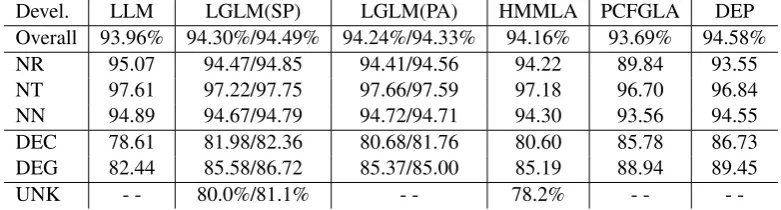
Devel. LLM LGLM(SP) LGLM(PA) HMMLA PCFGLA DEP
Overall 93.96% 94.30%/94.49% 94.24%/94.33% 94.16% 93.69% 94.58%
NR 95.07 94.47/94.85 94.41/94.56 94.22 89.84 93.55
NT 97.61 97.22/97.75 97.66/97.59 97.18 96.70 96.84
NN 94.89 94.67/94.79 94.72/94.71 94.30 93.56 94.55
DEC 78.61 81.98/82.36 80.68/81.76 80.60 85.78 86.73
DEG 82.44 85.58/86.72 85.37/85.00 85.19 88.94 89.45
UNK - - 80.0%/81.1% - - 78.2% - -
-Table 1: Tagging accuracies of different supervised models on the development data.
• Word bigrams: w−2 w−1, w−1 w, w w+1,
w+1 w+2;
• Charactern-gram prefixes and suffixes forn
up to 3.
To train LLMs, we use the open source linear clas-sifier –LIBLINEAR1. To train LGLMs, we choose structured perceptron (SP) (Collins, 2002) and passive aggressive (PA) (Crammer et al., 2006) learning algorithms. For the LAHMM and DEP models, we use the systems discribed in (Huang et al., 2009; Hatori et al., 2011); for the PCFGLA models, we use the Berkeley parser2.
2.3.2 Results
Table 1 summarizes the performance in terms of per word classification of different supervised models on the development data. We present the results of both first order (on the left) and second order (on the right) LGLMs. We can see that the perceptron algorithm performs a little better than the PA algorithm for Chinese POS tagging. There is only a slight gap between the local classification model and various structured models. This is very different from English POS tagging. Although the local classifier achieves comparable results when respectively applied to English and Chinese, there is much more significant gap between the corre-sponding structured models. Similarly, the gap be-tween the first and second order LGLMs is very modest too.
From the linguistic view, we mainly consider the disambiguiation ability of local and non-local dependencies. Table 1 presents accuracy results of several POS types, including nouns and func-tional words. The POS typesNR,NTandNN re-spectively represent proper nouns, temporal nouns and other common nouns. We can clearly see that models which only explore local dependencies are
1
www.csie.ntu.edu.tw/˜cjlin/liblinear/
2code.google.com/p/berkeleyparser/
good enough to deal with nouns. Surprisingly, the local classifier that does not directly define fea-tures of possible POS tags of other surrounding words performs even better than structured mod-els for proper nouns and other common nouns.
The tag DEC denotes a complementizer or a nominalizer, while the tagDEGdenotes a genitive marker and an associative marker. These two types only include two words: “的” and “之.” The lat-ter one is mainly used in ancient Chinese. 5.19% of words appearing in the training data set is DEC/DEG. The pattern of theDECrecognition is clause/verb phrase+DEC+noun phrase, and The pattern of theDEGrecognition isnominal modi-fier+DEC+noun phrase. To distinguish the sen-tential/verbal and nominal modification phrases, theDECandDEGwords usually need long range syntactic information for accurate disambiguation. We claim that the prediction performance of the two specific types is a good clue of how well a tag-ging model resolves long distance dependencies. We can see that the two syntactic parsers signifi-cantly outperform local models on the prediction of these types of words.
[image:4.595.103.494.63.168.2]supertag-LLM First order LGLM Second order LGLM
SP PA SP PA
Baseline 93.96% 94.30% 94.24% 94.49% 94.33%
+Word clustering 94.75% 94.90% 94.80% 95.05% 94.96% +Word clustering+HMMLA 95.12% 95.19% 95.18% 95.14% 95.22% +Word clustering+PCFGLA 95.42% 95.50% 95.40% 95.56% 95.44% +Word clustering+DEP 95.28% 95.22% 95.26% 95.29% 95.25%
[image:5.595.106.492.62.171.2]+ALL 95.56% 95.61% 95.60% 95.53% 95.53%
Table 3: Tagging accuracies of different stacking models on the development data.
ging.
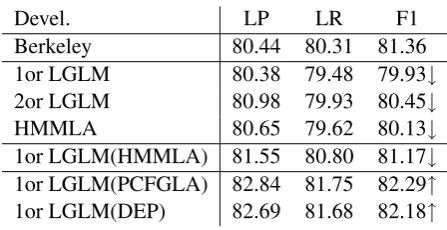
Devel. LP LR F1
Berkeley 80.44 80.31 81.36 1or LGLM 80.38 79.48 79.93↓
2or LGLM 80.98 79.93 80.45↓
HMMLA 80.65 79.62 80.13↓
1or LGLM(HMMLA) 81.55 80.80 81.17↓
1or LGLM(PCFGLA) 82.84 81.75 82.29↑
1or LGLM(DEP) 82.69 81.68 82.18↑
Table 4: Parsing accuracies on the development data. 1orand2or respectively denote first order and second order. LGLM(X) denotes a stacking model withXas the level-0 processing. All stack-ing models incorporate word clusters to improve the tagging accuracy.
To distinguish the predictive abilities of genera-tive and discriminagenera-tive models, we report the pre-cison of the prediction of unknown words (UNK). Discriminative learning can define arbitrary (even overlapping) features which play a central role in tagging English unknown words. The difference between generative and discriminative learning in Chinese POS tagging is not that much, mainly because most Chinese words are compactly com-posed by a very few Chinese characters that are usually morphemes. This language-specific prop-erty makes it relatively easy to smooth parameters of a generative model.
3 Improving Tagging Accuracy via Stacking
In this section, we study a simple way of inte-grating multiple heterogeneous models in order to exploit their complementary strength and thereby improve tagging accuracy beyond what is possi-ble by either model in isolation. The method in-tegrates the heterogeneous models by allowing the outputs of the HMMLA, PCFGLA and DEP to
de-fine features for the LLM/LGLM.
3.1 Stacked Learning
Stacked generalization is a meta-learning algo-rithm that has been first proposed in (Wolpert, 1992) and (Breiman, 1996). Stacked learning has been applied as a system ensemble method in sev-eral NLP tasks, such as joint word segmentation and POS tagging (Sun, 2011), and dependency parsing (Nivre and McDonald, 2008). The idea is to include two “levels” of predictors. The first level includes one or more predictorsg1, ..., gK :
Rd → R; each receives input x ∈ Rd and
out-puts a predictiongk(x). The second level consists of a single function h : Rd+K → R that takes
as inputhx, g1(x), ..., gK(x)i and outputs a final prediction yˆ = h(x, g1(x), ..., gK(x)). The pre-dictor, then, combines an ensemble (thegk’s) with a meta-predictor (h).
3.2 Applying Stacking to POS Tagging
We use the LLMs or LGLMs (ash) for the level-1 processing, and other models (asgk) for the level-0 processing. The characteristic of discrimina-tive learning makes LLMs/LGLMs very easy to integrate the outputs of other models as new fea-tures. We are relying on the ability of discrim-inative learning to explore informative features, which play a central role in boosting the tagging accuracy. For output labels produced by each aux-iliary model, five newlabel uni/bi-gram features are added: w−1, w, w+1, w−1 w, w w+1. This
choice is tuned on the development data.
[image:5.595.71.295.235.350.2]added: w−1,w, w+1,w−1 w, w w+1. The
clus-ters are acquired based on the Chinese giga-word data with the MKCLS tool. The number of total clusters is set to 500, which is tuned by (Sun and Uszkoreit, 2012).
3.3 Evaluation
Table 3 summarizes the tagging accuracy of dif-ferent stacking models. From this table, we can clearly see that the new features derived from the outputs of other models lead to substantial im-provements over the baseline LLM/LGLM. The output structures provided by the PCFGLA model are most effective in improving the LLM/LGLM baseline systems. Among different stacking mod-els, the syntax-free hybrid one (i.e., stacking LLM/LGLM with HMMLA) does not need any treebank to train their systems. For the situa-tions that parsers are not available, this is a good solution. Moreover, the decoding algorithms for linear-chain Markov models are very fast. There-fore the syntax-free hybrid system is more appeal-ing for many NLP applications.
Table 5 is the F1 scores of the DEC/DEG pre-diction which are obtained by different stacking models. Compared to Table 1, we can see that the hybrid sequence model is still not good at handling long-distance ambiguities. As a result, it harms the parsing performance (see Table 4), though it achieves higher overall precison.
Devel. DEC DEG
1or LGLM(HMMLA) 82.93 86.64 1or LGLM(PCFGLA) 88.11 91.12 1or LGLM(DEP) 87.46 89.86
Table 5: F1 score of the DEC/DEG prediction of different stacking models on the development data.
3.4 Related Work
(Sun and Uszkoreit, 2012) introduced a Bagging model to effectively combine the outputs of in-dividual systems. In the training phase, given a training setDof sizen, the Bagging model gener-atesmnew training setsDi’s by sampling exam-ples from D. EachDi is separately used to train
kindividual models. In the tagging phase, thekm
models outputskm tagging results, each word is assigned one POS label. The final tagging is the voting result of these km labels. Although this model is effective, it is too expensive in the sense
that it uses parser multiple times. We also imple-ment their method and compare the results with our stacking model. We find the accuracy perfor-mance produced by the two different methods are comparable.
(Rush et al., 2010) introduced dual decomposi-tion as a framework for deriving inference algo-rithms for serious combinatorial problems in NLP. They successfully applied dual decomposition to the combination of a lexicalized parsing model and a trigram POS tagger. Despite the effective-ness, their method iteratively parses a sentence many times to achieve convergence, and thus is not as efficient as stacking.
4 Improving Tagging Efficiency through Unlabeled Data
4.1 The Idea
Hybrid structured models often achieve excellent performance but can be slow at test time. In our problem, it is obviously too inefficient to improve POS tagging by parsing a sentence first. In this section, we explore unlabeled data to transfer the predictive power of hybrid models to sequence models. The main idea behind this is to use a fast model to approximate the function learned by a slower, larger, but better performing ensemble model. Unlike the true function that is unknown, the function learned by a high performing model is available and can be used to label large amounts of pseudo data. A fast and expressive model trained on large scale pseudo data will not overfit and will approximate the function learned by the high per-forming model well. This allows a slow, complex model such as massive ensemble to be compressed into a fast sequence model such as a first order LGLM with very little loss in performance.
This idea to use unlabeled data to transfer the predictive power of one model to another has been investigated in many areas, for example, from high accuracy neural networks to more interpretable de-cision trees (Craven, 1996), from high accuracy ensembles to faster and more compact neural net-works (Bucila et al., 2006), or from structured prediction models to local classification models (Liang et al., 2008),
4.2 Reducing Hybrid Models to Sequence Models
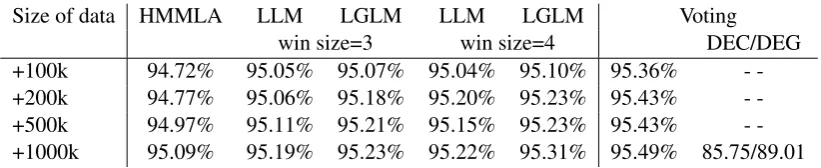
Size of data HMMLA LLM LGLM LLM LGLM Voting
win size=3 win size=4 DEC/DEG
[image:7.595.94.505.61.145.2]+100k 94.72% 95.05% 95.07% 95.04% 95.10% 95.36% -+200k 94.77% 95.06% 95.18% 95.20% 95.23% 95.43% -+500k 94.97% 95.11% 95.21% 95.15% 95.23% 95.43% -+1000k 95.09% 95.19% 95.23% 95.22% 95.31% 95.49% 85.75/89.01
Table 6: Tagging accuracies of different re-compiled models on the development data.
transfer the power of a chain conditional ran-dom field to a logistic regression model. Simi-larly, we do some experiments to explore the fea-sibility of reducing hybrid tagging models to a HMMLA, LLM or LGLM, for Chinese POS tag-ging. The large-scale unlabeled data we use in our experiments comes from the Chinese Gigaword (LDC2005T14), which is a comprehensive archive of newswire text data that has been acquired over several years by the Linguistic Data Consortium (LDC). We choose the Mandarin news text, i.e. Xinhua newswire. We tag giga-word sentences by applying the stacked first order LGLMs with all other models. In other words, the HMMLA, PCFGLA and DEP systems are applied to tag un-labeled data features and their outputs are utilized to define features for first-order and second-order LGLMs which produce pseudo training data. Both original gold standard training data and pseudo training data are used to re-train a HMMLA, a LLM/LGLM with extended features.
The key for the success of hybrid tagging mod-els is the existence of a large diversity among learners. Zhou (2009) argued that when there are lots of labeled training examples, unlabeled in-stances are still helpful for hybrid models since they can help to increase the diversity among the base learners. The author also briefly introduced a preliminary theoretical study. In this paper, we also combine the re-trained models to see if we can benefit more. We utilize voting as the strategy for final combination. In the tagging phase, the re-trained LLM, LGLM and HMMLA systems out-puts3 tagging results, each word is assigned one POS label. The final tagging is the voting result of these3labels.
4.3 Experiments
4.3.1 Reducing Hybrid Models to HMMLA
With the increase of (pseudo) training data, a HMMLA may learn better latent variables to sub-categorize POS tags, which could significantly
im-prove a purely supervised HMMLA. In our experi-ments, all HMMLA models are trained with 8 iter-ations of split, merge, smooth. The second column of Table 6 shows the performance of the re-trained HMMLAs. The first column is the number of sen-tences of pseudo sensen-tences. The pseudo sensen-tences are selected from the begining of the Chinese giga-word. We can clearly see that the idea to lever-age unlabeled data to transfer the predictive ability of the hybrid model works. Self-training can also slightly improve a HMMLA (Huang et al., 2009). Our auxiliary experiments show that self-training is not as effective as our methods.
4.3.2 Reducing Hybrid Models to LLM/LGLM
To increase the expressive power of a discrimi-native classification model, we extend the feature templates. This strategy is proposed by (Liang et al., 2008). In our experiments, we increase the window size of word uni/bi-gram features to ap-proximate long distance dependencies. For win-dow size 3, we will add w−3, w3, w−3w−2 and
w2w3 as new features; for size 4, we will add
w−4,w−3,w3,w4,w−4w−3,w−3w−2,w2w3 and
w3w4; Column 3 to 6 of Table 6 show the
perfor-mance of the re-compiled LLMs/LGLMs. Sim-ilar to the generative model, the discriminative LLM/LGLM can be improved too.
4.3.3 Voting
4.3.4 Improving Parsing
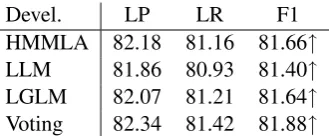
Purely supervised sequence models are not good at predicting function words, and accordingly are not good enough to be used as front modules to parsers. The re-compiled models can mimic some behaviors of parsers, and therefore are suitable for parsing. Our evaluation shows that the signifi-cant improvement of the POS tagging stop harm-ing syntactic parsharm-ing. Results in Table 7 indicate that the parsing accuracy of the Berkeley parser can be simply improved by inputting the Berke-ley parser with the re-trained sequential tagging results. Additionally, the success to separate tag-ging and parsing can improve the whole syntactic processing efficiency.
Devel. LP LR F1
HMMLA 82.18 81.16 81.66↑
LLM 81.86 80.93 81.40↑
LGLM 82.07 81.21 81.64↑
[image:8.595.100.265.279.347.2]Voting 82.34 81.42 81.88↑
Table 7: Accuracies of parsing based on re-compiled tagging.
[image:8.595.94.270.495.540.2]4.3.5 Final results
Table 8 shows the performance of different sys-tems evaluated on the test data. Our final se-quence model achieve the state-of-the-art perfor-mance, which is once obtained by combining mul-tiple parsers as well as sequence models.
Systems Acc.
(Sun and Uszkoreit, 2012) 95.34%
Our system 95.33%
Table 8: Tagging accuracies on the test data.
5 Conclusion
In this paper, we study two techniques to build accurate and fast sequence models for Chinese POS tagging. In particular, our goal is to capture long-distance dependencies in sequence models. To improve tagging accuracy, we study stacking to integrate multiple models with heterogeneous views. To improve tagging efficiency at test time, we explore unlabeled data to transfer the predic-tive power of hybrid models to simple sequence or even local classification models. Hybrid sys-tems are utilized to create large-scale pseudo train-ing data for cheap models. By applytrain-ing complex
machine learning techniques, we are able to build good sequential POS taggers. Another advantage of our system is that it serves as a front-end to a parser very well. Our study suggests that compli-cated structured models can be well simulated by simple sequence models through unlabeled data.
Acknowledgement
The work was supported by NSFC (61170166), Beijing Nova Program (2008B03) and National High-Tech R&D Program (2012AA011101).
References
Leo Breiman. 1996. Stacked regressions. Machine Learning, 24:49–64, July.
Cristian Bucila, Rich Caruana, and Alexandru Niculescu-Mizil. 2006. Model compression. In KDD, pages 535–541.
Eugene Charniak. 2000. A maximum-entropy-inspired parser. InProceedings of NAACL.
Stephen Clark and James R. Curran. 2004. The impor-tance of supertagging for wide-coverage ccg pars-ing. InProceedings of Coling 2004, pages 282–288, Geneva, Switzerland, Aug 23–Aug 27. COLING.
Michael Collins. 2002. Discriminative training meth-ods for hidden markov models: Theory and experi-ments with perceptron algorithms. InProceedings of EMNLP, pages 1–8. Association for Computa-tional Linguistics, July.
Michael Collins. 2003. Head-driven statistical models for natural language parsing. Computational Lin-guistics, 29(4):589–637.
Koby Crammer, Ofer Dekel, Joseph Keshet, Shai Shalev-Shwartz, and Yoram Singer. 2006. Online passive-aggressive algorithms. JOURNAL OF MA-CHINE LEARNING RESEARCH, 7:551–585.
Mark Craven. 1996.Extracting Comprehensible Mod-els from Trained Neural Networks. Ph.D. thesis, University of Wisconsin-Madison, Department of Computer Sciences. Also appears as UW Technical Report CS-TR-96-1326.
Jun Hatori, Takuya Matsuzaki, Yusuke Miyao, and Jun’ichi Tsujii. 2011. Incremental joint POS tag-ging and dependency parsing in chinese. In Pro-ceedings of 5th International Joint Conference on Natural Language Processing, pages 1216–1224, Chiang Mai, Thailand, November. Asian Federation of Natural Language Processing.
Zhongqiang Huang, Vladimir Eidelman, and Mary Harper. 2009. Improving a simple bigram hmm part-of-speech tagger by latent annotation and self-training. InProceedings of Human Language Tech-nologies: The 2009 Annual Conference of the North American Chapter of the Association for Computa-tional Linguistics, Companion Volume: Short Pa-pers, pages 213–216, Boulder, Colorado, June. As-sociation for Computational Linguistics.
John D. Lafferty, Andrew McCallum, and Fernando C. N. Pereira. 2001. Conditional random fields: Probabilistic models for segmenting and labeling se-quence data. InProceedings of the Eighteenth Inter-national Conference on Machine Learning, ICML ’01, pages 282–289, San Francisco, CA, USA. Mor-gan Kaufmann Publishers Inc.
Zhenghua Li, Min Zhang, Wanxiang Che, Ting Liu, Wenliang Chen, and Haizhou Li. 2011. Joint mod-els for Chinese POS tagging and dependency pars-ing. InProceedings of the 2011 Conference on Em-pirical Methods in Natural Language Processing, pages 1180–1191, Edinburgh, Scotland, UK., July. Association for Computational Linguistics.
Percy Liang, Hal Daum´e, III, and Dan Klein. 2008. Structure compilation: trading structure for features. InProceedings of the 25th international conference on Machine learning, ICML ’08, pages 592–599, New York, NY, USA. ACM.
Takuya Matsuzaki, Yusuke Miyao, and Jun’ichi Tsu-jii. 2005. Probabilistic cfg with latent annota-tions. InProceedings of ACL, ACL ’05, pages 75– 82, Stroudsburg, PA, USA. Association for Compu-tational Linguistics.
Joakim Nivre and Ryan McDonald. 2008. Integrat-ing graph-based and transition-based dependency parsers. In Proceedings of ACL-08: HLT, pages 950–958, Columbus, Ohio, June. Association for Computational Linguistics.
Slav Petrov, Leon Barrett, Romain Thibaux, and Dan Klein. 2006. Learning accurate, compact, and interpretable tree annotation. In Proceedings of the 21st International Conference on Computational Linguistics and 44th Annual Meeting of the Associa-tion for ComputaAssocia-tional Linguistics, pages 433–440, Sydney, Australia, July. Association for Computa-tional Linguistics.
Alexander M Rush, David Sontag, Michael Collins, and Tommi Jaakkola. 2010. On dual decomposi-tion and linear programming relaxadecomposi-tions for natu-ral language processing. InProceedings of EMNLP,
pages 1–11, Cambridge, MA, October. Association for Computational Linguistics.
Hiroyuki Shindo, Yusuke Miyao, Akinori Fujino, and Masaaki Nagata. 2012. Bayesian symbol-refined tree substitution grammars for syntactic parsing. In Proceedings of ACL, pages 440–448, Jeju Island, Korea, July. Association for Computational Linguis-tics.
Weiwei Sun and Hans Uszkoreit. 2012. Capturing paradigmatic and syntagmatic lexical relations: To-wards accurate Chinese part-of-speech tagging. In Proceedings of the 50th Annual Meeting of the Asso-ciation for Computational Linguistics. AssoAsso-ciation for Computational Linguistics, July.
Weiwei Sun. 2011. A stacked sub-word model for joint Chinese word segmentation and part-of-speech tagging. In Proceedings of the 49th Annual Meet-ing of the Association for Computational LMeet-inguis- Linguis-tics: Human Language Technologies, pages 1385– 1394, Portland, Oregon, USA, June. Association for Computational Linguistics.
Daniel Tse and James R. Curran. 2012. The chal-lenges of parsing chinese with combinatory cate-gorial grammar. In Proceedings of the 2012 Con-ference of the North American Chapter of the As-sociation for Computational Linguistics: Human Language Technologies, pages 295–304, Montr´eal, Canada, June. Association for Computational Lin-guistics.
Yoshimasa Tsuruoka, Jun’ichi Tsujii, and Sophia Ana-niadou. 2009. Fast full parsing by linear-chain conditional random fields. In Proceedings of the 12th Conference of the European Chapter of the ACL (EACL 2009), pages 790–798, Athens, Greece, March. Association for Computational Linguistics.
David H. Wolpert. 1992. Original contribution: Stacked generalization. Neural Netw., 5:241–259, February.
Nianwen Xue, Fei Xia, Fu-Dong Chiou, and Martha Palmer. 2005. The penn Chinese treebank: Phrase structure annotation of a large corpus. Natural Lan-guage Engineering, 11(2):207–238.
Yue Zhang and Stephen Clark. 2009. Transition-based parsing of the Chinese treebank using a global discriminative model. In Proceedings of the 11th International Conference on Parsing Technologies (IWPT’09), pages 162–171, Paris, France, October. Association for Computational Linguistics.