IJCNLP-2017 Task 4: Customer Feedback Analysis
Chao-Hong Liu, Yasufumi Moriya, Alberto Poncelas
ADAPT Centre, Ireland
Dublin City University
{chaohong.liu, yasufumi.moriya,
alberto.poncelas}@adaptcentre.ie
Declan Groves
Microsoft Ireland
Leopardstown, Dublin 18
degroves
@microsoft.com
Abstract
This document introduces the IJCNLP 2017 Shared Task on Customer Feedback Analysis. In this shared task we have pre-pared corpora of customer feedback in four languages, i.e. English, French, Span-ish and Japanese. They were annotated in a common meanings categorization, which was improved from an ADAPT-Microsoft pivot study on customer feed-back. Twenty teams participated in the shared task and twelve of them have sub-mitted prediction results. The results show that performance of prediction meanings of customer feedback is reason-able well in four languages. Nine system description papers are archived in the shared tasks proceeding.
1
Introduction
In this paper we introduce the results of IJCNLP 2017 Shared Task on Customer Feedback Analy-sis. The shared task is a follow-up of an ADAPT-Microsoft joint pilot study on multilingual cus-tomer feedback analysis. We have improved the categorization and the classes (tags) used in the corpora are the five-class “comment”, “request”, “bug”, “complaint”, “meaningless”, and the “un-determined” tag. By undetermined we mean that the feedback could be annotated as one of the five classes but due to lack of contexts it was annotated as undetermined. Table 1 shows the numbers of customer feedback sentences curated in the cor-pora and how many they are grouped into training, development and test sets. We also provided un-annotated customer feedback sentences in the cor-pora. Table 2 shows the statistics of each class in the meaning categorization in the training set. Noted we cannot find “meaningless” feedback
sentence in Japanese corpus. On the contrary, there is no “undetermined” feedback sentence in Spanish corpus. These might reflect some linguis-tic and/or cultural differences in the curated cus-tomer feedback corpora. Abbreviations EN, ES, FR and JP are used interchangeably with English, Spanish, French and Japanese where applicable.
Lang. Train. Dev. Test Unanno.
English 3,065 500 500 12,838 French 1,950 400 400 5,092 Spanish 1,631 301 299 6,035 Japanese 1,526 250 300 4,873 TOTAL 8,172 1,451 1,499 28,838 Table 1: Statistics of the curated Customer Feedback Analysis Corpora for the shared task.
EN FR ES JP
Comment 276 259 224 142
Request 21 6 12 22
Bug 21 13 5 18
Complaint 148 112 39 73 Meaningless 48 36 1 0
Undetermined 3 1 0 9
Table 2: Numbers of customer feedback tags that were annotated in the training set.
The purpose of the shared task is to try to an-swer the question that if we need to 1) train native systems for different languages (using the same meanings categorization of customer feedback), or it is good enough to 2) use Machine Translation (MT) to translate customer feedback in other lan-guages into English and use English based sys-tems to do the detection of meanings of customer feedback. If the answer is 1, we will have to pre-pare corpora for different languages using the same categorization. If the answer is 2, then it would be more reasonable to put more efforts to
enhance the performance of English based sys-tems and try to further improve the quality of MT results.
There are several categorizations that could be used for customer feedback analysis. First, differ-ent kinds of sdiffer-entimdiffer-ent categorizations that were used in sentiment analysis in Microsoft Office and many other institutions (Salameh et al., 2015) Customer feedback analysis is now an industry in its own right (Freshdesk, 2016; Burns, 2016). One commonly used categorization is the Excel-lent-Good-Average-Fair-Poor and its various kinds of variants (Yin et al., 2016; Survey-Monkey, 2016). (Freshdesk, 2016) and (Keatext, 2016) used a combined categorization of Positive-Neutral-Negative-Answered-Unanswered. (Sift, 2016) has the Refund-Complaint-Pricing-Tech Support-Store Locator-Feedback-Warranty Info categorization in seven classes. We can also have observed that there are many other categorizations that are not publicly available (Equiniti, 2016; UseResponse, 2016; Inmoment, 2016).
In this shared task, we followed (Liu et al., 2017)’s five-class customer feedback meanings categorization which is generalized from English, Spanish and Japanese customer feedback, add an “undetermined” class and prepared the corpora in four languages (English, French, Spanish and Jap-anese). The resulting categorization is as follows.
1. Comment 2. Request 3. Bug 4. Complaint 5. Meaningless 6. Undetermined
2
Measures
In this shared task, we concluded the results in four different measures. The details of the results can be download from the shared task website.
• Exact-match Accuracy: Feedback is con-sidered correct only when "all its oracle tags" are predicted correctly.
• Partial-match Accuracy: Feedback is con-sidered correct if 'any' of its oracle tags is predicted.
• Micro-Average of Precision, Recall and F1
• Macro-Average of Precision, Recall and F1: As the number of instances of each tag varies a lot this measure might not be suitable for comparisons in the shared task.
In this paper we show mainly the results of 1) Ex-act-match Accuracy and 2) Micro-Average of Pre-cision, Recall and F1, which are more suitable measures in our consideration.
3
Baseline and Submitted Systems
A baseline system was implemented using simi-larity based method. It uses trigrams to calculate the similarity of an input sentence and all the an-notated customer feedback sentences in the cor-pora and uses the annotation of the one (in the an-notated training corpora) with highest similarity score as the input sentence’s predicted annotation. The baseline system is referred to as “Baseline-Similarity” in this paper.
In this shared task, an initial team name was given to each team in the release of results. For example, TA was used to designate Team A. In the report of these results, i.e. this paper, a team name is revealed only when consent from its cor-responding team is granted.
The mapping of each team name and its corre-sponding system description paper is shown as follows. Please refer to each paper for details of the system/method they used for the problem of customer feedback analysis
• ADAPT: (Lohar et al., 2017) • Bingo: (Elfardy et al., 2017) • IIIT-H: (Danda et al., 2017) • OhioState: (Dhyani, 2017) • Plank: (Plank, 2017) • SentiNLP: (Lin et al., 2017) • YNU-HPCC: (Wang et al., 2017)
4
Results in Exact-Match Accuracy
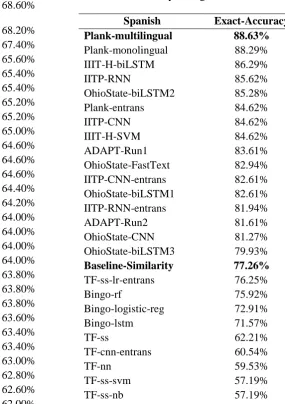
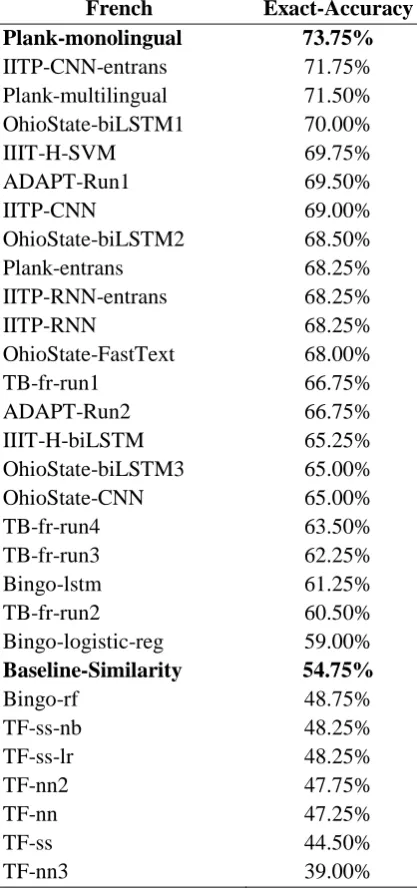
Tables 3-6 shows the results of each team-method in exact-match accuracy in English, Spanish, French and Japanese, respectively. The details of each method implemented by each team are described in their associated system description papers. The method denoted as “entrans” is the one that used machine translated sentences to do the prediction of meanings of customer feedback. For example, in the “Plank-entrans” system in Table 4, the sentences in Spanish test set are machine translated from Spanish to English using Google Translate, and then use Plank’s English based system to predict their tags.
Spanish which is the same phenomenon reported in (Liu et al., 2017). Second, performances in English, French and Japanese are also good and around the same level. Third, using machine translation the systems can achieve comparable results for Spanish and French, which are only 4 and 2 points behind native systems, respectively. For Japanese there is about 12 points behind the best native system.
English Exact-Accuracy YNU-HPCC-glove 71.00%
YNU-HPCC-EmbedCon-catNoWeight
71.00%
SentiNLP-bilstmcnn 70.80% SentiNLP-bilstm 70.40%
SentiNLP-bicnn 70.20%
IITP-CNN 70.00%
SentiNLP-cnnlstm 69.00% Plank-monolingual 68.80% Plank-multilingual 68.60%
YNU-HPCC-EmbedCon-catWeight
68.60%
SentiNLP-cnn 68.20%
TJ-single-cnn 67.40%
IIIT-H-SVM 65.60%
TJ-ensemble-sentiment 65.40%
ADAPT-Run3 65.40%
IIIT-H-biLSTM 65.20%
TJ-ensemble-2 65.20%
YNU-HPCC-hotelWeight 65.00% TJ-ensemble-epoch5 64.60%
TJ-ensemble-7 64.60%
TJ-ensemble-1 64.60%
TJ-ensemble-epoch10 64.40%
TJ-ensemble-5 64.20%
YNU-HPCC-hotel 64.00%
YNU-HPCC-gloveWeight 64.00% TJ-ensemble-epoch5n10 64.00%
ADAPT-Run2 64.00%
TJ-ensemble-8 63.80%
TJ-ensemble-6 63.80%
TJ-ensemble-3 63.80%
TJ-ensemble-4 63.60%
OhioState-FastText 63.40%
ADAPT-Run1 63.40%
YNU-HPCC-SVM 63.00%
OhioState-biLSTM3 62.80%
YNU-HPCC-bayes 62.60%
TJ-single-cbow 62.00%
OhioState-biLSTM2 61.60%
IITP-RNN 61.40%
YNU-HPCC-hotelNoATT 61.20% OhioState-biLSTM1 61.20% Bingo-logistic-reg 55.80%
Bingo-lstm 54.40%
OhioState-CNN 54.20%
TD-M1 52.20%
TF-nn 51.20%
Baseline-Similarity 48.80%
Bingo-rf 47.40%
TF-ss-svm 41.00%
TF-ss-lr 41.00%
TF-ss-nb 40.40%
TF-ss 40.40%
TB-en-run2 38.80%
TB-en-run1 37.40%
[image:3.595.226.512.356.761.2]TB-en-run3 37.00%
Table 3: Resulting scores of each team-method in exact-match accuracy in English.
Spanish Exact-Accuracy Plank-multilingual 88.63%
Plank-monolingual 88.29%
IIIT-H-biLSTM 86.29%
IITP-RNN 85.62%
OhioState-biLSTM2 85.28%
Plank-entrans 84.62%
IITP-CNN 84.62%
IIIT-H-SVM 84.62%
ADAPT-Run1 83.61%
OhioState-FastText 82.94% IITP-CNN-entrans 82.61% OhioState-biLSTM1 82.61% IITP-RNN-entrans 81.94%
ADAPT-Run2 81.61%
OhioState-CNN 81.27%
OhioState-biLSTM3 79.93%
Baseline-Similarity 77.26%
TF-ss-lr-entrans 76.25%
Bingo-rf 75.92%
Bingo-logistic-reg 72.91%
Bingo-lstm 71.57%
TF-ss 62.21%
TF-cnn-entrans 60.54%
TF-nn 59.53%
TF-ss-svm 57.19%
TF-ss-lr 57.19% Table 4: Resulting scores of each team-method in exact-match accuracy in Spanish.
French Exact-Accuracy Plank-monolingual 73.75%
IITP-CNN-entrans 71.75% Plank-multilingual 71.50% OhioState-biLSTM1 70.00%
IIIT-H-SVM 69.75%
ADAPT-Run1 69.50%
IITP-CNN 69.00%
OhioState-biLSTM2 68.50%
Plank-entrans 68.25%
IITP-RNN-entrans 68.25%
IITP-RNN 68.25%
OhioState-FastText 68.00%
TB-fr-run1 66.75%
ADAPT-Run2 66.75%
IIIT-H-biLSTM 65.25%
OhioState-biLSTM3 65.00%
OhioState-CNN 65.00%
TB-fr-run4 63.50%
TB-fr-run3 62.25%
Bingo-lstm 61.25%
TB-fr-run2 60.50%
Bingo-logistic-reg 59.00%
Baseline-Similarity 54.75%
Bingo-rf 48.75%
TF-ss-nb 48.25%
TF-ss-lr 48.25%
TF-nn2 47.75%
TF-nn 47.25%
TF-ss 44.50%
[image:4.595.73.292.610.756.2]TF-nn3 39.00%
Table 5: Resulting scores of each team-method in exact-match accuracy in French.
Japanese Exact-Accuracy Plank-multilingual 75.00%
Plank-monolingual 73.33%
ADAPT-Run1 67.67%
Plank-entrans 63.67%
IITP-CNN-entrans 63.00% Bingo-logistic-reg 60.67% IITP-RNN-entrans 58.67%
ADAPT-Run2 57.67%
Baseline-Similarity 56.67%
IIIT-H-biLSTM 56.67%
OhioState-CNN 56.67%
IIIT-H-SVM 56.33%
OhioState-biLSTM1 56.33% OhioState-biLSTM2 56.33%
IITP-RNN 56.00%
OhioState-biLSTM3 56.00% OhioState-FastText 56.00%
TF-nn 55.67%
TF-ss-svm 55.00%
TF-ss-nb 55.00%
TF-ss 55.00%
IITP-CNN 54.00%
TF-cnn-entrans 53.33%
TF-ss-lr-entrans 53.00%
Bingo-lstm 53.00%
Bingo-rf 45.00%
TF-ss-lr 28.67%
Table 6: Resulting scores of each team-method in exact-match accuracy in Japanese.
5
Results in Micro-Average Precision,
Recall and F1 measures
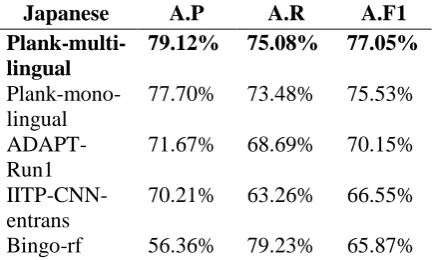
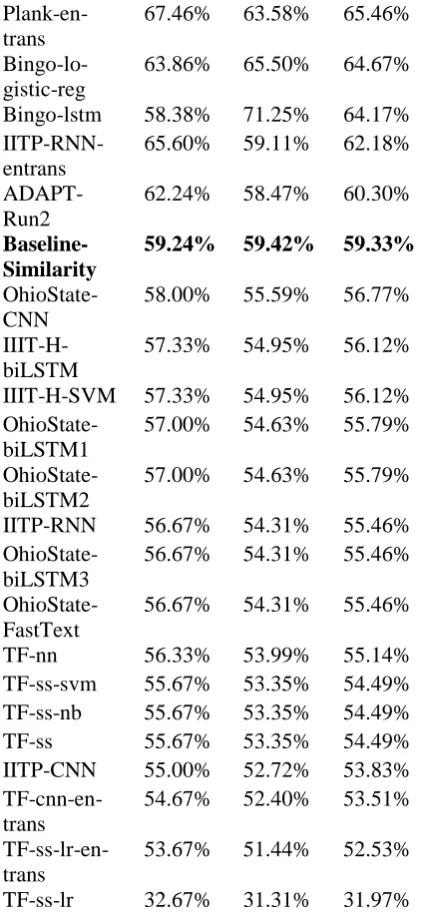
Likewise, Tables 7-10 show the results of each team-method in micro-average precision, recall and F1 measures in English, Spanish, French and Japanese, respectively.
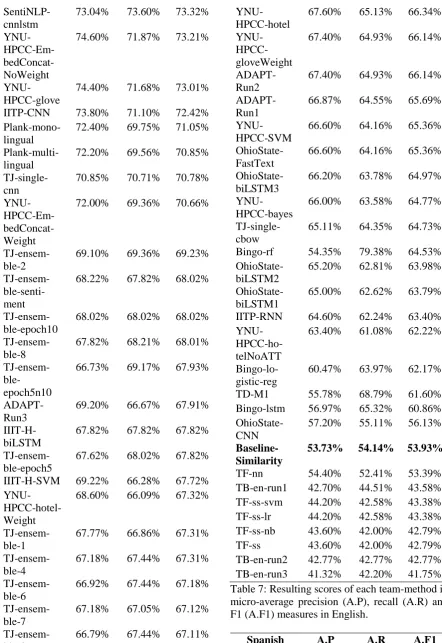
For micro-average F1, the best systems achieved 75.57%, 88.63%, 76.59% and 77.05% in English, Spanish, French and Japanese, respec-tively. The results in Spanish exhibit the same phenomenon as in exact-match accuracy results and in (Liu et al., 2017). The performances in English, French and Japanese are also good and around the same level. Using machine translation, the systems can also achieve comparable results in this measure for Spanish and French, which are 4 and 2 points behind native systems, respec-tively. There is 11 points behind in Japanese in this regard.
English A.P A.R A.F1
SentiNLP-bilstmcnn
74.86% 76.30% 75.57%
SentiNLP-bicnn
73.83% 76.11% 74.95%
SentiNLP-bilstm
73.77% 75.34% 74.55%
SentiNLP-cnn
[image:4.595.301.522.630.750.2]SentiNLP-cnnlstm
73.04% 73.60% 73.32%
YNU- HPCC-Em- bedConcat-NoWeight
74.60% 71.87% 73.21%
YNU-HPCC-glove
74.40% 71.68% 73.01%
IITP-CNN 73.80% 71.10% 72.42%
Plank-mono-lingual
72.40% 69.75% 71.05%
Plank-multi-lingual
72.20% 69.56% 70.85%
TJ-single-cnn
70.85% 70.71% 70.78%
YNU- HPCC-Em- bedConcat-Weight
72.00% 69.36% 70.66%
TJ-ensem-ble-2
69.10% 69.36% 69.23%
TJ-ensem- ble-senti-ment
68.22% 67.82% 68.02%
TJ-ensem-ble-epoch10
68.02% 68.02% 68.02%
TJ-ensem-ble-8
67.82% 68.21% 68.01%
TJ-ensem- ble-epoch5n10
66.73% 69.17% 67.93%
ADAPT-Run3
69.20% 66.67% 67.91%
IIIT-H-biLSTM
67.82% 67.82% 67.82%
TJ-ensem-ble-epoch5
67.62% 68.02% 67.82%
IIIT-H-SVM 69.22% 66.28% 67.72%
YNU- HPCC-hotel-Weight
68.60% 66.09% 67.32%
TJ-ensem-ble-1
67.77% 66.86% 67.31%
TJ-ensem-ble-4
67.18% 67.44% 67.31%
TJ-ensem-ble-6
66.92% 67.44% 67.18%
TJ-ensem-ble-7
67.18% 67.05% 67.12%
TJ-ensem-ble-3
66.79% 67.44% 67.11%
TJ-ensem-ble-5
66.99% 66.47% 66.73%
YNU-HPCC-hotel
67.60% 65.13% 66.34%
YNU- HPCC-gloveWeight
67.40% 64.93% 66.14%
ADAPT-Run2
67.40% 64.93% 66.14%
ADAPT-Run1
66.87% 64.55% 65.69%
YNU-HPCC-SVM
66.60% 64.16% 65.36%
OhioState-FastText
66.60% 64.16% 65.36%
OhioState-biLSTM3
66.20% 63.78% 64.97%
YNU-HPCC-bayes
66.00% 63.58% 64.77%
TJ-single-cbow
65.11% 64.35% 64.73%
Bingo-rf 54.35% 79.38% 64.53%
OhioState-biLSTM2
65.20% 62.81% 63.98%
OhioState-biLSTM1
65.00% 62.62% 63.79%
IITP-RNN 64.60% 62.24% 63.40%
YNU- HPCC-ho-telNoATT
63.40% 61.08% 62.22%
Bingo-lo-gistic-reg
60.47% 63.97% 62.17%
TD-M1 55.78% 68.79% 61.60% Bingo-lstm 56.97% 65.32% 60.86%
OhioState-CNN
57.20% 55.11% 56.13%
Baseline-Similarity
53.73% 54.14% 53.93%
[image:5.595.74.517.67.711.2]TF-nn 54.40% 52.41% 53.39% TB-en-run1 42.70% 44.51% 43.58% TF-ss-svm 44.20% 42.58% 43.38% TF-ss-lr 44.20% 42.58% 43.38% TF-ss-nb 43.60% 42.00% 42.79% TF-ss 43.60% 42.00% 42.79% TB-en-run2 42.77% 42.77% 42.77% TB-en-run3 41.32% 42.20% 41.75% Table 7: Resulting scores of each team-method in micro-average precision (A.P), recall (A.R) and F1 (A.F1) measures in English.
Spanish A.P A.R A.F1
Plank-mul-tilingual
88.63% 88.63% 88.63%
Plank-mono-lingual
IIIT-H-biLSTM
86.29% 86.29% 86.29%
IITP-RNN 85.62% 85.62% 85.62%
OhioState-biLSTM2
85.28% 85.28% 85.28%
Plank-en-trans
84.62% 84.62% 84.62%
IITP-CNN 84.62% 84.62% 84.62% IIIT-H-SVM 84.62% 84.62% 84.62%
ADAPT-Run1
83.61% 83.61% 83.61%
OhioState-FastText
82.94% 82.94% 82.94%
IITP-CNN-entrans
82.61% 82.61% 82.61%
OhioState-biLSTM1
82.61% 82.61% 82.61%
IITP-RNN-entrans
81.94% 81.94% 81.94%
ADAPT-Run2
81.61% 81.61% 81.61%
OhioState-CNN
81.27% 81.27% 81.27%
Bingo-lo-gistic-reg
82.29% 79.26% 80.75%
OhioState-biLSTM3
79.93% 79.93% 79.93%
Bingo-lstm 71.35% 86.62% 78.25% Bingo-rf 75.00% 81.27% 78.01%
Baseline-Similarity
77.26% 77.26% 77.26%
TF-ss-lr-en-trans
76.25% 76.25% 76.25%
TF-ss 62.21% 62.21% 62.21%
TF-cnn-en-trans
60.54% 60.54% 60.54%
[image:6.595.307.525.618.748.2]TF-nn 59.53% 59.53% 59.53% TF-ss-svm 57.19% 57.19% 57.19% TF-ss-nb 57.19% 57.19% 57.19% TF-ss-lr 57.19% 57.19% 57.19% Table 8: Resulting scores of each team-method in micro-average precision (A.P), recall (A.R) and F1 (A.F1) measures in Spanish.
French A.P A.R A.F1
Plank-mon-olingual
78.50% 74.76% 76.59%
IITP-CNN-entrans
76.50% 72.86% 74.63%
Plank-multi-lingual
76.25% 72.62% 74.39%
OhioState-biLSTM1
75.00% 71.43% 73.17%
ADAPT-Run1
74.50% 70.95% 72.68%
IIIT-H-SVM 74.68% 70.24% 72.39% IITP-CNN 73.50% 70.00% 71.71%
OhioState-biLSTM2
73.50% 70.00% 71.71%
Plank-en-trans
73.00% 69.52% 71.22%
IITP-RNN 72.75% 69.29% 70.98%
IITP-RNN-entrans
72.25% 68.81% 70.49%
OhioState-FastText
72.25% 68.81% 70.49%
TB-fr-run1 70.94% 69.76% 70.35% Bingo-lstm 62.04% 79.76% 69.79%
ADAPT-Run2
71.00% 67.62% 69.27%
IIIT-H-biLSTM
72.63% 65.71% 69.00%
TB-fr-run4 68.10% 68.10% 68.10%
OhioState-CNN
69.50% 66.19% 67.80%
OhioState-biLSTM3
69.25% 65.95% 67.56%
Bingo-rf 58.03% 80.00% 67.27% TB-fr-run3 66.75% 65.95% 66.35%
Bingo-lo-gistic-reg
64.84% 67.62% 66.20%
TB-fr-run2 65.02% 62.86% 63.92%
Baseline-Similarity
60.05% 60.48% 60.26%
TF-nn3 56.48% 53.80% 55.11% TF-ss-nb 52.25% 49.76% 50.98% TF-ss-lr 52.25% 49.76% 50.98% TF-nn2 51.75% 49.29% 50.49% TF-nn 51.50% 49.05% 50.24% TF-ss 48.75% 46.43% 47.56% Table 9: Resulting scores of each team-method in micro-average precision (A.P), recall (A.R) and F1 (A.F1) measures in French.
Japanese A.P A.R A.F1
Plank-multi-lingual
79.12% 75.08% 77.05%
Plank-mono-lingual
77.70% 73.48% 75.53%
ADAPT-Run1
71.67% 68.69% 70.15%
IITP-CNN-entrans
70.21% 63.26% 66.55%
[image:6.595.73.287.647.764.2]Plank-en-trans
67.46% 63.58% 65.46%
Bingo-lo-gistic-reg
63.86% 65.50% 64.67%
Bingo-lstm 58.38% 71.25% 64.17%
IITP-RNN-entrans
65.60% 59.11% 62.18%
ADAPT-Run2
62.24% 58.47% 60.30%
Baseline-Similarity
59.24% 59.42% 59.33%
OhioState-CNN
58.00% 55.59% 56.77%
IIIT-H-biLSTM
57.33% 54.95% 56.12%
IIIT-H-SVM 57.33% 54.95% 56.12%
OhioState-biLSTM1
57.00% 54.63% 55.79%
OhioState-biLSTM2
57.00% 54.63% 55.79%
IITP-RNN 56.67% 54.31% 55.46%
OhioState-biLSTM3
56.67% 54.31% 55.46%
OhioState-FastText
56.67% 54.31% 55.46%
TF-nn 56.33% 53.99% 55.14% TF-ss-svm 55.67% 53.35% 54.49% TF-ss-nb 55.67% 53.35% 54.49% TF-ss 55.67% 53.35% 54.49% IITP-CNN 55.00% 52.72% 53.83%
TF-cnn-en-trans
54.67% 52.40% 53.51%
TF-ss-lr-en-trans
53.67% 51.44% 52.53%
[image:7.595.76.287.72.530.2]TF-ss-lr 32.67% 31.31% 31.97% Table 10: Resulting scores of each team-method in micro-average precision (A.P), recall (A.R) and F1 (A.F1) measures in Japanese.
6
Conclusions
In this shared task, we address the problem if we should 1) train native systems for different lan-guages, or 2) use MT to translate customer feed-back into English and use English based systems to predict meanings of customer feedback. By ing the same categorization, we concluded that us-ing native systems, the performances in the four languages are all good. For Spanish and French, using MT can achieve comparable results as using native systems. Therefore, we would suggest im-proving English based systems and probably pre-paring the corpora in finer categorizations that would help us understand customer feedbacks.
However, for Japanese or other languages where MT still does not produce high quality transla-tions, preparing native corpora and building na-tive systems are still highly recommended.
Acknowledgements
This research is supported by the ADAPT Centre for Digital Content Technology, funded under the Science Foundation Ireland (SFI) Research Cen-tres Programme (Grant 13/RC/2106). We are grateful to ADAPT colleagues Anna Kostekidou, Julie Connelly, Clare Conran, among others, for their support to the project. We would like to thank Ms Sara Garvey and Ms Rachel Costello of Trinity College Dublin who prepared the English and French parts of corpora and helped improve the categorization. They also built an initial sys-tem using a nascent version of the corpora to help understand the performance that might be in both English and French. Special thanks to Dr Barbara Plank and Ms Shuying Lin for spotting the bug in the calculation of exact-match accuracy. Barbara also provided helpful comments on the use of these measures, among others, which are much appreciated. We are also grateful to Dr Heba Elfardy and her team from Amazon who identi-fied several issues of the corpora and helped im-prove the corpora for the shared task. Finally, all participants are much appreciated to take part of this shared task and together help us better under-stand the task questions.
References
Barbara Plank. All-In-1 at IJCNLP-2017 Task 4: Short Text Classification with One Model for All Lan-guages. In the Proceedings of IJCNLP, Shared
Tasks, pp. 143–148, 2017. AFNLP.
Bentley, Michael and Batra, Soumya. Giving Voice to Office Customers: Best Practices in How Office Handles Verbatim Text Feedback. In IEEE Interna-tional Conference on Big Data. pp. 3826–3832, 2016.
Burns, Michelle. (2016, February). Kampyle Intro-duces the NebulaCX Experience Optimizer. Re-trieved from http://www.kampyle.com/kampyle-in-troduces-the-nebulacx-experience-optimizer/
Chao-Hong Liu, Declan Groves, Akira Hayakawa, Al-berto Poncelas and Qun Liu. Understanding Mean-ings in Multilingual Customer Feedback. In the Pro-ceedings of First Workshop on Social Media and User Generated Content Machine Translation (So-cial MT 2017), Prague, Czech Republic.
Customer Feedback Analysis. In the Proceedings of
IJCNLP,Shared Tasks, pp. 170–173, 2017. AFNLP.
Equiniti. (2017, April). Complaints Management. Re-trieved from https://www.equiniticharter.com/ser-vices/complaints-management/#.WOH5X2_yt0w
Freshdesk Inc. (2017, February). Creating and sending the Satisfaction Survey. Retrieved from https://sup-
port.freshdesk.com/support/solutions/arti- cles/37886-creating-and-sending-the-satisfaction-survey
Heba Elfardy, Manisha Srivastava, Wei Xiao, Jared Kramer and Tarun Agarwal. Bingo at IJCNLP-2017 Task 4: Augmenting Data using Machine Transla-tion for Cross-linguistic Customer Feedback Classi-fication. In the Proceedings of IJCNLP, Shared
Tasks, pp. 59–66, 2017. AFNLP.
Inmoment. (2017, April). Software to Improve and Op-timize the Customer Experience. Retrieved from http://www.inmoment.com/products/
Keatext Inc. (2016, September). Text Analytics Made Easy. Retrieved from http://www.keatext.ai/
Nan Wang, Jin Wang and Xuejie Zhang. YNU-HPCC at IJCNLP-2017 Task 4: Attention-based Bi-direc-tional GRU Model for Customer Feedback Analysis Task of English. In the Proceedings of IJCNLP,
Shared Tasks, pp. 174–179, 2017. AFNLP.
Pintu Lohar, Koel Dutta Chowdhury, Haithem Afli, Mohammed Hasanuzzaman and Andy Way. ADAPT at IJCNLP-2017 Task 4: A Multinomial Naive Bayes Classification Approach for Customer Feedback Analysis task. In the Proceedings of
IJCNLP,Shared Tasks, pp. 161–169, 2017. AFNLP.
Potharaju, Rahul, Navendu Jain and Cristina Nita-Rotaru. Juggling the Jigsaw: Towards Automated Problem Inference from Network Trouble Tickets.
In 10th USENIX Symposium on Network Systems
De-sign and Implementation (NSDI 13). pp. 127–141, 2013.
Prathyusha Danda, Pruthwik Mishra, Silpa Kanneganti and Soujanya Lanka. IIIT-H at IJCNLP-2017 Task 4: Customer Feedback Analysis using Machine Learning and Neural Network Approaches. In the Proceedings of IJCNLP, Shared Tasks, pp. 155– 160, 2017. AFNLP.
Salameh, Mohammad, Saif M Mohammad, and Svet-lana Kiritchenko. Sentiment after translation: A case-study on Arabic social media posts. In Pro-ceedings of the 2015 Annual Conference of the
North American Chapter of the ACL, pp. 767–777,
2015.
Shuying Lin, Huosheng Xie, Liang-Chih Yu and K. Robert Lai. SentiNLP at IJCNLP-2017 Task 4: Cus-tomer Feedback Analysis Using a Bi-LSTM-CNN
Model. In the Proceedings of IJCNLP, Shared
Tasks, pp. 149–154, 2017. AFNLP.
SurveyMonkey Inc. (2017, April). Customer Service and Satisfaction Survey. Retrieved from https://www.surveymonkey.com/r/BHM_Survey
UseResponse. (2017, April). Customer Service & Cus-tomer Support are best when automated. Retrieved from https://www.useresponse.com/