Open Relation Extraction and Grounding
Dian Yu, Lifu Huang, Heng Ji
Computer Science Department Rensselaer Polytechnic Institute
{yud2, huangl7, jih}@rpi.edu
Abstract
Previous open Relation Extraction (open RE) approaches mainly rely on linguis-tic patterns and constraints to extract im-portant relational triples from large-scale corpora. However, they lack of abilities to cover diverse relation expressions or measure the relative importance of candi-date triples within a sentence. It is also challenging to name the relation type of a relational triple merely based on con-text words, which could limit the useful-ness of open RE in downstream applica-tions. We propose a novel importance-based open RE approach by exploiting the global structure of a dependency tree to extract salient triples. We design an unsu-pervised method to name relation types by grounding relational triples to a large-scale Knowledge Base (KB) schema, leverag-ing KB triples and weighted context words associated with relational triples. Exper-iments on the English Slot Filling 2013 dataset demonstrate that our approach achieves8.1% higher F-score over state-of-the-art open RE methods.
1 Introduction
Open Relation Extraction (open RE) (Banko and Etzioni,2008) aims at extracting relational triples from an open-domain corpus. Each triple contains two arguments and a phrase which denotes the re-lation between them. In this paper, we focus on discovering relations betweenentities.
Most successful open RE approaches (Fader et al., 2011; Xu et al., 2013; Bovi et al., 2015;
Bhutani et al., 2016) extract salient relational triples based on lexical or syntactic patterns. How-ever, such handcrafted or automatically learned
patterns are incapable of covering diverse rela-tion expressions (Soderland et al., 2013). Sub-sequently, the shortest path between arguments derived from a dependency tree has been widely applied to generate patterns to capture long-distance and complex relations. However, addi-tional heuristic rules are usually needed to filter out the resulting large number of meaningless pat-terns (Wu and Weld,2010;Mausam et al.,2012;
Bovi et al., 2015). Besides, such flat syntactic structures lack the ability to measure the relative importance of candidate triples in a sentence. For example, the sentence inE1places particular em-phasis on the relation between “Lucille Clifton” and“1936”which therefore should be retained.
E1 “Lucille Clifton, whom he married in 1958, was born in 1936.”
We notice that a candidate relational triple is likely to be salient if its two arguments are strongly connected in a dependency tree. Instead of re-lying on patterns to capture important triples, we use an importance-based strategy by exploring the entire dependency tree structure to automatically measure the connection strength of candidate ar-gument pairs. Specifically, we assume that a re-lational triple is important if there is a relatively short random walk-based distance between two relatively important arguments, measured against the entire dependency tree of a given sentence. For each argument pair, we apply an effective random-walk based method to assign weights to context words in the sentence (Section2).
How to assign a meaningful relation type name to a relational triple is also a primary challenge for open RE. Previous methods use relevant con-text words in the associated sentence as relation phrases (type names) (Del Corro and Gemulla,
2013;Bhutani et al.,2016). However, there is still no generally accepted guideline for relation phrase extraction. Multiple relation phrases can
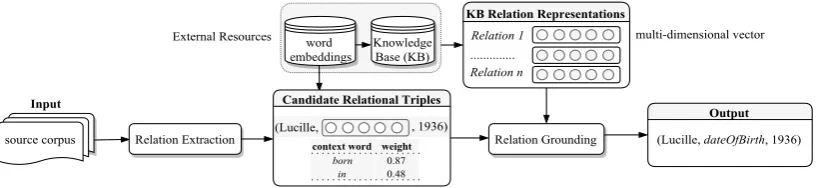
Figure 1: Framework overview.
spond to the same relation type. Besides, overly-specific or implicit relation phrases are incapable of providing adequate information for downstream applications. For example, the relation between “Patricia”and“Gary Cooper”cannot be clearly expressed by a set of words in the following sentence E2. Therefore, previous studies heav-ily rely on resources such as patterns (Soderland et al.,2013), training data (Weston et al.,2013), or distantly-labeled corpora (Angeli et al.,2015b) to map open RE triples to a known relation schema.
E2 “Patricia later described her relation with Gary Cooper as one of the most beautiful things that ever happed to her in her life.”
Compared with a small number of predefined relation types such as those defined in Automatic Content Extraction (ACE) 1, the relation schema in a large-scale Knowledge Base (KB) such as DBpedia (Auer et al.,2007) covers a much wider range of informative relations along with their type signatures. Considering the open-domain na-ture shared by open RE and a large-scale KB, we propose an unsupervised grounding method to name the relation type between two arguments as either a KB relation or NONE, by leveraging KB triples and weighted context information associ-ated with each argument pair based on pre-trained word embeddings (Section 3). Compared with previous methods (e.g., (Riedel et al., 2013; We-ston et al., 2013)), we regard intra-sentence con-text words as intermediate results for the subse-quent grounding process, and we do not require any aligned training corpora or relation phrases for KB triples. The proposed framework is illustrated in Figure1.
To the best of our knowledge, this is the first open RE method which exploits the global struc-ture of a dependency tree to extract salient re-lational triples. This is also the first unsuper-vised relation grounding method to name relation
1www.ldc.upenn.edu/collaborations/past-projects/ace.
types for open RE based on KB triples and intra-sentence context information. Experiments on the English Slot Filling (SF) (Ji et al., 2010, 2011) 2013 dataset demonstrate that our approach out-performs state-of-the-art open RE approaches. 2 Relation Extraction
In this section, we introduce a graph-based method to extract argument pairs of salient relational triples. We first present the extended dependency tree construction for each sentence (Section2.1). Then we show the computation of the relation strength between two arguments (Section 2.4) considering both their random-walk based dis-tance (Section2.2) and the relative importance of each argument in the tree (Section2.3).
2.1 Extended Dependency Tree Construction
Given a sentence containing N words, we con-struct a weighted directed graph G = (V,E), where V = {v1, . . . , vN} represents words, and
E is a directed edge set, associated with each di-rected edge vi → vj representing a dependency
relation originating from vi to vj. We assign a
weightwij = 1 tovi → vj and add its reverse
edgevj → vi withwji = 0.5. By adding
lower-weighted reverse edges, we can analyze the rela-tion between two nodes which are not connected by directed dependency links while maintaining our preferences toward the original directions.
We first apply a dependency parser to generate basic uncollapsed dependencies.2 We annotate an entity or time mention node with its type. For ex-ample in E1, “Lucille Clifton” is annotated as a person, and “1936” is annotated as a date. Finally we perform coreference resolution which intro-duces coreference links between nodes that refer to the same entity within a document. We replace any nominal or pronominal entity mention with its coreferential name mention. For example, “he” is
replaced by “Fred James Clifton”. Formally, an extended dependency tree is an annotated tree of entity mentions and their links. By adding the re-verse edges, we generate the final extended depen-dency tree in Figure2. We regard any two entities as a candidate argument pair. E1contains4 enti-ties and therefore we can extract 42= 6argument pairs (e.g., (“Lucille Clifton”,“1936”)).
E1: Lucille Clifton, whom he married in 1958, was born in 1936.
Lucille Clifton
whom
in
he 1958
Fred James Clifton in 1936
nsubjpass nmod
dobj nsubj nmod
coreference case
Person Year
Year
born
married
was
auxpass
case
Person
Figure 2: Extended dependency tree of E1.
2.2 Distance Computation
As mentioned previously, a shorter distance be-tween two strongly connected nodes is more likely to indicate the existence of an important rela-tion. We compute the distance between two nodes based on a Markov-chain model of random walk. We define a random walk through G by assign-ing a transition probability to each directed edge. Thus, a random walker can jump from nodevi to vjand represent a state of the Markov chain. For a
nodevi, we denoteN(i)as the set of its neighbors.
The probability of transitioning from node vj to
nodevi is defined aspji=wji/Pk∈N(j)wjk for
nodesvithat have an edge fromvjtovi, and0
oth-erwise. We define the transition probability matrix of the Markov chain associated with random walks onGasP.
The mean first-passage time mji (Aldous and Fill,2002) is the average number of steps needed by a random walker for reaching stateifor the first time, when starting from state j. We call cij = mij +mjias theaverage commute time(Lov´asz, 1993). The fact thatcij can be regarded as a
dis-tance in G between nodes vi and vj is proven
by Klein and Randi´c(1993). Compared with the shortest path between vi andvj, the value of cij
will decrease when the number of paths connect-ingviandvjincreases and when the length of any
path decreases (Fouss et al.,2007).
The fundamental matrix Z plays an essential role in computing various quantities related to
ran-dom walks. For a weighted and directed graph,Li and Zhang(2010) demonstrate thatZcan be com-puted directly using the following equation:
Z= (I−P +ED)−1−ED (1)
whereI is the identity matrix,E is a matrix con-taining all1s, andD is the diagonal matrix with elementsdkk=π(k)whereπ(k)is the stationary
distribution of nodevkin the Markov chain.
We can directly compute a mean first-passage
|V| × |V|matrix and a symmetric average com-mute time matrixCbased onZas follows:
mij = zjjπ−zij
j (2)
cij = zjjπ−zij
j +
zii−zji
πi (3)
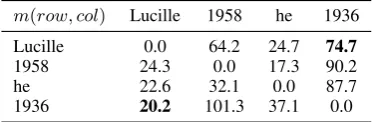
Using the example in Figure2, we can obtain a 10×10 matrixM based on the above steps (10 nodes in total). We list the result involving only entity nodes in Table1.
m(row, col) Lucille 1958 he 1936
Lucille 0.0 64.2 24.7 74.7
1958 24.3 0.0 17.3 90.2
he 22.6 32.1 0.0 87.7
1936 20.2 101.3 37.1 0.0
Table 1: Mean first-passage time matrixM for E1.
Argument Role Identification: We notice that
argument roles can be identified based on the mean first-passage time. In a weighted directed graph, mij and mji are not necessarily similar.
Actu-ally in many cases nodes that lie on the boundaries have shorter mean first-passage time to the cen-tral nodes in the graph while there exists longer mean first-passage time from a central node to a node close to the boundary. A central node is more likely to be the central argument. We define the first argument as the more important argument. Therefore, we can regardvias the first argument of
the argument pair(vi, vj)ifmij is larger thanmji.
Ifmij andmji are equal, vi andvj have similar
2.3 Node Importance Computation
As we mentioned earlier, a candidate relational triple is more likely to be salient if it involves im-portant entities of the sentence. In this section, we illustrate the node importance computation based on the extended dependency tree of a sentence.
TextRank (Mihalcea and Tarau, 2004) can be used to compute the importance of each node within G. Similarly, suppose a random walker keeps visiting adjacent nodes inGat random. The expected percentage of walkers visiting each node converges to the TextRank score.
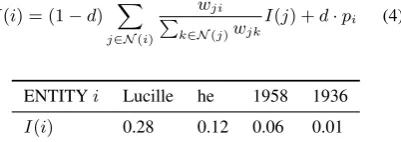
We define a set of preferred nodesRwhich cor-respond to entities in a sentence. We assign higher preferences toward these nodes when computing the importance scores since entities are more in-formative for relation extraction (Bj¨orkelund and Farkas, 2012). We extend TextRank by intro-ducing a new measure called “back probability” d ∈ [0,1] to determine how often walkers jump back to the nodes inRso that the converged score can be used to estimate the relative probability of visiting these preferred nodes. We define a pref-erence vector pR = {p1, ..., p|V|} such that the
probabilities sum to 1, andpkdenotes the relative
importance attached to vk. pk is set to 1/|R|for vk ∈ R, otherwise 0. Let I be the 1× |V|
im-portance vector to be computed over all nodes as follows.
I(i) = (1−d) X
j∈N(i)
wji
P
k∈N(j)wjk
I(j) +d·pi (4)
ENTITYi Lucille he 1958 1936
I(i) 0.28 0.12 0.06 0.01
Table 2: Importance score of each entity inE1.
2.4 Combination and Filtering
Given the average commute time cij between
nodesviandvj(Section2.2) and their relative
im-portance scoresI(i)andI(j)inG(Section2.3), we will discuss how to combine them and gen-erate the final score which can be used to mea-sure the relation strength between two nodes. In-tuitively, there exists a strong relation when there is a shorter distance between two relatively impor-tant nodes.
Previous approaches (Spagnola and Lagoze,
2011;Guo et al.,2011) consider the distance be-tween two nodes and the influence of each node
modeled by its weighted frequency to measure the strength of links in networks. Similarly, in our setting we can regardcij as the distance between vi andvj and use the relative importance score to
measure the influence of each node in G. There-fore, we obtain Equation 5 to compute the rela-tion strengthF(i, j)between nodesviandvj. We
are more confident in predicting the existence of a salient relation with stronger relation strength.
F(i, j) =I(i)c×2I(j)
ij (5)
Relation Filtering: We get a complete entity
graph since we analyze the connection between any two entities in a sentence. In this work, we fo-cus on identifying the most significant structures among entities based on the connection strength we have obtained. Since the entity graph is undi-rected, we can simply apply the maximum span-ning tree algorithm to keep those relatively im-portant pairs. ForE1, we obtain three argument pairs resulting after filtering: (“Lucille”,“1936”), (“Fred”, “1958”), and (“Lucille”, “Fred”). In comparison, the relations between argument pairs such as (“1958”,“1936”) and (“he”,“1936”) are less important.
3 Relation Grounding
We have presented how to extract candidate argu-ment pairs in Section2. In this section, we first introduce how to rank the context words given a pair of arguments (Section 3.1). Then we de-scribe methods of learning KB relation representa-tions from existing KB triples based on pretrained word embeddings. Finally we ground each rela-tional triple to a KB relation or assign NONE (Sec-tion3.2).
3.1 Context Word Selection and Weighting
In this section, we introduce how to extract infor-mative context words and their associated weights given an argument pair(vi, vj)in a sentence based
We only keep nouns, verbs, adjectives, preposi-tions, and particles as indicative context wordsX. We assume that a context wordvk ∈ X is more
important relative to(vi, vj)ifcik+ckj is close to cij. Actually if the relation betweenviandvjdoes
not rely on any indicative words,cij will be much
smaller thancik+ckj considering other nodes in
the same sentence. We denoteΛas the weight set for all the context words of a given argument pair (vi, vj)as follows. The higherλkis, the more
im-portant the context wordvkis relative to(vi, vj).
λk= c cij
ik+ckj (6)
InE1, given the argument pair (Lucille Clifton, Fred James Clifton), we generate the following weighted context words: {married : 0.60, in1 : 0.36,born:0.29,in2:0.24}.
3.2 Grounding
The associated weighted context words of each candidate argument pair are not sufficiently infor-mative and flexible to clearly express the relation between two arguments. Thus, we aim to name the relation between a pair of arguments as one of the KB relations or NONE by comparing the semantic representations of context words and KB relations based on word embeddings. We also learn argu-ment type signatures from KB triples.
For each word we obtain its pretrained word embeddinge ∈ Rkwherekis the embedding
di-mensionality. For a phrase which contains multi-ple words, we simply average the vectors of all the single words in the phrase as its embedding.
Given a KB triple(h, l, t)composed of two en-titiesh, tand a KB relationl ∈ L (the set of KB relations), we leverage a large-scale KB to learn the representation for each KB relation motivated by the basic idea behind previous studies (Bordes et al.,2013;Mikolov et al.,2013) that relation pat-terns can be represented as linear translations. We useSl ={(hi, l, ti), i= 1, . . . ,|Sl|}to represent
all the KB triples with the KB relationl.
KB relation type names can also provide impor-tant semantic information for relation representa-tion and disambiguarepresenta-tion especially when multiple relations co-occur in the same sentence, such as family relations (e.g., spouse, parents, and other family). We segment a compound name of a KB relation type into a set of words. For example, we
separate a DBpedia relation type name political-Groupsinto{political,groups}. Similarly, we av-erage the vectors of all the words in a relation type name as its embedding eel ∈ Rk. Incorporating
both implicit semantics from KB tuples and ex-plicit semantics from KB relation names, we rep-resent the relation embedding of each KB relation las follows.
el = |S1 l|
|Sl|
X
i=1
(ehi−eti+eel) (7)
Both of the involved embeddings are obtained from the linear combination of pretrained word embeddings, which guarantees that they are in the same space.
Given a single KB relation typel, an argument pair (vi, vj)and a single context wordx, we can
compute the cosine similarity between any can-didate open RE triple and any KB relation. We calculate the absolute value since we have already captured the direction of arguments in Section2.2. Therefore, we can regard similarity scores−1and 1equally and0as the lowest score.
S(l,(i, j, x)) = |ex·el|
kexkkelk (8)
When there are multiple context wordsx ∈ X, we can compute the weighted cosine similarity between them as follows based on the squared weights of context words described in Section3.1.
S(l,(i, j,X)) = max
x∈X S(l,(i, j, x))×λ
2
x (9)
Since we have multiple KB relationsl∈ L, we can ground a candidate relational triple (i, j,X) and obtain its relation bli,j,X considering all the
possible relations. The predicted relation can ei-ther be assigned a valid KB relation or NONE. We use a marker to denote the relation betweenviand vj which cannot be grounded to any KB relation.
b
li,j,X = arg maxl∈LS(l,(i, j,X)) (10)
Relation Argument Type Constraints
Given all the KB triples, we can estimate the probability of one of the arguments belonging to a certain entity type z ∈ Z, whereZ represents the set of all the KB concept types. For a given KB relation l, we define c(k ; z|l) to be the number of times thekth argument is seen paired
with the entity typezwherek∈ {1,2}since there are two arguments. Given the above definitions, the maximum likelihood estimate is as follows.
p(k, z|l) = P c(k;z|l)
z∈Zc(k;z|l) (11)
Therefore, given a candidate argument pair (vi, vj) and their entity types zi and zj, we can
compute the probability of its being labeled as the relation l by considering both p(1, zi|l) and p(2, zj|l). We setS(l,(i, j,X))to 0 if the
har-monic mean ofp(1, zi|l)andp(2, zj|l)is smaller
than a given threshold which will be introduced later in Section4.4. We will not consider a can-didate KB relation for comparison if the argument type ofiorjfails to satisfy its type constraints. In this way, we can filter out some candidate triples and reduce the number of similarity computations. For example, given a KB relation placeOfBurial, the concept type Species is less likely to be the correct second argument type compared with other entity types such as City andLocation. Remind that the order of arguments in the candidate triple has been introduced in Section2.2.
4 Experiments
4.1 Knowledge Base and Word Embeddings
We use the April 2016 dump of DBpedia as our KB which contains 2,060 relation types and 30,024,093 relation triples in total. We use the 300-dimensional GloVe vectors (Pennington et al., 2014) pretrained on 6 billion tokens from the English Gigaword Fifth Edition and a 2014 Wikipedia dump.
4.2 Evaluation based on Slot Filling
There are several benchmarks developed for open RE (e.g., (Fader et al., 2011;Stanovsky and Da-gan, 2016)). However, we mainly focus on re-lations between entities and therefore we cannot directly compare with state-of-the-art open RE methods on those datasets. To evaluate the ef-fectiveness of our approach, we choose the TAC-KBP SF (McNamee and Dang, 2009; Ji et al.,
2010, 2011; Surdeanu and Ji, 2014) task as our evaluation platform which has been widely used by open RE methods (Soderland et al.,2013; An-geli et al., 2015b) since 2009. The goal of SF is to extract the values (slot fillers) of specific at-tributes (slot types) for a given entity (query) from a large-scale corpus which includes news docu-ments, web blogs, and discussion forum posts. Justification sentences should be provided to sup-port slot fillers. SF defines25slot types for person queries and16slots for organization queries.
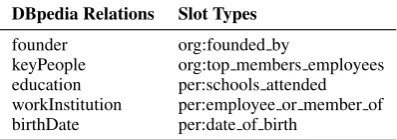
We use the SF 2013 dataset for which we can compare with the ground truth and state-of-the-art open RE results reported in SF. We obtain 1,701 relevant documents from the offi-cial evaluation assessment for 50 person queries and 50 organization queries. We manually map KB relations to slot types based on TAC-KBP slot descriptions.3 Note that a single KB relation can be mapped to multiple slot types. For example, birthPlace can be mapped to per:city of birth, per:stateofprovince of birth, and per:country of birth. We assign a subtype (e.g., country, province, or city) to a location entity based on gazetteer matching.
DBpedia Relations Slot Types founder org:founded by
keyPeople org:top members employees education per:schools attended workInstitution per:employee or member of birthDate per:date of birth
Table 3: Example Mappings from DBpedia rela-tions to slot types.
We ignore all the slot types which require nomi-nal phrases as fillers (e.g.,per:cause of death) and slot types per/org:alternate nameswhich depend on cross-document coreference resolution. We apply Stanford CoreNLP (Manning et al., 2014) for English part-of-speech tagging, name tagging, time expression extraction, dependency parsing, and coreference resolution. We use the official Slot Filling evaluation scoring metrics: Precision (P), Recall (R), and F-measure (F1).
As shown in Table4, our method outperforms the KBP2013 SF submission from the Univer-sity of Washington (Soderland et al.,2013) which applies Open IE V4.0, which is an extension of SRL-based IE (Christensen et al.,2011) and noun
3The resource is publicly available for research purposes
Method P R F1
UW Official (Soderland et al.,2013) 69.9 12.2 20.8 UMass Official (Singh et al.,2013) 10.6 19.5 13.7
Our Approach[1] KB Tuples[2] Relation Names 17.3 21.1 19.024.3 30.9 27.2 [1]+[2] Joint 26.2 32.4 28.9
Table 4: Performance (%) on KBP2013 English SF based on different relation representations.
phrase processing (Pal and Mausam, 2016), to generate relation triples. This is their latest pub-lished approach which uses Open IE for Regular Slot Filling. Their approach achieves very high precision but comparatively low recall (12.2%). In our experiments, we keep all the candidate triples which could be mapped to a slot type without tuning thresholds. On the same dataset, we also compare with an approach (Singh et al., 2013) which extracts relations with matrix factorization anduniversal schemas (Riedel et al., 2013) con-sisted of textual patterns and all the slot types. We do not directly compare with the work of Angeli et al.(2015b) because of the lack of access to their SF output.4
The importance-based strategy is effective at extracting more salient information. For example, previous methods only extract one argument pair (“the top Egyptian cleric”, “Wednesday”) from the sentence “Sheikh Tantawi, the topEgyptian cleric who died onWednesday on a visit to. . .” while omitting the person name. Our method ex-tracts both (“Sheikh Tantawi”, “Egyptian”) and (“Sheikh Tantawi”, “Wednesday”) with their as-sociated top-weighted context words“cleric”and “died”respectively, since the connection between “Egyptian”and“Wednesday”is much weaker.
Compared with relation phrases, the word em-beddings of weighted context words are more flexible for comparison when we map relational triples to a known schema. For example, it is impossible for previous methods (e.g., ( Soder-land et al., 2013)) to summarize all the related mentions (e.g., “appointed” and “CEO”) and manually map them to the relation employment. Therefore previous approaches missed the slot filler “Al-Azhar University” of the query “Mo-hammed Sayed Tantawi”from the following sen-tence “Tayeb, the president of Al-Azhar Uni-versity since 2003, succeeds Mohammed Sayed
4The highest recall they achieve is around13%on all the
slot types including nominal relations on the same dataset.
Tantawi”as“succeeds”was not included into the related terms. Our approach extracts it based on their semantic representations.
In addition, we obtain more generalized rela-tion type names based from the KB schema. For example, we ground the relation in E2 between “Patricia” and “Gary” to influencedBy. Simi-larly, in the sentence“Ginzburgshared the Nobel Physics Prize with US physicistsAlexei Abrikosov and Anthony Leggett for their contributions to the theory of superconductors ...”, the relation phrase “shared the Nobel Physics Prize with” between “Ginzburg”and“Alexei”is too specific compared with the grounded KB relation alongsideby our approach for subsequent applications.
4.3 Impact of Relation Representations
In Section 3.2, we use KB tuples and their rela-tion type names to learn KB relarela-tion representa-tions. As shown in Table4, our approach can al-ready achieve promising performance based on the relation representations learned from KB relation names. However, sometimes relations are implic-itly expressed. It is likely that the context words of a relation triple and its corresponding KB relation name are not semantically similar. In this case, we need more general relation representations with the help of millions of KB tuples. For example, we can ground the relationschool between “Mc-Gregor” and “Colorado State University” suc-cessfully by comparing the representation of con-text words“tight”and“end”with the joint rela-tion representarela-tions from the following sentence: “McGregorwas a two-time All-America tight end atColorado State University”even though this re-lation is not explicitly described.
4.4 Impact of Argument Type Constraints
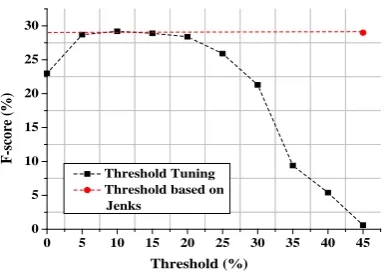
As mentioned in Section3.2, we aim to filter out some candidate relation triples if the entity types of the arguments are not popular for a given KB relation. By tuning thresholds, there are no signif-icant differences in performance when the thresh-old falls in the range 0.05–0.2. On the other hand, if the threshold is set too high (e.g., greater than 0.35%), we will mistakenly discard correct candi-dates which satisfy type constraints.
We implement Jenks optimization (Wikipedia,
the tier mean, while maximizing each tier’s devi-ation from the means of other groups (McMaster and McMaster,2002). We set the threshold auto-matically using the obtained natural breaks for two arguments respectively to compute the harmonic mean of them. This approach achieves28.9%F1 which is comparable to the highest F1(29.2%) ob-tained by threshold tuning.
1
0 5 10 15 20 25 30 35 40 45 0
5 10 15 20 25 30
Threshold Tuning Threshold based on Jenks
F
-s
co
re
(%
)
Threshold (%)
Figure 3: Performance (%) based on different thresholds for argument type constraints.
5 Related Work
5.1 Open Information Extraction
Lexical or syntactic features and patterns have been widely used to extract relational triples (Suchanek et al., 2009; Poon and Domin-gos,2009;Wu and Weld,2010;Nakashole et al.,
2011;Fader et al., 2011;Nakashole et al., 2012;
Mausam et al., 2012; Bovi et al., 2015; Angeli et al., 2015b;Grycner and Weikum, 2016). Our work explores the global structure of a depen-dency tree to identify salient triples within a sentence. Some open IE approaches have the capability to extract relations between concepts or phrases (Kok and Domingos,2008;Min et al.,
2012;Del Corro and Gemulla, 2013). Currently we focus on relations between two entities.
Given the SF schema, Soderland et al. (2013) manually design rules to map relational triples to slot types within hours. Researchers also use dis-tantly labeled corpora to compute the PMI2value between open IE and SF relation pairs (Angeli et al.,2015b). Instead, we propose a novel ground-ing approach which facilitates buildground-ing a mappground-ing table between KB relations and slot types. We do not compare with RE methods specifically de-signed for SF (Sun et al., 2011; Li et al., 2012;
Angeli et al.,2015a) since these methods actively search for candidate fillers of the given queries
based on slot-specific training resources while ig-noring the salient relations which are irrelevant to the queries or the predefined slot types.
5.2 Relation Grounding
Besides textual features, large-scale knowledge bases are widely used for distant supervised rela-tion extracrela-tion (Mintz et al., 2009; Riedel et al.,
2010) to deal with the challenges caused by in-sufficient training data.Weston et al.(2013) com-bine two relation representations trained from KB triples and context words independently for rela-tion extracrela-tion. Recent studies such as (Toutanova et al., 2015) train relation representations of KB and textual relations jointly. Another kind of representations combining matrix factoriza-tion (Riedel et al.,2013) with first-order logic in-formation is learned byRockt¨aschel et al.(2015). Compared with these previous efforts, our un-supervised grounding method does not need the aligned training corpus or relation mentions for KB tuples.Wijaya and Mitchell(2016) introduce an approach to map words to KB relations based on web text, but they only focus on verb phrases.
5.3 Node Importance Computation
Graph-based algorithms such as PageRank (Page et al., 1999) and TextRank (Mihalcea and Tarau,
2004) are useful in keyword extraction. The way we rank nodes is most similar to the work ofWhite and Smyth(2003) andYu and Ji(2016) which gen-erate the relative importance score of each node to-ward a set of preferred nodes. However, they only deal with unweighted undirected graphs.
6 Conclusions and Future Work
Acknowledgments
This work was supported by the DARPA DEFT No. FA8750-13-2-0041, U.S. ARL NS-CTA No. W911NF-09-2-0053, and NSF IIS 1523198. The views and conclusions contained in this document are those of the authors and should not be inter-preted as representing the official policies, either expressed or implied, of the U.S. Government. The U.S. Government is authorized to reproduce and distribute reprints for Government purposes notwithstanding any copyright notation here on.
References
David Aldous and Jim Fill. 2002. Reversible markov chains and random walks on graphs.
Gabor Angeli, Sonal Gupta, Melvin Johnson Premku-mar, Christopher D Manning, Christopher R´e, Julie Tibshirani, Jean Y Wu, Sen Wu, and Ce Zhang. 2015a. Stanford’s distantly supervised slot filling systems for kbp 2014. In Proceedings of the TAC, Gaithersburg, MD.
Gabor Angeli, Melvin Johnson Premkumar, and Christopher D Manning. 2015b. Leveraging linguis-tic structure for open domain information extraction. InProceedings of the ACL, pages 344–354, Beijing, China.
S¨oren Auer, Christian Bizer, Georgi Kobilarov, Jens Lehmann, Richard Cyganiak, and Zachary Ives. 2007. Dbpedia: A nucleus for a web of open data. InThe semantic web, pages 722–735, Busan, Korea.
Michele Banko and Oren Etzioni. 2008. The tradeoffs between open and traditional relation extraction. In
Proceedings of the ACL, pages 28–36, Columbus, OH.
Nikita Bhutani, HV Jagadish, and Dragomir R Radev. 2016. Nested propositions in open information ex-traction. InProceedings of the EMNLP, pages 55– 64, Austin, TA.
Anders Bj¨orkelund and Rich´ard Farkas. 2012. Data-driven multilingual coreference resolution using re-solver stacking. In Proceedings of the EMNLP-CoNLL, pages 49–55, Jeju, South Korea.
Antoine Bordes, Nicolas Usunier, Alberto Garcia-Duran, Jason Weston, and Oksana Yakhnenko. 2013. Translating embeddings for modeling multi-relational data. In Proceedings of the NIPS, pages 2787–2795, Lake Tahoe, NV.
Claudio Delli Bovi, Luca Telesca, and Roberto Navigli. 2015. Large-scale information extraction from tex-tual definitions through deep syntactic and semantic analysis. TACL, 3:529–543.
Janara Christensen, Mausam, Stephen Soderland, and Oren Etzioni. 2011. An analysis of open informa-tion extracinforma-tion based on semantic role labeling. In
Proceedings of the 6th International Conference on Knowledge Capture, pages 113–120, Banff, Canada. Luciano Del Corro and Rainer Gemulla. 2013. Clausie: clause-based open information extraction. In Pro-ceedings of the WWW, pages 355–365, Rio de Janeiro, Brazil.
Anthony Fader, Stephen Soderland, and Oren Etzioni. 2011. Identifying relations for open information extraction. In Proceedings of the EMNLP, pages 1535–1545, Edinburgh, UK.
Francois Fouss, Alain Pirotte, Jean-Michel Renders, and Marco Saerens. 2007. Random-walk compu-tation of similarities between nodes of a graph with application to collaborative recommendation. IEEE TKDE, 19:355–369.
Adam Grycner and Gerhard Weikum. 2016. Poly: Mining relational paraphrases from multilingual sentences. In Proceedings of the EMNLP, pages 2183–2192, Austin, TX.
Jun Guo, Hanliang Guo, and Zhanyi Wang. 2011. An activation force-based affinity measure for analyzing complex networks. Scientific reports, 1:113–122. Heng Ji, Ralph Grishman, and Hoa T. Dang. 2011.
An overview of the tac2011 knowledge base popula-tion track. InProceedings of the TAC, Gaithersburg, MD.
Heng Ji, Ralph Grishman, Hoa T. Dang, Kira Griffitt, and Joe Ellis. 2010. An overview of the tac2010 knowledge base population track. InProceedings of the TAC, Gaithersburg, MD.
Douglas J Klein and Milan Randi´c. 1993. Resistance distance.J. Math. Chemistry, 12:81–95.
Stanley Kok and Pedro Domingos. 2008. Extract-ing semantic networks from text via relational clus-tering. In Proceeding of the Joint Conference on Machine Learning and Knowledge Discovery in Databases, pages 624–639, Antwerp, Belgium. Yan Li, Sijia Chen, Zhihua Zhou, Jie Yin, Hao Luo,
Liyin Hong, Weiran Xu, Guang Chen, and Jun Guo. 2012. Pris at tac2012 kbp track. InProceedings of the TAC, Gaithersburg, MD.
Yanhua Li and Zhi-Li Zhang. 2010. Random walks on digraphs, the generalized digraph laplacian and the degree of asymmetry. InProceedings of the WAW, pages 74–85, Stanford, CA.
L´aszl´o Lov´asz. 1993. Random walks on graphs. Com-binatorics, Paul erdos is eighty, 2:1–46.
ACL: System Demonstrations, pages 55–60, Balti-more, MD.
Mausam, Michael Schmitz, Stephen Soderland, Robert Bart, and Oren Etzioni. 2012. Open language learn-ing for information extraction. InProceedings of the Joint Conference on EMNLP and CONLLL, pages 523–534, Jeju, South Korea.
Robert McMaster and Susanna McMaster. 2002. A his-tory of twentieth-century american academic cartog-raphy. Cartography and Geographic Inform. Sci., 29:305–321.
Paul McNamee and Hoa Trang Dang. 2009. Overview of the tac 2009 knowledge base population track. In
Proceeding of the TAC, Gaithersburg, MD.
Rada Mihalcea and Paul Tarau. 2004. Textrank: Bring-ing order into texts. InProceedings of the EMNLP, pages 404–411, Barcelona, Spain.
Tomas Mikolov, Ilya Sutskever, Kai Chen, Greg S Cor-rado, and Jeff Dean. 2013. Distributed representa-tions of words and phrases and their compositional-ity. InAdvances in neural information processing systems, pages 3111–3119, Lake Tahoe, NV.
Bonan Min, Shuming Shi, Ralph Grishman, and Chin-Yew Lin. 2012. Ensemble semantics for large-scale unsupervised relation extraction. InProceedings of the 2012 Joint Conference on EMNLP and CONLL, pages 1027–1037, Jeju, South Korea.
Mike Mintz, Steven Bills, Rion Snow, and Dan Juraf-sky. 2009. Distant supervision for relation extrac-tion without labeled data. In Proceedings of the ACL-IJCNLP, pages 1003–1011, Suntec, Singapore.
Ndapandula Nakashole, Martin Theobald, and Gerhard Weikum. 2011. Scalable knowledge harvesting with high precision and high recall. InProceedings of the WSDM, pages 227–236, Hong Kong, China.
Ndapandula Nakashole, Gerhard Weikum, and Fabian Suchanek. 2012. Patty: a taxonomy of relational patterns with semantic types. In Proceedings of the Joint Conference on EMNLP and CoNLL, pages 1135–1145, Jeju, South Korea.
Lawrence Page, Sergey Brin, Rajeev Motwani, and Terry Winograd. 1999. The pagerank citation rank-ing: Bringing order to the web. Technical Report 1999-66, Stanford InfoLab, Stanford, CA.
Harinder Pal and Mausam. 2016. Demonyms and com-pound relational nouns in nominal open IE. In Pro-ceedings of the 5th Workshop on AKBC, pages 35– 39, San Diego, CA.
Jeffrey Pennington, Richard Socher, and Christopher Manning. 2014. Glove: Global vectors for word representation. In Proceedings of the EMNLP, pages 1532–1543, Doha, Qatar.
Hoifung Poon and Pedro Domingos. 2009. Unsu-pervised semantic parsing. In Proceedings of the EMNLP, pages 1–10, Suntec, Singapore.
Sebastian Riedel, Limin Yao, and Andrew McCallum. 2010. Modeling relations and their mentions with-out labeled text. InProceedings of the Joint ECML and PAKDD, pages 148–163, Barcelona, Spain. Sebastian Riedel, Limin Yao, Andrew McCallum, and
Benjamin M Marlin. 2013. Relation extraction with matrix factorization and universal schemas. In Pro-ceedings of the NAACL-HLT, pages 74–84, Atlanta, GA.
Tim Rockt¨aschel, Sameer Singh, and Sebastian Riedel. 2015. Injecting logical background knowledge into embeddings for relation extraction. In Proceeding of the NAACL-HLT, pages 1119–1129, Denver, CO. Sameer Singh, Limin Yao, David Belanger, Ari Ko-bren, Sam Anzaroot, Mike Wick, Alexandre Passos, Harshal Pandya, Jinho D Choi, Brian Martin, et al. 2013. Universal schema for slot filling and cold start: Umass iesl at tackbp 2013. In Proceedings of the TAC, Gaithersburg, MD.
Stephen Soderland, John Gilmer, Robert Bart, Oren Et-zioni, and Daniel S Weld. 2013. Open information extraction to kbp relations in 3 hours. In Proceed-ings of the TAC, Gaithersburg, MD.
Steve Spagnola and Carl Lagoze. 2011. Edge depen-dent pathway scoring for calculating semantic simi-larity in conceptnet. InProceedings of IWCS, pages 385–389, Oxford, UK.
Gabriel Stanovsky and Ido Dagan. 2016. Creating a large benchmark for open information extraction. In Proceedings of the EMNLP, pages 2300–2305, Austin, TX.
Fabian M Suchanek, Mauro Sozio, and Gerhard Weikum. 2009. Sofie: a self-organizing framework for information extraction. In Proceedings of the International Conference on WWW, pages 631–640, Madrid, Spain.
Ang Sun, Ralph Grishman, Wei Xu, and Bonan Min. 2011. Nyu 2011 system for kbp slot filling. In Pro-ceedings of the TAC, Gaithersburg, MD.
Mihai Surdeanu and Heng Ji. 2014. Overview of the english slot filling track at the tac2014 knowledge base population evaluation. In Proceedings of the TAC, Gaithersburg, MD.
Kristina Toutanova, Danqi Chen, Patrick Pantel, Hoi-fung Poon, Pallavi Choudhury, and Michael Ga-mon. 2015. Representing text for joint embedding of text and knowledge bases. InProceedings of the EMNLP, pages 1499–1509, Lisbon, Portugal. Jason Weston, Antoine Bordes, Oksana Yakhnenko,
relation extraction. InProceedings of the EMNLP, pages 1366–1371, Seattle, WA.
Scott White and Padhraic Smyth. 2003. Algorithms for estimating relative importance in networks. In
Proceedings of the 9th ACM SIGKDD international conference on Knowledge discovery and data min-ing, pages 266–275, Washington, D.C.
Derry Tanti Wijaya and Tom M Mitchell. 2016. Map-ping verbs in different languages to knowledge base relations using web text as interlingua. In Proceed-ings of the NAACL-HLT, pages 818–827, San Diego, CA.
Wikipedia. 2017.Jenks natural breaks optimization — wikipedia, the free encyclopedia.
Fei Wu and Daniel S Weld. 2010. Open information extraction using wikipedia. In Proceedings of the ACL, pages 118–127, Uppsala, Sweden.
Ying Xu, Mi-Young Kim, Kevin Quinn, Randy Goebel, and Denilson Barbosa. 2013. Open information ex-traction with tree kernels. In Proceedings of the NAACL-HLT, pages 868–877, Atlanta, GA.