Annotation-Based Multimedia Summarization and Translation
Katashi Nagao
Dept. of Information Engineering Nagoya University
and CREST, JST Furo-cho, Chikusa-ku, Nagoya 464-8603, Japan [email protected]
Shigeki Ohira School of Science and
Engineering Waseda University 3-4-1 Okubo, Shinjuku-ku,
Tokyo 169-8555, Japan [email protected]
Mitsuhiro Yoneoka Dept. of Computer Science Tokyo Institute of Technology 2-12-1 O-okayama, Meguro-ku,
Tokyo 152-8552, Japan [email protected]
Abstract
This paper presents techniques for multimedia annotation and their application to video sum-marization and translation. Our tool for anno-tation allows users to easily create annoanno-tation including voice transcripts, video scene descrip-tions, and visual/auditory object descriptions. The module for voice transcription is capable of multilingual spoken language identification and recognition. A video scene description con-sists of semi-automatically detected keyframes of each scene in a video clip and time codes of scenes. A visual object description is created by tracking and interactive naming of people and objects in video scenes. The text data in the multimedia annotation are syntactically and semantically structured using linguistic annota-tion. The proposed multimedia summarization works upon a multimodal document that con-sists of a video, keyframes of scenes, and tran-scripts of the scenes. The multimedia transla-tion automatically generates several versions of multimedia content in different languages.
1 Introduction
Multimedia content such as digital video is be-coming a prevalent information source. Since the volume of such content is growing to huge numbers of hours, summarization is required to effectively browse video segments in a short time without missing significant content. Annotating multimedia content with semantic information such as scene/segment structures and metadata about visual/auditory objects is necessary for
advanced multimedia content services. Since
natural language text such as a voice transcript is highly manageable, speech and natural lan-guage processing techniques have an essential role in our multimedia annotation.
We have developed techniques for
semi-automatic video annotation integrating a
mul-tilingual voice transcription method, some
video analysis methods, and an interactive
visual/auditory annotation method. The
video analysis methods include automatic color change detection, characterization of frames, and scene recognition using similarity between frame attributes.
There are related approaches to video annota-tion. For example, MPEG-7 is an effort within the Moving Picture Experts Group (MPEG) of ISO/IEC that is dealing with multimedia con-tent description (MPEG, 2002). MPEG-7 can describe indeces, notes, and so on, to retrieve necessary parts of content speedily. However, it takes a high cost to add these descriptions by hands. The method of extracting them auto-matically through the video/audio analysis is
vitally important. Our method can be
inte-grated into tools for authoring MPEG-7 data. The linguistic description scheme, which will be a part of the amendment to MPEG-7, should play a major role in this integration.
Using such annotation data, we have also de-veloped a system for advanced multimedia pro-cessing such as video summarization and trans-lation. Our video summary is not just a shorter version of the original video clip, but an in-teractive multimedia presentation that shows keyframes of important scenes and their tran-scripts in Web pages and allow users to interac-tively modify summary. The video summariza-tion is customizable according to users’ favorite size and keywords. When a user’s client device is not capable of video playing, our system tran-forms video to a document that is the same as a Web document in HTML format.
The multimedia annotation can make deliv-ery of multimedia content to different devices
content will be facilitated by annotation on the usage of the content in different purposes, client devices, and so forth. Also, it provides object-level description of multimedia content which allows a higher granularity of retrieval and pre-sentation in which individual regions, segments, objects and events in image, audio and video data can be differentially accessed depending on publisher and user preferences, network band-width and client capabilities.
2 Multimedia Annotation
Multimedia annotation is an extension of doc-ument annotation such as GDA (Global Docu-ment Annotation) (Hasida, 2002). Since natu-ral language text is more tractable and mean-ingful than binary data of visual (image and moving picture) and auditory (sound and voice) content, we associate text with multimedia
con-tent in several ways. Since most video clips
contain spoken narrations, our system converts them into text and integrates them into video annotation data. The text in the multimedia annotation is linguistically annotated based on GDA.
[image:2.595.77.293.497.656.2]2.1 Multimedia Annotation Editor We developed an authoring tool called multi-media annotation editor capable of video scene change detection, multilingual voice transcrip-tion, syntactic and semantic analysis of tran-scripts, and correlation of visual/auditory seg-ments and text.
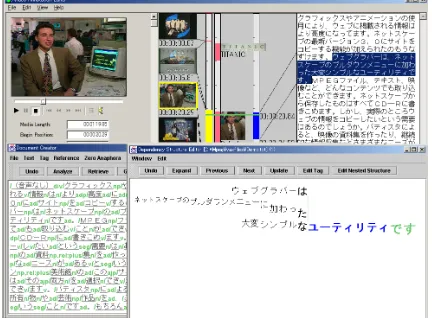
Figure 1: Multimedia Annotation Editor
An example screen of the editor is shown in Figure 1. The editor screen consists of three
windows. One window (top) shows a video con-tent, automatically detected keyframes in the video, and an automatically generated voice transcript. The second window (left bottom) enables the user to edit the transcript and mod-ify an automatically analyzed linguistic markup
structure. The third window (right bottom)
shows graphically a linguistic structure of the selected sentence in the second window.
The editor is capable of basic natural lan-guage processing and interactive disambigua-tion. The user can modify the results of the automatically analyzed multimedia and linguis-tic (syntaclinguis-tic and semanlinguis-tic) structures.
2.2 Linguistic Annotation
Linguistic annotation has been used to make digital documents machine-understandable, and to develop content-based presentation, retrieval, question-answering, summarization, and trans-lation systems with much higher quality than is currently available. We have employed the GDA tagset as a basic framework to describe linguistic and semantic features of documents. The GDA tagset is based on XML (Extensible Markup Language) (W3C, 2002), and designed to be as compatible as possible with TEI (TEI, 2002), CES (CES, 2002), and EAGLES (EA-GLES, 2002).
An example of a GDA-tagged sentence fol-lows:
<su><np opr="agt" sem="time0">Time</np> <v sem="fly1">flies</v>
<adp opr="eg"><ad sem="like0">like</ad> <np>an <n sem="arrow0">arrow</n></np> </adp>.</su>
The <su> element is a sentential unit. The other tags above, <n>, <np>, <v>, <ad> and <adp> mean noun, noun phrase, verb, adnoun or adverb (including preposition and postposi-tion), and adnominal or adverbial phrase, re-spectively.
The opr attribute encodes a relationship
in which the current element stands with respect to the element that it semantically
depends on. Its value denotes a binary
relation, which may be a thematic role
such as agent, patient, recipient, etc., or a rhetorical relation such as cause, concession,
<np opr="agt" sem="time0">Time</np>
depends on the second element
<v sem="fly1">flies</v>. opr="agt"
means that Time has the agent role with
respect to the event denoted by flies. The sem
attribute encodes a word sense.
Linguistic annotation is generated by auto-matic morphological analysis, interactive sen-tence parsing, and word sense disambiguation by selecting the most appropriate item in the domain ontology. Some research issues on lin-guistic annotation are related to how the anno-tation cost can be reduced within some feasible levels. We have been developing some machine-guided annotation interfaces to simplify the an-notation work. Machine learning mechanisms also contribute to reducing the cost because they can gradually increase the accuracy of au-tomatic annotation.
In principle, the tag set does not depend on language, but as a first step we implemented a semi-automatic tagging system for English and Japanese.
2.3 Video Annotation
The linguistic annotation technique has an
im-portant role in multimedia annotation. Our
video annotation consists of creation of text data related to video content, linguistic anno-tation of the text data, automatic segmenanno-tation of video, semi-automatic linking of video seg-ments with corresponding text data, and inter-active naming of people and objects in video scenes.
To be more precise, video annotation is per-formed through the following three steps.
First, for each video clip, the annotation sys-tem creates the text corresponding to its con-tent. We developed a method for creation of voice transcripts using speech recognition en-gines. It is called multilingual voice transcrip-tion and described later.
Second, some video analysis techniques are applied to characterization of visual segments (i.e., scenes) and individual video frames. For example, by detecting significant changes in the color histogram of successive frames, frame se-quences can be separated into scenes.
Also, by matching prepared templates to in-dividual regions in the frame, the annotation system identifies objects. The user can specify significant objects in some scene in order to
re-duce the time to identify target objects and to obtain a higher recognition accuracy. The user can name objects in a frame simply by selecting words in the corresponding text.
Third, the user relates video segments to text segments such as paragraphs, sentences, and phrases, based on scene structures and object-name correspondences. The system helps the user select appropriate segments by prioritiz-ing them based on the number of the detected objects, camera motion, and the representative frames.
2.4 Multilingual Voice Transcription
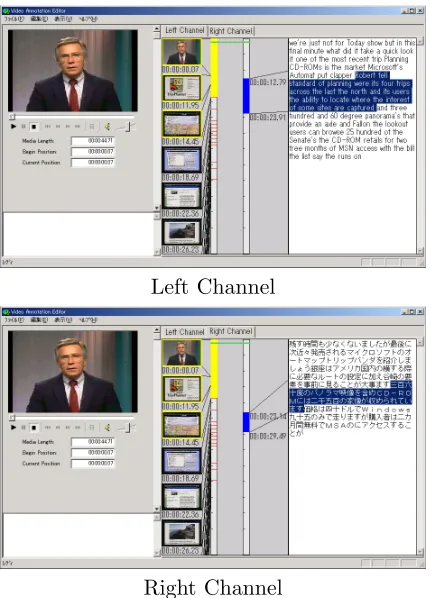
The multimedia annotation editor first extracts the audio data from a target video clip. Then, the extracted audio data is divided into left and right channels. If the average for the difference of the audio signals of the two channels exceeds a certain threshold, they are considerd different and transfered to the multilingual speech identi-fication and recognition module. The output of the module is a structured transcript contain-ing time codes, word sequences, and language information. It is described in XML format as shown in Figure 2.
<transcript lang="en" channel="l">
<w in="20.264000" out="20.663000">Web grabber </w> <w in="20.663000" out="21.072000">is a </w> <w in="21.072000" out="21.611000">very simple </w> <w in="21.611000" out="22.180000">utility </w> <w in="22.180000" out="22.778000">that is </w> <w in="22.778000" out="23.856000">attached to </w> <w in="23.856000" out="24.215000">Netscape </w>
<w in="24.215000" out="24.934000">as a pull down menu </w> <w in="24.934000" out="25.153000">and </w>
<w in="25.153000" out="25.462000">allows you </w> <w in="25.462000" out="25.802000">take </w>
<w in="25.802000" out="26.191000">your Web content </w> <w in="26.191000" out="27.039000">whether it’s a </w> <w in="27.039000" out="27.538000">MPEG file </w> ...
</transcript>
Figure 2: Transcript Data
Left Channel
[image:4.595.78.293.69.368.2]Right Channel
Figure 3: Multilingual Voice Transcriptor
2.4.1 Multilingual Speech Identification and Recognition
The progress of speech recognition technol-ogy makes it comparatively easy to transform speech into text, but spoken language identi-fication is needed for processing multilingual speech, because speech recognition technology assumes that the language used is known. While researchers have been working on the multilingual speech identification, few applica-tions based on this technology has been actually used except a telephony speech translation sys-tem. In the case of the telephone translation system, the information of the language used is self-evident; at least, the speaker knows; so there are little needs and advantages of develop-ing a multildevelop-ingual speech identification system. On the other hand, speech data in video do not always have the information about the lan-guage used. Due to the recent progress of digital broadcasting and the signal compression tech-nology, the information about the language is expected to accompany the content in the fu-ture. But most of the data available now do
not have it, so a large amount of labor is needed to identify the language. Therefore, the multi-lingual speech identification has a large part to play with unknown-language speech input.
A process of multilingual speech identification is shown in Figure 4. Our method determines the language of input speech using a simple dis-criminant function based on relative scores ob-tained from multiple speech recognizers working in parallel (Ohira et al., 2001).
Figure 4: Configuration of Spoken Language Identification Unit
Multiple speech recognition engines work
si-multaneously on the input speech. It is
as-sumed that each speech recognition engine has the speaker independent model, and each recog-nition output word has a score within a constant range dependent on each engine.
When a speech comes, each recognition en-gine outputs a word sequence with scores. The discriminant unit calculates a value of a dis-criminant function using the scores for every language. The engine with the highest average discriminant value is selected and the language is determined by the engine, whose recognition result is accepted as the transcript. If there is no distinct difference between discriminant val-ues, that is not higher than a certain threshold, a judgment is entrusted to the user.
Our technique is simple, it uses the exist-ing speech recognition engines tuned in each language without a special model for language identification and acoustic features.
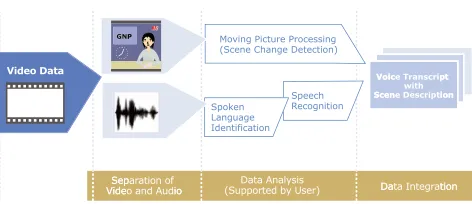
[image:4.595.319.556.205.373.2]semi-automatically. The entire process is as shown in Figure 5.
Figure 5: Multilingual Video Data Analysis
Our system drastically reduces the overhead on the user who analyzes and manages a large
collection of video content. Furthermore, it
makes conventional natural language processing techniques applicable to multimedia processing.
2.5 Scene Detection and Visual Object Tracking
As mentioned earlier, visual scene changes are detected by searching for significant changes in the color histogram of successive frames. Then, frame sequences can be divided into scenes. The scene description consists of time codes of the start and end frames, a keyframe (image data in JPEG format) filename, a scene title, and
some text representing topics. Additionally,
when the user specifies a particular object in a frame by mouse-dragging a rectangular region, an automatic object tracking is executed and time codes and motion trails in the frame (series of coordinates for interpolation of object move-ment) are checked out. The user can name the detected visual objects interactively. The visual object description includes the object name, the related URL, time codes and motion trails in the frame.
Our multimedia annotation also contains de-scriptions on auditory objects in video. The au-ditory objects can be detected by acoustic anal-ysis on the user specified sound sequence visual-ized in waveform. An example scene description in XML format is shown in Figure 6, and an ex-ample object description in Figure 7.
3 Multimedia Summarization and
Translation
Based on multimedia annotation, we have de-veloped a system for multimedia (especially,
<scene>
<seg in="0.066733" out="11.945279" keyframe="0.187643"/>
<seg in="11.945279" out="14.447781" keyframe="12.004385"/>
<seg in="14.447781" out="18.685352" keyframe="14.447781"/>
[image:5.595.74.310.109.211.2]... </scene>
Figure 6: Scene Description
<object>
<vobj begin="1.668335" end="4.671338" name="David" description="anchor" img="o0000.jpg"
link="http://...">
<area time="1.668335" top="82" left="34" width="156" height="145"/>
<area ... /> </vobj> ... </object>
Figure 7: Object Description
video) summarization and translation. One of the main functions of the system is to gener-ate an interactive HTML (HyperText Markup Language) document from multimedia content with annotation data for interactive multime-dia presentation, which consists of an embedded video player, hyperlinked keyframe images, and linguistically-annotated transcripts. Our sum-marization and translation techniques are ap-plied to the generated document called a multi-modal document.
different applications such as automatic editing and information extraction.
3.1 Multimodal Document
Video transformation is an initial process of multimedia summarization and translation. The transformation module retrieves the anno-tation data accumulated in an annoanno-tation repos-itory (XML database) and extracts necessary information to generate a multimodal docu-ment. The multimodal document consists of an embedded video window, keyframes of scenes, and transcipts aligned with the scenes as shown
in Figure 8. The resulting document can be
[image:6.595.321.534.243.409.2]summarized and translated by the modules ex-plained later.
Figure 8: Multimodal Document
This operation is also beneficial for people with devices without video playing capabil-ity. In this case, the system creates a simpli-fied version of multimodal document containing only keyframe images of important scenes and summarized transcripts related to the selected scenes.
3.2 Video Summarization
The proposed video summarization is per-formed as a by-product of text
summariza-tion. The text summarization is an
appli-cation of linguistic annotation. The method
is cohesion-based and employs spreading acti-vation to calculate the importance values of words and phrases in the document (Nagao and Hasida, 1998).
Thus, the video summarization works in terms of summarization of a transcript from
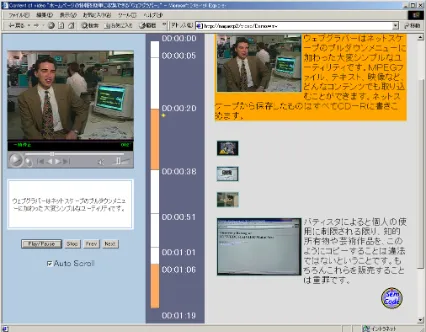
multimedia annotation data and extraction of the video scene related to the summary. Since a summarized transcript contains important words and phrases, corresponding video se-quences will produce a collection of significant scenes in the video. The summarization results in a revised version of multimodal documemt that contains keyframe images and summa-rized transcripts of selected important scenes. Keyframes of less important scenes are shown in a smaller size. An example screen of a sum-marized multimodal document is shown in Fig-ure 9.
Figure 9: Summarized Multimodal Document
The vertical time bar in the middle of the screen of multimodal document represents scene segments whose color indicates if the segment
is included in the summary or not. The
keyframe images are linked with their corre-sponding scenes so that the user can see the scene by just clicking its related image. The user can also access information about objects such as people in the keyframe by dragging a rectangular region enclosing them. The infor-mation appears in external windows. In the case of auditory objects, the user can select them by clicking any point in the time bar.
3.3 Video Translation
[image:6.595.80.293.282.447.2]translation mechanism. Text translation is also greatly improved by using linguistic annotation (Watanabe et al., 2002).
The other type of translation is performed in terms of synchronization of video playing and speech synthesis of the translation results. This translation makes another-language version of the original video clip. If comments, notes, or keywords are included in the annotation data on visual/auditory objects, then they are also translated and shown on a popup window.
In the case of bilingual broadcasting, since our annotation system generates transcripts in every audio channel, multimodal documents can be coming from both channels. The user can easily select a favorite multimodal document created from one of the channels. We have also developed a mechanism to change the language to play depending on the user profile that de-scribes the user’s native language.
4 Concluding Remarks
We have developed a tool to create multime-dia annotation data and a mechanism to ap-ply such data to multimedia summarization and translation. The main component of the anno-tation tool is a multilingual voice transcriptor to generate transcripts from multilingual speech in video clips. The tool also extracts scene and ob-ject information semi-automatically, describes the data in XML format, and associates the data with content.
We also presented some advanced applica-tions on multimedia content based on annota-tion. We have implemented video-to-document transformation that generates interactive multi-modal documents, video summarization using a text summarization technique, and video trans-lation.
Linguistic processing is an essential task in those applications so that natural language technologies are still very important in process-ing multimedia content.
Our future work includes a more efficient and flexible retrieval of multimedia content for re-quests in spoken and written natural language. The retrieval of spoken documents has also been evaluated in a subtask “SDR (Spoken Docu-ment Retrieval) track” at TREC (Text
RE-trieval Conference) (TREC, 2002). Johnson
(Johnson, 2001) suggested from his group’s
ex-perience on TREC-9 that new challenges such as use of non-lexical information derived di-rectly from the audio and integration with video data are significant works for the improvement
of retrieval performance and usefulness. We,
therefore, believe that our research has signifi-cant impacts and potetials on the content tech-nology.
References
A. Amir, S. Srinivasan, D. Ponceleon, and D. Petkovic. 1999. CueVideo: Automated index-ing of video for searchindex-ing and browsindex-ing. In Pro-ceedings of SIGIR’99.
CES. 2002. Corpus Encoding Standard. http://www.cs.vassar.edu/CES/.
EAGLES. 2002. EAGLES online. http://www.ilc.pi.cnr.it/EAGLES/home.html. Koiti Hasida. 2002. Global Document Annotation.
http://i-content.org/GDA/.
S. E. Johnson. 2001. Spoken document retrieval for TREC-9 at Cambridge University. InProceedings of Text REtrieval Conference (TREC-9).
MPEG. 2002. MPEG-7 context and objectives. http://drogo.cselt.stet.it/mpeg/standards/mpeg-7/mpeg-7.htm.
Katashi Nagao and Kˆoiti Hasida. 1998. Automatic text summarization based on the Global Doc-ument Annotation. In Proceedings of the Sev-enteenth International Conference on Computa-tional Linguistics (COLING-98), pages 917–921. Shigeki Ohira, Mitsuhiro Yoneoka, and Katashi
Na-gao. 2001. A multilingual video transcriptor and annotation-based video transcoding. In Proceed-ings of the Second International Workshop on Content-Based Multimedia Indexing (CBMI-01). Michael A. Smith and Takeo Kanade. 1995. Video
skimming for quick browsing based on audio and image characterization. Technical Report CMU-CS-95-186, School of Computer Science, Carnegie Mellon University.
TEI. 2002. Text Encoding Initiative. http://www.uic.edu/orgs/tei/.
TREC. 2002. Text REtrieval Conference home page. http://trec.nist.gov/.
W3C. 2002. Extensible Markup Language (XML). http://www.w3.org/XML/.