Annotating If Authors of Tweets are Located in
the Locations They Tweet About
Vivek Doudagiri, Alakananda Vempala
and
Eduardo Blanco
Human Intelligence and Language Technologies Lab University of North Texas
[email protected],[email protected],[email protected] Abstract
The locations in a tweet do not always indicate spatial information involving the author of the tweet. In this paper, we investigate whether authors are located or not located in the locations they tweet about, and temporally anchor this spatial information in the tweet timestamp. Specifically, we work with temporal tags centered around the tweet timestamp: longer than 24 hours before or after tweeting, within 24 hours before or after tweeting, and at the time of tweeting. We introduce a corpus of 1,200 location mentions from 1,062 tweets, discuss several annotation samples, and analyze annotator disagreements.
Keywords:Spatial knowledge, Social Networks, Twitter
1. Introduction
Twitter has quickly become one of the most popular so-cial media sites. It has 313 million monthly active users, and 500 million tweets are published daily. People tweet about their current locations (e.g.,I’m at Walgreens in Ana-heim, California), as well as past (e.g.,I miss living in Ker-man) and (probable) future locations (e.g.,Can’t wait to visit Italy!). Tweets often contain hints regarding how long the author is in a particular location, either implicitly (e.g., people usually stay at pharmacies such as Walgreens for a few minutes to an hour, not days) or explicitly (e.g.,My 2 day vacation to San Diego beach starts tomorrow). In this work, we present a corpus annotating whether the author of a tweet is located in the locations mentioned in his tweets. Going beyond named entity recognition, we an-notate whether the author is located ornotlocated in the lo-cation he tweets about with respect to the time he tweeted (before, during and after). To the best of our knowledge, this problem has not been explored before. We found that no spatial relationship can be inferred between authors of tweets and the locations they tweet about in 21% of in-stances. In other words, 1 out of 5 locations in a tweet do not indicate any spatial information about the author. The major contributions of this paper are:
1. We create a corpus of 1,062 tweets containing 1,200 location named entities, and annotate whether the au-thors are located ornotlocated in those locations with respect to the time they tweeted (when the author tweeted, within 24 hours before and after he tweeted, and longer than 24 hours before and after he tweeted).1
2. We provide several annotation examples and the label distributions per temporal tag.
3. We present detailed inter-annotator agreement calcu-lations, including Cohen’sand confusion matrices per temporal tag.
1Available at https://alakanandav.bitbucket.
io/
2. Previous Work
The work presented here is inspired by Li and Sun (2014), who work with points of interest in tweets using the Foursquare API (their points of interest are similar to our locations). Li and Sun determine if the author of a tweet is present at a point of interest in the past, present or fu-ture with respect to the tweet timestamp (three binary deci-sions). In their corpus, 47.3% of points of interest are an-notated invalid, meaning that their methodology to extract points of interest using Foursquare is not very effective. In contrast to their work, we (a) present a corpus with few invalid locations (⇡6%), and (b) work with finer-grained
temporal information (when somebody tweets, within 24 hours before and after he tweeted, and longer than 24 hours before and after he tweeted).
Tweet Location Before Before During After After
>24 <24 <24 >24
1 I’m at Walgreens in Anaheim, Calif Calif PY CY CY CY PY 2 Just got home from Vegas and I’m cooking omg Vegas CY PY CN PN UNK 3 First time in Squaw Valley and it could not have
been more perfect! #squawvalley Squaw Valley CN CY CY CY UNK 4 I adopted a child while in Mexico Mexico CY PN CN PN UNK 5 Found some really cute couches in Oakland and
did not have a car big enough to carry them back RIP
Oakland PY CY CN PN UNK
6 Tomorrow we are driving to Yosemite Valley Yosemite Valley UNK PN CN PY PY 7 I can’t wait to be in Hawaii permanently. Hawaii UNK UNK UNK UNK UNK 8 Bruh im bouta fall asleep on Keyasia Keyasia INV INV INV INV INV
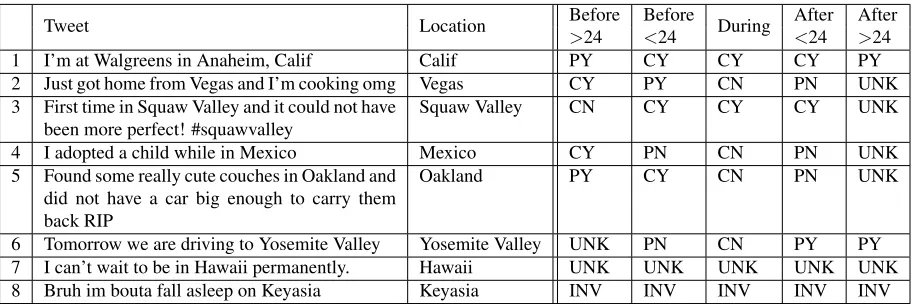
Table 1: Annotation examples. We show the original tweet, the location being annotated (we only detail one location per tweet), and the labels for the five temporal tags.
3. Corpus Creation
In this section, we detail the creation of the corpus. First, we present the steps to gather tweets and select locations to be annotated. Second, we describe the annotation process and the kind of spatial information annotators were asked about. Finally, we present annotation examples.
3.1. Selecting Tweets and Locations
We collected tweets containing at least one location named entity following 4 steps:
1. We downloaded over one million tweets published from California along with their metadata using the Twitter API.2Then, we discarded tweets (a)
consist-ing of less than 3 tokens, or (b) not containconsist-ing at least one pronoun.3
2. We extracted named entities using spaCy4and
Stan-ford CoreNLP (Manning et al., 2014) after remov-ing emoticons, URLs and newline characters from the original tweets. The corpus contains both the original tweet and the preprocessed version.
3. We identified locations in tweets if both Spacy and Stanford CoreNLP recognized a LOC or GPE named entity (location and geopolitical named entities re-spectively) spanning exactly the same tokens. 4. Finally, we randomly selected 1,200 locations from
1,062 tweets for annotation. 3.2. Annotation process
For each location in the selected tweets, we asked anno-tators the following question: “Is the author of the tweet present in the location . . . ”:
1. at any point of time earlier than 24 hours before tweet-ing (Before>24)?
2https://developer.twitter.com/en/docs
3Full list of pronouns:I,we,you,he,she,it,they,him,herand
them. Tweets containing these pronouns are more likely to be au-thored by an individual (as opposed to companies or institutions).
4https://spacy.io/
2. at any point of time within 24 hours before tweeting (Before<24)?
3. at the time he tweeted (During)?
4. at any point of time within 24 hours after tweeting (Af-ter<24)?
5. at any point of time later than 24 hours after tweeting (After>24)?
We decided to work with these temporal tags because peo-ple usually tweet about what is happening, about what has happened recently, or about what is about to happen (Sana-gavarapu et al., 2017).
We allow annotators to choose from six labels inspired by previous work on factuality (Saur´ı and Pustejovsky, 2012):
• Certainly Yes (CY): I am certain that the author is lo-cated in the given location at the specified time.
• Probably Yes (PY): I am not certain that the author is located in the given location at the specified time, but it is probably the case.
• Certainly No (CN): I am certain that the author isnot located in the given location at the specified time.
• Probably No (PN): I am not certain that the author is notlocated in the given location at the specified time, but it is probably the case.
• Unknown (UNK): There is not enough information to answer any of the four labels above.
• Invalid (INV): The location is invalid, it is nonsensical to ask whether the author is (or is not) located there.
Before>24 Before<24 During
After<24 After>24 All
Figure 1: Inter-annotator confusion matrices (percentages for all pairs of labels from both annotators) per temporal tag. Note that annotators almost never disagree between (CY, PY) and (CN, PN).
3.3. Annotation Examples
Table 1 presents sample tweets and the annotations for all temporal spans. We briefly interpret the annotations below:
• Regarding tweet 1, annotators understood that the au-thor is certainly inCalifwhen he tweeted, and also at some point of time within 24 hours before and after (one cannot leaveCalif in a split second). However, they annotated that the author is probably still inCalif at some point of time 24 hours before and after, as it is not guaranteed that they author is there for an extended period of time.
• In tweet 2, the author describes the return from a trip to Vegas. Annotations reveal that the author is not inVegaswhen he tweeted or shortly after (after<24,
people usually don’t travel to to the same destination within a day), but it is unknown whether he will go back in the long run (after>24). Annotations also re-veal that the author was inVegasprior to tweeting.
• In tweet 3, the author is also tweeting about a trip, this time toSquaw Valley. Annotators understood that the author tweeted shortly after arriving (before<24: CY) and he had not been there earlier (before>24: CN,
keywords:First time in). They also annotated that the author is inSquaw Valleywithin 24 hours after tweet-ing, or in other words, that he was not leaving when he tweeted. Finally, there is not information to deter-mine whether he was (or will be) there 24 hours after tweeting (after>24: UNK).
• Tweet 4 describes a past event. It is clear that the au-thor was a participant in the event, and thus he was inMexicoat some point of time in the past. Annota-tors were certain that the author (a) was not inMexico when he tweeted and (b) he was inMexico at some point of time 24 hours before he tweeted (presumably adopting a child takes longer than a day).
• In tweet 5, the author describes a recent event (Found some really cute couches) that took place inOakland. Annotators interpreted thatfinding couchesoccurred in the immediate past (before<24: CY), and maybe in the more distant past (before>24: PY). They also
understood that the author leftOaklandbefore tweet-ing (durtweet-ing: CN).
• Tweet 6 describes future plans for a trip toYosemite Valley. Annotators understood that the author is likely to be there within 24 hours of tweeting (af-ter<24: PY), and he will stay for longer than a day
(after>24: PY). They also annotated that the author is
certainly not there when he tweeted, and probably not there within a day before tweeting (before<24: PN). Finally, they couldn’t determine if the author has or has not been atYosemite Valleyprior to 24 hours from tweeting (before>24: UNK).
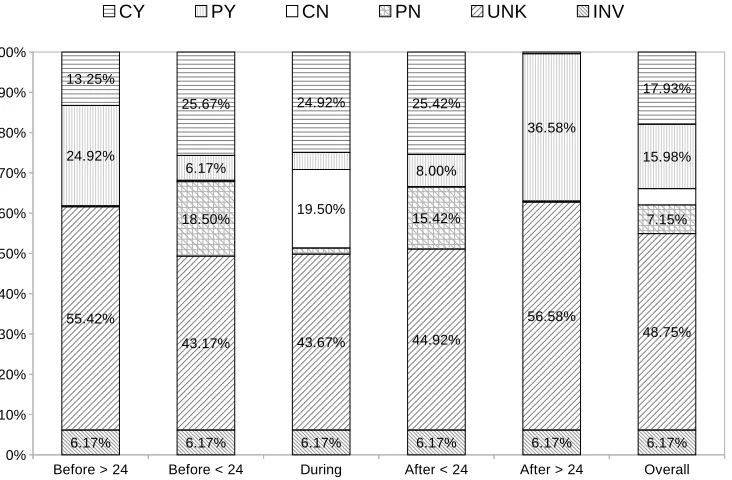
Figure 2: Label distribution per temporal tag and overall distribution after adjudicating disagreements. Percentage values are not shown if they are lesser than 5 %
Before Before During After After
>24 <24 <24 >24 ↵ 0.71 0.72 0.73 0.66 0.70
Table 2: Cohen’s kappa (k) agreements per temporal tag.
if the author is simply stating a wish. Thus, annotators chose UNK for all temporal tags.
• Finally, tweet 8 contains an invalid location. Keyasia is a girl’s name, but it was selected for annotation be-cause both spaCy and Stanford CoreNLP tagged it as a location.
4. Corpus Analysis
In this section we analyze the corpus. Specifically, we dis-cuss the quality in terms of inter-annotator agreement and the label distribution. Our corpus contains 1,200 location mentions extracted from 1,062 tweets (i.e., 1.14 locations per tweet on average).
4.1. Quality
Figure 1 presents confusion matrices per temporal tag and for all temporal tags (each matrix shows percentages for all pairs of labels from both annotators). Note that dis-agreements are relatively minor: most disdis-agreements are between CY and PY, CY and UNK, CN and PN, CN and UNK, or UNK and INV. In other words, while annotators do not agree all the time, the sources of disagreements are not a major source of concern.
Table 2 presents inter-annotator agreements prior to adju-dicating disagreements. The overall Cohen’s kappa coeffi-cient is 0.71, which is considered substantial (Landis and
Koch, 1977). Coefficients range between 0.66 and 0.73 de-pending on the temporal tag. The highest agreement was obtained when annotating whether the author is (or is not) in a location when he tweeted (during: 0.73), and the low-est agreement when annotating whether the author is (or is not) in a location within 24 hours after tweeting (after<24: 0.66). The remaining agreements range from 0.70 to 0.72.
4.2. Label Distribution
Figure 2 presents the label distribution per temporal tag and overall after adjudicating disagreements. Overall, la-bels that allow us to extract spatial knowledge (CY, PY, CN and PN labels) account for 45.08% of labels. This percent-age is similar across temporal tags, although we observe larger percentages of UNK withbefore>24andafter>24
(55.42% and 56.58% vs. 43.17%–44.92%). Authors are more likely to be located at the locations they tweet about thannotlocated (CY+PY: 33.91% vs. CN+PN: 11.15%). Overall, we can infer the location of authors of tweets with around 20% certainty (CY+CN). For within a day be-fore, during and within a day after posting the tweet, we can infer the location of the author with greater certainty (CY+CN: 26%, 44.42%, 26% vs. CY+CN: 13.25%,<5%). Also, we can infer the location of the author with greater certainty for before rather than after posting the tweet.
5. Conclusions
The corpus has substantial inter-annotator agreement. La-bel distributions indicate that many locations present in tweets do not indicate any spatial information about the au-thor. Additionally, annotators were more certain (CY and CN labels) when annotating spatial information for tempo-ral tags close to the tweet timestamp (during, and within 24 hours before and after) than for more distant temporal tags (longer than 24 hours before and after).
6. Bibliographical References
Jurgens, D., Finethy, T., McCorriston, J., Xu, Y. T., and Ruths, D. (2015). Geolocation prediction in twitter us-ing social networks: A critical analysis and review of current practice.ICWSM, 15:188–197.
Jurgens, D. (2013). That’s what friends are for: Inferring location in online social media platforms based on social relationships.ICWSM, 13(13):273–282.
Landis, J. R. and Koch, G. G. (1977). The measurement of observer agreement for categorical data. biometrics, pages 159–174.
Li, C. and Sun, A. (2014). Fine-grained location extrac-tion from tweets with temporal awareness. In Proceed-ings of the 37th international ACM SIGIR conference on Research & development in information retrieval, pages 43–52. ACM.
Mahmud, J., Nichols, J., and Drews, C. (2014). Home lo-cation identifilo-cation of twitter users.ACM Transactions on Intelligent Systems and Technology (TIST), 5(3):47. Manning, C. D., Surdeanu, M., Bauer, J., Finkel, J.,
Bethard, S. J., and McClosky, D. (2014). The stanford corenlp natural language processing toolkit. In Proceed-ings of the 52nd Annual Meeting of the Association for Computational Linguistics (ACL).
Sanagavarapu, K. C., Vempala, A., and Blanco, E. (2017). Determining whether and when people participate in the events they tweet about. In Proceedings of the 55th Annual Meeting of the Association for Computational Linguistics (Volume 2: Short Papers), pages 641–646, Vancouver, Canada, July. Association for Computational Linguistics.