JFCKB: Japanese Feature Change Knowledge Base
Tetsuaki Nakamura
†, Daisuke Kawahara
†‡ †Kyoto University,‡JST PRESTOYoshida-Honmachi, Sakyo-ku, Kyoto, Japan [email protected], [email protected]
Abstract
Commonsense knowledge plays an essential role in our language activities. Although many projects have aimed to develop language resources for commonsense knowledge, there is little work focusing on connotational meanings. This is because constructing com-monsense knowledge including connotational meanings is challenging. In this paper, we present a Japanese knowledge base where arguments in event sentences are associated with various feature changes caused by the events. For example, “my child” in “my wife hits my child” is associated with some feature changes, such asincrease in pain,increase in anger,increase in disgust, anddecrease in joy. We constructed this knowledge base through crowdsourcing tasks by gathering feature changes of arguments in event sentences. After the construction of the knowledge base, we conducted an experiment in anaphora resolution using the knowledge base. We regarded anaphora resolution as an antecedent candidate ranking task and used Ranking SVM as the solver. Experimental results demonstrated the usefulness of our feature change knowledge base.
Keywords:emotion, commonsense knowledge, knowledge base, crowdsourcing, anaphora resolution
1.
Introduction
Commonsense knowledge plays an essential role in our language activities. Such knowledge also plays an important role for computers to understand texts. In the area of language resource development, most studies on commonsense knowledge focus on denota-tional meanings such as predicate-argument structures (Baker et al., 1998; Palmer et al., 2005). Meanwhile, there are few studies focusing on connotational meanings (Nakamura and Kawahara, 2016; Rashkin et al., 2016). Even in such studies, abstract features such as polarities are used. However, concrete knowledge (that is, fine-grained knowledge) is better for computers than abstract knowledge because events actually cause various concrete feature changes to participants in the events or those who know of the events.
There are two approaches to acquiring commonsense knowledge. One is the automatic acquisition approach; the other is the manual acquisition approach. The au-tomatic acquisition approach uses machine learning tech-niques and pattern matching methods. Although this ap-proach is useful when the amount of data to be acquired is extremely large, the quality of acquired knowledge might be low. Moreover, the existence ofreporting biasin texts (Gordon et al., 2010; Gordon and Durme, 2013) shows that infrequent events tend to appear more in texts than quotid-ian events. The manual approach is useful for gathering subjective information (such as emotional information) and quotidian commonsense knowledge, which are difficult to acquire automatically. This approach may use a fully man-ual technique (at a very early stage of artificial intelligence studies) or collective intelligence (e.g., crowdsourcing and games with a purpose).
In this study, we aim to solve some problems in previ-ous work on connotational meanings by constructing a large-scale knowledge base of concrete feature changes of arguments in event sentences with a controlled
gran-ularity. For example, “my child” in “my wife hits my child” is associated with some feature changes such as
increase in pain, increase in anger, increase in disgust, and decrease in joy. The proposed knowledge base is for Japanese. We combined automatic and manual ap-proaches (collective intelligence) to exploit the merits of both techniques. After the construction of our feature change knowledge base, we conducted an experiment on anaphora resolution using the knowledge base. In this experiment, we used a Japanese translated version of the Winograd Schema Challenge (WSC) dataset (JWSC) (Levesque, 2011; Shibata et al., 2015).
2.
Related Work
There are many studies focusing on events themselves. FrameNet (Baker et al., 1998) is a corpus in which deep cases (semantic roles) of predicates are defined. In FrameNet, each argument in an example sentence is labeled with a deep case. ConceptNet (Speer and Havasi, 2012) is a large semantic network constructed in the Open Mind Com-mon Sense project (Singh et al., 2012). It is composed of relationships between concepts, where concepts are noun, verb or adjectival phrases.
in WordNet-Affect, it is hard to know who/what is asso-ciated with the emotions in events. Connotation Frames
are a knowledge base of emotional implications of events (Rashkin et al., 2016). In Connotation Frames, implica-tions of an event are represented by a set of polarities cat-egorized into five types (writers’ perspective, entities’ per-spective, effect, value, and mental state). To construct Con-notation Frames, crowdsourcing and a news corpus were used. Although this knowledge base is useful for under-standing information conveyed by event descriptions, it is hard to know details of the emotions associated with events because emotions themselves and associated behaviors are abstracted by polarities in the knowledge base.
As for connotational meanings, especially for men-tal states, there are many studies that exploit tra-ditional emotion models proposed by psycholo-gists (Tokuhisa et al., 2008; Tokuhisa et al., 2009; Hasegawa et al., 2013; Vu et al., 2014). In these stud-ies, Ekman’s Big Six Model (Ekman, 1992) or Plutchik’s wheel of emotions (Plutchik, 1980) are used to automati-cally extract emotion knowledge from large corpora or Web documents. However, as pointed out in Gui et al. (2017), most natural language processing studies on emotion focus on emotion classification (Tokuhisa et al., 2008; Tokuhisa et al., 2009; Li et al., 2015; Zhou et al., 2016) and emotion information extraction (Vu et al., 2014). There are few studies on emotion cause extraction based on relationships between events and emotions caused by the events (Ghazi et al., 2015; Gui et al., 2016; Gui et al., 2017). These studies use explicit keywords in texts to recognize relationships between emotions and events.
There are many studies on automatic acquisition of rela-tionships between events (Chambers and Jurafsky, 2009; Chambers and Jurafsky, 2010; Vanderwende, 2005; Shibata et al., 2014). Knowledge bases constructed in these studies are useful to determine what events happen after other events. However, these studies do not focus on motivations for events or effects caused by the events. As described in the previous section, this approach cannot guarantee quotidian connotational meanings from texts because of the reporting bias. Therefore, it is important to construct knowledge bases of such commonsense knowl-edge by manual intervention as well as through automatic acquisition.
3.
Design of JFCKB
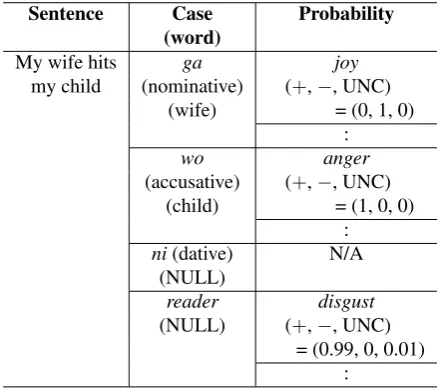
Our final goal is to construct a knowledge base of various feature changes of arguments in event sentences with the controlled granularity and to develop various methods for deep understanding of texts. To achieve the goal, we pro-pose a knowledge base structure shown in Table 1. In this structure, each argument in an event sentence is associated with various feature changes caused by the event. For ex-ample, in the case of “my wife hits my child,” “my child” is associated with changes of some features such asincrease in pain,increase in anger,increase in disgust,decrease in joy, anddecrease in trust. We gathered such information through collective intelligence (i.e., crowdsourcing). Event sentences to be stored in our knowledge base are created
Sentence Case Probability (word)
My wife hits ga joy
my child (nominative) (+,−, UNC) (wife) = (0, 1, 0)
:
wo anger
(accusative) (+,−, UNC) (child) = (1, 0, 0)
:
ni(dative) N/A (NULL)
reader disgust
(NULL) (+,−, UNC) = (0.99, 0, 0.01)
:
Table 1: Example of the proposed knowledge base struc-ture (JFCKB). This knowledge base is for Japanese. In JFCKB, each sentence has various feature changes for three cases (ga case, wo case, and nicase) and those of read-ers. The three cases are Japanese language specific syn-tactic roles. Thega,wo, andnicases roughly correspond to nominative, accusative, dative, respectively.Readersare not arguments in the sentence. In the “Probability” column, symbols+,−, and UNC denoteincreased,decreased, and
unchanged, respectively.
based on some knowledge bases automatically constructed from large-scale Web documents. Hereafter, we call our knowledge baseJFCKB(Japanese Feature Change Knowl-edge Base). JFCKB is a Japanese knowlKnowl-edge base.
We pay attention to the controlled granularity for feature definition. Many studies suggest that it is important to focus on the types of changes caused by events to rec-ognize the events. In infant cognitive development stud-ies, there are several reports that even infants use infor-mation about the basic features of participants in events to understand the events (Massey and Gelman, 1988; Baillargeon et al., 1989; Spelke et al., 1995). In cognitive linguistics, basic level categoryis an extremely important concept (Rosch et al., 1976; Taylor, 1995). Basic level cat-egories minimize attributes shared with other catcat-egories. Members belonging to a basic level category maximize at-tributes shared with other members of that same category. For example, “dog” is a basic level category while “Great Pyrenees” and “German shepherd” are not. Many cognitive linguists believe that our languages are built around basic level categories. Therefore, the granularity of knowledge is an important aspect of our language activity that needs to be captured.
[image:2.595.312.532.68.262.2]Verb: case frame ID Case Word
yaku: yaku1 ga(nominative) watashi(I): 114,haha(mom): 75,musume(daughter): 74, ... (bake) wo(accusative) pan(bread): 54076,ke-ki(cake): 31693,niku(meat): 14059, ...
de(tools/ingredients) koubo(yeast): 888,be-kari-(bakery): 768,o-bun(oven): 515,… yaku: yaku2 ga(nominative) mina(all persons): 23,sensei(teacher): 11,hito(person): 8, ... (have difficulty) wo(accusative) te(hand): 26449
ni(dative) kodomo(child): 168,musuko(son):108, ...
[image:3.595.61.533.69.178.2]yaku: yaku3 ga(nominative) daitouryou(president): 1,shidousya (mentor): 1, ... (burn) ni(dative) CD:13812, DVD:12200, ...
Table 2: Case frame examples. Each row denotes one case frame. In the “Word” column, each number denotes the frequency of the noun in the Web corpus.
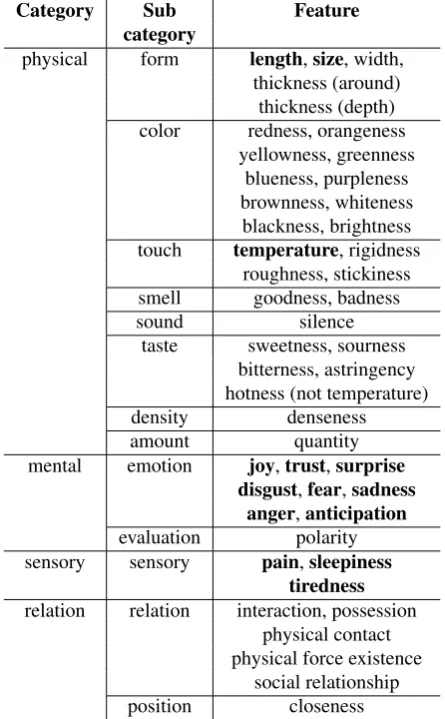
as closely as possible. This decision was based on a tra-ditional emotion study (Plutchik, 1980), Japanese thesauri (Ikehara, 1997; NINJAL, 2004), sentiment analysis studies (Tokuhisa et al., 2008; Tokuhisa et al., 2009), and features used in the VerbCorner project (Hartshorne et al., 2014). Although our final version of the proposed knowledge base will have all the features in Table 3, at present, emotional and sensory features in the table have been mainly investi-gated through crowdsourcing tasks described in the follow-ing section.
4.
Construction of JFCKB
In our previous work (Nakamura and Kawahara, 2016), we constructed a trial version of a knowledge base in which each argument of an event sentence was associated with various feature changes caused by the events. As a result of a subjective evaluation experiment, it was shown that such feature changes can be appropriately acquired using crowdsourcing. In this trial version, 857 sentences (includ-ing 144 verbs (types) and 1,788 arguments (tokens) (742 types), 391 case frames (types)) were used.
In this study, we constructed a full version of the knowl-edge base and extended the dataset as follows: (1) for the representation manner of behaviors, we used only triples (increased, decreased, andunchanged) whose val-ues are probabilities. In the trial version, some feature changes were represented by the triples while the other feature changes were represented by pairs (changed and
unchanged) whose values are probabilities. (2) In addi-tion to event sentences based on the 200 most frequent verbs in theKyoto University Web Document Leads Cor-pus (KWDLC) (Hangyo et al., 2012)1 used in our
previ-ous work, we used sentences from other Japanese lan-guage resources. The resources areKyoto University Case Frames(KUCF) (Kawahara and Kurohashi, 2006)2and the
Japanese translated version of the WSC (JWSC) dataset. KWDLC is a Japanese text corpus that comprises 5,000 documents (15,000 sentences) with annotations of mor-phology, named entities, dependencies, predicate-argument structures including zero anaphora and coreferences. KUCF is a database of case frames automatically con-structed from a corpus of 10 billion Japanese sentences taken from the Web. Case frames describe what kinds of nouns are related to each verb. Many Japanese verbs have
1
http://nlp.ist.i.kyoto-u.ac.jp/EN/index.php?KWDLC 2
http://www.gsk.or.jp/en/catalog/gsk2008-b/
Category Sub Feature
category
physical form length,size, width, thickness (around) thickness (depth) color redness, orangeness
yellowness, greenness blueness, purpleness brownness, whiteness
blackness, brightness touch temperature, rigidness
roughness, stickiness smell goodness, badness sound silence
taste sweetness, sourness bitterness, astringency hotness (not temperature) density denseness amount quantity mental emotion joy,trust,surprise
disgust,fear,sadness anger,anticipation evaluation polarity sensory sensory pain,sleepiness
tiredness relation relation interaction, possession
physical contact physical force existence
social relationship position closeness
Table 3: Features assumed in this study. These features were decided by considering various studies such as tradi-tional psychological studies, studies on cognitive develop-ment of infants, Japanese thesauri, sentidevelop-ment analysis stud-ies, and VerbCorner project. Features with bold fonts have been investigated so far.
[image:3.595.311.534.231.591.2]The construction of JFCKB was achieved using crowd-sourcing. The details are described in the next subsections.
4.1.
Phase 1: Event Sentence Creation
Event sentences in JFCKB are representative sentences of case frames of verbs in KUCF. The sentence creation pro-cedure was as follows. Step 1: Selection of verbs. We used the 200 most frequent verbs in KWDLC, the 1,000 most frequent verbs in KUCF, and all verbs in the JWSC dataset. Step 2: Representative argument selection. For each case (syntactic role) of each case frame of each verb, the most frequent argument was used as the representative argument of the case. In the case of KWDLC, the two most frequent arguments were used. We usedga case, wo case, andni
case as arguments. These cases are Japanese grammatical syntactic roles and roughly correspond to nominative, ac-cusative, and dative, respectively. Step 3: Representative sentence creation. Sentences were created by combining the verbs with the three types of representative arguments. Step 4: Incomprehensible sentence exclusion. Sentences difficult to understand were pruned based on a crowdsourc-ing task. The crowdsourccrowdsourc-ing workers were asked whether they could understand the sentences presented. The com-prehensibility of each sentence was judged by ten workers. In total, 1,559 people participated in the task.
After the crowdsourcing task, we estimated the probabil-ity that each sentence was judged comprehensible by the participants based on the aggregation method proposed by Whitehill et al. (2009). Sentences with probabilities of
comprehensibleless than 0.9 were discarded. Unlike ma-jority voting, this method calculates the probability based on worker agreements. As a result, 9,073 sentences re-mained out of 11,189 representative sentences. These 9,073 sentences included 19,052 arguments (tokens) (4,882 types).
4.2.
Phase 2: Animacy Investigation
When a word does not denote a concrete object, it is not necessary to ask about feature changes of the word (e.g., “discussion”). Even if the word denotes a concrete object, it is not necessary to investigate feature changes of emotions and senses of the word when the word denotes an object without emotions and senses (e.g., “stone”). To avoid such redundant asking in the feature change investigation task, we conducted a crowdsourcing task to investigate the ani-macy of words (arguments) in event sentences in advance. In this task, crowdsourcing workers were asked whether presented words denote concrete objects or may have emo-tions or senses. That is, we divided this phase into two sub phases. The former (sub phase 1) is a task to investigate the concreteness of arguments. The other (sub phase 2) is a task to investigate whether arguments have emotions. In to-tal, 1,011 participants completed these two sub tasks. The method for calculating the probability of answers was the same as in the event sentence creation phase. We discarded words whose probabilities ofconcrete objectorobject with emotionwere less than 0.5. As a result, as far as we inves-tigated, 1,575 types of words were judged as those repre-senting concrete objects out of 3,457 types of words. 677 types of words were judged as those with emotions out of
How doesangerof “my child” change before and after the event described
by the sentence below?
(selectincreased,decreased, orunchanged) My wife hits my child
(a)
How did yourangerchange
before and after you read the event described by the sentence below?
(selectincreased,decreased, orunchanged) My wife hits my child
[image:4.595.321.522.66.212.2](b)
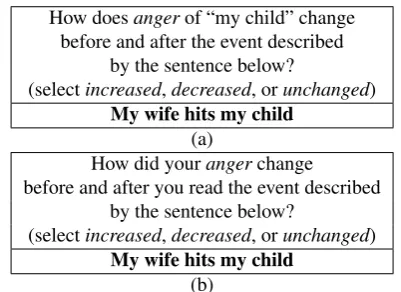
Figure 1: Questions used for crowdsourcing tasks. These tasks are to acquire concrete feature changes caused by events described by the sentences.
3,457 types of words. Note that the number of words whose animacies were investigated (3,457 types) is different from the number of words in JFCKB (4,882 types) because this phase was applied from the middle of constructing JFCKB.
4.3.
Phase 3: Feature Change Investigation
According to results of the previous two phases (i.e., event sentence creation and animacy investigation), we con-ducted a crowdsourcing task to gather feature changes of arguments in event sentences. We also attempted to gather those of sentence readers. That is, crowdsourcing workers were asked to answer one of feature changes of presented arguments in sentences (Figure 1 (a)) or those of the work-ers themselves (Figure 1 (b)). In total, 33,683 people par-ticipated in this task. Probability calculations were carried out in the same way as the previous phases. The resulting knowledge base includes 5,647 case frames (types). These case frames are for 975 verbs (types). Note that one verb has one or more case frames because of the verbal poly-semy as shown in Table 2.
5.
Validating Usefulness of JFCKB:
Anaphora Resolution
5.1.
Evaluation Settings
To validate the usefulness of JFCKB, we conducted an ex-periment of anaphora resolution using JFCKB. We adopted JWSC as an anaphora resolution problem. Each problem in JWSC is basically composed of two sentences including one anaphor, two antecedent candidates, and a correct an-tecedent. This anaphora resolution task can be regarded as an antecedent candidate ranking task because it is a task to select the correct antecedent from two candidates. We used Ranking SVMs3 (Joachims, 2002) as the solver and used
two-degree polynomial kernel as the kernel function. We set the cost parameter (trade-off between training error and margin) to 0.01.
In this experiment, three conditions were compared: (1) the case using only feature change information (hereafter,
FC); (2) the case using only word embeddings of word2vec (hereafter,W2V), and (3) the case using both feature change information and word embeddings (hereafter,BOTH).
3
S1 = The bee landed on the flower. S2 = Because it wanted pollen.
antecedent 1 = bee, antecedent 2 = flower, anaphora = it, correct antecedent = bee diff1 = it−bee, diff2 = it−flower
bee flower it land land want S1 S2 diff1 diff2 bee 1st= oo..o oo..o oo..o + oo..o oo..o oo..o + oo..o oo..o + oo..o oo..o + oo..o
[image:5.595.340.504.276.301.2]bee flower it land land want s1 s2 diff1 diff2 flower 2nd= oo..o oo..o oo..o + oo..o oo..o oo..o + oo..o oo..o + oo..o oo..o + oo..o
Figure 2: Example of anaphora resolution problem and vectors used in the anaphora resolution task. S1 and S2 denote the first sentence and the second sentence in the problem. Diff denotes the difference between an anaphor and an antecedent candidate. The vectors given to Ranking SVMs were composed of vectors expressing anaphors and antecedent candidates, vectors expressing the nearest (in parse trees) predicates of anaphoras and antecedent candidates, vectors expressing the first and second sentences, vectors expressing differences between anaphoras and antecedent candidates, and vectors expressing either of two antecedent candidates. As for the order in Ranking SVMs, the vector with the last component expressing the correct antecedent was regarded the first one.
The feature change vector of each argument is a 33 dimen-sional vector because we used eight emotion features ( joy, trust, surprise, disgust, fear, sadness, anger, and anticipa-tion) and three sensory featues (pain, sleepiness, and tired-ness). Each feature change is composed of three probabil-ities (increased, decreased, and unchanged). The feature change vector of each predicate is a 99 dimensional vector because each predicate vector is composed of vectors for three cases (gacase (nominative),wocase (accusative), and
nicase (dative)). Vectors in word2vec are 500 dimensional vectors learned from 100 million Web sentences analyzed by JUMAN++4.
Vectors composed of the following feature vectors were given to Ranking SVM in all three conditions. (1) vectors expressing anaphors and antecedent candidates, (2) vec-tors expressing the nearest (in parse trees) predicates of anaphoras and antecedent candidates, (3) vectors express-ing the first and second sentences, (4) vectors expressexpress-ing differences between anaphoras and antecedent candidates, and (5) vectors expressing either of two antecedent candi-dates. We used KNP5for dependency parsing.
To solve JWSC problems, we created each vector of an-tecedent candidates based on five types of vectors described above and compared them. For each antecedent candidate, the five types of vectors were concatenated. Therefore, ac-cording to the dimension numbers of feature change vectors and word2vec vectors described above,vectors inFC,W2V, and BOTH are 693 dimensional, 5,500 dimensional, and 6,193 dimensional vectors respectively. As for the order in Ranking SVM, the vector with the last component ex-pressing the correct antecedent was regarded the first one. For example, when the first sentence “the bee landed on the flower,” the second sentence “Because it wanted pollen,” two antecedent candidates “bee, flower,” the anaphor “it,” and the correct antecedent “bee” were given, the vector in which the last component represents “bee” is the first one (Figure 2).
We conducted ten-fold cross validation to evaluate system performance. Although JWSC is composed of 1,321 lems, we used 441 problems in this evaluation. These
prob-4
http://nlp.ist.i.kyoto-u.ac.jp/EN/index.php?JUMAN++ 5
http://nlp.ist.i.kyoto-u.ac.jp/EN/index.php?KNP
FC W2V BOTH
Accuracy 52.15% 47.39% 47.62%
Table 4: Anaphora resolution result.
lems satisfied the following conditions: (1) each was com-posed of two sentences; (2) all the predicates of anaphors and those of antecedent candidates have information about their feature changes and word embeddings.
5.2.
Results
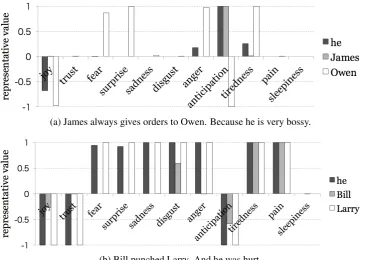
The result of the cross validation is shown in Table 4. Table 4 shows that the accuracy ofFCoutperformed those of the others. An example that feature changes worked well was the case “James always gives orders to Owen. Because he is very bossy.” Figure 3 (a) shows feature changes of this example. In this case,FCandBOTHestimated the correct answer whileW2Vfailed. An example that feature changes did not work was the case “Bill punched Larry. And he was hurt.” Figure 3 (b) shows feature changes of this example. In this case, FC andBOTH failed to estimate the correct answer while W2Vsucceeded. Note that Figure 3 shows representative feature change values. The representative value of each feature is the weighted average of the feature, where weights ofincreased,decreased, andunchangedare
+1,−1, and0, respectively. For example, when the feature change probabilities are 0.8, 0.15, and 0.05 forincreased,
decreased, andunchanged, respectively, the representative value of the feature is 0.65.
In the case that feature changes worked well, as can be seen in Figure 3 (a), the correct antecedent has some fea-ture changes in common with the anaphors but the incor-rect antecedent has a conflicting feature change (e.g., antic-ipation). In the case that feature changes did not work, as can be seen in Figure 3 (b), there are no conflicting feature changes. Considering these results, we speculate that such common feature changes and conflicting feature changes influence the estimation of the correct antecedent candi-dates in anaphora resolution.
6.
Conclusion
(a) James always gives orders to Owen. Because he is very bossy.
[image:6.595.115.483.69.329.2](b) Bill punched Larry. And he was hurt.
Figure 3: Examples of feature changes. (a) is an example where feature changes worked well. (b) is an example where feature changes did not work. The value of each feature is the representative feature change value. The representative value of each feature is the weighted average of the feature, where weights ofincreased,decreased, andunchangedare+1,−1, and0, respectively.
changes caused by the events. Features used in the pro-posed knowledge base are determined by considering vari-ous studies such as traditional psychological studies, stud-ies on cognitive development of infants, sentiment analy-sis studies. This knowledge base was constructed through crowdsourcing tasks. After the construction of our feature change knowledge base, we conducted an experiment of anaphora resolution using the knowledge base. In this ex-periment, we regarded anaphora resolution as an antecedent candidate ranking task and compare three conditions (the case using only the feature change information, the case us-ing only the word2vec information, and the case usus-ing both of the feature change information and the word2vec infor-mation). As a result, it was shown that the condition where only the feature change information was used outperformed the other conditions. This result suggests the usefulness of our feature change knowledge base.
7.
Acknowledgements
This work was supported by JST PRESTO Grant Number JPMJPR1402, Japan.
8.
Bibliographical References
Baillargeon, R., Devos, J., and Graber, M. (1989). Lo-cation memory in 8-month-old infants in a non-search ab task: Further evidence. Cognitive Development, 4(4):345–367.
Baker, C. F., Fillmore, C. J., and Lowe, J. B. (1998). The berkeley framenet project. InProceedings of ACL-COLING 1998, pages 86–90.
Chambers, N. and Jurafsky, D. (2009). Unsupervised learning of narrative schemas and their participants. In
Proceedings of the Joint Conference of the 47th Annual Meeting of the ACL and the 4th International Joint Con-ference on Natural Language Processing of the AFNLP, pages 602 –610.
Chambers, N. and Jurafsky, D. (2010). A database of nar-rative schemas. InProceedings of the Seventh Interna-tional Conference on Language Resources and Evalua-tion (LREC2010).
Ekman, P. (1992). An argument for basic emotions. Cog-nition and Emotion, 6:169–200.
Christiane Fellbaum, editor. (1998). WordNet: An Elec-tronic Lexical Database. The MIT Press.
Ghazi, D., Inkpen, D., and Szpakowicz, S., (2015). De-tecting Emotion Stimuli in Emotion-Bearing Sentences, pages 152–165. Springer.
Gordon, J. and Durme, B. V. (2013). Reporting bias and knowledge acquisition. InProceedings of the 2013 Workshop on Automated Knowledge Base Construction, pages 25–30.
Gordon, J., Durme, B. V., and Schubert, L. (2010). Learn-ing from the web: ExtractLearn-ing general world knowledge from noisy text. InProceedings of the AAAI 2010 Work-shop on Collaboratively-built Knowledge Sources and Artificial Intelligence (WikiAI 2010), pages 8–10. Gui, L., Wu, D., Xu, R., Lu, Q., and Zhou, Y. (2016).
Event-driven emotion cause extraction with corpus con-struction. InProceedings of EMNLP 2016, pages 1639– 1649.
Gui, L., Hu, J., He, Y., Xu, R., Lu, Q., and Du, J. (2017). A question answering approach to emotion cause extrac-tion. InarXiv:1708.05482v1.
Building a diverse document leads corpus annotated with semantic relations. In Proceedings of the 26th Pacific Asia Conference on Language Information and Comput-ing, pages 535–544.
Hartshorne, J. K., Bonial, C., and Palmer, M. (2014). The verbcorner project: Findings from phase 1 of crowd-sourcing a semantic decomposition of verbs. In Proceed-ings of the 52nd Annual Meeting of the Association for Computational Linguistics, pages 397–402.
Hasegawa, T., Kaji, N., Yoshinaga, N., and Toyoda, M. (2013). Predicting and eliciting addressee’s emotion in online dialogue. InProceedings of the 51st Annual Meet-ing of the Association for Computational LMeet-inguistics, pages 964–972.
Ikehara, S. (1997). Nihongo Goi Taikei. Iwanami Syoten, Tokyo.
Jackendoff, R. (1983). Semantics and Cognition. MIT Press.
Joachims, T. (2002). Optimizing search engines using clickthrough data. InProceedings of the ACM Confer-ence on Knowledge Discovery and Data Mining (KDD), ACM, 2002.
Kawahara, D. and Kurohashi, S. (2006). Case frame com-pilation from the web using high-performance comput-ing. InProceedings of the 5th International Conference on Language Resources and Evaluation (LREC2006), pages 1344–1347.
Levesque, H. J. (2011). The Winograd Schema Challenge. InProceedings of AAAI Spring Symposium: Logical For-malizations of Commonsense Reasoning.
Li, S., Huang, L., Wang, R., and Zhou, G. (2015). Sentence-level emotion classification with label and con-text dependence. In Proceedings of ACL 2015, pages 1045–1053.
Massey, C. M. and Gelman, R. (1988). Preschoolers’ abil-ity to decide whether a photographed unfamiliar object can move itself.Developmental Psychology, pages 307– 317.
Nakamura, T. and Kawahara, D. (2016). Constructing a dictionary describing feature changes of arguments in event sentences. InProceedings of the 4th Workshop on EVENTS: Definition, Detection, Coreference, and Rep-resentation, pages 46–50.
NINJAL. (2004). Bunrui Goihyo. Dainippon Tosho, Tokyo.
Palmer, M., Gildea, D., and Kingsbury, P. (2005). The proposition bank: An annotated corpus of semantic roles.
Computational Linguistics, 31(1):71–106.
Plutchik, R., (1980). A General Psychoevolutionary The-ory of Emotion, 1, pages 3–33. Academic Press. Rashkin, H., Singh, S., and Choi, Y. (2016). Connotation
frames: A data-driven investigation. In Proceedings of ACL 2016, pages 264–269.
Rosch, E., Mervisa, C. B., Gray, W. D., Johnson, D. M., and Boyes-Braem, P. (1976). Basic objects in natural categories. Cognitive Psychology, 8:382–439.
Shibata, T., Kohama, S., and Kurohashi, S. (2014). A large scale database of strongly-related events in Japanese. In Proceedings of the 9th International Conference on
Language Resources and Evaluation (LREC2014), pages 3283–3288.
Shibata, T., Kohama, S., and Kurohashi, S. (2015). Ni-hongo Winograd Schema Challenge no kouchiku to bun-seki (in Japanese). In Proceedings of NLP2015, pages 493–496.
Singh, P., Lin, T., Mueller, E. T., Lim, G., Perkins, T., and Zhu, W. L. (2012). Open mind common sense: Knowl-edge acquisition from the general public. InProceedings of On the Move to Meaningful Internet Systems, 2002, pages 1223–1237.
Speer, R. and Havasi, C. (2012). Representing general re-lational knowledge in conceptnet 5. InProceedings of LREC 2012, pages 86–90.
Spelke, E. S., Phillips, A., and Woodward, A. L., (1995).
Infants’ knowledge of object motion and human action. Oxford University Press.
Strapparava, C. and Valitutti, A. (2004). Wordnet-affect: an affective extension of wordnet. In Proceedings of the 4th International Conference on Language Resources and Evaluation (LREC 2004), pages 1083–1086. Taylor, J. R. (1995). Linguistic Categorization: Prototypes
in Linguistic Theory. Clarendon Press.
Tokuhisa, R., Inui, K., and Matsumoto, Y. (2008). Emotion classification using massive examples extracted from the web. InProceedings of the 22nd International Confer-ence on Computational Linguistics, pages 881–888. Tokuhisa, R., Inui, K., and Matsumoto, Y. (2009). Emotion
classification using massive examples extracted from the web. Journal of Information Processing (in Japanese), 50(4):1365–1374.
Vanderwende, L. (2005). Volunteers created the web. In Proceedings of the 2005 AAAI Spring Symposium, Knowledge Collection from Volunteer Contributors. Vu, H. T., Neubig, G., Sakti, S., Toda, T., and Nakamura,
S. (2014). Acquiring a dictionary of emotion-provoking events. In Proceedings of the 14th Conference of the European Chapter of the Association for Computational Linguistics, pages 128–132.
Whitehill, J., Ruvolo, P. L., Ting-fan Wu, J. B., and Movel-lan, J. R. (2009). Whose vote should count more: Op-timal integration of labels from labelers of unknown ex-pertise. In Y. Bengio, et al., editors,Advances in Neural Information Processing Systems 22, pages 2035–2043. Curran Associates, Inc.
Zhou, D., Zhou, Y., Zhang, X., Zhao, Q., and Geng, X. (2016). Emotion distribution learning from texts. In