Discourse-Level Annotation
for Investigating Information Structure
Ivana Kruijff-Korbayov´
a
and
Geert-Jan M. Kruijff
Computational Linguistics, Saarland University, Saarbr¨
ucken, Germany
{
korbay,gj
}
@coli.uni-sb.de
Abstract
We present discourse-level annotation of newspa-per texts in German and English, as part of an ongoing project aimed at investigating information structure from a cross-linguistic perspective. Rather than annotating some specific notion of information structure, we propose a theory-neutral annotation of basic features at the levels of syntax, prosody and discourse, using treebank data as a starting point. Our discourse-level annotation scheme cov-ers properties of discourse referents (e.g., semantic sort, delimitation, quantification, familiarity status) and anaphoric links (coreference and bridging). We illustrate what investigations this data serves and discuss some integration issues involved in combin-ing different levels of stand-off annotations, created by using different tools.
1
Introduction
The goal of this paper is to present a discourse-level annotation scheme developed for the pur-pose of investigating information distribution in text from a cross-linguistic perspective, with a particular focus on the interplay of various fac-tors pertaining to the realization of information structure. Information Structure (IS) concerns utterance-internal structural and semantic proper-ties reflecting the speaker’s/writer’s communica-tive intentions and the relation of the utterance to the discourse context, in terms of the dis-course status of the content, the actual and at-tributed attentional states of the discourse partici-pants, and the participants’ prior and changing atti-tudes (knowledge, beliefs, intentions, expectations, etc.) (Kruijff-Korbayov´a and Steedman, 2003). In many (if not all) languages, differences in IS moti-vate variations in surface realization of utterances, such as syntactic structure, word order and intona-tion. But languages differ in the extent to which they employ various combinations of IS-realization means (Vallduv´ı and Engdahl, 1996; Kruijff, 2001). Modeling these phenomena and their interaction re-quires understanding IS and its role in discourse. IS is therefore an important aspect of meaning at the interface between utterance and discourse, which computational models of discourse processing should take into account. Unfortunately, there exists no
theory that provides a comprehensive picture of IS, explaining its realization cross-linguistically, its rep-resentation at the level of linguistic meaning, and its interpretation in context. Employing corpora can help to deepen our intuitive understanding of IS, in order to construct explanatorily more adequate the-ories.
While the phenomena involved in discourse and IS are themselves complex and not yet fully un-derstood, studying and modeling their interaction is made difficult by proliferating and often under-formalized terminologies, especially for IS (cf. the diverging dichotomies, e.g., Theme-Rheme, Topic-Comment, Topic-Focus, Background-Focus, Given-New, Contextually Bound-Nonbound). What is needed is further systematization of terminologies, formalization and computational modeling, and em-pirical and corpus-based studies.
The goal of the MULI (MUltilingual Informa-tion structure) project is to contribute to this effort by empirically analyzing IS in German and English newspaper texts. For this, we designed annotation schemes for enriching existing linguistically inter-preted language resources with information at the levels of syntax, discourse semantics and prosody.
The MULI corpus consists of extracts
from the Tiger treebank for German
(Brants et al., to appear)1 and the Penn treebank for English (Marcus et al., 1994)2. It comprises 250 sentences in German (app. 3,500 tokens) and 320 sentences in English (app. 7,000 tokens). The MULI corpus has been created by extracting a continuous stretch of 21 relatively short texts from the Tiger treebank, and a set of 10 texts from the Penn Treebank. The selection was made so that the texts would be comparable in genre (financial news/announcements).
The morphological, part-of-speech and syntactic information encoded in the treebanks can be re-used for our purposes. We add annotations of syntactically marked constructions, prosodic fea-tures and discourse semantics. Our approach to annotation at the levels of syntax, prosody and discourse is outlined in (Bauman et al., 2004a; Bauman et al., 2004b). In this paper, we provide
more details about the discourse-level annotation. In §2 we overview the methodological concerns and desiderata we adhere to in designing our anno-tation schemes. In§3 we present the discourse-level annotation scheme in detail. In§4 we illustrate the multi-level investigation perspective. §5 we briefly describe the annotation tools we use. In§6 we con-clude and sketch future work.
2
Methodology
Text samples of varying origin, genre, language and size have been previously annotated with theory-specific notions of IS by various authors. Such data are typically not publicly available, and even if they can be obtained, it is very hard if not impossible to compare and reuse different annotations. More promising in this respect are annotations that in-clude or add some aspect(s) of IS to an existing corpus or treebank. The most systematic effort of this kind that we are familiar with is the Topic-Focus annotation in the Prague Dependency Tree-bank (Bur´aˇnov´a et al., 2000).
In contrast to other projects in which IS is annotated and investigated, we do not annotate theory-biased abstract categories like Topic-Focus or Theme-Rheme. Since we are particularly inter-ested in the correlations and co-occurrences of fea-tures on different linguistic levels that can be inter-preted as indicators of the abstract IS categories, we needed an annotation scheme to be as theory-neutral as possible: It should allow for a descrip-tion of the phenomena, from which ’any’ theory-specific explanatory mechanisms can subsequently be derived (Skut et al., 1997). We therefore con-centrate instead on features pertaining, on the one hand, to the surface realization of linguistic expres-sions (the levels of syntax and prosody), and, on the other hand, to the semantic character of the dis-course referents (the disdis-course level).
In designing our annotation schemes, we fol-lowed the guidelines of the Text Encoding Ini-tiative3 and the Discourse Resource Initiative (Carletta et al., 1997). In line with these standards, we define for each annotation level (i) the markable expressions, (ii) the attributes of markables, and (iii) the links between markables (if any).
Syntax The Tiger treebank and the Penn tree-bank we use as the starting point already con-tain syntactic information. The additional syntac-tic features annotated in the MULI project per-tain to clauses as markable units, and encode the presence of structures with noncanonical word order that typically serve to put the focus on certain syn-tactic elements. We include cleft, pseudo-cleft, re-versed pseudo-cleft, extraposition, fronting and ex-pletives, as well as voice distinctions (active, medio-passive and medio-passive). We annotate these features explicitly (when not already present in the
tree-3http://www.tei-c.org/
bank annotation), to be able to correlate them di-rectly with features at other levels. The annotation scheme draws on accounts of the analysed features in (Eisenberg, 1994) and (Weinrich, 1993) for German and in (Quirk et al., 1985) and (Biber et al., 1999) for English.
Prosody For the prosodic annotation, we recorded one German and one English native speaker reading aloud the texts of the MULI corpus.4,5 The recordings were digitised and annotated using the EMU Speech Database System ((Cassidy and Harrington, 2001b);
http://emu.sourceforge.net/).
The markables at the prosody level are into-nation phrases, intermediate phrases and words. Their attributes encode the position and strength of phrase breaks, and the position and type of pitch accents and boundary tones, following the conventions of ToBI (Tones and Break Indices (Beckmann and Hirschberg, 1994)) for English and GToBI6 (Grice et al., in press) for German, which are regarded as standards for describing the into-nation of these languages within the framework of autosegmental-metrical phonology.
Discourse At the discourse level, we define as markable those linguistic expressions that introduce or access discourse entities (i.e., discourse referents in the sense used in DRT and alike) (Webber, 1983; Kamp and Reyle, 1993). Currently we consider primarily the discourse entities introduced by “nominal-like” expressions (Passoneau, 1996). We include other kinds of expressions as markable only when they participate in an anaphoric relation with a “nominal-like” expression. For example, a sentence is a markable when it serves as an an-tecedent of a discourse-deictic anaphoric expres-sion (Webber, 1991); the main verb of a sentence is a markable when the subject of the sentence is a “zero-anaphor”, etc. Our annotation instruc-tions for identifying markables are an amalgamation and extension of those of the MUC-7 Coreference Task Definition7, the DRAMA annotation manual (Passoneau, 1996), and (Wind, 2002).
The attributes of markables in our discourse-level annotation scheme are designed to capture a range of properties that semantically character-ize the discourse entities evoked by linguistic
ex-4We are aware that using recorded speech is not ideal. We
nevertheless decided for this approach, as we wanted to work on top of existing treebanks. As far as we are aware, there does not exist a treebank for any of the publicly available speech corpora.
5Since prosodic annotation is very time-consuming, we had
to concentrate mainly on one language. Thus, we analysed all German texts and restricted ourselves to some English examples. Since individual speaking preferences may vary from speaker to speaker, we will have to record additional speakers in order to be able to come up with generalizable results.
6http://www.coli.uni-sb.de/phonetik/projects/Tobi/gtobi.html 7http://www.itl.nist.gov/iaui/894.02/related_projects/
pressions. Thereby we differ from most existing discourse-level annotation efforts, which concentrate on the linguistic expressions and on identifying anaphoric relations between them (i.e., identifying anaphors and their antecedents). A notable ex-ception is the GNOME project annotation scheme (Poesio et al., 1999): In GNOME, the aim was to annotate a corpus with information relevant for noun phrase generation. This included syntactic, seman-tic and discourse attributes of nominal expressions. The semantic attributes include, among others, an-imacy, ontological status, countability, quantifica-tion and generic vs. specific reference, which reflect similar distinctions as we make in our annotation scheme.
Besides the semantic properties that characterize discourse entities individually, our annotation scheme of course also covers referential rela-tions between discourse entities, including both identity and bridging. We build on and ex-tend the MUC-7 coreference specification and the coreference/bridging classifications described in (Passoneau, 1996), (Carletta et al., 1997), (Poesio, 2000) and (M¨uller and Strube, 2001). We represent anaphoric relations between linguistic ex-pressions through links between the corresponding markables. The type of relation is annotated as an attribute of the markable corresponding to the anaphor.
3
Discourse-Level Annotation
Information structure theories describe the phenom-ena at hand at a surface level, at a semantic level, or at both levels simultaneously, i.e., an expres-sion belongs to some IS partition, in virtue of some information-status of the corresponding discourse entity. For the investigation of IS at the (discourse) semantic level, we thus need more information about the character of the discourse entities introduced by linguistic expressions. We therefore annotated ex-pressions with their discourse referents and their fol-lowing properties:
Semantic type/sort reflects ontological charac-ter of a discourse entity: object, property, even-tuality or textual entity. Since the primary fo-cus of our current annotation are discourse enti-ties evoked by nominal-like expressions, most of them denote objects. Objects are further classi-fied according to semantic sorts: human/person, of-fice/profession, organization, animal, plant, physical object, quantity/amount, date/time, location/place, group/collection, abstract entity, other. Proper-ties are classified into either temporal or perma-nent. Eventuality has sub-classes phase (habit or state) and process (activity, accomplishment, achievement). Textual entities are for now not fur-ther classified.
Denotation characteristics of a discourse en-tity are captured by a combination of attributes, inspired by (Hlavsa, 1975). First, we distinguish
between denotational (extensional, referential) and non-denotational (intensional, attributive) uses of linguistic expressions. Denotationally used expres-sions pick out (specify) some instance(s) of the des-ignated concept(s). The instance(s) can be uniquely specified (=identifiable to the hearer), or specific but not identifiable, or even unspecific (arbitrary, generic – so any instance will do). Generic refer-ences are seen as denoting types. An expression is used non-denotationally when it attribute or qual-ifies, i.e., evokes the characteristic properties of a concept, without actually instantiating it. A typical example of a non-denotationally used expression is a predicative NP, as in “He was a painter”.
The annotation of a group of denotation proper-ties is motivated by the need to have a language-independent characterization of the referents as such, rather then the properties of the referring ex-pression, such as (in)definiteness. The latter is a surface reflex of a combination of denotation char-acteristics, and sometimes may not even be overtly indicated by articles or other determiners.
For the denotationally used expressions, we then analyze what part of the domain designated by the expression is actualy included in the extension. These aspects are annotated in the determination, delimitation and quantification attributes.
Determination characterizes the specificity of the denoted concept instance. Unique determina-tion means that the entity is uniquely specified, i.e., the hearer can (or is assumed to be able to) iden-tify the entity/instance intended by the speaker. There may be just one such entity, e.g., as with proper names, or there are possibly more entities that satisfy the description, but the speaker means a particular one and assumes that the hearer can identify it. Anaphoric pronouns are also typically used as unique denotators. Finally, an entity can be uniquely specified through a relation to another entity, or through a relation between expressions in the text. In (Hlavsa, 1975) this is called relational uniqueness; it seems to correspond to Loebner’s no-tion of NPs as funcno-tions, used in the GNOME an-notation scheme.
Existential determination is assigned to entities that are not uniquely specified, that is, the speaker does not assume the hearer to be able to identify a particular entity, but in principle the speaker would be able to identify one. Maybe such unique identifi-cation by the hearer is not important for the inter-action, it is enough to take “some instance”.
Variable determination is assigned when an ex-pression not only does not uniquely specify an en-tity, but a particular entity cannot in principle be identified, rather, the speaker means an arbitrary (’any’) instance. Typical examples are generics, or references to type.
total andpartial, indicating the entire domain desig-nated by the expression is included in the extension, or only a part.
Quantification captures the countability of the denotated concept instance, and if countable, the quantity of the individual objects included in the extension:
• uncountable is assigned when it is impossible to decompose the extension into countable dis-tinguishable individual objects, e.g., with mass nouns;
• specific-singlemeans quantity of one, e.g., “one x”, “the other x”;
• specific-multiple means a concrete quantity larger than one, e.g., “two x”, “both x”, “a dozen”;
• unspecific-multiple means an unspecified num-ber larger than one, e.g., “some x”, “many x”, “most x”.
Familiarity Status is a notion that most ap-proaches to IS use as one dimension or level of the IS-partitioning, for example Given/New in (Halliday, 1985), Background/Focus in (Steedman, 2000), or as the basis for deriving a higher level of partitioning (Sgall et al., 1986).
It is therefore important to capture it in our anno-tation as an independent feature, so that we can cor-relate it with other features at the discourse level and at other levels. We apply the familiarity status tax-onomy from (Prince, 1981), distinguishing between new, unused, inferrable, textually and situationally evoked entities. We are aware that operationalizing Prince’s taxonomy is a tough issue. For the time be-ing, our annotation guidelines give intuitive descrip-tions of the different statuses, roughly as follows:
• brand new: create a new discourse referent for a previously unknown object;
• unused: create a new discourse referent for a known object;
• inferable: create a new discourse referent for an inferable object;
• evoked (textually or situationally): access an available discourse referent.
Annotators’ uncertainty or discrepancies between annotators help us to identify problematic cases, and to revise the guidelines where necessary.8
Linguistic form encodes the syntactic category of the markable expression. This is not an attribute encoding a semantic property of a discourse entity. We have found it useful to distinguish the following categories:
8Our reason for applying the familiarity taxonomy from
(Prince, 1981) is that it addresses the status of discourse en-tities as such, not other referential properties. For example, the givenness hierarchy in (Gundel et al., 1993) interleaves in-formation status with uniqueness and specificity.
• nominal group is a “normal” NP with a head noun;
• pronominal subsumes expressions headed by a personal, demonstrative, interrogative or rela-tive pronoun;
• possessive covers possessive premodifiers (typ-ically a possessive pronoun, e.g., “our view”, or possessive adjective, e.g., “the Treasury’s threat” or in German “newyorker Burse”;
• pronominal adverb in German, e.g. “daraus” (from that);
• apposition andcoordination;
• clitic is used for clitics and in those cases when an expression contains a clitic affix (though not frequent in English and German newspaper text);
• ellipsis is used for elliptical (reduced) expres-sions, which function as nominal-like groups, but contain no nominal head (e.g., “the first”); in case a discourse entity is evoked by a zero ar-gument, e.g., in case of subject- or object pro-drop, a markable is created on a surrogate non-nominal expression, labeled aszero-arg; finally,
clause ortext are used for markables which are clause and simple sentences, or text segments, respectively (note that these are only mark-able, when they serve as antecedents to nominal anaphors).
These categories classify the linguistic forms of ex-pressions independently of the categories employed in the syntactic-level annotation. There are also technical reasons for introducing a form-feature, e.g., when some other expression serves as a markable to annotate the attributes of the discourse entity cor-responding to a “zero-anaphor” or to a clitic affix.
Referential link encodes the type of relation between the discourse entity corresponding to an anaphoric expression, and the one corresponding to the (most likely) antecedent. The referential links we distinguish are identity (representing coreference) and bridging, further classified into set-membership, set-containment, part-whole composition, property-attribution, generalized possession, causal link and lexical-argument-filling.
The attributes of information status and referen-tial link are related, but we include them both, be-cause the former is a property of a discourse entity, while the latter directly reflects anaphoricity as a property of an expression (the size of it ranging, ul-timately, from a word to a segment of a discourse). The relation between anaphoricity and IS is not a straightforward one, and needs further investigation, enabled by an annotation like ours.
analysis. Where relevant features are detected, we compare the annotation at other levels.
(1) In the 1987 crash, remember, the market was shaken by a Danny Rostenkowski pro-posal to tax takeovers out of existence. (2) Even more important, in our view, was the Treasury’s threat to thrash the dollar. (3) The Treasury is doing the same thing today; (4) thankfully, the dollar is not under 1987-style pressure.
Figure 1: Example from the English corpus
Of the four clauses in the example sequence, three show noncanonical word orders. In (1), the temporal adjunct is fronted, followed by the main predicate
remember (in imperative mood). Additionally, (1) contains a passive construction bringing the patient in subject position. In (2), subject complement and adjunct (marking stance) are fronted. In (4), an adjunct (againmarking stance) is fronted.
The discourse entity (DE) introduced in the fronted temporal phrasethe 1987 crash in (1) is ex-tensional, abstract, unique, specific singular, and has the information status of unused (also indicated by
remember). The DE introduced in the unmarked subject position is extensional, abstract, unique, specific singular, but has the status of inferrable:
the market can be seen as a bridging anaphor tothe crash, by means of an argument filling (crash of the market). The DEs introduced by the sentence-final expressions in (1) and (2) are also extensional, ab-stract, unique, specific singular, and both have the information status of new.9 What appears sentence-final in (1) and (2) are thus two negative things that happened during the 1987 crash. The fronted ex-pression(s) in (2) are not annotated as a DE. The DEs in the unmarked subject positions in (3) and (4) both have the information status of textually evoked, as both expressions are coreferential anaphors to parts of the Treasury’s threat to thrash the dollar. While the DE referred to bythe Treasury is an ex-tensional, office, unique, specific singular, that ofthe dollar is intensional, abstract, unique, uncountable. The expressionthe same thingin (3) is anaphoric to
the Treasury’s threat . . . in (2), but it introduces a new DE of the same type; its information status is that of inferrable. Finally, the DE introduced in the sentence-final expression 1987-style pressure in (4) is intensional, abstract, existential, uncountable, and also has the information status of inferable; it is however hard to code it as a bridging anaphor, because it is not clear what relation it would have to what antecedent: if anything, thena Danny Ros-tenkowski proposal . . . in (1).
The prosodic analysis shows that the fronted phrase in (2) is not only syntactically but also
9We assume a layman reader. For an economy expert,
these entities may have the status of unused.
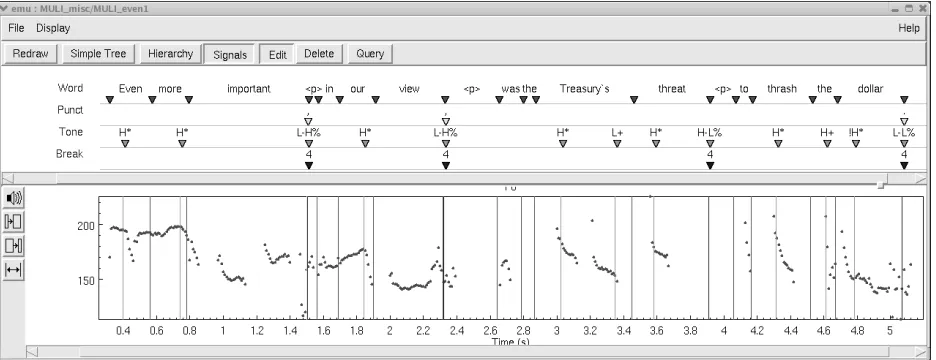
prosodically prominent (cf. Figure 2): Two peak ac-cents onevenandmorehighlight these words (with the more pronounced accent onmore expressing a contrast), whereas the wordimportantis deaccented, since the concept of ‘importance’ is inferable from the context. Furthermore, the adjective construc-tion forms a phrase of its own, delimited by an in-tonation phrase boundary, which is in turn signalled by a falling-rising contour plus a short pause. The following parenthesisin our view also constitutes a single intonation phrase. Here again,ouris assigned a contrastive accent, whileviewis unaccented.
All remaining content words of the clause re-ceive accents. However, the most ‘newsworthy’ word, threat, is the only one marked by a ris-ing pitch accent (L+H*), indicatris-ing its higher de-gree of importance for the speaker. This interpre-tation is further supported by the insertion of a phrase break directly after this word. Finally, the high-downstepped nuclear accent (H+!H*) ondollar
marks this item as being accessible by speaker and hearer (Pierrehumbert and Hirschberg, 1990).
5
Technical Realization
Above we presented a multi-level view on IS anno-tation, where each layer is to be annotated indepen-dently, to enable us to investigate interactions across the different levels. Such investigations involve ei-ther exploration of the integrated data (i.e., simul-taneous viewing of the different levels and searching across levels) or integrated processing, e.g., in order to discover or test correlations across levels. There are two crucial technical requirements that must be satisfied to make this possible: (i) stand-off anno-tation at each level and (ii) alignment of base data across the levels. Without the first, we would not be able to keep the levels separate and perform annota-tion at each level independently, without the latter we would not be able to align the separate levels.
We have chosen XML for the representation and maintenance of annotations. Each level of anno-tation is represented as a separate XML file, re-ferring to (sequences of) tokens in a common base file containing the actual text data. We keep inde-pendent levels of annotation separate, even if they can in principle be merged into a single hierarchy. Parallel aligned texts (e.g., the written and spo-ken versions of our corpus) are also represented via shared token IDs. A related issue is that of annota-tion tools. We are not using one generic tool for all levels for the simple reason that we have not found a tool that would support the needs of all levels and still be efficient (Bauman et al., 2004b; M¨uller and Strube, 2001). Therefore, we prefer to use tools specifically designed for the task at hand. We describe the tools of our choice below.
Prosodic Level The speech data was anno-tated with the EMU Speech Database System10 (Cassidy and Harrington, 2001a), which produces
Figure 2: Prosodic annotation of example sentence (2) in EMU
several files in which time stamps are associated with the respective annotated labels.
Syntactic LevelFor the syntactic annotation, we used the XML editor XML-Spy11. The annotation scheme is defined in a DTD, which is used to check the well-formedness and the validity of the annota-tion.
Discourse Level The discourse-level annotation is done with the MMAX annotation tool developed at EML, Heidelberg (M¨uller and Strube, 2003). MMAX is a light-weight tool written in Java that runs under both Windows and Unix/Linux. It sup-ports multilevel annotation of XML-encoded data using annotation schemes defined as DTDs. MMAX implements the above-mentioned general concepts of markables with attributes and standing in link rela-tions to one another. To exploit and reuse annotated data in the MMAX format, there is the MMAX XML Discourse API.
Integration The tools inevitably employ differ-ent data formats: on the prosodic level data is stored in the EMU data format, on the syntactic level in Tiger XML and on the discourse level in MMAX XML format.
The EMU files have to be converted into stand-off XML format. To be able to align the prosodic an-notation with the syntax and the discourse level, we chose the word as common basic unit. This poses several problems. First, punctuation marks count as separate words, but are not realised in spoken language. To be able to correlate prosodic phras-ing and punctuation marks, we store the punctua-tion marks as attributes of the respective preceding word. Second, pauses occur very often in speech, but as they are not part of the written texts, they do not count as words. Because they are an important fea-ture for phrasing and rhythm, we also code them as attributes of the preceding word. Third, in some cases a single word carries more than one accent, e.g.
11http://www.xmlspy.com/
long compounds (Getr¨ankedosenhersteller), or num-bers. In these cases, it would be interesting to know which part(s) of the word get accented, which re-quires some way of annotating parts of words (e.g., syllables). Finally, for some multi-word units, e.g.
18,50 Mark, the spoken realisation (achtzehn Mark f¨unfzig) cannot be aligned with the orthographic form, because spoken and orthographic form differ in number and order of words.
6
Conclusions and Perspectives
We presented the details of the discourse-level anno-tation scheme that we developed within the MULI project. This project is a pilot project: As such, the annotation has so far been restricted to a relatively small amount of data, since the experimental design of the study required testing of tools as well as man-ual annotation. We plan to extend the size of the corpus by manual and semi-automatic annotation in a follow-up project.The challenge in the MULI project has been to define theory-neutral and language-independent an-notation schemes for annotating linguistic data with information that pertains to the realisation and in-terpretation of information structure. An important characteristic of the MULI corpus, arising from its theory-neutrality, is that it is descriptive. The cor-pus annotation is not based on explanatory mecha-nisms: We have to derive such explanations from the data. (See (Skut et al., 1997) for related methodol-ogy pertaining to syntactic treebanks.)
computa-tional models from the corpus data.
Theory-neutrality enhances reusability of linguis-tic resources, because it facilitates the integration with other, theory-neutral resources. To some ex-tent we have already explored this in MULI, com-bining e.g. Tiger annotation with discourse-level annotation. Another possibility to explore is the to integrate MULI annotation with, e.g., the SALSA corpus (Erk et al., 2003), which provides more de-tailed semantico-pragmatic information in the style of FrameNet.
Our initial investigation also reveals where addi-tional annotation would be needed. For instance, the text example discussed above constitutes a con-cession scheme, which we cannot identify without annotating discourse/rhetorical relations. This in turn requires extending the annotation scheme to non-nominal markables.
Acknowledgements
We would like to thank Saarland University for fund-ing the MULI pilot project. Thanks also to Stella Neumann, Erich Steiner, Elke Teich, Stefan Bau-mann, Caren BrinckBau-mann, Silvia Hansen-Schirra and Hans Uszkoreit for discussions.
References
S. Bauman, C. Brinckmann, S. Hansen-Schirra, G.-J. Kruijff, I. Kruijff-Korbayov´a, S. Neumann, and E. Te-ich. 2004a. Multi-dimensional annotation of linguis-tic corpora for investigating information structure. In Proc. of the Workshop on Frontiers in Corpus Anno-tation, held at the NAACL-HLT 2004 Conference. S. Bauman, C. Brinckmann, S. Hansen-Schirra, G.-J.
Kruijff, I. Kruijff-Korbayov´a, S. Neumann, E. Te-ich, E. Steiner, and H. Uszkoreit. 2004b. The muli project: Annotation and analysis of information struc-ture in German and English. In Proc. of the LREC 2004 Conference.
M. E. Beckmann and J. Hirschberg. 1994. The ToBI an-notation conventions. Ms. and accompanying speech materials, Ohio State University.
D. Biber, S. Johansson, G. Leech, S. Conrad, and E. Finegan. 1999. The Longman Grammar of Spoken and Written English. Longman, Harlow.
S. Bird and M. Liberman. 2001. A formal framework for linguistic annotation. Speech Communication, 33(1-2):23–60.
S. Brants, S. Dipper, P. Eisenberg, S. Hansen, E. K¨onig, W. Lezius, C. Rohrer, G. Smith, and H. Uszkoreit. to appear. TIGER: Linguistic interpretation of a Ger-man corpus. Journal of Language and Computation (JLAC), Special Issue.
E. Bur´aˇnov´a, E. Hajiˇcov´a, and P. Sgall. 2000. Tagging of very large corpora: Topic-focus articulation. InProc. of the 18th Conference on Computational Linguistics (COLING’2000), July 31 - August 4 2000, pages 139– 144. Universit¨at des Saarlandes, Saarbr¨ucken, Ger-many.
J. Carletta, N. Dahlb¨ack, N. Reithinger, and M. A. Walker. 1997. Standards for dialogue coding in natu-ral language processing. Report on the dagstuhl sem-inar, Discourse Resource Initiative, February 3–7.
S. Cassidy and J. Harrington. 2001a. Multi-level anno-tation in the emu speech database management sys-tem. Speech Communication, 33(1-2):61–78.
S. Cassidy and J. Harrington. 2001b. Multi-level an-notation in the EMU speech database management system. Speech Communication, 33(1-2):61–78. P. Eisenberg. 1994. Grundriss der deutschen
Gram-matik, 3. Aufl. Metzler, Stuttgart, Weimar.
K. Erk, A. Kowalski, S. Pad´o, and M. Pinkal. 2003. To-wards a resource for lexical semantics: A large german corpus with extensive semantic annotation. In Proc. of ACL 2003, Sapporo, Japan.
M. Grice, S. Baumann, and R. Benzm¨uller. in press. German intonation in autosegmental-metrical phonol-ogy. In Sun-Ah Jun, editor, Prosodic Typology: Through Intonational Phonology and Transcription. OUP.
J. Gundel, N. Hedberg, and R. Zacharski. 1993. Cog-nitive status and the form of referring expressions in discourse. Language, (69):274–307.
M. A.K. Halliday. 1985. Introduction to Functional Grammar. Edward Arnold, London, U.K.
Z. Hlavsa. 1975. Denotace objektu a jej´ı prostˇredky v souˇcasn´e ˇceˇstinˇe [Denotating of objects and its means in contemporary Czech], volume 10 ofStudie a pr´ace lingvistick´e [Linguistic studies and works]. Academia. N. Ide, P. Bonhomme, and L. Romary. 2000. Xces: An xml-based standard for linguistic corpora. pages 825– 830, Athens, Greece.
H. Kamp and U. Reyle. 1993. From discourse to logic. Kluwer Academic Publishers, Dordrecht, the Nether-lands.
Geert-Jan M. Kruijff 2001. A Categorial-Modal Logical Architecture of Informativity: Dependency Grammar Logic & Information Structure, Faculty of Mathemat-ics and PhysMathemat-ics, Charles University. Prague, Czech Re-public.
I. Kruijff-Korbayov´a and M. Steedman. 2003. Discourse and information structure. Journal of Logic, Lan-guage and Information: Special Issue on Discourse and Information Structure, 12(3):249–259.
M. Marcus, G. Kim, M. Ann Marcinkiewicz, R. MacIn-tyre, A. Bies, M. Ferguson, K. Katz, and B. Schas-berger˙ 1994. The Penn treebank: Annotating predi-cate argument structure. InProc. of the Human Lan-guage Technology Workshop, San Francisco, Morgan Kaufmann.
D. McKelvie, A. Isard, A. Mengel, M.B. Moller, M. Grosse, and M. Klein. 2001. The MATE work-bench — an annotation tool for XML coded speech corpora. Speech Communication, 33(1-2):97–112. C. M¨uller and M. Strube. 2001. Annotating anaphoric
and bridging relations with MMAX. In Proc. of the 2nd SIGdial Workshop on Discourse and Dialogue, pages 90–95, Aalborg, Denmark, 1–2 September.
http://www.eml.villa-bosch.de/english/Research/NLP/sigdial
C. M¨uller and M. Strube. 2003. Multi-level an-notation in mmax. In Proc. of the 4th SIG-dial Workshop on Discourse and Dialogue, Sap-poro, Japan, 4-5 July. http://www.eml.villa-bosch.de/english/Research/NLP/Publications. R. Passoneau. 1996. Instructions for applying
J. Pierrehumbert and J. Hirschberg. 1990. The meaning of intonational contours in the interpretation of dis-course. In P.R. Cohen, J. Morgan, and M.E. Pollack, editors,Intentions in Communication, pages 271–311. MIT press.
Massimo Poesio, Renate Henschel, Janet Hitzeman, Rodger Kibble, Shane Montague, and Kees van Deemter 1999. Towards An Annotation Scheme For Noun Phrase Generation InProc. of the EACL Work-shop on Linguistically Interpreted Corpora. Bergen, Norway.
Massimo Poesio 2000. The GNOME
An-notation Scheme Manual Available online
http://www.hcrc.ed.ac.uk/~gnome/anno manual.html
E. Prince. 1981. Toward a taxonomy of given-new infor-mation. In P. Cole, editor,Radical Pragmatics, pages 223–256. Academic Press.
R. Quirk, S. Greenbaum, G. Leech, and J. Svartik. 1985. A comprehensive grammar of the English language. Longman, London.
P. Sgall, E. Hajiˇcov´a, and J. Panevov´a. 1986. The mean-ing of the sentence in its semantic and pragmatic as-pects. Reidel, Dordrecht, The Netherlands.
W. Skut, B. Krenn, T. Brants, and H. Uszkoreit. 1997. An annotation scheme for free word order languages. InApplied Natural Language Processing 1997, pages 88–95.
M. Steedman. 2000. Information structure and the syntax-phonology interface. Linguistic Inquiry, 31(4):649–689.
E. Teich, S. Hansen, and P. Fankhauser. 2001. Repre-senting and querying multi-layer annotated corpora. pages 228–237, Philadelphia.
E. Vallduv´ı and E. Engdahl. 1996. The linguistic reali-sation of information packaging. Linguistics, 34:459– 519.
B. L. Webber. 1983. So what can we talk about now? M.I.T. Press.
B. L. Webber. 1991. Structure and ostension in the in-terpretation of discourse deixis. Language and Cogni-tive Processes, 6(2):107–135.
H. Weinrich. 1993. Textgrammatik der deutschen Sprache. Dudenverlag, Mannheim u.a.