Exploiting OWL Ontologies in the Multilingual Generation of Object Descriptions
Ion Androutsopoulos
∗, Spyros Kallonis
∗+and Vangelis Karkaletsis
+ ∗Department of Informatics
Athens University of Economics and Business
Patission 76, GR-104 34 Athens, Greece
+Institute of Informatics and Telecommunications
National Centre for Scientific Research “Demokritos”
P.O. Box 60228, GR-153 10 Aghia Paraskevi, Greece
Abstract
We present three ways in which a natural language generator that produces textual descriptions of ob-jects from symbolic information can exploit OWL
ontologies, usingM-PIRO’s multilingual generation system as a concrete example.
1
Introduction
A strand of work in Natural Language Generation (NLG) has been devoted to the generation of textual descriptions of ob-jects from symbolic information in ontologies and databases. An example of such work isILEX [O’Donnell et al., 2001],
which was demonstrated mostly in the museums domain, where it could produce personalised English descriptions of exhibits; the Power system [Dale et al., 1998] is another ex-ample from the same domain. More recently, the M-PIRO
project [Isard et al., 2003] developed a multilingual exten-sion ofILEX, which has been tested in a variety of domains, including museum exhibits and items for sale.1 A major
prob-lem in this and many otherNLGsubareas is the difficulty of obtaining source symbolic information in forms compatible with the requirements of the language generators. This issue has mainly been addressed so far by extracting source infor-mation from structured and semi-structured data [Dale et al., 1998], and by developing authoring tools that help in the cre-ation of source informcre-ation and domain-dependent linguistic resources. Such tools were developed, for example, inGIST
[Power and Cavallotto, 1996],DRAFTER[Hartley and Paris,
1997],ITRI’sWYSIWYMsystems [Van Deemter and Power, 2003], andM-PIRO[Androutsopoulos et al., 2002].
In recent years, considerable effort has been invested in the Semantic Web, which can be seen as an attempt to develop mechanisms that will allow computer applications to reason more easily about the semantics of the resources (documents, services, etc.) of the Web. A major target is the development of standard representation formalisms, that will allow ontolo-gies to be published on the Web and be shared by different
1
M-PIROwas anISTproject of the European Union. It ran from 2000 to 2003. Its partners were: the University of Edinburgh,ITC -irst,NCSR“Demokritos”, the National and Kapodistrian University of Athens, the Foundation of the Hellenic World, and System Simu-lation. This paper includes additional work, carried out at the Athens University of Economics and Business andNCSR“Demokritos”.
computer applications. The emerging standard for specifying ontologies isOWL, an extension of RDF.2 In NLG systems
that describe objects, pre-existingOWL ontologies can pro-vide much of the required source information, reducing the authoring effort and providing a common standard represen-tation to generate from.3 We discuss the role thatOWL
on-tologies can play inM-PIRO’s authoring process, and report on progress we made towards extendingM-PIRO’s authoring tool to supportOWL. We argue that the benefit from using
OWLwould be greater, if the ontologies included the domain-dependent linguistic resources and user modelling informa-tion thatNLGsystems need. This would allow content to be published on the Sematic Web in the form ofOWLontologies, with differentNLGengines acting as browsers responsible for rendering the content in different natural languages and tai-loring it to the interests and interaction history of the users. A challenge for theNLG community, then, is to agree upon standards on how linguistic resources and user modelling in-formation should be embedded inOWLontologies.
Section 2 below introduces brieflyM-PIROand its author-ing tool. Section 3 then shows howM-PIRO’s ontologies can be expressed in OWL, and presents facilities we have added to the authoring tool to export ontologies in OWL. Among other benefits, this allows machine-generated texts to be pub-lished on the Web along with the ontology they were gen-erated from, and to be annotated with OWL entries that ex-press their semantics in terms of the ontology, making the semantics accessible to computer applications. Section 4 sub-sequently discusses how existingOWLontologies can be im-ported into the authoring tool, and the benefits that this brings. Our import facilities currently support only a subset ofOWL; part of section 4 is devoted to problems that remain to be solved. Section 5 focuses on the need to establish standards to embed linguistic resources and user modelling information in OWLontologies, and how this would allow NLGengines to become the browsers of the Semantic Web. Section 6 con-cludes and summarises directions for future research.
2
M-PIRO’s authoring tool
M-PIRO’s authoring tool allows authors, i.e., persons respon-sible for portingM-PIRO’s technology to new application
do-2
Consult http://www.w3.org/TR/owl-guide/.
3
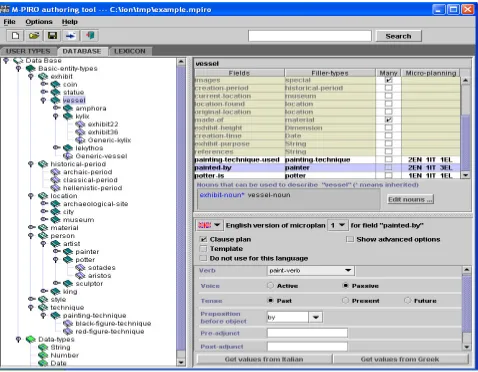
Figure 1: AnM-PIROontology and a clause plan.
mains, to modify the domain-dependent resources: the ontol-ogy, some language resources, and the end-user stereotypes.
M-PIROgenerates texts from an ontology that provides in-formation on the entities of a domain (e.g., the statues and artists in a museum), the relationships between the entities (e.g., the association of statues with their artists), and the enti-ties’ attributes (e.g., their names or dimensions). Entities are not necessarily physical objects; they may be abstract con-cepts (e.g, historical periods). They are organized in a tax-onomy of entity types, as illustrated in Figure 1, where ‘ex-hibit’ and ‘historical-period’ are basic entity types, i.e., they have no super-types. The ‘exhibit’ type is further subdivided into ‘coin’, ‘statue’, and ‘vessel’. The latter has the sub-types ‘amphora’, ‘kylix’, and ‘lekythos’. Each entity belongs to a particular type; e.g., ‘exhibit22’ belongs to ‘kylix’, and is, therefore, also a ‘vessel’ and an ‘exhibit’. For simplicity,M -PIROadopts single inheritance, i.e., a type may not have more than one parents, and an entity may not belong to more than one types.4 This introduces some problems when importing
OWLontologies; related discussion follows.
Relationships are expressed using fields. It is possible to introduce new fields at any entity type, which then be-come available at all the entities of that type and its subtypes. In Figure 1, the fields ‘painting-technique-used’, ‘painted-by’, and ‘potter-is’ are introduced at the type ‘vessel’. (The top right panel shows the fields of the type selected in the left panel.) Hence, all entities of type ‘vessel’ and its sub-types, i.e., ‘amphora’, ‘kylix’, and ‘lekythos’, carry these fields. Furthermore, entities of type ‘vessel’ inherit the fields ‘creation-period’, ‘current-location’, etc., up to ‘references’, which are introduced at the ‘exhibit’ type. (The ‘images’ field is used to associate images with entities.) The fillers of each field, i.e., the possible values, must be entities of a particular type. In Figure 1, the fillers of ‘potter-is’ are of type ‘potter’; hence, the entities ‘sotades’ and ‘aristos’ are the only possible values. To represent that a particular ‘vessel’ entity was
cre-4
[image:2.612.315.556.53.238.2]M-PIRO’s core language generator actually supports some forms of multiple inheritance, but the authoring tool does not.
Figure 2: Source information and the resulting English text.
ated during the classical period by ‘aristos’, one would fill in that entity’s ‘creation-period’ with ‘classical-period’, and its ‘potter-is’ with ‘aristos’. Figure 2 shows the fields of entity ‘exhibit22’, and the resulting English description. M-PIRO
supports English, Greek, and Italian; descriptions can be gen-erated in all three languages from the same ontology.
The ‘Many’ column in Figure 1 is used to mark fields whose values are sets of fillers of the specified type. In the ‘made-of’ field, this allows the value to be a set of materials (e.g., gold and silver). It is, thus, possible to represent many-to-one (e.g., only one material per exhibit) and many-to-many relationships (many materials per exhibit), but not one-to-one relationships (e.g., a unique social security code per person).
OWL, in contrast, supports one-to-one relationships.
Fields are also used to represent attributes of entities (e.g., their names or dimensions). Several built-in data-types are available (‘string’, ‘number’, ‘date’, etc.), and they are used to specify the possible values of attribute-denoting fields. The ‘Many’ column also applies to attributes. In Figure 1, the values of ‘references’ and ‘exhibit-purpose’ are strings. The two fields are intended to hold canned texts containing bibli-ographic references and descriptions of what a particular ex-hibit was used for; e.g., “This statue honours the memory of Kroissos, a young man who died in battle”. Information can be stored as canned text in string-valued fields when it is dif-ficult to represent in symbolic form. The drawback is that canned texts have to be entered in all three languages.
to generate comparisons to previously seen objects.
M-PIROuses systemic grammars, one for each language, to convert sentence specifications to surface text. The grammars can be used in a variety of object description applications without modifications, and, hence, can be treated as domain-independent for M-PIRO’s purposes. However, a part of the lexicon that the grammars employ, known as the domain-dependent lexicon, has to be filled in by the authors when the system is ported to a new application. The domain-dependent lexicon contains entries for nouns and verbs; when moving to a new application, it is initially empty. The authors enter the base forms of the nouns and verbs they wish the system to use, and there are facilities to generate the other forms au-tomatically. Noun entries are linked to entity types, to allow, for example, the system to generate referring noun phrases; in Figure 1, the entity type ‘vessel’ is associated with the lexicon entry ‘vessel-noun’ (see the area next to ‘Edit nouns’). The entries are trilingual; e.g., ‘vessel-noun’ contains the nouns “vessel”, “αγγι0o”, and “vaso” of the three languages.
For each field and each language, the authors have to pro-vide at least one micro-plan, that specifies how the field can be expressed as a clause in that language. Follow-ingILEX,M-PIRO’s primary form of micro-plans are clause plans, where the author specifies the clause to be generated in abstract terms, by selecting the verb to be used (from the domain-dependent lexicon), the voice and tense of the result-ing clause, etc. As with nouns, verb-entries are trilresult-ingual; e.g., the ‘paint-verb’ entry of the clause plan of Figure 1 con-tains the base verb forms “paint”, “ζωγραφι0ζω”, and “dipin-gere”. By default, the entity that carries the field becomes the subject of the resulting clause, and the filler of the field the object. The clause plan of Figure 1 leads to clauses like “This vessel was painted by Eucharides”. Appropriate referring ex-pressions, e.g., “Eucharides”, “a painter”, “him”, are gener-ated automatically. Alternatively, micro-plans can be speci-fied as simplistic templates, i.e., sequences of canned strings and automatically generated referring expressions; see [An-droutsopoulos et al., 2002] for details.
Unlike ILEX, M-PIRO allows multiple micro-plans to be specified per field, and this allows greater variety in the gen-erated texts. Furthermore, the user stereotypes can be used to indicate that particular micro-plans are more appropriate to particular user types, and this allows the system to tailor the expressions it produces. When planning the text,M-PIRO
attempts to place clauses that convey more interesting fields towards the beginning of the text. It is also possible for the authors to specify particular orderings; otherwise,M-PIRO’s text planner is domain-independent.
3
Exporting M-PIRO ontologies to OWL
M-PIRO’s ontological assumptions are very similar to those of OWL. As with M-PIRO, OWL assumes there are entity types, called classes, and entities, called individuals. M
-PIRO’s fields correspond toOWL’s properties. Relationships between entities are expressed by defining object properties, that map entities to other entities, while attributes of entities are expressed via datatype properties, that map entities to lit-erals of specific datatypes. It is, thus, relatively
straightfor-ward to export anM-PIROontology toOWL, as sketched be-low. There are actually three different versions ofOWL, called
OWL LITE,OWL DL, andOWL FULL, with increasing sophis-tication. The mapping fromM-PIRO’s ontologies toOWL pro-duces ontologies inOWL LITE, which can be thought of as a
subset ofOWL DLandOWL FULL.
When exporting M-PIRO ontologies to OWL, entity types give rise to class definitions; e.g., the ‘vessel’ entity type of Figure 1 leads to the followingOWLclass:
<owl:Class rdf:ID="Vessel"> <rdfs:subClassOf>
<owl:Class rdf:about="#Exhibit" /> </rdfs:subClassOf>
</owl:Class>
Fields are exported as OWLproperties; e.g., the ‘painted-by’ field of Figure 1 leads to the following object property that associates vessels with painters:
<owl:ObjectProperty rdf:ID="painted-by"> <rdfs:domain rdf:resource="#Vessel" /> <rdfs:range rdf:resource="#Painter" /> </owl:ObjectProperty>
The ‘exhibit-purpose’ field of Figure 1 leads to the following datatype property, that associates exhibits with strings:
<owl:DatatypeProperty rdf:ID="exhibit-purpose"> <rdfs:domain rdf:resource="#Exhibit" /> <rdfs:range rdf:resource=
"http://www.w3.org/2001/XMLSchema#string" /> </owl:DatatypeProperty>
Entities map toOWLindividuals, as with statue ‘exhibit42’
below. String-valued fields, like ‘exhibit-purpose’, lead to properties with separate values per language.
<Statue rdf:ID="exhibit42">
<current-location rdf:resource="#acropolis-museum" /> <creation-period rdf:resource="#archaic-period" /> <exhibit-purpose xml:lang="EN">This statue honours the
memory of Kroissos, a... </exhibit-purpose>
<exhibit-purpose xml:lang="IT">Questa...</exhibit-purpose> <exhibit-purpose xml:lang="GRC">...</exhibit-purpose> ...
</Statue>
One problem we have encountered is that OWL provides no mechanism to specify default values of properties. InM
A second problem is that some of M-PIRO’s datatypes (e.g., dates) do not correspond exactly to OWL’s recom-mended datatypes. We have defined new datatypes inOWL, using XML SCHEMA, that correspond exactly to M-PIRO’s datatypes, and we currently use those in the exported ontolo-gies instead of the recommended OWL datatypes. We hope to modify M-PIRO’s datatypes to correspond exactly to the recommended ones in future versions ofM-PIRO’s system.
The mapping from M-PIRO ontologies to OWL that we sketched above has been fully implemented, and it now al-lows the authoring tool to export its ontologies inOWL. Apart from allowing other systems to reuse M-PIRO’s ontologies, the mapping also opens up the possibility of generating object descriptions in both human-readable and machine readable forms. Every natural language description thatM-PIRO pro-duces can in principle also be rendered in a machine-readable form consisting ofOWLindividuals, this time using the map-ping to translate intoOWL the parts of the ontology that the system has decided to convey. For example, the English de-scription of Figure 2 can be rendered inOWLas:
<Kylix rdf:ID="exhibit22">
<creation-period rdf:resource="#archaic-period /> <painting-technique-used
rdf:resource="#red-figure-technique /> <painted-by rdf:resource="#eucharides /> ...
</Kylix>
M-PIRO’s generator might have also included in the resulting text information deriving from the fields of the painter, e.g., the city the painter was born in, or other entities mentioned in the text. In that case, theOWLrendering of the description’s content would include additional individuals, such as:
<Painter rdf:ID="eucharides">
<painter-city rdf:resource="#athens" /> ...
</Painter>
In the machine-readable forms of the descriptions, theOWL
individuals would include only properties corresponding to fields the generator has decided to convey, unlike when ex-porting the full ontology. That is, theOWL individuals may not include properties corresponding to fields deemed unin-teresting for the particular end-user, or fields that have already been conveyed; e.g., the painter’s city may have already been conveyed when describing another work of the same artist.
It is thus possible to annotate the generated texts withOWL
individuals representing their semantics. This would allow computer applications (e.g., Web agents visiting the site of a retailer that generates product descriptions usingM-PIRO’s technology) to reason about the semantics of the texts (e.g, locate items of interest). Alternatively, it is possible to de-fine user types for both human users (e.g., ‘expert’, ‘average-adult’) and artificial agents acting for users of different in-terests and expertise (e.g., ‘agent-expert’, ‘agent-average-adult’), and produce human-readable or machine-readable descriptions depending on the user type (inM-PIRO’s demon-strators, there is a login stage where visitors select their types). The OWL ontology without its individuals (classes
and properties only) can also be published on the Web to help the agents’ developers figure out the structure and semantics of theOWLindividuals their agents may encounter.
4
Importing OWL ontologies
When porting M-PIRO’s system to a new domain, much of the authoring effort is devoted to defining entity types, and the fields that express attributes and relationships. This is a time-consuming process, partly because the ontology often has to be reshaped as more experience about the domain is gained. If a well-thoughtOWLontology about the domain al-ready exists, as will be the case with the gradual expansion of the Semantic Web, the authoring can be accelerated by im-porting the existing ontology into the authoring tool. There-after, the authors can focus on adding the necessary domain-dependent linguistic resources (micro-plans, lexicon entries, etc.), setting up the user stereotypes, and populating the on-tology with entities that were not already present in the im-ported one. For the latter, we have developed software that allows the authoring tool to construct entities automatically from data in relational databases viaODBC; the authors only need to establish a mapping between the fields of the entity types and the attributes of the database’s relations.
As already mentioned, there are three versions of OWL
(OWL LITE, OWL DL, OWL FULL) with increasing sophisti-cation. The mapping from M-PIRO’s ontologies toOWL of the previous section uses only a subset ofOWL LITE. Hence, importing an arbitraryOWLontology, as opposed to anOWL
ontology exported by the authoring tool, is not simply a mat-ter of following the inverse mapping of the previous section. Below we highlight the problems that arise when importing arbitrary OWL LITE ontologies, to offer a taste of the work that remains to be carried out to makeM-PIRO’s system fully compatible withOWL LITE. We also point to some additional problems that arise when one moves on toOWL DLandOWL FULL. The discussion is based on experiments we conducted with more than a dozen of existingOWLontologies.5
One of the main difficulties is thatOWL (all versions) al-lows multiple inheritance, while M-PIRO does not (section 2). Importing an ontology with multiple inheritance currently causes the process to fail. The need for multiple inheritance has also been noted by authors, who often encounter cases where, for example, a person has to be categorized as both painter and potter. We hope to support multiple inheritance in future versions; this requires, among others, modifications in how the ontology is presented in the authoring tool.
Another problem is thatOWL(all versions) supports prop-erty inheritance. For example, there may be a propprop-erty ‘is-player-of’, used to represent the relationship between soccer players and their teams, and another property ‘is-goalkeeper-of’, that associates goalkeepers with their teams. The latter is a subproperty of the former, in the sense that if X is the goalkeeper ofY, thenX is also a player ofY. The import facilities of the authoring tool currently ignore subproperty inheritance, because there is no corresponding notion in M
-PIRO’s ontologies; i.e., the two properties would be treated as unrelated. Subproperty inheritance, however, could help the generator avoid expressing information that follows from other information it has already conveyed; e.g., if a user has been told thatX is the goalkeeper ofY, avoid saying thatX
is also a player of Y. We hope to extend M-PIRO’s model
5
with subproperty inheritance in future work.
A further complication is thatOWL LITEallows the range of possible values of a property to be the intersection of sev-eral classes, while inM-PIRO’s model the values of each field must come from a single, named entity type. A possible solu-tion is to create automatically a new entity type inM-PIRO’s ontology for each intersection in theOWLontology, but this leads back to the single inheritance problem, because the in-tersection has to inherit from all the intersected types. This problem is more acute inOWL DLandOWL FULL, where sev-eral set operations (e.g., union, complement) between classes are allowed when specifying the ranges of properties.
In OWL it is also possible to refine a property’s range. For example, an ontology may specify that individuals of the class ‘product’ have a property ‘made-by’, which asso-ciates them with individuals of the class ‘manufacturer’; there would be anrdfs:rangein the definition of ‘product’ set-ting the range of ‘made-by’ to ‘manufacturer’. We may then wish to specify that individuals of ‘automobile’, a subclass of ‘product’, accept as values of ‘made-by’ only individu-als of ‘automobile-manufacturer’, a subclass of ‘manufac-turer’. There are mechanisms inOWL (all versions) to state this (allValuesFromtag), but there is no equivalent mech-anism inM-PIRO’s ontological model. We currently ignore range refinements when importingOWL ontologies, but this has the risk that authors may violate refinements (e.g., when adding individuals), creating ontologies that are no longer compatible with the imported ones.6 Additional work is
needed to support OWL’s (all versions) someValuesFrom, which allows stating that in set-valued properties (cf. M
-PIRO’s ‘Many’ column) at least one of the elements of each set-value should belong to a particular class. A further mech-anism in OWL DL and OWL FULL (hasValuetag) allows specifying that all the individuals of a class have a particu-lar value at some of their properties; e.g., that all wines of class ‘burgundy’ have ‘dry’ taste. Such information can be imported into M-PIRO’s generic entities (Section 3), though the correspondence is not exact, as generic entities carry de-fault information that may be overridden.
As already pointed out (Section 1), M-PIRO does not al-low relationships or attributes to be declared as one-to-one. In contrast, OWL (all versions) provides appropriate facili-ties, as well as facilities to declare properties (relationships or attributes) as transitive, symmetric, or the inverse of an-other one. All such declarations are currently ignored when importing OWL ontologies; again, this has the risk that the authors may modify the ontologies in ways that are incom-patible with the ignored declarations. An additional problem inOWL FULLis that classes can be used as individuals, allow-ing the use of relationships to associate classes, as opposed to individuals; this violatesM-PIRO’s current ontological model. It should be clear, then, that there are still issues to be re-solved inM-PIRO’s ontological assumptions to makeM-PIRO
fully compatible withOWL LITE, and there are additional dif-ficulties withOWL DL andOWL FULL. As discussed above, however, most of the necessary improvements appear to be
6
ILEXandM-PIRO’s core generation engine provide some sup-port for such refinements, butM-PIRO’s authoring tool does not.
within reach, at least forOWL LITE. Overall, it appears rea-sonable to conclude that future versions ofNLGsystems like
M-PIRO’s will be able to exploit fullyOWLontologies.
5
Towards semantic browsers
We have so far proposed two ways in whichOWLontologies can be exploited in systems likeM-PIRO’s: first, the gener-ated texts can be accompanied byOWLspecifications of their semantics, with anOWL ontology establishing the semantic vocabulary; and, second, existingOWLontologies can be im-ported, to accelerate the authoring. In both cases, the on-tologies are linked to domain-dependent language resources (micro-plans, lexicon entries, etc.) and user stereotypes (the interest of each field per user type, etc.), but these additional resources are not parts of theOWLontologies: when export-ingM-PIROontologies toOWL, the authoring tool produces additional proprietary XML files that contain the domain-dependent language resources and stereotypes; and when im-portingOWL ontologies developed by others, the additional resources have to be filled in by the authors. We argue below that agreeing upon standards on how the additional resources could be embedded inOWLontologies would allowNLG sys-tems likeM-PIROto play a central role in the Semantic Web.
Note, first, that it is possible to represent inOWL M-PIRO’s domain-dependent linguistic resources and user stereotypes. For example, micro-plans could be treated as individuals of a class ‘Microplan’ with subclasses ‘ClausePlan’ and ‘Tem-plate’. In a similar manner, there would be a class ‘Voice’ with individuals ‘active’ and ‘passive’, and similarly for tenses, genders, supported languages, etc. There would also be a class ‘LexiconEntry’ with subclasses ‘VerbEntry’ and ‘NounEntry’, and individuals corresponding to the entries of the domain-dependent lexicon. (Classes corresponding to language resources could be grouped under a ‘LinguisticRe-source’ super-class.) Then, for example, the English micro-plan of Figure 1 would roughly be represented inOWLas:
<ClausePlan rdf:ID="painted-by-mp1-en"> <for-property rdf:resource="#painted-by" /> <for-language rdf:resource="#english" /> <use-verb rdf:resource="#paint-verb" /> <use-voice rdf:resource="#passive" /> <use-tense rdf:resource="#past" /> <use-preposition>by</use-preposition> </ClausePlan>
Similarly, the English part of the trilingual lexicon entry ‘vessel-noun’ could roughly be represented inOWLas:
<NounEntry rdf:ID="vessel-noun-en">
<lexicon-entry-id>vessel-noun</lexicon-entry> <for-language rdf:resource="#english" /> <refers-to-class rdf:resource="#vessel" /> <base-form>vase</base-form />
<has-gender rdf:resource="#neuter" /> ...
</NounEntry>
with noun entries, which have to be associated with classes (entity types) they can refer to: in the noun entry above, we used the class name ‘vessel’ as the value of property ‘refers-to-class’. Using class names as values of properties again requiresOWL FULL. Similar problems arise with stereotypes.
We are currently exploring how M-PIRO’s domain-dependent language resources and stereotypes can be best embedded inOWL ontologies. This embedding will lead to ‘language-enabled’ ontologies, that will include all the re-sources a system likeM-PIROneeds to render the ontologies in several natural languages. This opens up another possibil-ity for publishing content on the Semantic Web: a site could publish only its language-enabled ontology (including the in-dividuals that correspond, for example, to the items it sells), and the NLG technology to render the ontology in natural language could take the form of a browser plug-in. When visiting a site of this kind, a human user would be initially presented with an inventory of objects that can be described (e.g., product thumbnails). Selecting an object would trans-mit to the browser the ontology or its relevant parts, and it would be the responsibility of the NLG plug-in to produce an appropriate description in the user’s language and tailor it to the user’s type and interaction history. If the NLG com-munity could establish standards for language-enabled on-tologies, there could be different NLG plug-ins by different
makers, perhaps each specialising in particular languages and user types, in the same way that there are different browsers for HTML. There could also be a market for developers of language-enabled ontologies for particular sectors (e.g., mu-seums, retailers of computer equipment), who would sell their ontologies to organisations wishing to publish content in those sectors. The client organisations would only need to populate the ontologies with their own individuals (e.g., ex-hibits, products), possibly by reusing databases, and publish them at their sites. Artificial agents would interact directly with the ontologies of the various sites, invoking their own
NLGplug-ins to report their findings in natural language. Establishing standards is, of course, far from trivial. For example, different NLG systems may require very different domain-dependent language resources, or make different as-sumptions on which resources are domain-dependent or inde-pendent. Nevertheless, we believe it is worth trying to move towards this direction, as there are large potential gains for both theNLGcommunity and the users of the emerging Se-mantic Web. Furthermore, the effort to establish standards should proceed in cooperation with other fields that could ex-ploit language-enabled ontologies. For example, the associ-ation between entity types and noun entries can be used for query expansion in information retrieval; and the association between micro-plans and ontology fields can be useful in in-formation extraction systems that populate ontologies.
6
Conclusions and future work
We have presented three ways in which anNLGsystem that generates object descriptions from symbolic information can exploitOWLontologies, usingM-PIRO’s system as an exam-ple. First, theNLGsystem’s source symbolic information can be exported in the form of an OWL ontology. Apart from
enabling otherOWL-aware systems to reuse the source infor-mation, this allows the generated texts to be accompanied by
OWLdescriptions of their semantics, with theOWLontology establishing the semantic vocabulary. Thus, the semantics of the generated texts become fully accessible to computer ap-plications, such as Web agents. Second, when porting the
NLGsystem to a new domain, it is possible to import a pre-existing OWL ontology, saving a significant amount of ef-fort. Third, it is possible to embed inOWLontologies all the domadependent language resources and user modelling in-formation thatNLGsystems likeM-PIRO’s need. This would allow Web sites that carry information about objects to pub-lish their content solely in the form ofOWLontologies, pass-ing the responsibility of generatpass-ing natural language descrip-tions toNLGbrowser plug-ins. The latter requires the NLG
community to develop appropriate standards.
We hope that future work will address the remaining in-compatibilities betweenM-PIRO’s technology andOWL. We also plan to explore more fully howNLGengines could be-come central components of the Semantic Web’s browsers, and release prototypes that will demonstrate these ideas.
References
[Androutsopoulos et al., 2002] I. Androutsopoulos, D. Spi-liotopoulos, K. Stamatakis, A. Dimitromanolaki, V. Karkaletsis, and C.D. Spyropoulos. Symbolic authoring for multilingual natural language generation. In Methods and Applications of
Artificial Intelligence, number 2308 in Lecture Notes in Artificial
Intelligence, pages 131–142. Springer, 2002.
[Bontcheva and Wilks, 2004] K. Bontcheva and Y. Wilks. Auto-matic report generation from ontologies: the MIAKT approach. In Proc. of the 9th International Conference on Applications
of Natural Language to Information Systems, pages 324–335,
Manchester, U.K., 2004.
[Dale et al., 1998] R. Dale, S.J. Green, M. Milosavljevic, C. Paris, C. Verspoor, and S. Williams. Dynamic document delivery: gen-erating natural language texts on demand. In Proc. of the 9th
International Conference and Workshop on Database and Expert Systems Applications, pages 131–136, Vienna, Austria, 1998.
[Hartley and Paris, 1997] A. Hartley and C. Paris. Multilingual document production – from support for translating to support for authoring. Machine Translation, 12(1–2):109–129, 1997. [Isard et al., 2003] A. Isard, J. Oberlander, I. Androutsopoulos, and
C. Matheson. Speaking the users’ languages. IEEE Intelligent
Systems, 18(1):40–45, 2003.
[O’Donnell et al., 2001] M. O’Donnell, C. Mellish, J. Oberlander, and A. Knott. ILEX: an architecture for a dynamic hypertext generation system. Natural Language Engineering, 7(3):225– 250, 2001.
[Power and Cavallotto, 1996] R. Power and N. Cavallotto. Multi-lingual generation of administrative forms. In Proc. of the 8th
International Workshop on Natural Language Generation, pages
17–19, Herstmonceux Castle, U.K., 1996.
[Van Deemter and Power, 2003] K. Van Deemter and R. Power. High-level authoring of illustrated documents. Natural Language
Engineering, 9(2):101–126, 2003.
[Wilcock, 2003] G. Wilcock. Talking OWLs: towards an ontology verbalizer. In Proc. of the workshop “Human Language