A Q u e s t i o n A n s w e r i n g S y s t e m D e v e l o p e d as a P r o j e c t in a
Natural Language P r o c e s s i n g Course*
W . Wang, J. Auer, R. P a r a s u r a m a n , I. Zubarev, D.
Brandyberry, and
M. P.
H a r p m
Purdue University
West Lafayette, IN 47907
{wang28,jauer,pram,dbrandyb,harper}@ecn.purdue.edu and [email protected]
Abstract
This paper describes the Question Answering Sys- tem constructed during a one semester graduate- level course on Natural Language Processing (NLP). We hypothesized that by using a combination of syn- tactic and semantic features and machine learning techniques, we could improve the accuracy of ques- tion answering on the test set of the Remedia corpus over the reported levels. The approach, although novel, was not entirely successful in the time frame of the course.
1
Introduction
This paper describes a preliminary reading com- prehension system constructed as a semester-long project for a natural language processing course. This was the first exposure to this material for all but one student, and so much of the semester was spent learning about and constructing the tools that would be needed to attack this comprehen- sive problem. The course was structured around the project of building a question answering system following the HumSent evaluation as used by the Deep Read system (Hirschman e t a ] . , 1999). The Deep Read reading comprehension prototype system (Hirschman et al., 1999) achieves a level of 36% of the answers correct using a bag-of-words approach together with limited linguistic processing. Since the average number of sentences per passage is 19.41, this performance is much better than chance (i.e., 5%). We hypothesized that by using a combina- tion of syntactic and semantic features and machine learning techniques, we could improve the accuracy of question answering on the test set of the Remedia corpus over these reported levels.
2
System Description
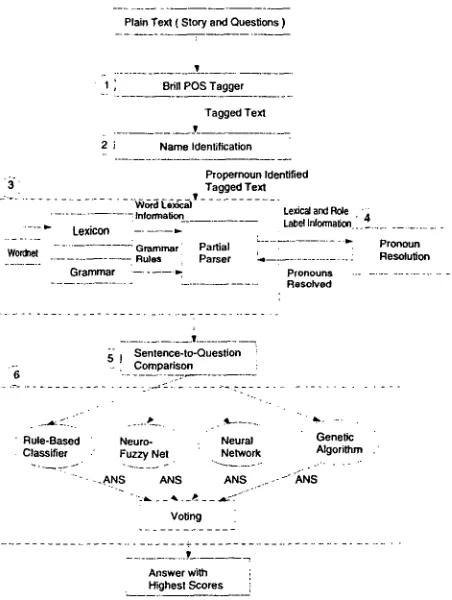
The overall architecture of our system is depicted in Figure 1. The story sentences and its five ques- tions (who, what, where, when, and why) are first preprocessed and tagged by the Brill part-of-speech
* W e w o u l d l i k e t o t h a n k t h e D e e p R e a d g r o u p for g i v i n g u s
" a c c e s s t o t h e i r test b e d .
P l a i n T e x t ( Story and Questions )
)i
. . . 8__~'!P°_s__!,g_ ~ L . . . Tagged T e x t2 i N a m e Identification
P r o p e r n o u n Identified
3 Tagged Text
J r _ . . . T . . .
Word Lex]cat
Lexica$ and R o l e • I n f o n m a t i o r L
. . . L a b e l l n f o r m a l J ~ 1 ~ . . . . . . . . ~ L e x i c o n . . . ~ . . . . . . L . . .
Wordnel . . . Grammar P a r t i a l ~ : P r o n o u n R e s o l u t i o n . . . - . . . Rules Parser 4 - - - . . . -
G r a m n r m r . . . ~ P r o n o u n s . . .
.............................. Resolved
Sentence-to-Question
. I, C o m p a r i s o n i
. - - ~ = : : . . . ~ _ _ . . ~ . . . ~ " R u l e - B a s e d " N e u r o - : N e u r a l G e n e t i c
Classifier .' F u z z y N e t . Network Algorithm .'
• • . A N S A N S A N S ~ - - ~ " A N S
V o t i n g
. . . ÷ . . .
Answer with i
Highest S c o r e s i
Figure 1: The architecture for our question answer- ing system.
[image:1.596.346.572.233.533.2]m o d u l e s which a t t e m p t to learn which features o f the comparison are the m o s t important for identify- ing whether a sentence is a strong answer candidate. We intended to set up a voting scheme a m o n g vari- ous modules; however, this part o f the work has not been completed (as indicated by the dashed lines).
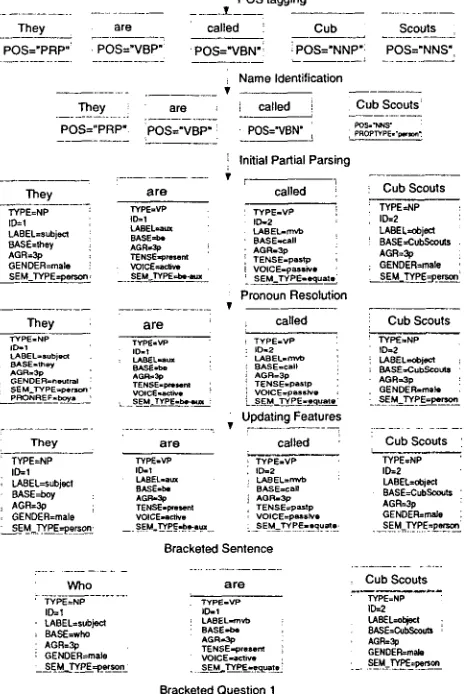
Our system, like Deep Read, uses as the develop- ment set 28 stories from grade 2 and 27 from grade 5, each with five short answer questions (who, what, when, where, and why), and 60 stories with ques- tions from grades 3 and 4 for testing 1. We will refer to the development and testing data as the R e m e d i a corpus. The following example shows the informa- tion added to a plain text sentence as it progresses through each m o d u l e of the s y s t e m we have created. Each module-is described in more detail in the fol- lowing sections.
2.1 N a m e I d e n t i f i c a t i o n M o d u l e
The N a m e Identification Module expects as in- put a file that has been tagged by the Brill tagger distributed with the Deep Read system. T h e most important named entities in the Re- media corpus are the names o f people and the
names of places. To distinguish between these
two types, we created dictionaries for n a m e s of
people and n a m e s of places. T h e first and last
n a m e dictionaries were derived from the files
at http ://www. census, gov/genealogy/names/.
First names had an associated gender feature; names that were either male or female included gender frequency. Place n a m e s were extracted from atlases and other references, and included n a m e s of countries, major cities and capital cities, major
attractions and parks, continents, etc. WordNet
was also consulted because of its coverage of place names. There are 5,165 first n a m e entries, 88,798 last n a m e entries, and 1,086 place n a m e entries in the dictionaries used by this module.
T h e m o d u l e looks up possible names to decide whether a word is a person's n a m e or a location. If it cannot find the word in the dictionaries, it then looks at the POS tags provided in the input file to deter- mine whether or not it is a propernoun. Heuristics (e.g., looking at titles like Mr. or word endings like
rifle)
are then applied to decide the semantic typeof the propernoun, and if the type cannot be deter- mined, the module returns both person and location as its type. The accuracy of the N a m e Identification Module on the testing set was 79.6%. The accuracy adjusted to take into account incorrect tagging was 83.6%.
T h e r e were differences b e t w e e n t h e D e e p R e a d e l e c t r o n i c version of t h e p a s s a g e s a n d t h e R e m e d i a p u b l i s h e d passages. We used the e l e c t r o n i c passages.
R m 3 - 5 (... The club is f o r boys who are under 12 years Bid.) They are called Cub ScButs.
(Answer to Question 1 )
: POS tagging
They are called i Cub Scouts PO_S _-.~_P.R. p_: P_O_ S_=_~V_B P" ' P_OS='__V_BN'_~ ii_POS='N_N_ P21 POS_--. :NN__S"
Name Identification
They are ~ i called Cub Scouts'
Pos.'t~s" : P O S = " P R P " P O S = ' V B P " " P O S = ' V B N " P R O P ~ P E . ' ~ t
They TYPE=NP ID=I LABEL=subject BASE=they AGR=3p GENDER=male SEM_TYPE=per~ .z~,
a r e
TYPE=VP ID=I LABEL=auK BASE=be AGR~,~p TENSE=present VOtCE=ac~,'e SEM T Y P E = t a n
They a r e
"P#PE=NP TYP~=VP
11:>-i io=1
IL'~'BE L=subjec~ L A B E L ~
~',SElthey BAS.~Mce
AGR=3p , AGR.~3 p
G E N D E R = n u t ~1 : TENBE=pQI=~I~ BEM T Y P E = p e r ' VOI CE,=active
PRONRE F=boys ' = _S E_M TYF~i=b~-pu~.E
T h e y a r e
TYPE=NP TYPE.V'P
ID=I IB=~
LABEL=subject LABEL=am BASE-be
BASE=boy AGR=3p
AGFt=3g TE NSIE.pms4mt
GENDER=male voICE~ctive
• SEM_ ~ P E = ~ . ~ e r s ~ __. SE M "i'~f P _Ept?e-p~_
W h o
: ~ ' V ~ ¢ - . . .
ID=I
, LABEL=subject = BABE=who : AGR=3p : GENDER=male
Initial Partial Parsing
called ]
T Y P E . V P ! ID..2 Lt~,B E L . rnvb BASE.,call ! A G R . 3 p TENSE=pastp i
VOICE=gas=ire
SEM_TYPEiequat el
Pronoun Resolution
Y
c a l l e d
TYPE=VP ~O.2 L A B E L . n w b BASE=call AGFI=3p TENSE=pastp
VOICE=pass)re
L SEM TYPE=equate Updating Features
called !
TYPE=VP 1[:),=2 LABEL=mvb i B A S E ~ a n AGRB3p T E N S E ~ p ~ t p VOICE=passive _ S E U = ' r ~ ' P e = ~ q 2 ~ :
Bracketed Sentence
a r e
TypE~.VP JD.I L A B E L ~ v b ! BABE.be
AGR,,3p i
TENSE=,preserd Y O I C E ~ c t i ~ ,
• s E_M ,. T Y ~ , ~ Bracketed Question 1
Cub Scouts
TYPE=NP 1[:)=2 LABEL=object BASE =CubScouts AGR=3p GENDER=male S E M ~__PE-~_erson
C u b Scouts
TYPE=NP ID=2 LAeEL,=objoct BASE=CubScouts
AGR=3p !
GENDER.mate , _, S E M - _ U P E = ~ _ _ ~
C u b Scouts '
TYPE=NP ID=2 LABEL=object BASE=CubSco~t= ' AGR=3p GENDER=mak~ ;
C u b S c o u t s
TYPE=NP ID=2 LABEL=object 8ABE=CubScout= i AGR=3p GENDER=male . . . . SE_M= D'~,E:--p. ~.
Figure 2: Processing an e x a m p l e sentence for match- ing with a question in our system.
2.2 P a r t i a l P a r s e r M o d u l e
T h e Partial Parser Module follows sequentially af- ter the N a m e Identification Module. T h e input is the set of story sentences and questions, such that the words in each are tagged with P O S tags and the n a m e s are marked with type and gender infor- mation. Initially pronouns have not been resolved; the partial parser provides segmented text with rich lexical information and role labels directly to the Pronoun Resolution Modffle. After pronoun reso- lution, the segmented text with resolved pronouns is returned to the partial parser for the parser to update the feature values corresponding to the pro- nouns. Finally, the partial parser provides bracketed text to the Comparison Module, which extracts fea- tures that will be used to construct m o d u l e s for an- swering questions.
[image:2.596.303.536.126.473.2]parses. The lexicon and the parser will be detailed in the next two subsections.
2.2.1 T h e L e x i c o n
T h e r e were two methods we used to construct the lexicon: o p e n l e x i c o n , which includes all words from the development set along with all determiners, pronouns, prepositions, particles, and conjunctions (these words are essential to achieving good sentence segmentation), and c l o s e d l e x i c o n , which includes all of the development and testing words 2. We con- structed the closed lexicon with the benefit of the development corpus only (i.e., we did not consult the test materials to design the entries). To improve cov- erage in the case of the open lexicon, we constructed a m o d u l e for obtaining features fbr words t h a t do not appear in the development set (unknown words) that interfaces with WordNet to determine a word's base/stem, semantic type, and synonyms. When an unknown word has multiple senses, we have opted to choose the first sense because WordNet orders senses by frequency of use. Ignoring numbers, there are 1,999 unique words in the development set of the Remedia corpus, and 2,067 in the testing data, of which 1,008 do not appear in the development set. Overall, there are 3,007 unique words across both training and testing.
One of our hypotheses was t h a t by creating a lex- icon with a rich set of features, we would improve the accuracy of question answering. The entries in the lexicon were constructed using the conventions adopted for the Parsec parser (Harper and Helzer- man, 1995; Harper et al., 1995; Harper et al., 2000). Each word entry contains information about its root word (if there is one), its lexical category (or cate- gories) along with a corresponding set of allowable features and their corresponding values. Lexical cat- egories include noun, verb, pronoun, propernoun, adjective, adverb, preposition, particle, conjunction, determiner, cardinal, ordinal, predeterminer, noun
modifier, and month. Feature types used in the
lexicon include s u b c a t , g e n d e r , agr, c a s e , v t y p e (e.g., progressive), mood, gap, i n v e r t e d , v o i c e , b e h a v i o r (e.g., mass), t y p e (e.g., interrogative, rel- ative), semtype, and c o n j t y p e (e.g., noun-type,
verb-type, etc.). We hypothesized that semtype
should play a significant role in improving question answering performance, but the choice of semantic granularity is a difficult problem. We chose to keep the number of semantic values relatively small. By using the lexicographers' files in WordNet to group the semantic values, we selected 25 possible seman- tic values for the nouns and 15 for the verbs. A
2Initially, we c r e a t e d the closed lexicon b e c a u s e t h i s list of w o r d s was in the D e e p R e a d m a t e r i a l s . Once we s p o t t e d t h a t the list c o n t a i n e d words n o t in t h e d e v e l o p m e n t m a t e r i a l , we kept it as a n a l t e r n a t i v e to see how i m p o r t a n t full lexical knowledge would b e for a n s w e r i n g q u e s t i o n s .
script was created to semi-automate the construc- tion of the lexicon from information extracted from previously existing dictionaries and from WordNet.
2.2.2 T h e P a r t i a l P a r s e r
T h e parser segments each sentence into either a noun phrase (NP), a verb phrase (VP), or a prepositional phrase (PP), each with various feature sets. NPs have the feature types: Base (the root word of the head word of the NP), AGR ( n u m b e r / p e r s o n infor- mation), SemType (the semtype of the root form in the lexicon, e.g., person, object, event, artifact, or- ganization), L a b e l (the role type of the word in the sentence, e.g., subject), and Gender. Verb phrases (VPs) have the feature types: Base, AGR, SemType (the s e m t y p e of the root form in the lexicon, e.g., contact, act, possession), Tense (e.g., present, past), and V o i c e . Prepositional phrases (PPs) have the feature types: P r e p (the root form of the preposition word), SemType (the s e m t y p e of the root form in the lexicon, e.g., at-loc, at-time), Need (the object of the preposition), and NeedSemType (the s e m t y p e of the object of the preposition). Feature values are as- signed using the lexicon, Pronoun Resolution Mod- ule, and g r a m m a r rules.
We implemented a b o t t o m - u p partial parser to segment each sentence into syntactic subparts. T h e g r a m m a r used in the b o t t o m - u p parser is shown be- low:
1. N P -+ D E T A D J + N O U N + 2. NP ~ D E T NOUN
3. N P ~ ADJ P R O P E R N O U N + 4. VP ~ (AUX-VERB) MAIN-VERB 5. P P --~ ADV
6. P P ~ ADJ ( P R E D ) 7. P P ~ P R E P N P
At the outset, the parser checks whether there are any p u n c t u a t i o n marks in the sentence, with corn- mass and periods being the most helpful. A c o m m a is used in two ways in the Remedia corpus: it acts as a signal for the conjunction of a group of nouns or propernouns, or it acts as punctuation signalling an auxiliary phrase (usually a P P ) or sentence. In the N P conjunction case, the parser groups the con- joined nouns or propernouns together as a plural NP. In the second case, the sentence is partially parsed. T h e partial parser operates in a b o t t o m - u p fashion taking as input a POS:tagged and name-identified sentence and matching it to the right-hand side of the g r a m m a r rules. Starting from the beginning of the sentence or auxiliary phrase (or sentence), the parser looks for the POS tags of the words, trans- forming the POS tags into corresponding lexical cat- egories and tries to match the RHS of the rules. Phrases are maintained on an agenda until they are finalized.
n a m e s and conjunctions). An NP t h a t results from merging two tokens into a single multi-word token has its Base as the rootword of the combined token, and AGR and SemType features are u p d a t e d according to the information retrieved from the lexicon based on the multi-word token. In the case of an N P con- junction, the Base is the union of the Base of each NP, AGR is set to 3p, and SemType is assigned as t h a t of the head word of the merged NP. T h e rule for find- ing the head word of an NP is: find the F I R S T con- secutive noun (propernoun) group in the NP, then the L A S T noun (propernoun) in this group is de- fined as the head word of the NP.
T h e partial parser performs word-sense disam-
biguation as it parses. Words such as
Washington
have multiple_semtype values in the lexicon for one lexical category. The following are rules for word- sense disambiguation used by the parser:
• N P plus V P rules for word-sense disambiguation:
If there are verbs such as
name, call,
orbe,
which have the s e m t y p e of equate, then the N P s t h a t precede and follow the V P have the s a m e s e m t y p e .
If a noun is the object of a verb, then the s u b c a t feature value of the verb can be used to disam-
biguate its word sense (e.g.,
take
generally hasthe s u b c a t of o b j + t i m e ) .
• P P rules for word-sense disambiguation:
For some nouns (propernouns) which are the object of a preposition, the intersection of the s e m t y p e value sets of the preposition word and its object determines their s e m t y p e .
• N P s in the date line of each passage are all ei- ther dates or places with the typical order be-
ing place then time. For example, in
(WASH-
INGTON, June, 1989), Washington
is assigned s e m t y p e of location rather t h a n person.To process unknown words (the 1,008 words in the testing set t h a t d o n ' t appear in the development set) in the case of the open lexicon, WordNet is used to assign the s e m t y p e feature for nouns and verbs, the AGR feature for verbs can be obtained in part from the POS tag, and AGR for unknown noun words can be determined when they are used as the subject of a sentence. For the closed lexicon, the only unknown words are numbers. If a n u m b e r is a four-digit num-
ber starting with 16 to 19 or is followed by
A.D
orB.C. then generally it is a year, so its s e m t y p e is de- fined as time. Other numbers tend to be modifiers or predicates and have the s e m t y p e of num.
2.3 P r o n o u n R e s o l u t i o n M o d u l e
A pronoun resolution module was developed using the rules given in Allen's text (Allen, 1995) along with other rules described in the work of Hobbs
(Hobbs, 1979). The module takes as input the
feature-augmented and segmented text provided by the partial parser. Hence, the words are m a r k e d
with lexical (including gender) and semantic feature information, and the phrase structure is also avail- able. After the input file is provided by the Par- tial Parser Module, the Pronoun Resolution Module searches for the pronouns by looking through the NPs identified by the partial parser. Candidate an- tecedents are identified and a comparison of the fea- tures is made between the pronoun and the possible antecedent. T h e phrase t h a t passes the m o s t rule filters is chosen as the antecedent. First and second person pronouns are handled by using default val- ues (i.e., writer and reader). If the system fails to arrive at an antecedent, the pronoun is marked as non-referential, which is often the case for pronouns
like
it
orthey.
Some of the m o s t useful rules arelisted below:
• Reflexives m u s t refer to an antecedent in the s a m e
sentence. For simplicity, we chose the closest
noun preceding the pronoun in the sentence with
m a t c h i n g Gender, AGR, and SemType.
• T w o NPs t h a t co-refer m u s t agree in AGR, Gender, and SemType (e.g., person, location). Since, in m a n y cases the gender cannot be determined, this information was used only when available. • A subject was preferred over the object when the
pronoun occurred as the subject in a sentence. • When it occurs in the beginning of a paragraph,
it is considered non-referential.
• We prefer a global entity (the first n a m e d entity in a paragraph) when there is a feature match. In the absence of such, we prefer the closest propernoun preceding the pronoun with a feature match. If t h a t fails, we prefer the closest preceding noun or pronoun with a feature match.
T h e accuracy of our pronoun resolution module on the training corpus was 79.5% for grade 2 and 79.4% for grade 5. On testing, it was 81.33% for grade 3 and 80.39% for grade 4. T h e overall accu- racy of this module on b o t h the testing and train- ing corpus was 80.17%. This was an improvement over the baseline Deep Read coreference module which achieved a 51.61% accuracy on training and a 50.91% accuracy on testing, giving an overall ac- curacy of 51.26%. T h i s accuracy was determined based on Professor H a r p e r ' s manual pronoun reso- lution of both the training and testing set (the per- fect coreference information was not included in the distribution of the Deep Read system).
2.4 S e n t e n c e - t o - Q u e s t i o n C o m p a r i s o n
M o d u l e
T h e Sentence-to-Question Comparison Module
:.'.'
provides d a t a about how questions compare to their answers and how questions compare to non-answers. T h e classification of answers and non-answers is im- plemented by using feature comparison vectors of phrase-to-phrase comparisons in questions and po- tential answer sentences.
A comparison is made using phrase-to-phrase comparisons between each sentence and each ques- tion in a passage. In particular, NP-to-NP, VP-to- VP, P P - t o - P P , and N P - t o - P P comparisons are m a d e between each sentence and each of the five questions. These comparisons are stored for each sentence in the following arrays. Note that in these arrays Q varies from 1 to 5, signifying the question t h a t the sentence matches. F varies over the features for the phrase match.
CN[Q][F] Comparison of NP features (F = I{Base,
h6R, and SemType}D between question Q and the sentence.
CV[Q][F] Comparison of V P features (F = i{Base, AGR, SemType, Tense}[) between
question Q and the sentence.
CP[Q][F] Comparison of P P features (F = [{NeedBase,
Prep, PPSemType, NeedSemType}[) between question Q and the sentence.
CPN[Q][F] Comparison of P P features in sentence
to N P features in question Q. Here F = 2 , c o m p a r i n g lWeedBase a n d Base, a n d
NeedSemType and SemType.
Values for these comparison matrices were calcu- lated for each sentence by comparing the features of each phrase type in the sentence to features of the indicated phrase types in each of the five questions. T h e individual matrix values describe the compari- son of the best match between a sentence and a ques- tion for N P - t o - N P (the three feature match scores for the best matching N P pair of the sentence and question Q are stored in CN[Q]), V P - t o - V P (stored in CV[Q]), P P - t o - P P (stored in CP[Q]), and PP-to- NP (store in CPN[Q]). Selecting the phrase compar- ison vector for a phrase type t h a t best matches a sentence phrase to a question phrase was chosen as a heuristic to avoid placing more importance on a sentence only because it contains more information. Comparisons between features were calculated us- ing the following equations. T h e first is used when comparing features such as Base, NeedBase, and Prep, where a partial match must be quantified. T h e second is used when comparing features such as SemType, AGR, and Tense where only exact matches make sense.
1 if Strl = Str2
rain len~th(Strl,Str2) l e n g t h ( S t h ) # length(Str2)
c = max length(Strl,Str2) A(Strl 6 Str2 V Str2 6 Strl )
0 if Strl -~ Str2
1 if Strl = Str2
c = 0 if Strl ~- Str2
The matrices for the development set were pro- vided to the algorithms in the Answer Module for training the component answer classifiers. The ma- trices for the testing set were also passed to the al- gorithms for testing. Additionally, specific informa- tion a b o u t the feature values for each sentence was passed to the Answer Module.
2.5 A n s w e r M o d u l e s
Several methods were developed in parallel in an a t t e m p t to learn the features that were central to identifying the sentence from a story t h a t correctly answer a question. These methods are described in the following subsections. Due to time constraints, the evaluations of these Answer Modules were car- ried out with a closed lexicon and perfect pronoun resolution.
2.5.1 A N e u r o - - F u z z y N e t w o r k C l a s s i f i e r
An Adaptive Network-based Fuzzy Inference System (ANFIS) (Jang, 1993) from the Matlab Fuzzy Logic Toolbox was used as one m e t h o d to resolve the story questions. A separate network was trained for each question type in an a t t e m p t to make the networks learn relationships between phrases t h a t classify an- swer sentences and non-answer sentences differently. ANFIS has the ability to learn complex relationships between its input variables. It was expected that by learning the relationships in the training set, the resolution of questions could be performed on the testing set.
For ANFIS, the set of sentence-question pairs was divided into five groups according to question type. Currently the implementation of ANFIS on Matlab is restricted to 4 inputs. Hence, we needed to devise a way to aggregate the feature comparison informa- tion for each comparison vector. T h e comparison vectors for each phrase-to-phrase comparison were reduced to a single n u m b e r for each comparison pair (i.e., NP-NP, VP-VP, P P - P P , N P - P P ) . This reduc- tion was performed by multiplying the vector values by a normalized weighting constant for the feature
values (e.g., NP-comparison =
(Base
weight)*(Basefeatures contribute more useful information. T h e weights, ordered to correspond to the features in the table on the previous page are: (.55, .15, .3) for CN, (.55, .1, .22, .13) for CV, (.55, .15, .2, .1) for CP, and (.55, .45) for C P N .
ANFIS was trained using the u p d a t e on the de- velopment set provided by the Sentence-to-Question
Comparison Module as described above. During
testing, the data, provided by the Comparison Mod- ule and u p d a t e d as described above, is used as input to ANFIS. T h e o u t p u t is a confidence value t h a t de- scribes the likelihood of a sentence being a answer. Every sentence is c o m p a r e d with every question in ANFIS, and then within question, the sentences are ranked by the likelihood t h a t they are a question's answer.
T h e accuracy of the best classifier produced with
ANFIS was quite poor. In the grade 3 set, we
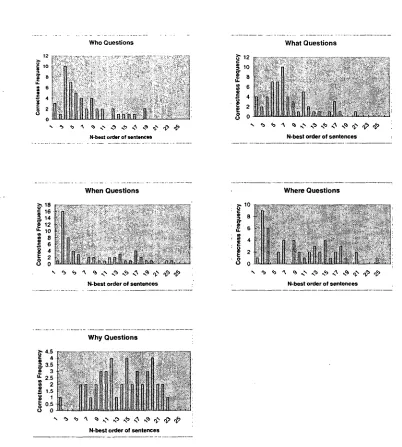
achieved an accuracy of 13.33% on who questions, 6.67% on what questions, 0% on where questions, 6.67% on when questions, and 3.33% on why ques- tions. In the grade 4 set, we achieved an accuracy of 3.54% on who questions, 10.34% on what questions, 10.34% on where questions, 0% on when questions, and 6.9% on why questions. Although the best rank- ing sentence produced poor accuracy results on the testing set, with some additional knowledge the top- ranking incorrect answers m a y be able to be elimi- nated. The plots in Figure 3 display the n u m b e r of times the answer sentence was assigned a particular rank by ANFIS. T h e rank of the correct sentence tends to be in the top 10 fairly often for m o s t ques- tion types. This rank tendency is most noticeable for who, what and when questions, but it is also present for where questions. T h e rank distribution for why questions appears to be random, which is consistent with our belief t h a t they require a deeper analysis than would be possible with simple feature comparisons.
2.5.2 A N e u r a l N e t w o r k C l a s s i f i e r
Like ANFIS, this module uses a neural network, but it has a different topology and uses an extended fea- ture set. T h e nn (Neureka) neural network sim- ulation system (Mat, 1998) was used to create a multi-layer (one hidden layer) back-propagation net- work. A single t r a i n i n g / t e s t i n g instance was gener- ated from each story sentence. T h e network contains an input layer with two groups of features. T h e sen- tence/question feature vectors t h a t c o m p a r e a sen- tence to each of the five story questions comprise the first group. Sentence features t h a t are independent of the questions, i.e., contains a location, contains a t i m e / d a t e , and contains a h u m a n , comprise the sec- ond group. T h e hidden layer contains a n u m b e r of nodes that was experimentally varied to achieve best performance. T h e o u t p u t layer contains five nodes, each of which has a binary o u t p h t value which indi-
cates whether or not the sentence is the answer to the corresponding question (i.e., question 1 through
5).
Several training trials were performed to deter- mine the o p t i m u m p a r a m e t e r s for the network. We trained using various subsets of the full input fea- ture set since some features could be detrimental to creating a good classifier. However, in the end, the full set of features performed b e t t e r than or equiva- lently to the various subsets. Increasing the n u m b e r of hidden nodes can often improve the accuracy of the network because it can learn more complex re- lationships; however, this did not help much in the current domain, and so the n u m b e r of hidden nodes was set to 16. For this domain, there are m a n y more sentences t h a t are not the answer to a question than t h a t are. An effort was m a d e to artificially change this distribution by replicating the answer sentences in the training set; however, no additional accuracy was gained by this experimentation. Finally, we cre- ated a neural network for each question type as in ANFIS; however, these small networks had lower ac- curacy than the single network approach.
T h e overall test set accuracy of the best neural network classifier was 14%. In the grade 3 set, we achieved an accuracy of 30% on who questions, 0% on what questions, 23.3% on when questions, 13.3% on where questions, and 3.3% on why questions. In the grade 4 set, we achieved an accuracy of 17.2% on who questions, 10.3% on w h a t questions, 23.6% on when questions, 10.3% on where questions, and 3.4% on why questions.
2.5.3 A R u l e - b a s e d C l a s s i f i e r b a s e d o n C 5 . 0
We a t t e m p t e d to learn rules for filtering out sen- tences t h a t are not good candidates as answers to
questions using C5.0 (Rul, 1999). First we ex-
tracted information from the sentence-to-question correspondence d a t a ignoring the comparison values to m a k e the input C5.0-compatible, and produced five different files (one for each question type). These files were then fed to C5.0; however, the p r o g r a m did not produce a useful tree. T h e problem m a y have been t h a t m o s t sentences in the passages are nega- tive instances of answers to questions.
2.5.4 G A S
Who Questions
~2 '~t < - ~ :~ ~ . ~ : ~ " ; ~ . ~ ~ .~ ~~ ~ . , ~ ! - :-::~ i~',~ . '
. . . , t . . . , ~ ~ : ~ . . . ~ , " - : . . . :~ ...
N-best order of sentences
W h a t Questions
•
t 2N-best order of sentences
When Questions 18
F~
6 .~- ~ ~
g 4 ~, . . . ~ ~ ,~ . . . : ~ ~
N-best order of sentences
Where Questions
•
10 [ ; p ~ ? , ~ z ~ , : : : : : : : ~ , ~ , : ~ : : ~ . ~ : ~ - : ~ : ~ : ~ : , ~ . ~ ? . : : ~ f f : , : ~N-best order of sentences
Why Questions
4.5 ~i~:~:~
0
N-best order of sentences
Figure 3: Correct answers ordered by A N F I S preference.
training data, the algorithm fails to produce a win- ning population based on the m e a n square minimiza- tion function.
3
A C l o s e r L o o k at t h e F e a t u r e s
After observing the question answer accuracy results of the above classifiers, we concluded that the fea- tures we extracted for the classifiers are affected by noise. T h e fact that we take into consideration only the top matching phrase-to-phrase m a t c h e s on a spe- cific set of features m a y have contributed to this noisiness. To analyze the noise source of features, given that SemType was hypothesized to be essen- tial for answer candidate discrimination, we exam-
ined those SemType values that occurred m o s t fre- quently and calculated statistics on h o w often the values occurred in story sentences that are answers versus non-answers to the questions. We observed the following phenomena:
[image:7.596.144.546.79.526.2]weakens its ability to act as an effective filter. 2. For what questions, the SemType value person ap-
pears as the NP SemType of most answer and non- answer sentences. The next most dominant fea- ture is the SemType value object, which appears in the NP for 29.41% of the answer sentences and P P NeedSemType for 15.68% of the answer sen- tences. Most of the other SemType values such as time contribute trivially to distinguishing answers from non-answers, as might be expected.
3. For when questions, person appears dominant among NP SemType values; however, time fea- tures appear to be second most dominant since 19.30% of the answer sentences have time as their NP SemType, and 26.32% have at-time as their P P SemType. N_o.te that the P P NeedSeraType and VP SemType appear to be less capable of guiding the selection of the correct answer.
4. For where questions, location features are impor- tant with 24.07% answer sentences having loca- tion as their N P SemType value, and 20.37% hav- ing at-loc as their P P SemType. However, the distribution of values for VP SemType and P P NeedSemType shows no interesting patterns. T h e current training strategy weights the NP-NP, VP-VP, P P - P P , and N P - P P comparisons equiva- lently. T h e above observations suggest that training classifiers based on these equally weighted compar- isons may have prevented the detection of a clear class boundary, resulting in poor classification per- formance. Since different phrase types do not appear to contribute in the same way across different ques- tion types, it may be better to generate a rule base as a prefitter to assign more weight to certain phrases or discard others before inputting the feature vector into the classifier for training.
4 F u t u r e D i r e c t i o n s
As a next step, we will try to tame our feature set. One possibility is to use a rule-based classifier that is less impacted by the serious imbalance between negative and positive instances than C5.0 in order to learn more effective feature sets for answer candi- date discrimination corresponding to different ques- tion types. We could then use the classifier as a pre- processing filter to discard those less relevant com- parison vector elements before inputting them into the classifiers, instead of inputting comparison re- sults based on the complete feature sets. This should help to reduce noise generated by irrelevant features. Also, we will perform additional d a t a analysis on the classification results to gain further insight into the
noise sources.
The classifiers we developed covered a wide range of approaches. To optimize the classification perfor- mance, we would like to implement a voting mod- ule to process the answer candidates from different
classifiers. T h e confidence rankings of the classifiers would be determined f r o m their corresponding an- swer selection accuracy in the training set, and will be used horizontally over the classifiers to provide a weighted confidence measure for each sentence, giving a final ordered list, where the head of the list is the proposed answer sentence. We propose to use a voting neural network to train the confi- dence weights on different classifiers based on differ- ent question types, since we also want to explore the relationship of classifier performance with question types. We believe this voting scheme will optimize the bagging of different classifiers and improve the hypothesis accuracy.
R e f e r e n c e s
J. Allen. 1995. Natural Language Understanding.
T h e B e n j a m i n / C u m m i n g s Publishing Company, Menlo Park, CA.
M. P. Harper and R. A. Helzerman. 1995. Man- aging multiple knowledge sources in constraint-
based parsing spoken language. Fundamenta In-
formaticae, 23(2,3,4):303-353.
M. P. Harper, R. A. Helzerman, C. B. Zoltowski, B. L. Yeo, Y. Chan, T. Stewart, and B. L. Pellom. 1995. Implementation issues in the development
of the parsec parser. S O F T W A R E - Practice and
Experience, 25:831-862.
M. P. Harper, C. M. White, W. Wang, M. T. John- son, and R. A. Helzerman. 2000. Effectiveness of corpus-induced dependency grammars for post-
processing speech. In Proceedings of the 1st An-
nual Meeting of the North American Association for Computational Linguistics.
L. Hirschman, M. Light, E. Breck, and J.D. Burger. 1999. Deep Read: A reading comprehension sys-
tem. In Proceedings of the 37th Annual Meeting
of the Association for Computational Linguistics,
pages 325-332.
J. R. Hobbs. 1979. Coherence and coreference. Cog-
nitive Science, 1:67-90.
J-SR Jang. 1993. ANFIS: Adaptive-Network-based
Fuzzy Inference System. IEEE Transactions on
System, Man, and Cybernetics, 23(3):665-685. M. Jelasity and J. Dombi. 1998. GAS, a concept on
modeling species in genetic algorithms. Artificial
Intelligence, 99 (1) :1-19.
The MathWorks, Inc., 1998. Neural Network Tool-
box, v3. O. 1.
Rulequest Research, 1999. Data
Mining Tools See5 and C5. O.