1
Advances in Tele Communications – Perceptions, Usage
Pattern of Mobile Phone and Impact on Health among
Engineering Students
Antim Bala Sharma1, Dr. OS Lamba2, Dr Lokendra Sharma3, Dr Abhishek Sharma4
Dept of Electronics and communication 1,2, Dept of Pharmacology3, Dept of Public Health Dentistry4 Suresh Gyan Vihar University1,2, SMS Medical College and Hospital3 , RUHS College of Dental Sciences and
Hospital4, Jaipur, Raj.
Email: [email protected]
ABSTRACT- The invention of mobile smartphones has revolutionized many aspects of human life from education
to social contacts. Mobile phones account for 88% of all telecommunication users. This study was conducted to measure the perceptions, usage pattern of mobile phone and impact on health. Permission was taken from higher authorities of the institution. A descriptive cross-sectional questionnaire study was conducted among the students studying at Rajasthan group of colleges in Dausa city, Rajasthan. Questionnaire included socio demographic details, perceptions, usage pattern and health related problems like headache, earache, neck pain, tinnitus, painful fingers, restlessness, tingling fingers, fatigue, eye symptoms, and sleep disturbance. A total of 721 students, out of which 343 engineering students and 378 polytechnic students constituted our sample. Proportions were calculated. The p-value < 0.05 was considered as statistically significant. 52 % of respondents used mobile phone for more than 11 hours close to body. Usage pattern revealed Calling facility (96%), Social media (90%), entertainment (72%), SMS (37%), academic purpose (28%). More than one third of respondents showed some signs of addiction to their mobile phones in respect with ringxiety and waking up from sleep to check the mobile for call or message. Almost 90% of respondents were unaware of SAR (specific absorption rate) values of mobile phone and its impact on health. Health problems like headache, earache, tinnitus, painful fingers and restlessness were found to be positively associated with mobile phone usage.
Key Words - Mobile phones, Students, SAR, Addiction, Ringxiety, Telecommunication, Health
1. INTRODUCTION
The invention of mobile smartphones has revolutionized different aspects of human life from education to social contacts to entertainment. India, a developing nation has become evident as second largest number of mobile phone users in the world, just after China. Mobile phones account approximately for 88% of all telecommunication users. [1]
Today, mobile phones and specially android smart phones are equipped with features other than voice call that allow further communications and entertainments such as the Short message service (SMS), MP3 player, games, internet, social networking, personal diary, e-mail dispatcher, calculator, calendar, and videos which attracted people across all streams of life and consequently led to the increase in the number of mobile phone users. With increasing toll of mobile phone users in the country, India is expected to become the country with
the largest number of mobile phone users soon. [2,3,4]
2 Many people in developing countries including India
are now showing signs of addiction to the Internet and are a cause for concern because of the adverse consequences. [9,10,11]
There is a scarcity in the literature about mobile phone usage pattern, addiction and health related problems among students in Rajasthan so far. So the present study was undertaken to explore usage pattern, addiction and health related problems associated with mobile phone.
2. MATERIALS AND METHODS
A descriptive cross-sectional study was conducted among the students studying at Rajasthan group of colleges in Dausa city, Rajasthan, India. Prior to conduct the study, higher authorities of the college, was explained about the study need and importance. Permission for conducting the study was obtained. Participation was voluntary. Two college Students (Rajasthan engineering college and Rajasthan Polytechnic College) from all academic years using mobile phone and willing to participate were included in the study. A total of 721 students constituted our sample, out of which 343 were enrolled in Engineering course and 372 were from polytechnic stream. Study was conducted in November December 2017. A self-administered questionnaire was distributed which questions had related to demographic details, usage pattern of mobile, false perception of ring, health related problems and SAR. Health related problems included headache, ear ache, neck pain, tinnitus, painful fingers, morning tiredness, fatigue, sleep disturbance, restlessness etc. Participants were interviewed for these questions by the principal investigator and at different times to make good response rate sure. Collected data was tabulated, numbered. Excel sheets were prepared using Microsoft office. Proportions were calculated. Chi square test was applied using SPSS 17.0.0 as and Yates correction was done when required. Level of significance was kept at P < 0.05.
[image:2.612.317.546.211.424.2]3. RESULTS
Table 1. Demographic details of participants
Course B.Tech
(total=343)
Polytechnic (total=378)
Male Female Male Female
No. of students
325 18 372 6
Table 1 shows demographic details of study participants. A total of 721 students participated in
the study, out of which 343 were enrolled in Engineering course and 372 were from polytechnic stream. Comparisons between males and females were not made due to huge difference in the number of male and female students.
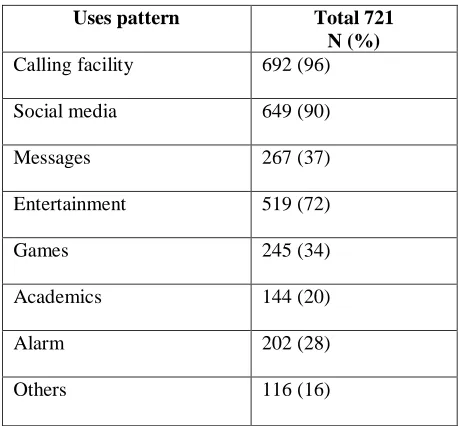
Table 2. Usage pattern of mobile phones among the students
Uses pattern Total 721
N (%)
Calling facility 692 (96)
Social media 649 (90)
Messages 267 (37)
Entertainment 519 (72)
Games 245 (34)
Academics 144 (20)
Alarm 202 (28)
Others 116 (16)
Usage pattern of mobile among the students is presented in table 2. Calling facility (96%), social media (90%), and entertainment (72%) was among the principle use of the mobile.
Table 3. Response of students to false perception of ring
False perception of ring Yes
N (%)
No N (%)
Engineering students (343)
110 (32) 233 (68)
Polytechnic students (378)
120 (31) 258 (69)
Table 3 illustrates false perception of ring among study participants. Around 30% engineering and polytechnic students gave positive response in relation with false perception of ring.
[image:2.612.66.295.611.699.2]3 woke up once, often, very often from sleep to see
[image:3.612.321.553.166.298.2]messages/ call.
Table 4. Response to Number of times of wake up from sleep to see messages/call
Number of times of wake up from sleep to see messages/call
Engineering students (343) N(%)
Polytechnic students (378) N (%) Does not
wake up
168 (49) 210 (56)
Once 82 (24) 68 (18) Often 72 (21) 51 (13) Very
often
[image:3.612.68.293.212.356.2]21 (6) 49 (13)
Table 5. Health problems associated with mobile phone use
Health problems
Engineering students (total 343)
N (%)
Polytechnic students (total 378)
N(%)
P – value (Chi- square
test)
Headache 96 (28) 83 (22) 0.08 Neck pain 72 (21) 91 (24) 0.07 Earache 24 (7) 15 (4) 0.06 Tinnitus 10 (3) 8 (2) 0.12 Painful
fingers
2 (7) 8 (2) 0.16
Morning tiredness
48 (14) 42 (11) 0.47
Tingling fingers
14 (4) 11 (3) 0.72
Fatigue 55 (16) 49(13) 0.21 Eye
symptoms
45 (13) 42 (11) 0.82
Sleep disturbance
62 (18) 61 (16) 0.84
Restlessness 34 (10) 45 (12) 0.09
Level of significance < 0.05
Health problems related to mobile usage is shown in table 5. Common health problems found were headache, neck pain, fatigue, sleep disturbance followed by morning tiredness. There was no
statistically significant difference was observed when engineering and polytechnic students were compared. (P-value >0.05).
Fig. 1. Awareness regarding SAR among study participants.
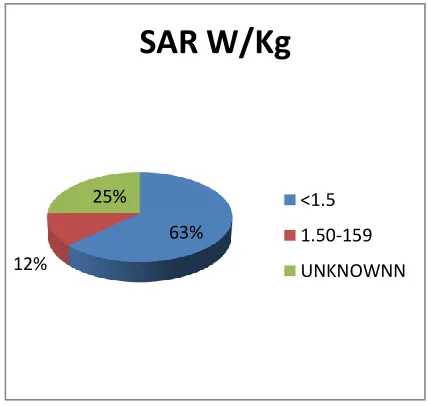
Figure 1 demonstrates knowledge regarding SAR among the students. Surprisingly 90% of the students were unaware of SAR, 92% were unaware of SAR limit. 73% of respondents were unaware of SAR (specific absorption rate) values of their mobile phone. USSD code was given to find the SAR value of their mobile phones. 63% of the sampled population had a mobile phone with SAR value less than 1.50 W/kg (Fig. 2). 12% of the mobile phones of the sampled population noted SAR value between 1.50 W/kg and 1.59 W/kg.
63% 12%
25%
SAR W/Kg
<1.5
1.50-159
UNKNOWNN
[image:3.612.66.296.390.640.2] [image:3.612.325.539.485.688.2]4
4. DISCUSSION
According to our study, the prevalence of mobile phone usage was found to be 100%. In contrast Kenya showed 85% prevalence of mobile phone users among students [12]. This could be attributed to socio economic class, competitive cheaper services provided by different telecom companies.
The findings of our study showed that participants used mobile for calling greater than the SMS facility whereas in Japan among 73 high school students showed that the frequency of using SMS facility was more [13]. This may be attributed advanced social media features of android mobile phones.
Headache, earache, neck pain, painful fingers, morning tiredness, fatigue, eye symptoms, sleep disturbance and restlessness were associated with mobile phone usage. Similarly, in Sweden, sleep disturbance, tiredness, headache and sleep disturbances were associated with mobile phone usage [14, 15]. These findings are in line with findings, reported in Saudi Arabia [16], and Poland [17]. In contrast, a study conducted by Cinel C et al in UK, there was no association between mobile phone usage and subjective symptoms [18]. Therefore, research on these areas should be done on a large scale and for a significant period until conclusive evidence on the relationship between mobile phone usage and subjective symptoms can be found.
We found only 20% of the students used mobile phone for academic purposes which are in contrast with results found by Prasad et al [19]. Undoubtedly, mobile phone and its functions such as listening tomusic and messaging with Whatsapp, facebook have become addiction to younger generation. Our study revealed a surprising fact that there was a minimal awareness about the concept of SAR value among the respondents. 90% of the respondents were not aware of what is an SAR in terms of MPR and 92% of the respondents were not aware of any radiation limit.
SAR is a measure of the maximum energy absorbed by the unit mass of exposed tissue of a mobile phone user. SAR values are expressed in units of Watts per kilogram in either 1.0 g or 10.0 g of human tissue. The permissible level for SAR in India has been kept as 1.60 W/kg. Research is going on to find out the impact of constant exposure to MPR on human health. Because there is no concrete evidence of the impact of MPR (mobile phone radiation) on human
health [20], the SAR limit has been set based on the thermal effects of MPR (mobile phone radiation) Most research focuses on short-term impacts and now, research on long term impacts of MPR on human health is need of the hour. Some researchers have hinted that long-term use of mobile phones may cause diseases such as migraine, infertility, cancer, eye defect, insomnia, depression, and hypersensitivity [21]. There is thus an urgent need to take the issue of radiation caused by mobile phones more seriously and establish adverse consequences it may have on human population.
Awareness needs to be increased among the youth on radiation and its regulation measures such as standard SAR values. This may be targeted through Government’s intervention of spreading relevant information through mass media, including all sections of the society. Laws should be made stringent to ensure that every mobile phone company displays the SAR value of individual mobile phone models with different parts of mobile phone. It is recommended that students should focus much of their mobile phone usage time to research and academic purposes rather engaging in social networking and unwanted activities. The study evaluated the students of one group of colleges, therefore further studies involving larger sample over a wide geographic area can be carried out to generalize of the findings.The results rely upon the presumption that the students gave real responses to the self-administered questionnaire.
5. CONCLUSION
Thus, the finding from the study proves significantly that the mobile phones have a solid impact on the social life and other aspects of students. Also despite student’s understanding about the negative effects of mobile phone, addiction, they are using cell phones. Thus, the students must be turned to use their mobile phones judiciously; otherwise advances in technological aspect will create numerous problems in our society.
REFERENCES
[1] India is the Second- Largest Mobile Phone user in World. [Cited 2018 Jan 09]. Available from: pib.nic.in/newsite/erelease. aspx?relid=85669.) [2] George S, Saif N, Joseph B (2017). A study on
5 in Kerala, India. Int J Res Med Sci. 2017
Aug;5(8):3615-3619.
[3] Sanjay D et al (2010). A study to evaluate mobile phone dependence among students of a medical college and associated hospital of central India. Ind J Comm Med.;35(2):339-41.
[4] Stalin P et al (2016). Mobile Phone Usage and its Health Effects. Journal of Clinical and Diagnostic Research. Jan, Vol-10(1): LC14-LC16)
[5] Saini D (2017). SAR and Mobile Phone Radiation Hazard. How Aware are College Students in Delhi? J. Innov. Inclusive Dev., vol. 2, no. 1, pp. 44-47
[6] Electromagnetic fields and public health: mobile phones. World Health Organization. Fact sheet No.193 June 2011 [Cited 2018 Feb 8] Available from:
http://www.who.int/mediacentre/factsheets/fs193 /en/)
[7] Chotpitayasunondh V, Douglas KM (2016). How “phubbing” becomes the norm: The antecedents and consequences of snubbing via smartphone; Comput Hum Behav. 63:9–18.
[8] Baron NS, Campbell EM (2012). Gender and mobile phones in cross-national context. Lang Sci; 34:13–27.
[9] Roberts JA, David ME (2016). My life has become a major distraction from my cell phone: Partner phubbing and relationship satisfaction among romantic partners. Comput Hum Behav. ;54:134–41.
[10]Davey S, Davey A (2014). Assessment of smartphone addiction in Indian adolescents: A Mixed method study by systematic-review and meta-analysis approach. Int J Prev Med. ;5:1500–11.
[11]Davey S et al (2018). Predictors and consequences of “Phubbing” among adolescents and youth in India: An impact evaluation study. J Family Community Med. Jan-Apr; 25(1): 35–42 [12]Wesolowski A, Eagle N, Noor AM, Snow RW,
Buckee CO (2012). Heterogeneous mobile phone ownership and usage patterns in Kenya. PLoS ONE.;7(4):e35319
[13]Tochigi M, Nishida A, Shimodera S, Oshima N, Inove K, Okazaki Y (2012). Irregular bedtime and nocturnal mobile phone usage as risk factors for being involved in Bullying: A cross sectional survey of Japanese adolescents. Journal pone;7(9):0045736.
[14]So¨derqvist F, Carlberg M, Hardell L (2008). Use of wireless telephones and self-reported
health symptoms: a population-based study among Swedish adolescents aged 15-19 years. Environ Health.;7:18.
[15]Thomée S, Härenstam A, Hagberg M (2011). Mobile phone use and stress, sleep disturbances, and symptoms of depression among young adults - a prospective cohort study. BMC Public Health.;11:66.
[16]Al-Khlaiwi T, Meo SA (2004). Association of mobile phone radiation with fatigue, headache, dizziness, tension and sleep disturbance in Saudi population. Saudi Med J.;25:732–36.
[17]Szyjkowska A, Bortkiewicz A, Szymczak W, Makowiec-Dabrowska T (2005). Subjective symptoms related to mobile phone use - a pilotstudy. Pol MerkurLekarski;19:529–31 [18]Cinel C, Russo R, Boldini A, Fox E (2008).
Exposure to mobile phone electromagnetic fields and subjective symptoms: a double blindstudy. Psychosom Med.;70:345–48.
[19]Prasad M et al (2017). Nomophobia: A Cross-sectional Study to Assess Mobile Phone Usage Among Dental Students. Journal of Clinical and Diagnostic Research. Feb, Vol-11(2): ZC34-ZC39
[20]Jokela, K et al. 1999. Radiation safety of handheld mobile phones and base stations. Finnish Centre for Radiation and Nuclear Safety. STUK–A 161.