Hypertext linking is akin to deixis in that each points out of the dis- course to the context in which the discourse occurs. The context of a hypertext document such as a World Wide Web page is the World Wide Web itself. This study investigates some linguistic aspects of hypertext, using as data Web pages from college students and commercial enterprises. I first look at the syntactic forms of hypertext anchors, finding them mostly noun phrases. Next, noting the intuitive similarities between hypertext and place deictics, I attempt to find a quantitative relationship between the two. I show that certain place deictics do occur more frequently inside of hypertext anchors than in the ordinary text of Web pages, but this is due to the popularity of the deictic here, as in click here. Ob- serving that hypertext style guides prescribe against the usage of click here, I hypothesize that more expe- neaced hypertext authors will dis- prefer this usage. Using the as- sumption that college students are less experienced than commercial Web authors, I am unable to con- firm this hypothesis statistically. Finally, I examine the various types ofdeixis Web authors use in hyper- text anch ors, finding the majority to be person deictics. I close by not- ing that the variety and creativity of deixis within hypertext anchors suggests that the relatively new medium of hypertext is a fully pro- ductive genre of natural language.
1. Introduction
Deixis is, in Lyons' [1979] simple phrase, "identification by pointing". Specifically, deictic terms point out of the current discourse to facts con- cerning the context of the utterance. Deictics in- clude words such as I, here, and now. Sentences
one knows the people, place, and time involved in the utterance of the sentence. As an example, imag- ine finding a bottle in the ocean with the note, "Meet me here at noon tomorrow" (from Fillmore [1975]). Unless we know when, where, and by whom the note was written, we are at a loss to interpret the sentence.
With the evolution of hypertext, we find another type of deixis. Hypertext, such as is found in World Wide Web pages, is electronic text which "points" to other locations in the same or different electronic doc u- ments. When hypertext is selected by means of a mouse or keyboard, the document "pointed to" is retrieved and displayed on the screen. An example of hypertext might be: I am a student at Georeetown
University. (The hypertext is underlined, a conve n- tion I will follow in this paper). If a reader of that sentence clicked on the words Georgetown Univer- sity, an electronic document pointed to by the hyper- text would be displayed: presumably (but not nece s- sarily) relating to Georgetown University.
This, then, is also deictic. Just as ordinary deicfics can not be fully evaluated without leaving the utter- ance and looking to the outside world, neither can hypertext be fully evaluated without leaving the text and looking at its context (the World Wide Web itself) to see what is being pointed at. We might call this hypertext deixis hyperdeixis (term credited to Dr. Cathy Ball), referring to the fact that hypertext "points", just as natural language expressions such as I, here, and now point. It is interesting to note that hypertext links are often referred to as "pointers", while the word deixis itself is from the Greek word for pointing.
It is important to make a distinction here. The dei c- tic aspects of hypertext need not have anything to do with the words used as the anchor of the hypertext (i.e., the words which, when selected, activate the link). The deictic aspect has solely to do with the fact that the hypertext link points elsewhere. The words in the anchor do not have to relate to where the link takes you - in fact, they do not have to be words at all. The anchor can be a picture, or simply a blank spot on a page. No linguistic analysis of the anchor is needed to follow the hypertext link.
30
D. Loehr
selves, this paper will look at four:
(1)
Given that hypertext - text which "jumps somewhere" - is a relatively new phenomenon, just what forms do authors use for hypertext an- chors?(2) Given the intuitive "pointing" simi- larity between place deictics (expressions which point to a place) and hypertext, is there any relatio n- ship between the two? Specifi- cally, do authors of the new me- dium of hypertext tend to use place deictics more frequently inside of hypertext anchors, since hypertext "reminds" them of place deictics? Or, for the same reason, do authors tend to avoid using place deictics inside .of hypertext anchors?
(3)
If any relationship is found in (2) above, do writers' preferences for using place deictics in hypertext change as they become more expe- rienced with this new genre?(4)
Again noting the similarity betweenplace deictics and hypertext, are place deictics the most common form of deixis found within hyper- text anchors? Or are other types, such as person deictics or time deictics, more prevalent?
This paper, then, represents an exploratory foray into the little-known world of hypertext and deixis. It will undoubtedly generate more questions than answers. 2. Background
The earliest major work on deictics (also called in- dexicals) is by Btihler. He begins with an elegant image:
The arm and the finger gesture of man, to which the index finger owes its name, recurs when the signpost imitates the outstretched "arm"...and the question [is] posed as to whether spoken language con- tains signs that function as sign- posts. The answer is yes, deictic words such as here and there have a similar function. [1934]
Biihler did not originate the idea of deixis. He notes
that classical Greek grammarians were aware of the concept. In the modern era, he credits turn-of-the- century linguists such as Brugmann and Wegener, who, while reconstructing Proto-Indo-European, de- scribed four types of deixis: I, you, this, and that. Biihler notes that land you are referred to as person- alia (Latin persona), which is from the Greek for mask or role. The meaning is that I and you, like actors, switch roles. BiJhler then advances a two- field theory: a deictic field, in which de ictics point to the actual entity in the world, and a symbolic field, in which all other terms refer symbolically to entities in the world.
Fillmore [1975] gives a very thorough taxonomy of deixis. He enumerates five types: person, place, time, discourse, and social.
Person deixis refers to the speaker, addressee, and audience of the utterance. Examples are pronouns and possessives such as I, we, yours, my, etc.
Place deixis, including the locative adverbs here and there and the demonstratives this and that, are di- vided into two types. Gestural place deixis requires the addressee to physically monitor the utterance for an accompanying gesture: "Put the flower pot here". Symbolic place deixis requires only knowledge of the conditions of the utterance, without physical monitor- ing. My friend from London may write, "It's raining here again." Though I did not see her write the let- ter, I know where she was when she wrote it, and thus I know where here is. As an interesting side- light, Fillmore notes that there is only one word in English which requires gestural deixis for its use: yea, as in "She is yea tall".
Time deixis, including the adverbs now, last night, and tomorrow, involves three different times. The encoding time is the time at which the utterance is made. The decoding time is the time at which the utterance is received (which will be delayed in writ- ten text). Finally, the reference time is any time referred to in the topic of the sentence. A typical voice-mail message might illustrate all three types. "This is Dan calling at 9 AM (encoding time). Give me a call back when you get this message (decoding time). I'd like to set up a meeting for Tuesday the 14th (reference time)."
scribed temporally, as "any point in discourse can be thought of as a point in time". For this reason, we can say "in the preceding paragraph", or "the follow- ing announcement is a paid advertisement". In a:kl i- tion, written discourse has unique terms due to pages being read top-to-bottom: thus, we say, "as men- tioned above", or "see below".
Finally, social deixis encodes, in Fillmore's words, "the social relationships on the part of the partic i- pants in the conversation that determine, for exa m- ple, the choice of honorific or polite or intimate or insulting speech levels". In addition to honorifics, examples include nicknames, informal names, and titles of respect.
Fillmore also notes that certain verbs, such as come and go, are also deictic, as they imply a here and a there.
Considerable work in the field has also been by Ly- ons. He makes note of the deictic center- the "zero- point of deictic context", which is always egocentric for the speaker [1968, 1977]. This zero-point is in relation to person, time, and space, with the center representing I, here, and now. Deictic terms are ex- pressed in relation to this deictic center. Here and this are closer than there and that, and now is closer than tomorrow. It is illustrative that the first, sec- ond, and third person radiate outward from the dei c- tic center. Lyons reminds us that deictic terms may also have non-deictic uses [1973]. "This idea is not new" refers anaphorically to some previously ex- pressed idea, while "This book is dedicated to my husband" refers deictically to the book containing the dedication. Finally, Lyons discusses tensed verbs as time deictics [1977]. Note that we need to know the time of utterance to work out any truth conditions of a tensed sentence.
I have thus far summarized work on deixis. As for deixis in relation to hypertext, no previous work ex- ists that I am aware of. I hope that this study (a deictic!) will shed some light on this new phenome- non.
3. Forms of Hypertext Anchors
Before addressing my first question the forms authors use for hypertext anchors - I will briefly dis- cuss my general methodology. Methodology specific to each of the other three questions will be covered in that question's section, in turn.
The data used for all four questions consists of pages
from the World Wide Web collected in April 1996. There are of course many types of Web pages (Roberts [1997] discusses the different genres found). For this study, I collected pages from two types: the "home pages" of college students, and the "home pages" of commercial enterprises. A home page is the initial, top-level page at a "web site", with a web site typically consisting of multiple related pages. For consistency, I used home pages only. For college student data, 126 different Web pages (containing roughly 1000 anchors) were collected randomly from three institutions: Cornell University, the University of Texas at Austin, and the University of Oregon. For commercial data, 31 Web pages (containing roughly 500 anchors) were collected. The commercial businesses included well-known firms in varying fields: examples are Apple Com- puter, Prudential Insurance, Pepsi-Cola, Sony, Whirlpool, Disney, and the American Stock Ex- change.
After each page was downloaded, an automatic script stripped out the words used as anchors. (Fortunately, Web pages are written in HyperText Markup Language (HTML), which has specific tags surrounding the anchors). The anchors were saved to a separate file, as was the original Web page, for reference. Graphical anchors were ignored, unless they had "alternate" text associated with them, for the use of non-graphical Web browsers.
To answer question (1), I then went through the list of anchors, and manually c ~ e d them per the follow- ing categories:
Noun Phrase Verb Phrase Adjective Phrase Adverb Phrase Prepositional Phrase Relative Clause Full Sentence
Imperative Question Declarative Other
32
D. Loehr
College Student Home Pages
Commercial Home Pages
Form
NP
Full Sentence Imperative Question Declarative VP
AdvP AdjP PP Other
Relative Clause
# - ~ # - ~
893 88.9 364 72.4
48 4.8 69 13.7
32 3.2 41 8.1
9 0.9 15 3.0
7 0.7 13 2.6
19 1.9 26 5.2
18 1.8 4 0.8
10 1.0 7 1.4
8 0.8 12 2.4
7 0.7 4 0.3
2 0.2 17 3.4
Totals 1005 =100 5 0 3 ! --100
Examples
Cornell University Home Page
What's New?
General Motors Announces I~ Electric Vehicle click here
click here New at National About Me
If Ooeratin~ Systems Were Beers,.. T
Who We Are
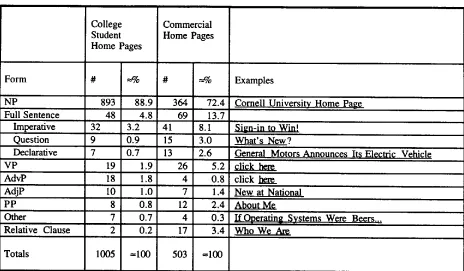
Table 1. Forms of hypertext anchors, number and approximate percentage, by source (Percentages do not exactly total 100.0, due to rounding)
We can now answer our first question, as to the forms hypertext anchors take. The overwhelming majority are noun phrases, with full sentences taking a distant second. Note however, that commercial Web authors tend to use fewer noun phrases and more full sentences than college students (the diffe r- ence is significant, per a chi-squared test, with p <= 0.01). Perhaps this is because commercial sites try to present a more polished image.
Our first answer regarding hypertext immediately raises another questio n: Why are the overwhelming majority of anchors noun phrases? An intuitive reply is that authors are viewing hypertext anchors as re- ferring expressions. Since referring expressions in more familiar non-hypertext are almost always noun phrases, authors choose noun phrases for their an- chors. Continuing this theory, to the extent that authors are not using noun phrases as anchors, to just this extent are they "branching out" in the new phe- nomenon of hypertext, and discovering linguistic forms other than noun phrases for encoding hypertext links. Confirmation of these speculations, however, must await f u ~ e r research.
4. Relationship Between Place Deictics and Hypertext
Let us now turn to our second question, reprinted here:
(2)
Given the intuitive "pointing" simi- larity between place deicfics and hypertext, is there any relationship between the two? Specifically, do authors of the new medium of hy- pertext tend to use place deictics more frequently inside of hypertext anchors, since hypertext "reminds" them of place deictics? Or, for the same reason, do such authors tend to avoid using place deictics inside of hypertext anchors?To determine this, we need to determine the fre- quency, or "density", of place deicfics inside of hy- pertext anchors versus that outside of hypertext an- chors (i.e. in the regular text of the Web page).
[image:4.612.56.520.116.387.2]frequency of the place deicfics in each file, by divid- ing the number of place deicfics by the number of words in the file.
There is a problem, however, in determining the fre- quency of something by dividing by the number of words in a text. As Ball explains:
In a word-based frequency analysis, to say that a phenomenon occurs with equal relative frequency in two samples is to say that equal amounts of text, measured in words, will yield the same number of to- kens. But relative frequency should be a measure of the number of times something occurs within the number of opportunities for it to oc- cur (emphasis mine) [1994].
To give an example: If we are comparing the fre- quency of, say, interrogative sentences in the writing styles of Hemingway and Dostoevski, it would be meaningless to divide the number of interrogatives by the number of words in each author's text. The results of this would be skewed by the length of sen- tences which each writer produces. Hemingway may pen fully twice the number of sentences in the same number of words as his Russian counterpart. Thus, if both authors had the same absolute number of inter- rogatives, we would be wrong to conclude that they both favored this form equally. Rather, Hemingway, who produced twice as many sentences, used the interrogative only half as frequently as Dostoevski. The key, then, is to measure a phenomenon against the number of opportunities for the phenomenon to occur, not against raw word count. In this example, the opportunity for an interrogative to occur is a sen- tence - hence, we must count the number of sen- tences as well.
We may now return to our problem of measuring the frequency of place deictics. We must decide what an appropriate opportunity for occurrence for a place deicfic would be. As Ball advises, selecting this category is "crucial and requires considerable thought [1994]", or else our results will be invalid. With this in mind, let us look first at the place dei c- tics here and there. Although technically these may be thought of as adverbs ("Come here"), I will argue
that they pattern with prepositional phrases ("Come to this place"). As further evidence, consider "Put the book here". Replacing here with an adverb is ungrammatical (* "Put the book slowly"), while a prepositional phrase is acceptable ("Put the book on the table"). Thus, when an author chooses to use here or there, the author is choosing to use these words instead of using a prepositional phrase. Hence, I will consider an opportunity for occurrence of here and there to be a prepositional phrase.
Although searching for prepositional phrases is time- consuming, it is certainly doable - and in fact, I did just that for this study. As a heuristic, I started by searching for a list of 50 common prepositions, which I estimate covered at least 90% of all raw occur- rences of prepositional phrases (the first six alone accounting for 70%, according to Mindt and Weber" [1989], reported in Crystal [1995]). I then visually scanned the text for any remaining prepositions. (A more efficient method would be to scan for the 81 prepositions found in both the Brown and LOB cor- pora, said by Mindt and Weber to account for 99.9% of all raw occurrences).
We must also consider the other types of place dei c- tics. While sometimes acting as determiners, the place deictics this and that can also be (and pattern with) both pronouns ("Look at that") and adjectives (" This morning"). Unfortunately, this means that an opportunity for an author to use this or that would be a noun phrase or an adjective phrase. While searc h- ing for prepositions is difficult, it is feasible because prepositions are a finite class. Yet searching for the open classes of nouns and adjectives I judged to be undoably time-consuming for this research. Equally difficult would be considering place deictics occu r- ring as motion verbs (i.e. come), as that requires searching for all verbs to find opportunities for occu r- rence. I have therefore chosen to restrict my study of place deicfics to only here and there. Hence, my research will have nothing to say about other place deictics. A strategy for resolving this dilemma would be to use an automatic parser, which could identify most nouns, adjective, and verbs. I leave that task to future work.
33 D. L o e h r
Inside of
Hypertext Anchors
Outside of Hypertext Anchors
Totals
Number of Occurrences of Here 42 66 108
and There
577 2433 3010
619 Number of PPs (Opportunities for
Occurrence of Here and There)
2.7
2499 Frequency (in Percentage)
Totals
7.3
[image:6.612.58.465.125.279.2]3118
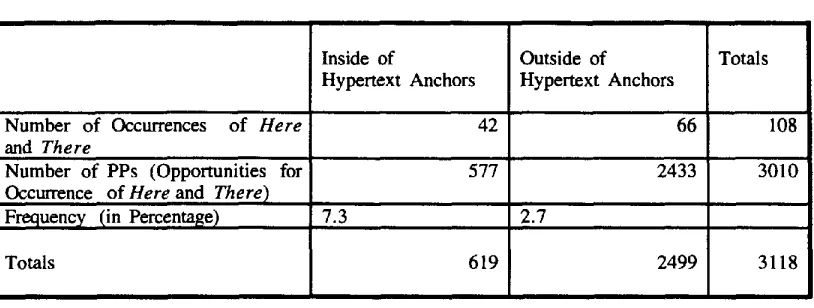
Table 2. Frequency of the place deictics here and there inside of and outside of hypertext anchors
In percentages, the place deictics here and there occur at a frequency of 7.3% inside of hypertext anchors, versus 2.7% outside hypertext anchors (the difference is significant, per chi-squared with p <= 0.001). For simplicity, I have grouped the edue a- tional and commercial pages together in this table - broken apart, there is no statistically significant dif- ference between them in this regard.
Thus, based on the place deicfics I've looked at, we can answer our second question: place deicfics do occur more frequently inside of hypertext anchors than in the regular Web page text.
However, the conclusion that this is so because of the place-deictic quality of hypertext is not so easily reached. It turns out that of the 42 place deictics found in anchors, 41 of them were the word here. This abundance is due to the popularity of the hyper- text expression click here. This usage may be a simple Graphical User Interface (GUI) issue, in which authors are merely instructing their audience to click a certain button. Furthermore, if authors want their readers to go to some other place there, it is counterintuitive to place deixis to use the word here. Thus, the usage of here in hypertext is proba- bly not due to place deixis, but rather a GUI artifact.
5. Changes in Hypertext Authors' Style as a Function of Experience
In answering question (2), we could not prove a rela- tionship between hypertext anchors and place deic- tics. We did, however, see a relationship between the word here and hypertext anchors. Going with this, let us modify our third question to be:
(3) Do writers' preferences for using the word here in hypertext change as a function of experience in this new genre?
This question is not unfounded. Many hypertext style guides preach against what has been labeled the "click-here syndrome". The argument is that the word here has nothing to do with the target of the link, and should be avoided in favor of a more de- scriptive term. To quote one HTML manual:
STYLE TIP: Try to create links that don't muck up the flow of the text .... Your text should stand on its own. You might want to avoid words like "click your mouse on this sentence to read about the his- tory of skyscrapers." Every Web user knows how to click . . . . Instead, say something like, "There's an ex- cellent article on the history of sky- scrapers by T.O. Tall" - and make the word "skyscraper" your link. (Fox and Downing [1995])
If this is what is prescribed, it is reasonable to hy- pothesize that professional writers will try to avoid the click-here syndrome. To test this, we can look at the frequency of the word here within the hypertext anchors of novice writers versus that of professional writers. To this end, I make the following assump- t i o n - that college students are less experienced at writing Web pages than those who author comme r- cial pages. This is of course a generalization, but given the fact that commercial outfits are concerned about the image they present, and that their Web page authors are most probably paid for their work (and hence professionals), it seems reasonable that they will hire experienced authors. No experience, however, is required for college students' authorship.
College Home Pages
Student Totals
Number of Occur~nces of Here 34 7 41
512 64 576
6.6 Number of PPs (Opportunities for Occurrence of Here)
Frequency (in Percentage)
Commercial Home Pages
10.9
546 71 617
[image:7.612.84.491.131.262.2]Totals
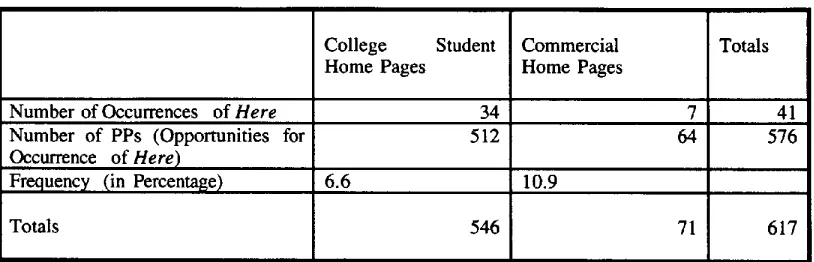
Table 3. Frequency of the term here inside of hype rtext anchors for college student home pages versus commercial home pages At first glance, the opposite of our hypothesis seems
to be true - that the more experienced commercial authors use here more frequently. However, the dif- ference is not significant (per chi-squared at p <= 0.05), so any discussion is moot. Hence, I cannot confirm or reject the hypothesis b a s ~ on this data~ Greater quantifies of data may be necessary to de- termine any real patterns. In addition, future work might also employ a more verifiable method of ide n- tifying novice and experienced Web authors than simply generalizing about college students and commercial webmasters.
6. Types of Deictics Found in Hypertext
Finally, let us turn to our fourth question:
(4)
Again noting the similarity betweenplace deiedc s and hypertext, are place deicfics the most common form of deixis found within hyper- text anchors? Or are other types, such as person deictics or time deictics, more prevalent?
To answer this, I looked at each anchor in the data to see if it contained any deicfics. These deictics were then categorized as one of:
Person
Speaker Audience Both Place Time Discourse Social
More than one of the above
Some discussion is necessary regarding my coding. First of all, the common Click here. as noted, was classified as a place deictic, as it refers to a physical
location in the universe (a spot on a computer screen which may be clicked on). Yet as a sidelight, one could also consider it a discourse deictic, as it refers to the word here itself, which is part of the discourse. This interesting case would be the purest discourse deixis imaginable. Most discourse deixis refers to the text in which the deictic word occurs (this book, the paragraph below). We even have cases where sentences refer to themselves (This sentence is in English). But the deicfic here in click here would be a word which points to itself. Verbally, it is difficult to find an equivalent. One possibility would be, "The word I say now has three letters and rhymes with cow". Though certainly possible before hyper- text was developed, it is the advent of hypertext which has made this "ultimate discourse deixis" commonplace in language.
(Note, however, that person deixis has always had this reflective deixis, at least verbally, in the first person. The speaker who says ' T ' is referring to her- self. Thus, the word here (in a manner somehow reminiscent of Lewis Carroll) is personified, by cal l- ing attention to itself..)
There were cases where here was not used in the click here sense. One example was an anchor la- beled The weather here, referring to the weather at Cornell University, the author's home. Another was the following: Here I am in Roslyn, WA, (where Northern Exposure was filmed). The hyperlink brought up a picture of the author in Roslyn, WA. This here is not referring to the word here. Nor is it referring to the location in which the author wrote the sentence (at Cornell University, in Ithaca, NY). Rather, we have a case in which the author has shifted his deictic center mentally, much as Thomas [1996] reports that speakers do when giving direc- tions.
36
D. Loehr
and a u d i e n c e types under the latter category. Though typically a u d i e n c e refers to others who hear the utterance (in addition to the intended addressee), Web pages are intended for everyone to read, not a specific addressee. Thus, there are no "bystanders" or, more accurately, the bystanders a r e the addres s- ees. Thus, for the Web, addressee and audience are the same thing. I have chosen the latter category as more accurately reflecting how the Web works.
Lyons' notion of deictic and non-deictic uses of words was needed in several cases. For instance, this in Why is this oaee b l a c k ? is clearly deictic. But in another anchor, Come to Think o f It. Who Is Thi¢ Phil Guy?. the same word is not. Rather, it is ana- phoric, since Phil has introduced himself at the be- ginning of the Web page.
Send an Electronic Postcard. Imperatives imply the second person, as in (You} Send an Electronic Post- card. The second form of implied deicfic was the implied first person possessive, as in Favorite W e b Sites. It is probable that the author meant My Favor- ite Web Sites. However, though both of these types implied a person deictic, the actual deictic lexical item was missing. There were other cases where a deictic word ( m y ) was just outside the anchor, as in M y f a t h e r . In all these instances, since there was no deictic word in the anchor, I did not classify it as containing an ordinary deictic.
Now, to answer our fourth question. Table 4 lists the distribution of deictics (by number and percentage) found in hypertext anchors.
Finally, when coding, I resisted the temptation to collect implied deictics. These occurred in two forms. The first was the imperative: an example was
Type
Person Only Speaker Audience Both Place Only Discourse Only Multiple Types Time Only Social Only
Totals
Number
69 60
Approx. Percent -age
54.8 47.6
Examples
Mall Me
4 3.1 Your feedback
5 4.0 Tell Us Your Storv
38 30.2 Return to Jane Austen's info DaMe 10 8.0 Whv is this oaee black?
7 5.6 alt=Make vour visit count, load this imaee 2 1.6 I'm in the lab
0 0.0
126 =100
Table 4. Types of deictics found in hypertext a nchors (Percentages do not exactly total 100.0, due to rounding)
For simplicity, I have again grouped the educational and commercial pages together in this table - broken apart, there is no statistically significant difference between them on this question.
We can now answer our fourth question. Of those deictics used in hypertext anchors, the majority are not place deictics, but person deictics. And of these, the majority refer to the speaker. O f course, the data for this effort was home pages, and the preponde r- ante of self-referenc es may reflect the fact that home page authors use their home page as a vehicle to tell the world about themselves. As research into the various genres of Web pages progresses, it will
be interesting to see which is the most common type of home page. This data suggests that personal nar- ratives may be the most common.
Though we have answered our fourth question quant i- tatively, there remain some interesting qualitative examples to discuss.
[image:8.612.55.433.358.568.2]"leaving" (here) is not. We can only know where we are returning from by deixis - by knowing the place of utterance. Note that this is another c~ase where the deictic center is mentally shifted. The reader never actually moves anywhere - she is still in her chair before her computer. But mentally, she is traveling to wherever her Web documents are re- trieved from. Such is the magic of the World Wide Web.
Another interesting area has to do with time deictics. There were only three of these found in anchors (two on their own, and one in combination with other deictics). The first rather novel example had a blink- ing anchor, in the sentence "Click n0w!" Perhaps the author meant for the reader to click at the mo- ment the blinking anchor was lit up. In the second example, the author writes, I may be in the computer lab, in fact, you can check if I'm in the lab right now. When this anchor is selected, a snapshot comes up which is taken from a live video camera in the author's laboratory (the author was not in when this data was collected). Even though the word now is not within this anchor, we can still find time deixis in the tensed verb am. The present tense implies just that - n o w - and the sentence cannot be evaluated unless one knows the time it is read. Note that both of these examples use decoding time (the time the sentence is read).
The third, very clever, example is:
I'd like to send a special hello to SteDhen Crawford. Why don't you, too? And watch here for a link to his future home page. Then you, too, can meet the greatest trombon- ist in the world
Still watching?
His home page isn't future anymore, it's here !
With his final here, this author has scored a deicfic triple play. First, he invokes here as a place deixis, meaning Stephen Crawford's home page is now avail- able from this place here. (Note the sentence above - Watch here for a link - this can be taken to mean Watch this place on the Web). Second, he uses the familiar click-here phrase - which, as mentioned, could be thought of as discourse deixis. Finally, the author uses a sense of here which means now, as in It's December 25, and Christmas is here. This invokes the third deixis (time). Note that this example uses encoding time (the time the sentence was written).
Another interesting point regards gestural place deixis. One may think that gestures (actual pointing) are not possible in a textual medium. Yet Web pages are more than text - they support animation, and many modern pages contain "moving arrows" acting as anchors. Even non-graphical, text-based pages can cream arrows such as these: --> <--. However, I concentrated only on textual anchors (avoiding the difficult problem of classifying im- ages), and found no gestural deixis in my data. Yet temptingly close was the sentence Here I am (which brought up a picture of the author). This might be thought of as a presentative, much like the French word voila, which requires a gesture for its use. The words Here I am, by convention, almost seem to im- ply a gesture - t h e one of an actor stepping from be- hind a curtain, sweeping his hands before him and bowing his head in presentation to the audience.
Note that no occurrences of social deixis were found. 7. Conclusions
Hypertext links behave much like ordinary deictics. Both require the context of the utterance for full in- terpretation. For hypertext, the "utterance" is the Web page, and the context of this Web page is the World Wide Web itself. Just as ordinary deictics like me make us look to the context to see who me really represents, so does hypertext make us look to the context of the Web to see what the hypertext link really represents.
This study investigated several questions regarding hypertext and deixis, using as data Web pages col- lected from the Internet. In terms of form, hypertext anchors tend to be noun phrases, with a lesser con- centration of complete sentences. Although one might intuit a relationship between place deicfics and hypertext, none could be substantiated. Hyper- text anchors do contain a greater concentration of a certain place deicfic (here) than the rest of the Web page, but this is due to the popularity of the phrase click here. This popularity, in turn, may be due to the unique environment of hypertext, which makes the text itself a computer input "button".
38 D. Loehr
present themselves to their audience.
The only statistically valid difference between the two sets of authors is that professional authors tended to use more full sentences and less noun phrases than college students. This may have nothing to do with deixis. It may instead be due to the polished image which commercial sites hope to project to their cus- tomers.
Fillmore, Charles. Santa Cruz Lectures on Deixis. Indiana University Linguistics Club, 1975.
Fox, D. and Downing, T. HTML Web Publisher's Construction Kit. Waite Group Press, 1995.
Lyons, John. Introduction to Theoretical Linguistics. Carnbndge University Press, 1968.
Further work in this area might include the following. Our first question revealed that the majority of hyper- text anchors were noun phrases. This might be inves- tigated with an eye to the use of anchors as referring expressions, which are typically noun phrases. The second question dealt with determining the relative frequency of a variety of place deictics, noting the difficulty of calculating their opportunities for occu r- rence (which manifest as a variety of parts of speech). A robust parser might be used to identify these parts of speech. The third question - whether experienced authors disprefer the "click-here syn- d r o m e " - remained unanswered. More data, and a more verifiable means of identifying experienced and novice authors, might prove fruitful. The final dis- covery - t h a t the preferred deictics used in home page anchors were person deicfics - might shed light on the classification of home page genres. My find- ings suggest that home pages are of a narrative form, utilizing first person.
Aside from any relationships between hypertext and deixis, we have seen that hypertext provides a unique environment for creative uses of deixis. Ges- tural deixis, time deixis, and even three-deixes-in- one-word were found. These examples, coupled with the fact that nearly all types of linguistic deixis ~xe found in hypertext, lend evidence that the relatively new medium of hypertext is a fully productive genre of natural language.
Acknowledgements
I gratefully acknowledge Hughes Electronics Corpo- ration, for providing a fellowship under which this research was carried out. I am also indebted to Dr. Cathenne Ball for the original idea of investigating hypertext and deixis.
Lyons, John. Deixis as the Source of Reference. Lin- guistic Agency University Taler, 1973.
Lyons, John. Semantics, Vol. 2. Cambridge Univer- sity Press, 1977.
Lyons, John. Deixis and Anaphora. In T. Myers (ed.) The Development of Conversation and Discourse. Edinburgh University Press, 1979.
Mindt, D and Weber, C. Prepositions in American and British English. World Englishes 8, 1989. Quoted in Crystal, D. The Cambridge Encyclopedia of the English Language. Cambridge University Press, 1995.
Roberts, Greg. Manuscript. 1997
Thomas, Katie. Manuscript. 1996
References
Ball, Catherine. Automated Text Analysis: Caution- ary Tales. Literary and Linguistic Computing, Vol. 9, No. 4, 1994.