282
Attributed and Predictive Entity Embedding for Fine-Grained
Entity Typing in Knowledge Bases
Hailong Jin and Lei Hou and Juanzi Li
DCST, Tsinghua University Beijing 100084, China
Tiansi Dong
B-IT, Bonn University 53113 Bonn, Germany
{jinhl15@mails.,houlei@mail.,lijuanzi@}tsinghua.edu.cn [email protected]
Abstract
Fine-grained entity typing aims at identifying the semantic type of an entity inKB. Type in-formation is very important in knowledge bases, but is unfortunately incomplete even in some large knowledge bases. Limitations of existing methods are either ignoring the structure and type information inKB or requiring large scale annotated corpus. To address these issues, we propose an attributed and predictive entity embedding method, which can fully utilize various kinds of information comprehensively. Extensive experiments on real DBpedia dataset show that our proposed method significantly outperforms 8 state-of-the-art methods, with 3.4% and 2.9% improvement in Mi-F1 and Ma-F1, respectively.
1 Introduction
Knowledge about entities in Knowledge Base (KB) is essential for language understanding. This knowl-edge can be attributional (e.g.,canFly,hasAge), relational (e.g.,marriedTo,bornIn) or type-based (e.g., isFood,isLocation). Type information, which clusters a group of entities with same properties, is valu-able inKB, because it is the glue that holds our mental world together (Murphy, 2004). Types inKB are usually organized as a hierarchical structure, namelytype hierarchy. Entity typing assigns types (e.g.,Person,Athlete,BasketballPlayer) to an entity (e.g.,Yao Ming) inKB, and is a fundamental task in knowledge base construction.
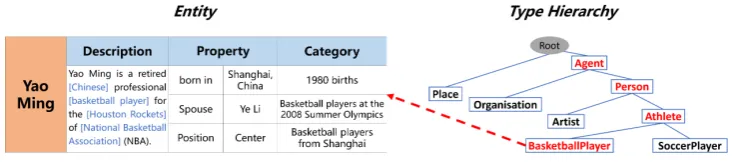
Traditional entity typing focuses on a small set of types, such as Person, Location and Or-ganization (Ratinov and Roth, 2009; Nadeau and Sekine, 2007), while fine-grained entity typ-ing assigns more specific types to an entity, which normally forms a type-path in the type hier-archy in KB (Ren et al., 2016a). As shown in Fig. 1, Yao Ming is associated with a type-path /Thing/Agent/Person/Athlete/BasketballPlayer. Fine-grained types (e.g.,AthleteandBasketballPlayer) are more informative than coarse-grained types (e.g.,Person), because they provide more specific se-mantic information about the entity (Xu et al., 2016). Characterizing an entity with fine-grained types (type-paths) benefits many real applications, such asknowledge base completion (Dong et al., 2014), entity linking (Ling et al., 2015; Durrett and Klein, 2014),relation extraction (Liu et al., 2014), and question answering(Yahya et al., 2014).
Many researches have been carried out onfine-grained entity typingin text, which detects local types for an entity mention in a particular plain text from predefined fine-grained entity types (Ling and Weld, 2012; Yogatama et al., 2015; Ren et al., 2016a; Shimaoka et al., 2017; Xin et al., 2018). However, only a few works aim atfine-grained entity typingin knowledge base, that is, inferring missing types for an entity inKB, which is the focus of this paper. MostKBs are incomplete and lack of type information, in part because the world is always changing. For example, 36.53% entities in DBpedia do not have type information. Therefore,KBs are aways in need of updating and completing. To this end, there are two main methods in the literature as follow: One method exploits various kinds of information to construct the feature representation of an entity, such as entity textual description, property and category (Nee-lakantan and Chang, 2015; Xu et al., 2016). After that, a predict functionP(t|e) is learned to infer
This work is licenced under a Creative Commons Attribution 4.0 International License. License details: http:// creativecommons.org/licenses/by/4.0/
Figure 1: An example of fine-grained entity typing inKB. The left part is an entity with various infor-mation. The red ones are assigned types, which forms a type-path.
whether entityeis an instance of typet. This method ignores rich structural information inKB(i.e., link relation between entities). It is a promising and challenging problem to utilize structural information for type inference. The second method utilizesannotated corpusto learn entity low-dimensional represen-tations then makes type inference based on the learned embeddings (Yaghoobzadeh and Sch¨utze, 2015; Yaghoobzadeh and Sch¨utze, 2017). Apparently, it requires large scale corpus in which entity mentions are annotated. But large scale highly-qualified annotated corpus is often difficult to obtain.
To address the above issues, we propose a novelattributed and predictive entity embeddingmethod, which can be described as follow: We first construct a partially-labeled attributed entity network, which contains structural, attribute and type information for entities. Here “partially-labeled” means some entities have been labeled with type information, while others not. Then, we employ a deep neural network to integrate the structural and attribute information for entity representation learning. For an unlabeled entity, we jointly utilize its structural and attribute information for neighbor prediction. For a labeled entity, besides neighbors, we also predict its types and type hierarchy via a margin-based loss function. Finally, a multi-label classification model is used for type inference based on the learned entity embeddings.
The main contributions of this paper can be summarized as follows:
• We encode various kinds of information into a partially-labeled entity network and propose a deep neural network model to effectively integrate the structural and attribute information for entity rep-resentation learning.
• We utilize type information of labeled entities to equip the learned embeddings with strong pre-dictive power in entity typing task, and further incorporate the structure of type hierarchy via a margin-based loss function to meet the fine-grained demand.
• We construct a dataset from DBpedia. Extensive experiments show that our proposed method sig-nificantly outperforms 8 state-of-the-art methods, with 3.4% and 2.9% improvement in Mi-F1 and Ma-F1, respectively.
The rest of this paper is organized as follows. In Section 2, we formally define the problem of fine-grained entity typing in knowledge bases. Section 3 demonstrates the proposed approach in detail. The dataset description and evaluation are presented in Section 4. Section 5 outlines some related works. Section 6 concludes our work.
2 Problem Formulation
In this section, we formally define the problem ofFine-Grained Entity TypinginKB.
Definition 1 Knowledge Baseis defined a tuple of entities E and a type hierarchyH, formally,KB = hE,Hi, whereHis used to organize entities inE. Each entitye∈ Edenotes a specific thing in the real world.
Definition 2 Type HierarchyHis defined as a tree or a directed acyclic graph (DAG). It provides a natural way to categorize and organize entities in largeKB. It is formalized(T,R), whereT is the type set andR={(ti, tj)|ti, tj ∈ T ∧ i6=j}is the relation set, in which(ti, tj)means thattiis the subtype
We distinguish three kinds of entity knowledge which are beneficial tofine-grained entity typingtask.
• Entity Link Relation:KBcontains a large number of link relations between entities. It is natural to convert entities inE into a network structure via these link relations. If an entityeilinks to another
entityejinKB, there will be a directed edge from entityei to entityej. These link relations reflect
the overall structure ofKBand provide important semantic relatedness between entities.
• Entity Attribute: Besides the above link structure, each entitye∈ E also has textual description, properties and categories (shown in Fig. 1). We term all such auxiliary information of an entity as attributes. The attributes of an entity provide valuable clues to predict its types.
• Entity Type:Part of entities inEhave been assigned with types, we refer them asEl. The assigned
types for an entity form a type-path in type hierarchyH, which starts from the root and ends at one specific type (not necessary to end at the leaf type). Those entities inE without type information are referred asEu. The type information observed inElcan be a useful signal to infer missing type
information inEu.
From the above definitions, we achieve apartially-labeled attributed entity network, including link structure, entity attributes, and type information. We formally define this entity network as follow:
Definition 3 Entity Network:LetG= (E,L)be an entity network.E =El∪ Euis the entity set, where
|E|=N and|El|=Nl.L={(e
i, ej)|ei, ej ∈ E and i6=j}is the link relation set.
For the convenience of formula deduction, we redefine this entity network in matrix form, G = (A,X,Y). Adjacency matrix A ∈ RN×N is equivalent to link setL,A
ij = 1if there is a link from
eitoej, otherwise 0. Each row inArefers to an entity’s link vectorAi. Attribute matrixX ∈RN×M
collects attributes for all entities, whereMis the number of attributes. Each row inXrefers to an entity’s attribute vectorXi.Xcan either be binary or take any real value. Type matrixY ∈RN
l×K
collects type information for entities inEl, whereK is the number of types. Each row inY refers to the type vector
Yiof a labeled entity inEl.Yij = 1ifeihas been assigned with typetj, otherwise 0.
Based on the terminologies described above, we formally define the problem of fine-grained entity typing inKBas follows:
Definition 4 Fine-grained entity typing in KB:Given a partially-labeled attributed entity networkG = (E,L), we aim at learning a type predictor from El, which comprehensively takes link structure, entity
attributes and type information into account. Then we utilize the learned type predictor to predict the type ofe∈ Eu, i.e., infer whether entitye∈ Euis an instance of typet∈ T.
3 The Proposed Approach
3.1 General Architecture
A general state-of-the-art architecture for fine-grained entity typing consists of two components.
• Entity Representation:It learns distributed representation~v(e)for each entitye∈ E.
• Type Predictor:It learns a predict functionP(t|e)usingElas training examples. P(t|e)denotes
the probability that entityebelongs to typet, and it is often used to infer types of those unlabeled entities inEu.
Type predictoris regarded as a multi-label classification model. P(t|e)is calculated through a two-layer Multi-Layer Perceptron (MLP).
[P(t1|e)· · ·P(tK|e)] =σ(Woutf(Win~v(e))) (1)
Each entry of output layer indicates the predicted probability of typeti for a given entitye. Win and
Wout are MLP parameter matrices. σ is the sigmoid function. f is the nonlinear activation function,
The lossLfor a predictiony = [P(t1|e)· · ·P(tK|e)]when the true labels are encoded in a binary
vectory∗ ∈ {0,1}1×K is the following cross entropy loss function:
L(y,y∗) =
K
X
i=1
−y∗(i)logy(i)−1−y∗(i)
log
1−y(i)
(2)
The key difficulty in computingP(t|e) is to learn a good representation~v(e)for entity e. Several models have achieved the state-of-the-art performance. However, these models still face the following non-trivial challenges:
• Entity attributes and link structure are typically regraded as separated features without considering their correlations. Recent research shows the importance of integrating link structure and entity attributes for learning more informative representations (Liao et al., 2017; Li et al., 2017). Could we seamlessly integrate entity attributes and link structure into a unified entity network? Since the link structure and entity attributes offer different sources of information, how shall we capture the complex non-linear relationship between them?
• The type information of the labeled entities inElis only used in the learning phase of the type
pre-dictor, but totally ignored in the representation learning phase. Recent research shows incorporating labeled information in representation learning could enhance the predictive power of the learning embeddings for specific tasks (Tang et al., 2015a; Yang et al., 2016). In our task, the entity types and their formed type hierarchyHare valuable labeled information, could we design a predictive model to make full use of the type information inEland the structure of type hierarchy?
To address the above challenges, we propose a novel attributed and predictive entity embedding method to learn entity representations. It combines the advantages of attributed network embedding method and semi-supervised learning. We integrate entity attributes and link structure via a deep neural network model (Section 3.2). For an entityeiinEl, we jointly predict its type and its neighbor entities
in the entity network (Section 3.3). In this way, we can fully utilize the type information inEl.
3.2 Attributed Entity Embedding
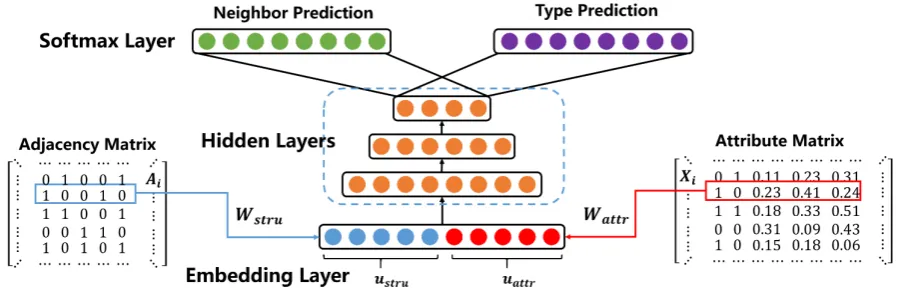
We aim at learning low-dimensional vector representations for each entity in the entity network, such that original link structure and entity attribute proximity can be preserved in vectors. The most intuitive idea is to directly concatenate the embeddings learned from different parts. However, this way can not capture the complex non-linear relationship between them, because each part is trained separately without interaction. To address this issue, we present a neural network model to integrate link structure (structural information) and entity attributes (attribute information). For an entity ei ∈ E, we jointly
utilize its link vector Ai and attribute vector Xi to predict the link probability between ei and other
entities (shown in Fig. 2). Our model integrates structure and attribute information on the input layer, so that these two parts closely interact with each other and all parameters can be optimized simultaneously. In our design, each entityehas two vector representations,self representationandcontext representa-tion. eis self representation ofewhen it is treated as an entity in entity networkG. While˜eis context representation ofewhen it is treated as a specific context. To comprehensively represent an entitye, we addeand˜eas the final representation~v(e).
Input and Embeddings. For an entity ei ∈ E,AiandXi denote its link vector and attribute vector
as defined in Section 2. Our model takes both structural information (Ai) and attribute information (Xi)
as input, and utilizes two embedding weight matrices to achieve the final input embeddings. Wstru
projects the link vectorAito a dense vectorustruwhich captures structural information.Wattrencodes
the attribute vectorXiand generates a compact vectoruattrwhich aggregates attribute information. We
concatenateustruanduattr, then feed this concatenated vector into a Multi-Layer Perceptron.
Figure 2: Attributed entity embedding framework
of data (Liao et al., 2017). Each layer is calculated as follows:
h(1)=f
W(1)[ustru, λuattr] +b(1)
(3)
h(k)=fW(k)h(k−1)+b(k), k= 1,2,· · ·, n (4)
λis the trade-off factor for structure and attribute information. f denotes the activation function. nis the number of hidden layers. From the last hidden layer, we obtain an informative representationh(n), which is regarded as the self representationeiof the input entityei.
Neighbor Prediction. Finally, we predict neighbors for an input entity ei (if there is a link from
ei to ej, ej isei’s neighbor). We call it neighbor prediction, which is widely used to model network
structure (Tang et al., 2015a; Liao et al., 2017). Specifically, we utilize the self representation ei to
predict the link probability between entityeiand other entities. The predictive link probability is defined
through a softmax layer as follows:
p(ej|ei) =
exp (˜ej·ei)
PN
j0=1exp ˜ej0·ei
(5)
˜
ejdenotes the context representation of entityej. Letyidenotes the predicted link probability vector for
entityei,yi(j)is thej-th entry of the vectoryi.Aiisei’s link vector (in Section 2),Aij indicates whether
there is a link fromeitoej. The loss functionLattris defined as cross entropy over all entities inE
Lattr= N
X
i=1 N
X
j=1
−Aijlogy(ij)−(1−Aij) log
1−y(ij) (6)
3.3 Predictive Entity Embedding
In this section, we propose predictive entity embedding learning that makes full use of the type infor-mation inEl, which is often ignored by existing methods in representation learning phase. Inspired by
(Tang et al., 2015a; Yang et al., 2016), we first introduce a type prediction loss to equip learned embed-dings with strong predictive power for entity typing task (Section 3.3.1). Then, to meet the fine-grained demand, we model the tree-structured type hierarchy in a margin-based framework (Section 3.3.2).
3.3.1 Type Prediction
We fully utilize type information inElto make the learned embeddings more predictive. For each entity
ei ∈ El, we not only predict its neighbors inG(Section 3.2), but also predict its types. We add another
softmax layer, the probability of entityeibeing an instance of typetjis defined as follows:
p(tj|ei) =
exp (tj·ei)
PK
j0=1exp tj0 ·ei
tj denotes the representation of typetj. Letyi denotes the predicted type probability vector for entity
ei,y(ij)is thej-th entry of the vectoryi.Yiisei’s type vector (in Section 2),Yij indicates whethereiis
an instance oftj. The loss functionLtypeis defined as cross entropy over all entities inEl:
Ltype= Nl
X
i=1 K
X
j=1
−Yijlogyi(j)−(1−Yij) log
1−y(ij) (8)
3.3.2 Type Hierarchy Modeling
Fine-grained entity typing requires us to pay more attention to specific types (fine-grained types) than to general types (coarse-grained types), because specific types are more informative. For example,Yao Mingbelongs toBasketballPlayerandAthlete, and it should get higher score onBasketballPlayerthan Athlete, because the former characterizesYao Mingmore accurately. Besides,Yao Mingshould get higher score on the correct typeBasketballPlayerthan its wrong sibling typeSoccerPlayeralthough both types belong toAthlete. If different types are treated equally, the structural information between types will be lost. Therefore, we usetype orderto model different relatedness between an entity and its related types, which reflects the structural information of type hierarchy to a certain degree. In particular, we define two kinds oftype orderas follow:
Definition 5 Ancestor order:In the type-path of an entity, specific types should get higher score than its ancestor. For example, Yao Ming should get higher score on BasketballPlayer than Athlete.
Ancestor order reflects the relationship between a type and its ancestor types. For each triple(e, t, ta), wheretis one of the type for entitye, andtaist’s ancestor in type hierarchy. We define adaptive margin γtta =ξ× l(t
a,t)
l(root,t), wherel(t
a, t)denotes the number of steps going down from typetato typet. The
hinge loss is defined as:
max (0, s(e, ta)−s(e, t) +γtta) (9)
Lancestor =E(e,t,ta)[max (0, s(e, ta)−s(e, t) +γtta)] (10)
wheres(e, t)is the score function, defined as the inner product ofeandt.
Definition 6 Sibling order: For an entity, the correct type should get higher score than its wrong sib-ling type in type hierarchy. For example, Yao Ming should get higher score on BasketballPlayer than SoccerPlayer.
Sibling order reflects the relationship between a type and its sibling types. For each triple (e, t, ts), wheretis one of the true type for entitye, andts is its wrong sibling type of entitye. We use the fixed marginξ. The hinge loss is defined as:
max (0, s(e, ts)−s(e, t) +ξ) (11)
Lsibling=E(e,t,ts)[max (0, s(e, ts)−s(e, t) +ξ)] (12)
We achieve the loss functionLhierfor type hierarchy modeling:Lhier =Lancestor+Lslibing. Objective and Training. Finally, we sum these three loss function to get the final objective function of entity representation component.
Loss=Lattr+λ1·Ltype+λ2·Lhier (13)
λ1andλ2are weight parameters. We apply negative sampling (Mikolov et al., 2013; Tang et al., 2015b),
4 Experiments and Analysis
In this section, we evaluate the proposed method using real world dataset collected from DBpedia. We will introduce the dataset and experiment settings in Section 4.1, present the comparison results in Sec-tion 4.2 and investigate some method details in SecSec-tion 4.3. Our source code is available1for reference.
4.1 Datasets and Experimental Setup
Datasets: To the best of our knowledge, there is no public large-scale dataset available for fine-grained entity typing in KB. We construct a dataset from DBpedia. The type hierarchy in DBpedia is of tree structure. We extract link relation and attribute information from DBpedia2. For each entity, we use the single type-path assigned in DBpedia as the ground truth.
[image:7.595.158.443.266.318.2]For this dataset, we remove those entities which are only labeled asThing. Because they do not provide any semantic information. In representation learning phase, we utilize the whole dataset with only 50% entities are labeled with types. In type predictor phase, we follow a 50/30/20 ratio to split the dataset into training, dev and test sets. Table 1 shows the detailed statistics. Each entity has 3.27 types on average.
Table 1: Statistics of the dataset
Type Entity Link Attribute
word property category
214 300,000 5,243,230 5,350 200 350
Metrics: To evaluate the performance of our proposed method, we use Accuracy (Strict-F1), Micro-averaged F1 (Mi-F1) and Macro-averaged F1 (Ma-F1), which have been used in many fine-grained typing systems (Yaghoobzadeh and Sch¨utze, 2015; Yaghoobzadeh and Sch¨utze, 2017; Ren et al., 2016a).
Parameter Settings: Our implementation of APEis based on TensorFlow3. Regarding the choice of activation function of hidden layers, we have triedReLU,softsignandtanh, findingsoftsignleads to the best performance in general. We randomly initialize model parameters with a Gaussian distribution (with a mean of 0.0 and standard deviation of 0.01), optimizing the model with mini-batch Adam (Kingma and Ba, 2014). We set fixed margin ξ = 1in our experiments. Both λ1 and λ2 are chosen among
{0.2,0.4,0.6,0.8}, we foundλ1 = 0.8andλ2 = 0.4achieve best performance. Baseline: We denote our model asAPE, and compare it with three sets of methods:
• Entity typing methods: We compareAPEwith five state-of-the-art entity typing methods. FIG-MENTuses entity representation learned from annotated corpus for type inference (Yaghoobzadeh and Sch¨utze, 2015).CUTEemploys a multi-label hierarchical classification method to address en-tity typing task (Xu et al., 2016).MuLRuses multi-level representations of entities (character, word and entity) to make type inference inKB(Yaghoobzadeh and Sch¨utze, 2017). Globalutilizes en-tity text description to infer missing enen-tity type instances (Neelakantan and Chang, 2015). Corpus
designs global and context model to make type inference jointly (Yaghoobzadeh et al., 2017).
• Network Embedding methods: Attributed and predictive network embedding methods can learn informative entity representations, so we compareAPEwith them. PTElearns predictive text em-beddings from heterogeneous network (Tang et al., 2015a).Planetoidis a semi-supervised network embedding method which makes neighbor and label prediction jointly (Yang et al., 2016). ASNE
integrates structural and attribute information via a deep neural architecture (Liao et al., 2017).
• APE’s variants: If we ignore the type information, that is, utilize the embeddings learned from section 3.2 to make type inference, the method is denoted asAPEno type. Similarly, if we omit the type hierarchy modeling in Section 3.3.2, the method is denoted asAPEno hierarchy.
4.2 Overall Comparison Results
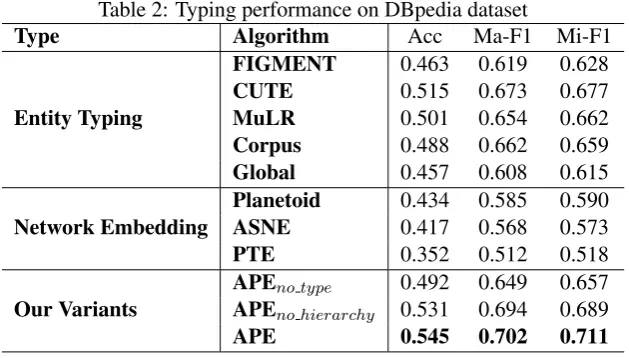
Table 2 shows the overall performance and we have the following conclusions:
1https://github.com/Tsinghua-PhD/APE 2
http://wiki.dbpedia.org/downloads-2016-10
Table 2: Typing performance on DBpedia dataset
Type Algorithm Acc Ma-F1 Mi-F1
FIGMENT 0.463 0.619 0.628
CUTE 0.515 0.673 0.677
Entity Typing MuLR 0.501 0.654 0.662
Corpus 0.488 0.662 0.659
Global 0.457 0.608 0.615
Planetoid 0.434 0.585 0.590
Network Embedding ASNE 0.417 0.568 0.573
PTE 0.352 0.512 0.518
APEno type 0.492 0.649 0.657
Our Variants APEno hierarchy 0.531 0.694 0.689
APE 0.545 0.702 0.711
Comparison with Entity Typing methods. Our model outperforms the state-of-the-art entity typing methods, and achieves 3.4% and 2.9% improvement in Mi-F1 and Ma-F1 respectively, because it em-ploys multiple kinds of information for type inference. Each part can provide complementary information about entities for type inference. Our model leverages label information (type information) in represen-tation learning phase, equip the learned embeddings with strong predictive power in entity typing task.
Comparison with Network Embedding methods.Our model outperforms the state-of-the-art network embedding methods (i.e.,Planetoid,ASNEandPTE), and achieves 12.1% and 11.7% improvement in Mi-F1 and Ma-F1 respectively. We model the structure of type hierarchy in a margin-based loss function. Specifically, ancestor order makes entities closer to specific types than general types, and sibling order makes the learned entity embeddings have strong discriminative power between sibling types.
Comparison with Variants. APE consistently outperforms APEno type and APEno hierarchy, and
the simplest versionAPEno type could achieve comparable results with state-of-the-art methods. The
results verify that each of these information sources contributes complementary information for fine-grained typing of entities. Structural information (link relation) provides important semantic relatedness between entities. Attribute information (text, property and category) provides additional clues for type inference. Type information (type hierarchy) makes our model more powerful in classification task.
4.3 Result Analysis
4.3.1 Impact of Features
We investigate the effect of information sources used to learn entity embeddings. In Table 3,Stru,T,
PandCis short for structural information, text description, property and category, respectively. From Table 3, we find different information sources play different roles in this task. Structural information is most common in KB, it makes related entities have similar representations. It models the relation between entities, while neglecting entities’s self-information.Attribute information(i.e., text description, property and category) can be viewed as entity features, which is often informative for type inference. We compare our model APE, APEno type and APEno hierarchy with different kinds of information
combination. For attribute information, category information is more import than property information and text descriptions.
4.3.2 Effects of Labeled Data
Table 3: Performance on different information source combination.
Information Type APE APEno type APEno hierarchy
Acc Ma-F1 Mi-F1 Acc Ma-F1 Mi-F1 Acc Ma-F1 Mi-F1
Stru+T 0.467 0.623 0.631 0.463 0.625 0.634 0.472 0.632 0.633
Stru+P 0.475 0.633 0.637 0.480 0.638 0.642 0.489 0.651 0.653
Stru+C 0.481 0.641 0.646 0.487 0.649 0.647 0.486 0.650 0.647
Stru+P+C 0.479 0.642 0.649 0.520 0.685 0.679 0.523 0.677 0.669
Stru+T+P 0.484 0.647 0.655 0.507 0.658 0.659 0.510 0.657 0.660
Stru+T+C 0.481 0.643 0.653 0.518 0.683 0.681 0.525 0.678 0.673
Stru+T+P+C 0.492 0.649 0.657 0.531 0.694 0.689 0.545 0.702 0.711
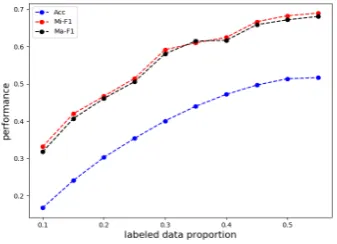
[image:9.595.93.262.239.361.2]Figure 3: Performance on different labeled data proportion.
Table 4: Type macro average F1 on test for all, fre-quent and infrefre-quent types, #training/testmeans the average entity number for each type.
Type infrequent frequent all
#training 1013 13,513 8,673
#test 417 5,217 3,462
FIGMENT 0.327 0.620 0.557
MuLR 0.374 0.718 0.636
Corpus 0.447 0.783 0.675
CUTE 0.418 0.730 0.652
APE 0.461 0.792 0.681
4.3.3 Results of Frequent/Infrequent Types
We use type macro average F1 proposed by (Yosef et al., 2012) to evaluate the performance onfrequent typesand infrequent types. Note that it is different from Ma-F1 reported in Table 2. The results for infrequent types (occur less than 2,000 times) and frequent types (occur more than 10,000 times) are shown in Table 4. Generally, the performance on infrequent types is worse than frequent ones. Our model consistently outperforms the other methods on infrequent types, which demonstrates its ability on dealing with rare types.
5 Related Work
Fine-grained entity typing inKB is an important sub-task of knowledge base completion. One way to address this problem is making type inference based on entity’s attribute information in KB, such as textual description, property, category and so on. (Neelakantan and Chang, 2015) infer missing types for entities inKBbased on text descriptions. (Xu et al., 2016) employ a multi-label hierarchical classifica-tion method to assign Chinese entities with DBpedia types based on property and category informaclassifica-tion. The other way relies on large-scale annotated corpus, then extracts type information from the annotated corpus for entities inKB. (Yaghoobzadeh and Sch¨utze, 2015) first propose FIGMENT to address this problem. They only used contextual information to assign types for entities in KB. After that, they present FIGMENT-Multi to learn multi-level representations of entities on three complementary levels (character, word and entity). FIGMENT-Multi predicts whether an entity is a member of a type based on the learned embeddings (Yaghoobzadeh and Sch¨utze, 2017). Finally, they propose an embedding based method which combines a global model with a context model. A global model that scores based on aggregated context information and a context model that aggregates the scores of individual con-texts (Yaghoobzadeh et al., 2017).
seeks to detect local types of an entity mention inside an individual sentence, and the same entity could have different types in different sentences (Ling and Weld, 2012; Yosef et al., 2012; Gillick et al., 2014; Dong et al., 2015; Del Corro et al., 2015; Yogatama et al., 2015; Ren et al., 2016b; Ren et al., 2016a; Shimaoka et al., 2017; Rabinovich and Dan, 2017).
6 Conclusion
In this paper, we propose an attributed and predictive entity embedding method to address the task of fine-grained entity typing inKB. It combines the advantages of attributed network embedding method and semi-supervised learning. Specifically, it employs a deep neural network architecture to integrate structure and attribute information of an entity. We jointly predict a labeled entity’s neighbors and types, and model the structure of type hierarchy in a margin-based way. Experiments on real world datasets demonstrate the effectiveness of the proposed model.
Acknowledgements
The work is supported by National Key Research and Development Program of China (2017YFB1002101), NSFC key project (U1736204), Ministry of Education and China Mobile Research Fund (No. 20181770250), and THUNUS NExT Co-Lab.
References
Luciano Del Corro, Abdalghani Abujabal, Rainer Gemulla, and Gerhard Weikum. 2015. Finet: Context-aware fine-grained named entity typing. InConference on Empirical Methods in Natural Language Processing, pages 868–878.
Xin Dong, Evgeniy Gabrilovich, Geremy Heitz, Wilko Horn, Ni Lao, Kevin Murphy, Thomas Strohmann, Shaohua Sun, and Wei Zhang. 2014. Knowledge vault: A web-scale approach to probabilistic knowledge fusion. In
Proceedings of the 20th ACM SIGKDD international conference on Knowledge discovery and data mining,
pages 601–610. ACM.
Li Dong, Furu Wei, Hong Sun, Ming Zhou, and Ke Xu. 2015. A hybrid neural model for type classification of entity mentions. InInternational Conference on Artificial Intelligence, pages 1243–1249.
Greg Durrett and Dan Klein. 2014. A joint model for entity analysis : Coreference , typing , and linking. TACL, pages 477–490.
Dan Gillick, Nevena Lazic, Kuzman Ganchev, Jesse Kirchner, and David Huynh. 2014. Context-dependent fine-grained entity type tagging. arXiv:1412.1820.
Diederik P Kingma and Jimmy Ba. 2014. Adam: A method for stochastic optimization. arXiv preprint arXiv:1412.6980.
Hang Li, Haozheng Wang, Zhenglu Yang, and Masato Odagaki. 2017. Variation autoencoder based network representation learning for classification. InACL 2017, Student Research Workshop, pages 56–61.
Lizi Liao, Xiangnan He, Hanwang Zhang, and Tat Seng Chua. 2017. Attributed social network embedding.
arXiv:1705.04969.
Xiao Ling and Daniel S Weld. 2012. Fine-grained entity recognition. InAAAI, pages 94–100.
Xiao Ling, Sameer Singh, and Daniel S Weld. 2015. Design challenges for entity linking.TACL, pages 315–328.
Yang Liu, Kang Liu, Liheng Xu, and Jun Zhao. 2014. Exploring fine-grained entity type constraints for distantly supervised relation extraction. InCOLING, pages 2107–2116.
Tomas Mikolov, Ilya Sutskever, Kai Chen, Greg Corrado, and Jeffrey Dean. 2013. Distributed representations of words and phrases and their compositionality. InInternational Conference on Neural Information Processing
Systems, pages 3111–3119.
David Nadeau and Satoshi Sekine. 2007. A survey of named entity recognition and classification. Lingvisticae Investigationes, 30(1):3–26.
Arvind Neelakantan and Ming Wei Chang. 2015. Inferring missing entity type instances for knowledge base completion: New dataset and methods.Computer Science, pages 35–40.
Maxim Rabinovich and Klein Dan. 2017. Fine-grained entity typing with high-multiplicity assignments. In
Meeting of the Association for Computational Linguistics, pages 330–334.
Lev Ratinov and Dan Roth. 2009. Design challenges and misconceptions in named entity recognition. In
Proceed-ings of the Thirteenth Conference on Computational Natural Language Learning, pages 147–155. Association
for Computational Linguistics.
Xiang Ren, Wenqi He, Meng Qu, Lifu Huang, Heng Ji, and Jiawei Han. 2016a. Afet: Automatic fine-grained entity typing by hierarchical partial-label embedding. InProceedings of the Conference on Empirical Methods
in Natural Language Processing (EMNLP), pages 1369–1378.
Xiang Ren, Wenqi He, Meng Qu, Clare R Voss, Heng Ji, and Jiawei Han. 2016b. Label noise reduction in entity typing by heterogeneous partial-label embedding. In Proceedings of the 22nd ACM SIGKDD International
Conference on Knowledge Discovery and Data Mining, pages 1825–1834.
Sonse Shimaoka, Pontus Stenetorp, Kentaro Inui, and Sebastian Riedel. 2017. Neural architectures for fine-grained entity type classification. InEACL, pages 1271–1280.
Jian Tang, Meng Qu, and Qiaozhu Mei. 2015a. Pte: Predictive text embedding through large-scale heterogeneous text networks. InProceedings of the 21th ACM SIGKDD International Conference on Knowledge Discovery
and Data Mining, pages 1165–1174. ACM.
Jian Tang, Meng Qu, Mingzhe Wang, Ming Zhang, Jun Yan, and Qiaozhu Mei. 2015b. Line: Large-scale infor-mation network embedding. InProceedings of the 24th International Conference on World Wide Web, pages 1067–1077. ACM.
Ji Xin, Yankai Lin, Zhiyuan Liu, and Maosong Sun. 2018. Improving neural fine-grained entity typing with knowledge attention. InAAAI.
Bo Xu, Yi Zhang, Jiaqing Liang, Yanghua Xiao, Seung-won Hwang, and Wei Wang. 2016. Cross-lingual type inference. InInternational Conference on Database Systems for Advanced Applications, pages 447–462.
Yadollah Yaghoobzadeh and Hinrich Sch¨utze. 2015. Corpus-level fine-grained entity typing using contextual information. InProceedings of the 2015 Conference on Empirical Methods in Natural Language Processing, pages 715–725.
Yadollah Yaghoobzadeh and Hinrich Sch¨utze. 2017. Multi-level representations for fine-grained typing of knowl-edge base entities. arXiv:1701.02025.
Yadollah Yaghoobzadeh, Heike Adel, and Hinrich Sch¨utze. 2017. Corpus-level fine-grained entity typing.
arXiv:1708.02275.
Mohamed Yahya, Klaus Berberich, Shady Elbassuoni, and Gerhard Weikum. 2014. Robust question answering over the web of linked data. InCIKM, pages 1107–1116.
Zhilin Yang, William W Cohen, and Ruslan Salakhutdinov. 2016. Revisiting semi-supervised learning with graph embeddings. InICML, pages 40–48.
Dani Yogatama, Dan Gillick, and Nevena Lazic. 2015. Embedding methods for fine grained entity type classifica-tion. InProceedings of the 53rd Annual Meeting of the Association for Computational Linguistics and the 7th International Joint Conference on Natural Language Processing of the Asian Federation of Natural Language Processing, ACL, pages 26–31.