Structured Aspect Extraction
Aspect extraction identifies relevant features of an entity from a textual description and is typ-ically targeted to product reviews, and other types of short text, as an enabling task for, e.g., opinion mining and information retrieval. Current aspect extraction methods mostly focus on as-pect terms, often neglecting associated modifiers or embedding them in the asas-pect terms without proper distinction. Moreover, flat syntactic structures are often assumed, resulting in inaccurate extractions of complex aspects. This paper studies the problem of structured aspect extraction, a variant of traditional aspect extraction aiming at a fine-grained extraction of complex (i.e., hierarchical) aspects. We propose an unsupervised and scalable method for structured aspect ex-traction consisting of statistical noun phrase clustering, cPMI-based noun phrase segmentation, and hierarchical pattern induction. Our evaluation shows a substantial improvement over existing methods in terms of both quality and computational efficiency.
1 Introduction
The abundance of web data has made information extraction (IE) of strategic importance for data-driven companies such as, e.g., retailers, because of its applications to information retrieval (Kannan et al., 2011), knowledge base construction (Shin et al., 2015), media intelligence (Zeng et al., 2010), and conversational agents (Cassell, 2000). Among allIE-related tasks, Aspect extraction (AE) (Zhang and Liu, 2014) is certainly one of the most challenging. AEaims at identifying features of an entity, e.g., a phone, from a free text description ans is commonly associated with (aspect-based) sentiment analysis as a means of extractingaspect terms and associatedopinions in, e.g., product reviews or other forms of opinionated and evaluative text (Hu and Liu, 2004; Popescu and Etzioni, 2005). Similar methods have also been used for extractingattributes from, e.g., product listings and other forms ofdescriptive
text (Ghani et al., 2006; Kannan et al., 2011). An obvious challenge in aspect extraction is dealing with noisy, unstructured text (NUT).NUThas consistently challenged traditional NLP tools, in particular POS taggers and dependency parsers, due to ungrammatical sentences and incorrect orthography.
Example 1: Aspect extraction
Victoriantwo bedroommid terracepropertylocated inCambridgeand comprising ofliving roomwith ORIGINAL!!!cupboards, andORIGINAL!!!picture rail.Stairwayoffliving roomleads totwobedrooms.
↓
{bedroom mid terrace,picture rail.Stairway,cupboards,bedrooms,property} {Cambridge,ORIGINAL}
Example 1 shows the output of IBM’s Alchemy Languageservice1 when asked to retrieve aspect terms and named entities. Alchemy Language extractspicture rail.Stairway as an aspect due to a missing space
after the full stop, andORIGINAL as a named entity, due to incorrect orthography. Another challenge
is distinguishing aspect terms from their modifiers. The terms Victorian, mid terrace, and the (nested) expressiontwobedroomarequalifyingthe termproperty, while the termtwoquantifiesthe termbedroom.
This work is licenced under a Creative Commons Attribution 4.0 International Licence. Licence details: http:// creativecommons.org/licenses/by/4.0/
1https://alchemy-language-demo.mybluemix.net as of July 2016.
Problem definition This paper studies the problem of recognizing and extractingstructuredaspects.
Structured Aspect Extraction (SAE) generalizes aspect term extraction (ATE) with the extraction and
linking of modifiers of the aspect term, identifying the possibly hierarchical structure of the aspects. Consider the textVictoriantwobedroommid terracepropertyfrom Example 1. AnSAEsystem is expected to produce a single extraction with explicit annotations for (i) the aspect terms, i.e.,property, bedroom (ii)the aspect modifiers, correctly typed as qualifiers, i.e.,Victorian,mid terrace, and quantifiers, i.e.,two, and(iii)the hierarchical structure of the aspect, i.e.,h{Victorian,h{two},bedroomi,mid terrace},propertyi.
Contributions (Zhang and Liu, 2014) termed the recognition of flathmodifier,aspectistructures (i.e., a simple form ofSAE) a very challenging task. In this paper we go beyond that, proposing (Section 2) a method for unsupervised SAEconsisting of: (1) An effective normalization strategy specifically en-gineered forNUT.(2)A statistical noun phrase clustering method for unsupervised discovery of aspect terms and (raw) modifiers. (3)A cPMI-based noun-phrase segmentation, to identify multi-word expres-sions and nested structures. (4)A controlled induction of structured aspect patterns. We evaluate our method against state-of-the-art aspect extraction systems using data from the widely-acceptedSemEval benchmarks and aSAE-specific dataset. The evaluation (Section 3) shows that our method improves on existing unsupervised systems for aspect-term extraction and solves the harderSAEtask reliably.
Positioning Existing work on aspect extraction focuses mostly on three tasks: (1) Entity extrac-tion (Zhang and Liu, 2014; Yahya et al., 2014), i.e., classifying entities in a free-text fragment (e.g., car, phone). (2)Aspect term extraction (Yu et al., 2011; Zhang and Liu, 2014; Chen et al., 2014), i.e., extracting features of the entity (e.g., battery, performance).(3)Opinion extraction (Pang and Lee, 2008; Yang and Cardie, 2014), i.e., extracting sentiments or opinions and link them to aspects terms.
(Probst et al., 2007) was the first method to go beyond simple aspect terms, proposing a semi-supervised method for extracting hmodifier,aspecti pairs from product descriptions. Despite being su-pervised, the method has issues distinguishing genuine pairs representing aspects from spurious ones. (Kelly et al., 2012) makes extractions more precise by targetinghmodifier,relation,aspectitriples in verbal phrases. Although precise, applying this method is unrealistic in practice since it severely impairs recall. In fact, empirical evidence suggests that most of the interesting aspects occur in proximity of named entities and in noun phrases. This shows the need for more flexibility in extracting aspects.
Leveraging a dependency parser is a possible way to capture more complex aspect structures, or at least to provide clues about the presence of entity modifiers (e.g., viaAMODrelations). However, deep parsing is known to be inaccurate onNUT, and training suitable models difficult, sinceNUTlacks proper grammatical structure in the first place. This has been clear since the works by (Popescu and Etzioni, 2005) and (Raju et al., 2009) proposing, as a solution,ATEmethods based on noun-phrase clustering. More recently, (Kim et al., 2012) used noun-phrase clustering to extract hmodifier,aspecti pairs where modifiers are arbitraryn-grams, generically typed as either modifiers or quantifiers. Although limited to flat structures, this is currently the closest work toSAEwe are aware of.
Similarly to (Popescu and Etzioni, 2005; Raju et al., 2009), we use frequency-based noun-phrase clustering to detect aspect terms in an unlabelled corpus. Besides making clustering more accurate by normalizing the descriptions, our method detects the underlying structure of the aspect via a cPMI-based segmentation of noun phrases that simulates an aspect-oriented parsing of the sentence. PMI values are also used by (Popescu and Etzioni, 2005) but only for aspect-term detection. Another option is to use topic modeling for clustering (Titov and McDonald, 2008; Sauper and Barzilay, 2013; Zhang and Liu, 2014). Topic modeling is effective in ATEbut can under-cluster when applied to SAE, e.g., noun phrases headed bybedroom andkitchenare clustered together despite having different modifiers, producing incorrect associations of modifiers to aspect terms.
al., 2010; Choi and Cardie, 2010; Jakob and Gurevych, 2010; Yang and Cardie, 2014). Our hierarchical extraction should not be confused with the mapping of flat aspects to taxonomies and knowledge bases as done, e.g., by (Yahya et al., 2014). The generalization of these hierarchical structures into patterns enables us to transfer these structures to the extracted aspects, thus labelling the extractions as in (Kim et al., 2012), distinguishing the aspect term, from its qualifiers and quantifiers. Let us stress out that these coarse hierarchical structures cannot be trivially derived from fine-grained dependency relations.
2 Structured Aspect Extraction
We now formally define the task ofstructured aspect extraction(SAE). We introduce some non-standard notation but we assume readers are familiar with aspect extraction terminology.
Definitions Astructured aspect is a tuple hM,ti, where tis an aspect term (orhead of the aspect) andM={m1, . . . ,mn}is a sequence of modifiers of the aspect term (ortailof the aspect). A labelling
function λ : M∪ {t} 7→ L maps aspect terms and modifiers to a set L of labels. Aspect terms are labelled as the real-world entities they represent, e.g., BEDROOM. Each modifier m ∈ M is labelled as either λ(t)-QUANTIFIER or λ(t)-QUALIFIER where λ(t) is the label of the aspect termt. Consider the
text fragment Victorian two bedroom mid terrace property from Example 1. The corresponding SAE is
h{Victorian,h{two},bedroomi,mid terrace},propertyi where the aspect terms propertyandbedroom are la-belled asPROPERTYandBEDROOMrespectively,Victorian,mid terrace, andh{two},bedroomi are labelled as PROPERTY-QUALIFIER, and two is labelled as a BEDROOM-QUANTIFIER. Structured aspects are obtained by
matching structured aspect patterns(hence SAP) against free text. AnSAP mirrors the structure of a structured aspect and consists of a tuplehP,Ti, whereTis either the surface form of an aspect term or a POS tag, andP={p1, . . . ,pm}is a sequence of surface forms of a modifier (e.g.,two,mid terrace), POS
tags (e.g.,CD,JJ), or (nested)SAPs. AnSAPis matched against free text in the usual way. For symmetry w.r.t. structured aspects,TandPare called theheadandtailof theSAPrespectively. A possibleSAP matching the structured aspect above ish{Victorian,h{CD},bedroomi,JJterrace},propertyi.
Overview and architecture SAPs are induced from a homogeneous corpus of texts, i.e., with texts coming from the same domain, e.g., restaurants, products. The induction operates in four phases: (1) normalization, (2) clustering, (3) segmentation and typing, and (4) generalization. Texts are pro-cessed to obtain a corpus of orthographically normalized and POS tagged noun phrases (NP). The nor-malizedNPs are clustered around their head nouns, being these likely candidates for aspect terms. A cPMI-based (Damani and Ghonge, 2013) segmentation of the modifiers of theNPslocates(i)multi-word expressions and(ii)nested aspects. The segmentedNPsare then taken as a first approximation of anSAP (ground), where the head noun becomes the head of the SAPand the (segmented) modifier of the NP becomes its tail. Modifiers are then typed as quantifiers or qualifiers. GroundSAPsare then generalized by replacing the surface forms of the modifiers by their POS tags, thus obtaining the finalSAPs.
Normalization and POS tagging The normalization tackles issues that affect subsequent phases of the induction process. In particular, it improves the accuracy of noun chunking onNUT, avoiding an expen-sive (and possibly pointless)NUT-specific training. The first problem is the high number of tokenization errors, leading to incorrect sentence splits. To address this, we have built aNUT-specific tokenizer, pro-ducing correct tokens in the presence of, e.g., abbreviations, units of measures, and incorrect sentence boundaries. These customizations are domain independent. Incorrect orthography is another major prob-lem inNUT. It directly affects the performance of POS taggers and, in turn, of noun chunking. To address this, we normalize the orthography of each token to its most common orthography in the whole corpus. We consider five orthographic classes: uppercase, lowercase, upper initial, lower initial, and alphanu-meric. An occurrence of a token is normalized if more than a certain percentage (experimentally set at 90% across all domains) of its other occurrences in the corpus have a different orthography.
Example 2: Normalization
Fantastic
CD CD2 NNPSBeds OXFORDVBD property.DonNN POS’ NNt missVBPPRPit PUNC!
↓
fantastic
JJ CD2 bedsNN OxfordNNP propertyNN PUNC.
Do
VBRBn’t missVB PRPit PUNC!
shows how POS tagging improves after our improved tokenization and orthographic normalization. We do not only produce more sensible POS tags, but we also recover the correct sentence boundaries.
Normalized texts are then split into sentences and POS tagged. We use a state-of-the-art rule-based sentence splitter and Hepple’s POS tagger tagger (Hepple, 2000) trained on the Penn TreeBank Corpus. The tagged sentences are handed over to a rule-based NP chunker (Ramshaw and Mitchell, 1999) to produce a corpus of noun phrases.
Noun-phrase clustering NPs are clustered around their head nouns. Head nouns are stemmed and lemmatized, e.g., by normalizing plurals, to avoid over-segmentation of the clusters due to different surface forms of equivalent head nouns. The modifiers of theNPsare also normalized to prevent non-content prefixes and numerical expressions from fragmenting the clusters.
NPsare generalized to abstract forms where non-content words and numerical expressions are replaced by POS tags. A non-content word is a token with a POS tag in{CC,DT,EX,IN,PRP,PUNC}, while a numerical expression has POS tagCD. Prefixes consisting only of non-content words are then removed from theNPs. The process is illustrated in Example 3.
Example 3: Clustering
Two further double bedrooms CDfurther double bedrooms {CDfurther double bedrooms, [BEDROOM]
Three further double bedrooms CDfurther double bedrooms further double bedrooms,
A further double bedroom DTfurther double bedroom CDfirst floor bedrooms} Two first floor bedrooms CDfirst floor bedrooms
We start with fourNPswith 2 different surface forms for the head noun (i.e.,bedroomandbedrooms). For three of theNPs, the modifier starts with a numerical expression. This remains part of theNPbut as a POS tag (CD). The non-content word prefixA(POS tag DT), is removed from theNP. The result of this process is a single cluster headed byBEDROOMand consisting of three partially-generalizedNPs. The clusters are filtered based on their cardinalities, i.e., the number of (possibly duplicated)NPsbelonging to the cluster. The top-kclusters whose elements cover at least a certain percentage (experimentally set at 70% across all domains) of all theNPsare retained. Clusters can also be fragmented by spelling errors. The head nouns of discarded clusters are therefore checked for similarity against the head nouns of the retained ones. Two clusters are merged if the Dameraau-Levenshtein string edit distance is less than an experimentally set threshold (20% across all domains). If multiple merging options are possible, the one with highest similarity is chosen. If only equivalent options are available, we merge in all possible ways. Clearly, the normalization of the noun-phrase modifiers described above can affect the ranking of the noun-phrases, since clusters can be merged thus increasing their ranking.
tandw. We then define cPMIC(t,w)as follows:
cPMIC(t,w) = log fC(tkw)
fC(t)·fC|C|(w) +pfC(t)·
q ln(δ) (−2)
The cPMI value is used to determine whether a token should be associated with (i) the head noun, (ii)a nested token representing the head of a different cluster, thus possibly inducing a nested structure, or(iii)an adjacent token, thus forming a multi-word expression.
We model the segmentation as the problem of finding a cPMI-optimal parenthesization (or, equiva-lently, a parse tree) of the NP. In order to achieve this, we first have to define the notions of (i) valid parenthesization and(ii)cPMIof a parenthesization. A valid parenthesization is a balanced parenthesiza-tion such that, eachk-th level of the parenthesization: (1)consists of at least two elements (i.e., tokens or subpatterns), and (2) it either terminates with a head of cluster or it contains no heads of cluster. The cPMI of a (valid) parenthesization is the sum of the cPMIvalues computed between each element (token or parenthesized sub-expression) in the parenthesization and the first head of cluster following the element at the same level of nesting. If no heads of cluster are present at the same level of nesting, then the sum of the cPMI values between subsequent tokens is taken. The cPMI of the parenthesized sub-expressions is then recursively added to this value.
Example 4: Segmentation
p : Victorian twobedroommid terraceproperty pi : (Victorian (twobedroommid) (terrace)property)
pv : (Victorian (twobedroom) (mid terrace)property) SAP : h{Victorian,h{two},bedroomi,mid terrace},propertyi
Consider theNPpof Example 4. A balanced but invalid parenthesization is shown aspi. The
parenthe-sization violates both conditions given above, i.e., the level-2parenthesization(twobedroommid)contains a head of cluster (i.e.,bedroom) but terminates with the tokenmid, and the level-2parenthesization (ter-race)contains a single token. A valid parenthesization ispvand its cPMIis computed as:
cPMInp = cPMIC(Victorian,property) + cPMIC(two bedroom,property) +
cPMIC(mid terrace,property) + cPMIC(two,bedroom) + cPMIC(mid,terrace) Notice that cPMInpnow includes the cPMIvalue betweenmidandterrace(i.e., a multi-word expression).
Algorithm 1 formalizes the process described above. The pseudocode focuses on the most technical aspect of the procedure, i.e., the generation of the different parenthesizations. We also omit minor tech-nicalities related to, e.g., handling of punctuation and non-content words. The algorithm receives as an input the clustered noun phrases, here represented as a mapChaving as keys the heads of clusters and as values (denoted asval(C)) sets of noun phrases. The output of the algorithm is again a mapP, having as keys the heads of the patterns, and sets ofSAPsas values. The algorithm iterates over all noun phrases npin all clusters and converts them into a sequence of tokensP(Line 4). The functionoptiParthen produces a cPMI optimal parenthesization ofP (Line 5) that is then transformed into an SAPvia the
par2SAPfunction (Line 6). TheSAPis stored inP (Line 7). The notationP(k)represents the clus-ter ofSAPsheaded byk, whilehead(P)returns the head of the patternP. The functionoptiParis an adaptation of standard combinatorial parenthesization algorithms, where we keep track of the paren-thesization producing the highest noun-phrase-wide cPMI. The function takes a sequence of tokensP and recursively parenthesizes it (Lines 4-9). The cPMInp of the parenthesization is then computed by the functionnpcPMIand tested against the current maximum (Lines 11-13). The function isValid
in Line 10 checks that only valid parenthesizations are considered. For the sake of readability, Algo-rithm 1 gives a straightforward recursive implementation of the procedure but more efficient dynamic programming implementations can be provided.
Algorithm 1:Segmentation Functionsegmentation(C)
input:C: the clusters
1 P← ∅;
2 forC∈val(C)
3 fordistinct np∈C 4 P←split(np); 5 Pmax←optiPar(P,C);
6 Psap←par2SAP(Pmax);
7 P(head(Psap))←P(head(Psap))∪ {Psap}; 8 returnP;
FunctionoptiPar(P,C)
input:C: the clusters
input:P: the sequence of tokens from the noun phrase
1 if|P| ≤2then
2 returnP;
3 hmaxpmi,Pmaxi ← h0,∅i;
4 fori∈[0,|P|-1]
5 forj∈[|P|-1,i+1]
6 ifi>0∨j<|P|-1then
7 P0←optiPar(sub(P,0,i))k’(’koptiPar(sub(P,i,j))k’)’koptiPar(sub(P,j,|P|-1));
8 else
9 P0←’(’kPk’)’;
10 ifisValid(P0)then 11 curpmi←npcPMI(P0,C);
12 ifcurpmi>maxpmithen
13 hmaxpmi,Pmaxi ← hcurpmi,P0i; 14 returnPmax;
of theSAPat runtime, thus avoiding matching multiple times the same fragment of text. The elements of a groundSAPare thentypedaccording to their role in the pattern (Example 5). The head of the pattern is labelled as the head of theSAPcluster it belongs to and is used to match the aspect term. Modifiers with a POS tagCDand linked to an aspect termtare labelled asλ(t)-QUANTIFIER. All other modifiers linked to
t, including nestedSAPs, are labelled asλ(t)-QUALIFIER. Extractions produced by matchingSAPagainst free text are labelled according to the typing of theSAP.
Example 5: Typing
h{Victorian,h{two},bedroomi,mid terrace},propertyi
property → PROPERTY bedroom → BEDROOM
Victorian → PROPERTY-QUALIFIER two → BEDROOM-QUANTIFIER
mid terrace → PROPERTY-QUALIFIER
two bedroom → PROPERTY-QUALIFIER
Generalization GroundSAPsare limited to what has been directly observed in the corpus. As a conse-quence, the elements of anSAPare generalized to their POS tags to increase recall. The process must be controlled because excessive generalization may also lead to inaccurate extractions. The generalization rules are illustrated in Example 6 and operate as follows: (1) Numerical expressions, non-content words, and punctuation are always generalized to their POS tags. (2) Multi-word expressions are generalized as bothn-grams and unigrams since they ”behave” like a single token. In the latter case, the POS tag of the last token is used. (3) Aspect terms are not generalized unless the tail of the pattern contains a nested SAPwith a ground head. The nature of the modifiers is often strictly related to the aspect term they refer to. This is obvious for, e.g., the modifiers ofbedroomandpropertyin Example 6. We therefore have to
Example 6: Generalization
h{Victorian,h{two},bedroomi,mid terrace},propertyi ↓
h{JJ,h{CD},bedroomi,mid terrace},propertyi h{Victorian,h{CD},bedroomi,midJJ},propertyi h{Victorian,h{CD},bedroomi,JJ},propertyi h{Victorian,h{CD},bedroomi,mid terrace},NNi h{Victorian,h{CD},bedroomi,JJterrace},propertyi
Patterns are scored based on their ability to discriminate between correct and incorrect extractions. We adapt the scoring mechanism of (Gupta and Manning, 2014), where the quality of a pattern is estimated by matching the extracted patterns against a manually labelled validation set. In our unsupervised setting, no labelled dataset is available. We take the heads of the noun-phrase clusters as a surrogate of the set of valid aspects. The analysis is limited to aspect terms. LetT be the set of valid aspect terms as defined above, andE be the set of aspect terms produced by anSAPP. The score ofPis computed as:
ν(P) =P |T|
e∈E(1−maxt∈T1(distlen((t,et)) <0.2))
·log|T| ν(P)∈[0,∞]
wheredist(t, e)denotes the Dameraau-Levenshtein edit distance between two stringstandeandlen(·)
denotes the length of the string. Patterns scoring less than an experimentally set threshold (50% across all domains) are eliminated.
3 Evaluation
Our method (Oxtractor) is implemented in Java. All experiments are run on a quad-core desktop machine at 3.40GHz and 32GB RAM, running Linux. All resources used in the evaluation are made available for replicability at http://bit.ly/2dewzdd and include: theSAEDdataset andGS, our reimplementations of IIITHandATL, a compiled version ofOxtractor, and all output files generated by all systems.
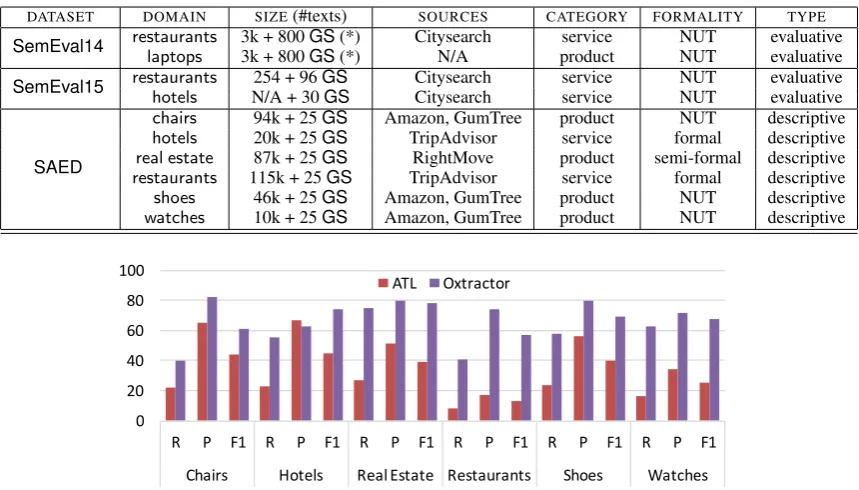
Datasets and metrics We use three groups of datasets in our evaluation (Table 1): The first two consist of theSemEval14andSemEval152datasets used for the aspect term extraction (ATE) and opinion target expression (OTE) subtasks of the aspect-based sentiment analysis (ABSA) task. The datasets provide
laptops,restaurantsandhotelreviews with associated gold standard (GS) annotations. Thehoteldomain is meant to be used in a completely unsupervised setting and therefore no training data is available. The size ofSemEval14 in Table 1 is expressed in number of sentences instead of number of texts since this information is unavailable. We complement theSemEval15datasets with some specifically designed for SAE(SAED). We provide texts from six domains (50% for testing, 50% for validation). Four of them, i.e.,
chairs,real estate,shoes, andwatches, describe products. The Amazon texts come from the Stanford’s Snap Lab’s web data corpus (McAuley and Leskovec, 2013). The two remaining domains, i.e.,hotels
andrestaurants, can be classified as services. These descriptions are still feature intensive but, differently from the products, the features are loosely connected to the main entity, i.e., locations, services/facilities offered. The dataset consists of bothNUTand (semi-) formal English texts. We provideGSannotations for 150 texts equally distributed across the six domains. The GS provides and average of 355 aspect terms, 30 quantifiers, 430 qualifiers, and 45 nested aspects per domain. Annotations were produced by 6 independent annotators (λ=87%). We use standard recall, precision, and F1 score metrics. However,
due to the different granularity of the output produced by the systems and of the GS annotations, the definition of a correct extraction varies slightly with each evaluation task.
Comparative evaluation – SimplifiedSAE The method by (Kim et al., 2012), henceATL, is currently
Table 1: Datasets
DATASET DOMAIN SIZE(#texts) SOURCES CATEGORY FORMALITY TYPE
SemEval14 restaurantslaptops 3k + 8003k + 800GSGS(*)(*) CitysearchN/A productservice NUTNUT evaluativeevaluative SemEval15 restaurantshotels N/A + 30254 + 96GSGS CitysearchCitysearch serviceservice NUTNUT evaluativeevaluative
SAED
chairs 94k + 25GS Amazon, GumTree product NUT descriptive
hotels 20k + 25GS TripAdvisor service formal descriptive
real estate 87k + 25GS RightMove product semi-formal descriptive
restaurants 115k + 25GS TripAdvisor service formal descriptive
shoes 46k + 25GS Amazon, GumTree product NUT descriptive
watches 10k + 25GS Amazon, GumTree product NUT descriptive
0 20 40 60 80 100
R P F1 R P F1 R P F1 R P F1 R P F1 R P F1
Chairs Hotels Real Estate Restaurants Shoes Watches
ATL Oxtractor
Figure 1:Oxtractorvs.ATLon simplifiedSAE(SAEDdataset)
SAEsetting where we do not require correct linking of modifiers to aspect terms.Oxtractorperforms 33% better thanATLin average, outperforming it in all domains. Besides being unable to extract hierarchical structures, a visible issue inATLis the inability to recognize semantic connections between modifiers and aspect terms. This leads to a number of incorrect extractions for both aspect terms and modifiers that could be avoided by leveraging, e.g., statistical co-occurrence or cPMI.
Comparative evaluation –ATE Restricting the evaluation to aspect terms makes it possible to compare
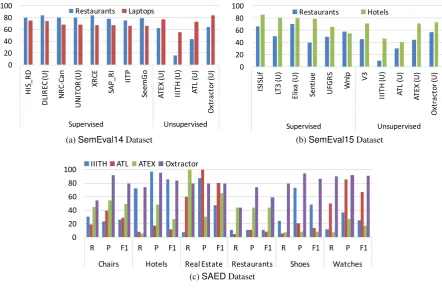
Oxtractoragainst otherATEsystems. We denote byIIITHandATEXthe methods proposed by (Raju et al., 2009) and (Zhang and Liu, 2014) respectively. IIITH uses unsupervised clustering of noun-phrases to derive aspect terms and is therefore similar toOxtractor. We could not obtain the originalIIITH system from the authors so the evaluation relies on our own implementation. ATEX, on the other end, is chosen because of itsATE method based on topic modeling. Moreover, it is freely available for testing. An aspect term is correctly extracted if it matches exactly aGSannotation. ForOxtractor,IIITH, andATLwe used theSAEDcorpora for training. Figures 2a and 2b show the results for theSemEval14andSemEval15 datasets respectively. For all systems, exceptOxtractor,IIITH,ATEX, andATL, we report the scores provided in the corresponding SemEval papers. The symbol(U)denotes systems that have used additional data besides the training set provided by SemEval (i.e., unconstrained in SemEval terminology). Oxtractor outperforms all unsupervised systems and some of the supervised ones. Moreover, this is a lower bound forOxtractordue to a difference between the granularity of theSemEval GSand the output produced by Oxtractor. E.g., Egyptian restaurant is considered a correct aspect term by SemEval but Oxtractor would only producerestaurantas the aspect term andEgyptianas its modifier (and thus a miss forSemEval). A striking result is the performance achieved byOxtractoron thelaptopsdomain inSemEval14, where also all supervised systems are outperformed. As for many other product-like domains, aspect terms in the
laptopsdomain frequently fall within the scope of noun-phrases that are easily processed by our method. This is much less true for other service-like domains such as, e.g., restaurants and hotels. Figure 2c shows the performance ofOxtractor,IIITH,ATEX, andATLon theSAEDdataset. In this case, theGSdifferentiates between aspect terms and modifiers, thus explaining the lower performance of traditionalATEsystems, e.g.,IIITHandATEX, and the higher accuracy of, e.g.,ATLthat is able to appreciate this difference. ATEX
0
Chairs Hotels Real Estate Restaurants Shoes Watches
IIITH ATL ATEX Oxtractor
(c)SAEDDataset
Figure 2:Oxtractorvs. others inATE
also struggles onrestaurantsdue to long sentences.
Full SAE We evaluate the performance of Oxtractor in the full SAE setting using the SAED dataset. An extraction is correct if aspect terms and modifiers match the GSannotations, including the correct (and possibly hierarchical) associations between modifiers and entities. In average (Figure 3),Oxtractor achieves an F1of 58.6% in the fullSAEsetting, sensibly below the one obtained in theATE(i.e., 79.6%)
and simplifiedSAE(i.e., 67.8%) settings. Linking modifiers to aspect terms in the presence of hierarchical structures is indeed a much more challenging task than simply identifying them. Another interesting aspect is the impact of the generalization on the performance. GeneralizedSAPs produce 444 correct extractions against the 386 of the ground ones (+15%).
0 Chairs Hotels Real Estate Restaurants Shoes Watches
ATE Simpl. SAE Full SAE
Figure 3:Oxtractoron fullSAE
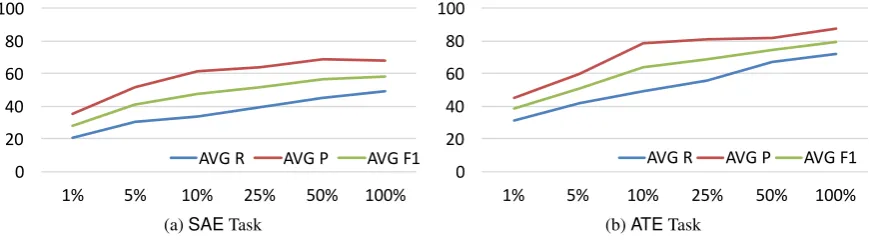
Long-tail aspects are only induced from sufficiently large corpora (thus the behavior between 10% and 50%). Larger corpora also have the disadvantages that sufficiently frequent but incorrect tokens can end up be-ing extracted as modifiers. In other words, the increase in recall is not matched by a comparable increase of precision (Figure 4b). In the case ofSAEwe even observe a slight drop in precision (Figure 4a).
0
Figure 4: Performance vs. corpus size (average –SAEDdataset)
A breakdown of the data per domain allows us to draw further conclusions on the relationship between the size of the corpus and the performance of the SAPs. There is a relationship between the variety of features and the amount of data that is necessary to induce good quality SAPs. For domains such as, e.g., chairs, realestate, shoes, and watches, starting from 25% of the size of the corpus we do not notice substantial improvements in performance. This can be explained by the nature of the features in these domains that are intrinsically limited, e.g., make and models of the products, types of real estate properties, etc. In therestaurantsandhoteldomains the texts are much more variegated in features, e.g., restaurant and hotel names, dishes, locations, etc. Despite the large amount of texts available, it seems that our method would require even larger corpora before being able to converge to a stable set of aspects.
Efficiency Finally, we evaluate the efficiency of the SAPinduction and matching phases. Oxtractor’s efficiency mostly depends on the length of the sentences, due, e.g., to the morphological analysis, our cPMI-based segmentation, and pattern matching. Oxtractor induces SAPs at a rate of 14 ms/sent and 6 ms/sentfor long (i.e.,≥10 tokens) and short (i.e.,<10 tokens) sentences respectively. The matching
time per sentence is almost negligible and ranges between 2msand 3msper text. We also notice a linear correlation between the size of theSAPand its matching time. This is achieved, despite the presence of hierarchical structures, by replacing nested patterns with references to the correspondingSAPclusters, enabling parallel matching of the nestedSAPs. In terms of training time,Oxtractorinduces patterns from 20ktexts within 1hr on average.IIITHandATLrequire more than 15hrs on the same dataset.
Discussion SAE is still in its infancy. A number of interesting problems can be studied in this area such as, e.g., semantic categorization of modifiers and aspect terms. Although the majority of structured aspects appear in noun phrases, a fair amount also appears in more complex syntactic structures. We extended our normalization to rewrite these structures into traditional noun-phrases with good results. Another issue is redundant SAPs, caused by aspect terms having the same ”tail” and semantically be-longing to a taxonomic hierarchy of concepts, e.g.,two bedroomapartment, two bedroomhouse. We are
currently investigating the use of knowledge bases such as, e.g.,BabelNet(Navigli and Ponzetto, 2012) to reduce this redundancy. Finally, our evaluation shows that the gap betweenOxtractorand supervised sys-tems is still considerable. Oxtractorcan be adapted to use supervision at different stages of the induction process, in particular during clustering and pattern scoring.
Acknowledgements
References
Justine Cassell. 2000. Embodied conversational interface agents.Commun. ACM, 43(4):70–78.
Zhiyuan Chen, Arjun Mukherjee, and Bing Liu. 2014. Aspect extraction with automated prior knowledge learning.
InProc. of ACL, pages 347–358.
Yejin Choi and Claire Cardie. 2010. Hierarchical sequential learning for extracting opinions and their attributes.
InProc. of ACL, pages 269–274.
Om P Damani and Shweta Ghonge. 2013. Appropriately incorporating statistical significance in pmi. InProc. of
EMNLP, pages 163–169.
R. Ghani, K. Probst, Y. Liu, M. Krema, and A. Fano. 2006. Text mining for product attribute extraction. SIGKDD
Explorations, 8(1):41–48.
Sonal Gupta and Christopher D Manning. 2014. Improved pattern learning for bootstrapped entity extraction. In
CoNLL, pages 98–108.
M. Hepple. 2000. Independence and commitment: Assumptions for rapid training and execution of rule-based pos taggers. InProc. of ACL, pages 278–277.
Minqing Hu and Bing Liu. 2004. Mining and summarizing customer reviews. In Proc. of SIGKDD, pages 168–177.
Niklas Jakob and Iryna Gurevych. 2010. Extracting opinion targets in a single and cross-domain setting with conditional random fields. InProc. of EMNLP, pages 1035–1045.
Anitha Kannan, Inmar E Givoni, Rakesh Agrawal, and Ariel Fuxman. 2011. Matching unstructured product offers to structured product specifications. InProc. of SIGKDD, pages 404–412.
C. Kelly, B. Devereux, and A. Korhonen. 2012. Semi-supervised learning for automatic conceptual property extraction. InProc. of CMCL, pages 11–20.
D. S. Kim, K. Verma, and P. Z. Yeh. 2012. Building a lightweight semantic model for unsupervised information extraction on short listings. InProc. of EMLNP, pages 1081–1092.
Fangtao Li, Chao Han, Minlie Huang, Xiaoyan Zhu, Ying-Ju Xia, Shu Zhang, and Hao Yu. 2010. Structure-aware review mining and summarization. InProc. of ACL, pages 653–661.
Kang Liu, Liheng Xu, and Jun Zhao. 2013. Syntactic patterns versus word alignment: Extracting opinion targets from online reviews. InProc. of ACL, pages 1754–1763.
J. McAuley and J. Leskovec. 2013. Hidden factors and hidden topics: Understanding rating dimensions with review text. InProc. of RecSys, pages 165–172.
R. Navigli and S. P. Ponzetto. 2012. BabelNet: The automatic construction, evaluation and application of a wide-coverage multilingual semantic network. Artif. Intell., 193:217–250.
Bo Pang and Lillian Lee. 2008. Opinion mining and sentiment analysis.Found. Trends Inf. Retr., 2(1-2):1–135. Ana-Maria Popescu and Oren Etzioni. 2005. Extracting product features and opinions from reviews. InProc. of
HLT-EMNLP, pages 339–346.
Soujanya Poria, Erik Cambria, Lun-Wei Ku, Chen Gui, and Alexander Gelbukh. 2014. A rule-based approach to aspect extraction from product reviews. InProc. of COLING, pages 28–37.
K. Probst, R. Ghani, M. Krema, A. E. Fano, and Y. Liu. 2007. Semi-supervised learning of attribute-value pairs from product descriptions. InProc. of IJCAI, pages 2838–2843.
Guang Qiu, Bing Liu, Jiajun Bu, and Chun Chen. 2011. Opinion word expansion and target extraction through double propagation. Computational Linguistics, 37(1):9–27.
S. Raju, P. Pingali, and V. Varma. 2009. An unsupervised approach to product attribute extraction. InProc. of ECIR, pages 796–800.
L. A. Ramshaw and M. P. Mitchell. 1999. Text chunking using transformation-based learning. In Armstrong S. et Al, editor,Natural Language Processing Using Very Large Corpora, volume 11 ofText, Speech and Language
Christina Sauper and Regina Barzilay. 2013. Automatic aggregation by joint modeling of aspects and values.
JAIR, 46(1):89–127.
Jaeho Shin, Sen Wu, Feiran Wang, Christopher De Sa, Ce Zhang, and Christopher R´e. 2015. Incremental knowl-edge base construction using DeepDive.PVLDB, 8(11):1310–1321.
Ivan Titov and Ryan T McDonald. 2008. A joint model of text and aspect ratings for sentiment summarization. In
Proc. of ACL, volume 8, pages 308–316.
Yuanbin Wu, Qi Zhang, Xuanjing Huang, and Lide Wu. 2009. Phrase dependency parsing for opinion mining. In
Proc. of EMNLP, pages 1533–1541.
Mohamed Yahya, Steven Whang, Rahul Gupta, and Alon Y Halevy. 2014. Renoun: Fact extraction for nominal attributes. InProc. of EMNLP, pages 325–335.
Bishan Yang and Claire Cardie. 2014. Joint modeling of opinion expression extraction and attribute classification.
TACL, 2:505–516.
Jianxing Yu, Zheng-Jun Zha, Meng Wang, and Tat-Seng Chua. 2011. Aspect ranking: identifying important product aspects from online consumer reviews. InProc. of HLT, pages 1496–1505.
Daniel Zeng, Hsinchun Chen, Robert Lusch, and Shu-Hsing Li. 2010. Social media analytics and intelligence.
IEEE Intell. Syst., 25(6):13–16.
Lei Zhang and Bing Liu, 2014. Aspect and Entity Extraction for Opinion Mining, pages 1–40. Springer Berlin Heidelberg.
Xinjie Zhou, Xiaojun Wan, and Jianguo Xiao. 2013. Collective opinion target extraction in chinese microblogs.
InProc. of EMNLP, pages 1840–1850.