Heat Transfer Augmentation Using Passive Techniques: A
Review.
1
Nalavade Sandeep P,
2Prabhune Chandrakant L,
3Sane Narayan k
1Research Scholar, 2Professor, 3 Adjunct Professor 1,2,3
Department of Mechanical Engineering, 1Dr. D.Y. Patil Institute of Technology, Pimpri, Pune, India.
2Zeal College of Engineering and Research, Pune, India. 3Walchand College of Engineering, Sangli, India.
Abstract:Heat transfer enrichment has significant role in energy conservation and chemical process heat transfer. to attain the increased rate of heat transfer, passive techniques like twisted tapes, helical tapes, gear ring turbulators, anchor shape inserts, vortex generators etc. are employed. in the present research paper, a review on the current scenario in heat transfer enhancement using various passive techniques has been conducted. these reports expose that the upcoming exploration in the region of heat transfer augmentation using passive techniques will fetch further growth in the performance of heat exchanging devices.
1. INTRODUCTION
The continuous depletion of conventional energy sources and rapid increase in material cost directed various investigators toward development of efficient heat exchangers. The method to improve the rate of heat transfer performance is mentioned as heat transfer augmentation. The methods of heat transfer augmentation are categorized as active, passive and combined techniques [1-2]. As compared to the active methods of heat transfer enhancement, passive methods, for example turbulators, rough surfaces, additives etc., do not involve any exterior power effort, and are inexpensive and simple in use. Hence, the many researchers were conducted investigation on various passive heat transfer enhancement methods. Bergles et.al. [2] discussed thermal performance assessment measure for several augmentation methods. Hejazi et al. [3] performed experiments on pipe in pipe heat exchanger incorporating twisted tape insert. It was observed that the rate of heat removal boosts through decline in twist ratio, but it is piloted with substantial rise in frictional pressure loss.
To control the surge in the frictional loss in a tube flow, due to incorporation of twisted tapes, several alterations of the traditional twisted tape, such as the variable length twisted tape, clockwise-counterclockwise twisted tape, equal spaced twisted tape, loose-fitted twisted tape, tapes with square-cut, delta winglet etc. were investigated [4-9]. It has been realized that, aforementioned modifications of twisted tape insert offer superior thermal augmentation effectiveness at lower value of flow rates.
Chang et.al [10, 11] experimentally studied the heat transfer and pressure drop characteristic for broken twisted tape insert and serrated twisted tape inside a tube. They recited that heat transfer coefficient; pressure loss rises with the reduction in twist ratio. Numerical study upon Nusselt number and pressure drop features for a tube equipped with center-cleared twisted tape was conducted by Guo et.al [12]. The outcomes displayed that the thermal performance factor for a tube incorporated with center-cleared twisted tape is improved in the range of 7% to 20% as compared to the
tube with regular twisted tape. The study of perforated twisted tapes with parallel wings in a heated tube was conducted by Thipong et.al [13]. The observation laid down the fact that wings prompt an additional turbulence to disrupt the boundary layer region whereas the holes on a tape length decline the pressure drop.
Bhuiya et.al [14] investigated the effect of perforated double counter twisted tapes on heat removal rate and pressure drop features in a circular tube. The experiment outcomes shown that heat transfer coefficient and pressure drop were increased with reducing porosity. Nanan et.al [15] explored the heat transfer enhancement performance with tapered twisted tapes with twist angle 0°, 0.3°,0.6° and 0.9° respectively in a turbulent flow regime. They observed that Nusselt number and friction loss amplified with decreased taper angle and twist ratio. Maximum thermal performance was yielded at taper angle 0.9° and Reynolds number 6000. Thus it has been intended that most of the combinations of twisted tapes upturns the rate of heat removal and friction coe. with decline in pitch to diameter ratio.
Wongcharee et.al [16] studied an alternate-axes twisted tape with wing shapes like triangle, rectangle and trapezoid. They found that, the tapes with combined alternative axes using trapezoidal wings offers the utmost heat transfer, pressure loss as well as thermal performance factor. The effect of twisted tape insert with and without V-cut on rate of heat transfer, frictional loss and thermal performance factor features in a circular tube was studied by Murugesan et al. [17]. The V-cut twisted tape presented a highest heat removal rate, frictional coefficient than the basic twisted tape; as well as, the influence of the depth ratio was overriding as compared to the width ratio for all the fluid flow rates.
effect of regularly spaced helical tape swirl generators with and without central rod on heat transfer enhancement. Experimental results revealed that evenly spaced helical tape inserts at space ratio 0.5 yields the highest Nusselt number. Garcia et.al [20] investigated heat transfer enhancement with wire coil inserts in a circular tube for laminar and transitional flow regimes. The performance difference between wire coils and twisted tape inserts has shown that wire coils provide better results than twisted tapes in the low Reynolds number range 700–2500.
Mostafa M. Ibrahim et.al [21] numerically inspected the impact of conical ring turbulator in turbulent region. They explored the influence of following configurations: convergent conical, convergent–divergent conical and divergent conical respectively. They found that both heat transfer coefficient and pressure loss amplified as the conical ring diameter ratio and pitch ratio reduces. Promvonge et.al [22] was conducted experimental investigation on the influence of conical ring with twisted tape on heat transfer rate. The experimental results revealed that convective heat transfer coefficient and thermal enhancement efficiency of tube are 4% to 10% superior to conical ring alone. The combined consequence of twisted tape with wire coil turbulator was experimentally investigated by P. Promvonge [23]. As compared to the use of wire coil/twisted tape alone, the existence of wire coils and twisted tapes steers towards increase in the heat transfer rate by two times.
L. Syam Sundar et.al [24] experimentally explored the influence of longitudinal strip inserts in a nano composite nanofluid flow inside a circular tube. The experimental investigation involved the volume concentrations for nanofluid from 0% - 0.3% and aspect ratio for inserts 1, 2, 4 and 12 respectively. They found that maximum Nusselt number enhancements observed for 0.3% concentration nanofluid flow with longitudinal strip insert of aspect ratio 1. The impact of intermittent helical turbulator in a concentric tube heat exchanger was investigated by Sheikholeslami et.al [25]. They observed that both Nusselt number and friction factor increased with reduction in open area ratio and pitch ratio.
Alok Kumar et.al [26] assessed the effect of solid hollow circular disk turbulators on performance of the tubular heat exchanger experimentally for the diameter ratio 0.6 to 0.8. They observed that as the diameter ratio of turbulator rises the thermal performance factor also increases considerably. Supreme thermal performance is witnessed at diameter ratio 0.8. Heat transfer augmentation by implanting punched delta winglet vortex generators[27] in a circular tube was inspected. The results shown that the rate of heat transfer gets increased along with increase in angle of attack.
Experimental and numerical study on effect of gear-ring turbulators (GR-T) on Nusselt number and friction
coefficient was conducted by Ruengpayungsak et.al [28]. The outcomes show that thermal enhancement performance increases along with rise in number of teeth of GR-T. The effect of curved winglet tape on thermal performance of heat exchanger tube was investigated by Skullong et.al [29]. It was concluded that as the height of curved winglet increases, the heat transfer rate enhances, whereas opposite trend was observed for relative pitch length.
The influence of the drainage inserts on heat transfer coefficient and frictional loss was studied by Pengxiao Li et.al [30]. The results shown that this insert, strengthens the mixing of fluids from core to wall and the insert also produces the swirl in the fluid domain. Sunil Chamoli et.al [31] conducted experimental investigation on perforated vortex generators in tube flow. They reported that thermal augmentation factor increases along with increase in perforation index, which is ratio of perforation area to trapezium area.
A numerical investigation on incorporating pipe inserts in tube flow was conducted by Wenbin Tu et.al [32]. It was observed that, compared to three pipes turbulator, four pipes turbulator have a superior thermal performance. The influence of sinusoidal wavy tapes inside a shell and tube heat exchanger device was numerically inspected by Chulin Yu et.al [33]. The results indicated that these tapes directs the fluid flow in a wavy manner and induce longitudinal swirling vortices, which enhance the heat transfer rate. The numerical investigation on anchor shape inserts on Nusselt number and frictional coefficient was conducted by Chamoli et.al [34]. They observed that the AVG inserts generate the recirculation vortex flow in the tube which causes better mixing within the hot and cold fluid.
2. SUMMARY:
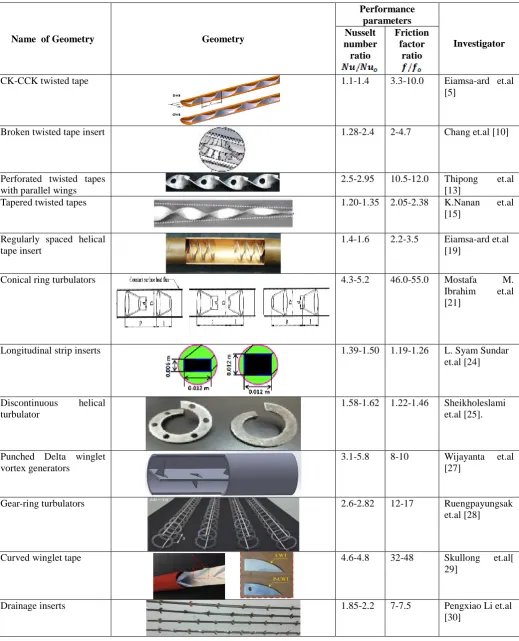
Table 1: Performance of different insert geometries.
Name of Geometry Geometry
Performance parameters
Investigator Nusselt
number ratio
Friction factor
ratio
CK-CCK twisted tape 1.1-1.4 3.3-10.0 Eiamsa-ard et.al
[5]
Broken twisted tape insert 1.28-2.4 2-4.7 Chang et.al [10]
Perforated twisted tapes with parallel wings
2.5-2.95 10.5-12.0 Thipong et.al [13]
Tapered twisted tapes 1.20-1.35 2.05-2.38 K.Nanan et.al
[15]
Regularly spaced helical tape insert
1.4-1.6 2.2-3.5 Eiamsa-ard et.al [19]
Conical ring turbulators 4.3-5.2 46.0-55.0 Mostafa M.
Ibrahim et.al [21]
Longitudinal strip inserts 1.39-1.50 1.19-1.26 L. Syam Sundar et.al [24]
Discontinuous helical turbulator
1.58-1.62 1.22-1.46 Sheikholeslami et.al [25].
Punched Delta winglet vortex generators
3.1-5.8 8-10 Wijayanta et.al [27]
Gear-ring turbulators 2.6-2.82 12-17 Ruengpayungsak
et.al [28]
Curved winglet tape
4.6-4.8 32-48 Skullong et.al[ 29]
Drainage inserts 1.85-2.2 7-7.5 Pengxiao Li et.al
Perforated vortex generators
3.14-4.04 15.8-19.89
Sunil Chamoli et.al [31]
Pipe inserts 4-6 2.37-5.05 Wenbin Tu et.al
[32]
Sinusoidal wavy tapes 1.16-1.80
4.07-16.06
Chulin Yu et.al [33]
Anchor shape inserts 2.24–
4.56
4.01– 23.23
Sunil Chamoli et.al [34]
3. CONCLUSION
The comprehensive review on heat transfer enhancement for tubular flow incorporated along with diverse inserts reveals the source of heat transfer enrichments
accomplished by the passive technique. To recognize the science behind the fluid flow that heads towards
increasing heat transfer rate, the inserts like twisted tape, CK-CCK twisted tape, tapes with perforations and cuts, helical screw, wire coil etc. were considered.
Some of the significant conclusions obtained from review were as follows:
• Use of turbulator builds the turbulence in the boundary layer region of fluid flow. The patterns of fluid flow for various inserts shown that the swirl motion tempted by the twisted tape disturbs the thin boundary layer adjacent to the pipe wall and improves the rate of heat transfer. • The pressure loss created due to the incorporation of twisted tape can be reduced by provision of the perforations along the tape length. As well as the fluid streams flown through the perforations bring extra turbulence in the flow. Whereas, the square cut at the tape edge fetches the vortex movement along with flow and hence improves heat transfer rate. The twisted tapes with V-cut, provides extra turbulence in the stream due to vortices following the v-cut edges which results into higher heat transfer augmentation.
• The helical screw fetched greater heat transfer rate as compared to the conventional twisted tape, since helical screw of shorter pitch promotes to tougher swirl movement and extended fluid retention period inside the conduit.
• The wire coil inserts were competent of delivering the enhanced rate of heat removal, which is preceded by the minimal friction loss.
• The heat transfer rate in the tube is improved significantly by incorporation of turbulators like conical
rings, vortex generators, gear rings, anchor shape inserts etc., but at the cost of higher pumping power.
ACKNOWLEDGMENT
The authors are very thankful for the inspiration and support, from Mechanical Engineering Department, Dr. D.Y. Patil Institute of Technology Pimpri, Pune.
REFERENCES
[1] Bergles A.E. 1985. Techniques to enhance heat transfer. Handbook of Heat Transfer Applications, Ch. 11, New York, USA: McGraw-Hill.
[2] Bergles A.E., Bunn R.L and Junkhan G.H. 1974. Extended performance evaluation criteria for enhanced heat transfer surfaces. Letters in Heat and Mass Transfer, 1: 113-120.
[3] Hejazi V, Akhavan-Behabadi M A, Afshari A. 2010. Experimental investigation of twisted-tape inserts performance on condensation heat transfer enhancement and pressure drop, International Communications in Heat and Mass Transfer 37: 1376–1387.
[4] Eiamsa-ard S, Thianpong C, Eiamsa-ard P, Promvonge P. 2009. Convective heat transfer in a circular tube with short-length twisted tape insert. International Communications in Heat and Mass Transfer, 36: 365-371.
[5] Eiamsa-ard S, Promvonge P. 2010. Performance assessment in a heat exchanger tube with alternate clockwise and counter-clockwise twisted tape inserts. International Journal of Heat Transfer and Mass Transfer, 53: 1364-1372.
[7] Eiamsa-ard S, Wongcharee K, and Sripattanapipat S. 2009. 3-D Numerical simulation of swirling flow and convective heat transfer in a circular tube induced by
means of loose-fit twisted tapes. International
Communications in Heat and Mass Transfer, 36: 947– 955.
[8] Smith Eiamsa-ard, Anucha Saysroy. 2017.
Periodically fully-developed heat and fluid flow behaviors in a turbulent tube flow with square-cut twisted tape inserts . Applied Thermal Engineering, 112: 895-910.
[9] Eiamsa-ard, K. Wongcharee, P. Eiamsa-ard, C. Thianpong. 2010. Heat transfer enhancement in a tube using delta-winglet twisted tape inserts. Applied Thermal Engineering, 30: 310–318.
[10] S.W. Chang, T.L. Yang, J.S. Liou. 2007. Heat transfer and pressure drop in tube with broken twisted tape insert. Experimental Thermal and Fluid Science, 32: 489–501.
[11] S.W. Chang, Y.J. Jan, J.S. Liou. 2007. Turbulent heat transfer and pressure drop in tube fitted with serrated twisted tape. International Journal of Thermal Science, 46: 506–518.
[12] J. Guo, A.W. Fan, X.Y. Zhang, W. Liu. 2011. A numerical study on heat transfer and friction factor characteristics of laminar flow in a circular tube fitted with center-cleared twisted tape. International Journal of Thermal Science, 50: 1263–1270.
[13] C. Thianpong, P. Eiamsa-ard, P. Promvonge, S. Eiamsa-ard. 2012. Effect of perforated twisted-tapes with parallel wings on heat transfer enhancement in a heat
exchanger tube. Energy Procedia, 14: 1117-1123.
[14] M.M.K. Bhuiya, A.K. Azad, M.S.U. Chowdhury, M. Saha. 2016. Heat transfer augmentation in a circular tube with perforated double counter twisted tape inserts. International Communications in Heat and Mass Transfer, 74: 18-26.
[15] K.Nanan, N.Piriyarungrod, Eiamsa-ard,
C.Thianpong, M.Pimsarn. 2015. Heat transfer enhancement by tapered twisted tape inserts. Chemical Engineering and Processing, 96: 62–71.
[16] Wongcharee K, Eiamsa-ard S. 2011.Heat transfer enhancement by twisted tapes with alternate-axes and triangular, rectangular and trapezoidal wings. Chemical Engineering and Processing: Process Intensification,50: 211–219.
[17] Murugesan P, Mayilsamy K, Suresh S, Srinivasan PSS.2011. Heat transfer and pressure drop characteristics in a circular tube fitted with and without V-cut twisted tape insert. International Communications in Heat and Mass Transfer, 38: 329–334.
[18] P.V.Durga Prasad, A.V.S.S.K.S.Gupta, M.Sreeramulu, L. SyamSundar. M.K.Singh, Antonio C.M.Sousa. 2015. Experimental study of heat transfer and friction factor of Al2O3 nanofluid in U-tube heat
exchanger with helical tape inserts. Experimental Thermal and Fluid Science, 62: 141-150.
[19] Eiamsa-ard, P. Promvonge. 2005. Enhancement of heat transfer in a tube with regularly-spaced helical tape swirl generators. Solar Energy, 78: 483–494.
[20] A. Garcia, J.P. Solano, P.G. Vicente, A. Viedma. 2007. Enhancement of laminar and transitional flow in
tubes by means of wire coil inserts. International Journal of Heat and Mass Transfer, 50: 3176–3189.
[21] Mostafa M. Ibrahim, Mohamed A. Essa, Nabil H. Mostafa. 2019. A computational study of heat transfer analysis for a circular tube with conical ring turbulators. International Journal of Thermal Sciences, 137: 138-160.
[22] P. Promvonge, S. Eiamsa-ard. 2007. Heat transfer behaviors in a tube with combined conical-ring and twisted-tape insert. International Communications in Heat and Mass Transfer, 34: 849–859.
[23] P. Promvonge. 2008. Thermal augmentation in circular tube with twisted tape and wire coil turbulators. Energy Conversion and Management, 49: 2949–2955.
[24] L. Syam sunder, G. Otero-Irurueta, Manoj k. Singh, Antonio C.M. Sousa. 2016. Heat transfer & friction factor of multi walled carbon nanotubes-Fe3O4 nano composite nano fluids flow in a tube with/without longitudinal strip inserts. International Journal of Heat and Mass Transfer, 100: 691-703.
[25] M. Sheikholeslami, M. Gorji-Bandpy, D.D. Ganji. 2016. Effect of discontinuous helical turbulators on heat transfer characteristics of double pipe water to air heat exchanger. Energy conversion & management, 118: 75-87.
[26] Alok Kumar, S.Chamoli, Manoj Kumar 2016. Experimental investigation on thermal performance and fluid flow characteristics in heat exchanger tube with solid hollow circular disk inserts. Applied Thermal Engineering, 100: 227-236.
[27] A.Tri Wijayanta, T. Istanto, K. Kariya, A. Miyara. 2017. Heat transfer enhancement of internal flow by inserting punched delta winglet vortex generators with various attack angles. Experimental Thermal and Fluid Science, 87: 141-148.
[28] K. Ruengpayungsak, K. Wongcharee, C. Thianpong, M. Pimsarn,V. Chuwattanakul, S.Eiamsa-ard. 2017. Heat transfer evaluation of turbulent flows through gear-ring elements. Applied Thermal Engineering, 123: 991-1005.
[29] Sompol Skullong, Pongjet Promvonge, Chinaruk Thianpong, Nuthvipa Jayranaiwachira, Monsak Pimsarn. 2018. Thermal performance of heat exchanger tube inserted with curved-winglet tapes. Applied Thermal Engineering, 129: 1197-1211.
[30] Pengxiao Li, Peng Liu, Zhichun Liu, Wei Liu. 2017. Experimental and numerical study on the heat transfer and flow performance for the circular tube fitted with drainage inserts. International Journal of Heat and Mass Transfer, 107: 686-696.
[31] Sunil Chamoli, Ruixin Lu, Peng Yu. 2017. Thermal characteristic of a turbulent flow through a circular tube fitted with perforated vortex generator inserts. Applied Thermal Engineering, 121: 1117-1134.
[32] Wenbin Tu, Yun Wang, Yong Tang. 2016. A numerical study on thermal-hydraulic characteristics of turbulent flow through a circular tube fitted with pipe inserts. Applied Thermal Engineering,101: 413-421.